
 100% FREE ACCESS
11th Standard Syllabus & Materials
11th Standard
TN 11th Tamil இயற்கை வேளாண்மை,சுற்றுச்சூழல் -செய்யுள் - மனோன்மணீயம் Important Questions And Answers Study Material - QB365 Set A
NEW11th Standard
TN 11th Tamil என்னுயிர் என்பேன் -துணைப்பாடம் - இசைத்தமிழர் இருவர் Important Questions And Answers Study Material - QB365 Set A
NEW11th Standard
TN 11th Tamil மொழி கலை -செய்யுள் - ஒவ்வொரு புல்லையும் Important Questions And Answers Study Material - QB365 Set A
NEW11th Standard
TN 11th Tamil பீடு பெற நில் - இலக்கணம் - பகுபத உறுப்புகள் Important Questions And Answers Study Material - QB365 Set A
NEW11th Standard
TN 11th Tamil பீடு பெற நில் - துணைப்பாடம் - வாடிவாசல் Important Questions And Answers Study Material - QB365 Set A
NEW11th Standard
TN 11th Tamil பீடு பெற நில் - செய்யுள் - குறுந்தொகை Important Questions And Answers Study Material - QB365 Set A

Published on: 07/06/2021
QB365 provides detailed and simple solution for every Book back Questions in class 11 Physics Subject. It will helps to get more idea about question pattern in every book back questions with solution.
Download Tamil Nadu 11th Standard Physics question papers, model tests, one-mark questions, important questions, and public exam papers in PDF format. Free study materials and answer keys for TN State Board students.
Questions + Answers key
Take MCQ Physics Test1.
Explain the second law of thermodynamics in terms of entropy.
2.
Explain in detail carnot heat engine.
3.
What are the limitations of the first law of thermodynamics?
4.
Explain the isobaric process and derive the work done in this process.
5.
Explain in detail an adiabatic process.
1.
Entropy and second law of thermodynamics:
(i) We have seen in the equation that the quantity \(\cfrac { { O }_{ H } }{ { T }_{ H } } \) is equal to \(\cfrac { { O }_{ H } }{ { T }_{ H } } \) The quantity\(\cfrac { Q }{ T } \) is called entropy. It is a very important thermodynamic property of a system.
(ii) It is also a state variable. \(\cfrac { { O }_{ H } }{ { T }_{ H } } \) is the entropy received by the Carnot engine from hot reservoir and \(\cfrac { { Q }_{ L } }{ { T }_{ L } } \) is entropy given out by the Camot engine to the cold reservoir. For reversible engines (Chamot Engine) both entropies should be same, so that the change in entropy of the Camot engine in one cycle is zero.
(iii) This is proved in equation (8.66). But for all practical engines like diesel and petrol engines which are not reversible engines, they satisfy the relation\(\cfrac { { Q }_{ L } }{ { T }_{ L } } >\cfrac { { Q }_{ H } }{ T_{ H } } \) fact we, can reformulate the second law of thermodynamics as follows
(iv) "For all the processes that occur in nature (irreversible process), the entropy always increases. For reversible process entropy will not change". Entropy determines the direction in which natural process should occur.
(v) Because entropy increases when heat flows from hot object to cold object. If heat were to. flow from a cold to a hot object, entropy will decrease leading to violation of second law thermodynamics
(vi) Entropy is also called 'measure of disorder'. All natural process occur such that the disorder should always increases.
(vii) Consider a bottle with a gas inside. When the gas molecules are inside the bottle it has less disorder. Once it spreads into the entire room it leads to more disorder.
(viii) In other words when the gas is inside the bottle the entropy is less and once the gas spreads into entire room, the entropy increases.
(ix) From the second law of thermodynamics, entropy always increases. If the air molecules go back in to the bottle, the entropy should decrease, which is not allowed by the second law of thermodynamics.
(x) The same explanation applies to a drop of ink diffusing into water. Once the drop of ink spreads, its entropy is increased. The diffused ink can never become a drop again. So the natural processes occur in such a way that entropy should increase for all irreversible proc
2.
A reversible heat engine operating in a cycle between two temperatures in a particular way is called a Carnot Engine.
The Carnot engine has four parts which are given below.
(i) Source: It is the source of heat maintained at constant high temperature TH. Any amount of heat can be extracted from it, without changing its temperature.
(ii) Sink: It is a cold body maintained at a constant low temperature TL. It can absorb any amount of heat.
(iii) Insulating stand: It is made of perfectly non-conducting material. Heat is not conducted through this stand.
(iv) Working substance: It is an ideal gas enclosed in a cylinder with perfectly nonconducting walls and perfectly conducting bottom. A non-conducting and frictionless piston is fitted in it.
Carnot's cycle:
(i) The working substance is subjected to four successive reversible processes forming what is called Carnot's cycle.
(ii) Let the initial pressure, volume of the working substance be P1, V 1.
Step A to B: Quasi-static isothermal expansion from (P1, V1, TH) to (P2, V2, TH):
(i) The cylinder is placed on the source. The heat (QH) flows from source to the working substance (ideal gas) through the bottom of the cylinder. Since the process is isothermal, the internal energy of the working substance will not -change. The input heat increases the volume of the gas. The piston is allowed to move out very slowly( quasi-statically).
(ii) W1 is the work done by the gas in expanding from volume V1 to volume V2 with a decrease of pressure from P1 to P2. This is represented by the P-V diagram along the path AB.
(iii) Then the work done by the gas (working substance) is given by
\(\therefore \mathrm{Q}_{\mathrm{H}}=W_{A \rightarrow B}=\int_{V_{1}}^{V_{2}} P d V\)
Since the process occurs quasi-statically, the gas is in equilibrium with the source till it reaches the final state. The work done in the isothermal expansion is given by the equation
\(W_{A \rightarrow B} =\mu R T_{H} \ln \left(\frac{V_{2}}{V_{1}}\right) \)
= Area under the curve AB ....(1)
Step B to C: Quasi-static adiabatic expansion from (P2,V2,TH) to (P3,V3,TL) .
(i) The cylinder is placed on the insulating stand and the piston is allowed to move out. As the gas expands adiabatically from volume V2 to volume V3 the pressure falls from P2 to P3.
(ii) The temperature falls to TL. This adiabatic expansion is represented by curve BC in the P-V diagram. This adiabatic process also occurs quasi-statically and implying that this process is reversible and the ideal gas is in equilibrium throughout the process.
From the equation
\(\therefore \mathrm{W}_{\mathrm{adia}}=\frac{\mu R}{\gamma-1}\left[T_{i}-T_{f}\right]\)
(iii) The work done by the gas in an adiabatic expansion is given by,
\(W_{ B\rightarrow C }=\int _{ { V }_{ 2 } }^{ { V }_{ 3 } }{ PdV= } \cfrac { \mu R }{ \gamma -1 } \left[ { T }_{ H }-T_{ L } \right] \)
Area under the curve BC ......(2)
Step C\(\rightarrow \) D: Quasi-static isothermal compression from (P3, V3, TL) to (P4, V4, TL):
(i) The cylinder is placed on the sink and the gas is isothermally compressed until the pressure and volume become P4 and V4 respectively. This is represented by the curve CD in the PV diagram. Let WC→D be the work done on the gas. According to first law of thermodynamics
\(\therefore \quad { W }_{ C\rightarrow D }=\int _{ { V }_{ 3 } }^{ { V }_{ 4 } }{ PdV=\mu RT_{ L } } ln=\left( { { V }_{ 4 } }/{ { V }_{ 3 } } \right) \)
=\(-\mu RT_{ L }\ ln\left( \cfrac { { V }_{ 3 } }{ { V }_{ 4 } } \right) \)
= - Area under the curve CD ... (3)
(ii) Here V3 is greater than V4' So the work done is negative, implying work is done on the gas.
Step D\(\rightarrow \)A: Quasi-static adiabatic compression from (P4, V4, TL) to (P1, V1, TH):
(i) The cylinder is placed on the insulating stand again and the gas is compressed adiabatically till it attains the initial pressure P1 volume V1 and temperature TH' This is shown by the curve DA in the P-V diagram.
\(\therefore \ { W }_{ D\rightarrow A }=\int _{ { V }_{ 4 } }^{ { V }_{ 1 } } PdV\)
\(=\cfrac { \mu R }{ \gamma -1 } \left( { T }_{ L }-{ T }_{ H } \right) \)
= - Area Under the curve DA ... (4)
(ii) In the adiabatic compression also work 'is done on the gas so it is negative.
Let 'w' be the net work done by the working substance in one cycle
\(\therefore \) W = Work done by the gas - work done on the gas
\(={ W }_{ A\rightarrow B }+{ W }_{ B\rightarrow C }-{ W }_{ C\rightarrow D }-{ W }_{ D\rightarrow A }\)
since \({ W }_{ B\rightarrow C }={ W }_{ D\rightarrow A }\)
=\({ W }_{ A\rightarrow B }-{ W }_{ C\rightarrow D }\)
(iii) The net work done by the Carnot engine in one cycle
\(W={ W }_{ A\rightarrow B }-{ W }_{ C\rightarrow D }\) ...(5)
(iv) Equation (5) shows that the net work done by the working substance in one cycle is equal to the area (enclosed by ABCD) of the P-V diagram. (Figure).
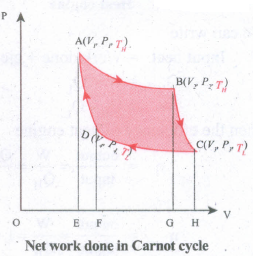
(v) It is very important to note that after one cycle the working substance returns to the initial temperature TH' This implies that the change in internal energy of the working substance after one cycle is zero.
3.
The first law of thermodynamics explains well the inter convertibility of heat and work. But it does not indicate the direction of change.
For example:
(a) When a hot object is in contact with a cold object, heat always flows from the hot object to cold object but not in the reverse direction. According to first law, it is possible for the energy to flow from hot object to cold object or from cold object to hot object. But in nature the direction of heat flow is always from higher temperature to lower temperature.
(b) When brakes are applied, a car stops due to friction and the work done against friction is converted into heat. But this heat is not reconverted to the kinetic energy of the car. So the first law is not sufficient to explain many of natural phenomena.
4.
This is a thermodynamic process that occurs at constant pressure. Even though pressure is constant in this, process, temperature, volume and internal energy are not constant. From the ideal gas equation, we have
\(V=\left( \cfrac { \mu R }{ P } \right) T\) ...(1)
Here \(\cfrac { \mu R }{ P } \) = constant
In an isobaric process the temperature is directly proportional to volume.
V \(\propto\) T (Isobaric process) ....(2)
This implies that for a isobaric process, the V-T graph is a straight line passing through the origin.
If a gas goes from a state (Vi, Ti) to (Vf, Tf) at constant pressure, then the system satisfies the following equation
\(\cfrac { { T }_{ f } }{ { V }_{ f } } =\cfrac { { T }_{ i } }{ { V }_{ i } } \) ....(3)
Examples for isobaric process
(i) When the gas is heated and pushes the piston so that it exerts a force equivalent to atmospheric pressure plus the force due to gravity then this process is isobaric.
(ii) Most of the cooking processes in our kitchen are isobaric processes. When the food is cooked cooked in an open vessel, the pressure above the food is always at atmospheric pressure.
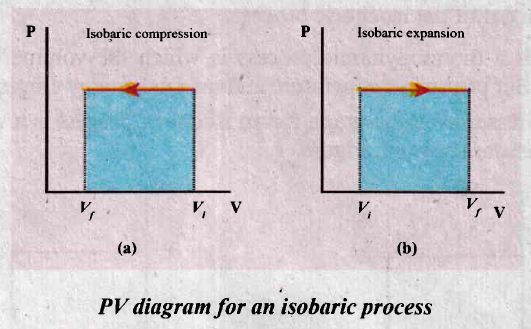
The PV diagram for an isobaric process is a horizontal line parallel to volume axis as shown in Figure.
Figure (a) represents isobaric process where volume decreases.
Figure (b) represents isobaric process where volume increases.
The work done in an isobaric process:
Work done by the gas
\(W=\int _{ { V }_{ i } }^{ { V }_{ f } }{ PdV } \) ....(4)
In an isobaric process, the pressure is constant, so P comes out of the integral,
\(W=P\int _{ { V }_{ i } }^{ { V }_{ f } }{ dV } \) ....(5)
\(W=P\left[ { V }_{ f }-{ V }_{ i } \right] =P\triangle V\) .....(6)
Where \(\triangle \)V denotes change in the volume. If \(\triangle \)V is negative, W is also negative. This implies that the work is done on the gas. If \(\triangle \)V is positive, W is also positive, implying that work is done by the gas.
The equation (6) can also be rewritten using the ideal gas equation.
From ideal gas equation
\(PV=\mu RT\ and\ V=\cfrac { \mu RT }{ P } \)
Substituting this in equation (6) we get
\(W=\mu RT_{ f }\left( 1-\cfrac { { T }_{ i } }{ { T }_{ f } } \right) \) ....(7)
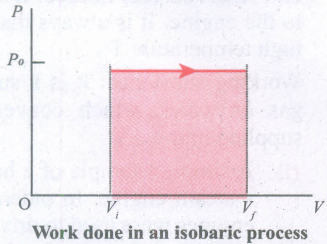
In the PV diagram, area under the isobaric curve is equal to the work done in isobaric process. The shaded area in the following Figure is equal to the work done by the gas.
The first law of thermodynamics for isobaric process is given by
\(\triangle U=Q-P\triangle V\) ....(8)
5.
This is a process in which no heat flows into or out of the system (Q = 0). But the gas can expand by spending its internal energy or gas can be compressed through some external work. So the pressure, volume and temperature of the system may change in an adiabatic process.
For an adiabatic process, the first law becomes ΔU = W.
This implies that the work is done by the gas at the expense of internal energy or work is done on the system which increases its internal energy.
The adiabatic process can be achieved by the following methods.
(i) Thermally insulating the system from surroundings so that no heat flows into or out of the system; for example, when thermally insulated cylinder of gas is compressed (adiabatic compression) or expanded (adiabatic expansion) as shown in the figure.
.JPG)
(ii) If the process occurs so quickly that there is no time to exchange heat with surroundings even though there is no thermal insulation.
Examples:
(a) When the tyre bursts the air expands so quickly that there is no time to exchange heat with the surroundings.
(b) When the gas is compressed or expanded so fast, the gas cannot exchange heat with surrounding even though there is no thermal insulation.
(c) When the warm air rises from the surface of the Earth, it adiabatically expands. As a result the water vapor cools and condenses into water droplets forming a cloud.
The equation of state for an adiabatic process is given by
\(P V^{\gamma}=\text { constant }\) ...(1)
Here \(\gamma\) is called adiabatic exponent \(\left(\gamma=C_{p} / C_{V}\right)\) which depends on the nature of the gas.
The equation (1) implies that if the gas goes from an equilibrium state \(\left(P_{i}, V_{i}\right)\) to another equilibrium state \(\left(\mathrm{P}_{\mathrm{f}}, \mathrm{V}_{\mathrm{f}}\right)\) adiabatically then it satisfies the relation
\(P_{i} V_{i}^{\gamma}=P_{f} V_{f}^{\gamma}\) .......(2)
.JPG)
The PV diagram of an adiabatic expansion and adiabatic compression process are shown in Figure. The PV diagram for an adiabatic process is also called adiabat. Note that the PV diagram for isothermal and adiabatic processes look similar. But actually the adiabatic curve is steeper than isothermal curve. We can also rewrite the equation (1) in terms of T and V. From ideal gas equation the pressure \(P=\frac{\mu R T}{V}\) Substituting this equation in the equation (1), we have
\(\frac{\mu R T}{V} V^{\gamma}=\text { constant (or) } \quad \frac{T}{V} V^{\gamma}=\frac{\text { constant }}{\mu R}\)
Note here that is another constant. So it can be written as
\(T V^{\gamma-1}=\text { constant }\)
The equation (3) implies that if the gas goes from an initial equilibrium state \(\left(T_{i}, V_{i}\right)\) to final equilibrium state \(\left(\mathrm{T}_{\mathrm{f}}, \mathrm{V}_{\mathrm{f}}\right)\) adiabatically then it satisfies the relation.
\(T V_{i}^{\gamma-1}=T_{f} V_{f}^{\gamma-1}\)
The equation of state for adiabatic process can also be written in terms of T and P as.
\(T^{\gamma} P^{1-\gamma}=\text { constant }\)

11th Standard Syllabus & Materials
11th Standard
TN 11th Tamil பீடு பெற நில் - செய்யுள் - காவடிச்சிந்து Important Questions And Answers Study Material - QB365 Set A
NEW11th Standard
TN 11th Tamil பீடு பெற நில் - உரைநடை - மலை இடப்பெயர்கள் : ஓர் ஆய்வு Important Questions And Answers Study Material - QB365 Set A
NEW11th Standard
TN 11th Tamil மாமழை போற்றுதும் - துணைப்பாடம் - யானை டாக்டர் Important Questions And Answers Study Material - QB365 Set A
NEW11th Standard
TN 11th Tamil மாமழை போற்றுதும் - செய்யுள் - ஐங்குறுநூறு Important Questions And Answers Study Material - QB365 Set A



Tamilnadu Stateboard 11th Standard Subjects

Maths

Commerce

Economics

Biology

Business Maths and Statistics

Accountancy

Computer Science
Physics

Chemistry
Maths
Biology
Economics
Physics
Chemistry

History
Business Maths and Statistics

Computer Science
Accountancy

Computer Applications
History
Computer Technology
Commerce
Computer Applications
Computer Technology

Tamil

English

French
Tamilnadu Stateboard Standards



