
 100% FREE ACCESS
11th Standard Syllabus & Materials
11th Standard
TN 11th Tamil இயற்கை வேளாண்மை,சுற்றுச்சூழல் -செய்யுள் - மனோன்மணீயம் Important Questions And Answers Study Material - QB365 Set A
NEW11th Standard
TN 11th Tamil என்னுயிர் என்பேன் -துணைப்பாடம் - இசைத்தமிழர் இருவர் Important Questions And Answers Study Material - QB365 Set A
NEW11th Standard
TN 11th Tamil மொழி கலை -செய்யுள் - ஒவ்வொரு புல்லையும் Important Questions And Answers Study Material - QB365 Set A
NEW11th Standard
TN 11th Tamil பீடு பெற நில் - இலக்கணம் - பகுபத உறுப்புகள் Important Questions And Answers Study Material - QB365 Set A
NEW11th Standard
TN 11th Tamil பீடு பெற நில் - துணைப்பாடம் - வாடிவாசல் Important Questions And Answers Study Material - QB365 Set A
NEW11th Standard
TN 11th Tamil பீடு பெற நில் - செய்யுள் - குறுந்தொகை Important Questions And Answers Study Material - QB365 Set A

Published on: 07/06/2021
QB365 provides detailed and simple solution for every Book back Questions in class 11 Physics Subject. It will helps to get more idea about question pattern in every book back questions with solution.
Download Tamil Nadu 11th Standard Physics question papers, model tests, one-mark questions, important questions, and public exam papers in PDF format. Free study materials and answer keys for TN State Board students.
Questions + Answers key
Take MCQ Physics Test1.
The shadow of a pole standing on a level ground is found to be 45 m longer when the sun's altitude is 30o than when it was 60o. Determine the height of the pole. [Given \(\sqrt { 3 } \)=1.73]
2.
Using a Vernier Callipers, the length of a cylinder in different measurements is found to be 2.36 cm, 2.27 cm, 2.26 cm, 2.28 cm, 2.31 cm, 2.28 cm and 2.29 cm. Find the mean value, absolute error, the relative error and the percentage error of the cylinder.
3.
Two resistors of resistances R1= 150 ± 2 Ohm and R2 = 220 ± 6 Ohm are connected in parallel combination. Calculate the equivalent resistance.
Hint:\(\frac{1}{R'}=\frac{1}{R_1}+\frac{1}{R_2}\)
4.
If the value of universal gravitational constant in SI is 6.610-11Nm-2kg-2, then find its value in CGS System?
5.
Obtain an expression for the time period T of a simple pendulum. The time period T depend upon
(i) mass 'm' of the bob
(ii) length 'l' of the pendulum and
(iii) acceleration due to gravity g at the place where the pendulum is suspended. (Constant k = 2π) i.e
1.
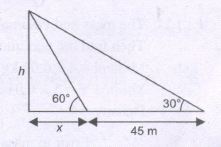
Let the height of the pole be h
Solution \(\frac { x+45 }{ h } \) = cot 30o ⇒ h =\(\frac { x+45 }{ cot\quad { 30 }^{ o } } \)
\(\frac { x }{ h } \) = cot 30o ⇒ x = h cot 60o
Substituting the values of x in the above equation
h = \(\frac { h\quad cot \ { 60 }^{ o }+45 }{ cot \ { 30 }^{ o } } \)
\(h \cot 30^{\circ} =h \cot 60^{\circ}+45
\)
\(h\left(\cot 30^{\circ}-\cot 60^{\circ}\right) =45
\)
\(h =\frac{45}{\cot 30^{\circ}-\cot 60^{\circ}}=\frac{45}{\sqrt{3}-\frac{1}{\sqrt{3}}}=38.97 \mathrm{~m}\)
2.
The given readings are 2.36 cm, 2.27 cm, 2.26 cm, 2.28 cm, 2.31 cm, 2.28 cm and 2.29 cm
The mass value \(\overrightarrow { l } =\frac { 2.36+2.27+2.26+2.28+2.31+2.28+2.29 }{ 7 } =\frac { 16.08 }{ 7 } \) = 2.29 cm
Absolute errors in the measurements are
\({ \Delta }l_{ _{ 1 } }\) = 2.29 - 2.36 = -0.07
\({ \Delta }l_{ _{ 2 } }\) = 2.29 - 2.27 = 0.02
\({ \Delta }l_{ _{ 3 } }\)= 2.29 - 2.26 = 0.03
\({ \Delta }l_{ _{ 4 } }\)= 2.29 - 2.28 = 0.01
\({ \Delta }l_{ _{ 5 } }\)=2.29 - 2.31 = -0.02
\({ \Delta }l_{ _{ 6 } }\)= 2.29 - 2.28 = 0.01
\({ \Delta }l_{ _{ 7 } }\)= 2.29 - 2.29 = 0.00
Mean Absolute error
Δlmean =\(\frac { 0.7+0.02+0.03+0.01+0.02+0.01+0.00 }{ 7 } =\frac { 0.16 }{ 7 } \)=0.02
Relative error = \(\frac { { \Delta l }_{ mean } }{ \overline { l } } =\pm \frac { 0.02 }{ 2.29 } =\pm 8.7\times { 10 }^{ -3 }\)
Percentage error = 8.7\(\times\)10-3\(\times\)100 = 0.87%\(\times\)100 = ± (8.7\(\times\)10-1) = 0.9%
3.
The equivalent resistance of a parallel combination
\(R'=\frac{R_1R_2}{R_1+R_2}=\frac{150\times220}{150+220}=\frac{33000}{370}=89.1\ Ohm\)
We know that, \(\frac{1}{R'}=\frac{1}{R_1}+\frac{1}{R_2}\)
\(\frac { \triangle { R }^{ ' } }{ \left( { R }^{ ' } \right) ^{ 2 } } =\frac { \triangle { R }_{ 1 } }{ { R }_{ 1 }^{ 2 } } +\frac { \triangle { R }_{ 2 } }{ { R }_{ 2 }^{ 2 } } \)
\(\triangle { R }^{ ' }=\left( { R }^{ ' } \right) ^{ 2 }\frac { \triangle { R }_{ 1 } }{ { R }_{ 1 }^{ 2 } } +\left( { R }^{ ' } \right) ^{ 2 }\frac { \triangle { R }_{ 2 } }{ { R }_{ 2 }^{ 2 } } =\left( \frac { { R }^{ ' } }{ { R }_{ 1 } } \right) ^{ 2 }\triangle { R }_{ 1 }+\left( \frac { { R }^{ ' } }{ { R }_{ 2 } } \right) ^{ 2 }\triangle { R }_{ 2 }\)
Substituting the value,
\(\triangle { R }^{ ' }=\left[ \frac { 89.1 }{ 150 } \right] ^{ 2 }\times 2+\left[ \frac { 89.1 }{ 220 } \right] ^{ 2 }\times 6=0.070+0.098=0.168\)
R' = 89.1 ± 0.168 Ohm.
4.
Let GSI be the gravitational constant in the SI system and Gcgs in the cgs system. Then
GSI = 6.6 10-11 Nm2 kg-2;
Gcgs = ?
n2 =\(n_1{ \left[ \frac { { M }_{ 1 } }{ { M }_{ 2 } } \right] }_{ }^{ a }{ \left[ \frac { L_{ 1 } }{ L_{ 2 } } \right] }_{ }^{ a }{ \left[ \frac { T_{ 1 } }{ T_{ 2 } } \right] }_{ }^{ c }\)
Gcgs = GSI \({ \left[ \frac { { M }_{ 1 } }{ { M }_{ 2 } } \right] }_{ }^{ a }{ \left[ \frac { L_{ 1 } }{ L_{ 2 } } \right] }_{ }^{ a }{ \left[ \frac { T_{ 1 } }{ T_{ 2 } } \right] }_{ }^{ c }\)
M1= 1 kg L1 = 1 m T1= 1s
M2= 1 kg L2 = 1 m T2= 1s
The dimensional formula for G is M-1L3 T-2
a = -1 b = 3 and c =-2
Gcgs = 6.6\(\times\)10-11 \(\left[ \frac { 1kg }{ 1g } \right] ^{ -1 }\left[ \frac { 1m }{ 1cm } \right] ^{ 3 }\left[ \frac { 1s }{ 1s } \right] ^{ -2 }\)
= 6.6\(\times\)10-11 \(\left[ \frac { 1kg }{ { 10 }^{ -3 }kg } \right] ^{ -1 }\left[ \frac { 1m }{ { 10 }^{ -2 }m } \right] ^{ 3 }\left[ \frac { 1s }{ 1s } \right] ^{ -2 }\)
= 6.6\(\times\)10-11\(\times\)10-3\(\times\)106\(\times\)1
Gcgs = 6.6\(\times\)10-8 dyne cm2 g-2
5.
T ∝ ma lb gc;
T = k.ma lb gc
Here k is the dimensionless constant. Rewriting the above equation with dimensions
[T1] = [Ma] [Lb] [LT-2]c
[M0L0T1] = [MaLb+cT-2c]
Comparing the powers of M, L and T on both sides, a = 0, b + c = 0, -2c = 1
Solving for a, b and c a = 0, b = 1/2, and c = -1/2
From the above equation T = k.m0 l1/2 g-1/2
T= k\(\left( \frac { 1 }{ g } \right) ^{ 1/2 }=k\sqrt { \frac { l }{ g } } \)
Experimentally k = 2π hence
T = \(2\pi \sqrt { l/g } \)

11th Standard Syllabus & Materials
11th Standard
TN 11th Tamil பீடு பெற நில் - செய்யுள் - காவடிச்சிந்து Important Questions And Answers Study Material - QB365 Set A
NEW11th Standard
TN 11th Tamil பீடு பெற நில் - உரைநடை - மலை இடப்பெயர்கள் : ஓர் ஆய்வு Important Questions And Answers Study Material - QB365 Set A
NEW11th Standard
TN 11th Tamil மாமழை போற்றுதும் - துணைப்பாடம் - யானை டாக்டர் Important Questions And Answers Study Material - QB365 Set A
NEW11th Standard
TN 11th Tamil மாமழை போற்றுதும் - செய்யுள் - ஐங்குறுநூறு Important Questions And Answers Study Material - QB365 Set A



Tamilnadu Stateboard 11th Standard Subjects

Maths

Commerce

Economics

Biology

Business Maths and Statistics

Accountancy

Computer Science
Physics

Chemistry
Maths
Biology
Economics
Physics
Chemistry

History
Business Maths and Statistics

Computer Science
Accountancy

Computer Applications
History
Computer Technology
Commerce
Computer Applications
Computer Technology

Tamil

English

French
Tamilnadu Stateboard Standards



