
 100% FREE ACCESS
11th Standard Syllabus & Materials
11th Standard
TN 11th Tamil இயற்கை வேளாண்மை,சுற்றுச்சூழல் -செய்யுள் - மனோன்மணீயம் Important Questions And Answers Study Material - QB365 Set A
NEW11th Standard
TN 11th Tamil என்னுயிர் என்பேன் -துணைப்பாடம் - இசைத்தமிழர் இருவர் Important Questions And Answers Study Material - QB365 Set A
NEW11th Standard
TN 11th Tamil மொழி கலை -செய்யுள் - ஒவ்வொரு புல்லையும் Important Questions And Answers Study Material - QB365 Set A
NEW11th Standard
TN 11th Tamil பீடு பெற நில் - இலக்கணம் - பகுபத உறுப்புகள் Important Questions And Answers Study Material - QB365 Set A
NEW11th Standard
TN 11th Tamil பீடு பெற நில் - துணைப்பாடம் - வாடிவாசல் Important Questions And Answers Study Material - QB365 Set A
NEW11th Standard
TN 11th Tamil பீடு பெற நில் - செய்யுள் - குறுந்தொகை Important Questions And Answers Study Material - QB365 Set A

Published on: 13/05/2022
QB365 provides detailed and simple solution for every Book back Questions in class 11 Physics Subject. It will helps to get more idea about question pattern in every book back questions with solution.
latest Book back QuestionsDownload Tamil Nadu 11th Standard Physics question papers, model tests, one-mark questions, important questions, and public exam papers in PDF format. Free study materials and answer keys for TN State Board students.
Questions + Answers key
Take MCQ Physics Test1.
2.
Derive the equations of motion for a particle
(a) falling vertically
(b) projected vertically.
3.
Discuss the properties of scalar and vector products.
4.
Suppose an object is thrown with initial speed 10 ms-1 at an angle \(\frac{\pi}{4}\) with the horizontal, what is the range covered? Suppose the same object is thrown similarly in the Moon, will there be any change in the range? If yes, what is the change? (The acceleration due to gravity in the Moon \(g_{moon}=\frac{1}{6}g\)).
5.
Two vectors \(\vec A\) and \(\vec B\) of magnitude 5 units and 7 units respectively make an angle 60° with each other as shown below. Find the magnitude of the resultant vector and its direction with respect to 7 unit the vector \(\vec A\).
.png)
1.
2.
Case (1): A body falling from a height h
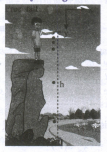
(i) Consider an object of mass 'm' falling from a height 'h: Assume there is no air resistance.
(ii) Let the downward direction is along positive y-axis. The object experiences acceleration 'g' due to gravity which is constant near the surface of the Earth. We can use kinematic equations to explain its motion. We have
The acceleration \(\overrightarrow{a}=g\hat{h}\)
By comparing the components,
ax = 0, az = 0, ay = g ,
Let us take ay = a = g
If the particle is thrown with initial velocity 'u'downward which is in negative y axis, then velocity and position of the particle at any time t is given by
v = u + gt ..............(1)
\(y=ut+{{1}\over{2}}gt^2\) .................(2)
The square of the speed of the particle when it is at a distance y from the hill-top, is
v2 = u2 + 2gy .................(3)
Suppose the particle starts from rest.
Then u = 0
Then the velocity v, the position of the particle and v2 at any time t are given by (for a point y from the hill-top)
v = gt ................(4)
\(y={{1}\over{2}}{gt}^{2}\) .............(5)
v2 = 2gy ...................(6)
Suppose the particle starts from rest.
Then u = 0
The time (t = T) taken by the particle to reach the ground (for which y = h), is given by using equation (5).
\(h={{1}\over{2}}g{T}^{2}\) ...........(7)
\(T=\sqrt{{{2h}\over{g}}}\) ............(8)
The equation (8) implies that greater the height (h), particle takes more time (T) to reach the ground. For lesser height (h), it takes lesser time to reach the ground.
The speed of the particle when it reaches the ground (y = h) can be found using equation (6), we get
\({v}_{gound}=\sqrt{2gh}\) ..............(9)
The above equation implies that the body falling from greater height (h) will have higher velocity when it reaches the ground.
The motion of a body falling towards the Earth from a small altitude (h<< R), purely under the force of gravity is called free fall. (Here R is radius of the Earth)
Case (ii): A body thrown vertically upwards.
Consider an object of mass m thrown vertically upwards with an initial velocity u. Let us neglect the air friction.
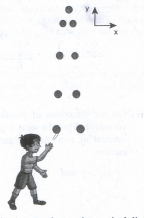
In this case we choose the vertical direction as positive y axis as shown in the Figure then the acceleration a = -g (neglect air friction) and g points towards the negative y axis.
The kinematic equations for this motion are, The velocity and position of the object at any time tare,
v = u - gt .............(10)
\(s=ut={{1}\over{2}}{gt}^{2}\) ............(11)
The velocity of the object at any position y (from the point where the object is thrown) is
v2 = u2 - 2gy. ................(12)
3.
Scalar product:
Scalar product or dot product of two vectors in defined as the product of the magnitudes of both the vectors and the cosine of the angle between them.
If \(\vec{A}\) and \(\vec{B}\) are two vector having an angle \(\theta\) between them, then \(\vec{A} \vec{B}=A B \cos \theta\) where A and B are magnitudes of \(\vec{A}\) and \(\vec{B}\) .
Example: work, energy and electric flux.
Properties:
1. \(\vec{A}\).\(\vec{B}\) is always a scalar. It is positive if \(\theta\)<90 and it is negative if \(90^{\circ}<\theta<180^{\circ}\)
2. When the vectors are parallel, \(\theta=0^{\circ} \ and \ \cos 0^{\circ}=1 \therefore(\vec{A} \cdot \vec{B})_{\text {mat }}=A B\).
3. When the vectors are anti-parallel, \(\theta=180^{\circ}\ and \ \cos 180^{\circ}=-1 \therefore(\vec{A} \cdot \vec{B})_{\min }=-A B\)
4. When the vectors are perpendicular to each other, \(\theta=90^{\circ}\ and \ \cos 90^{\circ}=0\therefore \vec{A} \vec{B}=0\).
5. Scalar product is commutative i.e, \(\vec{A} \cdot \vec{B}=\vec{B} \cdot \vec{A}\)
6. It obeys distributive law i.e., \(\vec{A} \cdot(\vec{B}+\vec{C})=\vec{A} \cdot \vec{B}+\vec{A} \cdot \vec{C}\)
7. Self dot product is given by \(\vec{A} \cdot \vec{A}=A A \cos \theta=A^{2}, \ here\ \theta=0^{\circ}\). The magnitude of the vector \(\vec{A}\ is \ (\vec{A})=A=\sqrt{\vec{A} \cdot \vec{A}}\)
8. In the case of orthogonal unit vectors \(\vec{i}, \vec{j} \ and \ \vec{k}\)
\(\hat{i} \hat{j}=\hat{j} \hat{j}=\hat{k} \cdot \hat{k}=1 \text { and } \)
\(\vec{i} \cdot \vec{j}=\hat{j} \hat{k}=\hat{k} \hat{i}=0\)
9. The angle between the vectors \(\theta=\cos ^{-1}\left[\frac{\vec{A} \cdot \vec{B}}{A B}\right]\)
10. In terms of components,
\(\vec{A} \cdot \vec{B} =\left(A_{x} \hat{i}+\mathrm{A}_{y} \hat{j}+A_{z} \hat{k}\right)\left(B_{x} \hat{i}+\mathrm{B}_{y} \hat{j}+B_{z} \hat{k}\right) \)
\(=A_{x} B_{x}+A_{y} B_{y}+A_{i} B_{z} \text {, with all other terms zero. }\)
The magnitude of A is given by \(|\vec{A}|=A=\sqrt{A_{x}^{2}+A_{y}^{2}+A_{2}^{2}}\) and \(|\vec{B}|=B=\sqrt{B_{x}^{2}+B_{y}^{2}+B_{2}^{2}}\) Vector product:
The vector product or cross product of two vectors is defined as another vector having a magnitude equal to the product of the magnitudes of two vectors and the sine of the angle between them.
If \(\vec{A}\) and \(\vec{B}\) are two vectors, then \(\vec{A} \times \vec{B}=\vec{C}=(A B \sin \theta) \hat{n}\).
The direction \(\hat{n}\ of \ \vec{A} \times \vec{B}\) is perpendicular to the plane containing the vectors \(\vec{A}\) and \(\vec{B}\) and is determined by the right hand screw rule or right hand thumb rule.
Example: Torque \(\tau=\vec{r} \times \vec{F}\) and Angular momentum \(\vec{L}=\vec{r} \times \vec{p}\)
Properties:
1. The resultant of the vector product is always another vector whose direction is perpendicular to the plane containing these two vectors \(\vec{A}\) and \(\vec{B}\) even though the vectors \(\vec{A}\) and \(\vec{B}\) may or may not be mutually orthogonal.
2. It is not commutative. \(\vec{A} \times \vec{B} \neq \vec{B} \times \vec{A}\). But \(\vec{A} \times \vec{B}=-[\vec{B} \times \vec{A}]\)
3. When the vectors \(\vec{A}\) and \(\vec{B}\) are orthogonal to each other the vector product will have maximum magnitude as \(\theta=90^{\circ}\ and \ \sin \theta=1\).
\((\vec{A} \times \vec{B})_{\max }=A B \hat{n}\)
4. The vector product of two non-zero vectors will be minimum when (sin \(\theta\))=0, i.e., \(\theta=0^{\circ} \ or \ 180^{\circ}(\vec{A} \times \vec{B})_{\min }=0\).
It means that the vector product of two non-zero vectors vanishes if the vectors are parallel or anti parallel.
5. The self-cross product is a null vector. \(\vec{A} \times \vec{A}=A A \sin 0^{\circ} \hat{n}=\overrightarrow{0}\)
6. The self-vector products of unit vectors are then zero \(\hat{i} \times \hat{i}=\hat{j} \times \hat{j}=\hat{k} \times \hat{k}=0\).
7. In the case of orthogonal unit vectors, \(\vec{i}, \vec{j} \ and \ \hat{k}\)
\(\hat{i} \times \hat{j}=\hat{k}, \hat{j} \times \hat{k}=\hat{i} \ and \ \hat{k} \times \hat{i}=\hat{j}\) and
\(\hat{j} \times \hat{i}=-\hat{k}, \hat{k} \times \hat{j}=-\hat{i} \ and \ \hat{i} \times \hat{k}=-\hat{j}\)
8. In terms of components,
\(\vec{A} \times \vec{B}=\left|\begin{array}{ccc}
\hat{i} & \hat{j} & \hat{k} \\
A_{x} & A_{y} & A_{z} \\
B_{x} & B_{y} & B_{z}
\end{array}\right|=\begin{array}{r}
+\hat{i}\left(A_{y} B_{z}-A_{z} B_{y}\right) \\
+\hat{j}\left(A_{z} B_{x}-A_{x} B_{z}\right) \\
+\hat{k}\left(A_{0} B_{y}-A_{z} B_{x}\right)
\end{array}\)
9. If two vectors \(\vec{A}\) and \(\vec{B}\) form adjacent sides of a parallelogram, then magnitude \((\vec{A} \times \vec{B})\) is equal to the area of the parallelogram.
10. If two vectors \(\vec{A}\) and \(\vec{B}\) are represented by the two sides of a triangle taken in order, then the area of the triangle is equal to \(\frac{1}{2}|\vec{A} \times \vec{B}|\)
4.
In projectile motion, the range of particle is given by,
\(R=\frac{u^2sin\ 2\theta}{g}\)
\(\theta=\frac{\pi}{4}\ u=v_0=10\ ms^{-1}\)
\(\therefore\ R_{earth}=\frac{(10)^2\sin\frac{\pi}{2}}{9.8}=\frac{100}{9.8}\)
Rearth = 10.20 m (Approximately 10 m)
If the same object is thrown in the Moon, the range will increase because in the Moon, the acceleration due to gravity is smaller than g on Earth,
\(g_{moon}=\frac{g}{6}\)
\(R_{moon}=\frac{u^2sin2\theta}{g_{moon}}=\frac{v_0^2sin2\theta}{\frac{g}{6}}\)
\(\therefore\ R_{moon}=6\times10.24=61.22m\) (Approximately 60 m)
The range attained on the Moon is approximately six times that on Earth.
5.
By following the law of triangular addition, the resultant vector is given by \(\vec R\) = \(\vec A\) + \(\vec B\) as illustrated below.
The magnitude of the resultant vector \(\vec R\) is given by
\(R=|\vec R|=\sqrt{5^2+7^2+2\times 5\times 7\cos 60^o}\)
\(R=\sqrt{25+49+\frac{70\times 1}{2}}=\sqrt{109}\) units
i.png)
The angle \(\alpha\) between \(\vec R\) and \(\vec A\) is given by
\(\tan\alpha=\frac{B\sin\theta}{A+B\cos\theta}\)
\(\tan\alpha=\frac{7\times\sin60^o}{5+7\cos60^o}=\frac{7\sqrt{3}}{10+7}=\frac{7\sqrt{3}}{17}\) = 0.713
\(\therefore\alpha=35^o\)
ii.png)

11th Standard Syllabus & Materials
11th Standard
TN 11th Tamil பீடு பெற நில் - செய்யுள் - காவடிச்சிந்து Important Questions And Answers Study Material - QB365 Set A
NEW11th Standard
TN 11th Tamil பீடு பெற நில் - உரைநடை - மலை இடப்பெயர்கள் : ஓர் ஆய்வு Important Questions And Answers Study Material - QB365 Set A
NEW11th Standard
TN 11th Tamil மாமழை போற்றுதும் - துணைப்பாடம் - யானை டாக்டர் Important Questions And Answers Study Material - QB365 Set A
NEW11th Standard
TN 11th Tamil மாமழை போற்றுதும் - செய்யுள் - ஐங்குறுநூறு Important Questions And Answers Study Material - QB365 Set A



Tamilnadu Stateboard 11th Standard Subjects

Maths

Commerce

Economics

Biology

Business Maths and Statistics

Accountancy

Computer Science
Physics

Chemistry
Maths
Biology
Economics
Physics
Chemistry

History
Business Maths and Statistics

Computer Science
Accountancy

Computer Applications
History
Computer Technology
Commerce
Computer Applications
Computer Technology

Tamil

English

French
Tamilnadu Stateboard Standards



