
 100% FREE ACCESS
11th Standard Syllabus & Materials
11th Standard
TN 11th Tamil இயற்கை வேளாண்மை,சுற்றுச்சூழல் -செய்யுள் - மனோன்மணீயம் Important Questions And Answers Study Material - QB365 Set A
NEW11th Standard
TN 11th Tamil என்னுயிர் என்பேன் -துணைப்பாடம் - இசைத்தமிழர் இருவர் Important Questions And Answers Study Material - QB365 Set A
NEW11th Standard
TN 11th Tamil மொழி கலை -செய்யுள் - ஒவ்வொரு புல்லையும் Important Questions And Answers Study Material - QB365 Set A
NEW11th Standard
TN 11th Tamil பீடு பெற நில் - இலக்கணம் - பகுபத உறுப்புகள் Important Questions And Answers Study Material - QB365 Set A
NEW11th Standard
TN 11th Tamil பீடு பெற நில் - துணைப்பாடம் - வாடிவாசல் Important Questions And Answers Study Material - QB365 Set A
NEW11th Standard
TN 11th Tamil பீடு பெற நில் - செய்யுள் - குறுந்தொகை Important Questions And Answers Study Material - QB365 Set A

Published on: 24/06/2021
QB365 provides detailed and simple solution for every
Creative Questions in class 11 Physics Subject. It will helps to get more idea about question pattern in every Creative questions with solution.
Download Tamil Nadu 11th Standard Physics question papers, model tests, one-mark questions, important questions, and public exam papers in PDF format. Free study materials and answer keys for TN State Board students.
Questions + Answers key
Take MCQ Physics Test1.
Find horizontal range and Time of flight projectile in horizontal projection.
2.
Mention important properties of the scalar product of two vectors.
3.
Explain the subtraction of vectors.
4.
Explain triangular law of addition method.
5.
Define the term motion and explain the different types of motion.
1.
Consider a projectile, say a ball, thrown horizontally with an initial velocity \(\overrightarrow{u}\) from the top of a tower of height h (Figure).
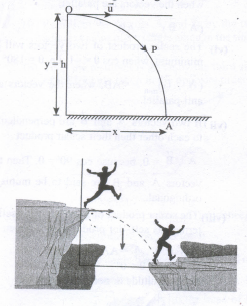
(i) As the ball moves, it covers a horizontal distance due to its uniform horizontal velocity u, and a vertical downward distance because of constant acceleration due to gravity g.
(ii) Thus, under the combined effect the ball moves along the path OPA. The motion is in a 2-dimensional plane. Time to reach the ground at A = t. Then the horizontal distance travelled by the ball is x (t) = x, and the vertical distance travelled is y (t) = y.
iii) Applying the kinematic equation, the velocity of horizontal component = ux The velocity of horizontal vertical component = uy. Acceleration along x direction a = 0. ux = constant.
The distance travelled by the projectile at a time t is given by the equation
\(x={u}_{x}t+{{1}\over{2}}{at}^{2}.\)
\(\therefore\) x = u.t.
\(\sqrt{t={{x}\over{{u}_{x}}}}\) ...........(1)
Motion along downward direction
(i) Here uy = 0 (initial velocity has no downward component), a = g (we choose the +ve y-axis in downward direction), and distance y at time t.
\(\therefore\) from equation y = uy t \(+{{1}\over{2}}\) at2, we get
\(y={{1}\over{2}}{gt}^{2}\) .........(2)
Substituting the value of 't' from equation (1) in (2).
\(y={{1}\over{2}}g{{{x}^{2}}\over{{u}_{x}^{}2}}=\left( {{g}\over{{2u}_{x}^{2}}} \right){x}^{2}\)
y = Kx2 ..........(3)
where \(K={{g}\over{{2u}_{x}^{2}}}\) is constant.
(iii) Equation is the equation of a parabola. Thus, the path followed by the projectile is a parabola (curve OPA in the Figure).
Time of Flight:
h - height of a tower
t - time taken by the projectile to hit the ground after thrown to right for vertical motion
\(s_y+u_yt+{{1}\over{2}}{at}^{2}\)
sy = h, t = T, uy = 0 (i.e. no initial vertical velocity)
\(T=\sqrt{{{2h}\over{g}}}\)
(iv) Thus, the time of flight for projectile motion depends on the height of the tower, but is independent of the horizontal velocity of projection.
(i) The horizontal, distance covered by the projectile from the foot of the tower to the point where the projectile hits the ground is called horizontal range. For horizontal motion, we have
\({s}_{u}={u}_{x}t+{{1}\over{2}}{ar}^{2}.\)
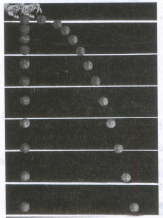
(ii) Here, sx = R (range), ux = u, a = 0 (no horizontal acceleration) T is time of flight. Then horizontal range = uT.
(iii) Since the time of flight T = \(\sqrt{{{2h}\over{g}}},\) we substitute this and we get the horizontal range of the particle as \(R=u\sqrt{{{2h}\over{g}}}.\)
(iv) The above equation implies that the range R is directly proportional to the initial velocity u and inversely proportional to acceleration due to gravity g.
2.
(i) The product quantity \(\overrightarrow{A}.\overrightarrow{B}\) is always a scalar. It is positive if the angle between the vectors is acute (i.e., < 90°) and negative if the angle between them is obtuse (i.e. 90°<0< 180°).
(ii) The scalar product is commutative i.e., \(\overrightarrow{A}.\overrightarrow{B}=\overrightarrow{B}.\overrightarrow{A}\)
(iii) The vectors obey distributive law i.e.
\(\overrightarrow{A}.\left( \overrightarrow{B}+\overrightarrow{C} \right)=\overrightarrow{A}+\overrightarrow{B}+\overrightarrow{A}.\overrightarrow{C}\)
(iv) The angle between the vectors
\(\theta={cos}^{-1}\left[ {{\overrightarrow{A}.\overrightarrow{B}}\over{AB}} \right]\)
(v) The scalar product of two vectors will be maximum when cos \(\theta\) = 1, i.e., \(\theta=0°\) , i.e., when the vectors are parallel;
\((\overrightarrow{A}.\overrightarrow{B})_{max}=AB\)
(vi) The scalar product of two vectors will be minimum, when cos \(\theta\) = -1, i.e. 0 = 180° \((\overrightarrow{A}.\overrightarrow{B})=-AB,\) when the vectors are mm anti-parallel.
(vii) If two vectors \(\overrightarrow{A}\) and \(\overrightarrow{B}\) are perpendicular to each other then their scalar product \(\overrightarrow{A}.\overrightarrow{B}=0,\) 0, because cos 90°= O. Then the vectors \(\overrightarrow{A}\) and \(\overrightarrow{B}\) are said to be mutually orthogonal.
(viii) The scalar product of a vector with itself is termed as self-dot product and is given by \({(\overrightarrow{A})}^{2}=\overrightarrow{A}.\overrightarrow{A}=AA\ \cos\ \theta={A}^{2}.\)
Here angle 0 = 0°
The magnitude or norm of the vector \(\overrightarrow{A}\) is \(|\overrightarrow{A}|=A=\sqrt{\overrightarrow{A}.\overrightarrow{A}}\)
(ix) In case of a unit vector \(\overrightarrow{n}\)
\(\hat{n},\hat{n}=1\times1\times\cos\theta=1.\) For example,
\(\hat{i},\hat{j}=\hat{j}.\hat{j}=\hat{k},\hat{k}=1.\)
(x) In the case of orthogonal unit vectors \(\hat{i},\hat{j}\) and \(\hat{k}.\)
\(\hat{i},\hat{j}=\hat{j},\hat{k}=\hat{k},\hat{i}=1.1\cos 90°=0\)
(xi) In terms of components, the scalar product of \(\overrightarrow{A}\) and \(\overrightarrow{B}\) can be written as \(\overrightarrow{A}.\overrightarrow{B}=(A_z\hat{i}+A_y\hat{j}+A_z\hat{k}).(B_x\hat{i}+B_y\hat{j}+B_z\hat{k})\)
\(=A_xB_x+A_yB_y+A_zB_z,\) with all other terms zero. The magnitude of vector \(|\overrightarrow{A}|\) is given by \(|\overrightarrow{A}|=A=\sqrt{{A}_{x}^{2}+{A}_{y}^{2}+{A}_{z}^{2}}\)
3.
(i) For two non-zero vectors \(\overrightarrow{A}\) and \(\overrightarrow{B}\) which are inclined to each other at an angle 0, the difference \(\overrightarrow{A}-\overrightarrow{B}\) is obtained as follows. First obtain - B as in Figure. The angle between A and -B is 180 - \(\theta.\)
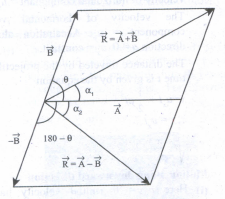
(ii) The difference A - B is the same as the resultant of A and - B
We can write \(\overrightarrow{A}-\overrightarrow{B}=\overrightarrow{A}+(-\overrightarrow{B})\) and using the equation
\(|\overrightarrow{A}+\overrightarrow{B}|=\sqrt{{A}^{2}+{B}^{2}+2AB\cos\theta,}\) we have
\(|\overrightarrow{A}-\overrightarrow{B}|=\sqrt{{A}^{2}+{B}^{2}+2AB\cos(180-\theta)}\)
(iii) Since, cos (180 - \(\theta\)) = - cos\(\theta\), we get Magnitude of vector
\(\Rightarrow |\overrightarrow{A}-\overrightarrow{B}|=\sqrt{A^2+B^2+2AB\cos\theta}\)
(iv) Again from the Figure and using an equation similar to equation
\(\tan \alpha{{B\sin\theta}\over{A+B\sin\theta}}\)
we have
\(\tan{\alpha}_{2}={{B\sin(180°-\theta)}\over{A+B\cos180°-\theta}}\)
(v) But \(\sin(180°-\theta)=\sin\ \theta,\) hence we get
\(\Rightarrow\) \(\tan{\alpha}_{2}-{{B\sin\theta}\over{A-B\cos\theta}}\)
4.
Let us consider two vectors \(\overrightarrow{A}\) and \(\overrightarrow{B}\)
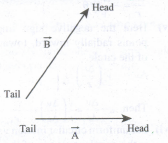
(i) Represent the vectors \(\overrightarrow{A}\) and \(\overrightarrow{B}\) by the two adjacent sides of a triangle taken in the same order.
(ii) Then the resultant is given by the third side of the triangle taken in the opposite order.
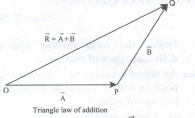
(iii) The head of the first vector \(\overrightarrow{A}\) is connected to the tail of the second vector \(\overrightarrow{B}.\)
(iv) Let 9 be the angle between \(\overrightarrow{A}\) and \(\overrightarrow{B}.\) Then R is the resultant vector connecting the tail of the first vector A to the head of the second vector \(\overrightarrow{B}.\)
(v) The magnitude of \(\overrightarrow{R}\) (resultant) is given geometrically by the length of \(\overrightarrow{R}\) (OQ) and the direction of the resultant vector is the angle between \(\overrightarrow{R}\) and \(\overrightarrow{A}\)
(vi) Thus we write \(\overrightarrow{R}=\overrightarrow{A}+\overrightarrow{B}\)
\(\because \overrightarrow{OQ}=\overrightarrow{OP}+\overrightarrow{PQ}\)
Magnitude of resultant vector
consider the triangle ABN, which is obtained by extending the side OA to ON. ABN is a right angled triangle.
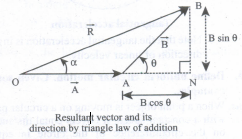
\(\cos\ \theta={{AN}\over{B}}\therefore AN=B\ \cos\theta\) and
\(\sin \ \theta={{BN}\over{B}}\) \(\therefore BN=B\sin\theta\)
For L10BN,we have OB2+ ON2+ BN2
\(\Rightarrow\) R2 = (A + B cos\(\theta\))2 + (B sin\(\theta\))2
\(\Rightarrow\) R2 = A2+ B2cos2\(\theta\) + 2AB cos\(\theta\) + B2sin2\(\theta\)
\(\Rightarrow\) R2 = A2+ B2 (cos2\(\theta\)+ sin2\(\theta\))+ 2AB cos\(\theta\)
\(\Rightarrow\ R=\sqrt{{A}^{2}+{B}^{2}+2AB\cos\ \theta}\)
which is the magnitude of the resultant of \(\overrightarrow{A}\) and \(\overrightarrow{B}.\)
Direction of resultant vectors: If \(\theta\) is the angle between \(\overrightarrow{A}\) and \(\overrightarrow{B}\), then
\(|\overrightarrow{A}+\overrightarrow{B}|=\sqrt{A^2+B^2+2AB\cos\theta}\)
If \(\overrightarrow{R}\) makes an angle \(\alpha\) with \(\overrightarrow{A},\) then in \(\triangle OBN,\)
\(\tan\ \alpha={{CN}\over{ON}}={{CN}\over{OA+AN}}\)
\(\tan\ \alpha={{BN}\over{ON}}={{BN}\over{OA+AN}}\)
\(\tan\ \alpha=\left({{B\sin\theta}\over{A+B\cos\theta}} \right)\)
\(\Rightarrow\alpha = {tan}^{-1}\left( {{B\sin\theta}\over{A+B\cos\theta}} \right)\)
5.
An object is said to be in motion if it changes its position with respect to its surroundings with the passage of time.
(i) Linear motion
An object is said to be in linear motion if it moves in a straight line.
Example: An athlete running on a straight track.
(ii) Circular motion
Circular motion is defined as a motion described by an object traversing a circular path.
Example: The whirling motion of a stone attached to a string.
(iii) Rotational motion
If any object moves in a rotational motion about an axis, the motion is called 'rotation'.
Example: Spinning of the Earth about its own axis.
(iv) Vibratory motion
If an object or particle executes a to-and fro motion about a fixed point, it is said to be in vibratory motion.
Example: Vibration of a string on a guitar.

11th Standard Syllabus & Materials
11th Standard
TN 11th Tamil பீடு பெற நில் - செய்யுள் - காவடிச்சிந்து Important Questions And Answers Study Material - QB365 Set A
NEW11th Standard
TN 11th Tamil பீடு பெற நில் - உரைநடை - மலை இடப்பெயர்கள் : ஓர் ஆய்வு Important Questions And Answers Study Material - QB365 Set A
NEW11th Standard
TN 11th Tamil மாமழை போற்றுதும் - துணைப்பாடம் - யானை டாக்டர் Important Questions And Answers Study Material - QB365 Set A
NEW11th Standard
TN 11th Tamil மாமழை போற்றுதும் - செய்யுள் - ஐங்குறுநூறு Important Questions And Answers Study Material - QB365 Set A



Tamilnadu Stateboard 11th Standard Subjects

Maths

Commerce

Economics

Biology

Business Maths and Statistics

Accountancy

Computer Science
Physics

Chemistry
Maths
Biology
Economics
Physics
Chemistry

History
Business Maths and Statistics

Computer Science
Accountancy

Computer Applications
History
Computer Technology
Commerce
Computer Applications
Computer Technology

Tamil

English

French
Tamilnadu Stateboard Standards



