
 100% FREE ACCESS
11th Standard Syllabus & Materials
11th Standard
TN 11th Tamil இயற்கை வேளாண்மை,சுற்றுச்சூழல் -செய்யுள் - மனோன்மணீயம் Important Questions And Answers Study Material - QB365 Set A
NEW11th Standard
TN 11th Tamil என்னுயிர் என்பேன் -துணைப்பாடம் - இசைத்தமிழர் இருவர் Important Questions And Answers Study Material - QB365 Set A
NEW11th Standard
TN 11th Tamil மொழி கலை -செய்யுள் - ஒவ்வொரு புல்லையும் Important Questions And Answers Study Material - QB365 Set A
NEW11th Standard
TN 11th Tamil பீடு பெற நில் - இலக்கணம் - பகுபத உறுப்புகள் Important Questions And Answers Study Material - QB365 Set A
NEW11th Standard
TN 11th Tamil பீடு பெற நில் - துணைப்பாடம் - வாடிவாசல் Important Questions And Answers Study Material - QB365 Set A
NEW11th Standard
TN 11th Tamil பீடு பெற நில் - செய்யுள் - குறுந்தொகை Important Questions And Answers Study Material - QB365 Set A

Published on: 13/05/2022
QB365 provides detailed and simple solution for every
Creative Questions in class 11 Physics Subject. It will helps to get more idea about question pattern in every Creative questions with solution.
Download Tamil Nadu 11th Standard Physics question papers, model tests, one-mark questions, important questions, and public exam papers in PDF format. Free study materials and answer keys for TN State Board students.
Questions + Answers key
Take MCQ Physics Test1.
Find the vector sum of three vectors \(\overrightarrow { A } ,\overrightarrow { B } \ and \ \overrightarrow { C } \) , using analytical method.
2.
Find the magnitude and directions of the vectors, \(\hat { i } +\hat { j } \ and\ \hat { i } -\hat { j } \)
3.
Express cross and dot product of two vectors in Cartesian coordinate.
4.
Two bodies of mass 30 and 6g have position vectors \(2\hat { i } +\hat { j } +3u\ and\ \hat { j } +3\hat { j } +2u\) respectively. Find the position vectors of centre of mass.
5.
Find the angle between two vectors \(A=\hat { i } +2\hat { j } -u\ and\ B=-4\hat { i } +\hat { j } -2u\)
1.
Let \(\overrightarrow{A},\overrightarrow{B}\) and \(\overrightarrow{C}\) be represented in component form,
\(\overrightarrow{A}=\overrightarrow{A}_z\hat{i}+\hat{j}\overrightarrow{A}_y\hat{j}+\overrightarrow{A}_z\hat{k}\)
\(\overrightarrow{B}=\overrightarrow{B}_z\hat{i}+\overrightarrow{B}_y\hat{j}+\overrightarrow{B}_z\hat{k}\)
\(\overrightarrow{C}=\overrightarrow{C}_x\hat{i}+\overrightarrow{C}_y\hat{j}+\overrightarrow{C}_z\hat{k}\)
Let \(\overrightarrow{D}\) be their summation vector,
\(\overrightarrow{D}=(\overrightarrow{A}+\overrightarrow{B}+\overrightarrow{C})\)
\(=\left( (\overrightarrow{A} _x\hat{i}+\overrightarrow{A}_y\hat{j}+\overrightarrow{A}_z\hat{k})+(\overrightarrow{B}_x\hat{i}+\overrightarrow{B}_y\hat{j}+\overrightarrow{B}_z\overrightarrow{k} +\overrightarrow{C}_x\hat{i}+\overrightarrow{C}_y\hat{j}+\overrightarrow{C}_z\hat{k}\right)\)
Addition of vectors obey the commutative as well as associative laws.
\(A_y+B_y+C_yD=(A_x+B_x+C_x){2 u \sin \theta\over g}+(A_y+B_y+C_y)\hat{j}+(A_z+B_z+C_z)\hat{k}+(A_x+B_x+C_x)\hat{i}+(A_yB_y+C_y){2\ u\ \sin \theta\over g}(A_z+B_z+C_z)\hat{k}+(A_x+B_x+C_x)\hat{i}+(A_y+B_y+C_y)\hat{j}+(A_z+B_z+C_z){2\ u \sin \theta \over g}\)Dx = Ax + Bx+ Cx
Dy = Ay + By+ Cy
Dz = Az + Bz + Cz
2.
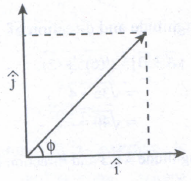
Magnitude of vectors \(\hat { i } +\hat { j } \)
\(=\left| \hat { i } +\hat { j } \right| \)
\(=\sqrt { { 1 }^{ 2 }+{ 1 }^{ 2 } } =\sqrt { 2 } \)
\(tan \ \theta =\frac { |\hat { j } | }{ |\hat { i } | } =\frac { 1 }{ 1 } =1\)
\(\theta ={ tan }^{ -1 }1=45° \ with \ x \ axis\)
Magnitude of vectors \(\hat { i } -\hat { j } \)
=|\(\hat { i } -\hat { j } \)|
\(=\sqrt { { 1 }^{ 2 }+1-{ 1 }^{ 2 } } =\sqrt { 2 } \)
\(tan \ \theta =\frac { |-\hat { j } | }{ |\hat { i } | } =\frac { -1 }{ 1 } =-1\)
\(\theta ={ tan }^{ -1 }-1\)
= - 45°with x axis.
3.
Let \(\overrightarrow{A}\) and \(\overrightarrow{B}\) be the two vectors
\(\overrightarrow{A}=\overrightarrow{A}_x\hat{i}+{\overrightarrow{A}}_{y}\hat{j}+{\overrightarrow{A}}_{z}\hat{k}\)
\(\overrightarrow{B}=\overrightarrow{B}_x\hat{i}+\overrightarrow{B}_y\hat{j}+\overrightarrow{B}_z\hat{k}\)
Cross product of \(\overrightarrow{A}\) and \(\overrightarrow{B}\) ,
\(\overrightarrow{A}\times\overrightarrow{B}=(\overrightarrow{A}_x\hat{i}+\overrightarrow{A}_y\hat{j}+\overrightarrow{A}_z\hat{k})\times({\overrightarrow{B}}_{x}\hat{i}+\overrightarrow{B}_y\hat{j}+\overrightarrow{B}_z\hat{k})\)
\(=\overrightarrow{A}_x\overrightarrow{B}_x\hat{i}\times\hat{i}+\overrightarrow{A}_x\overrightarrow{B}_x\hat{i}\times\hat{i}+{\overrightarrow{A}}_{x}{\overrightarrow{B}}_{x}\overrightarrow{i}\times\overrightarrow{j}+\overrightarrow{A}_x\overrightarrow{B}_z\hat{i}\times\hat{j}\)
\(=\overrightarrow{A}_z\overrightarrow{B}_x\hat{k}\times\hat{i}+\overrightarrow{A}_z\overrightarrow{B}_y\hat{k}\times\hat{j}+\overrightarrow{A}_z\overrightarrow{B}_z\hat{k}+\hat{k}\)
\(\overrightarrow{A}\times\overrightarrow{B}=\overrightarrow{A}_z\overrightarrow{B}_z(0)+\overrightarrow{A}_x\overrightarrow{B}_y(\hat{k})+A_xA_z(\hat{j})+\overrightarrow{A}_y{\overrightarrow{B}}_{x}(-\hat{k})+\overrightarrow{A}_y\overrightarrow{B}_y(0)+\overrightarrow{A}_y\overrightarrow{B}{}_{z}(\hat{i})+9\overrightarrow{A}_z\overrightarrow{B}_z(\hat{i})+\overrightarrow{A}_z\overrightarrow{B}_y(-\hat{i})+\overrightarrow{A}_z\overrightarrow{B}_z(0)\)
\((\overrightarrow{A}\times\overrightarrow{B})=(\overrightarrow{A}_z\overrightarrow{B}_x-\overrightarrow{A}_z\overrightarrow{B}_y)\hat{i}+(A_yB_y-A_yB_x)\hat{k}+(A_zB_x-A_x-B_x)\hat{j}\)
\([\because \hat{i}\times\hat{i}=\hat{j}\times\hat{j}=\hat{k}\times\hat{k}=0 \hat{i}\times\hat{j}=k,\hat{i}\times\hat{k}]=-\hat{j},\hat{j}\times\hat{i}=-k,\hat{j}\times\hat{k}=\hat{i} \hat{k}\times\hat{i}=-\hat{j},\hat{k}\times\hat{j}=-\hat{i}\)
It can be in determinant form as
\(\overrightarrow{A\times\overrightarrow{B}}=\begin{vmatrix} \hat{i}&\hat{j}&\hat{k}\\A_x&A_y&A_z\\B_x&B_y&B_z \end{vmatrix}\)
\(=\hat{i}(A_yB_z-B_y-A_z)-\hat{j}(A_xB_z-B_xA_z)+\hat{k}(A_xB_y-B_x-A_Y)\)
Dot product of \(\overrightarrow{A}\) and \(\overrightarrow{B}\),
\(\overrightarrow{A}={\overrightarrow{A}}_{z},\hat{i}+\overrightarrow{A}_y\hat{j}+\overrightarrow{A}_z\hat{k}\)
\(\overrightarrow{B}=\overrightarrow{B}_x\hat{i}+\overrightarrow{B}_g\hat{j}+\overrightarrow{B}_z\hat{k}\)
\(\overrightarrow{A}.\overrightarrow{B}=(\overrightarrow{A}_x\hat{i}+\overrightarrow{A}_y\hat{j}+\overrightarrow{A}_z\hat{k}).(\overrightarrow{B}_x\hat{i}+\overrightarrow{B}_y\hat{j}+\overrightarrow{B}_z\hat{k})\)
\(=(\overrightarrow{A}_x\overrightarrow{B}_x(\hat{i}.\hat{j})+\overrightarrow{A}_x\overrightarrow{B}_y(\hat{i}.\hat{j})+\overrightarrow{A}_x\overrightarrow{B}_z(\hat{i}\hat{k})+\overrightarrow{A}_y\overrightarrow{B}_z(\hat{j}.\hat{i})+\overrightarrow{A}_y\overrightarrow{B}_y(\hat{i}.\hat{j})+\overrightarrow{A}_z\overrightarrow {B}_x(\hat{k}.\hat{i})+\overrightarrow{A}_z\overrightarrow{B}_y(\hat{k}.\hat{j})+A_zB_z(\hat{k}.\hat{k})\)
\(\overrightarrow{A}.\overrightarrow{B}=\overrightarrow{A}_x\overrightarrow{B}_x(1)+\overrightarrow{A}_x\overrightarrow{B}_y(0)+A_x\overrightarrow{B}_z(0)+\overrightarrow{A}_y\overrightarrow{B}_x(0)+\overrightarrow{A}_y\overrightarrow{B}-Y(1)+\overrightarrow{A}_y\overrightarrow{B}_z()+\overrightarrow{A}_z\overrightarrow{B}_z(0)+A_zB_Z(1)\)
\(\overrightarrow{A}.\overrightarrow{B}=\overrightarrow{A}_x\overrightarrow{B}_x(X)+\overrightarrow{A}_y\overrightarrow{B}_y+\overrightarrow{A}_z\overrightarrow{B}_z\)
\([\because \hat{i}.\hat{j}=\hat{j}.\hat{j}=\hat{k}.\hat{k}=1\hat{i}.\hat{j}=\hat{i}.\hat{j}=\hat{i}.\hat{k}=0\hat{k}.\hat{i}=\hat{k}.\hat{j}=0]\)
4.
Mass M1=3g, \(\overrightarrow { { r }_{ 1 } } =2\hat { i } +\hat { j } +3u\)
Mass M2=6g, \(\overrightarrow { { r }_{ 2 } } =\hat { j } +3\hat { j } +2u\)
Position vector of centre of mass
\(=\frac { { M }_{ 1 }{ r }_{ 1 }+{ M }_{ 2 }{ r }_{ 2 } }{ { M }_{ 1 }+{ M }_{ 2 } } \)
\(=3\frac { (2\hat { i } +\hat { j } +3u)+6(\hat { j } +3\hat { j } +2u) }{ 3+6 } \)
\(=\frac { 6\hat { i } +3\hat { j } +6u+6i+18\hat { j } +12u }{ 9 } \)
\(=\frac { 12\hat { i } +21\hat { j } +18u }{ 9 } =\frac { 4 }{ 3 } \hat { i } +\frac { 7 }{ 3 } \hat { j } +\frac { 6 }{ 3 } u\)
\(\because\) Position vectors of centre of mass
\(=\frac { 4 }{ 3 } \hat { i } +\frac { 7 }{ 3 } \hat { j } +\frac { 6 }{ 3 } u\)
5.
AB=|A||B| cos \(\theta\)
\(cos\theta =\frac { A.B }{ |A||B| } \)
A.B=\((\hat { i } +2\hat { j } -u).(-4\hat { i } +\hat { j } -2u)\)
-4+2+2u = -4+4u
= -4 + 4 =0
cos \(\theta\) =0
\(\theta\) = cos-1
\(\theta\) = 90°
Hence, the angle between two vectors of A and B is 90°

11th Standard Syllabus & Materials
11th Standard
TN 11th Tamil பீடு பெற நில் - செய்யுள் - காவடிச்சிந்து Important Questions And Answers Study Material - QB365 Set A
NEW11th Standard
TN 11th Tamil பீடு பெற நில் - உரைநடை - மலை இடப்பெயர்கள் : ஓர் ஆய்வு Important Questions And Answers Study Material - QB365 Set A
NEW11th Standard
TN 11th Tamil மாமழை போற்றுதும் - துணைப்பாடம் - யானை டாக்டர் Important Questions And Answers Study Material - QB365 Set A
NEW11th Standard
TN 11th Tamil மாமழை போற்றுதும் - செய்யுள் - ஐங்குறுநூறு Important Questions And Answers Study Material - QB365 Set A



Tamilnadu Stateboard 11th Standard Subjects

Maths

Commerce

Economics

Biology

Business Maths and Statistics

Accountancy

Computer Science
Physics

Chemistry
Maths
Biology
Economics
Physics
Chemistry

History
Business Maths and Statistics

Computer Science
Accountancy

Computer Applications
History
Computer Technology
Commerce
Computer Applications
Computer Technology

Tamil

English

French
Tamilnadu Stateboard Standards



