
 100% FREE ACCESS
11th Standard Syllabus & Materials
11th Standard
TN 11th Tamil இயற்கை வேளாண்மை,சுற்றுச்சூழல் -செய்யுள் - மனோன்மணீயம் Important Questions And Answers Study Material - QB365 Set A
NEW11th Standard
TN 11th Tamil என்னுயிர் என்பேன் -துணைப்பாடம் - இசைத்தமிழர் இருவர் Important Questions And Answers Study Material - QB365 Set A
NEW11th Standard
TN 11th Tamil மொழி கலை -செய்யுள் - ஒவ்வொரு புல்லையும் Important Questions And Answers Study Material - QB365 Set A
NEW11th Standard
TN 11th Tamil பீடு பெற நில் - இலக்கணம் - பகுபத உறுப்புகள் Important Questions And Answers Study Material - QB365 Set A
NEW11th Standard
TN 11th Tamil பீடு பெற நில் - துணைப்பாடம் - வாடிவாசல் Important Questions And Answers Study Material - QB365 Set A
NEW11th Standard
TN 11th Tamil பீடு பெற நில் - செய்யுள் - குறுந்தொகை Important Questions And Answers Study Material - QB365 Set A

Published on: 07/06/2021
QB365 provides detailed and simple solution for every Book back Questions in class 11 Physics Subject. It will helps to get more idea about question pattern in every book back questions with solution.
Download Tamil Nadu 11th Standard Physics question papers, model tests, one-mark questions, important questions, and public exam papers in PDF format. Free study materials and answer keys for TN State Board students.
Questions + Answers key
Take MCQ Physics Test1.
Describe the method of measuring angle of repose.
2.
Briefly explain 'centrifugal force' with suitable examples.
3.
State Newton's three laws and discuss their significance.
4.
Explain the motion of blocks connected by a string in Horizontal motion.
5.
Prove the law of conservation of linear momentum. Use it to find the recoil velocity of a gun when a bullet is fired from it.
1.
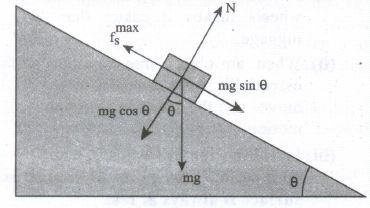
Consider an inclined plane on which an object is placed as shown in the figure, Let the angle which this plane makes with the horizontal be ፀ. For small angle of ፀ, the object may not slide down. As ፀ is increased, for a particular value of ፀ, the object begins to slide down. This value is called angle of repose. Hence, the angle of repose is the angle of the inclined plane with the horizontal such that an object placed on it begins to slide.
2.
(i) Consider the case of a whirling motion of a stone tied to a string. Assume that the stone has angular velocity ω in the inertial frame (at rest).
(ii) If the motion of the stone is observed from a frame which is also rotating along with the stone with same angular velocity ω then, the stone appears to be at rest.
(iii) This implies that in addition to the inward centripetal force - mω2r there must be an equal and opposite force that acts on the stone outward with value + mω2r.
(iv) So the total force acting on the stone in a rotating frame is equal to zero (-mω2r + mω2r=0).
(v) This outward force + mω2r is called the centrifugal force.
3.
i. Every object continues to be in the state of rest or of uniform motion unless there is external force acting on it.
ii. The force acting on an object is equal to the rate of change of its momentum.
iii. For every action there is an equal and opposite reaction.
Discussion:
i) Newton's laws are vector laws. The equation \(\vec{F}=\mathrm{m} \vec{a}\) can be written in cartesian coordinates as
\(\mathrm{F}_{x} \hat{\mathrm{i}}+\mathrm{f}_{\mathrm{y}} \hat{\mathrm{j}}+\mathrm{F}_{z} \hat{\mathrm{k}}=\operatorname{ma}_{x} \hat{\mathrm{i}}+\operatorname{ma}_{\mathrm{y}} \hat{\mathrm{j}}+\operatorname{ma}_{\mathrm{z}} \hat{\mathrm{k}}\)
On comparing both sides,
\(\mathrm{F}_{x}=m \mathrm{~m}_{x} \)
\(\mathrm{F}_{\mathrm{y}}=m \mathrm{ma}_{\mathrm{y}} \)
\(\mathrm{F}_{\mathrm{z}}=m \mathrm{ma}_{\mathrm{z}}\)
From the above equations, we can infer that the force acting along y direction cannot alter the acceleration along n direction. In the same way, F2 can not affect ay and an
ii) The acceleration experienced by the body at a time t depends on the force which acts on the body at that instant of time. Thus, \(\vec{F}(\mathrm{t})=\mathrm{m} \vec{a}(\mathrm{t})\)
when a bowler throws the ball to a batsman the acceleration of the ball is determined by the gravitational and air frictional forces and not by the speed which it is thrown.
iii) The direction of force may be different from the direction of force. The following motions are possible.
a) Force and motion in the same direction.
Example: Falling of an apple from the tree.
b) Force and motion are not in the same direction.
Example: The Moon experiences a force towards the Earth but Moon moves in the elliptical path.
c) Force and motion are in the opposite direction.
Example: The motion of a body thrown vertically upward.
d) Zero net force, but there is motion.
Example: The falling of rain drops.
4) If multiple forces \(\vec{F}_{1}, \vec{F}_{2}, \vec{F}_{3} \ldots\) act on the same body then total force is equal to the vectorial sum of the individual forces \(\vec{F}_{\text {net }}=\vec{F}_{1}+\vec{F}_{2}+\vec{F}_{3}+\ldots\)
5) Newton's second law can be written in the second derivative of position vector as \(\vec{F}=\mathrm{m} \frac{\mathrm{d}^{2}\overrightarrow{\mathrm{r}}}{\mathrm{dt}^{2}}\). It means that whenever the second derivative of position vector is not zero, there must be a force acting on the body.
6) If no force acts on the body then \(m \frac{d \vec{v}}{\mathrm{dt}}=0\). It implies that \(\vec{v}\) is constant. Thus second law is consistent with the first law even though they are independent to each other.
7) Newton's second law is cause and effect relation force is the cause and acceleration is effect.
4.
Horizontal motion:
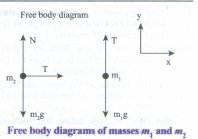
(i) In this case, mass m2 is kept on a horizontal table and mass m1 is hanging through a small pulley. Assume that there is no friction on the surface.
(ii) As both the blocks are connected to them unstretchable string, if m, moves with an acceleration a downward then m2 also moves with the same acceleration a horizontally.
The forces acting on mass m2 are
(i) Downward gravitational force (m2g)
(ii) Upward normal force (N) exerted by the surface
(iii) Horizontal tension (T) exerted by the string.
The forces acting on mass m1 are
(i) Downward gravitational force (m1g)
(ii) Tension (T) acting upwards
The free body diagrams for both the masses.
\(T\hat{j}-m_1g\hat{j}=m_1a\hat{j}\) ( along y direction)
(iii) By comparing the components on both sides of the above equation,
Applying Newton's second law for m2
\(T\hat{i}-m_2a\hat{i}\) (along x direction)
By comparing the components on both sides of above equation,
\(N\hat{j}-m_2g\hat{i}=0\)
By comparing the components on both sides
of the above equation
N - m2g = 0
N = m2g ........(3)
By substituting equation (2) in equation (1), we can find the tension T.
(iv) Comparing motion in both cases, it is clear that the tension in the string for horizontal motion is half of the tension for vertical motion for same set of masses and strings.
5.
Conservation of linear momentum is equivalent to Newton's third law of motion. If no external force acts on a system (called isolated) of constant mass, the total momentum of the system remains constant with time.
According to this law for a system of particles \(\vec{F}=\frac{d \vec{p}}{d t}\)
In the absence of external force F = 0 and \(\vec{p}\) = constant
i.e., \(p_{1}+\vec{p}_{2}+\vec{p}_{3}+\dots=\) constant
or \(m_{1} \vec{v}_{1}+m_{2} \vec{v}_{2}+m_{3} \vec{v}_{3}+\dots=\) constant
This equation shows that in absence of external force for a closed system the linear momentum of individual particles may change but their sum remains unchanged with time. For a system of two particles in absence of external force by law of conservation of linear momentum.
\(\vec{p}_{1}+\vec{p}_{2} =\text { constant } \)
\(m_{1} \vec{v}_{1}+m_{2} \vec{v}_{2} =\text { constant } \)
\(m_{1} \frac{d \vec{v}_{1}}{d t}+m_{2} \frac{d \vec{v}_{2}}{d t} =0 \Rightarrow m_{1} \vec{a}_{1}+m_{2} \vec{a}_{2}=0 \Rightarrow \vec{F}_{1}+\vec{F}_{2}=0 \)
\(\therefore \vec{F}_{2} =-\vec{F}_{1}\)
For every action there is equal and opposite reaction which is Newton's third law of motion.
Recoiling of a gun: For bullet and gun system, the force exerted by trigger will be internal so the momentum of the system remains unaffected.
Let mG= mass of gun, mB= mass of bullet, vG velocity of gun, vB= velocity of bullet Initial momentum of system =0
Final momentum of system \(=m_{G} \vec{v}_{G}+m_{B} \vec{v}_{B}\)
By the law of conservation linear momentum \(m_{G} \vec{v}_{G}+m_{B} \vec{v}_{B}=0\)
So recoil velocity \(v_{G}=-\frac{m_{B}}{m_{G}} \vec{v}_{B}\)
Here negative sign indicates that the velocity of recoil \(\vec{v}_{G}\) is opposite to the velocity of the bullet.
\(v_{G} \propto \frac{1}{m_{G}}\) i.e. higher the mass of gun, lesser the velocity of recoil of gun.
While firing the gun must be held tightly to the shoulder, this would save hurting the shoulder because in this condition the body of the shooter and the gun behave as one body. Total mass become large and recoil velocity becomes too small.
\(\vec{v}_{G} \propto \frac{1}{m_{G}+m_{\operatorname{man}}}\)

11th Standard Syllabus & Materials
11th Standard
TN 11th Tamil பீடு பெற நில் - செய்யுள் - காவடிச்சிந்து Important Questions And Answers Study Material - QB365 Set A
NEW11th Standard
TN 11th Tamil பீடு பெற நில் - உரைநடை - மலை இடப்பெயர்கள் : ஓர் ஆய்வு Important Questions And Answers Study Material - QB365 Set A
NEW11th Standard
TN 11th Tamil மாமழை போற்றுதும் - துணைப்பாடம் - யானை டாக்டர் Important Questions And Answers Study Material - QB365 Set A
NEW11th Standard
TN 11th Tamil மாமழை போற்றுதும் - செய்யுள் - ஐங்குறுநூறு Important Questions And Answers Study Material - QB365 Set A



Tamilnadu Stateboard 11th Standard Subjects

Maths

Commerce

Economics

Biology

Business Maths and Statistics

Accountancy

Computer Science
Physics

Chemistry
Maths
Biology
Economics
Physics
Chemistry

History
Business Maths and Statistics

Computer Science
Accountancy

Computer Applications
History
Computer Technology
Commerce
Computer Applications
Computer Technology

Tamil

English

French
Tamilnadu Stateboard Standards



