
 100% FREE ACCESS
11th Standard Syllabus & Materials
11th Standard
TN 11th Tamil இயற்கை வேளாண்மை,சுற்றுச்சூழல் -செய்யுள் - மனோன்மணீயம் Important Questions And Answers Study Material - QB365 Set A
NEW11th Standard
TN 11th Tamil என்னுயிர் என்பேன் -துணைப்பாடம் - இசைத்தமிழர் இருவர் Important Questions And Answers Study Material - QB365 Set A
NEW11th Standard
TN 11th Tamil மொழி கலை -செய்யுள் - ஒவ்வொரு புல்லையும் Important Questions And Answers Study Material - QB365 Set A
NEW11th Standard
TN 11th Tamil பீடு பெற நில் - இலக்கணம் - பகுபத உறுப்புகள் Important Questions And Answers Study Material - QB365 Set A
NEW11th Standard
TN 11th Tamil பீடு பெற நில் - துணைப்பாடம் - வாடிவாசல் Important Questions And Answers Study Material - QB365 Set A
NEW11th Standard
TN 11th Tamil பீடு பெற நில் - செய்யுள் - குறுந்தொகை Important Questions And Answers Study Material - QB365 Set A

Published on: 24/06/2021
QB365 provides detailed and simple solution for every
Creative Questions in class 11 Physics Subject. It will helps to get more idea about question pattern in every Creative questions with solution.
Download Tamil Nadu 11th Standard Physics question papers, model tests, one-mark questions, important questions, and public exam papers in PDF format. Free study materials and answer keys for TN State Board students.
Questions + Answers key
Take MCQ Physics Test1.
Give some examples for centripetal force.
2.
Find the impulse of a constant force and variable force with diagrams.
3.
What is Static Friction? Explain
4.
5.
Find
(i) acceleration
(ii) speed of the sliding object using free body diagram.
1.
(i) In the case of whirling motion of a stone tied to a string, the centripetal force on the particle is provided by the tensional force on the string. In circular motion in an amusement park, the centripetal force is provided by.the tension in the iron ropes.
(ii) In motion of satellites around the Earth, the centripetal force is given by Earth's gravitational force on the satellites. Newton's second law for satellite motion is F = Earth's gravitational force = \(\frac { { mv }^{ 2 } }{ r } \)
Where r- a distance of the planet from the center of the Earth
.png)
(iii) When a car is moving on a circular track the centripetal force is given by the frictional force between the road and the tires Newton second law for this case is
.png)
Frictional force = \(\frac { { mv }^{ 2 } }{ r } \)
m-mass of the car
v-speed of the car
r-radius of curvature of track.
Even when the car moves on a curved track, the car experiences the centripetal force which is provided by a frictional force between the surface and the tire of the car.
(iv) When the planets orbit around the Sun, they experience the centripetal force towards the center of the Sun. Here the gravitational force of the Sun acts as a centripetal force on the planets.
Newton's second law for this motion Gravitational force of Sun on the planet = \(\frac { { mv }^{ 2 } }{ r } \)
2.
(i) For a constant force, the impulse is denoted as \(j=F\triangle t\) and it is also equal to change in momentum \((\triangle p)\) of the object over the time interval \(\triangle t\)
Impulse is a vector quantity and its unit is Ns.
(ii) The average force acted on the object over the short interval of time is defined by
\({ F }_{ avg }=\frac { \triangle p }{ \triangle t } \) ..........(1)
(iii) From equation (1), the average force that act on the object is greater if t is smaller. Whenever the momentum of the body changes very quickly, the average force becomes larger.
(iv) The impulse can also be written in terms of the average force. Since \(\triangle\) p is change in momentum of the object and is equal to impulse (J), we have
\(j={ F }_{ avg }\triangle t\) .........(2)
(v) The graphical representation of constant force impulse and variable force impulse is given in Figure.
.png)
.png)
3.
(i) If some external force Fext is applied on the object parallel to the surface on which the object is at rest, the surface exerts exactly an equal and opposite force on the object to resist its motion and tries to keep the object at rest. It implies that external force and frictional force are exactly equal and opposite.
(ii) The magnitude of static frictional force \({ f }_{ s }\) satisfies the following empirical relation. \(0\le { f }_{ s }\le { u }_{ s }N\)
where \(\mu\) s is the coefficient of static friction. It depends on the nature of the surfaces in contact. N is a normal force exerted by the surface on the body and sometimes it is equal to me.
(iii) If the object is at rest and no external force is applied on the object, the static friction acting on the object is zero ( \({ f }_{ s }\) =0)
(iv) If the object is at rest, and there is an external force applied parallel.to the surface, then the force of static friction acting on the object is exactly equal to the external force applied on the object (\({ f }_{ s }\) = Fext). But still the static friction \({ f }_{ s }\) is less than \(\mu\) s
(v) When object begins to slide, the static friction (\({ f }_{ s }\)) acting on the object attains maximum.
(vi) If the object is pressed hard on the surface then the normal force acting on the object will increase. As a consequence, it is more difficult to move the object. The static friction does not depend upon the area of contact.
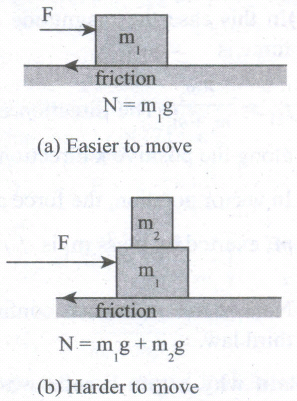
4.
5.
(i) To draw the free body diagram, the block is assumed to be a point mass. Since the motion is on the inclined surface, we have to choose the coordinate system parallel to the inclined surface as shown in Figure (b).
(ii) The gravitational force mg is resolved in to parallel component mg sin e along the inclined plane and perpendicular component mg cos e perpendicular to the inclined surface. (Figure (b)).
(iii) Note that the angle made by the gravitational force (mg) with the perpendicular to the surface is equal to the angle of inclination angle e as shown in Figure (c).
.png)
(a)Free body diagram
(b) mg resolved into parallel and perpendicular components
.png)
In the Triangle ABC Total Angle = 90 + \(\theta +{ \theta }_{ 1 }\) = 180 From the above equation
\({ \theta }_{ 1 }\) = 180 -90 - \(\theta\) = 90 - \(\theta\)
But from the figure \({ \theta }_{ 2 }\) =90 - \({ \theta }_{ 1 }\) = 90 -(90-\(\theta\))
It given \({ \theta }_{ 2 }\) = \(\theta\)
C) The angle \({ \theta }_{ 2 }\) is equal to \(\theta\)
There is no motion(acceleration) along they axis. Applying Newton's second law in the y-direction
-mg cos \(\theta\) \(\hat { j } +N\vec { j } \) = 0(No acceleration)
By comparing the components on both sides, N - mg cos \(\theta =0\)
N=mg cos \(\theta\)
The magnitude of normal force (N) exerted by the surface is equivalent to mg cos \(\theta\)
(v) The object slides (with an acceleration) along the x-direction. Applying Newton's second law in the x-direction
mg sin \(\quad \theta \hat { i } =ma\hat { i } \)
By comparing the components on both sides, we can equate. mg sin \(\theta\) = ma
The acceleration of the sliding object is a = g sin \(\theta\)
(vi) Note that the acceleration depends on the angle of inclination.\(\theta\) If the angle 9 is 90 degree, the block will move vertically with acceleration a = g
(vii) Newton's kinematic equation is used to find the speed of the object when it reaches the- bottom. The acceleration is constant throughout the motion
v2 = u2 + 2as along the x-direction .......(1)
The acceleration a is equal to mg sin \(\theta\) The initial speed (u) is equal to zero as it starts from rest. Here s is the length of the inclined surface.
The speed (v) when it reaches the bottom is (using equation (1))
\(v=\sqrt { 2sg\ sin\ \theta } \)

11th Standard Syllabus & Materials
11th Standard
TN 11th Tamil பீடு பெற நில் - செய்யுள் - காவடிச்சிந்து Important Questions And Answers Study Material - QB365 Set A
NEW11th Standard
TN 11th Tamil பீடு பெற நில் - உரைநடை - மலை இடப்பெயர்கள் : ஓர் ஆய்வு Important Questions And Answers Study Material - QB365 Set A
NEW11th Standard
TN 11th Tamil மாமழை போற்றுதும் - துணைப்பாடம் - யானை டாக்டர் Important Questions And Answers Study Material - QB365 Set A
NEW11th Standard
TN 11th Tamil மாமழை போற்றுதும் - செய்யுள் - ஐங்குறுநூறு Important Questions And Answers Study Material - QB365 Set A



Tamilnadu Stateboard 11th Standard Subjects

Maths

Commerce

Economics

Biology

Business Maths and Statistics

Accountancy

Computer Science
Physics

Chemistry
Maths
Biology
Economics
Physics
Chemistry

History
Business Maths and Statistics

Computer Science
Accountancy

Computer Applications
History
Computer Technology
Commerce
Computer Applications
Computer Technology

Tamil

English

French
Tamilnadu Stateboard Standards



