
 100% FREE ACCESS
11th Standard Syllabus & Materials
11th Standard
TN 11th Tamil இயற்கை வேளாண்மை,சுற்றுச்சூழல் -செய்யுள் - மனோன்மணீயம் Important Questions And Answers Study Material - QB365 Set A
NEW11th Standard
TN 11th Tamil என்னுயிர் என்பேன் -துணைப்பாடம் - இசைத்தமிழர் இருவர் Important Questions And Answers Study Material - QB365 Set A
NEW11th Standard
TN 11th Tamil மொழி கலை -செய்யுள் - ஒவ்வொரு புல்லையும் Important Questions And Answers Study Material - QB365 Set A
NEW11th Standard
TN 11th Tamil பீடு பெற நில் - இலக்கணம் - பகுபத உறுப்புகள் Important Questions And Answers Study Material - QB365 Set A
NEW11th Standard
TN 11th Tamil பீடு பெற நில் - துணைப்பாடம் - வாடிவாசல் Important Questions And Answers Study Material - QB365 Set A
NEW11th Standard
TN 11th Tamil பீடு பெற நில் - செய்யுள் - குறுந்தொகை Important Questions And Answers Study Material - QB365 Set A

Published on: 13/05/2022
QB365 provides detailed and simple solution for every
Creative Questions in class 11 Physics Subject. It will helps to get more idea about question pattern in every Creative questions with solution.
Download Tamil Nadu 11th Standard Physics question papers, model tests, one-mark questions, important questions, and public exam papers in PDF format. Free study materials and answer keys for TN State Board students.
Questions + Answers key
Take MCQ Physics Test1.
Briefly explain how is a horse able to pull a cart.
2.
Using Newton's laws calculate the tension acting on the mango (mass m = 400g) hanging from a tree.
3.
What happens to the object at rest if
(i) fs = 0
(ii) fs = Fext
(iii) fs = max.
4.
Show how impulse force can be measured graphically.
5.
Prove Impulse - Momentum equation.
1.
Consider the horse as the 'system', then there are three forces acting on the horse
(i) Downward gravitational force (mhg)
(ii) Force exerted by the road (Fr)
(iii) Backward force exerted by the cart (Fc)
It is shown in the following figure.
Fr - Force exerted by the road on the horse
Fc - force exerted by the cart on the horse
Fr丄 - Perpendicular component of Fr = N
Fr||-Parallel component of F, which is reason for forward movement.
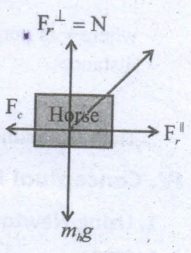
The force exerted by .the road can be resolved into parallel and perpendicular components, The perpendicular component balances the downward gravitational force. There is parallel component along the forward direction. It is greater than the backward force (Fc). So there is net force along the forward direction which causes the forward movement of the horse.
If we take the cart as the system, then there are three forces acting on the cart.
(i) Downward gravitational force (mcg)
(ii) Force exerted by the road (Fr')
(iii) Force exerted by the horse (Fh)
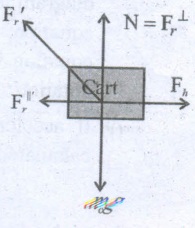
It is shown in the figure
The force exerted by the road (\(\vec { { F }_{ r } } \)) can be resolved into parallel and perpendicular components. The perpendicular component cancels the downward gravity (mcg)
Parallel component acts backwards and the force exerted by the horse (\(\vec { { F }_{ h } } \)) acts forward. Force (\(\vec { { F }_{ h } } \)) is greater than the parallel component acting in the opposite direction. So there is an overall unbalanced force in the forward direction which causes the cart to accelerate forward.
If we take the cart + horse as a system, then there are two forces acting on the system.
(i) Downward gravitational force (mh + mc)g
(ii) The force exerted by the road (Fr) on the system.
It is shown in the following figure.
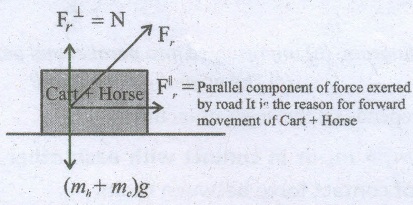
(iii) In this case the force exerted by the road (Fr) on the system (cart + horse) is resolved in to parallel and perpendicular components. The perpendicular component is the normal force which cancels the downward gravitational force (mh +mc)g. The parallel component of the force is not balanced, hence the system (cart + horse) accelerates and moves forward due to this force.
2.
(i) Choose a suitable inertial coordinate system to analyse the problem. For most of the cases we can take Earth as an inertial coordinate system.
(ii) Identify the system to which Newton's laws need to be applied. The system can be a single object or more than one object.
(iii) Draw the free body diagram.
(iv) Once the forces acting on the system are identified, and the free body diagram is drawn, apply Newton's second law. In the left hand side of the equation, write the forces acting on the .system in vector notation and equate it to the right hand side of equation which is the product of mass .and acceleration. Here, acceleration should also be in vector notation.
(v) If acceleration is given, the force can be calculated. If the force is given, acceleration can be calculated.
By following the above steps: We fix the inertial coordinate system on the. ground as shown in the figure.
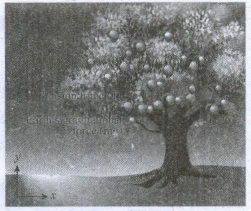
The forces acting on the mango are
(i) Gravitational force exerted by the Earth on the mango acting downward along negative y-axis.
(ii) Tension (in the cord attached to the mango) acts upward along positive y-axis.
The free body diagram for the mango is shown in the figure.
\(\vec { { F }_{ g } } =mg(-\hat { j } )=-mg\hat { j } \)
Here, mg is the magnitude of the gravitational force and \((-\hat { j } )\) represents the unit vector in negative y direction.
\(\vec { T } =T\hat { j } \)
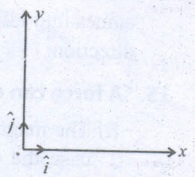
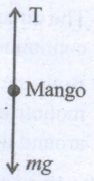

Here T is the magnitude of the tension force and \((-\hat { j } )\) represents the unit vector in positive y direction.
\({ \vec { F } }_{ net }={ \vec { F } }_{ s }+{ \vec { T } }_{ g }=-mg\hat { j } +T\hat { j } =(T-mg)\hat { j } \)
From Newton's second law \({ \vec { F } }_{ net }=m\vec { a } \)
Since the mango is at rest with respect to us (inertial coordinate system) the acceleration is zero (\(\vec { a } =0\))
So \({ \vec { F } }_{ net }=m\vec { a } =0\)
\((T-mg)\hat { j } =0\)
By comparing the components on both sides of the above equation, we get T - mg = 0
So the tension force acting on the mango is given by T - mg
Mass of the mango m = 400g and g = 9.8 ms-2 Tension acting on the mango is T = 0.4\(\times\)9.8 = 3.92 N.
3.
(i) If the object is at rest and no external force is applied on the object, the static friction acting on the object is zero (fs = 0).
(ii) If the object is at rest, and there is an external force applied parallel to the surface, then the force of static friction acting on the object is exactly equal to the external force applied on the object (fs = Fext). But still the static friction Is is less than μsN.
(iii) When object begins to slide, the static friction (fs) acting on the object attains maximum.
4.
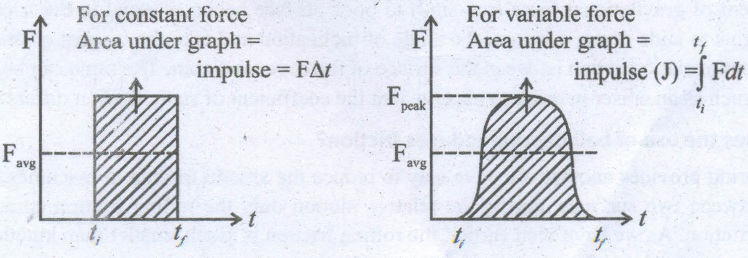
5.
If a force (F) acts on the object in a very short interval of time (M), from Newton's second law in magnitude form
Fdt = dp
Integrating over time from an initial time ti to a final time tf, we get
\(\int _{ i }^{ f }{ dp } =\int _{ { t }_{ i } }^{ { t }_{ f } }{ Fdt } \)
pf-pi = \(\int _{ { t }_{ i } }^{ { t }_{ f } }{ Fdt } \)
pi = initial momentum of the object at time ti
Pt = final momentum of the object at time tf.
pf - pi = Δp change in momentum of the object during the time interval
tf - ti = Δt
The integral \(\int _{ { t }_{ i } }^{ { t }_{ f } }{ Fdt } \)=J is called the impulse and it is equal to change in momentum of the object.
If the force is constant over the time interval, then
\(\int _{ { t }_{ i } }^{ { t }_{ f } }{ F } dt=\int _{ i }^{ f }{ dp } \) = F(tf - ti) = FΔt
FΔt = Δp

11th Standard Syllabus & Materials
11th Standard
TN 11th Tamil பீடு பெற நில் - செய்யுள் - காவடிச்சிந்து Important Questions And Answers Study Material - QB365 Set A
NEW11th Standard
TN 11th Tamil பீடு பெற நில் - உரைநடை - மலை இடப்பெயர்கள் : ஓர் ஆய்வு Important Questions And Answers Study Material - QB365 Set A
NEW11th Standard
TN 11th Tamil மாமழை போற்றுதும் - துணைப்பாடம் - யானை டாக்டர் Important Questions And Answers Study Material - QB365 Set A
NEW11th Standard
TN 11th Tamil மாமழை போற்றுதும் - செய்யுள் - ஐங்குறுநூறு Important Questions And Answers Study Material - QB365 Set A



Tamilnadu Stateboard 11th Standard Subjects

Maths

Commerce

Economics

Biology

Business Maths and Statistics

Accountancy

Computer Science
Physics

Chemistry
Maths
Biology
Economics
Physics
Chemistry

History
Business Maths and Statistics

Computer Science
Accountancy

Computer Applications
History
Computer Technology
Commerce
Computer Applications
Computer Technology

Tamil

English

French
Tamilnadu Stateboard Standards



