
 100% FREE ACCESS
11th Standard Syllabus & Materials
11th Standard
TN 11th Tamil இயற்கை வேளாண்மை,சுற்றுச்சூழல் -செய்யுள் - மனோன்மணீயம் Important Questions And Answers Study Material - QB365 Set A
NEW11th Standard
TN 11th Tamil என்னுயிர் என்பேன் -துணைப்பாடம் - இசைத்தமிழர் இருவர் Important Questions And Answers Study Material - QB365 Set A
NEW11th Standard
TN 11th Tamil மொழி கலை -செய்யுள் - ஒவ்வொரு புல்லையும் Important Questions And Answers Study Material - QB365 Set A
NEW11th Standard
TN 11th Tamil பீடு பெற நில் - இலக்கணம் - பகுபத உறுப்புகள் Important Questions And Answers Study Material - QB365 Set A
NEW11th Standard
TN 11th Tamil பீடு பெற நில் - துணைப்பாடம் - வாடிவாசல் Important Questions And Answers Study Material - QB365 Set A
NEW11th Standard
TN 11th Tamil பீடு பெற நில் - செய்யுள் - குறுந்தொகை Important Questions And Answers Study Material - QB365 Set A

Published on: 07/06/2021
QB365 provides detailed and simple solution for every Book back Questions in class 11 Physics Subject. It will helps to get more idea about question pattern in every book back questions with solution.
Download Tamil Nadu 11th Standard Physics question papers, model tests, one-mark questions, important questions, and public exam papers in PDF format. Free study materials and answer keys for TN State Board students.
Questions + Answers key
Take MCQ Physics Test1.
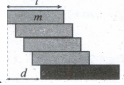
On the edge of a wall, we build a brick tower that only holds because of the bricks own weight. Our goal is to build a stable tower whose overhang d is greater than the length l of a single brick. What is the minimum number of bricks you need?
2.
State and prove perpendicular axis theorem.
3.
State and prove parallel axis theorem.
4.
Derive the expression for moment of inertia of a uniform ring about an axis passing through the center and perpendicular to the plane?
5.
Explain why a cyclist bends while negotiating a curve road? Arrive at the expression for angle of bending for a given velocity?
1.
Since the blocks are identical, the centre of mass of each block is located at its midpoint. Let us take the origin to be at the midpoint [or centre of mass ] of block at the bottom and find out the shift in the position of centre of mass of the stack on the addition of the block each time.
The stack will not fall over till the shift in the position of its centre of mass is less than 1/2 cm. When the stack contains two blocks: if Δx1 and Δx2 are the shifts in the positions of the centre, of the mass of the blocks with respect to origin, then shift in the position of the centre of mass of the stack
\(\Delta X=\frac { M\Delta x_{ 1 }+M\Delta x_{ 2 } }{ M+M } \)
\(=\frac { M\left[ \Delta x_{ 1 }+\Delta x_{ 2 } \right] }{ 2M } \)
\(\Delta X=\frac { \Delta x_{ 1 }+\Delta x_{ 2 } }{ M+M } \)
Here Δx1= 0 and Δx2= d cm
Therefore, ΔX = 0+\(\frac{d}{2}\) = \(\frac{d}{2}\) cm
Here, If \(\frac{d}{2}\) cm < \(\frac{1}{2}\) cm
Then the stack will not fall over.
In the above way, Suppose that let the maximum n block can be stacked before the stack falls over. If Δx1, Δx2, Δx3 .......,Δxn are the shifts in the position of the n blocks then shift in the position of the centre of mass of the stack
ΔX = Δx1 + Δx2 + Δx3 + .... + Δxn
So that the stack does not fall
Δx1 + Δx2 + Δx3 + .... + Δ\(\frac {x^n}{n}\) < \(\frac{1}{2}\)
Sn = Δx1 + Δx2 + Δx3 + ..... + Δxn
Then the above condition becomes,
\(\frac { S_{ n } }{ n }<\frac{1}{2}\)
2.
Perpendicular axis theorem:
(i) The theorem states that the moment of inertia of a plane laminar body about an axis perpendicular to its plane is equal to the sum of moments of inertia about two perpendicular axes lying in the plane of the body such that all the three axes are mutually perpendicular and have a common point.
(ii) Let the X and Y-axes lie in the plane and Z-axis perpendicular to the plane of the laminar object. If the moments of inertia of the body about X and Y-axes are Ix and Iy respectively and Iz is the moment of inertia about Z-axis, then the perpendicular axis theorem could be expressed as,
Iz = Ix + Iy
(iii) To prove this theorem, let us consider a plane laminar object of negligible thickness on which lies the origin (0). The X and Y-axes lie on the plane and Z-axis is perpendicular to it as shown in Figure. The lamina is considered to be made up of a large number of particles of mass m. Let us choose one such particle at a point P which has coordinates (x, y) at a distance r from O.
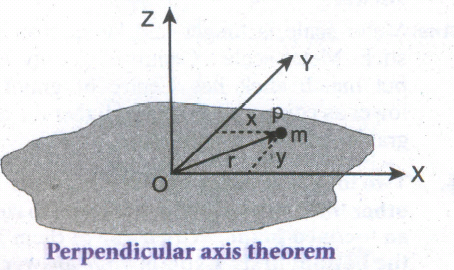
(iv) The moment of inertia of the particle about Z axis is mr2. The summation of the above expression gives the moment of inertia of the entire lamina about Z-axis as, Iz = \(\Sigma \)mr2
Here r2 = x2 + y2
Then, Iz = \(\Sigma \)(x2 +y2)
Iz = \(\Sigma \)mx2 + \(\Sigma \)my2
(v) In the above expression, the term \(\Sigma \)mx2 is the moment of inertia of the body about the Y-axis and similarly the term \(\Sigma \)my2 is the moment of inertia about X-axis. Thus,
Ix= \(\Sigma \)my2and Iy= \(\Sigma \)mx2
Substituting in the equation for Iz gives,
Iz = Ix + Iy
Y-axis and similarly the term \(\Sigma \)my2 is the moment of inertia about X-axis. Thus,
IX = \(\Sigma \)my2and Iy= \(\Sigma \)mx2
Substituting in the equation for Iz gives,
Iz = Ix + Iy
Thus, the perpendicular axis theorem is proved.
3.
(i) Parallel axis theorem states that the moment of inertia of a body about any axis is equal to the sum of its moment of inertia about a parallel axis through its center of mass and the product of the mass of the body and the square of the perpendicular distance between the two axes.
(ii) If IC is the moment of inertia of the body of mass M about an axis passing through the center of mass, then the moment of inertia I about a parallel axis at a distance d from it is given by the relation,
I = IC + Md2
(iii) Let us consider a rigid body as shown in Figure. Its moment of inertia about an axis AB passing through the center of mass is IC DE is another axis parallel to AB at a perpendicular distance d from AB. The moment of inertia of the body about DE is I. We attempt to get an expression for I in terms of IC For this, let us consider a point mass m on the body at position x from its center of mass.
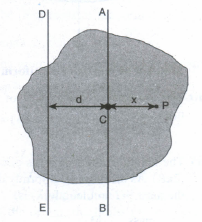
(iv) The moment of inertia of the point mass about the axis DE is, m(x + d)2. The moment of inertia I of the whole body about DE is the summation of the above expression.
\(I=\sum { m\left( x+d \right) ^{ 2 } } \)
This equation could further be written as,
\(I=\sum { m\left( { x }^{ 2 }+{ d }^{ 2 }+2xd \right) } \)
\(I=\sum { \left( { mx }^{ 2 }+m{ d }^{ 2 }+2dmx \right) } \)
\(I=\sum { { mx }^{ 2 }+\sum { m{ d }^{ 2 } } +2d\sum { mx } } \)
(v) Here, \(\sum { mx^{ 2 } } \) is the moment of inertia of the body about the center of mass. Hence,
IC = \(\sum { mx= } 0\) because, x can take positive and negative values with respect to the axis AB. The summation \(\left( \sum { mx } \right) \) will be zero.
Thus, I = Ic + \(\sum { md^{ 2 } } \) = IC + \(\left( \sum { m } \right) d^{ 2 }\)
(vi) Here, \(\sum { m } \) is the entire mass M of the object \(\left( \sum { m=M } \right) \)
I = IC + Md2
Hence the parallel axis theorem is proved.
4.
Let us consider a uniform ring of mass and radius R. To find the moment of inertia of the ring about an axis passing through its center and perpendicular to the plane, let us take an infinitesimally small mass (dm) of length (dx) of the ring. This (dm) is located at a distance R, which is the radius of the ring from the axis as shown in Figure.
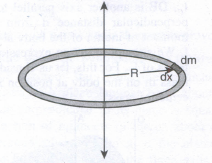
The moment of inertia (dI) of this small mass (dm) is,
dI = (dm)R2
The length of the ring is its circumference (2\(\pi\)R). As the mass is uniformly distributed, the mass per unit length (λ) is,
\(\lambda =\frac { mass }{ length } =\frac { M }{ 2\pi R } dx\)
The mass (dm) of the infinitesimally small length is, dm = λ.dx = \(\frac { M }{ 2\pi R } dx\)
Now, the moment of inertia (I) of the entire ring is
\(I=\int { dI } =\int { (dm) } R^{ 2 }=\int { \left( \frac { M }{ 2\pi R } dx \right) } R^{ 2 }\)
\(I=\frac { MR }{ 2\pi } \int { dx } \)
To cover the entire length of the ring, the limits of integration are taken from 0 to 2\(\pi\)R.
\(I=\frac { MR }{ 2\pi } \int _{ 0 }^{ 2\pi R }{ dx } \)
\(I=\frac { MR }{ 2\pi } \left[ x \right] ^{ 2\pi R }_{ 0 }=\frac { MR }{ 2\pi } \left[ 2\pi R-0 \right] \)
\(I=MR^{ 2 }\)
5.
For a body to move in a circular path, there has, to be a centripetal force \((F=\frac {mv^2}{r})\) that keeps it in the circular path. When a cyclist bends while negotiating a round path, the direction of the normal force tilts which results in a vertical as well as the horizontal component of the force.
The forces acting on the cyclist are not balanced in a turn, since the cyclist is not having a uniform motion. The sum of the forces on the cyclist is oriented inside the turn, this force is created by the tire friction. When a cyclist bends inward on a curve to create the centripetal force needed to pull him in the curved path by the horizontal component of the normal reaction.
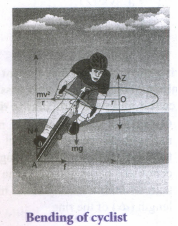
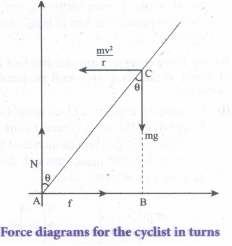
Let us consider a cyclist negotiating a circular level road (not banked) of radius r with a speed v. The cycle and the cyclist are considered as one system with mass m. The centre gravity of the system is C and it goes in a circle of radius r with center at O. Let us choose the line OC as X-axis and the vertical line through O as Z-axis as shown in Figure.
The system as a frame is rotating about Z-axis. The system is at rest in this rotating frame.
To solve problems in rotating frame of reference, we have to apply a centrifugal force (pseudo force) on the system which will be \(\frac{mv^2}{r}\). This force will act through the center of gravity. The forces acting on the system are, (i) gravitational force (mg), (ii) normal force (N), (iii) frictional force (f) and (iv) centrifugal force \(\left( \frac { mv^{ 2 } }{ r } \right) \). As the system is in equilibrium in the rotational frame of reference, the net external force and net external torque must be zero. Let us consider all torques about the point A in Figure.
The torque due to the gravitational force about point A is (mg AB) which causes a clockwise turn that is taken as negative. The torque due to the centripetal force is
\(\left( \frac { mv^{ 2 } }{ r } BC \right) \)which causes an anti-clockwise turn that is taken as positive.
-mg AB + \(\frac { mv^{ 2 } }{ r } BC=0\)
mg AB \( = \ \frac { mv^{ 2 } }{ r } BC\)
From ΔABC,
AB = AC sin θ and BC = AC cos θ
mg AC sin θ = \(\frac{mv^2}{r}\) AC cos θ
tan θ = \(\frac{v^2}{rg}\)
θ = tan-1\(\left( \frac { { v }^{ 2 } }{ rg } \right) \)
While negotiating a circular level road of radius r at velocity v, a cyclist has to bend by an angle θ from vertical given by the above expression to stay in equilibrium (i.e. to avoid a fall).

11th Standard Syllabus & Materials
11th Standard
TN 11th Tamil பீடு பெற நில் - செய்யுள் - காவடிச்சிந்து Important Questions And Answers Study Material - QB365 Set A
NEW11th Standard
TN 11th Tamil பீடு பெற நில் - உரைநடை - மலை இடப்பெயர்கள் : ஓர் ஆய்வு Important Questions And Answers Study Material - QB365 Set A
NEW11th Standard
TN 11th Tamil மாமழை போற்றுதும் - துணைப்பாடம் - யானை டாக்டர் Important Questions And Answers Study Material - QB365 Set A
NEW11th Standard
TN 11th Tamil மாமழை போற்றுதும் - செய்யுள் - ஐங்குறுநூறு Important Questions And Answers Study Material - QB365 Set A



Tamilnadu Stateboard 11th Standard Subjects

Maths

Commerce

Economics

Biology

Business Maths and Statistics

Accountancy

Computer Science
Physics

Chemistry
Maths
Biology
Economics
Physics
Chemistry

History
Business Maths and Statistics

Computer Science
Accountancy

Computer Applications
History
Computer Technology
Commerce
Computer Applications
Computer Technology

Tamil

English

French
Tamilnadu Stateboard Standards



