
 100% FREE ACCESS
11th Standard Syllabus & Materials
11th Standard
TN 11th Tamil இயற்கை வேளாண்மை,சுற்றுச்சூழல் -செய்யுள் - மனோன்மணீயம் Important Questions And Answers Study Material - QB365 Set A
NEW11th Standard
TN 11th Tamil என்னுயிர் என்பேன் -துணைப்பாடம் - இசைத்தமிழர் இருவர் Important Questions And Answers Study Material - QB365 Set A
NEW11th Standard
TN 11th Tamil மொழி கலை -செய்யுள் - ஒவ்வொரு புல்லையும் Important Questions And Answers Study Material - QB365 Set A
NEW11th Standard
TN 11th Tamil பீடு பெற நில் - இலக்கணம் - பகுபத உறுப்புகள் Important Questions And Answers Study Material - QB365 Set A
NEW11th Standard
TN 11th Tamil பீடு பெற நில் - துணைப்பாடம் - வாடிவாசல் Important Questions And Answers Study Material - QB365 Set A
NEW11th Standard
TN 11th Tamil பீடு பெற நில் - செய்யுள் - குறுந்தொகை Important Questions And Answers Study Material - QB365 Set A

Published on: 24/06/2021
QB365 provides detailed and simple solution for every
Creative Questions in class 11 Physics Subject. It will helps to get more idea about question pattern in every Creative questions with solution.
Download Tamil Nadu 11th Standard Physics question papers, model tests, one-mark questions, important questions, and public exam papers in PDF format. Free study materials and answer keys for TN State Board students.
Questions + Answers key
Take MCQ Physics Test1.
Briefly explain the different types of errors and their causes with an example. How can these error be minimised?
2.
How will you determine the distance of moon from earth using parallax method?
3.
Write to causes of errors in measurement.
4.
Explain propagation of errors in the difference of two quantities and also in the division of two quantities.
1.
The uncertainty in a measurement is called an error. The three possible errors are
(i) Systematic error
(ii) Random error and
(iii )Gross error
(i) Systematic Errors: Systematic errors are reproducible inaccuracies that are consistently in the same direction. These occur often due to a problem that persists throughout the experiment. Systematic errors can be classified as follows,
Instrumental errors: When an instrument is not calibrated properly at the time of manufacture, instrumental errors may arise. If a measurement is made with a meter scale whose end is worn out, the result obtained will have errors. These errors can be corrected by choosing the instrument carefully.
Imperfections in experimental technique or procedure: These errors arise due to the limitations iri the experimental arrangement. As an example, while performing experiments with a calorimeter, if there is no proper insulation, there will be radiation losses. This results in errors and to overcome these, necessary correction has to be applied.
Personal errors: These errors are due to, individuals performing the experiment, may be due to incorrect initial setting up of the experiment or carelessness of the individual making the observation due to improper precautions. Errors due to external causes: The change in the external conditions during an experiment can cause error in measurement. For example, changes in temperature, humidity, or pressure during measurements may affect-the result of the measurement.
Least count error: Least count is the smallest value that can be measured by the measuring instrument, and the error due to this measurement is least count error. The instrument's resolution hence is the cause of this error. Least count error can be reduced by using a high precision instrument for the measurement.
(ii) Random errors: Random errors may arise due to random and unpredictable variations in experimental conditions like pressure, temperature, voltage supply etc. Errors may also be due to personal errors by the observer who performs the experiment. Random errors are sometimes called "chance error". When different readings are obtained by a person every time he repeats the experiment, personal error occurs. For example, consider the case of the thickness of a wire measured using a screw .gauge. The readings taken may be different for different trials. In this case, a large number of measurements are made and then the arithmetic mean is taken.
If n number of trial readings are taken in an experiment, and the readings are a1,a2,a3,..... an. The arithmetic mean is
\(a_m={a_1+a_2+a_3+...a_n\over n}(or)a_m={1\over n}\sum _{ i=1 }^{ i=n }{ { a }_{ i } } \)
Usually this arithmetic mean is taken as the best way to minimize the error.
(iii) Gross Error: The error caused clue to the shear carelessness of an observer is called gross error.
for example
(a) Reading an instrument without setting it properly.
(b) Taking observations in a wrong manner without bothering about the sources of errors and the precautions.
(c) Recording wrong observations.
(d) Using wrong values of the observations in calculations.
These errors can. be minimized only when an observer is careful and mentally alert.
| Type of error | Example | How to minimize it |
| Random error | Suppose you measure the mass of a ring three times using the same balance and get slightly different values. 15.46g,15.42g, 15.44g. | Take more data. Random errors can be evaluated through statistical analysis and can be reduced by averaging over a large number of observations. |
| Systematic error | Suppose the cloth tape measure that you use to measure the length of an object has been stretched out from years of use. (As a result all of the length measurements are not correct). | Systematic errors are difficult to detect and cannot be analysed statistically, because all of the data is in the same direction. (Either too high or too low) |
2.
C is the centre of the Earth A and B are two diametrically opposite places on the surface of the Earth. From A and B, the parallaxes \(\theta _1\) and \(\theta _2\) respectively of Moon M with respect to some distant star are determined with the help of an astronomical telescope.
Thus, the total parallax of the Moon subtended on Earth \(\angle\)AMB = \(\theta _1\)+ \(\theta _2\) =\(\theta \)
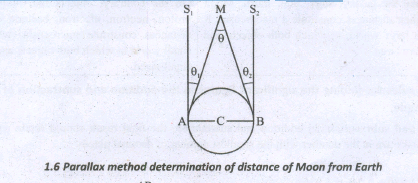
If \(\theta\) is measured in radians, then\(\theta ={AB\over MC};AM\approx MC\)
\(\theta ={AB\over MC} or M.C={AB\over\theta}\)
Knowing the values of AB and \(\theta\) , we can calculate the distance MC of Moon from the Earth.
3.
| (i) | Least count error | Associated with the poor resolution of the instrument |
| (ii) | Instrumental errors | Associated with the faulty calibration or change in conditions |
| (iii) | Random errors | Getting difficult results for the same measurement done repeatedly |
| (iv) | Personal errors | Associated with the individual performing the experiments ie. Improper precautions, incorrect initial set up of experiment |
| (v) | Systematic errors | Which tends to be in the same direction |
4.
Errors in the difference of two quantities.
Let \(\triangle A\) and \(\triangle B\) be the absolute errors in the two quantities, A and B, respectively. Then,
Measured value of \(A=A\pm\triangle A\)
Measured value of \(B=B\pm\triangle B\)
Consider the difference, Z =A - B
The error \(\triangle Z\) in Z is the given by
\(Z\pm \triangle Z=(A+\triangle A)-(B\pm \triangle B)\)
\(=(A-B)\pm(\triangle A+\triangle B)\)
\(=Z\pm(\triangle A+\triangle B)\)
(or) \(\triangle Z=\triangle A+\triangle B\)
The maximum error in difference of two quantities is equal to the sum of the absolute errors in the individual quantities. Error in the division or quotient of two quantities
Let \(\triangle A\) and \(\triangle B\) be the absolute errors in the two quantities A and B respectively.
Consider the quotient, \(Z={{A}\over{B}}\)
The error \(\triangle Z\) in Z is given by
\(Z\pm Z={{A\pm \triangle A}\over{B+\triangle B}}={{A\left(1\pm{{{\triangle A}\over{A}}} \right)}\over{B\left( 1\pm{{\triangle B}\over{B}} \right)}}\)
\(={{A}\over{B}} \left( 1\pm{{\triangle A}\over{A}} \right)\left( 1\pm{{\triangle B}\over{B}} \right)^{-1}\)
or \(Z\pm \triangle Z=Z\left( 1\pm{{\triangle A}\over{A}} \right)\left( 1\mp{{\triangle B}\over{B}} \right)\)
[ using (1+x)n \(\approx\) 1 + nx, when x<<1]
Dividing both sides by Z, we get
\(1\pm{{\triangle Z}\over{Z}}=\left( 1\pm{{\triangle A}\over{A}} \right)\left( 1\mp {{\triangle B}\over{B}} \right)\)
\(=1\pm{{\triangle A}\over{A}}\mp{{\triangle B}\over{B}}\pm{{\triangle A}\over{A}}.{{\triangle B}\over{B}}\)
As the terms \(\triangle A/A\) and \(\triangle B/B\) are small, their product term can be neglected.
The maximum fractional error in Z is given by
\({{\triangle Z}\over{Z}}=\left( {{\triangle A}\over{A}} +{{\triangle B}\over{B}}\right)\)
The maximum fractional error in the quotient of two quantities is equal to the sum of their individual fractional errors.

11th Standard Syllabus & Materials
11th Standard
TN 11th Tamil பீடு பெற நில் - செய்யுள் - காவடிச்சிந்து Important Questions And Answers Study Material - QB365 Set A
NEW11th Standard
TN 11th Tamil பீடு பெற நில் - உரைநடை - மலை இடப்பெயர்கள் : ஓர் ஆய்வு Important Questions And Answers Study Material - QB365 Set A
NEW11th Standard
TN 11th Tamil மாமழை போற்றுதும் - துணைப்பாடம் - யானை டாக்டர் Important Questions And Answers Study Material - QB365 Set A
NEW11th Standard
TN 11th Tamil மாமழை போற்றுதும் - செய்யுள் - ஐங்குறுநூறு Important Questions And Answers Study Material - QB365 Set A



Tamilnadu Stateboard 11th Standard Subjects

Maths

Commerce

Economics

Biology

Business Maths and Statistics

Accountancy

Computer Science
Physics

Chemistry
Maths
Biology
Economics
Physics
Chemistry

History
Business Maths and Statistics

Computer Science
Accountancy

Computer Applications
History
Computer Technology
Commerce
Computer Applications
Computer Technology

Tamil

English

French
Tamilnadu Stateboard Standards



