
 100% FREE ACCESS
11th Standard Syllabus & Materials
11th Standard
TN 11th Tamil இயற்கை வேளாண்மை,சுற்றுச்சூழல் -செய்யுள் - மனோன்மணீயம் Important Questions And Answers Study Material - QB365 Set A
NEW11th Standard
TN 11th Tamil என்னுயிர் என்பேன் -துணைப்பாடம் - இசைத்தமிழர் இருவர் Important Questions And Answers Study Material - QB365 Set A
NEW11th Standard
TN 11th Tamil மொழி கலை -செய்யுள் - ஒவ்வொரு புல்லையும் Important Questions And Answers Study Material - QB365 Set A
NEW11th Standard
TN 11th Tamil பீடு பெற நில் - இலக்கணம் - பகுபத உறுப்புகள் Important Questions And Answers Study Material - QB365 Set A
NEW11th Standard
TN 11th Tamil பீடு பெற நில் - துணைப்பாடம் - வாடிவாசல் Important Questions And Answers Study Material - QB365 Set A
NEW11th Standard
TN 11th Tamil பீடு பெற நில் - செய்யுள் - குறுந்தொகை Important Questions And Answers Study Material - QB365 Set A

Published on: 24/06/2021
QB365 provides detailed and simple solution for every
Creative Questions in class 11 Physics Subject. It will helps to get more idea about question pattern in every Creative questions with solution.
Download Tamil Nadu 11th Standard Physics question papers, model tests, one-mark questions, important questions, and public exam papers in PDF format. Free study materials and answer keys for TN State Board students.
Questions + Answers key
Take MCQ Physics Test1.
A simple pendulum has time period T, the point of suspension is now moved upward acceleration to the relation Y= kt2 (k = 1 ms-2) where Y is the verticle displacement the time period now becomes T2. What is the ratio \(\frac { { T }_{ 1 }^{ 2 } }{ { T }_{ 2 }^{ 2 } } \)? Given g=10 ms-2.
2.
Two simple harmonic moles are represented by Y1=0.1 sin (100 \(\pi\)t + \(\pi\)/3) and Y2=0.1 cos what is the phase difference of the velocity of the particle 1 with respect to the velocity of particle?
3.
Consider a simple pendulum having a bob attached to a string, that oscillates under the action of the force of gravity. Suppose that the period of oscillation of the simple. Pendulum depends on its length (I), mass of the bob, (m) and acceleration due to gravity (g). Derive the expression for its time period using method of dimension.
4.
One end of a U-tube containing mercury is connected to a suction pump and the other end to atmosphere. A small pressure difference is maintained between the two columns. Show that, when the suction pump is removed, the liquid column of mercury in the U-tube executes simple harmonic motion.
5.
Explain briefly about oscillations.
1.
In first case
T1=\(2\pi \sqrt { \frac { l }{ g } } \)
in second case, displacement y = kt2
upward velocity, v =\(\frac{dy}{dt}\)=2 kt.
upward acceleration a = 2,
k = 2\(\times\)1 ms-2 = 2 ms-2
T2= \(2\pi \sqrt { \frac { l }{ g+a } } =2\pi \sqrt { \frac { l }{ g+2 } } \)
Hence \(\frac { { T }_{ 1 }^{ 2 } }{ { T }_{ 2 }^{ 2 } } =\frac { 4{ \pi }^{ 2 }l }{ g } \times \frac { g+2 }{ 4{ \pi }^{ 2 }l } \)
=\(\frac { g+2 }{ g } =\frac { 10+2 }{ 10 } =\frac { 6 }{ 5 } \)
2.
Velocity of particle 1
V1=\(\frac { d{ y }_{ 1 } }{ dt } =0.1cos(100\pi t+\frac { \pi }{ 3 } )\times 100\pi \)
=10\(\pi\) cos(100 \(\pi\)t+\(\frac{\pi }{3}\))
Velocity of particle 2
V2=\(\frac { d{ y }_{ 2 } }{ dt } =0.1(-sin\pi t)\times p\)
= -0.1\(\pi\) sin\(\pi\)t
= 0.1 cos(\(\pi\)t+\(\frac{\pi}{2}\))
Phase difference of the velocity of particle 1 With respect to the elecity of particle 2 is
\(\triangle \phi ={ \phi }_{ 1 }-{ \phi }_{ 2 }=\frac { \pi }{ 3 } -\frac { \pi }{ 2 } =-\frac { \pi }{ 6 } \)
3.
Let \(\theta\) be the angle made by the string with vertical. When the bob is at the mean position \(\theta\) = 0.
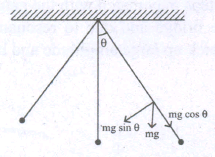
(ii) These are two forces acting on the bob the tension T along the vertical force due to gravity (= mg).
(iii) The force can be resolved into mg cos \(\theta\) along a circle of length L and centre at this support point.
(iv) Its radial acceleration (w2L) and also tangential acceleration. So net radial force = T - mg cos \(\theta\), while the tangential acceleration provided by mg sin \(\theta\). Since the radial force gives zero torque.
(v) So torque provided by the tangential component.
\(\tau\) = Lmg sin\(\theta\)
\(\tau\) = \(\alpha\)(by Newton's law of rotational motion)
I\(\tau\) =mg sin\(\theta\) L
\(\alpha =\frac { mgL }{ I } sin\theta \)
Where I is the moment of inertia, a \(\alpha\) angular acceleration,
(iv) The \(\theta\) is to small,
sin \(\theta\) = \(\theta\)
\(\alpha =-\frac { mgL }{ I } \theta \)
\(w=\sqrt { \frac { I }{ mgL } } \)
[for simple harmonic a (t) = -w2t \(\times\) \(\theta\) is small] and T =2\(\pi \sqrt { \frac { I }{ mgL } } \) \(\left[ \therefore w=\frac { 2\pi }{ T } \right] \)
4.
(i) The suction pump creates the pressure difference. Hence mercury rises in one limb of the U-tube.
(ii) When it is removed a net force acts on the liquid column due to the difference in level of mercury in the two limbs and therefore the liquid column executes S.H.M. Which can be explained as follows.
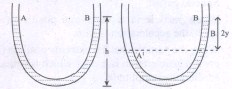
(iii) The mercury contained in a vertical U-tube upto the level A and B in its two limbs.
Suppose \(\rho\) = density of the mercury.
Where, L is total length of the mercury column in both the limbs.
A is internal cross-sectional area of U-tube
M is mass of mercury in U-tube = LAp
(iv) Suppose the mercury be depressed in left links to A' by the small distance y, then it rises by the same amount in the right limb to position B'.
∴ Difference in levels in the two limbs.
= A'B' =2y
(v) Volume of mercury contained in the column of length
2y = A\(\times\)2y
m = A\(\times\)2y\(\times\) \(\rho\)
(vi) When w = weight of liquid contained in the column of length 2y
Then w = mg = t\(\times\)2y\(\times\)\(\rho\) \(\times\)g
This weight produced the restoring force F which tends to bring back the mercury to its equilibrium position.
F = -2 Ay\(\rho\)p = -(2Apg)y
(vii) When a = acceleration produced in the liquid column, then
a =\(\frac { F }{ m } =\frac { (2A\rho g)y }{ LAP } \)
or a =\(\frac { -2\rho yg }{ L\rho } =\frac { 2\rho g }{ 2Lp } y\) ........(1)
[∴ L=2h]
Where, h is height of mercury in each limb. Now from equation (1), if is clear that a ay and Negative sigh shows that it acts opposite to y, so the motion of mercury in U-tube is simple harmonic in nature having time period (T) given by T =\(2\pi \sqrt { \frac { y }{ a } } =2\pi \sqrt { \frac { 2h\rho }{ 2\rho g } } \)
= \(2\pi \sqrt { \frac { h\rho }{ \rho g } } \)
T = \(2\pi \sqrt { \frac { h }{ g } } \) .
5.
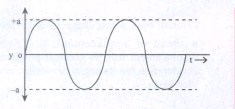
(1) Free oscillation:
(i) The oscillation of a particle with fundamental frequency under the influence of restoring force are defined as free oscillation.
(ii) The amplitude, frequency, and energy of oscillation remains constant.
(iii) Frequency of oscillation is called natural frequency because it depends upon the nature and structure of the body.
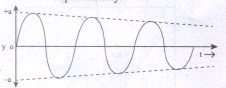
(2) Damped oscillation:
(i) The oscillation of a body whos amplitude goes on decreasing with time are defined as damped oscillation.
(ii) In these oscillation the amplitude oscillation decreases exponentially due to damping forces like frictional fore viscouse force, etc.
(iii) Due to decrease in amplitude the energy of the oscillator also goes on decreasing exponentially.
(iv) The force produces a resistance to the oscillation is called damping force.
If the velocity of oscillator is v then Damping force Fd=-bv, b = damping constant.
(v) Resultant force on a damped oscillator is given by
F = FR+Fd= -kx-kv ⇒ \(\frac { md^{ 2 }x }{ dt^{ 2 } } +b\frac { dx }{ dt } +kx\) = 0
(vi) Displacement of damped oscillator given by
x = \({ x }_{ m }e^{ \frac { bt }{ 2m } }sin(w't+\psi )\)
where w' = angular frequency of the damped oscillator = \(\sqrt { { W }_{ 0 }^{ 2 }-\left( \frac { b }{ 2m } \right) ^{ 2 } } \)
The amplitude decreases continuously with time according to x =\(x_{ m }e^{ \left( \frac { b }{ 2m } \right) t }\)
(vii) For a damped oscillator if the damping is small then the mechanical energy decreases exponentially with time as
E = \(\frac { 1 }{ 2 } kx_{ m }^{ 2 }e^{ \frac { ht }{ m } }\) .

11th Standard Syllabus & Materials
11th Standard
TN 11th Tamil பீடு பெற நில் - செய்யுள் - காவடிச்சிந்து Important Questions And Answers Study Material - QB365 Set A
NEW11th Standard
TN 11th Tamil பீடு பெற நில் - உரைநடை - மலை இடப்பெயர்கள் : ஓர் ஆய்வு Important Questions And Answers Study Material - QB365 Set A
NEW11th Standard
TN 11th Tamil மாமழை போற்றுதும் - துணைப்பாடம் - யானை டாக்டர் Important Questions And Answers Study Material - QB365 Set A
NEW11th Standard
TN 11th Tamil மாமழை போற்றுதும் - செய்யுள் - ஐங்குறுநூறு Important Questions And Answers Study Material - QB365 Set A



Tamilnadu Stateboard 11th Standard Subjects

Maths

Commerce

Economics

Biology

Business Maths and Statistics

Accountancy

Computer Science
Physics

Chemistry
Maths
Biology
Economics
Physics
Chemistry

History
Business Maths and Statistics

Computer Science
Accountancy

Computer Applications
History
Computer Technology
Commerce
Computer Applications
Computer Technology

Tamil

English

French
Tamilnadu Stateboard Standards



