
 100% FREE ACCESS
11th Standard Syllabus & Materials
11th Standard
TN 11th Tamil இயற்கை வேளாண்மை,சுற்றுச்சூழல் -செய்யுள் - மனோன்மணீயம் Important Questions And Answers Study Material - QB365 Set A
NEW11th Standard
TN 11th Tamil என்னுயிர் என்பேன் -துணைப்பாடம் - இசைத்தமிழர் இருவர் Important Questions And Answers Study Material - QB365 Set A
NEW11th Standard
TN 11th Tamil மொழி கலை -செய்யுள் - ஒவ்வொரு புல்லையும் Important Questions And Answers Study Material - QB365 Set A
NEW11th Standard
TN 11th Tamil பீடு பெற நில் - இலக்கணம் - பகுபத உறுப்புகள் Important Questions And Answers Study Material - QB365 Set A
NEW11th Standard
TN 11th Tamil பீடு பெற நில் - துணைப்பாடம் - வாடிவாசல் Important Questions And Answers Study Material - QB365 Set A
NEW11th Standard
TN 11th Tamil பீடு பெற நில் - செய்யுள் - குறுந்தொகை Important Questions And Answers Study Material - QB365 Set A

Published on: 24/06/2021
QB365 provides detailed and simple solution for every
Creative Questions in class 11 Physics Subject. It will helps to get more idea about question pattern in every Creative questions with solution.
Download Tamil Nadu 11th Standard Physics question papers, model tests, one-mark questions, important questions, and public exam papers in PDF format. Free study materials and answer keys for TN State Board students.
Questions + Answers key
Take MCQ Physics Test1.
What is latent heat? Give its units. With the help of a suitable graph, explain the terms latent heat of fusion and latent heat of vaporisation.
2.
Define
(i) Specific heat capacity
(ii) Heat capacity
(iii) Molar specific heat capacity at constant pressure and at constant volume and write their units.
3.
Write any two applications of Bernoulli's Theorem.
4.
Write the applications of surface tension?
5.
Write the Applications of elasticity.
1.
Latent heat:
The amount of heat transferred per unit mass during the change of phase of a substance without any change in its temperature is called latent heat of the substance for particular change.
Latent heat is denoted by L and having SI unit JKg-1.
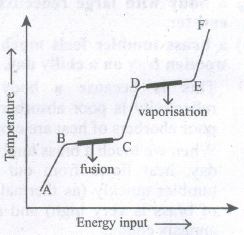
(i) Latent heat of fusion:
It is latent heat for solid-liquid state change.
It is denoted by Lf and is given by
Latent heat of fusion, \(L_{f}=\frac{Q}{m}\)
Its SI unit is J Kg-1
(ii) Latent heat of vaporisation:
It is in latent heat for liquid-gas state change. It is denoted by Lv and often refferred to as heat of fusion and heat of vaporisation. It is given by
Latent heat of vaporisation, \(L_{v}=\frac{Q}{m}\) and its SI unit is J Kg-1
Starting a point A, the substance is in its solid phase, heating it brings the temperature up to its melting point but the material is still a solid at point B. As it is heated further, the energy from the heat source goes into breaking the bonds holding the atoms is place.
This takes place form B to C. At point C all of the solid phase has been transformed into the liquid phase. Once again, as energy is added the energy goes into the kinetic energy of the particles raising the temperature, (C to D). At point D the temperature has reached its boiling point but it is still in the liquid phase. From points D to E thermal energy is overcoming the bonds and the particles have enough kinetic energy to escape from the liquid, the substance is entering the gas phase .. Beyond E, further heating under pressure can raise the temperature still further is how a pressure cooker works.
2.
(i) Specific heat capacity:
The amount of heat needed to raise the temperature of unit mass of a substance by unity is known as the specific heat capacity. It is defined by S and its SI unit is JKg-1K-1.
(ii) Heat capacity:
The heat capacity is defined as amount of heat needed to change the temperature by unity. i.e., 1°C, it is denoted by S and having SI unit JK-1 Heat capacity S = \(\frac{\Delta Q}{\Delta T}\)
(iii) Molar specific heat capacity at constant pressure and at constant volume
(a) Molar specific heat capacity at constant pressure:
It is molar heat capacity of a gas at constant pressure. i.e., the amount of heat required to raise the temperature of 1 mole of gas by unity at constant pressure and is denoted by Cp.
(b) Molar specific heat capacity at constant volume:
It is molar heat capacity of a gas at constant volume. i.e., the amount of heat required to raise the temperature of 1 mole of gas through 1°C at constant volume and denoted by Cv.
3.
(a) Blowing off roofs during wind storm
(i) In olden days, the roofs of the huts or houses were designed with a slope.
(ii) One important scientific reason is that as per the Bernoulli's principle, it will be safeguarded except roof during storm or cyclone.
(iii) During cyclonic condition, the roof is blown off without damaging the other parts of the house.
(iv) In accordance with the Bernoulli's principle, the high wind blowing over the roof creates a low-pressure P1.
(v) The pressure under the roof P2 is greater. Therefore, this pressure difference (P2 - P1) creates an up thrust and the roof is blown off.
(b) Aerofoil lift
(i) The wings of an airplane (aerofoil) are so designed that its upper surface is more curved than the lower surface and the front edge is broader than the real edge.
(ii) As the aircraft moves, the air moves faster above the aerofoil than at the bottom.
(iii) According to Bernoulli's Principle, the pressure of air below is greater than above, which creates an upthrust called the dynamic lift to the aircraft.
4.
(i) Mosquitoes lay their eggs on the surface of water. To reduce the surface tension of water, a small amount of oil is poured. This breaks the elastic film of water surface and eggs are killed by drowning.
(ii) Chemical engineers must finely adjust the surface tension. of the liquid, so it forms droplets of designed size and so it adheres to the surface without smearing. This is used in desktop printing, to paint automobiles and decorative items.
(iii) Specks of dirt get removed when detergents are added to hot water while washing clothes because surface tension is reduced.
(iv) A fabric can be made waterproof, by adding suitable waterproof material (wax) to the fabric. This increases the angle of contact.
5.
(i) Elastic behavior is one such property which especially decides the structural design of the columns and beams of a building.
(ii) As the structural engineering is concerned the amount of stress that the design could withstand is a primary safety factor.
(iii) A bridge has to be designed in such a way that it should have the capacity to withstand the load of the flowing traffic, the force of winds, and even its own weight.
(iv) The elastic behavior or in other words the bending of beams is a major concern over the stability of the buildings or bridges.
(v) To reduce the bending of a beam for a given load, one should use the material with a higher Young's modulus of elasticity (Y).
(vi) The Young's modulus of steel is greater than aluminum or copper.
(vii) Iron comes next to steel.
(viii) This is the reason why steel is mostly preferred in the design of heavy duty machines and iron rods in the construction of buildings.

11th Standard Syllabus & Materials
11th Standard
TN 11th Tamil பீடு பெற நில் - செய்யுள் - காவடிச்சிந்து Important Questions And Answers Study Material - QB365 Set A
NEW11th Standard
TN 11th Tamil பீடு பெற நில் - உரைநடை - மலை இடப்பெயர்கள் : ஓர் ஆய்வு Important Questions And Answers Study Material - QB365 Set A
NEW11th Standard
TN 11th Tamil மாமழை போற்றுதும் - துணைப்பாடம் - யானை டாக்டர் Important Questions And Answers Study Material - QB365 Set A
NEW11th Standard
TN 11th Tamil மாமழை போற்றுதும் - செய்யுள் - ஐங்குறுநூறு Important Questions And Answers Study Material - QB365 Set A



Tamilnadu Stateboard 11th Standard Subjects

Maths

Commerce

Economics

Biology

Business Maths and Statistics

Accountancy

Computer Science
Physics

Chemistry
Maths
Biology
Economics
Physics
Chemistry

History
Business Maths and Statistics

Computer Science
Accountancy

Computer Applications
History
Computer Technology
Commerce
Computer Applications
Computer Technology

Tamil

English

French
Tamilnadu Stateboard Standards



