
 100% FREE ACCESS
11th Standard Syllabus & Materials
11th Standard
TN 11th Tamil இயற்கை வேளாண்மை,சுற்றுச்சூழல் -செய்யுள் - மனோன்மணீயம் Important Questions And Answers Study Material - QB365 Set A
NEW11th Standard
TN 11th Tamil என்னுயிர் என்பேன் -துணைப்பாடம் - இசைத்தமிழர் இருவர் Important Questions And Answers Study Material - QB365 Set A
NEW11th Standard
TN 11th Tamil மொழி கலை -செய்யுள் - ஒவ்வொரு புல்லையும் Important Questions And Answers Study Material - QB365 Set A
NEW11th Standard
TN 11th Tamil பீடு பெற நில் - இலக்கணம் - பகுபத உறுப்புகள் Important Questions And Answers Study Material - QB365 Set A
NEW11th Standard
TN 11th Tamil பீடு பெற நில் - துணைப்பாடம் - வாடிவாசல் Important Questions And Answers Study Material - QB365 Set A
NEW11th Standard
TN 11th Tamil பீடு பெற நில் - செய்யுள் - குறுந்தொகை Important Questions And Answers Study Material - QB365 Set A

Published on: 07/06/2021
QB365 provides detailed and simple solution for every Book back Questions in class 11 Physics Subject. It will helps to get more idea about question pattern in every book back questions with solution.
Download Tamil Nadu 11th Standard Physics question papers, model tests, one-mark questions, important questions, and public exam papers in PDF format. Free study materials and answer keys for TN State Board students.
Questions + Answers key
Take MCQ Physics Test1.
Consider two organ pipes of same length in which one organ pipe is closed and another organ pipe is open. If the fundamental frequency of closed pipe is 250 Hz. Calculate the fundamental frequency of the open pipe.
2.
If a flute sounds a note with 450Hz, what are the frequencies of the second, third, and fourth harmonics of this pitch? If the clarinet sounds with a same note as 450Hz, then what are the frequencies of the lowest three harmonics produced?
3.
A baby cries on seeing a dog and the cry is detected at a distance of 3.0 m such that the intensity of sound at this distance is 10-2 W m-2. Calculate the intensity of the baby’s cry at a distance 6.0 m.
4.
Describe the formation of beats.
5.
Consider a tuning fork which is used to produce resonance in an air column. A resonance air column is a glass tube whose length can be adjusted by a variable piston. At room temperature, the two successive resonances observed are at 20 cm and 85 cm of the column length. If the frequency of the length is 256 Hz, compute the velocity of the sound in air at room temperature.
1.
For a closed organ Pipe
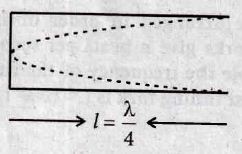
\(\ell=\frac{\lambda}{4}
\)
\(\therefore \lambda=4 \ell\)
For a open organ pipe \(L=\frac{\lambda}{2} \quad \therefore \lambda=2 L\)
Fundamental frequency of a closed pipe
\(f_{c} =250 \mathrm{~Hz}
\)
\(f_{0} =\frac{V}{\lambda}
\)
\(=\frac{V}{2 L}\)
Fundamental frequency of open organ pipe
\(f_{o} =2\left(\frac{V}{4 L}\right)
\)
\(=2 \times f_{c}
\)
\(=2 \times 250=500 \mathrm{~Hz}\)
∴ Frequency of open organ pipe =500 Hz.
2.
For a flute which is an open pipe, we have
Second harmonics f2 = 2 f1 = 900 Hz
Third harmonics f3 = 3 f1 = 1350 Hz
Fourth harmonics f4 = 4 f1 = 1800 Hz
For a clarinet which is a closed pipe, we have
Second harmonics f2 = 3f1 = 1350 Hz
Third harmonics f3 = 5 f1 = 2250 Hz
Fourth harmonics f4 = 7f1 = 3150 Hz
3.
I1 is the intensity of sound detected at a distance 3.0 m and it is given as 10-2 W m-2. Let I2 be the intensity of sound detected at a distance 6.0 m. Then,
r1 = 3.0 m, r2 = 6.0 m
and since, I\(\propto \frac { 1 }{ { r }^{ 2 } } \)
the power output does not depend on the observer and depends on the baby. Therefore
\(\frac { { I }_{ 1 } }{ { I }_{ 2 } } =\frac { { r }_{ 2 }^{ 2 } }{ { r }_{ 1 }^{ 2 } } \)
\({ I }_{ 2 }{ =I }_{ 1 }\frac { { r }_{ 2 }^{ 2 } }{ { r }_{ 1 }^{ 2 } } \)
I2 = 0.25\(\times\)10-2 W m-2
4.
When two or more waves. superimpose each other with slightly different frequencies, then a sound of periodically varying amplitude at a point is observed. This phenomenon is known as beats. The number of amplitude maxima per second is called beat frequency. If we have two sources, then their difference in frequency gives the beat frequency.
Number of beats per second
n = |f1 - f2| per second
5.
Given two successive length (resonance) to be L1 = 20 cm and L2 = 85 cm
The frequency is f = 256 Hz
v = f \(\lambda\) = 2f \(\Delta\)L = 2f (L2 − L1)
= 2 × 256 × (85 − 20) × 10 −2 m s−1
v = 332.8 cm−1

11th Standard Syllabus & Materials
11th Standard
TN 11th Tamil பீடு பெற நில் - செய்யுள் - காவடிச்சிந்து Important Questions And Answers Study Material - QB365 Set A
NEW11th Standard
TN 11th Tamil பீடு பெற நில் - உரைநடை - மலை இடப்பெயர்கள் : ஓர் ஆய்வு Important Questions And Answers Study Material - QB365 Set A
NEW11th Standard
TN 11th Tamil மாமழை போற்றுதும் - துணைப்பாடம் - யானை டாக்டர் Important Questions And Answers Study Material - QB365 Set A
NEW11th Standard
TN 11th Tamil மாமழை போற்றுதும் - செய்யுள் - ஐங்குறுநூறு Important Questions And Answers Study Material - QB365 Set A



Tamilnadu Stateboard 11th Standard Subjects

Maths

Commerce

Economics

Biology

Business Maths and Statistics

Accountancy

Computer Science
Physics

Chemistry
Maths
Biology
Economics
Physics
Chemistry

History
Business Maths and Statistics

Computer Science
Accountancy

Computer Applications
History
Computer Technology
Commerce
Computer Applications
Computer Technology

Tamil

English

French
Tamilnadu Stateboard Standards



