
 100% FREE ACCESS
11th Standard Syllabus & Materials
11th Standard
TN 11th Tamil இயற்கை வேளாண்மை,சுற்றுச்சூழல் -செய்யுள் - மனோன்மணீயம் Important Questions And Answers Study Material - QB365 Set A
NEW11th Standard
TN 11th Tamil என்னுயிர் என்பேன் -துணைப்பாடம் - இசைத்தமிழர் இருவர் Important Questions And Answers Study Material - QB365 Set A
NEW11th Standard
TN 11th Tamil மொழி கலை -செய்யுள் - ஒவ்வொரு புல்லையும் Important Questions And Answers Study Material - QB365 Set A
NEW11th Standard
TN 11th Tamil பீடு பெற நில் - இலக்கணம் - பகுபத உறுப்புகள் Important Questions And Answers Study Material - QB365 Set A
NEW11th Standard
TN 11th Tamil பீடு பெற நில் - துணைப்பாடம் - வாடிவாசல் Important Questions And Answers Study Material - QB365 Set A
NEW11th Standard
TN 11th Tamil பீடு பெற நில் - செய்யுள் - குறுந்தொகை Important Questions And Answers Study Material - QB365 Set A

Published on: 13/05/2022
QB365 provides detailed and simple solution for every Book back Questions in class 11 Physics Subject. It will helps to get more idea about question pattern in every book back questions with solution.
latest Book back QuestionsDownload Tamil Nadu 11th Standard Physics question papers, model tests, one-mark questions, important questions, and public exam papers in PDF format. Free study materials and answer keys for TN State Board students.
Questions + Answers key
Take MCQ Physics Test1.
Discuss the law of transverse vibrations in stretched strings.
2.
Explain how the interference of waves is formed.
3.
Write short notes on reflection of sound waves from plane and curved surfaces.
4.
Show that the velocity of a travelling wave produced in a string is v\(\sqrt { \frac { T }{ \mu } } \)
5.
Discuss how ripples are formed in still water.
1.
There are three laws of transverse vibrations of stretched strings which are given as follows:
(i) The law of length : For a given wire with tension T (which is fixed) and mass 'per unit' length Il (fixed) the frequency varies inversely with the vibrating length. Therefore
\(f∝{1\over l}⇒f={C\over l}\)
⇒ l x f = C, where C is a constant
(ii) The law of tension: For a given vibrating length I (fixed) and mass per unit length Il (fixed) the frequency varies directly with the square root of the tension T,
f∝√T
⇒ f = A√T, where A is a constant
(iii) The law of mass : For a given vibrating length I (fixed) and tension T (fixed) the frequency varies inversely with the square root of the mass per unit length μ
\(f∝{1\over\sqrt\mu}\)
\(⇒f={B\over \sqrt{\mu}}\) where B is a constant
2.
Consider two harmonic waves having identical frequencies, constant phase difference \(\varphi \) and same wave form (can be treated as coherent source), but having amplitudes A1 and A2 then
y1 = A1 sin(kx - \(\omega t\)) ............... (1)
Y2 = A2 sin (kx - \(\omega t+\varphi \)) ............ (2)
Suppose they move simultaneously in a particular. direction, then interference occurs (i.e., overlap of these two waves). Mathematically
Y = Y1 + Y2 ......... (3)
Therefore, substituting equation (1) and equation (2) in equation (3), we get
Y = A1 sin(kx - \(\omega t\)) + A2 sin(kx - \(\omega t\) + \(\varphi \))
Using trigonometric identity \(\sin (\alpha+ \beta)=(\sin \alpha \ \cos \beta+ \cos \alpha\ \sin\beta)\), we get
Y = A1 sin(kx - \(\omega t\)) + A2 [sin(kx - \(\omega t\)) cos\(\varphi \) + cos(kx - \(\omega t\)) sin\(\varphi \)]
y = sin(kx - \(\omega t\))(A1 + A2 cos\(\varphi \)) + A2 sim\(\varphi \) cos(kx - \(\omega t\)) ............ (4)
Let us re-define
A cos\(\theta\) = (A1 + A2 cos\(\varphi \)) ..............(5)
and A sin\(\theta\) = A2 sin\(\varphi \). ...............(6)
then equation (4) can be rewritten as
y = A sin(kx - \(\omega t\)) cos\(\theta\) + A cos(kx - \(\omega t\)) sin\(\theta\)
y = A (sin(kx - \(\omega t\)) cos\(\theta\) + sin\(\theta\) cos(kx - \(\omega t\)))
y = A sin(kx - \(\omega t\) + 0) ........... (7)
By squaring and adding equation (5) and equation (6), we get
A2 = A12 + A22+ A1 A2 cos\(\varphi \) .............(8)
Since, intensity is square of the
(I = A2), we have
I = I1 + I2 + 2\(\sqrt{I_1I_2}\cos \varphi \) ..........(9)
This means the resultant intensity at any point depends on the phase difference at that point.
(a) For constructive interference:
When crests of one wave overlap with crests of another wave, their amplitudes will add up and constructive interference is obtained. The resultant wave has a larger amplitude than the individual waves as shown in Figure (a)
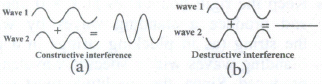
The constructive interference at a point occurs ifthere is maximum intensity at that point, which means that
cos\(\varphi \) = + 1 \(\Rightarrow\) \(\varphi \) = 0, 2\(\pi\), 4\(\pi\), ... = 2n\(\pi\),
where n = 0, 1, 2, ...
This is the phase difference in which two 'Yaves overlap to give constructive interference.
Therefore, for this resultant wave,
Imaximum = \((\sqrt{I_1}+\sqrt{I_2})^2=(A_1+A_2)^2\)
(b) For destructive Interference: When the trough of one wave overlaps with the crest of another wave, their amplitudes "cancel" each other and we get destructive interference is obtained. The resultant amplitude is nearly zero. The destructive interference occurs if there is minimum intensity at that point, which means \(\cos { \varphi } =-1\Rightarrow =\pi ,3\pi ,5\pi ...=(2n-1)\pi \) where n = 0,1,2, .... i.e. This is the phase difference in which two waves overlap to give destructive interference. Therefore,
Iminimum = \((\sqrt{I_1}+\sqrt{I_2})^2=(A_1+A_2)^2\)
Hence, the resultant amplitude
A = |A1 - A2|
3.
Sound reflects from a harder flat surface, is called as specular reflection.
Specular reflection is observed only when the wavelength of the source is smaller than dimensions of the reflecting surface, as well as smaller than surface irregularities.
When the sound waves hit the plane wall, they bounce off in a manner similar to that of light. Suppose a loudspeaker is kept at an angle with respect to a wall (plane surface), then the waves coming from the source (assumed to be a point source) can be treated as spherical wave fronts (say, compressions moving like a spherical wave front). Therefore, the reflected wave front on the plane surface is also spherical, such that its centre. of curvature (which lies on the other side of plane surface) can be treated as the image of the sound source (virtual or imaginary loud speaker) which can be assumed to be at a position behind the plane surface.
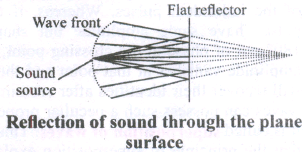
Reflection of so d ' through the curved surface.
The behaviour of sound is different when it is reflected from different surfaces-convex or concave or plane. The sound reflected from a convex surface is spread out and so it is easily attenuated and weakened. Whereas, if it is reflected from the concave surface it will converge at a point and this can be easily amplified. The parabolic reflector (curved reflector) which is used to focus the sound precisely to a point is used in designing the parabolic mics which are known as high directional microphones. We know that any surface (smooth or rough) can absorb sound.
4.
Consider an elemental segment in the string as shown in the Figure.
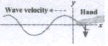
(a) Transverse waves in a stretched string.
(b) Elemental segment in a stretched string is zoomed and the pulse seen from an observer frame who moves with velocity v.
Let A and B be two points on the string at an instant of time. Let dl and dm be the length and mass of the elemental string, respectively. By definition, linear mass density, \(\mu\) is
\(\mu=\frac{dm}{dt}\) ......................(1)
dm = \(\mu\) dl ...................(2)
The elemental string AB has a curvature which looks like an arc of a circle with centre at 0, radius R and the arc subtending an angle \(\theta\) at the origin O as shown in Figure.
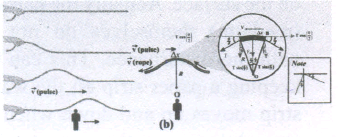
The angle e can be written in terms of arc length and radius as \(\theta=\frac{dl}{R}\). The centripetal acceleration supplied by the tension in the string is
acp = \(\frac{V^2}{R}\) ................ (3)
Then, centripetal force can be obtained when mass of the string (dm) IS included in equation (3)
Fep = \(\frac{(dm)v^2}{R}\) ................... (4)
The centripetal force experienced by elemental string can be calculated by substituting equation (2) in equation (4) we get
\(\frac{(dm)v^2}{R}=\frac{\mu v^2\ dl}{R}\) ......................(5)
The tension T acts along the tangent of the elemental segment of the string at A and B. Since the arc length is very small, variation in the tension force can be ignored. T is resolved into horizontal component \(T\cos(\frac{\theta}{2})\) and verical component \(T\ Sin(\frac{\theta}{2})\)
The horizontal components at A and B ar equal in magnitude but opposite in direction; therefore, they cancel each other. Since the elemental arc length AB is taken to be very small, the vertical components at A and B appears to acts vertical towards the centre of the arc and hence, they add up. The net radial force Fr is
Fr = \(2T\ Sin(\frac{\theta }{2})\) ................... (6)
Since the amplitude of the wave is very small when it is compared with the length of the string, the sine of small angle is approximated as \(\ Sin(\frac{A}{2})\approx \frac{A}{2}\). Hence equation (6) can be written as
Fr = \(2T\times \frac{\theta }{2}=T\theta\) ................... (7)
But \(\theta =\frac{di}{R},\) therefore substituting in equation (7), we get
Fr = \(T\frac{dl}{R}\) .....................(8)
Applying Newton's second law to the elemental string in the radial direction, under equilibrium, the radial component of the force is equal to the centripetal force. Hence equating equation (5) and equation (8), we have
\(T\frac{dl}{R}=\mu v^2\frac{di}{R}\)
\(V=\sqrt{\frac{T}{\mu}}\) measured in ms-1 .............(9)
5.
A stone is dropped in a trough of still water, we can see a disturbance produced at the place where the stone strikes the water surface is seen.
This disturbance spreads out (diverges out) in the form of concentric circles of ever increasing radii (ripples) and strike the boundary of the trough. This is because some of the kinetic energy of the stone is transmitted to the water molecules on the surface. Actually the particles of the water (medium) themselves do not move outward with the disturbance. This can be observed by keeping a paper strip on the water surface. The strip moves up and down when the disturbance (wave) passes on the water surface. This shows that the water molecules only undergo vibratory motion about their mean positions.

11th Standard Syllabus & Materials
11th Standard
TN 11th Tamil பீடு பெற நில் - செய்யுள் - காவடிச்சிந்து Important Questions And Answers Study Material - QB365 Set A
NEW11th Standard
TN 11th Tamil பீடு பெற நில் - உரைநடை - மலை இடப்பெயர்கள் : ஓர் ஆய்வு Important Questions And Answers Study Material - QB365 Set A
NEW11th Standard
TN 11th Tamil மாமழை போற்றுதும் - துணைப்பாடம் - யானை டாக்டர் Important Questions And Answers Study Material - QB365 Set A
NEW11th Standard
TN 11th Tamil மாமழை போற்றுதும் - செய்யுள் - ஐங்குறுநூறு Important Questions And Answers Study Material - QB365 Set A



Tamilnadu Stateboard 11th Standard Subjects

Maths

Commerce

Economics

Biology

Business Maths and Statistics

Accountancy

Computer Science
Physics

Chemistry
Maths
Biology
Economics
Physics
Chemistry

History
Business Maths and Statistics

Computer Science
Accountancy

Computer Applications
History
Computer Technology
Commerce
Computer Applications
Computer Technology

Tamil

English

French
Tamilnadu Stateboard Standards



