
 100% FREE ACCESS
11th Standard Syllabus & Materials
11th Standard
TN 11th Tamil இயற்கை வேளாண்மை,சுற்றுச்சூழல் -செய்யுள் - மனோன்மணீயம் Important Questions And Answers Study Material - QB365 Set A
NEW11th Standard
TN 11th Tamil என்னுயிர் என்பேன் -துணைப்பாடம் - இசைத்தமிழர் இருவர் Important Questions And Answers Study Material - QB365 Set A
NEW11th Standard
TN 11th Tamil மொழி கலை -செய்யுள் - ஒவ்வொரு புல்லையும் Important Questions And Answers Study Material - QB365 Set A
NEW11th Standard
TN 11th Tamil பீடு பெற நில் - இலக்கணம் - பகுபத உறுப்புகள் Important Questions And Answers Study Material - QB365 Set A
NEW11th Standard
TN 11th Tamil பீடு பெற நில் - துணைப்பாடம் - வாடிவாசல் Important Questions And Answers Study Material - QB365 Set A
NEW11th Standard
TN 11th Tamil பீடு பெற நில் - செய்யுள் - குறுந்தொகை Important Questions And Answers Study Material - QB365 Set A

Published on: 13/05/2022
QB365 provides detailed and simple solution for every Book back Questions in class 11 Physics Subject. It will helps to get more idea about question pattern in every book back questions with solution.
latest Book back QuestionsDownload Tamil Nadu 11th Standard Physics question papers, model tests, one-mark questions, important questions, and public exam papers in PDF format. Free study materials and answer keys for TN State Board students.
Questions + Answers key
Take MCQ Physics Test1.
Write short notes on intensity and loudness.
2.
Explain the concepts of fundamental frequency, harmonics and overtones in detail.
3.
What are stationary waves? Explain the formation of stationary waves and also write down the characteristics of stationary waves.
4.
Briefly explain the concept of superposition principle.
5.
1.
The loudness of sound is defined as the degree of sensation of sound produced in the ear or the perception of sound by the listener.
Loudness of sound depends on both intensity of sound wave and sensitivity of the ear.
Intensity of sound is the sound power fans miffed per unit area placed normal to the propagation of sound wave.
According to Weber-Fechner's law, "loudness (L) is proportional to the logarithm of the actual intensity (I) measured with an accurate non-human instrument". This means that
\(L \propto \ln I\)
\(\mathrm{L}=\mathrm{k} \ln \mathrm{I}\)
where k is a constant, which depends on the unit of measurement. The difference between two loudness, L1 and L0 measures the relative loudness
between two precisely measured intensities and is called as sound intensity level. Mathematically, sound intensity level is
\(\Delta L =\mathrm{L}_{1}-\mathrm{L}_{0}
\)
\(=\mathrm{k} \ln \mathrm{I}_{1}-\mathrm{I}_{1}-\mathrm{k} \ln \mathrm{I}_{0}=\mathrm{k} \ln \left[\frac{I_{1}}{I_{0}}\right]\)
If k = 1, then sound intensity level is measured in bel, in honour of Alexander Graham Bell. Therefore
\(\Delta L=\ln \left[\frac{I_{1}}{I_{0}}\right] \text { bel }\)
However, this is practically a bigger unit, so we use a convenient smaller unit, called decibel. Thus, decibel \(=\frac{1}{10}\) bel. Therefore, by multiplying and dividing by 10, we get
\(\Delta L=10\left[\ln \left[|\frac{I_{1}}{I_{0}} |\right] \frac{1}{10}\right. \text { bel }
\)
\(\Delta L=10 \ln \left[\frac{I_{1}}{I_{0}}\right] \text { decibel with } \mathrm{k}=10\)
For practical purposes, we use logarithm to base 10 instead of natural logarithm,
\(\Delta L=10 \log _{10}\left[\frac{I_{1}}{I_{0}}\right] \text { decibel }\) ....(1)
2.
Keep the rigid boundaries at x = 0 and x = L and produce a standing waves by wiggling the string (as in plucking strings in a guitar). Standing waves with a specific wavelength are produced. Since, the amplitude must vanish at the boundaries, therefore, the displacement at the boundary
y(x = 0, t) = 0 and y(x = L, t) = 0 ..... (1)
Since the nodes formed are at a distance \({\lambda_n\over 2}\)
apart, \(n\left[\lambda_n\over 2\right]=L\) we have where n is an integer, L is the length between the two boundaries and ⋋n is the specific wavelength that satisfy the specified boundary 'conditions. Hence
\(⋋_n=\left(2L\over n\right)\) ....(2)
For n = 1, the first mode of vibration has specific wavelength ⋋1, = 2L. Similarly for n = 2, the second mode of vibration has specific wavelength
\(⋋_2=\left(2L\over n\right)=L\)
For n = 3, the third mode of vibration has specific wavelength
\(⋋_3=\left(2L\over 3\right)\)
and so on.
The frequency of each mode of vibration (called natural frequency) can be calculated. We have,
\(f_n={v\over \lambda _n}=n\left(v\over 2L\right)\) ....(3)
The lowest natural frequency is called the fundamental frequency.
\(f_1={v\over \lambda_1}=\left(v\over 2L\right)\) .....(4)
The second natural frequency is called the first over tone
\(f_2=2\left(v\over 2L\right)={1\over L}\sqrt{T\over \mu}\)
The third natural frequency is called the second over tone
\(f_2=3\left(v\over 2L\right)=3\left({1\over L}\sqrt{T\over \mu}\right)\)
and so on.
Therefore, the nth natural frequency is equal to integral (or integer ) multiple of fundamental frequency, i.e.
fn = nf1 where n is an integer ..... (5)
If natural frequencies are written as integral multiple of fundamental frequencies, then the frequencies are called harmonics. Thus, the first harmonic is f1 =f1 (the fundamental frequency is called first harmonic), the second harmonic is f2= 2f1, the third harmonic is f3 = 3f1 etc.
3.
When the wave hits the rigid boundary it bounces back to the original medium and can interfere with the original waves. A pattern is formed, which are known as standing waves or stationary waves. Consider two harmonic progressive waves (formed.by strings) that have the same amplitude and same velocity but move in opposite directions. Then the displacement of the first wave (incident wave) is
Y1 =A sin(kx - \(\omega_t\)) ..... (1)
(waves move toward right)
and the displacement of the second wave (reflected wave) is
Y2 =A sin(kx + ωt) .....(2)
both will interfere with each other by the principle of superposition, the net displacement is
y = y1 + y2 .....(2)
Substituting equation (1) and equation (2) in equation (3), we get
Y = A sin(kx - ωt) + A sin(kx + ωt) ..... (4)
Using trigonometric identity, we rewrite equation (4) as
Y (x, t) = 2A cos(ωt) sin(kx) ..... (5)
This represents a stationary wave or standing wave, which means that this wave does not move either forward or backward, whereas progressive or travelling waves will move forward or backward. Further, the displacement of the particle in equation (5) can be written in more compact form,
y(x, t) = A' cos(ωz)
where, A' = 2Asin(kx), implying that the particular element of the string executes simple harmonic motion with amplitude equals to A'. The maximum of this amplitude occurs at positions for which
\(sin (kx) =1\Rightarrow kx={\pi\over 2},{3\pi\over2},{5\pi\over 2},...=m\pi\)
where m takes half integer or half integral values. The position of maximum amplitude is known as antinode
Characteristics of stationary waves
(1) Stationary waves are characterised by the confinement of a wave disturbance between two rigid boundaries. This means, the wave does not move forward or backward in a medium (does not advance), it remains steady at its place. Therefore, they are called "stationary waves or standing waves".
(2) Certain points in. the region in which the wave exists have maximum amplitude, called as anti-nodes and at certain points the amplitude is minimum or zero, called as nodes.
(3) The distance between two consecutive nodes (or) anti-nodes is \(\lambda\over2\)
(4) The distance between a node and its neighbouring anti-node is \(\lambda\over2\)
(5) The transfer of energy along the standing wave is zero
4.
When a jerk is given to a stretched string which is tied at one end, a wave pulse is produced and the pulse travels along the string. Suppose two persons holding the stretched string on either side give a jerk simultaneously, then these two wave pulses move towards each other, meet at some point and move away from each other with their original identity. Their behaviour is very different only at the crossing/meeting points; this behaviour depends on whether the two pulses have the same or different shape as shown in Figure.
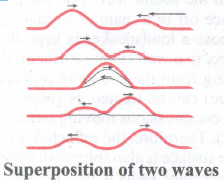
When the pulses have the same shape, at the crossing, the total displacement is the algebraic sum of their individual displacements and hence its net amplitude is higher than the amplitudes of the individual pulses. Whereas, if the two pulses have same amplitude but shapes are 1800 out of phase at the crossing point, the net amplitude vanishes at that point and the pulses will recover their identities after crossing. Only waves can possess such a peculiar property and It is called superposition of waves. This means that the principle of superposition explains the net behaviour of the waves when they overlap. Generalizing to any number of waves i.e, if two or more waves in a medium move simultaneously, when they overlap, their total displacement is the vector sum of the individual displacements.
To express mathematically, consider two functions which characterize the displacement of the waves, for example,
Y1 = A1 sin(kx - \(\omega t\))
and
Y2 = A2 cos(kx - \(\omega t\))
Since, both Y1 and Y2 satisfy the wave equation (solutions of wave equation) then their algebraic sum
Y = Y1 + Y2
also satisfies the wave equation. This means, the displacements are additive. Suppose we multiply Y1 and y2 with some constant then their amplitude is scaled by that constant Further, if C1 and C2 are used to multiply the displacernents y1 andY2 respectively, then, their net displacement Y is
Y = C1Y1 + C2Y2
This can be generalized to any number of waves. In the case of n such waves in more than one dimension the displacements are written using vector notation.
Here, the net displacement \(\vec y\) is
\(\vec { y } =\overset { n }{ \underset { i=1 }{ \Sigma } } { C }_{ i }\vec { { y }_{ i } } \)
The principle of superposition can explain the following:
(a) Space (or spatial) Interference (also known as Interference)
(b) Time (or Temporal) Interference (also known as Beats)
(c) Concept of stationary waves
Waves that obey principle of superposition are called linear waves (amplitude is much smaller than their wavelengths). In general, if the amplitude of the wave is not small then they are called non-linear waves.
5.

11th Standard Syllabus & Materials
11th Standard
TN 11th Tamil பீடு பெற நில் - செய்யுள் - காவடிச்சிந்து Important Questions And Answers Study Material - QB365 Set A
NEW11th Standard
TN 11th Tamil பீடு பெற நில் - உரைநடை - மலை இடப்பெயர்கள் : ஓர் ஆய்வு Important Questions And Answers Study Material - QB365 Set A
NEW11th Standard
TN 11th Tamil மாமழை போற்றுதும் - துணைப்பாடம் - யானை டாக்டர் Important Questions And Answers Study Material - QB365 Set A
NEW11th Standard
TN 11th Tamil மாமழை போற்றுதும் - செய்யுள் - ஐங்குறுநூறு Important Questions And Answers Study Material - QB365 Set A



Tamilnadu Stateboard 11th Standard Subjects

Maths

Commerce

Economics

Biology

Business Maths and Statistics

Accountancy

Computer Science
Physics

Chemistry
Maths
Biology
Economics
Physics
Chemistry

History
Business Maths and Statistics

Computer Science
Accountancy

Computer Applications
History
Computer Technology
Commerce
Computer Applications
Computer Technology

Tamil

English

French
Tamilnadu Stateboard Standards



