
 100% FREE ACCESS
11th Standard Syllabus & Materials
11th Standard
TN 11th Tamil இயற்கை வேளாண்மை,சுற்றுச்சூழல் -செய்யுள் - மனோன்மணீயம் Important Questions And Answers Study Material - QB365 Set A
NEW11th Standard
TN 11th Tamil என்னுயிர் என்பேன் -துணைப்பாடம் - இசைத்தமிழர் இருவர் Important Questions And Answers Study Material - QB365 Set A
NEW11th Standard
TN 11th Tamil மொழி கலை -செய்யுள் - ஒவ்வொரு புல்லையும் Important Questions And Answers Study Material - QB365 Set A
NEW11th Standard
TN 11th Tamil பீடு பெற நில் - இலக்கணம் - பகுபத உறுப்புகள் Important Questions And Answers Study Material - QB365 Set A
NEW11th Standard
TN 11th Tamil பீடு பெற நில் - துணைப்பாடம் - வாடிவாசல் Important Questions And Answers Study Material - QB365 Set A
NEW11th Standard
TN 11th Tamil பீடு பெற நில் - செய்யுள் - குறுந்தொகை Important Questions And Answers Study Material - QB365 Set A

Published on: 24/06/2021
QB365 provides detailed and simple solution for every
Creative Questions in class 11 Physics Subject. It will helps to get more idea about question pattern in every Creative questions with solution.
Download Tamil Nadu 11th Standard Physics question papers, model tests, one-mark questions, important questions, and public exam papers in PDF format. Free study materials and answer keys for TN State Board students.
Questions + Answers key
Take MCQ Physics Test1.
Derive the relation between Intensity and loudness
2.
Derive the Equation of a plane progressive wave.
3.
How are sound waves-classified?
4.
Write a not about Stethoscope.
5.
Write the application of reflection of sound though the be curved surface.
1.
According to Weber-Fechner's law, "loudness (L) is proportional to the logarithm of the actual intensity (1) measured with an accurate nonhuman instrument". This means that
L ∝ 1n I|
L = k 1n I
where k is a constant, which depends on the unit of measurement. The difference between two loudnesses, L1 and Lo measures the relative loudness between two precisely measured intensities and is called as sound intensity level. Mathematically, sound intensity level is
ΔL = L1-Lo = k In I1- k In I0 = k In \(\left[I_1\over I_0\right]\)
If k = 1, then sound intensity level is measured in bel, Therefore,
\(ΔL=In\)\(\left[I_1\over I_0\right]\)bel
However, this to express smaller unit, decibel. Thus, [decibel = \(1\over10\)bel] by multiplying and dividing by 10
\(ΔL=10\left(In\left[I_1\over I_0\right]\right){1\over 10}bel\)
\(ΔL=10In\left[I_1\over I_0\right]\)decibel with k = 10
For practical purposes,
\(ΔL=10log_{10}\left[I_1\over I_0\right]\)decibel.
2.
A jerk is given on a stretched string at time t = 0 s. Assume that the wave pulse created during this disturbance moves along positive x direction with constant speed v as shown in Figure (a).
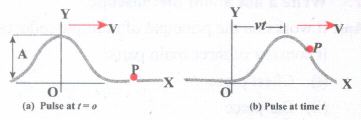
Represent the shape of the wave pulse, mathematically as y = y(x, 0) = j(x) at time t = 0s. Assume that the shape of the wave pulse remains the same during the propagation. After some time t, the pulse moving towards the right and any point on it can be represented by x' (read it as x prime) as shown in Figure (b). Then
y(x, t) =j(x') =j(x - vt)
Similarly, if the wave pulse moves towards left with constant speed v, then y =j(x + vt). Both waves y =j(x + v!) and y =j(x - vt) will satisfy the following one dimensional differential equation known as the wave equation
\({∂^2y\over ∂x^2}={1\over4 v^2}{∂^2y\over ∂t^2}\)
where the symbol p represent partial derivative (read \({∂y\over ∂x}\) as partial y by partial x). Not all the solutions satisfying this differential equation can represent waves, because any physical acceptable wave must take finite values for all values of x and t. But if the function represents a wave then it must satisfy the differential equation. Since, in one dimension (one independent variable), the partial derivative with respect to x is the same as total derivative in coordinate x, we write So it can be written as
\({d^2y\over dx^2}={1\over v^2}{d^2y\over dt^2}\)
3.
Sound waves can be classified in three groups according to their range of frequencies:
(1) Infrasonic waves : Sound waves having frequencies below 20. Hz are called infrasonic waves. These waves are produced during earthquakes. Human beings cannot hear these frequencies. Snakes can hear these frequencies.
(2) Audible waves : Sound waves having frequencies between 20 Hz to 20,000 Hz (20kHz) are called audible waves. Human beings can hear these frequencies.
(3) Ultrasonic waves : Sound waves having frequencies greater than 20 kHz are known as ultrasonic waves. Human beings cannot hear these frequencies. Bats can produce and hear these frequencies.
4.
It works on the principle of multiple reflections.
It consists of three main parts:
(i) Chest piece
(ii) Ear piece
(iii) Rubber tube
(i) Chest piece: It consists of a small disc-shaped resonator (diaphragm) which is very sensitive to sound and amplifies the sound it detects.
(ii) Ear piece: It is made up of metal tubes which are used to hear sounds detected by the chest piece.
(iii) Rubber tube: This tube connects both chest piece and ear piece. It is used to transmit the sound signal detected by the diaphragm, to the ear piece. The sound of heart beats (or lungs) or any sound produced by internal organs can be detected, and it reaches the ear piece through this tube by multiple reflections.
5.
The sound produced in a big hall or auditorium or theatre is absorbed by the walls, ceilings, floor, seats, etc. To avoid such losses, a curved sound board (concave board) is kept in front of the speaker, so that the board reflects the sound waves of the speaker towards the audience. This method will minimize the spreading of sound waves in all possible direction in that hall and also enhances the uniform distribution of sound throughout the hall. That is why a person sitting at any position in that hall can hear the sound without any disturbance.

11th Standard Syllabus & Materials
11th Standard
TN 11th Tamil பீடு பெற நில் - செய்யுள் - காவடிச்சிந்து Important Questions And Answers Study Material - QB365 Set A
NEW11th Standard
TN 11th Tamil பீடு பெற நில் - உரைநடை - மலை இடப்பெயர்கள் : ஓர் ஆய்வு Important Questions And Answers Study Material - QB365 Set A
NEW11th Standard
TN 11th Tamil மாமழை போற்றுதும் - துணைப்பாடம் - யானை டாக்டர் Important Questions And Answers Study Material - QB365 Set A
NEW11th Standard
TN 11th Tamil மாமழை போற்றுதும் - செய்யுள் - ஐங்குறுநூறு Important Questions And Answers Study Material - QB365 Set A



Tamilnadu Stateboard 11th Standard Subjects

Maths

Commerce

Economics

Biology

Business Maths and Statistics

Accountancy

Computer Science
Physics

Chemistry
Maths
Biology
Economics
Physics
Chemistry

History
Business Maths and Statistics

Computer Science
Accountancy

Computer Applications
History
Computer Technology
Commerce
Computer Applications
Computer Technology

Tamil

English

French
Tamilnadu Stateboard Standards



