
 100% FREE ACCESS
11th Standard Syllabus & Materials
11th Standard
TN 11th Tamil இயற்கை வேளாண்மை,சுற்றுச்சூழல் -செய்யுள் - மனோன்மணீயம் Important Questions And Answers Study Material - QB365 Set A
NEW11th Standard
TN 11th Tamil என்னுயிர் என்பேன் -துணைப்பாடம் - இசைத்தமிழர் இருவர் Important Questions And Answers Study Material - QB365 Set A
NEW11th Standard
TN 11th Tamil மொழி கலை -செய்யுள் - ஒவ்வொரு புல்லையும் Important Questions And Answers Study Material - QB365 Set A
NEW11th Standard
TN 11th Tamil பீடு பெற நில் - இலக்கணம் - பகுபத உறுப்புகள் Important Questions And Answers Study Material - QB365 Set A
NEW11th Standard
TN 11th Tamil பீடு பெற நில் - துணைப்பாடம் - வாடிவாசல் Important Questions And Answers Study Material - QB365 Set A
NEW11th Standard
TN 11th Tamil பீடு பெற நில் - செய்யுள் - குறுந்தொகை Important Questions And Answers Study Material - QB365 Set A

Published on: 13/05/2022
QB365 provides detailed and simple solution for every
Creative Questions in class 11 Physics Subject. It will helps to get more idea about question pattern in every Creative questions with solution.
Download Tamil Nadu 11th Standard Physics question papers, model tests, one-mark questions, important questions, and public exam papers in PDF format. Free study materials and answer keys for TN State Board students.
Questions + Answers key
Take MCQ Physics Test1.
Explain the Graphical representation of the wave.
2.
Write Characteristics of progressive waves.
3.
Write the applications of reflection of sound waves.
4.
Discuss the effect of density, humidity and wind.
5.
Write the expression for the velocity of longitudinal waves in an elastic medium.
1.
Let us graphically represent the two forms of the wave variation
(a) Space (or Spatial) variation graph
(b) Time (or Temporal) variation graph
(a) Space variation graph
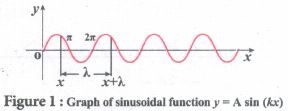
By keeping the time fixed, the change in displacement with respect to x is plotted. Consider a sinusoidal graph, y =A sinekx) as shown in the figure 1, where k is a constant. Since the wavelength A denotes the distance between any two points in the same state of motion, the displacement y is the same at both the ends
y = x and y =x + ⋋, i.e.,
y = A sin(kx) = A sin(k(x + ⋋))
= A sin(kx + k ⋋) ..... (1)
The sine function is a periodic function with period 2n. Hence,
y = A sin(kx + 2πn) =A sin(kx) ..... (2)
Comparing equation (1) and equation (2), we get
kx + k ⋋ = kx + 2π
This implies
\(k={2\pi\over \lambda}rad\ m^{-1}\)
where k is called wave number. This measures how many wavelengths are present in 2π radians.
The spatial periodicity of the wave is
\(\lambda={2\pi\over k}in \ m\)
Then,
At t = 0s y(x, 0) = y(x + ⋋ 0) and At any time t, y(x, t) =y(x + ⋋, t)
(b) Time variation graph: By keeping the position fixed, the change in displacement with respect to time is plotted. Let us consider a sinusoidal graph, y =A sinωt) as shown in the figure 2, where ω is angular frequency of the wave which measures how quickly wave oscillates in time or number of cycles per second
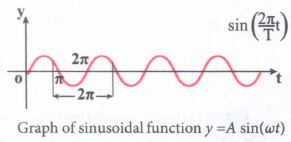
The temporal periodicity or time period is
\(T={2\pi\over ω}⇒ω={2\pi\over T}\)
The angular frequency is related to frequency f by the expression ω = 2 πf, where the frequency f is defined as the number of oscillations made by the medium particle per second. Since inverse of frequency is time period, we have,
\(T={1\over f}\)in seconds
This is the time taken by a medium particle to complete one oscillation. Hence, we can define the speed of a wave (wave speed, v) as the distance traversed by the wave per second
\(v={\lambda \over T}=\lambda f\)in ms-1
2.
(i) Particles in the medium vibrate about their mean positions with the same amplitude.
(ii) The phase of every particle ranges from 0 to 2π.
(iii) No particle remains at rest permanently. During wave propagation, particles come to the rest position only twice at the extreme points.
(iv) Transverse progressive waves are characterized by crests and troughs whereas longitudinal progressive waves are characterized by compressions and rarefactions.
(v) When the particles pass through the mean position they always move with the same maximum velocity.
(vi) The displacement, velocity and acceleration of particles separated from each other by n\(\lambda\) are the same, where n is an integer, and \(\lambda\) is the wavelength.
3.
(a) Stethoscope: It works on the, principle of multiple reflections.
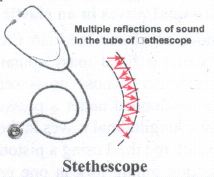
It consists of three main parts:
(i) Chest piece
(ii) Ear piece
(iii) Rubber tube
(i) Chest piece: It consists of a small disc-shaped resonator (diaphragm) which is very sensitive to sound and amplifies the sound it detects.
(ii) Ear piece: It is rnade up of metal tubes which are used to hear sounds detected by the chest piece.
(iii) Rubber tube: This tube connects both chest piece and ear piece. It is used to transmit the sound signal detected by the diaphragm, to the ear piece. The sound of heart beats (or lungs) or any sound produced by internal organs can be detected, and it reaches the ear piece through this tube by multiple reflections.
(b) Echo: An echo is a repetition of sound produced by the reflection of sound waves from a wall, mountain or other obstructing surfaces. The speed of sound in air at 20°C is 344 ms-1 If we shout at a wall which is, at 344 m away, then the sound will take 1 second to reach the wall. After reflection, the sound will take one more second to reach us. Therefore, we hear the echo after, two seconds.
Scientists have estimated that we can hear two sounds properly if the time gap or time \(\left(1\over 10\right)^{th}\) of a second (persistence of hearing) i.e., 0.1 s
Then,
\(velocity={Distance\ travelled\over time\ taken}=2d\)
2d= 344\(\times\)0.1 = 34.4 m
d= 17.2 m.
The minimum distance from a sound reflecting wall to hear an echo at 20°C is 17.2 meter.
(c) SONAR: Sound Navigation and Ranging. Sonar systems make use of reflections of sound waves in water to locate the position or motion of an object. Similarly, dolphins and bats use the sonar principle to find their way in the darkness
(d) Reverberation: In a closed room the sound is repeatedly reflected from the walls and it is even heard long after the sound source ceases to function. The residual sound remaining in an enclosure and the phenomenon of multiple reflections of sound is called reverberation. The duration for which the sound persists is called reverberation time. It should be noted that the reverberation time greatly affects the quality of sound heard in a hall. Therefore, halls are constructed with some optimum reverberation time.
4.
Effect of density: Consider two gases with different densities having same temperature and pressure. Then the speed of sound in the two gases are
\(v_1=\sqrt{\gamma_1 P\over \rho_1}\) ...(1)
and
\(v_1=\sqrt{\gamma_2 P\over \rho_2}\) ....(2)
Taking ratio of equation (1) and equation (2), we get
\({v_1\over v_2}={\sqrt{\gamma_1P\over \rho} \over \sqrt{\gamma_2 P\over \rho_2}}=\sqrt{\gamma_1\rho_2\over \gamma_2\rho_1}\)
For gases having same value of γ,
\({v_1\over v_2}=\sqrt{\rho_2\over \rho_1}\)
Thus the velocity of sound in a gas is inversely proportional to the square root of the density of the gas.
Effect of moisture (humidity): The density of moist air is 0.625 of that of dry air, which means the presence of moisture in air (increase in humidity) decreases its density. Therefore, speed of sound increases with rise in humidity.
From equation \(v=\sqrt{\gamma P\over \rho}=\sqrt{\gamma cT}\)
\(v=\sqrt{\gamma P\over \rho}\)
Let ρ1' v1 and ρ2, v2 be the density and speeds of sound in dry air and moist air, respectively. Then
\({v_1\over v_2}={\sqrt{\gamma_1P\over \rho} \over \sqrt{\gamma_2 P\over \rho_2}}=\sqrt{\rho_2\over\rho_1}\) if ⋎1 = ⋎2
Since P is the total atmospheric pressure, it can be shown that
\({\rho_2\over \rho_1}={P\over p_1+0.625p_2}\)
where p1 and p2 are the partial pressures of dry air and water vapour respectively, Then
1Effect of density: Consider two gases with different densities having same temperature and pressure. Then the speed of sound in the two gases are
\(v_1=\sqrt{\gamma_1 P\over \rho_1}\) ...(1)
and
\(v_1=\sqrt{\gamma_2 P\over \rho_2}\) ....(2)
Taking ratio of equation (1) and equation (2), we get
\({v_1\over v_2}={\sqrt{\gamma_1P\over \rho} \over \sqrt{\gamma_2 P\over \rho_2}}=\sqrt{\gamma_1\rho_2\over \gamma_2\rho_1}\)
For gases having same value of γ,
\({v_1\over v_2}=\sqrt{\rho_2\over \rho_1}\)
Thus the velocity of sound in a gas is inversely proportional to the square root of the density of the gas.
Effect of moisture (humidity ): The density of moist air is 0.625 of that of dry air, which means the presence of moisture in air (increase in humidity) decreases its density. Therefore, speed of sound increases with rise in humidity.
From equation \(v=\sqrt{\gamma P\over \rho}=\sqrt{\gamma cT}\)
\(v=\sqrt{\gamma P\over \rho}\)
Let ρ1' vI and ρ2, v2 be the density and speeds of sound in dry air and moist air, respectively. Then
\({v_1\over v_2}={\sqrt{\gamma_1P\over \rho} \over \sqrt{\gamma_2 P\over \rho_2}}=\sqrt{\rho_2\over\rho_1}\) if ⋎1 = ⋎2
Since P is the total atmospheric pressure, it can be shown that
\({\rho_2\over \rho_1}={P\over p_1+0.625p_2}\)
where p1I and p2 are the part !al pressures of dry air and water vapour respectively, Then
\(v_1=v_2\sqrt{P\over p_1+0.625p_2}\)
Effect of wind: The speed of sound is also affected by blowing of wind. In the direction along the wind blowing, the speed of sound increases whereas in the direction opposite to wind blowing, the speed of sound decreases.
5.
Consider an elastic medium (here we assume air) having a fixed mass contained in a long tube (cylinder) whose cross sectional area is A and maintained under a pressure P. One can. generate longitudinal waves in the fluid either by displacing the fluid using a piston or by keeping a vibrating tuning fork at one end of the tube. Assume that the direction of propagation of waves coincides with the axis of the cylinder. Let p be the density of the fluid which is initially at rest. At t = 0, the piston at left end of the tube is set in motion toward the right with a speed u. Let u be the velocity of the piston and v be the velocity of the elastic wave. In time interval Δt, the distance moved by the piston Δd = u Δt. Now, the distance moved by the elastic disturbance is Δx = vΔt. Let t1m be the mass of the air that has attained a velocity v in a time Δt. Therefore
Δm = ρ A Δx= ρ A (v Δt)
Then, the momentum imparted due to motion of piston with velocity u is
Δp = [p A (v Δt)]u
But the change in momentum is impulse.
The net impulse is
I= (ΔP A)Δt
or (ΔP A)Δt = [ρ A (v Δt)]u
ΔP = ρ v u ......(1)
When the sound wave passes through air, the small volume element (ΔV) of the air undergoes regular compressions and rarefactions. So, the change in pressure can also be written as
\(ΔP={B{ΔV\over V}}\)
where, V is original volume and B is known as bulk modulus of the elastic medium
But V = A Δ=A v Δt and
ΔV = A Δd =A u Δt
Therefore,
\(ΔP=B{AuΔt\over AvΔt}=B{u\over v}\)
Comparing equation (1) and equation (2), we get
\(ρvu=B\ or\ v^2={B\over \rho}\)
\(⇒v=\sqrt{B\over \rho}\) .....(3)
In general, the velocity of a longitudinal wave in elastic medium is \(v=\sqrt{E\over \rho}\) where E is the modulus of elasticity of the medium.
Cases: For a solid:
(i) one dimension rod (1D)
\(v=\sqrt{Y\over \rho}\) ....(4)
where Y is the Young's modulus of the material of the rod and p is the density of the rod. The 1D rod will have only Young's modulus.
(ii) Three dimension rod (3D) The speed of longitudinal wave in a solid is
\(v=\sqrt{K+{4\over3}\eta\over \rho}\)
where η is the modulus of rigidity, K is the bulk modulus and p is the density of the rod.
Cases: For liquids:
\(v=\sqrt{K\over \rho}\)
where, K is the bulk modulus and p is the density of the rod.

11th Standard Syllabus & Materials
11th Standard
TN 11th Tamil பீடு பெற நில் - செய்யுள் - காவடிச்சிந்து Important Questions And Answers Study Material - QB365 Set A
NEW11th Standard
TN 11th Tamil பீடு பெற நில் - உரைநடை - மலை இடப்பெயர்கள் : ஓர் ஆய்வு Important Questions And Answers Study Material - QB365 Set A
NEW11th Standard
TN 11th Tamil மாமழை போற்றுதும் - துணைப்பாடம் - யானை டாக்டர் Important Questions And Answers Study Material - QB365 Set A
NEW11th Standard
TN 11th Tamil மாமழை போற்றுதும் - செய்யுள் - ஐங்குறுநூறு Important Questions And Answers Study Material - QB365 Set A



Tamilnadu Stateboard 11th Standard Subjects

Maths

Commerce

Economics

Biology

Business Maths and Statistics

Accountancy

Computer Science
Physics

Chemistry
Maths
Biology
Economics
Physics
Chemistry

History
Business Maths and Statistics

Computer Science
Accountancy

Computer Applications
History
Computer Technology
Commerce
Computer Applications
Computer Technology

Tamil

English

French
Tamilnadu Stateboard Standards



