
 100% FREE ACCESS
11th Standard Syllabus & Materials
11th Standard
TN 11th Tamil இயற்கை வேளாண்மை,சுற்றுச்சூழல் -செய்யுள் - மனோன்மணீயம் Important Questions And Answers Study Material - QB365 Set A
NEW11th Standard
TN 11th Tamil என்னுயிர் என்பேன் -துணைப்பாடம் - இசைத்தமிழர் இருவர் Important Questions And Answers Study Material - QB365 Set A
NEW11th Standard
TN 11th Tamil மொழி கலை -செய்யுள் - ஒவ்வொரு புல்லையும் Important Questions And Answers Study Material - QB365 Set A
NEW11th Standard
TN 11th Tamil பீடு பெற நில் - இலக்கணம் - பகுபத உறுப்புகள் Important Questions And Answers Study Material - QB365 Set A
NEW11th Standard
TN 11th Tamil பீடு பெற நில் - துணைப்பாடம் - வாடிவாசல் Important Questions And Answers Study Material - QB365 Set A
NEW11th Standard
TN 11th Tamil பீடு பெற நில் - செய்யுள் - குறுந்தொகை Important Questions And Answers Study Material - QB365 Set A

Published on: 13/05/2022
QB365 provides detailed and simple solution for every Book back Questions in class 11 Physics Subject. It will helps to get more idea about question pattern in every book back questions with solution.
latest Book back QuestionsDownload Tamil Nadu 11th Standard Physics question papers, model tests, one-mark questions, important questions, and public exam papers in PDF format. Free study materials and answer keys for TN State Board students.
Questions + Answers key
Take MCQ Physics Test1.
What is inelastic collision? In which way it is different from elastic collision. Mention few examples in day to day life for inelastic collision.
2.
Arrive at an expression for elastic collision in one Dimension and discuss various cases.
3.
State and explain work energy principle. Mention any three examples for it.
4.
Explain with graphs the difference between work done by a constant force and by a variable force.
5.
Arrive at an expression for power and velocity. Give some examples for the same.
1.
If there is a loss of kinetic energy during a collision, then it is called as an inelastic collision
In the case of inelastic collision,
(i) Total kinetic energy is not conserved.
(ii) Some or all of the forces involved are non-conservative.
(iii) A part of the mechanical energy is transformed into heat, sound, light etc.
Examples for inelastic collision:
(i) Collision between ball and floor
(ii) Collision between two vehicles
Examples for perfectly inelastic collision:
(i) Mud thrown on a wall and sticking to it
(ii) a man jumping into a moving trolley
(iii) a bullet fired into a wooden block and remaining embedded in it.
2.
Consider two elastic bodies of masses m1 and m2 moving in a straight line (along positive x-direction) on a frictionless horizontal.
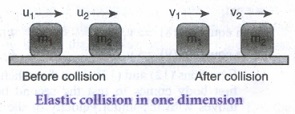
| Mass | Initial Velocity | Final Velocity |
| Mass m1 | u1 | v1 |
| Mass m2 | u2 | v2 |
(i) In order to have collision, we assume that the mass m1 moves faster than mass m2 i.e., u1 > u2 For elastic collision, the total linear momentum and kinetic energies of the two bodies before and after collision must remain the same.
| Momentum of mass m1 | Momentum of mass m2 | Total linear momentum | |
| Before collision | Pi1 = m1u1 | Pi2 = m2u2 | Pi = pi1 + Pi2 Pi = m1u1 + m2u2 |
| After collision | Pf1 = m1v1 | Pf2 = m2v2 | Pf = Pf1 + Pf2 Pf = m1v1 + m2v2 |
From the law of conservation of linear momentum,
Total momentum before collision (pi) = Total momentum after collision (Pf)
Further,
m1u1 + m2u2 = m1v1 + m2vs ...........(1)
or
m1 (u1 - v1) = m2 (v2 - u2) ...............(2)
| Kinetic energy of mass m1 | Kinetic energy of mass m2 | Total kinetic energy | |
| KEi = KEi1 + KEi2 | |||
| Before collision |
KEi1 = \(\frac { 1 }{ 2 } { m }_{ 1 }{ u }_{ 1 }^{ 2 }\) | KEi2 = \(\frac { 1 }{ 2 } { m }_{ 1 }{ u }_{ 2 }^{ 2 }\) | KEi = \(\frac { 1 }{ 2 } { m }_{ 1 }{ u }_{ 1 }^{ 2 }\) + \(\frac { 1 }{ 2 } { m }_{ 1 }{ u }_{ 2 }^{ 2 }\) KEi = KEi1 + KEi2 |
| After collision | KEf1 = \(\frac { 1 }{ 2 } { m }_{ 1 }{ v }_{ 1 }^{ 2 }\) | KEf2 = \(\frac { 1 }{ 2 } { m }_{ 1 }{ v }_{ 2 }^{ 2 }\) | KEf1 = \(\frac { 1 }{ 2 } { m }_{ 1 }{ v }_{ 1 }^{ 2 }\) + \(\frac { 1 }{ 2 } { m }_{ 1 }{ v }_{ 2 }^{ 2 }\) |
For elastic collision,
Total kinetic energy before collision KEi = Total kinetic energy after collision KEf.
\(\frac { 1 }{ 2 } { m }_{ 1 }{ u }_{ 1 }^{ 2 }+\frac { 1 }{ 2 } { m }_{ 2 }{ u }_{ 2 }^{ 2 }=\frac { 1 }{ 2 } { m }_{ 1 }{ v }_{ 1 }^{ 2 }+\frac { 1 }{ 2 } { m }_{ 2 }{ v }_{ 2 }^{ 2 }\) ................(3)
After simplifying and rearranging the terms,
\({ m }_{ 1 }\left( { u }_{ 1 }^{ 2 }-{ v }_{ 1 }^{ 2 } \right) ={ m }_{ 2 }\left( { v }_{ 2 }^{ 2 }-{ u }_{ 2 }^{ 2 } \right) \)
Using the formula a2 - b2 = (a + b) (a - b), we can rewrite the above equation as
m1 (u1 + v1) (u1 - v1) = m2 (v2 + u2) (v2 - u2) .................(4)
Dividing equation (4) by (2) gives,
\(\frac { { m }_{ 1 }\left( { u }_{ 1 }+{ v }_{ 1 } \right) \left( { u }_{ 1 }-{ v }_{ 1 } \right) }{ { m }_{ 1 }\left( { u }_{ 1 }-{ v }_{ 1 } \right) } =\frac { { m }_{ 2 }\left( { u }_{ 2 }+{ v }_{ 2 } \right) \left( { u }_{ 2 }-{ v }_{ 2 } \right) }{ { m }_{ 2 }\left( { u }_{ 2 }-{ v }_{ 2 } \right) } \)
u1 + v1 = v2 + u2
u1 - u2 = v2 - v1 .............(5)
Equation (5) can be rewritten as
(u1 - u2) = -(v1 - v2)
This means that for any elastic head on collision, the relative speed of the two elastic bodies after the collision has the same magnitude as before collision but in opposite direction. Further note that this result is independent of mass.
Rewriting the above equation for v1 and v2,
v1 = v2+ u2 - u1 .........(6)
or
v2 = u1 + v1 - u2 ............(7)
To find the final velocities v1 and v2:
Substituting equation (7) in equation (2) gives the velocity of m1 as
m1 (u1 - vI) = m2 (u1 + v1 - u2 - u2)
m1 (u1 - v1) = m2 (u1 + v1 - 2u2)
m1u1 - m1v1 = m2u1 + m2v1 - 2m2u2
m1u1 - m2u1 + 2m2u2 = m1v1 + m2v1
(m1 - m2)u1 + 2m2u2 = (m1 + m2) v1
or \({ v }_{ 1 }=\left( \frac { { m }_{ 1 }-{ m }_{ 2 } }{ { m }_{ 1 }+{ m }_{ 2 } } \right) { u }_{ 1 }+\left( \frac { { 2m }_{ 2 } }{ { m }_{ 1 }+{ m }_{ 2 } } \right) { u }_{ 2 }\) ............(8)
Similarly, by substituting (6) in equation (2) or substituting equation (8) in equation (7), we get the final velocity of m2 as
\({ v }_{ 2 }=\left( \frac { { 2m }_{ 1 } }{ { m }_{ 1 }+{ m }_{ 2 } } \right) { u }_{ 1 }+\left( \frac { { m }_{ 2 }-{ m }_{ 1 } }{ { m }_{ 1 }+{ m }_{ 2 } } \right) { u }_{ 2 }\) ............... (9)
Case 1:
When bodies has the same mass i.e., m1 = m2,
equation (8) \(\Rightarrow { v }_{ 1 }=\left( 0 \right) { u }_{ 1 }+\left( \frac { { 2m }_{ 2 } }{ { 2m }_{ 2 } } \right) { u }_{ 2 }\)
v1 = u2 ...........................(10)
equation (9) \(\Rightarrow { v }_{ 2 }=\left( \frac { { 2m }_{ 1 } }{ { 2m }_{ 1 } } \right) { u }_{ 1 }+\left( 0 \right) { u }_{ 2 }\)
v2 = u1 ..........................(11)
The equations (10) and (11) show that in one dimensional elastic collision when two bodies of equal mass collide after the collision their velocities are exchanged.
Case 2:
When bodies have the same mass i.e., m1 = m2 and second body (usually called target) is at rest (u2 = 0),
By substituting m1 = m2 = and u2 = 0 in equations (8) and (9).
we get,
from equation (8) => v1 = 0 (..................... 12)
from equation (9) => v2 = u1 ( .................. 13)
Equations (12) and (13) show that when the first body comes to rest the second body moves with the initial velocity of the first body.
Case 3:
The first body is very much lighter than the second body
\(\left( { m }_{ 1 }<{ m }_{ 2 },\frac { { m }_{ 1 } }{ { m }_{ 2 } } <1 \right) \) then the ratio \(\frac { { m }_{ 1 } }{ { m }_{ 2 } } = 0\) and also if the target is at rest (u2 = 0)
Dividing numerator and denominator of equation (8) by m2, we get
\({ v }_{ 1 }=\left( \frac { \frac { { m }_{ 1 } }{ { m }_{ 2 } } -1 }{ \frac { { m }_{ 1 } }{ { m }_{ 2 } } +1 } \right) { u }_{ 1 }+\left( \frac { 2 }{ \frac { { m }_{ 1 } }{ { m }_{ 2 } } +1 } \right) \left( 0 \right) \)
\({ v }_{ 1 }=\left( \frac { 0-1 }{ 0+1 } \right) { u }_{ 1 }\)
v1 = - u1 ............................(14)
Similarly,
Dividing numerator and denominator of equation (9) by m2, we get
\({ v }_{ 2 }=\left( \frac { 2\frac { { m }_{ 1 } }{ { m }_{ 2 } } }{ \frac { { m }_{ 1 } }{ { m }_{ 2 } } +1 } \right) { u }_{ 1 }+\left( \frac { 1-\frac { { m }_{ 1 } }{ { m }_{ 2 } } }{ \frac { { m }_{ 1 } }{ { m }_{ 2 } } +1 } \right) \left( 0 \right) \)
\({ v }_{ 2 }=\left( 0 \right) { u }_{ 1 }+\left( \frac { 1-\frac { { m }_{ 1 } }{ { m }_{ 2 } } }{ \frac { { m }_{ 1 } }{ { m }_{ 2 } } +1 } \right) \left( 0 \right) \)
v2 = 0 ..............................(15)
The equation (14) implies that the first body which is lighter returns back (rebounds) in the opposite direction with the same initial velocity as it has a negative sign. The equation (15) implies that the second body which is heavier in mass continues to remain at rest even after collision. For example, if a ball is thrown at a fixed wall, the ball will bounce back from the wall with the same velocity with which it was thrown but in opposite direction.
Case 4:
The second body is very much lighter than the first body
\(\left( { m }_{ 2 }<<{ m }_{ 1 },\frac { { m }_{ 2 } }{ { m }_{ 1 } } <<1 \right) \) then the ratio \(\frac { { m }_{ 2 } }{ { m }_{ 1 } } = 0\) and also if the target is at rest (u2 = 0).
Dividing numerator and denominator of equation 8 by m1 we get
\({ v }_{ 1 }=\left( \frac { 1-\frac { { m }_{ 2 } }{ { m }_{ 1 } } }{ 1+\frac { { m }_{ 2 } }{ { m }_{ 1 } } } \right) { u }_{ 1 }+\left( \frac { 2\frac { { m }_{ 2 } }{ { m }_{ 1 } } }{ 1+\frac { { m }_{ 2 } }{ { m }_{ 1 } } } \right) \left( 0 \right) \)
\({ v }_{ 1 }=\left( \frac { 0-1 }{ 0+1 } \right) { u }_{ 1 }+\left( \frac { 0 }{ 1+0 } \right) \left( 0 \right) \)
v1 = u1 .....................(16)
Dividing numerator and denominator of equation (14) by m1 we get
\({ v }_{ 2 }=\left( \frac { 2 }{ 1+\frac { { m }_{ 2 } }{ { m }_{ 1 } } } \right) { u }_{ 1 }+\left( \frac { \frac { { m }_{ 2 } }{ { m }_{ 1 } } -1 }{ 1+\frac { { m }_{ 2 } }{ { m }_{ 1 } } } \right) \left( 0 \right) \)
\({ v }_{ 2 }=\left( \frac { 2 }{ 1+0 } \right) { u }_{ 1 }\)
v2 = 2u1 ....................(17)
The equation (16) implies that the first body which is heavier continues to move with the same initial velocity. The equation (17) suggests that the second body which is lighter will move with twice the initial velocity of the first body. It means that the lighter body is thrown away from the point of collision.
3.
Work-Kinetic Energy Theorem
Work and energy are equivalents. This is true in the case of kinetic energy also. To prove this, let us consider a body of mass m at rest on a frictionless horizontal surface.
The work (W) done by the constant force (F) for a displacement (s) in the same direction is,
W = Fs
The constant force is given by the equation,
F = ma
The third equation of motion can be written as,
\(v^{2} =u^{2}+2 a s \)
\(a =\frac{v^{2}-u^{2}}{2 s}\)
Substituting for a in equation (2),
\(F=m\left(\frac{v^{2}-u^{2}}{2 s}\right)\)
Substituting equation (2), (1)
\(w=m\left(\frac{v^{2}}{2 s} s\right)-m\left(\frac{u^{2}}{2 s} s\right) \)
\(w=\frac{1}{2} m v^{2}-\frac{1}{2} m u^{2}\)
The expression for kinetic energy:
The term \(\left(\frac{1}{2} m v^{2}\right)\) in the above equation is the kinetic energy of the body of mass (m) moving with velocity(v).
\(K E=\frac{1}{2} m v^{2}\)
Kinetic energy of the body is always positive. From equations (4) and (5)
\(\Delta K E =\frac{1}{2} m v^{2}-\frac{1}{2} m u^{2} \)
\(\text {Thus, } W =\Delta K E\)
The expression on the right hand side (RHS) of equation (6) is the change in kinetic energy (\(\Delta\)KE) of the body.
This implies that the work done by the force on the body changes the kinetic energy of the body, This is called work-kinetic energy theorem.
The work-kinetic energy theorem implies the following.
1. If the work done by the force on the body is positive then its kinetic energy increases.
2. If the work done by the force on the body is negative then its kinetic energy decreases.
3. If there is no work done by the force on the body then there is no change in its kinetic energy, which means that the body has moved at constant speed provided its mass remains constant.
4.
Work done by a constant force:
(i) When a constant force F acts on a body, the small work done (dW) by the force in producing a small displacement dr is given by the relation,
dW= (F cos\(\theta\) ) dr
(ii) The total work done in producing a displacement from initial position ri to final position rf is,
\(W=\overset { { r }_{ f } }{ \underset { { r }_{ i } }{ \int } } dw\)
\(W=\overset { { r }_{ f } }{ \underset { { r }_{ i } }{ \int } } \left( F\cos { \theta } \right) dr=\left( F\cos { \theta } \right) \)\(\overset { { r }_{ f } }{ \underset { { r }_{ i } }{ \int } } dr=\left( F\cos { \theta } \right) \left( { r }_{ f }-{ r }_{ i } \right) \)
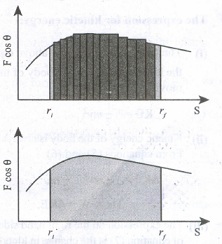
(iii) The graphical representation of the work done by a constant force is shown in Figure. The area under the graph shows the work done by the constant force.
.jpg)
Work done by a variable force:
(i) When the component of a variable force F acts on a body, the small work done (dW) by the force in producing a small displacement dr is given by the relation
dw = (F cos\(\theta\)) dr
[F cos\(\theta\) is the component of the variable force F]
where, F and \(\theta\) are variables. The total work done for a displacement from initial position ri to final position rf is given by the relation,
\(W=\overset { { r }_{ f } }{ \underset { { r }_{ i } }{ \int } } dw=\overset { { r }_{ f } }{ \underset { { r }_{ i } }{ \int } } F\cos { \theta } dr\)
(ii) A graphical representation of the work done by a variable force is shown in Figure. The area under the graph is the work done by the variable force.
5.
Relation between power and velocity
The work done by a force \(\overrightarrow{\mathbf{F}}\) for a displacement \(d \vec{r}\) is
\(W=\int \overrightarrow{\mathrm{F}} \cdot d \vec{r}\) ......(1)
Left hand side of the equation (1) can be written as
\(W=\int d W=\int \frac{d W}{d t} d t\)
(multiplied and divided by dt) (2)
Since, velocity is \(\vec{v}=\frac{d \vec{r}}{d t} ; \overrightarrow{d r}=\vec{v} d t.\) Right hand side of the equation (1) can be written as
\(\int \overrightarrow{\mathrm{F}} \cdot d \vec{r}=\int\left(\overrightarrow{\mathrm{F}}, \frac{d \vec{r}}{d t}\right) d t=\int(\overrightarrow{\mathrm{F}} \cdot \vec{v}) d t\left[v=\frac{d \vec{r}}{d t}\right] \ldots \ldots\) (3)
Substituting equation (2) and equation (3) in equation (1), we get
\(\int \frac{d W}{d t} d t=\int(\overrightarrow{\mathrm{F}} \cdot \vec{v}) d t\)
Or
\(\int\left(\frac{d W}{d t}-\overrightarrow{\mathrm{F}} \cdot \vec{v}\right) d t=0\)
This relation is true for any arbitrary value of dt. This implies that the term within the bracket must be equal to zero, i.e.,
\(\frac{d W}{d t}-\overrightarrow{\mathrm{F}} \cdot \vec{v} =0 \)
\(\frac{d W}{d t} =\overrightarrow{\mathbf{F}} \vec{v}\)
Examples: Motors, Engines and Automobiles
A vehicle of mass 1250 kg is driven with an acceleration 0.2 ms-2 along a straight level road against an external resistive force 500 N. Calculate the power delivered by the vehicle's engine if the velocity of the vehicle is 30 ms-1.
Solution
The vehicle's engine has to do work against resistive force and make vehicle to move with an acceleration. Therefore, power delivered by the vehicle engine is
\(P =(\text { resistive force }+\text { mass } \times \text { acceleration }) \text { (velocity) } \)
\(P =\overrightarrow{\mathbf{F}}_{-\mathrm{ma}} \vec{v}=\left(F_{\text {reistie }}+F\right) \vec{v} \)
\(P =\overrightarrow{\mathbf{F}}_{\text {tot }} \vec{v}=\left(F_{\text {reithie }}+m a\right) \vec{v} \)
\(=500 \mathrm{~N}+\left((1250 \mathrm{~kg}) \times\left(0.2 \mathrm{~ms}^{-2}\right)\right)\left(30 \mathrm{~ms}^{-1}\right)=22.5 \mathrm{kw}\)

11th Standard Syllabus & Materials
11th Standard
TN 11th Tamil பீடு பெற நில் - செய்யுள் - காவடிச்சிந்து Important Questions And Answers Study Material - QB365 Set A
NEW11th Standard
TN 11th Tamil பீடு பெற நில் - உரைநடை - மலை இடப்பெயர்கள் : ஓர் ஆய்வு Important Questions And Answers Study Material - QB365 Set A
NEW11th Standard
TN 11th Tamil மாமழை போற்றுதும் - துணைப்பாடம் - யானை டாக்டர் Important Questions And Answers Study Material - QB365 Set A
NEW11th Standard
TN 11th Tamil மாமழை போற்றுதும் - செய்யுள் - ஐங்குறுநூறு Important Questions And Answers Study Material - QB365 Set A



Tamilnadu Stateboard 11th Standard Subjects

Maths

Commerce

Economics

Biology

Business Maths and Statistics

Accountancy

Computer Science
Physics

Chemistry
Maths
Biology
Economics
Physics
Chemistry

History
Business Maths and Statistics

Computer Science
Accountancy

Computer Applications
History
Computer Technology
Commerce
Computer Applications
Computer Technology

Tamil

English

French
Tamilnadu Stateboard Standards



