
 100% FREE ACCESS
11th Standard Syllabus & Materials
11th Standard
TN 11th Tamil இயற்கை வேளாண்மை,சுற்றுச்சூழல் -செய்யுள் - மனோன்மணீயம் Important Questions And Answers Study Material - QB365 Set A
NEW11th Standard
TN 11th Tamil என்னுயிர் என்பேன் -துணைப்பாடம் - இசைத்தமிழர் இருவர் Important Questions And Answers Study Material - QB365 Set A
NEW11th Standard
TN 11th Tamil மொழி கலை -செய்யுள் - ஒவ்வொரு புல்லையும் Important Questions And Answers Study Material - QB365 Set A
NEW11th Standard
TN 11th Tamil பீடு பெற நில் - இலக்கணம் - பகுபத உறுப்புகள் Important Questions And Answers Study Material - QB365 Set A
NEW11th Standard
TN 11th Tamil பீடு பெற நில் - துணைப்பாடம் - வாடிவாசல் Important Questions And Answers Study Material - QB365 Set A
NEW11th Standard
TN 11th Tamil பீடு பெற நில் - செய்யுள் - குறுந்தொகை Important Questions And Answers Study Material - QB365 Set A

Published on: 29/11/2018
Practicing with good questions leads you to score high. Preparing for board exams is quite difficult. Grab this model question paper for 11th Economics and practice to get the high score in exams. In this question paper, all the questions are analyzed and added by our panel of experienced teachers.
Not only with book back questions, but also included creative questions as well. Practice with different important model question papers and enhance the conceptual knowledge about the different strategies on questions types which can be framed during the examination.
Here you can get all the important model question papers for plus one economics. By practicing with this important model question paper student can gain more knowledge and confidence to crack the exams. The question paper is designed based on the half-yearly syllabus.
Download Tamil Nadu 11th Standard Economics question papers, model tests, one-mark questions, important questions, and public exam papers in PDF format. Free study materials and answer keys for TN State Board students.
Questions + Answers key
Take MCQ Economics Test
1.
Higher the risks, the greater are the ________.
Loss
Subsidy
profit
None of these
2.
The foundation for various other economic law is ____
Law of diminishing marginal utility
Law of equi-marginal utility
Consumer surplus
None of these
3.
Gossen's first law is known as
Law of Equi-Marginal Utility
Law of Diminishing Marginal Utility
Law of Demand
Law of Diminishing returns
4.
Production means overall increase in the creation of _____________
Exchange
Distribution
Utility
Demand
5.
Capital goods also called as_____good
Consumer
Producer's
Free goods
None of these
6.
A shopkeeper sold 20 bags with the price of Rs. 100 each. The total revenue of the seller is Rs.
200
20
2000
1500
7.
Annual plans formed in the year _________ .
1989 - 1991
1990 - 1992
2000 - 2001
1981 - 1983
8.
What is the other name for concealed unemployment?
Open
Disguised
Seasonal
Rural
9.
10.
The power for governance of India was transferred from the East India Company (EIC) to the British crown in
1758
1858
1958
1658
11.
Which Union Territory has the highest sex ratio?
Chandigarh
Pondicherry
Lakshadweep
Andaman Nicobar
12.
The Raja Chelliah Committee on Trade Policy Reforms suggested the peak rate on import duties at
25%
50%
60%
100%
13.
Which of the following is a market structure where the Price is expected to be lower?
Perfect competition
Monopoly
Duopoly
Oligopoly
14.
The main source of irrigation in Tamil Nadu is
river
tank
well
canals
15.
Expansion of FDI____
Foreign Private Investment
Foreign Portfolio
Foreign Direct Investment
Forex Private Investment
16.
Which of the following is a microeconomics statement?
The real domestic output increased by 2.5 percent last year
Unemployment was 9.8 percent of the labour force last year
The price of wheat determines its demand
The general price level increased by 4 percent last year
17.
Money cost is also known as _____ cost.
explicit
implicit
social
real
18.
Formula for calculating AP is
\(\frac { \Delta TP }{ N } \)
\(\frac { \Delta TP }{ \Delta N } \)
\(\frac { TP }{ MP } \)
\(\frac { TP }{ N } \)
19.
The position of Indian Economy among the other strongest economies in the world is ______
Fourth
Seventh
Fifth
Tenth
20.
Rent is the reward for the use of
Capital
Labour
Land
Organization
21.
What was called as PURA by former President Abdul Kalam?
22.
Write the formula of consumer's surplus?
23.
What is price discrimination?
24.
What are the objectives of Tenth five year plan?
25.
26.
Mention any four food crops which are favourable to Tamil Nadu.
27.
State the reasons for implementing LPG.
28.
Distinguish goods from services.
29.
Distinguish between real and money wages.
30.
Give the definition for 'Real cost'.
31.
Explain the Planning Commission's National Human Development Reports 2011 and 2016.
32.
How are the energy sources classified? Explain.
33.
Explain briefly characteristics of Demand?
34.
Explain 'Monopsony'.
35.
Write any three objectives of Industrial Policy 1991.
36.
List out the objectives of MUDRA Bank
37.
Explain GSDP in Tamil Nadu.
38.
Write a short note on Marginal Revenue.
39.
Write the V.K.R.V. Rao's contribution on macroeconomics.
40.
What are the assumptions of the Marginal Productivity Theory of Distribution?
41.
Explain the meaning of Fixed and Variable factors and costs.
42.
Changes in Tastes and fashions the demand for some goods and services is very susceptible to change in tastes and fashions?
43.
Explain the law of Equi-marginal utility
44.
45.
46.
47.
48.
49.
Describe the salient features of EXIM policy (2015 - 2020)
50.
51.
52.
If total cost = 10+ Q3, find out AC, AVC, TFC, AFC when Q = 5.
53.
Write the importance of mineral resources in India.
1.
(c)
profit
2.
(a)
Law of diminishing marginal utility
3.
(b)
Law of Diminishing Marginal Utility
4.
(c)
Utility
5.
(a)
Consumer
6.
(c)
2000
7.
(b)
1990 - 1992
8.
(b)
Disguised
9.
(b)
10.
(b)
1858
11.
(b)
Pondicherry
12.
(b)
50%
13.
(a)
Perfect competition
14.
(c)
well
15.
(c)
Foreign Direct Investment
16.
(c)
The price of wheat determines its demand
17.
(a)
explicit
18.
(d)
\(\frac { TP }{ N } \)
19.
(b)
Seventh
20.
(c)
Land
21.
(i) Rural development should minimise, the gap between rural and urban areas in terms of the provision of infrastructural facilities.
(ii) It was called as PURA by former President Abdul Kalam.
22.
(i) Consumer's surplus = potential price - actual price (or)
(ii) Consumer's surplus = what a person is willing to pay - what he actually pays (or)
(iii) Consumer's surplus = TU - (P x Q)
23.
(i) A discriminating monopoly is a single entry.
(ii) It charges different prices for different consumers.
24.
(i) The plan aimed to double the per capita income of India in the next 10 years.
(ii) It aimed to reduce the poverty ratio to 15 % by 2012.
(iii) Its growth target was 8.0 % but it
achieved only 7.2%.
25.
26.
1. Rice
2. Kambu
3. Corn
4. Groundnut
5. Millets
6. Pulses
7. Maize
27.
(i) Liberalization was needed because the various licensing policies were preventing economic growth.
(ii) Since the private sector was not given enough opportunities to earn more money privatization was done.
(iii) Globalization was needed because today a developed country
can grow without the help of the underdeveloped countries.
28.
(i) Goods are tangible, (eg) car but services are intangible (eg) goodwill.
(ii) Goods can be stored but services cannot be stored.
29.
(i) Nominal or money wages are the wages paid in terms of money.
(ii) Real wages are the wages paid in terms of goods & services.
30.
It is the payment made for the efforts, pain and sacrifices of all factor owners in production.
31.
(i) According to Planning Commission's National Human Development Report 2011, HDI has improved significantly between 1980 and 2011. That is, The HDI went up from 0.302 in 1981 to 0.472 score in 2011.
(ii) As per latest Human Development Report (2016) by the United Nations Development Programme (UNDP), India has been ranked 131st out of 188 countries.
(iii) Out of 188 countries, India lies in Medium Human Development bracket.
(iv) The other nations such as Bangladesh, Bhutan, Pakistan, Kenya, Myanmar and Nepal attained the medium human development.
(v) The HDR 2016 stated that regional disparities in education, health and living standards within India has caused India's downfall to 27 % on HDI score.
(vi) India's HDI rank value in 2015 stood at 0.624, which had increased from 0.580 in 2010. India's rank in 2014 was 131.
32.
Energy Sources:
Electrical energy is one of the necessary components of our life. Nowadays, without electricity, we cannot survive in this world of technology. The energy sources are classified under two heads based on the availability of the raw materials used, while generating energy.
(a) Non-renewable energy sources and
(b) Renewable energy sources
(a) Non-renewable energy sources: As the name suggests, the sources of energy which cannot be renewed or re-used are called non-renewable energy sources. Basically these are the energy sources which will get exhausted over a period of time. Some of the examples of this kind of resources are coal, oil, gas etc.
(b) Renewable energy sources: These are the kind of energy source which can be renewed or reused again and again. These kinds of materials do not exhaust or literally speaking these are available in abundant or infinite quantity. Example for this kind include
(i) Solar energy
(ii) Wind energy
(iii) Tidal energy
(iv) Geothermal energy
(v) Biomass energy
Sometimes renewable sources are also called non-conventional sources of energy since; these kinds of materials of these ways of energy production were not used earlier or conventionally.
33.
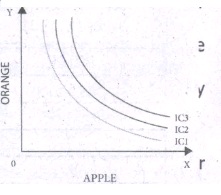
i) Price: Demand is always related to price.
ii) Time: Demand always means demand per unit of time, per day per work per month or per year.
34.
(i) It is a market structure in which there is only one buyer of a good or service.
(ii) If there is only one customer for a certain good that customer has 'Monopsony' power in the market for that good.
(iii) Monopsony is analogous to monopoly. But monopoly has market power on the demand side rather than the supply side.
35.
(i) The policy aimed at correcting the weaknesses and rigidities in the various sectors of the economy - industry, trade, fiscal and agriculture.
(ii) To liberate the industry from licensing system.
(iii) To reduce the role of public sector.
(iv) To encourage foreign participation in India's industrial development.
36.
(i) To regulate the lender and the borrower of microfinance and bring stability to the microfinance system.
(ii) To extend finance and credit support to microfinance institutions and agencies that lend money to small businesses, retailers, self help groups and individuals.
(iii) To register all MFIs and introduce a system of performance rating and accreditation for the first time.
(iv) Offer a credit guarantee scheme for providing guarantees to loans offered to micro businesses.
(v) Introduce appropriate technologies to assist in lending, borrowing and monitoring of distributed capital.
37.
(i) Gross State Domestic Product refers to the total money value of all the goods & services produced annually in the state.
(ii) Tamil Nadu is the 2nd largest economy with a GSDP of $207.8 billion in 2016-17.
(iii) This is equal to the GDP of Kuwait (on nominal terms) and of UAE (PPP terms).
(iv) This is due to population effect.
(v) If per capita GSDP is considered for comparison Tamil Nadu may go below.
38.
Marginal revenue is the addition to the total revenue by the sale of an additional unit of a commodity. It is got by dividing change in TR by the change in quantity sold.
\(M R=\frac{\Delta T R}{\Delta Q}\), where MR = Marginal revenue.
\(M R=T R_{n}-T R_{n-1} \quad \Delta T R=\text { change in total revenue. } \)
\(M R=T R_{n+1}-T R_{n} \quad \Delta Q=\text { change in total quantity. } \)
\(T R_{n}=\text { total revenue of } n^{\text {th }} \text { item } \)
\(T R_{n-1}=\text { total revenue of } n-1^{\text {th }} item\)
\(T R_{n+1}=\text { total revenue of } n+1^{\text {th }}item\)
39.
Rao's examination of the "interrelation between investment, income and multiplier in an underdeveloped economy" (1952) was his major contribution to macroeconomic theory.
40.
Marginal Productivity Theory of Distribution: Assumptions:
This theory is based on the following assumptions:
(i) All the factors of production are homogenous.
(ii) Factors of production can be substituted for each other.
(iii) There is perfect competition both in the factor market and product market.
(iv) There is perfect mobility of factors of production.
(v) There is full employment of factors.
(vi) This theory is applicable only in the long-run.
(vii) The entrepreneurs aim at profit maximization.
(viii) There is no government intervention in fixing the price of a factor.
(ix) There is no technological change.
41.
Fixed cost and variable cost: Fixed cost and variable cost are helpful in understanding the behaviour of costs over different levels of output.
Meaning of Fixed and Variable factors and costs:
Fixed and variable factors are with reference to short run production function. Short run is a period of time over which certain factors of production cannot be changed, and such factors are called fixed factors. The costs incurred on fixed factors are called fixed costs. The factors whose quantity can be changed in the short run are variable factors, and the costs incurred on variable factors are called variable costs
Fixed costs are those which are independent of output, that is, they do not change with changes in output. These costs are a 'fixed' amount, which must be incurred by a firm in the short run whether the output is small or large. E.g. contractual rent, interest on capital invested, salaries to the permanent staff, insurance premia and certain taxes. Variable costs are those costs, which are incurred on the employment of variable factors of production whose amount can be altered in the short run. Thus the total variable costs change with the level of output. It rises when output expands and falls when output contracts. When output is nil, variable cost becomes zero. These costs include payments such as wages of labour employed, prices of raw materials, fuel and power used arid the transport costs.
42.
1. Changes in Tastes and Fashions
The demand for some goods and services is very susceptible to changes in tastes and fashions.
2. Changes in Weather: An unusually
dry summer results in a increase in the demand for cool drinks.
3. Taxation and Subsidy
If fresh taxes are levied or the existing rates of taxation on commodities are increased their prices go up. The subsidies will bring down the prices. Therefore taxes reduce demand and subsidies raise demand.
4. Changes in Expectations
Expectations also bring about a change in demand. Expectation of rise in price in future. results in increase in demand.
5. Changes in Savings
Savings and demand are inversely related.
6. State of Trade Activity:
During the periods of boom and prosperity, the demand for all commodities tends to increase. On the contrary, during times of depression there is a general slackening of demand.
7. Advertisement
In advanced capitalistic countries advertising is a powerful instrument increasing the demand in the market.
8. Changes in Income
An increase in family income may increase the demand for durables like video recorders and refrigerators. Equal distribution of income enables poor to get more income. As a result consumption level increases.
9. Change in Population
The demand for goods depends on the size of population. An increase in population tends to increase the demand for goods and a decrease in population.
43.
Introduction:
(i) The law of diminishing marginal utility was extended and is called Law of Equi-marginal utility
(ii) Law of substitution or Law of consumer's Equilibrium or Gossen's II law or law of maximum satisfaction.
Definition:
Marshall, "If a person has a thing which he can put to several uses, he will distribute it among these uses in such a way that it has the same marginal utility in all. For, if it had a greater marginal utility in one use than another, he would gain by taking away some of it from the second use and applying it to first.
Assumption
(i) Consumer is rational and wants maximum satisfaction.
(ii) Utility is measurable in cardinal numbers.
(iii) Marginal utility of money is constant.
(iv) Income of the consumer is given.
(v) There is perfect competition.
(vi) Price is given.
(vii) Law of diminishing marginal utility operates
Explanation:
(i) The consumer has Rs. 11.
(ii) He wants to spend it on apple ( Rs 1 each) and orange (Rs. 1 each)
(iii) He will be in equilibrium only when he gets maximum satisfaction ie.
\(\mathrm{K}=\frac{\text { Marginal utility of apple }}{\text { Price of apple }}=\frac{\text { Marginal utility of orange }}{\text { Price of orange }}\)
If is \(\frac{\mathrm{MU_A}}{\mathrm{P_A}}\) less than \(\frac{\mathrm{MU_O}}{\mathrm{P_O}}\) he would transfer money from apple to orange till it is equal.
He should buy 6 units of apple & 5 units of oranges. He gets (92 + 58) = 150 units satisfaction.
\(\frac{\mathrm{MU_A}}{\mathrm{P_A}}=\frac{\mathrm{MU_O}}{\mathrm{P_O}}=\frac{4}{1}=\frac{4}{1}\)
| Apple | orange | |||
| Units of Commodities | Total Utility | marginal Utility | Total Utility | marginal Utility |
| 1 | 25 | 25 | 30 | 30 |
| 2 | 45 | 20 | 41 | 11 |
| 3 | 63 | 18 | 49 | 8 |
| 4 | 78 | 15 | 54 | 5 |
| 5 | 88 | 10 | 58 | 4 |
| 6 | 92 | 4 | 61 | 3 |
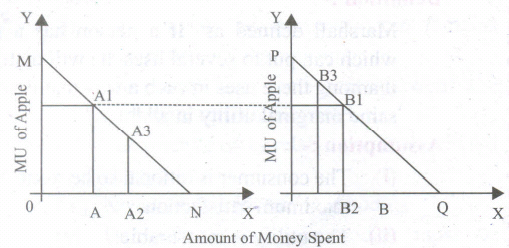
Explanation:
(i) X axis shows amount of money spent
(ii) Y axis shows marginal utility of apple and orange.
(iii) If consumer spends Rs.6 on apple and Rs.5 on orange MU will be equal.
(iv) ie. AA1 = BB1 = 4 = 4. So he gets maximum utility.
Criticisms:
(i) Utility cannot be measured.
(ii) No consumer compares the utility and disutility from each unit of the commodity while buying it.
(iii) This law cannot be applied to durable goods.
Conclusion:
(i) The law of Equi-marginal utility is an improvement over the law of diminishing marginal utility because it can be used for many commodities consumed at the same time.
44.
45.
46.
47.
48.
49.
Introduction:
The government of India, Ministry of Commerce and Industry announced New Foreign Trade Policy on 1st April 2015 for a period 2015 - 2020.
Salient Features:
(i) Reduce export obligations by 25% and give boost to domestic manufacturing supporting the 'Make in India' concept.
(ii) As a step to Digital India concept, online procedure to upload digitally signed document by CA/CS/Cost Accountant are developed and further mobile app for filing tax, stamp duty has been developed.
(iii) Repeated submission of physical copies of documents available on Exporter Importer Profile is not required.
(iv) Export obligation period for export items related to defence, military store, aerospace and nuclear energy to be 24 months.
Conclusion: EXIM Policy 2015 - 2020 is expected to double the share of India in World Trade from present level of 3% by 2020. This is too ambitious.
50.
51.
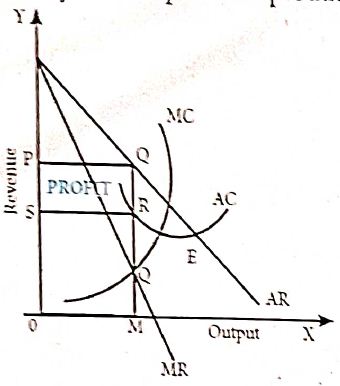
52.
\(\text { TC }=10+Q^{3} \)
\(A C=\frac{10}{Q}+\frac{Q^{3}}{Q}=\frac{10}{Q}+Q^{2}=\frac{10}{5}+5^{2}=2+25=27 \)
\(\text {AVC }=\frac{Q^{3}}{Q}=Q^{2}=5^{2}=25 \)
\(\text {TFC }=10 \)
\(\text {AFC }=\frac{10}{\mathrm{Q}}=\frac{10}{5}=2 \)
\(Ans; \mathrm{AC}=27 ; \quad \mathrm{AVC}=25 ; \quad \mathrm{TFC}=10 ; \quad \mathrm{AFC}=2.\)
53.
Introduction:
Mineral resources are valuable natural resources that play an important role in the economic development of India. Important minerals found in India include iron ore, coal, lignite, bauxite, mica, crude oil, gold, and diamonds.
1. Iron Ore
India has abundant reserves of high-quality iron ore. It is the basic raw material for the iron and steel industry. Major iron ore producing states are Odisha, Chhattisgarh, Karnataka, Jharkhand, and Goa.
2. Coal and Lignite
Coal is the most important source of commercial energy in India. It is used for electricity generation and industrial purposes. Major coal-producing states include Jharkhand, Odisha, Chhattisgarh, West Bengal, and Madhya Pradesh.
3. Bauxite
Bauxite is the chief ore of aluminium. Aluminium is widely used in transport, construction, and electrical industries. Odisha is the leading producer of bauxite in India.
4. Mica
Mica is a good insulator and heat-resistant mineral. It is used in electrical and electronic industries. India is one of the leading producers of mica.
5. Crude Oil
Crude oil is an important source of energy. It is used to produce petrol, diesel, kerosene, and other petroleum products. Major oil-producing areas are Assam, Gujarat, and offshore regions.
6. Gold and Diamonds
Gold and diamonds have high commercial value. They support the jewellery industry and contribute to exports.
Conclusion:
Mineral resources are essential for industrial development, energy production, employment generation, and economic growth. Therefore, they are a valuable asset for India's development.

11th Standard Syllabus & Materials
11th Standard
TN 11th Tamil பீடு பெற நில் - செய்யுள் - காவடிச்சிந்து Important Questions And Answers Study Material - QB365 Set A
NEW11th Standard
TN 11th Tamil பீடு பெற நில் - உரைநடை - மலை இடப்பெயர்கள் : ஓர் ஆய்வு Important Questions And Answers Study Material - QB365 Set A
NEW11th Standard
TN 11th Tamil மாமழை போற்றுதும் - துணைப்பாடம் - யானை டாக்டர் Important Questions And Answers Study Material - QB365 Set A
NEW11th Standard
TN 11th Tamil மாமழை போற்றுதும் - செய்யுள் - ஐங்குறுநூறு Important Questions And Answers Study Material - QB365 Set A



Tamilnadu Stateboard 11th Standard Subjects

Maths

Commerce
Economics

Biology

Business Maths and Statistics

Accountancy

Computer Science

Physics

Chemistry
Maths
Biology
Economics
Physics
Chemistry

History
Business Maths and Statistics

Computer Science
Accountancy

Computer Applications
History
Computer Technology
Commerce
Computer Applications
Computer Technology

Tamil

English

French
Tamilnadu Stateboard Standards
