
 100% FREE ACCESS
11th Standard Syllabus & Materials
11th Standard
TN 11th Tamil இயற்கை வேளாண்மை,சுற்றுச்சூழல் -செய்யுள் - மனோன்மணீயம் Important Questions And Answers Study Material - QB365 Set A
NEW11th Standard
TN 11th Tamil என்னுயிர் என்பேன் -துணைப்பாடம் - இசைத்தமிழர் இருவர் Important Questions And Answers Study Material - QB365 Set A
NEW11th Standard
TN 11th Tamil மொழி கலை -செய்யுள் - ஒவ்வொரு புல்லையும் Important Questions And Answers Study Material - QB365 Set A
NEW11th Standard
TN 11th Tamil பீடு பெற நில் - இலக்கணம் - பகுபத உறுப்புகள் Important Questions And Answers Study Material - QB365 Set A
NEW11th Standard
TN 11th Tamil பீடு பெற நில் - துணைப்பாடம் - வாடிவாசல் Important Questions And Answers Study Material - QB365 Set A
NEW11th Standard
TN 11th Tamil பீடு பெற நில் - செய்யுள் - குறுந்தொகை Important Questions And Answers Study Material - QB365 Set A

Published on: 29/11/2018
Preparing question papers for all the school tests and exams are quite repetitive and time-consuming process. On the other side preparing your students to crack the examination with the right choice of the question also difficult. Here we are providing a solution for this. Mathematics is the easiest subject to increase the score if practiced well. Grab this model question paper for 11th state board Maths and practice to get the high score in exams.
In this question paper, all the questions are analyzed and added by our panel of experienced teachers. The question paper is created based on the state board syllabus. It has the important questions expected to ask in board exams. Important questions for 11th maths have been added from all chapters. Creative questions were added in this question paper in order to enhance the student's knowledge and get the idea that how to answer strategic questions asked in the board exams.
Our aim is to bring out the best scores on board exams. By practicing with this important model question paper student can gain more knowledge and confidence to crack the exams.
Download Tamil Nadu 11th Standard Maths question papers, model tests, one-mark questions, important questions, and public exam papers in PDF format. Free study materials and answer keys for TN State Board students.
Questions + Answers key
Take MCQ Maths Test1.
Find the derivatives of the following : \(\sqrt{x^2+y^2}=tan^{-1}({y\over x})\)
2.
If A =\(\begin{bmatrix} 1&-1 &2 \\ -2 & 1 & 3 \\ 0 &-3 &4 \end{bmatrix}\) and B = \(\begin{bmatrix} 1&-3 \\ -1 & 1 \\ 1 &2 \end{bmatrix}\) find AB and BA if they exist.
3.
Prove that \(cos\frac { B-C }{ 2 }= \frac { b+c }{ a } sin\frac { A }{ 2 } \)
4.
The line 2x - y = 5 turns about the point on it, whose ordinate and abscissae are equal, through an angle of 45° in the anti-clockwise direction. find the equation of the line in the new position.
5.
Expand the following in ascending powers of x and find the condition on x for which the binomial expansion is valid.
\({ \left( x+2 \right) }^{ -\frac { 2 }{ 3 } }\)
6.
If R is the set of all real numbers, what do the cartesian products R \(\times\) R and R \(\times\)R \(\times\)R represent?
7.
Prove that cos(30o _ A) cos(30o +A)+cos (45o _ A)cos (45o + A) \(=\cos 2 A+\frac{1}{4}\)
8.
If \(\left( { x }^{ \frac { 1 }{ 2 } }+{ x }^{ -\frac { 1 }{ 2 } } \right) ^{ 2 }=\frac { 9 }{ 2 } \), then find the value of \(\left( { x }^{ \frac { 1 }{ 2 } }-{ x }^{ -\frac { 1 }{ 2 } } \right) \)for x > 1
9.
Find cos(x - y), given that cos x = \(-\frac{4}{5}\) with \(\pi<x<{{3\pi}\over{2}}\) and \(sin \ y = -{{24}\over{25}}\) with \(\pi<x<{{3\pi}\over{2}}\).
10.
The vector in the direction of the vector\(\hat{i}-2\hat{j}+2\hat{k}\) that has magnitude 9 is _________ .
\(\hat{i}-2\hat{j}+2\hat{k}\)
\(\frac { \hat { i } -2\hat { j } +2\hat { k } }{ 3 } \)
3(\(\hat{i}-2\hat{j}+2\hat{k}\))
9(\(\hat{i}-2\hat{j}+2\hat{k}\))
11.
Choose the correct or the most suitable answer from the given four alternatives.
If f(x) = 4x8, then ________
\(f^{ ' }\left( \frac { 1 }{ 2 } \right) =f^{ ' }\left( \frac { -1 }{ 2 } \right) \)
\(f\left( \frac { 1 }{ 2 } \right) =-f^{ ' }\left( \frac { -1 }{ 2 } \right) \)
\(f\left( \frac { 1 }{ 2 } \right) =f\left( \frac { -1 }{ 2 } \right) \)
\(f\left( \frac { 1 }{ 2 } \right) =f^{ ' }\left( \frac { -1 }{ 2 } \right) \)
12.
0
2
3
4
13.
If y = cos (sin x2), then \({dy\over dx}\) at x = \(\sqrt{\pi\over 2}\) is
-2
2
\(-2\sqrt{\pi\over 2}\)
0
14.
\(lim_{\theta\rightarrow0}{Sin\sqrt{\theta}\over \sqrt{sin \theta}} \)
1
-1
0
2
15.
A vector \(\overrightarrow{OP}\) makes 60° and 45° with the positive direction of the x and y axes respectively. Then the angle between \(\overrightarrow{OP}\)and the z-axis is
45°
60°
90°
30°
16.
If A =\(\begin{bmatrix} 1 & -1 \\ 2 &-1 \end{bmatrix}\), B = \(\begin{bmatrix} a & 1 \\ b &-1 \end{bmatrix}\) and (A + B)2 = A2 + B2, then the values of a and b are
a = 4, b = 1
a = 1, b = 4
a = 0, b = 4
a = 2, b = 4
17.
If A = {x / x is an integer, x2 \(\le\) 4} then elements of A are ___________
A = {-1, 0, 1}
A = {-1, 0, 1, 2}
A = {0, 2, 4}
A = {- 2, - 1, 0, 1, 2}
18.
For the below figure of ax2 + bx + c = 0
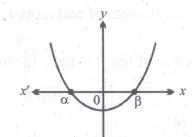
a < 0, D > 0
a > 0, D > 0
a < 0, D < 0
a > 0, D = 0
19.
The lines x + 2y - 3 = 0 and 3x - y + 7 = 0 are ______________
parallel
neither parallel nor perpendicular
perpendicular
parallel as wellas perpendicular
20.
In the series \(\frac{1}{1+\sqrt 2}+\frac{1}{\sqrt 2+\sqrt 3}+\frac{1}{\sqrt 3+\sqrt 4}+...\) some of first 24 number is ______________
4
\(\sqrt 24\)
\(\frac{1}{\sqrt 24}\)
\(\frac{1}{\sqrt 25-\sqrt 24}\)
21.
Solve \(\sqrt{7+6x-x^2}=x+1\)
(1, -3)
(3, -1)
(1, -1)
(3, -3)
22.
Distance between the lines 5x + 3y - 7 = 0 and 15x + 9y + 14 = 0 is ______________
\(\frac{35}{\sqrt{34}}\)
\(\frac{1}{3\sqrt{34}}\)
\(\frac{35}{2\sqrt{34}}\)
\(\frac{35}{3\sqrt{34}}\)
23.
If n+1 C3 = 2.nC21 then n = _________
3
4
5
6
24.
Which of the following point lie on the locus of 3x2+ 3y2- 8x - 12y + 17 = 0
(0, 0)
(-2, 3)
(1, 2)
(0, -1)
25.
In 3 fingers, the number of ways four rings can be worn is _______ ways.
43-1
34
68
64
26.
The remainder when 3815 is divided by 13 is
12
1
11
5
27.
cos 2ፀ cos 2ф + sin2(ፀ - ф) - sin2(ፀ + ф) is equal to
sin2(ፀ+\(\phi \))
cos2(ፀ+\(\phi \))
sin2(ፀ-\(\phi \))
cos2(ፀ-\(\phi \))
28.
Let X = {1, 2, 3, 4} and R = {(1, 1), (1, 2), (1, 3), (2, 2), (3, 3), (2, 1), (3, 1), (1, 4),(4, 1)}. Then R is
reflexive
symmetric
transitive
equivalence
29.
The shaded region in the adjoining diagram represents.

A\B
B\A
AΔB
A'
30.
If y = \((cos^{-1}x)^2\) ,prove that \((1-x^2){d^2y\over dx^2}-x{dy\over dx}-2=0.\) Hence find y2 when x = 0
31.
Evaluate the following limits :
\(lim_{x\rightarrow a}{\sqrt{x-b}-\sqrt{a-b}\over x^2-a^2}(a>b)\)
32.
Show that the points whose position vectors are 2\(\hat{i}\) + 3\(\hat{j}\) − 5\(\hat{k}\), 3\(\hat{i}\) + \(\hat{j}\) − 2\(\hat{k}\) and, 6\(\hat{i}\) − 5\(\hat{j}\) + 7\(\hat{k}\) are collinear
33.
Compute all minors, cofactors of A and hence compute |A| if A =\(\begin{bmatrix} 1& 3 &-2 \\4 & -5 &6 \\ -3 & 5 & 2 \end{bmatrix}\) .
Also check that | A | remains unaltered by expanding along any row or any column.
34.
Show that the locus of the mid-point of the segment intercepted between the axes of the variable line x cos \(\alpha\) + y sin \(\alpha\) = p is \(\frac{1}{x^2}+\frac{1}{y^2}=\frac{4}{p^2}\) where p is a constant.
35.
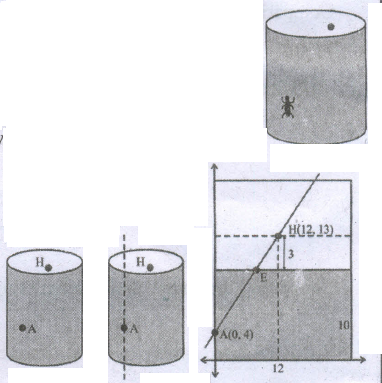
Consider a hollow cylindrical vessel, with circumference 24 cm and height 10 cm. An ant is located on the outside of vessel 4 cm from the bottom. There is a drop of honey at the diagrammatically opposite inside of the vessel, 3 cm from the top.
(i) What is the shortest distance the ant would need to crawl to get the honey drop?
(ii) Equation of the path traced out by the ant.
(iii) Where the ant enter in to the cylinder? Here is a picture that illustrates the position of the ant and the honey.
36.
Prove that \(\left( 1+\frac { 1 }{ 1 } \right) \left( 1+\frac { 1 }{ 2 } \right) \left( 1+\frac { 1 }{ 3 } \right) ...\left( 1+\frac { 1 }{ n } \right) =\left( n+1 \right) \) for all \(n\in N\) by the principle of mathematical induction.
37.
A spring was hung from a hook in the ceiling. A number of different weights were attached to the spring to make it stretch, and the total length of the spring was measured each time shown in the following table.
| Weight, (kg) | 2 | 4 | 5 | 8 |
| Length, (cm) | 3 | 4 | 4.5 | 6 |
(i) Draw a graph showing the results.
(ii) Find the equation relating the length of the spring to the weight on it.
(iii) What is the actual length of the spring.
(iv) If the spring has to stretch to 9 cm long, how much weight should be added?
(v) How long will the spring be when 6 kilograms of weight on it?
38.
If P(2,-7) is a given point and Q is a point on (2x2 + 9y2 = 18), then find the equations of the locus of the mid-point of PQ.
39.
Compute the sum of first n terms of the following series 6 + 66 + 666 + .......
40.
If the equations x2 - ax + b = 0 and x2 - ex + f = 0 have one root in common and if the second equation has equal roots, then prove that ae = 2 (b + f).
41.
If \(x={{\sqrt{3}-\sqrt{2}}\over{\sqrt{3}+\sqrt{2}}}\) and \(y={{\sqrt{3}+\sqrt{2}}\over{\sqrt{3}-\sqrt{2}}}\) find the value of x2+xy+y2.
42.
Write the values of f at -4, 1, -2, 7, 0 if
43.
Differentiate : \(y=(x^3-1)^{100}\)
44.
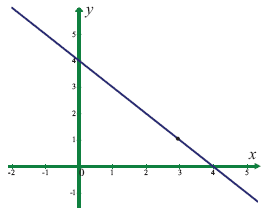
Use the graph to find the limits (if it exists). If the limit does not exist, explain why?
\(lim_{x\rightarrow3}(4-x)\).
45.
In problem, using the table estimate the value of the limit
\(lim_{x\rightarrow0}{cos x-1\over x}\)
| x | -0.1 | -0.01 | -0.001 | 0.001 | 0.01 | 0.1 |
| f(x) | 0.04995 | 0.0049999 | 0.0004999 | –0.0004999 | –0.004999 | –0.04995 |
46.
Verify whether the following ratios are direction cosines of some vector or not \({1\over\sqrt{2}},{1\over 2},{1\over 2}\)
47.
Find the sum A + B + C if A, B, C are given by
\(A=\left[\begin{array}{ll}
\sin ^2 \theta & 1 \\
\cot ^2 \theta & 0
\end{array}\right], B=\left[\begin{array}{cc}
\cos ^2 \theta & 0 \\
-\operatorname{cosec}^2 \theta & 1
\end{array}\right] \text { and } C=\left[\begin{array}{cc}
0 & -1 \\
-1 & 0
\end{array}\right]\)
48.
Find the value of \(\frac { 12! }{ 9!\times 3! } \)
1.
\(
\sqrt{x^2+y^2} =\tan ^{-1} \frac{y}{x}
\)
\(\left(x^2+y^2\right)^{1 / 2} =\tan ^{-1} \frac{y}{x}\)
\(
\frac{1}{2 \sqrt{x^2+y^2}}\left(2 x+2 y \frac{d y}{d x}\right)=\frac{1}{1+\left(\frac{y}{x}\right)^2}\left(\frac{x \frac{a y}{d x}-y}{x^2}\right)
\)
\(\frac{2\left(x+y \frac{d y}{d x}\right)}{2 \sqrt{x^2+y^2}}=\frac{1}{\left(\frac{x^2+y^2}{x^2}\right)}\left(\frac{x \frac{d y}{d x}-y}{x^2}\right)\)
\(
x+y \frac{d y}{d x}=\frac{\sqrt{x^2+y^2}}{\left(x^2+y^2\right)}\left(x \frac{d y}{d x}-y\right)
\)
\(x+y \frac{d y}{d x}=\frac{1}{\sqrt{x^2+y^2}}\left(x \frac{d y}{d x}-y\right) \)
\(x+y \frac{d y}{d x}=\frac{x}{\sqrt{x^2+y^2}} \frac{d y}{d x}-\frac{y}{\sqrt{x^2+y^2}}\)
\(
\frac{x}{\sqrt{x^2+y^2}} \frac{d y}{d x}-y \frac{d y}{d x} =x+\frac{y}{\sqrt{x^2+y^2}}\)
\(\frac{d y}{d x}\left(\frac{x}{\sqrt{x^2+y^2}}-y\right) =\frac{x \sqrt{x^2+y^2}+y}{\sqrt{x^2+y^2}}
\)
\(\frac{d y}{d x}\left(\frac{x-y \sqrt{x^2+y^2}}{\sqrt{x^2+y^2}}\right) =\frac{x \sqrt{x^2+y^2}+y}{\sqrt{x^2+y^2}} \)
\(\frac{d y}{d x} =\frac{x \sqrt{x^2+y^2}+y}{x-y \sqrt{x^2+y^2}}\)
2.
The order of A is 3 \(\times\) 3 and the order of B is 3 \(\times\) 2. Therefore the order of AB is 3 \(\times\) 2.
A and B are conformable for the product AB. Call C = AB. Then,
c11 = (first row of A) (first column of B)
\(\Rightarrow c_{11}=[1\ -1 \ 2 ]\begin{bmatrix} 1 \\ -1 \\ 1 \end{bmatrix}=1+1+2=4,\)since c11 is an element.
Similarly c12 = 0, c21 = 0, C22 = 13, c31 = 7, c32 = 5.
Therefore, AB = C = [cij] =\(\begin{bmatrix} 4 &0 \\ 0 & 13 \\ 7 & 5 \end{bmatrix}\)
The product BA does not exist, because the number of columns in B is not equal to the number of rows in A.
3.
\(\frac { b+c }{ a } sin\frac { A }{ 2 } =\frac { 2RsinB+2RsinC }{ 2RsinA } sin\frac { A }{ 2 } \)
\(=\frac { sinB+sinC }{ sinA } sin\frac { A }{ 2 } \)
\(=\frac { 2sin\frac { B+C }{ 2 } cos\frac { B-C }{ 2 } }{ 2sin\frac { A }{ 2 } cos\frac { A }{ 2 } } sin\frac { A }{ 2 } =\frac { sin\frac { B+C }{ 2 } cos\frac { B-C }{ 2 } }{ cos\frac { A }{ 2 } } \)
\(=\frac { sin\left( \frac { 180-A }{ 2 } \right) cos\frac { B-C }{ 2 } }{ cos\frac { A }{ 2 } } =\frac { sin\left( 90-\frac { A }{ 2 } \right) cos\frac { B-C }{ 2 } }{ cos\frac { A }{ 2 } } \)
\(=cos\frac { B-C }{ 2 } \ \because sin\left( 90-\frac { A }{ 2 } \right) =cos\frac { A }{ 2 } \)
4.
If the line 2x - y = 5 makes an angle \(\theta\) with x - axis. Then, tan \(\theta\) = 2. Let P (a, a) be a point on the line 2x - y = 5. Then, 2 a - a = 5 \(\Rightarrow\) a = 5
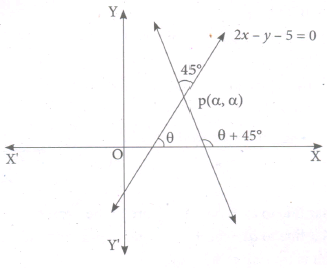
So, the coordinates of Pare (5, 5). If the line 2x - y - 5 = 0 is rotated about point P through 45° in anti-clockwise direction, then the line in its new position makes angle 8 + 45° with x -axis. Let m be the slope of the line in its new position. Then,
\(m'=tan(\theta+45^o)=\frac{\tan\theta+\tan45^o}{1-\tan\theta\tan45^o}=\frac{2+1}{1-2\times 1}=-3\)
Thus, the line in its new position passes through P (5, 5) and has slope m' = -3
So, its equationy -5 = m' (x - 5) or, y -5 = -3 (x - 5) or, 3x + y - 20 = 0.
5.
\((x+2)^{-2\over3}=(2+x)^{-2\over3}\)
\(=2^{-2\over3}\left(1+{x\over2}\right)\left[∵(1+x)^{-p\over q}=1-\left(p\over q\right)x+{\left(p\over q\right)\left({p\over q}-1\right)\over2!}x^2-{\left(p\over q\right)\left({p\over q}-1\right)\left({p\over q}-2\right)\over3!}x^3+... \right]\)
\(={1\over 2^{2\over3}} \left( 1-{2\over3}\left(x\over2\right)+{\left(-{2\over3} \right)\left(-{2\over3}-1 \right)\over2!} \left( x\over2 \right)^2+{\left(-{2\over3} \right)\left(-{2\over3}-1\right)\left(-{2\over3}-2 \right)\over3!\left({x\over2} \right)^3}+{\left(-{2\over3} \right)\left(-{2\over3} -1 \right)\left(-{2\over3}-2 \right)\left(-{2\over3}-3 \right)\over 4!}\left({x\over2} \right)^4+{\left( - {2\over3} \right)\left( - {2\over3}-1 \right)\left( -{2\over3}-2 \right)\left(- {2\over3}-3 \right)\left( - {2\over3} -4 \right)\over5!}\left( {x\over2} \right)^5+.... \right)\)\(={1\over 2^{2\over3}}\left[ 1-{x\over3}+{\left( -{2\over3}\right)\left( -{5\over3}\right)\over2 }{x^2\over4}+{\left( -{2\over3}\right)\left( -{5\over3}\right)\left( -{8\over3}\right)\over6}{x^3\over8}+{\left( -{2\over3}\right)\left( -{5\over3}\right)\left( -{8\over3}\right)\left( -{11\over3}\right)\over24}{x^4\over16}+... \right]\)
\(={ 2 }^{ \frac { -2 }{ 3 } }\left[ 1-\frac { x }{ 3 } +\frac { { 5x }^{ 2 } }{ 36 } -\frac { 5 }{ 81 } .{ x }^{ 3 }+\frac { 55 }{ 1944 } { x }^{ 4 }-.. \right] \)
6.
Given R is the set of all real numbers. Then R x R is the set of all ordered pairs (x, y) where x, y ∈ R.
R \(\times\)R = {(x,y): x, y ∈ R}
Clearly R \(\times\)R is the set of all points in xy-plane. Now R \(\times\)R \(\times\)R = {(x, y, z) : x,y, x ∈ R}.
∴ R \(\times\)R \(\times\)R represents the set of all points in space.
7.
\(LHS=cos({ 30 }-A)cos({ 30 }+A)cos({ 45 }-A)cos(45+A)\)
\(={ cos }^{ 2 }30-{ sin }^{ 2 }A+{ cos }^{ 2 }45-{ sin }^{ 2 }A \quad \left[ \because cos(A+B)cos(A-B=cos^{ 2 }A-{ sin }^{ 2 }B \right] \)
\(={ \left( \frac { \sqrt { 3 } }{ 2 } \right) }^{ 2 }-2{ sin }^{ 2 }A+{ \left( \frac { 1 }{ \sqrt { 2 } } \right) }^{ 2 }\)
\(=\frac { 3 }{ 4 } +\frac { 1 }{ 2 } -2{ sin }^{ 2 }A=\frac { 3 }{ 4 } -(1-cos2A)+\frac { 1 }{ 2 } \)
\(=\frac { 3 }{ 4 } -1+cos2A+\frac { 1 }{ 2 } \quad \left[ \because 2{ sin }^{ 2 }A=1-cos2A \right] \)
\(=\frac { 3-4+2 }{ 4 } +cos2A=\frac { 1 }{ 4 } +cos2A=RHS.\)
8.
Given \(\left( { x }^{ +\frac { 1 }{ 2 } }+{ x }^{ -\frac { 1 }{ 2 } } \right) ^{ 2 }=\frac { 9 }{ 2 } \)
⇒ \(x+\frac { 1 }{ 2 } +{ 2x }^{ \frac { 1 }{ 2 } }.\frac { 1 }{ { x }^{ -\frac { 1 }{ 2 } } } =\frac { 9 }{ 2 } \)
⇒ \(x+\frac { 1 }{ x } +2=\frac { 9 }{ 2 } \)
⇒ \(x+\frac { 1 }{ x } =\frac { 9 }{ 2 } -2=\frac { 9-4 }{ 2 } =\frac { 5 }{ 2 } \)
Consider \(\left( { x }^{ \frac { 1 }{ 2 } }-{ x }^{ -\frac { 1 }{ 2 } } \right) ^{ 2 }\)
= \(x+\frac { 1 }{ x } -2x^{ \frac { 1 }{ 2 } }.\frac { 1 }{ { x }^{ \frac { 1 }{ 2 } } } \)
= \(x+\frac { 1 }{ x } -2\) [From (1)]
= \(\frac { 5 }{ 2 } -2=\frac { 5-4 }{ 2 } =\frac { 1 }{ 2 } \) [using 1]
∴ \(x^{ \frac { 1 }{ 2 } }-x^{ -\frac { 1 }{ 2 } }=\pm \frac { 1 }{ \sqrt { 2 } } \)
⇒ \(x^{ \frac { 1 }{ 2 } }-x^{ -\frac { 1 }{ 2 } }=\frac { 1 }{ \sqrt { 2 } } \) since x > 1
9.
Since \(\pi,x<{{3\pi}\over{2}},\) x lies in the III quadrant only cot x and tan x are positive
Also \(\pi,x<{{3\pi}\over{2}},\) y is also lies in the III quadrant
Only cot y and tan y are positive
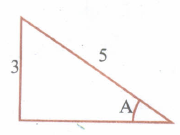
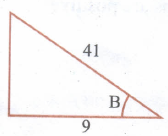
\(sinx=-\frac { 3 }{ 5 } \quad siny=-\frac { 24 }{ 25 } \)
\(cosx=-\frac { 4 }{ 5 } \quad cosy=-\frac { 7 }{ 25 } \)
ஃ cos(x - y) = cosx cosy + sinx siny
\(=\left( -\frac { 4 }{ 5 } \right) \left( -\frac { 7 }{ 25 } \right) +\left( -\frac { 3 }{ 5 } \right) \left( -\frac { 24 }{ 25 } \right) \)
\(=\frac { 28 }{ 125 } +\frac { 72 }{ 125 } =\frac { 100 }{ 125 } =\frac { 4 }{ 5 } \)
10.
(c)
3(\(\hat{i}-2\hat{j}+2\hat{k}\))
11.
(c)
\(f\left( \frac { 1 }{ 2 } \right) =f\left( \frac { -1 }{ 2 } \right) \)
12.
\(\text { The right hand derivative of } f(x) \text { at } x=2 \text { is }\)
\(f^{\prime}\left(2^{+}\right) =\lim _{x \rightarrow 2^{+}} \frac{f(x)-f(2)}{x-2} \)
\(=\lim _{x \rightarrow 2^{+}} \frac{(3 x+4)-(3(2)+4)}{x-2} \)
\(=\lim _{x \rightarrow 2^{+}} \frac{3 x+4-6-4}{x-2} \)
\(=\lim _{x \rightarrow 2^{+}} \frac{3(x-2)}{(x-2)}=3 \)
13.
\(y =\cos \left(\sin x^{2}\right) \)
\(\frac{d y}{d x} =-\sin \left(\sin x^{2}\right) \cos \left(x^{2}\right)(2 x) \)
\(\text { At } x =\sqrt{\pi / 2}, \frac{d y}{d x}=-\sin \sin \left(\frac{\pi}{z}\right) \cos (\pi / 2) 2(\sqrt{\pi / 2}) \)
\(=(\sin 1)(0) 2\left(\frac{\sqrt{\pi}}{2}\right)=0 \quad[\because \cos \pi / 2=0] \)
14.
\(\lim _{\theta \rightarrow 0} \frac{\sin \sqrt{\theta}}{\sqrt{\sin \theta}} =\lim _{\theta \rightarrow 0}\left(\frac{\sin \sqrt{\theta}}{\sqrt{\theta}} \cdot \frac{\sqrt{\theta}}{\sqrt{\sin \theta}}\right) \)
\(=\lim _{\theta \rightarrow 0} \frac{\sin \sqrt{\theta}}{\sqrt{\theta}} \cdot\left(\lim _{\theta \rightarrow 0} \frac{\sin \sqrt{\theta}}{\theta}\right)^{\frac{1}{2}}=1.1=1
\)
15.
\(\cos ^{2} \alpha+\cos ^{2} \beta+\cos ^{2} \gamma=1 \)
\(\cos ^{2} 60^{\circ}+\cos ^{2} 45^{\circ}+\cos ^{2} \gamma=1 \)
\(\left(\frac{1}{2}\right)^{2}+\left(\frac{1}{\sqrt{2}}\right)^{2}+\cos ^{2} \gamma=1 \Rightarrow \cos ^{2} \gamma=1-\frac{1}{4}-\frac{1}{2} \)
\(\cos ^{2} \gamma=\frac{4-1-2}{4}=\frac{1}{4} \Rightarrow \cos \gamma=\frac{1}{2} \Rightarrow \gamma=60^{\circ} \)
\(\text { Angle between } \overrightarrow{O P} \text { and } z \text { axis is } 60^{\circ}\)
16.
\(A+B =\left[\begin{array}{ll} 1+a & 0 \\ 2+b & -2 \end{array}\right] \)
\((A+B)^{2} =\left[\begin{array}{ll} 1+a & 0 \\ 2+b & -2 \end{array}\right]\left[\begin{array}{ll} 1+a & 0 \\ 2+b & -2 \end{array}\right] \)
\(=\left[\begin{array}{ll} (1+a)^{2} & 0 \\ (2+b)(1+a)-2(2+b) & 4 \end{array}\right] \)
\(A^{2} =\left[\begin{array}{ll} 1 & -1 \\ 2 & -1 \end{array}\right]\left[\begin{array}{ll} 1 & -1 \\ 2 & -1 \end{array}\right]=\left[\begin{array}{cc} -1 & 0 \\ 0 & -1 \end{array}\right] \)
\(B^{2} =\left[\begin{array}{cc} a & 1 \\ b & -1 \end{array}\right]\left[\begin{array}{cc} a & 1 \\ b & -1 \end{array}\right]=\left[\begin{array}{ll} a^{2}+b & a-1 \\ a b-b & b+1 \end{array}\right] \)
\(A^{2}+B^{2} =\left[\begin{array}{cc} -1 & 0 \\ 0 & -1 \end{array}\right]+\left[\begin{array}{cc} a^{2}+b & a-1 \\ a b-b & b+1 \end{array}\right] \)
\(=\left[\begin{array}{cc} a^{2}+b-1 & a-1 \\ a b-b & b \end{array}\right]\)
\((A+B)^{2} =A^{2}+B^{2} \)
\(\therefore a-1 =0 \)
\(a =1 \)
\(b =4\)
17.
(d)
A = {- 2, - 1, 0, 1, 2}
18.
(b)
a > 0, D > 0
19.
(b)
neither parallel nor perpendicular
20.
(a)
4
21.
(b)
(3, -1)
22.
(c)
\(\frac{35}{2\sqrt{34}}\)
23.
(c)
5
24.
\((1,2) \text { lies on } 3 x^{2}+3 y^{2}-8 x-12 y+17=0\)
\(\text { Because, } 3(1)^{2}+3(2)^{2}-8(1)-12(2)+17\)
\(=3+12-8-24+17=0\)
25.
4 rings can be worn in 3 fingers in 34 ways
26.
\((38)^{5} =(39-1)^{15} \)
\(=(39)^{15}-{ }^{15} C_{1}(39)^{14}+\ldots+{ }^{15} C_{14}(39)-1 \)
The remainder will be 12 because all the terms except the last is divisible by 39 and so by 13, -1 remains
27.
\(\cos 2 \theta \cos 2 \phi+\sin ^{2}(\theta-\phi)-\sin ^{2}(\theta+\phi) \)
\(=\cos 2 \theta \cos 2 \phi+\frac{1}{2}-\frac{1}{2} \cos (2 \theta-2 \phi)-\frac{1}{2}+\frac{1}{2} \cos (2 \theta+2 \phi) \)
\(=\cos 2 \theta \cos 2 \phi+\frac{1}{2}[\cos (2 \theta+2 \phi)-\cos (2 \theta-2 \phi)] \)
\(=\cos 2 \theta \cos 2 \phi-\sin 2 \theta \cos 2 \phi \)
\(=\cos (2 \theta+2 \phi) \)
\(=\cos 2(\theta+\phi) \)
28.
\(\text { If } 4 \in X \text { then }(4,4) \notin \mathrm{R}\)
R is not reflexive
symmetric can be easily checked
29.
(c)
AΔB
30.
Given y = (cos-1x)2
Differentiating with respect to 'x' we get
y' = 2.cos-1x\(\left(\frac{-1}{\sqrt{1-x^2}}\right)\)
\(\sqrt{1-x^2} y_1=-\left(2 \cos ^{-1} x\right)\)
Squaring on both sides
\( \left(1-x^2\right) y_1^2=4\left(\cos ^{-1} x\right)^2 \)
\(\left(1-x^2\right) \dot{y}_1^2=4 y \) (using(1))
Differentiate W. R. T x
\( \left(1-x^2\right)\left(2 y_1 y_2\right)+y_1^2(-2 x)=4 y_1 \)
\(\left(1-x^2\right) 2 y_1 y_2-2 x y_1^2-4 y_1=0\)
Divide it by 2y1
\(\left(1-x^2\right) y_2-x y_1-2=0\)
when x = 0
\( (1-0) y_2-0 y_1-2=0 \)
\(y_2-2=0 \)
\(y_2=2 \)
31.
\(lim_{x\rightarrow a}{\sqrt{x-b}-\sqrt{a-b}\over x^2-a^2}(a>b)\)
Multiplying and dividing by \((\sqrt{x-b}+\sqrt{a-b})\)we get,
\(=lim_{x\rightarrow a}{\sqrt{x-b}-\sqrt{a-b}\over x^2-a^2}{\sqrt{x-b}+\sqrt{a-b}\over\sqrt{x-b}+\sqrt{a-b}}\)
\(=lim_{x\rightarrow a}{({x-b})-({a-b})\over (x^2-a^2)[\sqrt{x-b}+\sqrt{a-b}]}\)
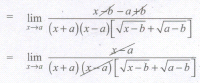
\(={1\over (a+a)[\sqrt{a-b}+\sqrt{a-b}]}={1\over2a[2\sqrt{a-b}]}\)
\(={1\over4a[\sqrt{a-b}]}\)
32.
Let O be the origin and let \(\overrightarrow{OA}\), \(\overrightarrow{OB}\), and\(\overrightarrow{OC}\) be the vectors 2\(\hat{i}\) + 3\(\hat{j}\) − 5\(\hat{k}\), 3\(\hat{i}\) + \(\hat{j}\) − 2\(\hat{k}\) and, 6\(\hat{i}\) − 5\(\hat{j}\) + 7\(\hat{k}\) respectively. Then
\(\overrightarrow{AB}=\hat{i}-2\hat{j}+3\hat{k} \ and \ \overrightarrow{AC}=4\hat{i}-8\hat{j}+12\hat{k}\).
Thus \(\overrightarrow{AC}=4\overrightarrow{AB}\) and hence \(\overrightarrow{AB}\) and\(\overrightarrow{AC}\) are parallel. They have a common point namely A. Thus, the three points are collinear.
Alternative method
Let O be the point of reference.
Let \(\overrightarrow {OA} = 2\hat i+3\hat j-5\hat k, \) \(\overrightarrow {OB} = 3 \hat j+\hat j-2\hat k\ and\ \overrightarrow {OC} = 6\hat i-5\hat j+7\hat k \)
\(\overrightarrow {AB} = \hat i- 2\hat j+3\hat k; \overrightarrow {BC} = 3\hat i-6\hat j+9\hat k; \overrightarrow {CA} = -4\hat i+8\hat j-12 \hat k\\ |\overrightarrow {AB}| = \sqrt 14; |\overrightarrow {BC}|= \sqrt 126 = 3 \sqrt 14; |\overrightarrow {CA}|= \sqrt 224 = 4 \sqrt 4\)
Thus, AC = AB + BC.
Hence A, B, C are lying on the same line. That is, they are collinear.
33.
Minors : M11 = \(\begin{vmatrix} -5 & 6 \\ 5 & 2 \end{vmatrix}\) = -10 - 30 = -40
M12 = \(\begin{vmatrix}4 & 6 \\ -3 & 2 \end{vmatrix}\) = 8 + 18 = 26
M13 = \(\begin{vmatrix}4 & -5 \\ -3 & 5 \end{vmatrix}\) = 20 - 15 = 5
M21 = \(\begin{vmatrix}3 & -2 \\ 5 & 2 \end{vmatrix}\) = 6 + 10 = 16
M22 = \(\begin{vmatrix}1 & -2 \\ -3 & 2 \end{vmatrix}\) = 2 - 6 = -4
M23 = \(\begin{vmatrix}1 & 3 \\ -3 & 5 \end{vmatrix}\) = 5 + 9 = 14
M31 = \(\begin{vmatrix}3 & -2 \\ -5 & 6 \end{vmatrix}\) = 18 - 10 = 8
M32 = \(\begin{vmatrix}1 & -2 \\ 4 & 6 \end{vmatrix}\) = 6 + 8 = 14
M33 = \(\begin{vmatrix}1 & 3 \\ 4 & -5 \end{vmatrix}\) = -5 - 12 = -17
Cofactors:
A11 = (−1)1+1(−40) = −40
A12 = (−1)1+2 (+26) = −26
A13 = (−1)1+3 (5) = 5
A21 = (−1)2+1(16) = −16
A22 = (−1)2+2 (−4) = −4
A23 = (−1)2+3 (14) = −14
A31 = (−1)3+1(8) = 8
A32 = (−1)3+2 (14) = −14
A33 = (−1)3+3 (−17) = −17
Expanding along R1 yields
|A| = a11 A11 + a12 A12 + a13 A13 .
|A| = 1(−40) + (3)(−26) + (−2)(5) = −128 ....(1)
Expanding along C1 yields
|A| = a11 A11 + a21 A21 + a31 A31
= 1(−40) + 4(−16) + −3(8) = −128....(2)
From (1) and (2), we have
|A| obtained by expanding along R1 is equal to expanding along C1.
34.
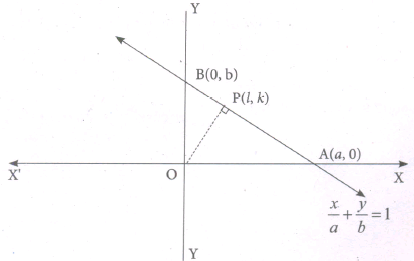
The given equation is x cos \(\alpha\) + y sin \(\alpha\) = p or \(\frac{x}{p/\cos\alpha}+\frac{y}{p/sin\alpha}=1\) ........(i)
This cuts the coordinate axes at \(A(p/\cos\alpha,0)\) and \(B(0,p/\sin\alpha)\). Let P (h, k)be the mid point of the intercept AB. Then,
\(h=\frac{p/\cos\alpha+0}{2},k=\frac{0+p/\sin\alpha}{2}\)
\(\Rightarrow h=\frac{p}{2\cos\alpha},k=\frac{p}{2\sin\alpha}\)
\(\Rightarrow \cos\alpha=\frac{p}{2h},\sin\alpha=\frac{p}{2k}\)
Here, u is a variable. to find the locus of P (h, k), we have to eliminate c.
From (i), we obtain
\(\cos^2\alpha+\sin^2\alpha=\frac{p^2}{4h^2}+\frac{p^2}{4k^2}\Rightarrow 1=\frac{p^2}{4h^2}+\frac{p^2}{4k^2}\Rightarrow \frac{4}{p^2}=\frac{1}{h^2}+\frac{1}{k^2}\)
Hence, the locus of (h, k) is \(\frac{1}{x^2}+\frac{1}{y^2}=\frac{4}{p^2}\)
35.
By unrolling the hollow cylinder and flattening it into a rectangle, and with a single reflection allows us to determine the ant's path, as shown the figure. Let the baseline x-axis in cm and the vertical line through A (initial position of the ant) be the y-axis. Let H be the position of honey drop and E be the entry point of ant inside the vessel. From the given information we have
Let A(x1, y1) and H(x2, y2) be (0, 4) and (12, 13) respectively.
(i) The shortest distance between A and H is
\(\sqrt{(x_2-x_1)^2+(y_2-y_1)^2}=\sqrt{12^2+9^2}=15\)
the ant would need to crawl 15 cm to get the honey.
(ii) The equation of the path AH is \(\frac{y-4}{13-4}=\frac{x-0}{12-0}\)
y = 0.75x + 4
(iii) At the entry point E, y = 10 ⇒ x = 8
E = (8, 10)
36.
Let p(n): be \(\left( 1+\frac { 1 }{ 1 } \right) \left( 1+\frac { 1 }{ 2 } \right) \left( 1+\frac { 1 }{ 3 } \right) ...\left( 1+\frac { 1 }{ n } \right) =\left( n+1 \right) \)
Step 1: p(1): \(( 1+\frac { 1 }{ 1 }) =\left( 1+1 \right) \)
\(\Rightarrow\) p(1):2 = 2
\(\Rightarrow\) p(1) is true.
Step 2: Let p(m) be true
\(\left( 1+\frac { 1 }{ 1 } \right) \left( 1+\frac { 1 }{ 2 } \right) \left( 1+\frac { 1 }{ 3 } \right) ...\left( 1+\frac { 1 }{ m } \right) =\left( m+1 \right) \)
Step 3: To prove that p(m + 1) is true
i.e. to prove that \(\left( 1+\frac { 1 }{ 1 } \right) \left( 1+\frac { 1 }{ 2 } \right) ...\left( 1+\frac { 1 }{ m } \right)\left( 1+\frac { 1 }{ m+1 } \right) =\left( m+2 \right) \)
LHS = \(\left( 1+\frac { 1 }{ 1 } \right) \left( 1+\frac { 1 }{ 2 } \right) ...\left( 1+\frac { 1 }{ m } \right)\left( 1+\frac { 1 }{ m+1 } \right) \)
= (m + 1) \(\left( 1+\frac { 1 }{ m+1 } \right)\) = m + 1 + 1
= (m + 2) = RHS
p(m + 1) is true.
By the principle of mathematical induction, p(n) is true for all \(n\in N\)
37.
(i) Let the x - axis represent the weight and the y-axis represent the length
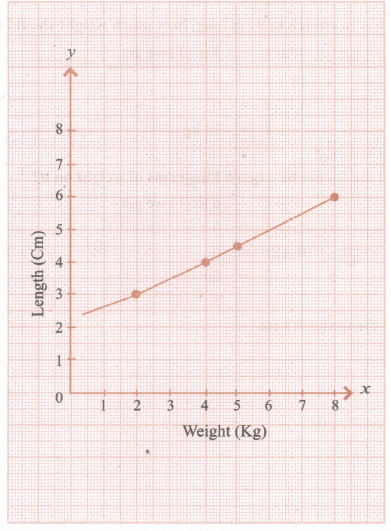
(ii) Consider the point \(\begin{pmatrix} { x }_{ 1 } & { y }_{ 1 } \\ 2 & 3 \end{pmatrix}\begin{pmatrix} { x }_{ 2 } & { y }_{ 2 } \\ 4 & 4 \end{pmatrix}\)
Equation of the straight line using two point form is
\(\frac { y-{ y }_{ 1 } }{ { y }_{ 2 }-{ y }_{ 1 } } =\frac { x-{ x }_{ 1 } }{ { x }_{ 2 }-{ x }_{ 1 } } \)
\(\Rightarrow \quad \frac { y-3 }{ 4-3 } =\frac { x-2 }{ 4-2 } \)
\(\Rightarrow \quad \frac { y-3 }{ 1 } =\frac { x-2 }{ 2 } \)
\(\Rightarrow\) 2y - 6 = x-2
\(\Rightarrow\) x - 2y + 4 = 0
(iii) To find the actual length of the spring,
Put x = 0
\(\Rightarrow\) 0 - 2y + 4 = 0
\(\Rightarrow\) -2y = -4
\(\Rightarrow\) y = 2 cm
(iv) Put y = 9 in (1) we get
\(\Rightarrow\) x - 18 + 4 = 0
\(\Rightarrow\) x - 14 = 0
\(\Rightarrow\) x = 14 kg
\(\therefore\) 14 Kg must be added
(v) Put x = 6 in (1) we get,
\(\Rightarrow\) 6 - 2y + 4 = 0
\(\Rightarrow\) 10 - 2y = 0
\(\Rightarrow\) 10 = 2y
\(\Rightarrow\) y = 5
\(\therefore\) Length of the spring = 5 cm
38.
Let R(h, k) be the locus of the mid-point of PQ where, P is (2, -7) and Q is a point on (2x2 + 9y2 = 18)
Given equation is 2x2 + 9y2 = 18
Dividing by 18 we get,
\(\Rightarrow \quad \frac { { x }^{ 2 } }{ 9 } +\frac { { y }^{ 2 } }{ 2 } =1\)
\(\Rightarrow \quad \frac { { x }^{ 2 } }{ { 3 }^{ 2 } } +\frac { { y }^{ 2 } }{ { \left( \sqrt { 2 } \right) }^{ 2 } } =1\)
\(\Rightarrow \quad a=3\quad and\quad b=\sqrt { 2 } \)
Any point on the ellipse is (a cos \(\theta\), b sin \(\theta\))
\(\therefore\) Q is (3 cos \(\theta\), \(\sqrt { 2 } \) sin \(\theta\)
Since R is the mid-point of PQ, we get, (h,k) = \(\left( \frac { 2+3cos\theta }{ 2 } ,\frac { -7+\sqrt { 2 } sin\theta }{ 2 } \right) \)
\(\Rightarrow \quad h=\frac { 2+3\quad cos\quad \theta }{ 2 } \)
\(\Rightarrow \quad 2h=2+3cos\theta \)
\(\Rightarrow \quad 2h-2=3cos\theta \)
\(\Rightarrow \quad \frac { 2h-2 }{ 3 } =cos\quad \theta \)
\(k=\frac { -7+\sqrt { 2 } sin\theta }{ 2 } \)
\(\Rightarrow \quad 2k=-7+\sqrt { 2 } sin\theta \)
\(\Rightarrow \quad 2k+7\quad =\quad \sqrt { 2 } sin\theta \)
\(\Rightarrow \quad \frac { 2k+7 }{ \sqrt { 2 } } =sin\quad \theta \)
Squaring and adding we get,
\({ \left( \frac { 2h-2 }{ 3 } \right) }^{ 2 }+{ \left( \frac { 2k+7 }{ \sqrt { 2 } } \right) }^{ 2 }={ cos }^{ 2 }\theta +{ sin }^{ 2 }\theta \)
\(\Rightarrow \quad \frac { { 4h }^{ 2 }+4-8h }{ 9 } +\frac { { 4k }^{ 2 }+49+28k }{ 2 } =1\quad [\because { cos }^{ 2 }\theta +{ sin }^{ 2 }\theta =1]\)
\(\Rightarrow \quad 2({ 4h }^{ 2 }+4-8h)=9({ 4k }^{ 2 }+49+28k)=18\)
\(\Rightarrow \quad { 8h }^{ 2 }+8-16h+36{ k }^{ 2 }+441+252k-18=0\)
\(\Rightarrow \quad { 8h }^{ 2 }+36{ k }^{ 2 }-16h+252k+431=0\)
\(\therefore\) Locus of (h,k) is
8x2+36y2-16x+252y+431=0
39.
Let = 6 + 66 + 666 + ... upto n terms
= 6 (1 + 11 + 111+ ....) upto n terms
\(={6\over9}(9+99+999+ ...)\) upto n terms
\(={63\over 6}[(10 -1) + (10^2-1) + (10^3 -1) + ...]\) upto n terms
\(={6\over 9}[(10+ 10^2 + 10^3+ ...) - (1+ 1+1...)]\) upto n terms
\(={6\over9}\left[{ 10(10^n-1)\over 10-1}n\right]\)[In a G.P with a = 10 r = 10, \(S_n={(r^n-1)\over r-1}\)]
\(={6\over9}\left[{ 10(10^n-1)\over 10-1}n\right]={6\over9}\left[ 10(10^n-1)-9n\over9\right]\)
\({ S }_{ n }=\frac { 6 }{ 81 } \left[ 10\left( { 10 }^{ n }-1 \right) -9n \right] \)
40.
Given equations are x2 - ax + b = 0 .....(1)
and x2 - ex + f = 0 .....(2)
Let \(\alpha\) be the common root.
Let \(\alpha ,\beta \) be the roots of x2 - ax + b = 0
Then \(\alpha +\beta =a\) and \(\alpha \beta =b\) ....(3)
Let \(\alpha\), \(\alpha\) be the roots of x2 - ex +f = 0 [\(\because\) the roots are equal]
\(\therefore\) \(\alpha\)+\(\alpha\) = e, \(\alpha \times \alpha =f\)
\(\Rightarrow\) \(2\alpha =e\) and \({ \alpha }^{ 2 }=f\) .....(4)
Now LHS = \(ae=\left( \alpha +\beta \right) 2\alpha \)
LHS = \(ae=2{ \alpha }^{ 2 }+2\alpha \beta \)
= 2(f) + 2b [From (4)]
= 2 (b + f) = RHS. Hence proved.
41.
Given \(x={{\sqrt{3}-\sqrt{2}}\over{\sqrt{3}+\sqrt{2}}}\)
Multiplying by the conjugate of the denominator we get,
\(x={{(\sqrt{3}-\sqrt{2})(\sqrt{3}-\sqrt{2})}\over{(\sqrt{3}+\sqrt{2})(\sqrt{3}-\sqrt{2})}}={{3-2\sqrt{6}+2}\over{({\sqrt{3}})^{2}-{(\sqrt{2})}^{2}}}\)
\(={{5-2\sqrt{6}}\over{3-2}}=5-2\sqrt{6}\)
Similarly, \(y={{\sqrt{3}+\sqrt{2}}\over{\sqrt{3}-\sqrt{2}}}\times{{\sqrt{3}+\sqrt{2}}\over{\sqrt{3}+\sqrt{2}}}\)
y \(={{3+2+2\sqrt{6}}\over{{(\sqrt{3})}^{2}-{(\sqrt{2})}^{2}}}={{5+2\sqrt{6}}\over{3-2}}=5+2\sqrt{6}\)
Now, x+y\(=5-2\sqrt{6}+5+2\sqrt{6}=10\)
and xy \(= (5-2\sqrt{6})(5+2\sqrt{6})=5^2-(2\sqrt{6})^2=25-4(6)=25-24=1. \)
We know that
x2 + xy + y2 = (x + y)2 - xy = 102 - 1 = 100 - 1 = 99
42.
f(-4) = +4 + 4 [\(\therefore\) f(x) = -x + 4 when x = -4]
=8
f(1) = 1-12 [\(\therefore\) f(x) = x-x2 when x = 1]
f(1) = 0
f(-2) = (-2)2-(-2) [\(\therefore\) f(x) = x2-x when x = -2]
= 4+2 = 6
f(7) = 0 [\(\therefore\) f(x) = 0 when x = 7]
f(0 = 02-0 [\(\therefore\) f(x) = x2 - x when x = 0]
=0
\(\therefore\) f(-4) = 8, f(1) = 0, f(-2) = 6, f(7) = 0 and f(0) = 1
43.
Take u = x3-1 so that
y = u100
and \({dy \over dx}={dy\over du}\times {du\over dx}\)
= 100u100-1 \(\times\) (3x2-0)
= 100(x3-1)99 \(\times\) 3 x2
= 300 x2(x3-1)99.
44.
\(lim_{x\rightarrow3}(4-x)\)
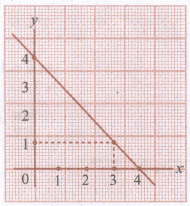
At x = 3, the value of the curve on y-axis is 1.
\(\therefore lim_{x\rightarrow3}(4-x)=1\)
45.
Let \( f(x)=\frac{\cos x-1}{x}
\)
\(\therefore \lim _{x \rightarrow 0} \frac{\cos x-1}{x}=0\)
46.
Let \(l={2\over \sqrt{2}},m={1\over2}\) and \(n={1\over2}\)
\(\therefore l^2+m^2+n^2=({1\over \sqrt{2}})^2+({1\over2})^2+({1\over2})^2\)\(={1\over2}+{1\over4}+{1\over 4}={2+1+1\over4}={4\over4}=1\)
Hence, the given ratios are direction cosines of some vector.
47.
By the definition of sum of matrices, we have
\(A+B+C=\left[\begin{array}{cc}
\sin ^2 \theta+\cos ^2 \theta+0 & 1+0-1 \\
\cot ^2 \theta-\operatorname{cosec}^2 \theta-1 & 0+1+0
\end{array}\right]=\left[\begin{array}{cc}
1 & 0 \\
-2 & 1
\end{array}\right]\)
48.
= \(\frac { 12\times 11\times 10\times 9! }{ 9!\quad 3\times 2 } =\frac { 12\times 11\times 10 }{ 6 } \)
= 2 \(\times\) 11 \(\times\) 10 = 220

11th Standard Syllabus & Materials
11th Standard
TN 11th Tamil பீடு பெற நில் - செய்யுள் - காவடிச்சிந்து Important Questions And Answers Study Material - QB365 Set A
NEW11th Standard
TN 11th Tamil பீடு பெற நில் - உரைநடை - மலை இடப்பெயர்கள் : ஓர் ஆய்வு Important Questions And Answers Study Material - QB365 Set A
NEW11th Standard
TN 11th Tamil மாமழை போற்றுதும் - துணைப்பாடம் - யானை டாக்டர் Important Questions And Answers Study Material - QB365 Set A
NEW11th Standard
TN 11th Tamil மாமழை போற்றுதும் - செய்யுள் - ஐங்குறுநூறு Important Questions And Answers Study Material - QB365 Set A



Tamilnadu Stateboard 11th Standard Subjects
Maths

Commerce

Economics

Biology

Business Maths and Statistics

Accountancy

Computer Science

Physics

Chemistry
Maths
Biology
Economics
Physics
Chemistry

History
Business Maths and Statistics

Computer Science
Accountancy

Computer Applications
History
Computer Technology
Commerce
Computer Applications
Computer Technology

Tamil

English

French
Tamilnadu Stateboard Standards

