
 100% FREE ACCESS
11th Standard Syllabus & Materials
11th Standard
TN 11th Tamil இயற்கை வேளாண்மை,சுற்றுச்சூழல் -செய்யுள் - மனோன்மணீயம் Important Questions And Answers Study Material - QB365 Set A
NEW11th Standard
TN 11th Tamil என்னுயிர் என்பேன் -துணைப்பாடம் - இசைத்தமிழர் இருவர் Important Questions And Answers Study Material - QB365 Set A
NEW11th Standard
TN 11th Tamil மொழி கலை -செய்யுள் - ஒவ்வொரு புல்லையும் Important Questions And Answers Study Material - QB365 Set A
NEW11th Standard
TN 11th Tamil பீடு பெற நில் - இலக்கணம் - பகுபத உறுப்புகள் Important Questions And Answers Study Material - QB365 Set A
NEW11th Standard
TN 11th Tamil பீடு பெற நில் - துணைப்பாடம் - வாடிவாசல் Important Questions And Answers Study Material - QB365 Set A
NEW11th Standard
TN 11th Tamil பீடு பெற நில் - செய்யுள் - குறுந்தொகை Important Questions And Answers Study Material - QB365 Set A

Published on: 18/02/2019
11th Second Revision Test 2019
Download Tamil Nadu 11th Standard Maths question papers, model tests, one-mark questions, important questions, and public exam papers in PDF format. Free study materials and answer keys for TN State Board students.
Questions + Answers key
Take MCQ Maths Test1.
\(\int { x } \) sin x dx = -x cos x + a, then a =
sin x + c
cos x + c
c
none of these
2.
If P(A\(\cup \)B) = 0.8 and P(A\(\cap \)B) = 0.3 then \(P(\bar { A } )+P(\bar { B } )\) =
0.3
0.5
0.7
0.9
3.
For what values of x is the rate of increase of x3 - 2x2 + 3x + 8 is twice the rate of increase of x?
\(\left( -\frac { 1 }{ 3 } ,-3 \right) \)
\(\left( \frac { 1 }{ 3 } ,3 \right) \)
\(\left( -\frac { 1 }{ 3 } ,3 \right) \)
\(\left( \frac { 1 }{ 3 } ,1 \right) \)
4.
If A is a square matrix of order 3, then the number of minors in determinant of A are _____________
3
21
9
27
5.
A number x is chosen at random from the first 100 natural numbers. Let A be the event of numbers which satisfies\({(x-10)(x-50)\over x-30}\ge0\), then P(A) is
0.20
0.51
0.71
0.70
6.
\(\int \frac{x^2+\cos ^2 x}{x^2+1} \operatorname{cosec}^2 x d x\) is
cot x + sin -1x + c
-cot x + tan-1x + c
-tan x + cot-1x + c
-cot x - tan-1x + c
7.
If y = \({1\over4}u^4,u={2\over 3}x^3+5,\) then \({dy\over dx}\) is
\({1\over 27}x^2(2 x^3+15)^3\)
\({2\over 27}x(2 x^3+5)^3\)
\({2\over 27}x^2(2 x^3+15)^3\)
\(-{2\over 27}x(2 x^3+5)^3\)
8.
\(lim_{\alpha \rightarrow {\pi/4}}{sin \alpha -cos \alpha \over \alpha -{\pi\over 4}}\) is
\(\sqrt{2}\)
\(1\over \sqrt{2}\)
1
2
9.
If \(\overrightarrow{a},\overrightarrow{b}\) are the position vectors A and B, then which one of the following points whose position vector lies on AB, is
\(\overrightarrow{a}+\overrightarrow{b}\)
\({2\overrightarrow{a}-\overrightarrow{b}\over 2}\)
\({2\overrightarrow{a}+\overrightarrow{b}\over 3}\)
\({\overrightarrow{a}-\overrightarrow{b}\over 3}\)
10.
If the square of the matrix \(\begin{bmatrix} \alpha & \beta \\ \gamma & -\alpha \end{bmatrix}\) is the unit matrix of order 2, then \(\alpha ,\beta \) and \(\gamma\) should satisfy the relation.
1 + \(\alpha ^2+\beta \gamma=0\)
1 - \(\alpha ^2-\beta \gamma=0\)
1 - \(\alpha ^2+\beta \gamma=0\)
1 + \(\alpha ^2-\beta \gamma=0\)
11.
If the points (2k, k) (k, 2k) and (k, k) enclose a triangle of area 18 sq units, then the centroid of the triangle is ______________
(8, 8)
(4, 4)
(3, 3)
(2, 2)
12.
If \(\alpha\) and \(\beta\) are two values of θ obtained from the equation a cos θ + b sin θ = c then the value of \(tan(\frac{\alpha+\beta}{2})\) is _______________
\(\frac{a}{b}\)
\(\frac{b}{a}\)
\(\frac{c}{a}\)
\(\frac{c}{b}\)
13.
If sin(45 ° + 10°) - sin(45° -10°) = \(\sqrt{2}\)sin x then x is ___________
0o
5°
10°
15°
14.
If nPr = 720, nCr = 120 then r is _________
2
4
3
5
15.
If 7x2 - 8xy +A = 0 represents a pair of perpendicular lines, the A is ______________
7
-7
-8
8
16.
The number of ways to arrange the letters of the word CHEESE are _________
120
240
720
6
17.
The nth term of the sequence \(\frac { 1 }{ 2 } ,\frac { 3 }{ 4 } ,\frac { 7 }{ 8 } ,\frac { 15 }{ 6 } \),......is
2n - n - 1
1 - 2-n
2-n + n - 1
2n-1
18.
If \(\frac { |x-2| }{ x-2 } \ge 0\), then x belongs to
\([2,\infty]\)
\((2,\infty )\)
\((-\infty,2)\)
\((-2,\infty )\)
19.
The number of students who take both the subjects Mathematics and Chemistry is 70. This represents 10% of the enrollment in Mathematics and 14% of the enrollment in Chemistry. The number of students take at least one of these two subjects, is
1120
1130
1100
insufficient data
20.
For real numbers x and y, define xRy if x - y + √2 is an irrational number. Then the relation R is __________
reflexive
symmetric
transitive
none of these
21.
If x = \(a\sec ^{ 3 }{ \theta }\) and \(y=a\tan ^{ 3 }{ \theta }\) find \(\frac { dy }{ dx }\) at \(\theta =\frac { \pi }{ 3 }\)
22.
Integrate the following functions with respect to x : \({1\over \sqrt{1-81x^2}}\)
23.
Consider the functions:(i) y = ex; (ii) y = logeX.
24.
Write the first six terms of the sequences given by a1 = a2 = 1, an = an-1+ an-2 (n ≥ 3)
25.
Find the value of \(cot(\frac{-15\pi}{4})\).
26.
If the angle between two lines is \(\frac{\pi}{4}\) and slope of one of the line is \(\frac{1}{2}\) find the slope of the other line
27.
What is the length of the arc intercepted by a central angle of measure 410 in a circle radius 10 ft ?
28.
Evaluate log \({{(\sqrt{\sqrt{625}+11})(\sqrt{64})}\over{\sqrt{\sqrt [ 5 ]{ 3125 }+\sqrt{\sqrt [ 3 ]{ 343 } } }}}\)
29.
Let A, Band C represent the angles of a \(\triangle\)ABC and a, band c represent the lengths of the sides opposite to them, then prove that a2 = b2 + c2 - 2bc cos A (Law of cosines)
30.
Evaluate \(\int { \frac { { x }^{ 2 }{ tan }^{ -1 }\left( { x }^{ 3 } \right) }{ 1+{ x }^{ 6 } } } \)dx
31.
for a loaded die, the probabilities of outcomes are given as under
P(1) = P(2) = \(\frac { 2 }{ 10 } \), P(3) = P(5) = P(6) = \(\frac { 1 }{ 10 } \) and P(4) = \(\frac { 3 }{ 10 } \)
The die is thrown 2 times. Let A and B be the events as defined below
A: Getting same number each time
B: Getting a total score of 10 or more
Discuss the independency of the events A and B
32.
Differentiate \({ \left( \sin { x } \right) }^{ { \cos { ^{ -1x } } } }\) with respect to 'x'.
33.
A town has 2 fire engines operating independently. The probability that a fire engine is available when needed is 0.96.
(i) What is the probability that a fire engine is available when needed?
(ii) What is the probability that neither is available when needed?
34.
Evaluate the following : \(\int \sqrt{(x-3)(5-x)}dx\)
35.
Evaluate the following limits :\(lim_{x\rightarrow0}{e^x-e^{-x}\over sin x}\)
36.
Find the value of the product \(\begin{vmatrix} log_364 &log_43 \\ log_38 & log_49 \end{vmatrix}\times \begin{vmatrix} log_23 & log_83 \\ log_34 & log_34 \end{vmatrix}\)
37.
By the principle of mathematical induction, prove that, for all integers n \(\ge\)1, 1 + 2 + 3+....+n = \({n(n+1)\over2}\) .
38.
Find the values of k so that the equation x2 = -2x(1 + 3k) + 7(3 + 2k) = 0 has real and equal roots.
39.
Find the equation of the line passing through the point of intersection 2x + y = 5 and x + 3y + 8 = 0 and parallel to the line 3x +4y = 7.
40.
The Government plans to have a circular zoological park of diameter 8 km. A separate area in the form of a segment formed by a chord of length 4 km is to be allotted exclusively for a veterinary hospital in the park. Find the area of the segment to be allotted for the veterinary hospital.
41.
The sum of the distance of a moving point from the points (4, 0) and (-4, 0) is always 10 units. Find the equation to the locus of the moving point.
42.
Compute the sum of first n terms of the following series 8 + 88 + 888 + .......
43.
The ratio of the number of boys to the number of girls in a class is 1:2. It is known that the probability of a girl and a boy getting a first class are 0.25 and 0.28 respectively. Find the probability that a student chosen at random will get first class?
44.
Evaluate \(\lim _{ x\rightarrow 2 }{ \frac { { x }^{ 2 }-3x+2 }{ { x }^{ 2 }-x-2 } } \)
45.
Integrate the following with respect to x : \({1\over \sqrt{1-25 x^2}}\)
46.
Find the derivatives of the following functions using first principle. f(x) = - x2 + 2
47.
Calculate \(lim_{x \rightarrow \infty}{1-x^3\over 3x+2}\)
48.
Find a direction ratio and direction cosines of the following vectors \(3\hat{i}+4\hat{j}-6\hat{k}\)
49.
Check the following functions for one-to-oneness and ontoness.
(i) \(f:N\rightarrow N\) defined by f(n) = n2.
(ii) \(f: \mathbb{R} \rightarrow \mathbb{R}\) defined by f(n) = n2.
50.
If X = {1, 2, 3, .. 10} and A = {1, 2, 3, 4, 5}, find the number of sets \(B\subseteq X\) such that A - B = {4}.
51.
Find the general term in the expansion of \({ \left( \frac { 4x }{ 5 } -\frac { 5 }{ 2x } \right) }^{ 9 }\)
52.
Write down all the permutations of the vowels A, E, I, O, U in English alphabets taking three at a time starting with A.
53.
Show that the lines are 3x + 2y + 9 = 0 and 12x + 8y - 15 = 0 are parallel lines.
1.
(a)
sin x + c
2.
(d)
0.9
3.
(d)
\(\left( \frac { 1 }{ 3 } ,1 \right) \)
4.
(c)
9
5.
The equation is not valid for 1 to 9. 30 to 49
(i.e) for 9 + 20 = 29 numbers
Valid for 10 to 29 and 50 to 100 = 71 numbers
n(A) = 71, n(S) = 100
\(\mathrm{P}(\mathrm{A})=\frac{71}{100}=0.71\)
6.
\(\int \frac{x^{2}+\cos ^{2} x}{x^{2}+1} \operatorname{cosec}^{2} x d x \)
\(=\int \frac{x^{2}+\left(1-\sin ^{2} x\right)}{x^{2}+1} \times \frac{1}{\sin ^{2} x} d x \)
\(=\int \frac{\left(x^{2}+1\right)-\sin ^{2} x}{\left(x^{2}+1\right) \sin ^{2} x} d x \)
\(=\int\left(\frac{1}{\sin ^{2} x}-\frac{1}{x^{2}+1}\right) d x \)
\(=\int\left(\operatorname{cosec}^{2} x-\frac{1}{x^{2}+1}\right) d x \)
\(=-\cot x-\tan ^{-1} x+c \)
7.
\(u =\frac{2}{3} x^{3}+5 \)
\(\frac{d u}{d x} =\frac{2}{3}\left(3 x^{2}\right)=2 x^{2} \)
\(y =\frac{1}{4} u^{4} \)
\(\frac{d y}{d x} =\frac{1}{4}\left(4 u^{3}\right) \frac{d u}{d x}=u^{3}\left(2 x^{2}\right) \)
\(=\left(\frac{2}{3} x^{3}+5\right)^{3}\left(2 x^{2}\right) \)
\(=\left(\frac{2 x^{3}+15}{3}\right)^{3} \times 2 x^{2}=\frac{\left(2 x^{3}+15\right)^{3}}{27}\left(2 x^{2}\right) \)
8.
We know that,
\(\sin \alpha-\cos \alpha =\sqrt{2}\left[\frac{1}{\sqrt{2}} \sin \alpha-\frac{1}{\sqrt{2}} \cos \alpha\right] \)
\(=\sqrt{2}\left[\cos \frac{\pi}{4} \sin \alpha-\sin \frac{\pi}{4} \cos \alpha\right] \)
\(=\sqrt{2} \sin \left(\alpha-\frac{\pi}{4}\right) \)
\(\therefore \lim _{\alpha \rightarrow \frac{\pi}{4}} \frac{\sin \alpha-\cos \alpha}{\alpha-\frac{\pi}{4}} =\lim _{\alpha-\frac{\pi}{4} \rightarrow 0} \frac{\sqrt{2} \sin \left(\alpha-\frac{\pi}{4}\right)}{\left(\alpha-\frac{\pi}{4}\right)}=\sqrt{2}
\)
9.
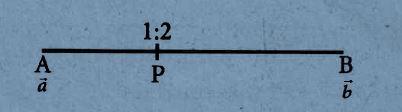
\(\vec{m}=\frac{|\vec{b}+2 \vec{a}|}{1+2}=\frac{2 \vec{a}+\vec{b}}{3}\)
10.
\(\text { Given } \text {matrix } A=\left[\begin{array}{cc} \alpha & \beta \\ \gamma & -\alpha \end{array}\right] \text { is unit matrix }\)
\(|A|=1 \)
\(-\alpha^{2}-\beta \gamma=1 \)
\(1+\alpha^{2}+\beta \gamma=0 \)
11.
(a)
(8, 8)
12.
(b)
\(\frac{b}{a}\)
13.
(c)
10°
14.
(c)
3
15.
(b)
-7
16.
(a)
120
17.
\(n^{\text {th }} \text { term }=1-\frac{1}{2^{n}}=1-2^{-n}\)
18.
\(\text { In }(-\infty, 2), \frac{|x-2|}{x-2} \text { is negative }\)
\(\operatorname{In}[2, \infty), \frac{|x-2|}{x-2} \geq 0\)
19.
\(M \cap C=70 \text { which is } 10 \% \text { of } M \text { and } 14 \% \text { of } C\)
\(M =700, C=500\)
\(M \cup C=700+500-70=1130\)
20.
(a)
reflexive
21.
\(x=a\sec ^{ 3 }{ \theta } \)
\(\Rightarrow \frac { dx }{ d\theta } =3a\sec ^{ 2 }{ \theta } .\frac { d }{ d\theta } (\sec { \theta } )=3a\sec ^{ 2 }{ \theta } .\sec { \theta } \tan { \theta } =3a\sec ^{ 3 }{ \theta } \tan { \theta } \)
\(y=a\tan ^{ 3 }{ \theta } \)
\(\Rightarrow \frac { dy }{ d\theta } =a.3\tan ^{ 2 }{ \theta } .\frac { d }{ d\theta } (\tan { \theta } )=3a\tan ^{ 2 }{ \theta } .\sec ^{ 2 }{ \theta } \)
\(\frac { dy }{ dx } =\frac { dy }{ d\theta } /\frac { dx }{ d\theta } =\frac { 3a\tan ^{ 2 }{ \theta } \sec ^{ 2 }{ \theta } }{ 3a\sec ^{ 3 }{ \theta } \tan { \theta } } =\frac { \tan { \theta } }{ \sec { \theta } } =\frac { \sin { \theta } }{ \cos { \theta \times \frac { 1 }{ \cos { \theta } } } } =\sin { \theta } \)
\(\therefore \frac { dy }{ dx } \quad at\quad \theta =\frac { \pi }{ 3 } =\sin { \frac { \pi }{ 3 } } =\frac { \sqrt { 3 } }{ 2 } \)
22.
\(\int { \frac { dx }{ \sqrt { 1-{ 81x }^{ 2 } } } } =\int { \frac { dx }{ \sqrt { 1-\left( 9x \right) ^{ 2 } } } } =\frac { sin^{ -1 }\left( 9x \right) }{ 9 } +c\)
23.
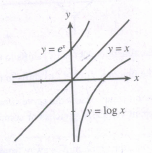
We know that, y = ex is the inverse function of y = logex and hence y = ex is the reflection of y -= logex about y = x.
24.
Here a1 = a2 = 1,an = an-1 + an-2 (n≥3)
Putting n = 3, a3 = a2 + a1 = 1 + 1= 2
Putting n = 4, a4 = a3 + a2 = 2 + 1= 3
Putting n=5, a5 = a4 + a3 = 3 + 2 = 5
Putting n = 6, a6 = a5 + a4 = 5 + 3 = 8
First six terms of the sequence are 1, 1, 2, 3, 5, 8.
25.
\(cot(\frac{-15\pi}{4})=-cot(\frac{15\pi}{4})=-cot(4\pi-\frac{\pi}{4})=cot\frac{\pi}{4}=1\)
26.
The acute angle \(\theta\) between two lines with slopes m1 and m2 is
\(\tan\theta=\left|\frac{m_1-m_2}{1+m_1m_2}\right|\)
Let \(m_1=\frac{1}{2}\) and m2=m,\(\theta=\frac{\pi}{4}\)
\(\Rightarrow\tan\frac{\pi}{4}=\left|\frac{\frac{1}{2}-m}{1+\frac{1}{2}m}\right|\)
\(\Rightarrow1=\left|\frac{1-2m}{2+m}\right|\)
\(\Rightarrow1=\pm\frac{1-2m}{2+m}\Rightarrow2+m=\pm(1-2m)\)
If 2+m=1-2m\(\Rightarrow\)3m=-1\(\Rightarrow m=\frac{-1}{3}\)
If 2+m=-1+2m
m=3
Hence, the slope of the other line is 3 or \(-\frac{1}{3}\)
27.
Given Central angle \(\theta\) = 41o
⇒ \(\theta\) = 41 x \(\frac { \pi }{ 180 } =\frac { 41\pi }{ 180 } \) radians
and radius of the circle = 10 ft
Let l cm be the length of the arc, subtending the angle then
\(\theta =\frac { 1 }{ r } \Rightarrow l={ r }^{ \theta }\)
∴ \(l=10\times \frac { 41\pi }{ 180 } =10\times 41\times \frac { 22 }{ 7\times 180 } \)
∴ \(l=10\times \frac { 41\times 11 }{ 7\times 9 } =\frac { 451 }{ 63 } \)
= 7.158 = 7.16 ft
28.
log \({{(\sqrt{\sqrt{625}+11})(\sqrt{64})}\over{\sqrt{\sqrt [ 5 ]{ 3125 }+\sqrt{\sqrt [ 3 ]{ 343 } } }}}\)
\(=\log{{\sqrt{25+11}(8)}\over{\sqrt{5}+7}}\)
\(\left[ \because \sqrt{625} \ =25 \\ \sqrt [ 5]{ 3125 } ={5}^{5\times1/5}=5\\ \sqrt [ 3 ]{ 343 }=(7^3) ^{1/3}=7\right]\)
\(=\log\left({{\sqrt{36}\times8}\over{\sqrt{12}}} \right)\)
\(=\log\left({{6\times8}\over{2\sqrt{3}}}\right)=\log{{3\times8}\over{\sqrt{3}}}\)
\(=\log8+{{1}\over{2}}\log\ 3\)
\(=0.9031+{{1}\over{2}}(0.4771)\)
= 1.1416
29.
Let \(\overrightarrow{BC}=\overrightarrow{a},\overrightarrow{AC}=\overrightarrow{b},\overrightarrow{BA}=\overrightarrow{c}\)
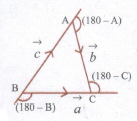
Then \(|\overrightarrow{a}|=a,|\overrightarrow{b}|=b,\) and \(|\overrightarrow{c}|=c\)
Since \(\overrightarrow{BC}=\overrightarrow{BA}+\overrightarrow{AC}\)
We have \(\overrightarrow{a}=\overrightarrow{c}+\overrightarrow{b}\) and angle between \(\overrightarrow{c}\) and \(\overrightarrow{b}\) is (180-A)
\(=|\overrightarrow{a}|^2=|\overrightarrow{c}+\overrightarrow{b}|^2=|\overrightarrow{c}|^2+|\overrightarrow{b}|^2+2|\overrightarrow{c}||\overrightarrow{b}|cos (180-A)\)
\(=c^2+b^2+2cb \ cos (180-A)\)
\(=b^2+c^2-2cb \ cos A\) \([\because cos(180-A)=-cos \ A]\)
30.
Let I = \(\int { \frac { { x }^{ 2 }{ tan }^{ -1 }\left( { x }^{ 3 } \right) }{ 1+{ x }^{ 6 } } } dx=\int { \frac { { x }^{ 2 }{ tan }^{ -1 }\left( { x }^{ 3 } \right) }{ 1+\left( { x }^{ 3 } \right) ^{ 2 } } } \)dx
put x3 = t \(\Rightarrow\) 3x2 dx = dt \(\Rightarrow\) x2 dx = \(\frac { dt }{ 3 } \)
I = \(\int { \frac { tan^{ -1 }(t) }{ 1+{ t }^{ 2 } } } .\frac { dt }{ 3 } =\frac { 1 }{ 3 } \int { \frac { tan^{ -1 }(t) }{ 1+{ t }^{ 2 } } } dt\)
Let tan-1 (t) = u \(\Rightarrow\) \(\frac { dt }{ 1+{ t }^{ 2 } } \) = du
I = \(\frac { 1 }{ 3 } \int { udu } =\frac { 1 }{ 3 } \left( \frac { { u }^{ 2 } }{ 2 } \right) +c=\frac { { u }^{ 2 } }{ 6 } +c=\frac { 1 }{ 6 } \left[ { tan }^{ -1 }\left( t \right) \right] ^{ 2 }+c\) [\(\therefore\)u = tan-1 (t)]
= \(\frac { 1 }{ 6 } \left[ { tan }^{ -1 }\left( x^{ 3 } \right) \right] ^{ 2 }+c\) [\(\because\) t = x3]
31.
A = {(1, 1) (2, 2) (3, 3) 94, 4) (5, 5) (6, 6)}
B = {(4, 6) (6, 4) (5, 5) (6, 5) (5, 6) (6, 6)}
A\(\cap \)B = {(6, 6) (5, 5)}
\(\therefore\) P(A) = P(1, 1) +P(2, 2)+P(3, 3)+P(4, 4) +P(5, 5) +P96, 6)
= P(1). P(1)+P(2).P(2) + P(3).P(3) +P(4).P(4) +P(5).P(5)+P(6).P(6)
\(=\frac { 2 }{ 10 } \times \frac { 2 }{ 10 } +\frac { 2 }{ 10 } \times \frac { 2 }{ 10 } \times \frac { 1 }{ 10 } \times \frac { 1 }{ 10 } +\frac { 3 }{ 10 } \times \frac { 3 }{ 10 } +\frac { 1 }{ 10 } \times \frac { 1 }{ 10 } +\frac { 1 }{ 10 } \times \frac { 1 }{ 10 } \)
\(=\frac { 4 }{ 100 } +\frac { 4 }{ 100 } +\frac { 1 }{ 100 } +\frac { 9 }{ 100 } +\frac { 1 }{ 100 } +\frac { 1 }{ 100 } =\frac { 20 }{ 100 } =\frac { 1 }{ 5 } \)
P(B) = P(4, 6) + p(6, 4) + P(5, 5) + P(6, 5) + P(5, 6) + P(6, 6)
\(=\frac { 3 }{ 10 } \times \frac { 1 }{ 10 } +\frac { 1 }{ 10 } \times \frac { 3 }{ 10 } +\frac { 1 }{ 10 } \times \frac { 1 }{ 10 } +\frac { 1 }{ 10 } \times \frac { 1 }{ 10 } +\frac { 1 }{ 10 } \times \frac { 1 }{ 10 } +\frac { 1 }{ 10 } \times \frac { 1 }{ 10 } \)
\(=\frac { 3 }{ 100 } +\frac { 3 }{ 100 } +\frac { 1 }{ 100 } +\frac { 1 }{ 100 } +\frac { 1 }{ 100 } +\frac { 1 }{ 100 } =\frac { 10 }{ 100 } =\frac { 1 }{ 10 } \)
\(P(A\cap B)\) = P95, 5) + P(6, 6) = P(5).P(5)+P(6).P(6)
\(=\frac { 1 }{ 10 } \times \frac { 1 }{ 10 } +\frac { 1 }{ 10 } \times \frac { 1 }{ 10 } =\frac { 1 }{ 100 } +\frac { 1 }{ 100 } =\frac { 2 }{ 100 } =\frac { 1 }{ 50 } \)
\(\therefore\) P(A\(\cap \)B) = P(A) \(\times\) P(B)
\(\frac { 1 }{ 50 } =\frac { 1 }{ 5 } \times \frac { 1 }{ 10 } =\frac { 1 }{ 50 } \)
Hence A and B are independent events.
32.
Let y = \({ \left( \sin { x } \right) }^{ { \cos { ^{ -1x } } } }\)
Taking logarithm on both sides we get,
\(\log { y } =\cos ^{ -1 }{ x.\log { (\sin { x } ) } } \)
Differentiating both sides with respect to 'x', we get
\(\frac { 1 }{ y } \frac { dy }{ dx } =\cos ^{ -1 }{ x. } \frac { d }{ dx } (\log { \sin { x } } )+\log { \sin { x. } \frac { d }{ dx } } (\cos ^{ -1 }{ x } )\)
\(\Rightarrow \frac { 1 }{ y } \frac { dy }{ dx } =\cos ^{ -1 }{ x. } \frac { 1 }{ \sin { x } } .\cos { x } +\log { (\sin { x) } } \left( \frac { -1 }{ \sqrt { 1-{ x }^{ 2 } } } \right) =\cos ^{ -1 }{ x. } \cot { x } -\frac { \log { \sin { x } } }{ \sqrt { 1-{ x }^{ 2 } } } \)
\(\therefore \frac { dy }{ dx } =y\left[ \cos ^{ -1 }{ x. } \cot { x } -\frac { \log { \sin { x } } }{ \sqrt { 1-{ x }^{ 2 } } } \right] \Rightarrow \frac { dy }{ dx } ={ \left( \sin { x } \right) }^{ { \cos { ^{ -1x } } } }\left[ \cos ^{ -1 }{ x. } \cot { x } -\frac { \log { \sin { x } } }{ \sqrt { 1-{ x }^{ 2 } } } \right] \)
33.
Let A'and B be the availability of first and second fire engine respectively, then A and B are independent.
Then \(P(A)=P(B)=0.96 \)
\(P(\bar{A})=P(\bar{B})=1-0.96=0.04\)
(i) P(a fire engine is available when needed)
\(=P(A \cap \bar{B})+P(\bar{A} \cap B)+P(A \cap B)\)
\(=P(A) \cdot P(\bar{B})+P(\bar{A}) \cdot P(B)+P(A) \cdot P(B)\)
\(=0.96 \times 0.04+0.04 \times 0.96+0.96 \times 0.96\)
\(=0.96(0.04+0.04+0.96) \)
\(=0.96 \times 1.04 \)
\(=0.9984\)
(ii) P (Neither is available when needed)
\(=P(\bar{A} \cap \bar{B}) \)
\(=P(\bar{A}) \cdot P(\bar{B})\)
\(=0.04 \times 0.04\)
\(=0.0016\)
34.
Let I = \(\int \sqrt{(x-3)(5-x)}dx\)
\(=\int \sqrt{8x-x^2-15}dx\)
\(=\int \sqrt{1^2-(x-4)^2}dx\)
\(={x-4\over 2}\sqrt{1^2-(x-4)^2}+{1\over2}sin^{-1}({x-4\over 1})+c\)
Therefore, I \(={x-4\over 2}\sqrt{8x-x^2-15}+{1\over2}sin^{-1}({x-4})+c\)
35.
\(lim_{x\rightarrow0}{e^x-e^{-x}\over sin x}\)\(=lim_{x\rightarrow0}{e^x-1-e^{-x}+1\over {sin x\over x}\times x}\)
\(=lim_{x\rightarrow0}{{e^x-1\over x}-{(e^{-x}+1)\over x}\over {sin x\over x}}\)
\(={(lim_{x\rightarrow 0}{e^x-1\over x})-(lim_{x\rightarrow 0}{e^{-x}-1\over x})\over (lim_{x\rightarrow 0}{sin x\over x})}\) \((\because lim_{x\rightarrow 0}{e^x-1\over x})=1\)
\({1-(-1)\over 1}={2\over1}=2\)
36.
\(\begin{vmatrix} log_364 &log_43 \\ log_38 & log_49 \end{vmatrix}\times \begin{vmatrix} log_23 & log_83 \\ log_34 & log_34 \end{vmatrix}\) = \(\left| \begin{matrix} { log }_{ 3 }64.{ { log }_{ 2 }3+log }_{ 4 }3.{ log }_{ 3 }4 & { log }_{ 3 }64.{ log }_{ 8 }3+{ log }_{ 4 }3.{ log }_{ 3 }4 \\ { log }_{ 3 }8.{ log }_{ 2 }3+{ log }_{ 4 }9.{ log }_{ 3 }4 & { log }_{ 3 }8.{ log }_{ 8 }3+{ log }_{ 4 }9.{ log }_{ 3 }4 \end{matrix} \right| \)
= \(\left| \begin{matrix} { log }_{ 2 }64+1 & { log }_{ 8 }64+1 \\ { log }_{ 2 }8+{ log }_{ 3 }9 & 1+{ log }_{ 3 }9 \end{matrix} \right| [\therefore { log }_{ y }x.{ log }_{ x }y=1]\)
= \(\left| \begin{matrix} { log }_{ 2 }{ 2 }^{ 6 }+1 & { log }_{ 8 }{ 8 }^{ 2 }+1 \\ { log }_{ 2 }{ 2 }^{ 3 }+{ log }_{ 3 }{ 3 }^{ 2 } & 1+{ log }_{ 3 }{ 3 }^{ 2 } \end{matrix} \right| [\therefore { log }_{ x }x=1]\)
= \(\left| \begin{matrix} 6+1 & 2+1 \\ 3+2 & 1+2 \end{matrix} \right| =\left| \begin{matrix} 7 & 3 \\ 5 & 3 \end{matrix} \right| \) = 21 - 15 = 6
37.
Let,
p(n) : = 1 + 2 + 3 +....+n = \({n(n+1)\over2}\) .
Substituting the value of n = 1, in the statement we get, P(1) = \({1(1+1)\over2}\) = 1. Hence, P(1) is true.
Let us assume that the statement is true for n = k. Then
P(k) = 1 + 2 + 3 + .... + k = \({k(k+k)\over2}\)
We need to show that P(k + 1) is true. Consider.
P(k+1) = \(\underbrace { 1+2+3+......+k } \) + (k + 1) = \({k(k+1)\over2}+(k+1)\)
That is, P(k + 1) = \({k(k+1)+2(k+1)\over2}={(k+1)(k+2)\over2}\)
This implies, P(k + 1) is true. The validity of P(k + 1) follows from that of P(k). Therefore by the principle of mathematical induction, for all integers n \(\ge\),
1 + 2 + 3 + .... + n = \({n(n+1)\over2}\)
38.
The equation is x2 = -2x(1+3k)+7(3+2k) = 0
The roots are real and equal
⇒ Δ = 0 (i.e) b2- 4ac = 0
Here a = 1, b = -2(1+ 3k), c = 7(3 + 2k)
So b2-4ac = 0 ⇒ [-2(1+3k)]2 - 4(1) (7) (3 + 2k) = 0
(i.e) 4(1 + 3k)2-28(3 + 2k) = 0
(÷ by 4) (1 + 3k)2 - 7(3 + 2k) = 0
1 + 9k2+ 6k - 21-14k = 0
9k2- 8k - 20 = 0
(k-2) (9k + 10) = 0
⇒ k - 2 > 0 or 9k + 10 = 0
⇒ k = 2 or k = \(\frac { -10 }{ 9 } \)
To solve the quadratic inequalities ax2+ bx+ c < 0 (or) ax2+ bx + c > 0
39.
Given that:
2x+y=5.....(i)
x+3y+8=0...(ii)
3x+4y=7 ....(iii)
Equation of any line passing through the point of intersection of equation (i) and (ii) is
(2x+y-5)+λ(x+3y+8)=0 ...(iv) (λ=constant)
⇒ 2x+y-5+λx+3λy+8λ=0
⇒ (2+λ)x+(1+3λ)y-5+8λ=0
Slope of line m1 (say) = \(\frac { -(2+\lambda ) }{ 1+3\lambda } \) \(\left[ \because m=\frac { -a }{ b } \right] \)
Now slope of line 3x + 4y = 7 is
m2(say) = -\(\frac { 3 }{ 4 } \)
If equation (iii) is parallel to equation (iv) then m1 = m2
⇒ \(\frac { -(2+\lambda ) }{ 1+3\lambda } =-\frac { 3 }{ 4 } \)
⇒ \(\frac { 2+\lambda }{ 1+3\lambda } =\frac { 3 }{ 4 } \) ⇒ 8+4λ=3+9λ
⇒ 9λ-4λ=5 ⇒ 5λ=5 ⇒ λ=1
On putting the value of A.in equation (iv) we get
(2x+y-5)+1(x+3y+8)=0
⇒ 2x+y-5+x+3y+8=0 ⇒ 3x+4y+3=0
Hence, the required equation is 3x+4y+3=0
40.
Let AB be the chord and O be the centre of the circular park.
Let\(\angle\)AOB = \(\theta\)
Area of the segment = Area of the sector - Area of \(\triangle\)OAB
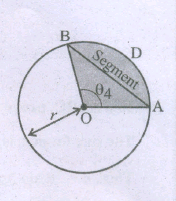
\(={1\over2}r^2\theta-{1\over2}r^2sin \theta\)
\(=({1\over 2}\times 4^2)[\theta -sin \theta] \) \(=8[\theta -sin \theta]...(i) \)
But cos \(\theta ={4^2+4^2-4^2\over 2(4)(4)}={1\over2}\)
Thus, \(\theta ={\pi\over3}\)
From (i), area of the segment to be allotted for the veterinary hospital
\(=8[{\pi\over3}-{\sqrt{3}\over2}]={4\over3}[2\pi-3\sqrt{3}]m^2\)
41.
Let P(h, k) be the locus of the point and A(4, 0) B(-4, 0) are the given points.
Given PA + PB = 10
\(\sqrt { { (h-4) }^{ 2 }+{ (k-0) }^{ 2 } } +\sqrt { { (h+4) }^{ 2 }+{ k-0) }^{ 2 } } =10\)
\(\sqrt { { (h-4) }^{ 2 }+{ k }^{ 2 } } =10-\sqrt { { (h+4) }^{ 2 }+{ k }^{ 2 } } \)
Squaring both sides we get,
\({ (h-4) }^{ 2 }+{ k }^{ 2 }=100+[({ h }+4)^{ 2 }+{ k }^{ 2 }]-20\sqrt { { (h+4) }^{ 2 }+{ k }^{ 2 } } \)
\(\Rightarrow \ { h }^{ 2 }-8h+16+{ k }^{ 2 }=100+{ h }^{ 2 }+16+8h+{ k }^{ 2 }-20\sqrt { { (h+4) }^{ 2 }+{ k }^{ 2 } } \)
\(\Rightarrow \ { h }^{ 2 }-8h+16+{ k }^{ 2 }-100+{ h }^{ 2 }+16+8h+{ k }^{ 2 }-20\sqrt { { (h+4) }^{ 2 }+{ k }^{ 2 } } \)
\(\Rightarrow -16h-100=-20\sqrt { { (h+4) }^{ 2 }+{ k }^{ 2 } } \)
Dividing by -4, we get
4h + 25 = \(\\ 5\sqrt { ({ h+4) }^{ 2 }+{ k }^{ 2 } } \)
Squaring both sides we get,
\(\Rightarrow\) (4h + 25)2 = 25(h2+ 8h + 16 + k2)
\(\Rightarrow\) 16h2 + 625 + 200h = 25h2+ 400 + 200h + 25k2
\(\Rightarrow\) 9h2 + 25k2 = 225
\(\Rightarrow\) 9h2+ 25k2 = 225
Dividing by 225, we get
\(\Rightarrow \ \frac { { h }^{ 2 } }{ 25 } +\frac { { k }^{ 2 } }{ 9 } =1\)
\(\therefore \) Locus of (h, k) is \(\frac{x^2}{25}+\frac{y^2}{9}=1\)
42.
Let Sn = 8 + 88 + 888 + 8888 + .... upto n terms
= 8 (1 + 11 + 111 + 1111 + ....) upto n terms
\(={8\over9}(9 + 99 + 999 + ...)\)
\({ S }_{ n }=\frac { 8 }{ 81 } \left[ \left( { 10 }^{ n }-1 \right) -9n \right] \) [multiplying and dividing by 9]
\(={8\over9}[10 -1) + (100 -1) + (1000 -1) + ...]\)
\(S_n={8\over 9}[(10^1 +10^2 +10^3 + ... +10^n)-(1+1+1+ ... +1n\ terms)]\)
In 10 + 102 + 103 + ... + 10n, a = 10, r= 10, and it forms a G.P.
\(∴\ S_n={a(r^n-1)\over r-1}=10{(10^n-1)\over 10-1}={10\over 9}(10^n)-1\) and 1 + 1 + 1 ... + upto n terms = n
Substituting these values in (1) we get
\(S_n={8\over 9}\left[ 10(10^n-1)n\over 9\right]\)
\(S_n={8\over 81}[(10^n-1)-9n]\)
43.
Let E1 and E2 be the events of choosing a boy and a girl respectively from the class.
Given that the number of boys to the number of girls = 1: 2
\(\therefore P({ E }_{ 1 })=\frac { 1 }{ 1+2 } =\frac { 1 }{ 3 } \) and P(E2) = \(\frac { 2 }{ 1+12 } =\frac { 2 }{ 3 } \)
Let A be the event that a student chosen will get first class
Given P(A/E1) = 0.28 and P(A/E2) = 0.25
\(\therefore\) By theorem of total probability,
P(A) = P(E1).P(A/E1) + P(E2).P(A/E2)
\(\Rightarrow \quad =\frac { 1 }{ 3 } \times 0.28+\frac { 2 }{ 3 } \times 0.25\)
\(=\frac { 28 }{ 300 } +\frac { 50 }{ 300 } =\frac { 78 }{ 300 } =0.26\)
44.
\(\lim _{x \rightarrow 2} \frac{x^{2}-3 x+2}{x^{2}-x-2}=\lim _{x \rightarrow 2} \frac{(\not x-2)(x-1)}{(\not x-2)(x+1)}=\lim _{x \rightarrow 2} \frac{(x-1)}{(x+1)}=\frac{2-1}{2+1}=\frac{1}{3}\)
45.
\(\int {1\over \sqrt{1-25 x^2}} dx=\int {1\over \sqrt{1-(5x)^2}}dx={1\over5}sin^{-1}(5x)+c\)
46.
\(f(x)=-x^2+2\)
\(f(x+h)=-(x+h)^2+2=-x^2-h^2-2 x h+2\)
\(f^{\prime}(x)=\lim _{h \rightarrow 0} \frac{f(x+h)-f(x)}{h}\)
\(=\lim _{h \rightarrow 0} \frac{-x^2-h^2-2 x h+2+x^2-2}{h}\)
\(=\lim _{h \rightarrow 0} \frac{+h(-h-2 x)}{h}\)
= -0 - 2x
\(f^{\prime}(x)=-2 x\)
47.
Dividing by x, we get
\({1-x^3\over 3x+2}={{1\over x}-x^2\over 3+{2\over x}}\rightarrow -\infty \ as x\rightarrow \infty\)
Therefore the limit does not exist.
48.
The direction ratios of \(3\hat{i}+4\hat{j}-6\hat{k}\) are 3, 4, -6.
The direction cosines are \({x\over r},{y\over r},{z\over r},\) where r = \(\sqrt{x^2+y^2+z^2}\) .
Therefore, the direction cosines are \({3\over \sqrt{61}},{4\over \sqrt{61}},{-6\over \sqrt{61}}\)
49.
(i) f( m) = f( n) \(\Rightarrow\) m2 = n2 \(\Rightarrow\) m = n since \(m,\ n\in N.\) Thus f is one-to-one. But, non-perfect square elements in the co-domain do not have pre-images and hence not onto.
(ii) Two different elements in the domain have same images and hence f is not one-to-one. Clearly the range of f is a proper subset of R. Thus it is not onto.
50.
For every subset C of {6, 7, 8, 9, 10}, let B = C \(\cup \) {1, 2, 3, 5}. Then A - B = {4}. In other words, for every subset C of {6, 7, 8, 9, 10}, we have a unique set B so that A - B = {4}.
So number of sets \(B \subseteq X\) such that A - B = {4} and the number of subsets of {6, 7, 8, 9, 10} are the same.
So the number of sets \(B \subseteq X\) such that A - B = {4} is 25 = 32.
51.
Given \({ \left( \frac { 4x }{ 5 } -\frac { 5 }{ 2x } \right) }^{ 9 }\)
Here n = 9, x = \(\frac{4x}{5}\) and a = \((\frac{-5}{2x})\)
\(\therefore { T }_{ r+1 }={ 9C }_{ r }{ \left( \frac { 4x }{ 5 } \right) }^{ 9-r }{ \left( \frac { -5 }{ 2x } \right) }^{ r }\)
\(={ 9C }_{ r }.\frac { { 4 }^{ 9-r } }{ { 5 }^{ 9-r } } .{ x }^{ 9-r }{ \left( -1 \right) }^{ r }.\frac { { 5 }^{ r } }{ { 2 }^{ r }.{ x }^{ r } } \)
\(={ \left( -1 \right) }^{ r }9Cr\frac { { 12 }^{ 18-3r } }{ { 5 }^{ 9-2r } } .\frac { { 5 }^{ r } }{ { 2 }^{ r } } .{ x }^{ 9-2r }\)
\({ T }_{ r+1 }={ \left( -1 \right) }^{ r }9Cr\frac { { 12 }^{ 18-3r } }{ { 5 }^{ 9-2r } } .{ x }^{ 9-2r },0\le r\le 9.\)
52.
The permutations of vowels A, E, I, O, U in English alphabets taking 3 at a time and starting with A are AEI, AIE, AEO, AOE, AEU, AUE, AIO, AOI, AIU, AUI, AOU and AUO.
Clearly, there are 12 permutations.
53.
If the equation of two lines are in general form as a1 x + b1 y1 + c = 0 and a2x + b2y + c2 = 0
\(\frac { { a }_{ 1 } }{ { a }_{ 2 } } =\frac { { b }_{ 1 } }{ { b }_{ 2 } }\ or\ { a }_{ 1 }{ b }_{ 2 }={ a }_{ 2 }{ b }_{ 1 }\)
Given lines are 3x + 2y + 9 = 0 and 12x + 8y - 15 = 0
\(\frac { 3 }{ 12 } =\frac { 2 }{ 8 } \)
\(\Rightarrow \frac { 1 }{ 4 } =\frac { 1 }{ 4 } \)
Hence the given lines are parallel.

11th Standard Syllabus & Materials
11th Standard
TN 11th Tamil பீடு பெற நில் - செய்யுள் - காவடிச்சிந்து Important Questions And Answers Study Material - QB365 Set A
NEW11th Standard
TN 11th Tamil பீடு பெற நில் - உரைநடை - மலை இடப்பெயர்கள் : ஓர் ஆய்வு Important Questions And Answers Study Material - QB365 Set A
NEW11th Standard
TN 11th Tamil மாமழை போற்றுதும் - துணைப்பாடம் - யானை டாக்டர் Important Questions And Answers Study Material - QB365 Set A
NEW11th Standard
TN 11th Tamil மாமழை போற்றுதும் - செய்யுள் - ஐங்குறுநூறு Important Questions And Answers Study Material - QB365 Set A



Tamilnadu Stateboard 11th Standard Subjects
Maths

Commerce

Economics

Biology

Business Maths and Statistics

Accountancy

Computer Science

Physics

Chemistry
Maths
Biology
Economics
Physics
Chemistry

History
Business Maths and Statistics

Computer Science
Accountancy

Computer Applications
History
Computer Technology
Commerce
Computer Applications
Computer Technology

Tamil

English

French
Tamilnadu Stateboard Standards

