
 100% FREE ACCESS
11th Standard Syllabus & Materials
11th Standard
TN 11th Tamil இயற்கை வேளாண்மை,சுற்றுச்சூழல் -செய்யுள் - மனோன்மணீயம் Important Questions And Answers Study Material - QB365 Set A
NEW11th Standard
TN 11th Tamil என்னுயிர் என்பேன் -துணைப்பாடம் - இசைத்தமிழர் இருவர் Important Questions And Answers Study Material - QB365 Set A
NEW11th Standard
TN 11th Tamil மொழி கலை -செய்யுள் - ஒவ்வொரு புல்லையும் Important Questions And Answers Study Material - QB365 Set A
NEW11th Standard
TN 11th Tamil பீடு பெற நில் - இலக்கணம் - பகுபத உறுப்புகள் Important Questions And Answers Study Material - QB365 Set A
NEW11th Standard
TN 11th Tamil பீடு பெற நில் - துணைப்பாடம் - வாடிவாசல் Important Questions And Answers Study Material - QB365 Set A
NEW11th Standard
TN 11th Tamil பீடு பெற நில் - செய்யுள் - குறுந்தொகை Important Questions And Answers Study Material - QB365 Set A

Published on: 04/02/2020
11th Standard Maths Important Question
Download Tamil Nadu 11th Standard Maths question papers, model tests, one-mark questions, important questions, and public exam papers in PDF format. Free study materials and answer keys for TN State Board students.
Questions + Answers key
Take MCQ Maths Test1.
Find the derivation : sin 5 + log10 x + 2 sec x
2.
If \(f(x)=\{ \begin{matrix} 2x+3, & x\le 0 \\ 3(x+1), & x>0 \end{matrix}\) .Find \(\underset { x\rightarrow 0 }{ lim } \underset { x\rightarrow 1 }{ lim } f(x)\) and \(\underset { x\rightarrow 1 }{ lim } f(x)\)
3.
Integrate the function with respect to x : \(\sqrt { 169-\left( 3x+1 \right) ^{ 2 } } \)
4.
If \(\vec { P } =-3\vec { i } +4\vec { j } -7\vec { k } \) and \(\vec { q } =6\vec { i } +2\vec { j } -3\vec { k } \) then find \(\vec { p } \times \vec { q } \) .Verify that \(\vec { p } \) and \(\vec { p } \times \vec { q } \) are perpendicular to each other and also verify that \(\vec { q } \) and \(\vec { p } \times \vec { q } \) are perpendicular to each other.
5.
Evaluate: \(\underset { x\rightarrow 0 }{ lim } \frac { { e }^{ 5x }-1 }{ x } \)
6.
Resolve into partial function \(\frac{2}{x^2-1}\).
7.
Draw the curves of
(i) y = x2 + 1
(ii) Y = (x + 1)2 by using the graph of curve y = x.
8.
Show that the vectors \(2\hat{i}-3\hat{j}+4\hat{k}\) are \({-4\hat{i}+6\hat{j}-8\hat{k}}\) are collinear.
9.
Write two different vectors having same magnitude.
10.
Events A and B are such that P(A) = \(\frac { 1 }{ 2 } \) , P(B) = \(\frac { 7 }{ 12 } \) and P(not A or not B) = \(\frac { 1 }{ 4 } \). State whether A and B are independent?
11.
For what value of x the matrix A =\(\left[ \begin{matrix} 1 & -2 & 3 \\ 1 & 2 & 1 \\ x & 2 & -3 \end{matrix} \right] \) is singular.
12.
Nine coins are tossed once, find the probability to get at least two heads
13.
If \(P(A)=0.6, P(B)=0.5\), and \(P(A \cap B)=0.2\) Find \( P(\bar{A} / B)\)
14.
A single card is drawn from a pack of 52 cards. What is the probability that
The card is either a queen or 9?
15.
A single card is drawn from a pack of 52 cards. What is the probability that
The card will be 6 or smaller?
16.
If an experiment has exactly the three possible mutually exclusive outcomes A, B, and C, check in each case whether the assignment of probability is permissible.
P(A) = 0.421, P(B) = 0.527 P(C) = 0.042
17.
If A and B are two independent events such that P(A\(\cup \)B) = 0.6, P(A) = 0.2, find P(B).
18.
Integrate the following with respect to x : e2x sin x
19.
Evaluate the following integrals : \(\int e^{-5x}sin 3x \ dx\)
20.
Integrate the following with respect to x : \({x^2\over 1+x^6}\)
21.
Integrate the following functions with respect to x : \(e^{xlog a}e^x\)
22.
Integrate the following with respect to x : \(e^{2x}-1\over e^{x}\)
23.
Integrate the following with respect to x : \({x^{24}\over x^{25}}\)
24.
Find the derivatives of the following : y = xlogx + (log x)x
25.
Differentiate: \(y={x^{3\over4}\sqrt{x^2+1}\over (3x+2)^5}\)
26.
Differentiate 2x.
27.
Find f '(x) if f(x) = \({1\over 3\sqrt{x^2+x+1}}\)
28.
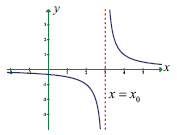
State how continuity is destroyed at x = x o for each of the following graphs.
29.
Evaluate the following limits :\(lim_{x\rightarrow \infty}(1+{1\over x})^{7x} \)
30.
Compute\(lim_{x\rightarrow-2}(-{3\over 2}x)\)
31.
In problem, using the table estimate the value of the limit
\(lim_{x\rightarrow{-3}}{\sqrt{1-x}-2\over x+3}\)
| x | -3.1 | -3.01 | -3.00 | -2.999 | -2.99 | -2.9 |
| f(x) | – 0.24845 | – 0.24984 | – 0.24998 | – 0.25001 | – 0.25015 | – 0.25158 |
32.
Complete the table using calculator and use the result to estimate the limit.
\(lim_{x\rightarrow{2}}{x-2\over x^2-4}\)
| x | 1.9 | 1.99 | 1.999 | 2.001 | 2.01 | 2.1 |
| f(x) | 0.25641 | 0.25062 | 0.250062 | 0.24993 | 0.24937 | 0.24390 |
33.
Find the direction cosines of a vector whose direction ratios are 3, -1, 3
34.
Determine the values of b so that the following matrices are singular:\(\begin{bmatrix}b-1 &2 &3 \\3 & 1 & 2 \\ 1 & -2 &4 \end{bmatrix}\)
35.
Determine the values of a so that the following matrices are singular: A =\(\begin{bmatrix} 7& 3 \\ -2 & a \end{bmatrix}\)
36.
Without expanding the determinant, prove that \(\begin{vmatrix} s & a^2 & b^2+c^2 \\ s & b^2 &c^2+a^2 \\ s & c^2 & a^2+b^2 \end{vmatrix}=0\)
37.
Evaluate :\(\begin{vmatrix} 2 & 4 \\ -1 & 2 \end{vmatrix}\)
38.
Suppose that a matrix has 12 elements. What are the possible orders it can have? What if it has 7 elements?
39.
A group consists of 4 girls and 7 boys. In how many ways can a team of 5 members be selected, if the team has atleast one boy and one girl
40.
A line passing through the points (a, 2a) and (-2, 3) is perpendicular to the line 4x+3y+ 5 = 0, find the value of a.
41.
Find the values of cos(300°).
42.
Find the combined equation of the straight lines through the origin one of which is parallel to and the other is perpendicular to the straight line 3x + y + 5 = 0.
43.
Find the equation of the line through (1, 2) and which is perpendicular to the line joining (2, -3) (-1, 5)..
44.
Simplify: cos A + cos (120° + A) + cos (120° - A)
45.
Find the principal value of cosec-1\(({2\over\sqrt{3}})\)
46.
Find the principal value of sin-1\(({\sqrt{3}\over2})\)
47.
Find the middle term in the expansion of (x +y)6.
48.
Evaluate: 5P3.
49.
Convert : 18° to radians.
50.
If \(\frac { 6! }{ n! } \) = 6, then find the value of n.
51.
If a, b, c are in A.P., show that (a-c)2 = 4(b2 - ac).
52.
Write the first 6 terms of the sequences whose nth term an given below
\({ a }_{ n }=\begin{cases} n+1\quad if\quad n\quad is\quad odd \\ n\quad \quad if\quad n\quad is\quad even \end{cases}\)
53.
If p is the length of the perpendicular from the origin to the line \(\frac{x}{a}+\frac{y}{b}=1\), then prove that \(\frac{1}{p_2}=\frac{1}{a^2}+\frac{1}{b^2}\)
54.
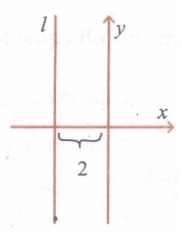
Find the equation of the line perpendicular to x-axis and having intercept -2 on x-axis.
55.
Show that the sum of (m + n)th and (m - n)th term of an A.P. is equal to twice the mth term.
56.
If (n-1)P3 :n P4 = 1 : 10, find n
57.
Evaluate \(\frac { n! }{ r!(n-r)! } \) For any n when r = 2
58.
Find the number of ways of distributing 12 distinct prizes to 10 students?
59.
Express each of the following as a product.
cos 65o + cos 15o
60.
Express each of the following as a product.
sin 75o - sin 35o
61.
Evaluate sin\(\left( \frac { -11\pi }{ 3 } \right) \).
62.
Discuss the nature of roots of -x2 + 3x + 1 = 0
63.
Find the real roots of x4 = 16
64.
Find the values of other five trigonometric functions for the following
Sec \(\theta\) = \(\frac { 13 }{ 5 },\) \(\theta\) lies in the IV quadrant
65.
Find the principal solution and general solutions of the following cot\(\theta\) = \(\sqrt { 3 } \)
66.
Discuss the following relations for reflexivity, symmetricity and transitivity :
On the set of natural numbers, the relation R is defined by "xRy if x + 2y = 1".
67.
Discuss the following relations for reflexivity, symmetricity and transitivity:
Let A be the set consisting of all the members of a family. The relation R defined by "aRb if a is not a sister of b".
68.
Show that tan (45o + A) = \(\frac { 1+\tan { A } }{ 1-\tan { A } } \)
69.
Find the degree measure corresponding to the following radian measure; \(\frac { 7\pi }{ 3 } \)
70.
Find the degree measure corresponding to the following radian measure; \(\frac { 2\pi }{ 5 } \)
71.
Represent the following inequalities in the interval notation:
\(-2x>0\) or \(3x-4<11\)
72.
By taking suitable sets A, B, C, verify the following results:
C-(B-A) = (C\(\cap \) A) \(\cup \) (C\(\cap \)B')
73.
Find the principal value of cosec-1(-1)
74.
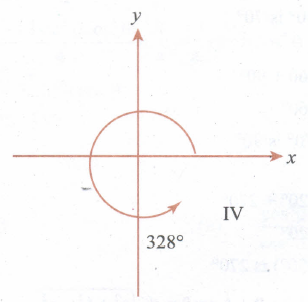
Identify the quadrant in which an angle of each given measure lies; 3280
75.
p(A) = 0.3, P(B) = 0.6 and \(P(A\cap B)=0.25\) .Find
(i) \(P(A\cup B)\)
(ii) P(A/B)
(iii) \(P(B/\bar { A } )\)
(iv) \(P(\bar { A } /B)\)
(v) \(P(\bar { A } /\bar { B } )\)
76.
Express the equation √3x - y + 4 = 0 in the following equivalent form Intercept form,
77.
Let A = {0,1, 2, 3}. Construct relations on A of the following types:
(i) reflexive, not symmetric, not transitive.
(ii) reflexive, not symmetric, transitive.
78.
Integrate the function with respect to x
e2x sin 3x dx
79.
If \(A=\left[ \begin{matrix} 1 & 2 & 2 \\ 2 & 1 & 2 \\ 2 & 2 & 1 \end{matrix} \right] \), Show that k so that A2 -4A- 51 = 0
80.
Let \(\vec{a}=2\hat{i}+\hat{j}-2\hat{k}\) and \(\vec{b}=\hat{i}+\hat{j}\) . Let \(\vec{c}\) be a vector such that \(\vec { a } .\vec { c } =\left| \vec { c } \right| ,\left| \vec { c } -\vec { a } \right| =2\sqrt { 2 } \) and the angle between and is 30o.Then find the value of \(\left| (\vec { a } \times \vec { b } )\times \vec { c } \right| \)
81.
Let \(\overrightarrow { a } =\hat { i } +\hat { j } +2\hat { k } \) and \(\overrightarrow { b } =\hat { i } +2\hat { j } +\hat { k } \) and \(\overrightarrow { c } \) be a unit vectorin the plane determined by \(\overrightarrow { a } \) and \(\overrightarrow { b } \). If \(\overrightarrow { c } \) is perpendicular to the vector \(\hat { i } +\hat { j } +\hat { k } \) and makes an obtuse angle with \(\overrightarrow { a } \), then prove that \(\overrightarrow { c } =\frac { \hat { j } -\hat { k } }{ \sqrt { 2 } } \)
82.
Evaluate \(\lim _{ x\rightarrow \frac { 1 }{ \sqrt { 2 } } }{ \frac { x-\cos { (\sin ^{ -1 }{ (x) } ) } }{ 1-\tan { (\sin ^{ -1 }{ x } ) } } } \)
83.
If \(\log { ({ x }^{ 2 }+{ y }^{ 2 }) } =2\tan ^{ -1 }{ \frac { y }{ x } , } \) Show that \(\frac { dy }{ dx } =\frac { x+y }{ x-y } .\)
84.
For a sports meet, a winners’ stand comprising of three wooden blocks is in the form as shown in figure. There are six different colours available to choose from and three of the wooden blocks is to be painted such that no two of them has the same colour. Find the probability that the smallest block is to be painted in red, where red is one of the six colours.

85.
The probability that a new railway bridge will get an award for its design is 0.48, the probability that it will get an award for the efficient use of materials is 0.36, and that it will get both awards is 0.2. What is the probability, that (i) it will get at least one of the two awards (ii) it will get only one of the awards.
86.
A town has 2 fire engines operating independently. The probability that a fire engine is available when needed is 0.96.
(i) What is the probability that a fire engine is available when needed?
(ii) What is the probability that neither is available when needed?
87.
Let the matrix M = \(\left[ \begin{matrix} x & y \\ z & 1 \end{matrix} \right] \), If x,y and z are chosen at random from the set {1, 2,3, } and repetition is allowed (i.e., x = y = z ), what is the probability that the given matrix M is a singular matrix?
88.
A main road in a City has 4 crossroads with traffic lights. Each traffic light opens or closes the traffic with the probability of 0.4 and 0.6 respectively. Determine the probability of
(i) a car crossing the first crossroad without stopping
(ii) a car crossing first two crossroads without stopping
(iii) a car crossing all the crossroads, stopping at third cross.
(iv) a car crossing all the crossroads, stopping at exactly one cross.
89.
X speaks truth in 70 percent of cases, and Y in 90 percent of cases. What is the probability that they likely to contradict each other in stating the same fact?
90.
Two cards are drawn from a pack of 52 cards in succession. Find the probability that both are Jack when the first drawn card is (i) replaced (ii) not replaced.
91.
A problem in Mathematics is given to three students whose chances of solving \(\frac { 1 }{ 3 } ,\frac { 1 }{ 4 } \) and \(\frac { 1 }{ 5 } \) (i) What is the probability that the problem is solved? (ii) What is the probability that exactly one of them will solve it?
92.
Integrate the following functions with respect to x : \(\sqrt{81+(2x+1)^2}\)
93.
Integrate the following with respect to x : \({2x-3\over x^2+4x-12}\)
94.
Evaluate the following integrals : \(\int {x+1\over x^2-3x+1}dx\)
95.
Evaluate the following integrals : \(\int {1\over x^2-2x+5}dx\)
96.
Integrate the following with respect to x : \(e^{tan^{-1}x}({1+x+x^2\over 1+x^2})\)
97.
If f'(x) = 3x2 - 4x + 5 and f(1) = 3, then find f(x).
98.
Find the derivatives of the following : \(x=\frac{1-t^2}{1+t^2}, y=\frac{2 t}{1+t^2}\)
99.
Find \({d^2y\over dx^2}\) if x2 + y2 = 4.
100.
Differentiate the following: y = 4 sec 5x
101.
A tomato wholesaler finds that the price of a newly harvested tomatoes is Rs. 0.16 per kg if he purchases fewer than 100 kgs each day. However, if he purchases at least 100 kgs daily, the price drops to Rs. 0.14 per kg. Find the total cost function and discuss the cost when the purchase is 100 kgs.
102.
Compute \(lim_{x\rightarrow{0}}[{x^2+x\over x}+4x^3+3]\) .
103.
Sketch the graph of a function f that satisfies the given values :
f(- 2) = 0
f(2) = 0
\(lim_{x\rightarrow -2}f(x)=0\)
\(lim_{x\rightarrow -2}f(x)\) does not exist.
104.
Sketch the graph of f, then identify the values of x0 for which \(lim_{x\rightarrow{x_o}}f(x)\) exists.
\(f(x)=\begin{cases} { x^ 2 } ,\quad x \le 2 \\ 8-{ 2x } ,\quad 2 < x < 4 \\ { 4 } ,\quad x\ge 4 \end{cases}\)
105.
The position vectors of the vertices of a triangle are \(\hat{i}+2\hat{j}+3\hat{k};3\hat{i}-4\hat{j}+5\hat{k}\) and\(-2\hat{i}+3\hat{j}-7\hat{k}\).Find the perimeter of the triangle.
106.
A triangle is formed by joining the points (1, 0, 0), (0, 1, 0) and (0, 0, 1). Find the direction cosines of the medians.
107.
Prove that the line segment joining the midpoints of two sides of a triangle is parallel to the third side whose length is half of the length of the third side.
108.
Let \(\vec a\) and \(\vec b\) be the position vectors of the points A and B. Prove that the position vectors of the points which trisects the line segment AB are \(\frac{\vec{a}+2 \vec{b}}{3} \text { and } \frac{\vec{b}+2 \vec{a}}{3} \text {. }\)
109.
Prove that \(\begin{vmatrix} 1 &x^2 &x^3 \\ 1 & y^2 &y^3 \\1 &z^2 &z^3 \end{vmatrix}\) = (x - y)(y - z)(z - x)(xy + yz + zx).
110.
If a, b, c are all positive and are pth, qth and rth terms of a G.P., show that \(\begin{vmatrix} log \ a & p & 1 \\ log\ b & q & 1 \\ log\ c & r & 1 \end{vmatrix}=0.\)
111.
Show that f(x) f(y) = f(x + y), where f(x) =\(\begin{bmatrix} cos \ x & -sin \ x & 0 \\ sin x & cos x & 0 \\ 0 & 0 & 1 \end{bmatrix}\).
112.
A fruit shop keeper prepares 3 different varieties of gift packages. Pack-I contains 6 apples, 3 oranges, and 3 pomegranates. Pack-II contains 5 apples, 4 oranges and 4 pomegranates and Pack –III contains 6 apples, 6 oranges and 6 pomegranates. The cost of an apple, an orange and a pomegranate respectively are Rs. 30, Rs. 15 and Rs. 45. What is the cost of preparing each package of fruits?
113.
2n < (n + 2)! for all natural number n.
114.
Forensic Scientists use h = 61.4+2.3F to predict the height h in centimeters for a female whose thigh bone (femur) measures F cm. If the height of the female lies between 160 to 170 cm find the range of values for the length of the thigh bone?
115.
Find x from the equation cosec (90° + A) + x cos A cot (90° + A) = sin (90° + A).
116.
Find the equation of the line passing through the point of intersection 2x + y = 5 and x + 3y + 8 = 0 and parallel to the line 3x +4y = 7.
117.
Find \(\sum_{k=1}^{n}{1\over k(k+1)}.\)
118.
Find the coefficient of x in the expansion of \(log(\frac{1}{1-5x+6x^2})\).
119.
If the equation λx2 - 10xy + 12y2+ 5x -16y - 3 = 0 represents a pair of straight lines, find
(i) the value of λ and the separate equations of the lines
(ii) point of intersection of the lines
(iii) angle between the lines.
120.
In a triangle ABC, prove that \({a^2+b^2\over a ^2+c^2}={1+cos(A-B)cosC\over1+cos(A-C)cosB}\)
121.
By the principle of mathematical induction, prove that, for all integers n ≥ 1,
12 + 22 + 32+...n2 = \(\frac { n(n+1)(2n+1) }{ 6 } \).
122.
Find the values of sin 72°.
123.
Find the condition that one of the roots of ax2+bx+c may be reciprocal of the other.
124.
Find the condition that one of the roots of ax2+ bx + c may be thrice the other.
125.
The slope of one of the straight lines ax2 + 2hxy + by2 = 0 is three times the other, show that 3h2 = 4ab.
126.
A family is using Liquefied petroleum gas (LPG) of weight 14.2 kg for consumption. (Full weight 29.5kg includes the empty cylinders tare weight of 15.3kg.). If it is use with constant rate then it lasts for 24 days. Then the new cylinder is replaced.
(i) Find the equation relating the quantity of gas in the cylinder to the days.
(ii) Draw the graph for first 96 days.
127.
Find the number of ways of forming a committee of 5 members out of 7 Indians and 5 Americans, so that always Indians will be the majority in the committee.
128.
If p - q is small compared to either p or q, then show that \(n\sqrt { \frac { p }{ q } } =\frac { \left( n+1 \right) p+\left( n-1 \right) q }{ \left( n-1 \right) p+\left( n+1 \right) q } \)
Hence find \(8\sqrt { \frac { 15 }{ 16 } } \)
129.
Prove that 2nCn = \(\frac { { 2 }^{ n }\times 1\times3\times ...(2n-1) }{ n! } \)
130.
If R is any point on the x - axis and Q is any point on the y-axis and P is a variable point on RQ with RP = b, PQ = a. then find the equation of locus of P
131.
Prove that \(\sqrt [ 3 ]{ { x }^{ 3 }+6 } -\sqrt [ 3 ]{ { x }^{ 3 }+3 } \) is approximately equal to \(\frac { 1 }{ { x }^{ 2 } } \) when x is sufficiently large.
132.
Compute 994
133.
Compute the sum of first n terms of the following series 6 + 66 + 666 + .......
134.
Using the mathematical induction, show that for any natural number n,
\({1\over 1.2.3}+{1\over 2.3.4}+{1\over 3.4.5}+..+{1\over n(n+1)(n+2)}+={n(n+3)\over 4(n+1)(n+2)}\)
135.
If f:R \(\rightarrow\) R is defined by f(x) = 3x - 5, prove that f is a bijection and find its inverse.
136.
Express \( tan ^{ -1 }{ \left( \frac { \cos { x } }{ 1-\sin { x } } \right) } ,\frac { \pi }{ 2 }\)
137.
Write the values of f at -3, 5, 2, -1, 0 if
\(f(x)=\begin{cases} x^2+x-5\quad if\ x \in(-\infty, 0) \\x^2+3x-2\quad if\ x\in(3,\infty) \\x^2\quad \quad \quad \quad \quad if\ x\ \in(0,2) \\x^2-3 \quad \quad \quad otherwise \end{cases}\)
138.
Two soldiers A and B in two different underground bunkers on a straight road, spot an intruder at the top of a hill. The angle of elevation of the intruder from A and B to the ground level in the eastern direction are 300 and 450 respectively. If A and B stand 5 km apart, find the distance of the intruder from B
139.
Resolve the following rational expressions into partial fractions.
\({{x}\over{(x^2+1)(x-1)(x+2)}}\)
140.
On the set of natural numbers let R be the relation defined by aRb if a + b \(\le\) 6. Write down the relation by listing all the pairs. Check whether it is symmetric
141.
Find all values of x for which \({{x^3(x-1)}\over{x-2}}>0.\)
143.
On the set of natural numbers let R be the relation defined by aRb if 2a + 3b = 30. Write down the relation by listing all the pairs. Check whether it is transitive
144.
On the set of natural numbers let R be the relation defined by aRb if 2a + 3b = 30. Write down the relation by listing all the pairs. Check whether it is reflexive
145.
If \(\theta\) is an acute angle, then find \(\sin { \left( \frac { \pi }{ 4 } -\frac { \theta }{ 2 } \right) } \), when \(\sin { \theta } =\frac { 1 }{ 25 } \)
146.
Find the values of \(\tan { \left( \alpha +\beta \right) } \), given that \(\cot { \alpha } =\frac { 1 }{ 2 } ,\alpha \epsilon \left( \pi ,\frac { 3\pi }{ 2 } \right) and \ sec { \beta } =-\frac { 5 }{ 3 } ,\beta \epsilon \left( \frac { \pi }{ 2 } ,\pi \right) \)
147.
Find the sum and difference of the identity function and the modulus function?
148.
If A + B + C = 1800, prove that sin(B + C - A) + sin(C + A - B) + sin(A + B - C)= 4 sin A sin B sin C
149.
Solve : \({ log }_{ 2 }x-3{ log }_{ \frac { 1 }{ 2 } }x=6\)
150.
Determine the region in the Plane determined by the inequalities.
\(3x+5y\ge 45,\ x\ge 0,\ y\ge 0\)
151.
If A + B + C = 1800, prove that \(sinA+sinB+sinC=4cos\frac { A }{ 2 } cos\frac { B }{ 2 } cos\frac { C }{ 2 } \)
152.
Write the values of f at -4, 1, -2, 7, 0 if
153.
Prove that \(sin\frac { \theta }{ 2 } sin\frac { 7\theta }{ 2 } +sin\frac { 3\theta }{ 2 } sin\frac { 11\theta }{ 2 } =sin2\theta sin5\theta \)
154.
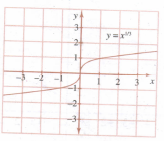
For the given curve, \(y=x^{1\over 3}\)given in figure draw
(i) \(y=-x^{ \left( \frac { 1 }{ 3 } \right) }\)
(ii) \(y=x^{ \left( \frac { 1 }{ 3 } \right) }+1\)
(iii) \(y=x^{ \left( \frac { 1 }{ 3 } \right) }-1\)
(iv) \(y=(x+1)^{1\over 3}\)
155.
A plane is 1 km from one landmark and 2 km from another. From the planes point of view the land between them subtends an angle of 450. How far apart are the landmarks?
156.
The vertices of a triangle have position vectors \(4\hat { i } +5\hat { j } +6\hat { k } ,5\hat { i } +6\hat { j } +4\hat { k } ,6\hat { i } +4\hat { j } +5\hat { k } \) Prove that the triangle is equilateral.
157.
Prove that \(LHS=\left| \begin{matrix} -{ a }^{ 2 } & ab & ac \\ ab & -{ b }^{ 2 } & bc \\ ac & bc & -{ c }^{ 2 } \end{matrix} \right| ={ 4a }^{ 2 }{ b }^{ 2 }{ c }^{ 2 }\)
158.
In ∆ABC, if tan \(\frac{A}{2}=\frac{5}{6}\) and tan \(\frac{C}{2}=\frac{2}{5}\), then show that a, b, c, are in A.P.
159.
Evaluate \(\int { \frac { { sin }^{ 6 }x+cos^{ 6 }x }{ sin^{ 2 }xcos^{ 2 }x } } \)
160.
A persons has undertaken a construction job. The probabilities are 0.65, that there will be strike, 0.80 that the construction job will be completed on time, if there is no strike and 0.32 that the construction job will be completed on time if there is a strike. Determine the probability that the construction job will be completed on time.
161.
Let \(f\left( x \right) =\begin{cases} 2x,\quad x<2 \\ 2,\quad x=2 \\ { x }^{ 2 },\quad x>2 \end{cases}.\) Prove that 2 is a removable discontinuity of f.
162.
Evaluate \(\lim _{ x\rightarrow \pi }{ \frac { \sin { x } }{ x-\pi } } \)
163.
If x = \(a\sec ^{ 3 }{ \theta }\) and \(y=a\tan ^{ 3 }{ \theta }\) find \(\frac { dy }{ dx }\) at \(\theta =\frac { \pi }{ 3 }\)
164.
A man has 2 ten rupee notes, 4 hundred rupee notes and 6 five hundred rupee notes in his pocket. If 2 notes are taken at random, what are the odds in favour of both notes being of hundred rupee denomination and also its probability?
165.
Suppose ten coins are tossed. Find the probability to get (i) exactly two heads (ii) at most two heads (iii) at least two heads.
166.
Integrate the following with respect to x: : \({x sin^{-1}\over \sqrt{1-x^2}}\)
167.
Integrate the following with respect to x : \({1\over (5-4x)}\)
168.
Find \({dy\over dx}\) if x2 + y2 = 1
169.
Differentiate the following: \(y=5^{\frac{-1}{x}}\)
170.
Find the derivatives of the following functions with respect to corresponding independent variables : y = x sin x cos x
171.
Find the derivatives of the following functions with respect to corresponding independent variables : \(y={tan \ x \over x}\) .
172.
Differentiate the following with respect to x : \(y={cos \ x \over x^3}\)
173.
Show that the following functions are not differentiable at the indicated value of x.
\(f(x)=\left\{\begin{array}{ll} -x+2, & x \leq 2 \\ 2 x-4, & x>2 \end{array} ; \quad x=2\right.\)
174.
Find the derivatives from the left and from the right at x = 1 (if they exist) of the following functions. Are the functions differentiable at x = 1?
\(f(x)=\sqrt{1-x^2}\)
175.
Find the constant b that makes g continuous on \((-\infty,\infty)\)
\(g(x)= \begin{cases}x^{2}-b^{2} & \text { if } x<4 \\ b x+20 & \text { if } x \geq 4\end{cases}\)
176.
Find the points of discontinuity of the function f, where
f(x) = {\(\begin{matrix} x+2, & if\quad x\ge 2 \\ { x }^{ 2 }, & if\quad x<2 \end{matrix}\)
177.
Evaluate the following limits :\(\)\(lim_{x \rightarrow \infty}\{ x[log(x+a)-log(x)]\}\)
178.
Evaluate the following limits \(lim_{x\rightarrow{3}}{x^2-9\over x^2(x^2-6x+9)}\)
179.
Evaluate the following limits :
\(lim_{x\rightarrow2}{{1\over x}-{1\over2}\over x-2}\)
180.
Find the relation between a and b if \(lim_{x\rightarrow3}f(x)\) exists where \(f(x)= \begin{cases}a x+b & \text { if } x>3 \\ 3 a x-4 b+1 & \text { if } x<3\end{cases}\)
181.
For any vector \(\overrightarrow{r}\) prove that \(\overrightarrow{r}\) = (\(\overrightarrow{r}.\hat{i}\)) \(\hat{i}\) + (\(\overrightarrow{r}.\hat{j}\)) \(\hat{j}\) + (\(\overrightarrow{r}.\hat{k}\)) \(\hat{k}\).
182.
Find the direction cosines and direction ratios for the following vectors.3\(\hat{i}\) - 3\(\hat{k}\) + 4\(\hat{j}\)
183.
Find the area of the triangle whose vertices are (0, 0), (1, 2) and (4, 3).
184.
If a, b, c are pth, qth and rth terms of an A.P, find the value of \(\begin{vmatrix} a & b & c \\ p & q & r \\ 1& 1 &1 \end{vmatrix}\)
185.
Write the general form of a 3 \(\times\) 3 skew-symmetric matrix and prove that its determinant is 0.
186.
Prove that \(\begin{vmatrix} a^2 & bc & ac+c^2 \\ a^2+ab & b^2 & ac \\ ab & b^2+bc & c^2 \end{vmatrix}=4a^2b^2c^2\)
187.
If \({n!\over 3!(n-4)!}and {n!\over 5!(n-5)!}\) are in the ratio 5 : 3 find the value of n.
188.
Find the equation of the line which passes through the point (- 4, 3) and the portion of the line intercepted between the axes is divided internally in the ratio 5: 3 by this point.
189.
Let \(\alpha,\beta\) be such that \(\pi<\alpha-\beta<3\pi.\)If \(sin\alpha+sin\beta=-\frac{21}{65}\ and\ cos\alpha+cos\beta=-\frac{27}{65}\) then find the value of \(cos\frac{\alpha-\beta}{2}\) is
190.
If the sum of the coefficients in the expansion of (x+y)n is 4096. Then find the greatest coefficient in the expansion.
191.
If θ is a parameter, find the equation of the locus of a moving point, whose coordinates are (a sec θ, b tan θ)
192.
Solve x = \(\sqrt{x+20}\) for x ∈ R
193.
Find the length of an arc of a circle of radius 5 cm subtending a central angle measuring 15°.
194.
Our monthly electricity bill contains a basic charge, that is independent of units consumed and a charge that depends on the units consumed. Let us say Electricity board charges Rs. 110 as basic charge and charges Rs. 4 for each unit we use. If a person wants to keep his electricity bill below Rs. 250, then what should be his electricity usage?
195.
A straight line cuts intercepts from the axes of co-ordinates the sum of whose reciprocals is a constant. Show that it always passes through a fixed point.
196.
Write the first 4 terms of the logarithmic series of log (1 - 2x). Find the intervals on which the expansions are valid
197.
If the points P(6, 2) and Q(-2, 1) and R are the vertices of a Δ PQR and R is the point on the locus of y = x2- 3x + 4, then find the equation of the locus of centroid of Δ PQR
198.
Find the value of k and b, if the points P(-3, 1) and Q(2, b) lie on the locus of x2 - 5x + ky = 0.
199.
A coin is tossed 8 times,
(i) How many different sequences of heads and tails are possible?
(ii) How many different sequences containing six heads and two tails are possible?
200.
If nPr = 720. If nCr = 120, find n, r = ?
201.
How many strings can be formed from the letters of the word ARTICLE, so that vowels occupy the even places?
202.
Two ships leave a port at the same time one goes 24 km/hr in the direction N 45o E and other travels 32 km/hr in the direction S 75o E. Find the distance between the ships at the end of 3 hours.
203.
The angles of a triangle ABC, are in arithmetic progression and if b:c = \(\sqrt { 3 } :\sqrt { 2 } \) , find \(\angle A.\)
204.
If \(\cos { \theta } =\frac { 1 }{ 2 } \left( a+\frac { 1 }{ a } \right) \), show that \(\cos {3\theta } =\frac { 1 }{ 2 } \left( { a }^{ 3 }+\frac { 1 }{ { a }^{ 3 } } \right) \)
205.
Find the quotient of the identity function by the modulus function
206.
If \(\frac { log \ x }{ y-z } =\frac { log \ y }{ z-x } =\frac { log \ z }{ x-y } \) , then prove that xyz = 1
207.
If \({{a}\over{x}}+{{y}\over{b}}=1\) and show that \({{b}\over{y}}+{{z}\over{c}}=1.\)
208.
Let A and B be two sets such that n(A) = 3 and n(B) = 2. If (x, 1) (y, 2) (z, 1) are in A\(\times\)B, find A and B, where x, y, z are distinct elements.
209.
Solve \(\frac { 1 }{ \left| 2x-1 \right| } <6\) and express the solution using the interval notation.
210.
Simplify and hence find the value of n: \(3^{2 n} 9^{2} 3^{-n} / 3^{3 n}=27\)
211.
For each given Angle, find a coterminal angle with a measure of \(\theta\) such that \(0^o\le \theta \le 360°\)
-4500
212.
For each given Angle, find a coterminal angle with a measure of \(\theta\) such that \(0^o\le \theta \le 360°\)
11500
213.
Find cos(x - y), given that cos x = \(-\frac{4}{5}\) with \(\pi<x<{{3\pi}\over{2}}\) and \(sin \ y = -{{24}\over{25}}\) with \(\pi<x<{{3\pi}\over{2}}\).
214.
If sin A = \(\frac{3}{5}\) and cos B = \(\frac{9}{41}\), 0 < A < \(\frac{\pi}{2}\), 0 < B < \(\frac{\pi}{2}\). Find the value of cos (A - B)
1.
y = sin 5 + log10 x + 2 sec x
\(\therefore \cfrac { dy }{ dx } =0+\left( \cfrac { 1 }{ x } \right) { log }_{ 10 }e+2\left[ secxtanx \right] =\cfrac { { log }_{ 10 }e }{ x } +2secxtanx\)
2.
\(f(x)=\{ \begin{matrix} 2x+3, & x\le 0 \\ 3(x+1), & x>0 \end{matrix}\)
\(\therefore \underset { x\rightarrow { 0 }^{ - } }{ lim } f(x)=\underset { x\rightarrow { 0 }^{ - } }{ lim } (2x+3)=2\times 0+3=3\)
and \(\underset { x\rightarrow { o }^{ + } }{ lim } f(x)=\underset { x\rightarrow { 1 }^{ - } }{ lim } 3(x+1)=3(0+1)=3\)
So,\(\underset { x\rightarrow 0 }{ lim } f(x)\) exists and is equal to 3.
\(\underset { x\rightarrow { 1 }^{ - } }{ lim } f(x)=\underset { x\rightarrow { 1 }^{ - } }{ lim } 2x+3=2\times 1+3=5\)
\(\underset { x\rightarrow { 1 }^{ - } }{ lim } f(x)=\underset { x\rightarrow { 1 }^{ - } }{ lim } 2x+3=2\times 1+3=5\)
\(\underset { x\rightarrow { 1 }^{ + } }{ lim } f(x)=\underset { x\rightarrow { 1 }^{ + } }{ lim } 3(x+1)=3(1+1)=6\)
\(\underset { x\rightarrow { 1 }^{ - } }{ lim } f(x)\neq \underset { x\rightarrow { 1 }^{ + } }{ lim } f(x)\)
Hence,\(\underset { x\rightarrow 1 }{ lim } f(x)\) does not exist.
3.
= \(\int { \sqrt { 169-\left( 3x+1 \right) ^{ 2 } } } dx\)
= \(\cfrac { \frac { (3x+1) }{ 2 } \sqrt { 169-\left( 3x+1 \right) ^{ 2 } } +\frac { 169 }{ 2 } { sin }^{ -1 }\left( \frac { 3x+1 }{ 13 } \right) }{ 3 } +c\)
= \(\frac { 1 }{ 6 } \left\{ 3x+1\sqrt { 169-(3x+1)^{ 2 } } +169{ sin }^{ -1 }\left( \frac { 3x+1 }{ 13 } \right) \right\} +c\)
4.
\(\vec { p } \times \vec { q } =\left| \begin{matrix} \vec { i } & \vec { j } & \vec { k } \\ -3 & 4 & -7 \\ 6 & 2 & -3 \end{matrix} \right| \)
= \(2\vec { i } -5\vec { j } -30\vec { k } \)
Now, \(\vec { p } .\left( \vec { p } \times \vec { q } \right) =\left( -3\vec { i } +4\vec { j } -7\vec { k } \right) .\left( 2\vec { i } -51\vec { j } -30\vec { k } \right) \)
= - 6 - 204 + 210 = 0
Hence \(\vec { p } \) and \(\vec { p } \times \vec { q } \) are perpendicular to each other.
Now \(\vec { q } .\left( \vec { p } \times \vec { q } \right) =\left( 6\vec { i } +2\vec { j } -3\vec { k } \right) .\left( 2\vec { i } -51\vec { j } -30\vec { k } \right) \)
Hence \(\vec { q } \) and \(\vec { p } \times \vec { q } \) are perpendicular to each other.
5.
\(\underset { 5x\rightarrow 0 }{ lim } \frac { { e }^{ 5x }-1 }{ x } \times5=5(1)\)
6.
\(\frac { 2 }{ { x }^{ 2 }-1 } =\frac { 2 }{ (x+1)(x-1) } =\frac { A }{ x+1 } +\frac { B }{ x-1 } \)
\(\frac { 2 }{ { x }^{ 2 }-1 } =\frac { A(x-1)+B(x+1) }{ (x+1)(x-1) } \)
2 = A(x-1)+B(x+1) ...(1)
Putting x = 1 we get,
2 = B(1 + 1) ⇒ B(2) = 2 ⇒ B = 1
Putting x = -1 in (1) we get,
2 = A(-1-1) + B(-1 + 1)
2 = A(-2) ⇒ A = -1
\(\\ \therefore \frac { 2 }{ { x }^{ 2 }-1 } =\frac { 1 }{ x+1 } +\frac { 1 }{ x-1 } \)
7.
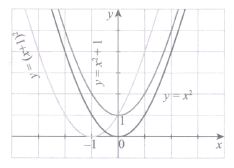
f (x) = x2 + 1 causes the graph of the function
f(x) = x2 shifts to the upward for one unit.
f (x) = (x + 1)2 causes the graph of the
function f(x) = x2 shifts to the left for one unit.
8.
Let \(\vec{a}=2\hat{i}-3\hat{j}+4\hat{k}\) and \(\vec{b}={-4\hat{i}+6\hat{j}-8\hat{k}}\)
Then \(\left| \vec { a } \right| =\sqrt { { 2 }^{ 2 }+{ (-3) }^{ 2 }+{ 4 }^{ 2 } } =\sqrt { 4+9+17 } =\sqrt { 29 } \)
and \(\left| \vec { b } \right| =\sqrt { { (-4) }^{ 2 }+6^{ 2 }+(-8)^{ 2 } } =\sqrt { 16+36+64 } =\sqrt { 116 } \)
\(\therefore \left| \vec { b } \right| =2\left| \vec { a } \right| \)
Thus, \(\vec{a}\)and \(\vec{b}\) are collinear.
9.
Let \(\vec{a}=2\vec{i}-\vec{j}+3\vec{k}\) and \(\vec{b}=\vec{i}+2\vec{j}-3\vec{k}\) be two vectors.
Then, \(\left| \vec { a } \right| =\sqrt { { 2 }^{ 2 }+{ (-1) }^{ 2 }+{ 3 }^{ 2 } } =\sqrt { 14 } \)
and \(\left| \vec { b } \right| =\sqrt { { 1 }^{ 2 }+{ 2 }^{ 2 }+(-{ 3) }^{ 2 } } =\sqrt { 14 } \)
Hence the required vectors are\(2\vec{i}-\vec{j}+3\vec{k}\) and \(\vec{i}+2\vec{j}-3\vec{k}.\)
10.
Given P(A) = \(\frac { 1 }{ 2 } \), P(B) = \(\frac { 7 }{ 12 } \) and P(\(\bar { A } \cup \bar { B } \)) = \(\frac { 1 }{ 4 } \).
Now, \(P(\bar { A } \cup \bar { B } )=P(\overline { A\cap B } )=1-P(A\cap B)\)
\(\Rightarrow \frac { 1 }{ 4 } =1-P(A\cap B)\quad \Rightarrow P(A\cap B)=1-\frac { 1 }{ 4 } =\frac { 3 }{ 4 } \)
Now P(A) \(\times\) P(B) = \(\frac { 1 }{ 2 } \times \frac { 7 }{ 12 } =\frac { 7 }{ 24 } \)
\(\therefore P(A\cap B)\neq P(A)\times P(B)\)
Thus, A and B are not independent.
11.
The matrix A is singular if |A| = 0
\(\left| \begin{matrix} 1 & -2 & 3 \\ 1 & 2 & 1 \\ x & 2 & -3 \end{matrix} \right| =0\)
\(1\left| \begin{matrix} 2 & 1 \\ 2 & -3 \end{matrix} \right| +2\left| \begin{matrix} 1 & 1 \\ x & -3 \end{matrix} \right| +3\left| \begin{matrix} 1 & 2 \\ x & 2 \end{matrix} \right| =0\)
\(\Rightarrow\)(-6 - 2) + 2(-3 - x) + 3(2 - 2x) = 0
\(\Rightarrow\) 
\(\Rightarrow\) -8x = 8 => x = -1
12.
Let S be the sample space and A be the event of getting at least two heads.
Therefore, the event Ā denotes, getting at most one head.
n(S) = 29 = 512, n(Ā) = 9C0 + 9C1= 1 + 9 = 10
\(P(\bar{A})=\frac{10}{512}=\frac{5}{256} \)
\(
P(A)=1-P(\bar{A})=1-\frac{5}{256}=\frac{251}{256}\)


13.
\(P(\bar{A} / B) =\frac{P(\bar{A} \cap B)}{P(B)} \)
\(=\frac{P(B)-P(A \cap B)}{P(B)} \)
\(=\frac{0.5-0.2}{0.5}=\frac{0.3}{0.5}=\frac{3}{5}\)
14.
(iii) P(queen card or 9)=\(\frac{4}{52}+\frac{4}{52}=\frac{8}{52}=\frac{2}{13}\)
15.
P(card will be 6 or smaller)
= \(\frac{5+5+5+5}{52}=\frac{20}{52}=\frac{5}{13}\) [∵ 5 cards which are 6 or smaller from each variety]
16.
since the experiment has exactly the three possible mutually exclusive outcomes A, B and C, they must be exhaustive events.
\(\Rightarrow S=A\cup B\cup C\)
Therefore, by axioms of probability
\(P(A)\ge 0,P(B)\ge P(C)\ge 0\) and
\(P(A\cup B\cup C)=P(A)+P(B)+P(C)=P(S)=1\)
Even though P(A) + P(B) + P(C) = 0.421 + 0.527 + 0.042 = 0.990 < 1
therefore, the assignment is not permissible

17.
Given A and B are independent
\(
\Rightarrow P(A \cap B) =P(A) P(B) \)
\(P(A \cup B) =0.6, P(A)=0.2\)
\(P(A \cup B) =P(A)+P(B)-P(A \cap B) \)
\(=P(A)+P(B)-P(A) \cdot P(B) \)
\(0 \cdot 6 =0 \cdot 2+P(B)(1-0 \cdot 2) \)
\(\frac{0 \cdot 4}{0 \cdot 8} =P(B) \)
\(\text { i.e., } P(B) =\frac{1}{2}=0.5\)
18.
Let = \(\int { { e }^{ 2x } } sinx\quad dx\)
We know \(\int { { e }^{ ax } } sin\) bx dx = \(\frac { { e }^{ ax } }{ { a }^{ 2 }+{ b }^{ 2 } } \) (asin bx - b cos bx)
Here a = 2, b = 1
\(\int e^{2 x} \sin x d x=\frac{e^{2 x}}{5}[2 \sin x-\cos x]+c\)
19.
\(\int e^{-5x}sin 3x \ dx\)
Using the formula
\(\int e^{ax}sin \ bx \ dx={e^{ax}\over a^2+b^2}[a \ sin \ bx +b \ cos \ bx]+c\)
for a = -5, b = 3, we get
\(\int e^{-5x}sin \ 3x \ dx=({e^{-5x}\over (-5)^2+3^2})(-5sin 3x-3cos 3x)+c\)
\(\int e^{-5x}sin \ 3x \ dx=-({e^{-5x}\over 34})(5sin 3x-3cos 3x)+c\)
20.
Let \(I=\int \frac{x^2}{1+x^6} d x\)
put t = \(x^3 \Rightarrow d t=3 x^2 d x\)
\(
\frac{d t}{3} =x^2 d x\)
\(I =\int \frac{d t}{1+t^2} \)
\(=\frac{1}{3} \int \frac{d t}{1+t^2} \)
\(=\frac{1}{3} \tan ^{-1}(t)+c \)
\(=\frac{1}{3 \tan ^{-1}}\left(x^3\right)+c
\)
21.
\( \int e^{z \log a} \times e^x d x =\int e^{\log a^2} \times e^x d x \)
\(=\int a^x \times e^x d x \quad\left(\because e^{\log u}=u\right) \)
\(=\int(a e)^x d x \)
\(=\frac{(a e)^x}{\log a e}+c \)
Aliter :
\( \int e^{x \log a} \times e^x d x =\int e^{x \log a+x} d x \)
\(=\int e^{x(\log a+1)} d x \)
\(=\frac{e^{\log a+1) x}}{(\log a+1)}+c\)
22.
\(\int {e^{2x}-1\over e^{x}}dx=\int ({e^{2x}\over e^x}-{1\over e^x})dx\)
\(=\int (e^x-e^{-x})dx=e^x+e^{-x}+c\)
23.
\(\int { \frac { { x }^{ 24 } }{ { x }^{ 25 } } } dx=\int { \frac { 1 }{ x } } dx\)
= \(log|x|+c\)
24.
\(
y=x^{\log x}+(\log x)^x
\)
Take log on both sides
\(
\log y=\log x^{\log x}+\log (\log x)^x \)
\(\log y=\log x(\log x)+x \log (\log x) \)
\(\frac{1}{y} \cdot \frac{d y}{d x}=\log x\left(\frac{1}{x}\right)+\log (x) \cdot \frac{1}{x}+\log (\log x) \) \(+x \frac{1}{\log x} \cdot \frac{1}{x}\)
\(
\frac{1}{y d x} =2 \log x\left(\frac{1}{x}\right) \div \log (\log x) \div \frac{1}{\log x}\)
\(
\frac{d y}{d x} =y\left[\frac{2}{x} \log x+\log (\log x) \div \frac{1}{\log x}\right] \)
\(=\left[x^{\log x} \div(\log x)^z\right] \) \(
{\left[\frac{2}{x} \log x \div \log (\log x) \div \frac{1}{\log x}\right] }
\)
25.
Taking logarithm on both sides of the equation and using the rules of logarithm we have,
log y = \({3\over 4}log \ x+{1\over2}log(x^2+1)-5log(3x+2)\)
Differentiating implicitly
\({y'\over y}={3\over 4x}+{1\over 2}{2x\over (x^2+1)}-{5\times 3\over 3x+2}\)
\(={3\over 4x}+{x\over (x^2+1)}-{15\over 3x+2}\)
Therefore,\({dy\over dx}=y'={x^{3\over4}\sqrt{x^2+1}\over (3x+2)^5}[{3\over 4x}+{x\over x^2+1}-{15\over 3x+2}]\)
26.
Let y = 2x = exlog2.
Take u = (log 2)x so that
y = eu
\({dy\over dx}={dy\over du}\times {du\over dx}=e^u \times log2=e^{xlog 2}\)
= (log2)2x.
27.
First we write : f(x) = (x2 + x + 1)\({-1\over 3}\)
Then, f '(x) = -\({1\over3}(x^2+x+1)^{{-1\over3}-1} {d\over dx} (x^2+x+1)\)
\(=-{1\over 3}(x^2+x+1)^{-4\over 3}\times (2x+1)\)
\(=-{1\over 3}(2x+1)(x^2+x+1)^{-4\over 3}\).
28.
The limit of f(x) does not exist at x = xo.
29.
\(lim_{x\rightarrow \infty}(1+{1\over x})^{7x} \)\(=lim_{x\rightarrow \infty}[(1+{1\over x})^{x}]^7 \)
Put \({1\over x}=t,\)
when \(x\rightarrow \infty\) means \({1\over x}\rightarrow 0\)
\(\therefore {1\over x}\rightarrow 0\) means \(t \rightarrow 0\)
\(=[lim_{t\rightarrow 0}[(1+t)^{1\over t}]^7 =e^7\) \([\because lim_{x\rightarrow 0}(1+x)^{1\over x}=e]\)
\(\therefore lim_{x\rightarrow \infty}(1+{1\over x})^{7x}=e^7\)
30.
\(lim_{x\rightarrow-2}(-{3\over 2}x)=-{3\over2}lim_{x\rightarrow-2}(x)=({-{3\over2}})(-2)=3.\)
31.
Let \( f(x)=\frac{\sqrt{1-x}-2}{x+3}
\)
\(\therefore \lim _{x \rightarrow-3} \frac{\sqrt{1-x}-2}{x+3}=-0.250
\)
32.
Let \(
f(x)=\frac{x-2}{x^2-4}=\frac{x-2}{(x-2)(x+2)}=\frac{1}{x+2}
\)
\( \therefore \lim _{x \rightarrow 2} \frac{x-2}{x^2-4}=\lim _{x \rightarrow 2} \frac{1}{x+2}=\frac{1}{4}=0.25
\)
33.
Let x = 3, y = -1, z = 3
\(\therefore r= \sqrt{x^2+y^2+z^2}=\sqrt{9+1+9}=\sqrt{19}\)
Hence, the direction consines are \({3\over \sqrt{19}},{-1\over \sqrt{19}},{3\over \sqrt{19}}\)
34.
Given B is singular
\(\therefore|B|=0\)
\(\left|\begin{array}{ccc}
b-1 & 2 & 3 \\
3 & 1 & 2 \\
1 & -2 & 4
\end{array}\right|=0\)
\((b-1)(4+4)-2(12-2)+3(-6-1)=0\)
\((b-1)(8)-2(10)+3(-7)=0\)
\(8 b-8-20-21=0\)
\(8 b-49=0\)
\(8 b=49\)
\(b=\frac{49}{8}\)
35.
Given A is singular
\(\therefore|A|=0\)
\(\left|\begin{array}{cc}
7 & 3 \\
-2 & a
\end{array}\right|=0\)
7a + 6 = 0
7a = -6
\(a=\frac{-6}{7} .\)
36.
Let A = \(\begin{vmatrix} s & a^2 & b^2+c^2 \\ s & b^2 &c^2+a^2 \\ s & c^2 & a^2+b^2 \end{vmatrix}\)
Applying C2 ⟶ C2 + C3 we get,
A = \(\left| \begin{matrix} s & { a }^{ 2 }+{ b }^{ 2 }+{ c }^{ 2 } & { b }^{ 2 }+{ c }^{ 2 } \\ s & { a }^{ 2 }+{ b }^{ 2 }+{ c }^{ 2 } & { c }^{ 2 }+{ a }^{ 2 } \\ s & { a }^{ 2 }+{ b }^{ 2 }+{ c }^{ 2 } & { a }^{ 2 }+{ b }^{ 2 } \end{matrix} \right| \)
A = s(a2 + b2 + c2)\(\left| \begin{matrix} 1 & 1 & { b }^{ 2 }+{ c }^{ 2 } \\ 1 & 1 & { c }^{ 2 }+{ a }^{ 2 } \\ 1 & 1 & { a }^{ 2 }+{ b }^{ 2 } \end{matrix} \right| \) = s(a2 + b2 + c2)(0) = 0 [\(\therefore\) C1 ≡ C2]
Hence, \(\left| \begin{matrix} s & { a }^{ 2 } & { b }^{ 2 }+{ c }^{ 2 } \\ s & { b }^{ 2 } & { c }^{ 2 }+{ a }^{ 2 } \\ s & { c }^{ 2 } & { a }^{ 2 }+{ b }^{ 2 } \end{matrix} \right| \) = 0
= RHS Hence Proved.
37.
\(\begin{vmatrix} 2 & 4 \\ -1 & 2 \end{vmatrix}\) = (2 \(\times\) 2) - (- 1 \(\times\) 4) = 4 + 4 = 8.
38.
The number of elements is the product of number of rows and number of columns.
Therefore, we will find all ordered pairs of natural numbers whose product is 12.
Thus, all the possible orders of the matrix are 1 \(\times\) 12, 12 \(\times\) 1, 2 \(\times\)6, 6 \(\times\)2, 3 \(\times\) 4 and 4 \(\times\) 3.
Since 7 is prime, the only possible orders of the matrix are 1 \(\times\) 7 and 7 \(\times\) 1.
39.
When at least one by and one girl are to be selected, then
Number of ways=4C1 \(\times\) 7C4 +4C7\(\times\) 7C3 +4C3\(\times\)7C2 +4C4+ 7C1
\(=4\times{7\times6\times5\times4\over4\times3\times2\times1}+{4\times3\over2\times1}\times{7\times6\times5\over3\times2\times1}+4\times{7\times6\over2\times1}+1\times7\)
= (4 \(\times\) 35) + (6 \(\times\) 35) + (4 \(\times\)21) + 7
= 140 + 120 + 84 + 7 = 441 ways
Hence the required number of ways are 441 ways
40.
Let m be the slope of the line joining A (a, 2a) and B (-2,3).Then m1 = \(\frac { 2a-3 }{ a+2 } \)
Let m2 be the slope of the line 4 x + 3y + 5=0. Then m2=-\(\frac { 4 }{ 3 } \)
Since given lines are perpendicular. Therefore,
m1m2=-1 ⇒ \(\frac { 2a-3 }{ a+2 } \times -\frac { 4 }{ 3 } \)=-1 ⇒ 3a+6 ⇒ a=18/5.
41.
cos(300°) = cos(270° + 30°)
= sin 30° = \(\frac{1}{2}\)
42.
(3x +y) (x - 3y) = 0 \(\Rightarrow\) 3x2- 8xy - 3y2 = 0
43.
3x - 8y + 13= 0
44.
0
45.
Let cosec-1\(({2\over\sqrt{3}})\) = y, where - \({\pi\over 2}\le y \le {\pi\over 2}\)
\(\Rightarrow cosec\quad y={2\over\sqrt{3}}=sin \ y={\sqrt{3}\over2}\)
Thus, the principal value of cosec-1\(({2\over\sqrt{3}})\) = \({\pi\over 3}\)
46.
Let sin-1\(({\sqrt{3}\over2})\) = y, where -\({\pi\over 2}\le y \le {\pi\over 2}\)
\(\Rightarrow \) sin y = \({\sqrt{3}\over2}\) = sin \({\pi\over3}\Rightarrow y ={\pi\over3}\)
Thus, the principal value of sin-I \(({\sqrt{3}\over2})\) = \({\pi\over 3}\)
47.
Here n = 6, which is even.
Thus the middle term in the expansion of (x +y)6 is the term containing \({x}^{{6\over 2}}{y}^{{6\over 2}},\) that is the term 6C3 x3y3 which is equal to 20x3y3.
48.
5P3 = 5 \(\times\)4 \(\times\) 3 = 60
49.
Now, 180° =π radians gives \(1^0=\frac{\pi}{180}\) radians
\(18^0=\frac{\pi}{180}\times\ 18\ radians\ =\frac{\pi}{10}\ radians\).
50.
\(\frac { 6! }{ n! } =\frac { 1.2.3.4.5.6 }{ 1.2.3...n } \) = 6. As n < 6 we get, n = 5
51.
Given a, b, c are in A.P
\(\Rightarrow b=\frac { a+c }{ 2 } \)
RHS = 4[b2 - ac]
\(=4\left[ { \left( \frac { a+c }{ 2 } \right) }^{ 2 }-ac \right] =4\left[ { \left( \frac { a+c }{ 4 } \right) }^{ 2 }-ac \right] \)
\(=4\left[ \frac { { \left( a+c \right) }^{ 2 }-4ac }{ 4 } \right] ={ a }^{ 2 }+{ c }^{ 2 }+2ac-4ac\)
= a2 + c2 - 2ac
= (a - c)2 = LHS
Hence proved.
52.
\({ a }_{ n }=\begin{cases} n+1\quad if\quad n\quad is\quad odd \\ n\quad \quad if\quad n\quad is\quad even \end{cases}\)
a1 = 1 + 1 = 2, a2 = 2, a3 = 3 + 1 = 4
a4 = 4, a5 = 5 +1 = 6, a6 = 6
hence the first 6 terms are 4, 2, 2, 4, 6, 6...
53.
Given equation is \(\frac{x}{a}+\frac{y}{b}=1\)
\(\Rightarrow \frac{bx+ay}{ab}=1\)
\(\Rightarrow\)bx + ay - ab = 0....(1)
Given that p= Length of the perpendicular from the origin to the line (1)
\(\Rightarrow p=\left|\frac{b(0)+a(0)-ab}{\sqrt{b^2+a^2}}\right|\)
\(\Rightarrow p^2=\left(\frac{ab}{\sqrt{a^2+b^2}}\right)^2\Rightarrow P^2=\frac{a^2b^2}{a^2+b^2}\)
\(\Rightarrow\frac{1}{p^2}=\frac{a^2+b^2}{a^2b^2}\)
\(\Rightarrow\frac{1}{p^2}=\frac{a^2}{a^2b^2}+\frac{b^2}{a^2b^2}\)
\(\Rightarrow\frac{1}{p^2}=\frac{1}{b^2}+\frac{1}{a^2}\)
Hence proved.
54.
Since the given line, is perpendicular to x-axis, it will be parallel to y-axis.
\(\therefore\) Equation of the line is x = -2
55.
Tn = a + (n - 1)d
Tm+n = a + (m + n - 1)d
& Tm-n = a + (m - n - 1)d
Tm+n + Tm-n = a + (m + n - 1)d + a + (m - n - 1)d
= 2a + d(m + n - 1 + m - n - 1)
= 2a + d(2m - 2)
= 2[a + (m - 1)d]
Tm+n + Tm-n = 2. Tm
56.
Given (n-1)P3 :n P4 = 1 : 10
⇒ \(\frac { (n-1){ P }_{ 3 } }{ n{ P }_{ 4 } } =\frac { 1 }{ 10 } \)
⇒ 10.(n-1)P3 = 1.nP4 \(\left[ \because npr\quad =\frac { n! }{ (n-r)! } \right] \)
⇒ \(10\times \frac { (n-1)! }{ (n-1-3)! } =\frac { n! }{ (n-4)! } \)
⇒ \(\frac { 10\times (n-1)! }{ (n-4)! } =\) \(\frac { 10\times (n-1)! }{ (n-4)! }\)⇒\(\frac { n(n-1)! }{ (n-4)! } \)
⇒10 = n
∴ n = 10.
57.
For any n with r = 2
\(\therefore \frac { n! }{ r!(n-r)! } =\frac { n! }{ 2!(n-2)! } =\frac { n(n-1)(n-2)! }{ 2\times 1(n-2)! } =\frac { { n }^{ 2 }-n }{ 2 } \)
58.
Each I prize can be distributed to any one of the 10 students.
∴ By the rule of product, the number of ways of distributing 12 distinct prizes to 10 students are
\(10 \times 10 \times 10 \times 10 \times 10 \times 10 \times\) \(10 \times 10 \times 10 \times 10 \) = 1012
59.
cos 65o + cos 15o = \(2\cos { \left( \frac { 65+15 }{ 2 } \right) } .\cos { \left( \frac { 65-15 }{ 2 } \right) } \)
= 2 cos 40o cos 25o
60.
sin 75o - sin 35o = \(2\cos { \left( \frac { 75+35 }{ 2 } \right) } .\sin { \left( \frac { 75-35 }{ 2 } \right) } \)
= 2 cos(55o) sin 20o
61.
sin\(\left( \frac { -11\pi }{ 3 } \right) =-sin\frac { 11\pi }{ 3 } \)
= \(-sin\left( \frac { 11\times 180 }{ 3 } \right) \) = -sin(6600)
= -sin(2 \(\times\) 3600 - 600)
= -(-sin(600)) [Angle is in the IV quadrant and sine is negative
= sin 600 = \(\frac { \sqrt { 3 } }{ 2 } \).
62.
-x2 + 3x + 1 = 0
Given equation is -x2 + 3x + 1 = 0
Here a = -1, b = 3, c = 1
\(\therefore\) D = b2 - 4ac = 32 - 4 (-1) (1)
= 9 + 4 = 13
Since D > 0, the two roots are real and distinct.
63.
Given equation is x4 = 16
\(\Rightarrow\) x4 = 16 = 0
\(\Rightarrow\) (x2)2- (4)2 = 0
\(\Rightarrow\) (x2 + 4)(x2- 4) = 0 [ \(\because\) a2- b2 = (a + b)(a - b) ]
\(\Rightarrow\) x = -4,
\(\Rightarrow\) x2 = 4 When
\(\Rightarrow\) x2 = -4,
x = \(\pm\sqrt{-4}=\pm2\) i where \(i=\sqrt{-1}\) when
\(\Rightarrow\) x2 = 4,
x = \(\pm\sqrt{4}=\pm2\)
Hence the four roots of the given equation are x = 2, -2, 2i, -2i
64.
\(\frac{1}{cos\theta}=\frac{13}{5} ⇒ cos\theta=\frac{5}{13}\)
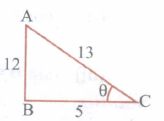
AB =\(\sqrt{13^2-5^2}\)
= \(\sqrt{169-25}\)
= \(\sqrt{144}=12\)
Since θ lies in the IV quadrant, only cos θ-. and sec θ are positive
sin θ = \(\frac{-12}{13}, cos θ=\frac{5}{13}, tanθ=\frac{-12}{5}, cosecθ=\frac{-13}{12} and\quad cotθ=\frac{-5}{12}\)
65.
\(cot\theta =\sqrt { 3 } \Rightarrow tan\theta =\frac { 1 }{ \sqrt { 3 } } \)
Since tan\(\theta\) = \(\frac { 1 }{ \sqrt { 3 } } \)>0, the principal value lies in the I quadrant
tan \(\theta\) = \(\frac { 1 }{ \sqrt { 3 } } \) = tan\(\left( \frac { \pi }{ 6 } \right) \)
\(\Rightarrow\) \(\theta\) = \(\left( \frac { \pi }{ 6 } \right) \) is the principal
66.
The relation R is defined by xRy if x + 2y = 1 for x, y \(\in \) N.
Reflexivity : Let x, y \(\in \) N
xRx \(\Rightarrow\) x + 2x = 1 \(\Rightarrow\) 3x = 1 \(\Rightarrow\) x = \(\frac { 1 }{ 3 } \notin N\)
\(\therefore\) R is reflexive.
Symmetricity: xRy \(\Rightarrow\) yRx for x, y \(\in \) N
xRy \(\Rightarrow\) x + 2y = 1 which is not possible for any values of x, Y \(\in \) N
\(\therefore\) R is not symmetric
Transitivity: xRy and yRz \(\Rightarrow\) xRz.
xRy and yRz are not possible for any values of x, y, z \(\in \) N
\(\therefore\) R is not transitive.
\(\therefore\) R is neither reflexive, nor symmetric and not transitive.
67.
Given relation is "aRb if a is not a sister of b". and a, b, c \(\in \) A.
Reflexivity: aRa \(\Rightarrow\) a is not a sister of a
\(\therefore\) R is reflexive.
Symmetric : aRb \(\Rightarrow\) bRa
a is not a sister of b \(\Rightarrow\) b is not a sister of a
\(\therefore\) R is not symmetric.
Transitivity: aRb and bRC \(\Rightarrow\) aRC
a is not a sister of b and b is not a sister of C. [Eg : Mother is not a sister of daughter, daughter is not a sister of chithi, but mother is a sister of chithi.]
\(\Rightarrow\) a is not a sister of C.
\(\therefore\) R is not transitive.
68.
tan (45o + A) = \(\frac { 1+\tan { A } }{ 1-\tan { A } } \)
LHS = tan (45o + A) = \(\frac { \tan { { 45 }^{ o } } +\tan { A } }{ 1+\tan { { 45 }^{ o } } .A\tan { } } =\frac { 1+\tan { A } }{ 1-\tan { A } } \) = RHS
Hence proved.
69.
\(\frac { 7\pi }{ 3 } \)
\(\frac { 7\pi }{ 3 } \) = \(\frac { 7\pi }{ 3 } \) \(\times\) \(\frac { 180 }{ \pi } \) = 4200
70.
\(\frac { 2\pi }{ 5 } \)
\(\frac { 2\pi }{ 5 } \) \(\times\) \(\frac { 180 }{ \pi } \) = 2 \(\times\) 360 = 720
71.
-2x > 0 or 3x - 4 < 11

⇒ -x > 0 or 3x < 11 + 4
⇒ x < 0 or 3x < 15 [a > b ⇒ -a < -b]
⇒ x < 0 or x < \(\frac{15}{3}\)
⇒ x < 0 or x < 5
⇒ x ∈ (-\(\infty \), 5)
72.
B-A = {4, 5, 6, 7}
LHS = C-(B-A) = {3, 9}...(1)
C\(\cap \)A = {3}
B' = {1,2,3,8,9}
C\(\cap \)B' = {3, 9}
RHS = (C\(\cap \)A)\(\cup \) (C\(\cap \)B') = {3, 9}...(2)
From (1) and (2), LHS = RHS
73.
Let cosec-1(-1) = y, where \(-\frac { \pi }{ 2 } \le y\le \frac { \pi }{ 2 } \)
⇒ -1 = cosec y
⇒ cosec y = -cosec \(\left( \frac { \pi }{ 2 } \right) \)
⇒ cosec y = cosec -\(\left( \frac { \pi }{ 2 } \right) \) [∵ cosec (-ፀ) = -cosec ፀ]
⇒ y = -\(\left( \frac { \pi }{ 2 } \right) \)
Thus, the principal value of cosec-1 is -\(\left( \frac { \pi }{ 2 } \right) \).
74.
3280
3280 = 2700 + 580
∴ 3280 lies in the IV quadrant
75.
(i) \(P(A\cup B)=P(A)+P(B)-P(A\cap B)\)
= 0.3 + 0.6 - 0.25
= \(0.9-0.25=0.65=\cfrac { 65 }{ 100 } =\cfrac { 13 }{ 20 } \)
(ii) \(P(A/B)=\cfrac { P(A\cap B) }{ P(B) } =\cfrac { 0.25 }{ 0.6 } =\cfrac { 25 }{ 60 } =\cfrac { 5 }{ 12 } \)
(iii) \(P(B/\bar { A } )=\cfrac { P\left( B\cap \bar { A } \right) }{ P\left( \bar { A } \right) } \)
= 0.35
\(P(\bar { A } )=1-P(A)=1-0.3=0.7\)
\(\therefore P(B\cap \bar { A } )=\cfrac { 0.35 }{ 0.7 } =\cfrac { 1 }{ 2 } \)
(iv) \(P(\bar { A } /B)=P\left( \bar { A } \cap B \right) /P(B)\)
\(P(\bar { A } \cap B)=0.35\) (from iii)
\(\therefore P(\bar { A } /B)=\cfrac { P\left( \bar { A } \cap B \right) }{ P(B) } =\cfrac { 0.35 }{ 0.6 } =\cfrac { 35 }{ 60 } =\cfrac { 7 }{ 12 } \)
(v) \(P(\bar { A } /\bar { B } )=\cfrac { P\left( \bar { A } \cap \bar { B } \right) }{ P(\bar { B } ) } \)
= \(1-\left( \bar { A } \cap \bar { B } \right) =P(\bar { A\cup B } )\)
=1 - 0.65 = 0.35
\(\therefore P(\bar { A } /\bar { B } )=\cfrac { P\left( \bar { A } \cap \bar { B } \right) }{ P(\bar { B } ) } =\cfrac { 0.35 }{ 0.4 } =\cfrac { 35 }{ 40 } =\cfrac { 7 }{ 8 } \)
76.
Intercept form √3x - y + 4 = 0 ⇒ √3x - y = -4
\(\frac{-\sqrt{3}}{4}x+\frac{y}{4}=1\)
That is \(\frac{x}{(-\frac{4}{\sqrt{3}})}+\frac{y}{4}=1\)
Comparing the above equation with the equation \(\frac{x}{a}+\frac{y}{b}=1\)
We get, x-intercept = -\(\frac{4}{\sqrt{3}}\) and y-intercept = 4
77.
(i) For a relation on {0, 1, 2, 3} to be reflexive, it must have the pairs (0, 0), (1, 1), (2, 2), (3, 3). Fortunately, it becomes symmetric and transitive. Therefore, as in (i) if we insert (1, 2) and (2, 3) we get the required one. Thus {(0, 0), (1, 1), (2, 2), (3, 3), (1, 2), (2, 3)} is reflexive; it is not symmetric and it is not transitive.
(ii) Proceeding like this we get the relation {(0, 0), (1, 1), (2, 2), (3, 3), (1, 2)} that is reflexive, transitive and not symmetric.
78.
\(I=\int { { e }^{ 2x } } sin3xdx\) put u = sin 3x; du = 3 cos 3x dx
e2xdx = dv \(\therefore v=\cfrac { { e }^{ 2x } }{ 2 } \)
= \(\left( sin3x \right) \left( \cfrac { { e }^{ 2x } }{ 2 } \right) -\int { \cfrac { { e }^{ 2x } }{ 2 } \left( 3cos3x \right) dx } \)
= \(\cfrac { { e }^{ 2x } }{ 2 } sin3x-\cfrac { 3 }{ 2 } \int { { e }^{ 2x }cos3xdx } =\cfrac { { e }^{ 2x } }{ 2 } sin3x-\cfrac { 3 }{ 2 } { I }_{ 1 }\)
\(I=\int { { e }^{ 2x }sin3xdx } \)
= \(\cfrac { { e }^{ ax } }{ { a }^{ 2 }+{ b }^{ 2 } } \left( asinbx-bcosbx \right) =\cfrac { { e }^{ ax } }{ 13 } \left[ 2sin3x-3cos3x \right] +c\)
where \({ I }_{ 1 }=\int { { e }^{ 2x }cosx3xdx } \)
Let u = cos 3x; du = -3 sin 3x dx
e2xdx=dv,\(\therefore v=\cfrac { { e }^{ 2x } }{ 2 } \)
\({ I }_{ 1 }=\left( cos3x \right) \cfrac { { e }^{ 2x } }{ 2 } -\int { \cfrac { { e }^{ 2x } }{ 2 } -\left( -3sin3x \right) } dx\)
(i.e.,) \({ I }_{ 1 }=\cfrac { { e }^{ 2x } }{ 2 } cos3x+\cfrac { 3 }{ 2 } \int { { e }^{ 2x }sin3x } dx\)
= \(\cfrac { { e }^{ 2x } }{ 2 } cos3x+\cfrac { 3 }{ 2 } I\)
Substituting (2) in (1) we get
\(I=\cfrac { { e }^{ 2x } }{ 2 } sin3x-\cfrac { 3 }{ 2 } \left\{ \cfrac { { e }^{ 2x } }{ 2 } cos3x+\cfrac { 3 }{ 2 } I \right\} \)
(i.e.,) \(I=\cfrac { e^{ 2x } }{ 2 } \left[ sin3x-\cfrac { 3 }{ 2 } cos3x \right] -\cfrac { 9 }{ 4 } I\)
\(I\left( 1+\cfrac { 9 }{ 4 } \right) =\cfrac { { e }^{ 2x } }{ 2 } \left[ 2sin3x-3xos3x \right] \)
(i.e.,) \(I\left( \cfrac { 13 }{ 14 } \right) =\cfrac { { e }^{ 2x } }{ 2 } \left[ 2sin3x-3cos3x \right] \)
So,\(I=\cfrac { { e }^{ 2x } }{ 13 } \cfrac { { e }^{ 2x } }{ 4 } \left[ 2sin3x-3cos3x \right] \)
(i.e)\(I=\cfrac { { e }^{ 2x } }{ 13 } \left[ 2sin3x-3cos3x \right] +c\)
79.
\(A=\left[ \begin{matrix} 1 & 2 & 2 \\ 2 & 1 & 2 \\ 2 & 2 & 1 \end{matrix} \right] \)
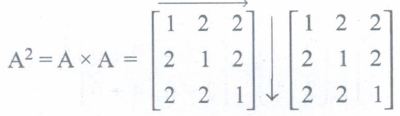
= \(\left[ \begin{matrix} 1+4+4 & 2+2+4 & 2+4+2 \\ 2+2+4 & 4+1+4 & 4+2+2 \\ 2+4+2 & 4+2+2 & 4+4+1 \end{matrix} \right] \)
= \(\left[ \begin{matrix} 9 & 8 & 8 \\ 8 & 9 & 8 \\ 8 & 8 & 9 \end{matrix} \right] \)
\(-4A=-4\left[ \begin{matrix} 1 & 2 & 2 \\ 2 & 1 & 2 \\ 2 & 2 & 1 \end{matrix} \right] =\left[ \begin{matrix} -4 & -8 & -8 \\ -8 & -4 & -8 \\ -8 & -8 & -4 \end{matrix} \right] \)
\(-5I=-5\left[ \begin{matrix} 1 & 0 & 0 \\ 0 & 1 & 0 \\ 0 & 0 & 1 \end{matrix} \right] =\left[ \begin{matrix} -5 & 0 & 0 \\ 0 & -5 & 0 \\ 0 & 0 & -5 \end{matrix} \right] \)
LHS :\(A^{ 2 }-4A-51=\left[ \begin{matrix} 9 & 8 & 8 \\ 8 & 9 & 8 \\ 8 & 8 & 9 \end{matrix} \right] +\left[ \begin{matrix} -4 & -8 & -8 \\ -8 & -4 & -8 \\ -8 & -8 & -4 \end{matrix} \right] +\left[ \begin{matrix} -5 & 0 & 0 \\ 0 & -5 & 0 \\ 0 & 0 & -5 \end{matrix} \right] \)
= \(\left[ \begin{matrix} 9-4-5 & 8-8+0 & 8-8+0 \\ 8-8+0 & 9-4-5 & 8-8+0 \\ 8-8+0 & 8-8+0 & 9-4-5 \end{matrix} \right] =\left[ \begin{matrix} 0 & 0 & 0 \\ 0 & 0 & 0 \\ 0 & 0 & 0 \end{matrix} \right] \)
80.
Given \(\vec{a}=2\hat{i}+\hat{j}-2\hat{k}\)
\(\left| \vec { a } \right| =\sqrt { { 2 }^{ 2 }+{ 1 }^{ 2 }+({ -2) }^{ 2 } } =\sqrt { 4+1+4 } =\sqrt { 9 } \)=3
\(\vec { b } =\hat { i } +\hat { j } \)
\(\left| \vec { b } \right| =\sqrt { { 1 }^{ 2 }+{ 1 }^{ 2 } } =\sqrt { 2 } \)
\(\left| \vec { c } -\vec { a } \right| =2\sqrt { 2 } \)
\({ \left| \vec { c } -\vec { a } \right| }^{ 2 }={ (2\sqrt { 2 } ) }^{ 2 }\)
\(\therefore { \left| \vec { c } \right| }^{ 2 }+{ \left| \vec { a } \right| }^{ 2 }-2(\vec { c } .\vec { a } )=8\)
\({ \left| \vec { c } \right| }^{ 2 }+9-2\left| \vec { c } \right| =8\quad [\therefore \left| \vec { a } \right| =3,\vec { c } .\vec { a } =\left| \vec { c } \right| ]\)
\({ \left| \vec { c } \right| }^{ 2 }+2\left| \vec { c } \right| +1=0\)
\({ [\left| \vec { c } \right| -1] }^{ 2 }=0\)
\({ \left| \vec { c } \right| -1 }=0\) \(\Rightarrow { \left| \vec { c } \right| }=0\)
Also \(\vec { a } \times \vec { b } =\left| \begin{matrix} \hat { i } & \hat { j } & \hat { k } \\ 2 & 1 & -2 \\ 1 & 1 & 0 \end{matrix} \right| \begin{matrix} =\hat { i } (0+2)-\hat { j } (0+2)+\hat { k } (2-1) \\ =2\hat { i } -2\hat { j } +\hat { k } \end{matrix}\)
\(\left| \vec { a } \times \vec { b } \right| =\sqrt { { 2 }^{ 2 }+{ (-2) }^{ 2 }+{ 1 }^{ 2 } } =\sqrt { 4+4+1 } =\sqrt { 9 } =3\)
\(\therefore \left| (\vec { a } \times \vec { b } ).\vec { c } \right| =\left| \vec { a } \times \vec { b } \right| \left| \vec { c } \right| sin30\) [angle between \(\vec{a} \times \vec{b}\) and \(\vec{c}\) is 30o]
=3(1)\(\left( \frac { 1 }{ 2 } \right) =\left( \frac { 3 }{ 2 } \right) \)
81.
Since \(\overrightarrow { c } \) is co-planar with \(\overrightarrow { a } \) and \(\overrightarrow { b } \)
Let \(\overrightarrow { c } =x\overrightarrow { a } +y\overrightarrow { b } \) where x, y are sclars.
\(\Rightarrow \overrightarrow { c } =x(\hat { i } +\hat { j } +2\hat { k } )+y(\hat { i } +2\hat { j } +\hat { k } )\)
\(\Rightarrow \overrightarrow { c } =\hat { i } (x+y)+\hat { j } (x+2y)+\hat { k } (2x+y)\)
\(\therefore |\overrightarrow { c } |=1\Rightarrow \sqrt { { (x+y) }^{ 2 }+{ (x+2y) }^{ 2 }+{ (2x+y) }^{ 2 } } =1\) ....(1)
Also, \(\overrightarrow { c } \) is perpendicular to \(\hat { i } +\hat { j } +\hat { k } \)
\(\Rightarrow \overrightarrow { c } .(\hat { i } +\hat { j } +\hat { k } )=0\)
\(\\ \\ \\ \Rightarrow \) (x+y)(1)+(x+2y)1+(2x+y)1 = 0
\(\Rightarrow \) 4x+4y = 0 \(\Rightarrow \) x = -y
Substituting y = -x in (1) we get,
\(\sqrt { 0+{ (-x) }^{ 2 }+{ (x) }^{ 2 } } =1\Rightarrow \sqrt { { 2x }^{ 2 } } =1\)
\(\Rightarrow{ 2x }^{ 2 }=1\Rightarrow { x }^{ 2 }=\frac { 1 }{ 2 } \Rightarrow x=\pm \frac { 1 }{ \sqrt { 2 } } \quad \)
\(\therefore\) when \(x=\frac { 1 }{ \sqrt { 2 } } ,y=-\frac { 1 }{ \sqrt { 2 } } \) and when \(x=-\frac { 1 }{ \sqrt { 2 } } ,y=\frac { 1 }{ \sqrt { 2 } } \)
\(\therefore x=\frac { 1 }{ \sqrt { 2 } } \) and \(y=-\frac { 1 }{ \sqrt { 2 } } \Rightarrow \overrightarrow { c } =-\frac { \hat { j } }{ \sqrt { 2 } } +\frac { \hat { k } }{ \sqrt { 2 } } \)
when \(x=-\frac { 1 }{ \sqrt { 2 } } \) , and \(y=\frac { 1 }{ \sqrt { 2 } } \Rightarrow \overrightarrow { c } =\frac { \hat { j } }{ \sqrt { 2 } } -\frac { \hat { k } }{ \sqrt { 2 } } \)
\(\therefore\) \(\overrightarrow { a } .\overrightarrow { c } =0+\frac { 1 }{ \sqrt { 2 } } -\frac { 2 }{ \sqrt { 2 } } =\frac { -1 }{ \sqrt { 2 } } <0\)
\(\overrightarrow { c } \) makes obtuse angle with \(\overrightarrow { a } \) means.
\(\overrightarrow { c } =\frac { \hat { j } -\hat { k } }{ \sqrt { 2 } } \)
82.
\(Let\quad \sin ^{ -1 }{ x } =t\Rightarrow x =\sin { t } \)
\(Also\quad x\rightarrow \frac { 1 }{ \sqrt { 2 } } \Rightarrow \sin { t } \rightarrow \frac { 1 }{ \sqrt { 2 } } \Rightarrow t\rightarrow \frac { \pi }{ 4 } \)
\(\therefore \lim _{ x\rightarrow \frac { 1 }{ \sqrt { 2 } } }{ \frac { x-\cos { (\sin ^{ -1 }{ (x) } ) } }{ 1-\tan { (\sin ^{ -1 }{ x } ) } } } =\lim _{ t\rightarrow \frac { \pi }{ 4 } }{ \frac { \sin { t } -\cos { t } }{ 1-\tan { t } } } =\lim _{ t\rightarrow \frac { \pi }{ 4 } }{ \frac { \sin { t } -\cos { t } }{ 1-\frac { \sin { t } }{ \cos { t } } } } =\lim _{ t\rightarrow \frac { \pi }{ 4 } }{ \frac { (\sin { t } -\cos { t) } \cos { t } }{ (\cos { t } -\sin { t } ) } }\)
\( =\lim _{ t\rightarrow \frac { \pi }{ 4 } }{ -\cos { t } } =-\cos { \left( \frac { \pi }{ 4 } \right) } =-\frac { 1 }{ \sqrt { 2 } } \)
83.
Given \(\log { ({ x }^{ 2 }+{ y }^{ 2 }) } =2\tan ^{ -1 }{ \frac { y }{ x } , } \)
Differentiating both sides, with respect to 'x' we get
\(\frac { 1 }{ { x }^{ 2 }+{ y }^{ 2 } } .\frac { d }{ dx } ({ x }^{ 2 }+{ y }^{ 2 })=2.\frac { 1 }{ 1+{ \left( \frac { y }{ x } \right) }^{ 2 } } .\frac { d }{ dx } { \left( \frac { y }{ x } \right) }\)
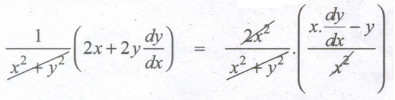
\(\Rightarrow 2x+2y\frac { dy }{ dx } =2x\frac { dy }{ dx } -2y\\ \Rightarrow x+y\frac { dy }{ dx } =x\frac { dy }{ dx } -y\\ \Rightarrow \frac { dy }{ dx } (y-x)=-x-y\\ \Rightarrow \frac { dy }{ dx } =\frac { -(x+y) }{ y-x } =\frac { x+y }{ x-y } \quad\)
Hence Proved
84.
Let S be the sample space and A be the event that the smallest block is to be painted in red.
n(S) = 6 P3 = 6 \(\times\) 5 \(\times\) 4 = 120
n(A) = 5 \(\times\) 4 = 20
P(A) = \(\frac { n(A) }{ n(S) } =\frac { 20 }{ 120 } =\frac { 1 }{ 6 } \)

85.
Let A be the event of getting award for design of railway bridge and B be the event of getting award for the efficient use of materials
Then, \(P(A)=0.48, P(B)=0.36, P(A \cap B)=0.2\)
(i) P (atleast one of the two awards)
\(=P(A \cup B) \)
\(=P(A)+P(B)-P(A \cap B) \)
\(=0.18+0.36-0.2=0.64\)
(ii) P (will get only one of the award)
\(=P(A \cap \bar{B})+P(\bar{A} \cap B) \)
\(=P(A)-P(A \cap B)+P(B)-P(A \cap B) \)
\(=0.48-0.20+0.36-0.20 \)
\(=0.44\)
86.
Let A'and B be the availability of first and second fire engine respectively, then A and B are independent.
Then \(P(A)=P(B)=0.96 \)
\(P(\bar{A})=P(\bar{B})=1-0.96=0.04\)
(i) P(a fire engine is available when needed)
\(=P(A \cap \bar{B})+P(\bar{A} \cap B)+P(A \cap B)\)
\(=P(A) \cdot P(\bar{B})+P(\bar{A}) \cdot P(B)+P(A) \cdot P(B)\)
\(=0.96 \times 0.04+0.04 \times 0.96+0.96 \times 0.96\)
\(=0.96(0.04+0.04+0.96) \)
\(=0.96 \times 1.04 \)
\(=0.9984\)
(ii) P (Neither is available when needed)
\(=P(\bar{A} \cap \bar{B}) \)
\(=P(\bar{A}) \cdot P(\bar{B})\)
\(=0.04 \times 0.04\)
\(=0.0016\)
87.
If the given matrix M is singular, then
\(\left| \begin{matrix} x & y \\ z & 1 \end{matrix} \right| \) = 0.
That is , x - yz = 0
Hence the possible ways of selecting (x, y, z) are
{(1,1,1), (2,1,2), (,2,2,1), (3,1,3), (3,3,1)} = A(say)
The number of favourable cases n(A) = 5
The total number of cases are n(S) = 33 = 27
The probability of the given matrix is a singular matrix is
P = \(\frac { n(A) }{ n(S) } =\frac { 5 }{ 27 } \)
88.
Let Ai be the event that the traffic light opens at i th cross, for i = 1, 2, 3, 4.
Let Bi be the event that the traffic light closes at i th cross, for i = 1, 2, 3, 4.
The traffic lights are all independent.
Therefore Ai and Bi are all independent events, for i = 1, 2, 3, 4.
Given that P(Ai) = 0.4, i = 1, 2, 3, 4
P(Bi) = 0.6, i =1, 2, 3, 4
(i) Probability of car crossing the first crossroad without stopping,
P(A1) = 0.4
(ii) Probability of car crossing first two crossroads without stopping
\(P({ A }_{ 1 }\cap { A }_{ 2 })\)= P(A1A2) = (0.4)(0.4) = 0.16
(iii) Probability of car crossing all the crossroads, stopping at third cross
P\(({ A }_{ 1 }\cap { A }_{ 2 }{ B }_{ 3 }\cap { B }_{ 3 }\cap { A }_{ 4 })\) = P(A1A2B3A4) = (0.4)(0.4)(0.6)(0.4) = 0.0384
(iv) Probability of car crossing all the crossroads, stopping at exactly one of the crossroads is
P(B1A2A3A4 \(\cup \) A1B2A3A4 \(\cup \) A1A2B3A4 \(\cup \) A2A3A3B4)
= P(B1A2A3A4)+P(A1B2A3A4)+P(A1A2B3A4)+P(A1A2A3B4)
= 4(0.4)(0.4)(0.6)(0.4) = 4(0.0384) = 0.1536.
89.
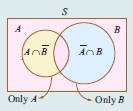
Let be the event of speaks the truth, be the event of speaks the truth
∴ \(\bar { A } \) is the event of X not speaking the truth and \(\bar { B } \) is the event of Y not speaking the truth.
Let C be the event that they will contradict each other.
Given that
P(A) = 0.70 ⇒ P(\(\bar { A } \)) = 1 - P(A) = 0.30
P(B) = 0.90 ⇒ P(\(\bar { B } \)) = 1 - P(B) = 0.10
C = (A speaks truth and B does not speak truth or B speaks truth and A does not speak truth)
C =\(\left[ (A\cap \bar { B } )\cup (\bar { A } \cap B) \right] \) (see figure)
since \((A\cap \bar { B } )\) and \((\bar { A } \cap B)\) are mutually exclusively,
P(C) = \((A\cap \bar { B } )+(\bar { A } \cap B)\)
= P(A)P(\(\bar { B } \)) + P(\(\bar { A } \))P(B)
( Since A, B are independent event A, \(\bar { B } \) are also independent events
= (0.70) (0.10) + (0.30) (0.90)
= 0.070 + 0.270 = 0.34
P(C) = 0.34
90.
Let A be the event of drawing a Jack in the first draw,
B be the event of drawing a Jack in the second draw.
Case (i)
Card is replaced
n(A) = 4 (Jack)
n(B) = 4 (Jack)
and n(S) = 52 (Total)
Clearly the event A will not affect the probability of the occurrence of event B and therefore A and B are independent.
P(A\(\cap \) B) = P(A). P(B)
P(A) = \(\frac{4}{52}\) , P(B) = \(\frac{4}{52}\)
P(A\(\cap \) B) = P(A).P(B)
=\(\frac{4}{52}\).\(\frac{4}{52}\)
=\(\frac{1}{169}\) .
Case (ii)
Card is not replaced
In the first draw, there are 4 Jacks and 52 cards in total. Since the Jack, drawn at the first draw is not replaced, in the second draw there are only 3 Jacks and 51 cards in total. Therefore the first event A affects the probability of the occurrence of the second event B.
Thus A and B are not independent. That is, they are dependent events.
Therefore, P( A \(\cap \) B ) = P(A). P(B)
P(A) = \(\frac{4}{52}\)
P(B/A) = \(\frac{3}{51}\)
P( A \(\cap \) B ) = P(A).P(B/A)
=\(\frac { 4 }{ 52 } .\frac { 3 }{ 51 } \)
=\(\frac { 1 }{ 121 } \) .
91.
Let A, B, C be the events that the problems solved by 3 students. Then,
\(P(A)=\frac{1}{3}, P(B)=\frac{1}{4}, P(C)=\frac{1}{5}\)
(i) P (Problem is solved) \(=P(A \cup B \cup C)\)
\(=1-P(\overline{A \cup B \cup C})\)
\(=1-P(\bar{A} \cap \bar{B} \cap \bar{C})\)
\(=1-P(\bar{A}) P(\bar{B}) P(\bar{C})\)
\(=1-\frac{2}{3} \times \frac{3}{4} \times \frac{4}{5} \)
\(=1-\frac{2}{5}=\frac{3}{5}\)
(ii) P (exactly one of them will solve)
\(=P(A \bar{B} \bar{C} \cup \bar{A} B \bar{C} \cup \bar{A} \bar{B} C)\)
\(=P(A) \cdot P(\bar{B}) \cdot P(\bar{C})+P(\bar{A}) \cdot P(B) \cdot P(\bar{C})
+P(\bar{A}) \cdot P(\bar{B}) \cdot P(C)\)
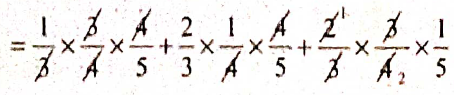
\(=\frac{1}{5}+\frac{2}{15}+\frac{1}{10}=\frac{1}{5}\left(1+\frac{2}{3}+\frac{1}{2}\right) \)
\(=\frac{6+4+3}{30}=\frac{13}{30}\)
92.
\(\int \sqrt{81+(2 x+1)^2} d x =\frac{\frac{2 x+1}{2} \sqrt{51+(2 x+1)^2}+\frac{81}{2} \log \mid 2 x+1+\sqrt{31+(2 x+1)^2} \mid+6}{\frac{d}{dx}(2 x+1)}\)
\(
=\frac{1}{4}\left[(2 x+1) \sqrt{81+(2 x+1)^2}\right.
\left.+81 \log \left|(2 x+1)+\sqrt{81+(2 x+1)^2}\right|\right]+c
\)
93.
Let \(2 x-3=A \frac{d}{d x}\left[x^2+4 x-12\right]+B\)
Then 2x - 3 = A(2x + 4) + B
Equating corresponding terms'on both sides,
2A = 2 ........(1)
4A + B = -3 .........(2)
from (1), A = 1
Putting this in (2)
4(1) + B = -3
\(\therefore\) B = -7
\(\therefore\) 2x - 3 = 1(2x + 4) - 7
\(\therefore \frac{2 x-3}{x^2+4 x-12}=\frac{2 x+4}{x^2+4 x-12}-\frac{7}{x^2+4 x-12}\)
\(=\frac{2 x+4}{x^2+4 x-12}-\frac{7}{\left(x^2+4 x+2^2\right)-2^2-12} \)
\(=\frac{2 x+4}{x^2+4 x-12}-\frac{7}{(x+2)^2-16}\)
\(=\frac{2 x+4}{x^2+4 x-12}-\frac{7}{(x+2)^2-4^2}\)
\(\therefore \int \frac{2 x-3}{x^2+4 x-12} d x=\int \frac{2 x+4}{x^2+4 x-12} d x
-7 \int \frac{1}{(x+2)^2-4^2} d x\)
\(=\log \left|x^2+4 x-12\right|-7 \times \frac{1}{2(4)} \log \left|\frac{(x+2)-4}{(x+2)+4}\right|+c \)
\(=\log \left|x^2+4 x-12\right|-\frac{7}{8} \log \left|\frac{x-2}{x+6}\right|+c\)
94.
Let I = \(\int {x+1\over x^2-3x+1}dx\)
\(x+1=A{d\over dx}(x^2-3x+1)+B\)
\(x+1=A(2x-3)+B\)
Comparing the coefficients of like terms, we get
\(2A=1 \Rightarrow A={1\over2};-3A+B=1\Rightarrow B={5\over2}\)
\(I=\int{{1\over2}(2x-3)+{5\over2}\over x^2-3x+1}dx\)
\(I={1\over2}\int {2x-3\over x^2-3x+1}dx+{5\over2}\int {1\over x^2-3x+1}dx\)
\(={1\over2}log |x^2-3x+1|+{5\over2}\int{1\over (x-{3\over2})^2-(\sqrt{5\over 2})^2}dx\)
\(={1\over2}log|x^2-3x+1|+{5\over2}{1\over 2({\sqrt{5}\over 2})}log\left| {x-{3\over 2}-{\sqrt{5}\over 2}\over x-{3\over 2}+{\sqrt{5}\over 2}} \right| +c\)
\(={1\over2}log|x^2-3x+1|+{\sqrt{5}\over 2}log |{2x-3-\sqrt{5}\over 2x-3+\sqrt{5}}|+c\)
95.
\(\int {1\over x^2-2x+5}dx=\int {1\over x^2-2(1)x+(1)^2+4}dx\)
\(=\int {1\over (x-1)^2+2^2}dx\)
\(\int {1\over x^2-2x+5}dx={1\over 2}tan^{-1}({x-1\over 2})+c\)
96.
Let \(\theta=\tan ^{-1} x\)
Then \(\tan \theta=x \text { and }\)
\(\frac{d \theta}{d x}=\frac{1}{1+x^2} \Rightarrow d \theta=\frac{1}{1+x^2} d x\)
\(\therefore \int e^{\tan ^{-1}} z \left(\frac{1+x-x^2}{1+x^2}\right) d x
=\int e^{\operatorname{tan} ^{-1} x}\left(1+x+x^2\right) \times \frac{1}{1+x^2} d x \)
\(=\int e^{\theta}\left(1+\tan \theta+\tan ^2 \theta\right) d \theta \)
\(=\int e^{\theta}\left(\sec ^2 \theta+\tan \theta\right) d \theta\)
\(=e^\theta\tan \theta+c\)
\(=e^{tan^{-1} x} \times x+c\)
\(=x e^{\tan ^{-1} x}+c\)
97.
Given that f'(x) = \({d\over dx}(f(x))=3x^2-4x+5\)
Integrating on both sides with respect to x, we get
\(\int f'(x)dx=\int (3x^2-4x+5)dx\)
\(f(x)=x^3-2x^2+5x+c\)
To determine the constant of integration c, we have to apply the given information f(1) = 3
\(f(1)=3\Rightarrow 3=(1)^3-2(1)^2+5(1)+c \Rightarrow c=-1\)
Thus \(f(x)=x^3-2x^2+5x-1\).
98.
\(
x =\frac{1-t^2}{1+t^2}\)
\(
\frac{d x}{d t} =\frac{\left(1+t^2\right)(-2 t)-\left(1-t^2\right)(2 t)}{\left(1+t^2\right)^2} \)
\(=\frac{-2 t-2 t^3-2 t+2 t^3}{\left(1+t^2\right)^2}=\frac{-4 t}{\left(1+t^2\right)^2} \)
\(
y =\frac{2 t}{1+t^2} \)
\(
\frac{d y}{d t} =\frac{\left(1+t^2\right)(2)-2 t(2 t)}{\left(1+t^2\right)^2}=\frac{2+2 t^2-4 t^2}{\left(1+t^2\right)^2} \)
\(=\frac{2-2 t^2}{\left(1+t^2\right)^2}=\frac{2\left(1-t^2\right)}{\left(1+t^2\right)^2}
\)
\(
\frac{d y}{d x} =\frac{d y}{\frac{d t}{d t}}=\frac{2\left(1-t^2\right)}{\left(1+t^2\right)^2} \frac{\left(1+t^2\right)^2}{-t t} \)
\(\frac{d y}{d x}=\frac{\frac{d x}{d t}}{\frac{d x}{d t}}=\frac{2\left(1-t^2\right)}{\left(1+t^2\right)^2} \frac{\left(1+t^2\right)^2}{-4 t}\)
\(=\frac{\left(1-t^2\right)}{-2 t}=\frac{1}{2 t}\left(t^2-1\right)\).
99.
We have \(x^2+y^2=4\)
As before, \({dy\over dx}=-{x\over y}\)
Hence, by the quotient rule
\({d^2y\over dx^2}=-{d\over dx}({x\over y})\)
\(=-{y.1-x.{dy\over dx}\over y^2}\)
\(=-{y-x(-{x\over y})\over y^2}\)
\(=-{x^2+y^2\over y^3}=-{4\over y^3}\).
100.
\(y=4 \sec 5 x\)
\(Take\ u=5 x\)
\(\frac{d u}{d x}=5\)
\(y =4 \sec u\)
\(\frac{d y}{d x} =\frac{d y}{d u} \cdot \frac{d u}{d x}=4 \sec u \tan u .(5)\)
\(=20 \sec 5 x \tan 5 x\)
101.
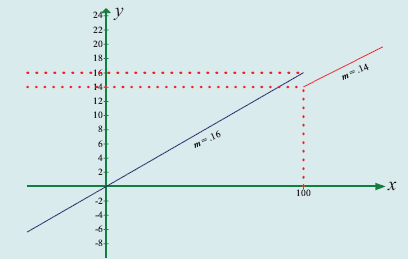
Let x denote the number of kilograms bought per day and C denote the cost. Then,
\(C(x)= \begin{cases}0.16 x, & \text { if } 0 \leq x<100 \\ 0.14 x, & \text { if } x \geq 100\end{cases}\)
The sketch of this function
It is discontinuous at x = 100 since \(lim_{x\rightarrow100^-}c(x)=16\) and \(lim_{x\rightarrow100^+}c(x)=14\)
Note that C(100) = 14. Thus,\(lim_{x\rightarrow100^-}c(x)=16\neq 14=lim_{x\rightarrow100^+}C(x)=C(100).\)
Note also that the function jumps from one finite value 14 to another finite value 16.
102.
\(lim_{x\rightarrow{0}}[{x^2+x\over x}+4x^3+3]=lim_{x\rightarrow 0}({x^2+x\over x})+lim_{x\rightarrow{0}}(4x^3+3)\)
\(lim_{x\rightarrow 0}(x+1)+lim_{x\rightarrow 0}(4x^3+3)\)
= (0 + 1) + (0 + 3)
= 4.
103.
Given: f(-2) = 0, f(2) = 0
\(\lim _{x \rightarrow-2} f(x)=0, \lim _{x \rightarrow 2} f(x)\) does not exist.
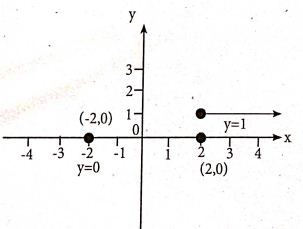
To sketch the graph of y = f(x)
(i) consider the points (-2, 0) and (2, 0).
(ii) Both points lie on x-axis. Therefore choose x-axis where \(x \leq 2\)
(iii) For x > 2 choose some other curve which does not pass through (2, 0).
It is better to choose y = 1 where x > 2
104.
\(f(x)=\begin{cases} { x^ 2 } ,\quad x \le 2 \\ 8-{ 2x } ,\quad 2 < x < 4 \\ { 4 } ,\quad x\ge 4 \end{cases}\)
To sketch the graph of y = f(x)
(i) y = x2 is an upward parabola with vertex at origin
when x = 2, y = (2)2 = 4
Draw the graph y = x2 where \(x \leq 2\)
(ii) y = 8 - 2x is a straight line.
when x = 2, y = 8 - 4 = 4
when x = 4, y = 8 - 8 = 0
Join (2, 4) and (4, 0) by a line segment and delete the points (2, 4) and (4, 0)
(iii) y = 4 is a horizontal line with y intercept 4.
when x = 4, y = 4
Draw y = 4 where \(k \geq 4\)
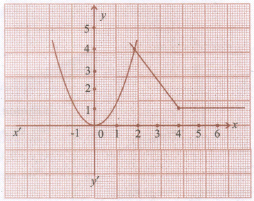
\( \lim _{x \rightarrow 4^{-}} f(x)=0 \ and\ \lim _{x \rightarrow \mathbb{4}^{+}} f(x)=4 \)
\( \therefore \lim _{x \rightarrow 4} f(x) \) does not exist.
\( \therefore \lim _{x \rightarrow x_0} f(x) exists\ for\ x_0 \in R-\{4\} \)
105.
Let the vertices of the triangle be A, B, C.
Then, given \(\overrightarrow { OA } =\hat { i } +2\hat { j } +3\hat { k } ,\overrightarrow { OB } =3\hat { i } -4\hat { j } +5\hat { k } \) and \(\overrightarrow { OC } =-2\hat { i } +3\hat { j } -7\hat { k } \)
\(\overrightarrow { AB } =\overrightarrow { OB } -\overrightarrow { OA } =(3\hat { i } -4\hat { j } +5\hat { k } )-(\hat { i } +2\hat { j } +3\hat { k } )=2\hat { i } -6\hat { j } +2\hat { k } \)
\(|\overrightarrow { AB } |=\sqrt { { 2 }^{ 2 }+{ (-6 })^{ 2 }+{ 2 }^{ 2 } } =\sqrt { 4+36+4 } =\sqrt { 44 } \)
\(\overrightarrow { BC } =\overrightarrow { OC } -\overrightarrow { OB } =(-2\hat { i } +3\hat { j } -7\hat { k } )-(3\hat { i } -4\hat { j } +5\hat { k } )=-5\hat { i } +7\hat { j } -12\hat { k } \)
\(|\overrightarrow { BC } |=\overrightarrow { OC } -\overrightarrow { OB } =(-2\hat { i } +3\hat { j } -7\hat { k } )-(3\hat { i } -4\hat { j } +5\hat { k } )=-5\hat { i } +7\hat { j } -12\hat { k } \)
\(|\overrightarrow { BC } |=\sqrt { { (-5) }^{ 2 }+{ 7 }^{ 2 }+{ (-12) }^{ 2 } } =\sqrt { 25+49+144 } =\sqrt { 218 } \)
\(\overrightarrow { CA } =\overrightarrow { OA } -\overrightarrow { OC } =(\hat { i } +2\hat { j } +3\hat { k } )-(-2\hat { i } +3\hat { j } -7\hat { k } )=3\hat { i } -\hat { j } +10\hat { k } \)
\(|\overrightarrow { CA } |=\sqrt { { 3 }^{ 2 }+{ (-1) }^{ 2 }+{ 1 }0^{ 2 } } =\sqrt { 9+1+100 } =\sqrt { 110 } \)
\(\therefore\) Perimeter of \(\Delta ABC,\)
\(|\overrightarrow { AB } |+|\overrightarrow { BC } |+|\overrightarrow { CA } |=\left( \sqrt { 44 } +\sqrt { 218 } +\sqrt { 110 } \right) \) units
106.
Let the vertices of the triangle be A( 1, 0, 0), B(0, 1, 0), C(0, 0, 1).
Let D, E, F are the mid-point of the sides BC, CA and AB respectively.
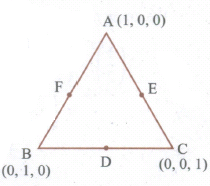
\(\therefore D \ is \ ({x_1+x_2\over 2},{y_1+y_2\over 2},{z_1+z_2\over 2})\)
\(\Rightarrow D \ is \ (0,{1\over 2},{1\over2})\) and E is \(({1\over 2},0,{1\over 2}), F \ is \ ({1\over2},{1\over 2},0)\)
Medians \(\overrightarrow{AD}=\overrightarrow{OD}-\overrightarrow{OA}\)
\(=(0\hat{i}+{1\over2}\hat{j}+{1\over 2}\hat{k})-(\hat{i}-0\hat{j}+0\hat{k})=-\hat{i}+{1\over2}\hat{j}+{1\over2}\hat{k}\)
\(r=\sqrt{x^2+y^2+z^2}=\sqrt{1+{1\over4}+{1\over 4}}=\sqrt{4+1+1\over 4}={\sqrt{6}\over 2}\)
Hence, the direction cosines of \(\overrightarrow{AD}\) are,
\({-1\over {\sqrt{6}\over 2}},{-1\over 2\times{\sqrt{6}\over 2}},{-1\over 2\times{\sqrt{6}\over 2} } \Rightarrow {-2\over \sqrt{6}},{1\over \sqrt{6}},{1\over \sqrt{6}}\)
The median \(\overrightarrow{BE}\) are
\({-1\over 2\times{\sqrt{6}\over 2}},-{-1\over {\sqrt{6}\over 2}},{-1\over 2\times{\sqrt{6}\over 2} } \Rightarrow {1\over \sqrt{6}},{-2\over \sqrt{6}},{1\over \sqrt{6}}\)
The median \(\overrightarrow{CF}=\overrightarrow{OF}-\overrightarrow{OC}=({1\over 2}\hat{i}+{1\over2}\hat{j}+0\hat{k})\)\(-(0\hat{i}+0\hat{j}+\hat{k})={1\over2}\hat{i}+{1\over2}\hat{j}-\hat{k}\)
\(r=\sqrt{{1\over4}+{1\over4}+1}={\sqrt{6}\over 2}\)
\(\therefore\) The direction of cosines of \(\overrightarrow{CF}\) are \({1\over 2\times{\sqrt{6}\over 2}},{1\over 2\times{\sqrt{6}\over 2} },{-1\over {\sqrt{6}\over 2}} \Rightarrow {1\over \sqrt{6}},{1\over \sqrt{6}},{-2\over \sqrt{6}}\)
107.
Let ABC be a triangle and let O be the origin.
Let D and E be the midpoints of AB and AC\(\overrightarrow{OE}={\overrightarrow{OA}+\overrightarrow{OC}\over 2}={\overrightarrow{a}+\overrightarrow{c}\over 2}\)
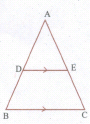
\(
\text { Let } \overrightarrow{O A}=\vec{a}, \overrightarrow{O B}=\vec{b}, \overrightarrow{O C}=\vec{c}
\)
\(\overrightarrow{O D}= \frac{\vec{a}+\vec{b}}{2}, \quad \overrightarrow{O E}=\frac{\vec{a}+\vec{c}}{2}
\)
\(\left.\therefore \overrightarrow{D E}=\overrightarrow{O E}-\overrightarrow{O D}=\left(\frac{\vec{a}+\vec{c}}{2}\right)-\left(\frac{\vec{a}+\vec{b}}{2}\right)=\frac{\vec{a}+\vec{c}-\vec{a}-\vec{b}}{2}\right)
\)
\(=\frac{\vec{c}-\vec{b}}{2}=\frac{(\overrightarrow{O C}-\overrightarrow{O B})}{2}\)
\(
\overrightarrow{D E}=\frac{\overrightarrow{B C}}{2}=\frac{1}{2} \overrightarrow{B C}
\)
\(\therefore D E \| B C .
\)
\(\text {Also } \overrightarrow{D E}=\frac{1}{2} \overrightarrow{B C} \Rightarrow|\overrightarrow{D E}|=\frac{1}{2}|\overrightarrow{B C}|
\)
\(D E=\frac{1}{2} B C
\)
Hence, \(D E \| B C \text { and } D E=\frac{1}{2} B C \text {. }\)
108.
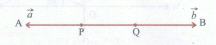
Let \(\overrightarrow{a}\) and \(\overrightarrow{b}\) be the position vectors of the points A and B.
\(\Rightarrow \overrightarrow{OA}=\overrightarrow{a}\) and \( \overrightarrow{OB}=\overrightarrow{b}\).
Let P divides the line segment AB in the ratio 1:2 and Q divides the line segment AB in the ratio 2 : 1
\(\therefore \overrightarrow{OP}={1.(\overrightarrow{OB})+2(\overrightarrow{OA})\over 1+2}={1(\overrightarrow{b})+2(\overrightarrow{a})\over 3}={\overrightarrow{b}+2\overrightarrow{a}\over 3}\)
and \( \overrightarrow{OQ}={2(\overrightarrow{OB})+1(\overrightarrow{OA})\over 2+1}={2\overrightarrow{b}+\overrightarrow{a}\over 3}={\overrightarrow{a}+2\overrightarrow{b}\over 3}\)
Hence, the required position vectors are \({\overrightarrow{b}+2\overrightarrow{a}\over 3}\)and \({\overrightarrow{a}+2\overrightarrow{b}\over 3}\).
109.
Let |A| = \(\begin{vmatrix} 1 &x^2 &x^3 \\ 1 & y^2 &y^3 \\1 &z^2 &z^3 \end{vmatrix}\) .
Putting x = y gives |A| = \(\begin{vmatrix} 1 &x^2 &x^3 \\ 1 & y^2 &y^3 \\1 &z^2 &z^3 \end{vmatrix}\) = 0 (since R1 \(\equiv\) R2).
Therefore (x - y) is a factor.
The given determinant is in cyclic symmetric form in x, y and z. Therefore (y - z) and (z - x) are also factors.
The degree of the product of the factors (x − y)( y − z)(z − x) is 3 and the degree of the product of the leading diagonal elements 1× y2 × z3 is 5.
Therefore the other factor is k(x2 + y2 + z2 ) + l(xy + yz + zx) .
Thus \(\begin{vmatrix} 1 &x^2 &x^3 \\ 1 & y^2 &y^3 \\1 &z^2 &z^3 \end{vmatrix}\)=[k(x2 + y2 + z2 ) + l(xy + yz + zx) ] × (x − y)( y − z)(z − x) .
Putting x = 0, y = 1 and z = 2, we get
\(\begin{vmatrix} 1 &0 &0 \\ 1 & 1 & 1 \\ 1 &4 &8 \end{vmatrix}\)= [k(0+1+4 ) +l(0+2+0) ](-1)( 1 - 2)(2 - 0)
\(\Rightarrow\) (8 - 4) = [(5k + 2l)](−1)(−1)(2)
4 = 10k + 4l \(\Rightarrow\) 5k + 2l = 2.
Putting x = 0, y = −1 and z =1, We get
\(\begin{vmatrix} 1 &0 &0 \\ 1 & 1 & -1 \\ 1 &4 &8 \end{vmatrix}\) = [k(2) + l(−1)](1)(−2)(1)
\(\Rightarrow\) [(2k − l)(−2)] = 2
2k − l = - 1.
Solving (1) and (2), we get k = 0, l =1.
Thus \(\begin{vmatrix} 1 &x^2 &x^3 \\ 1 & y^2 &y^3 \\1 &z^2 &z^3 \end{vmatrix}\) = (x - y)(y - z)(z - x)(xy + yz + zx).
110.
Given a, b, c are pth, qth and rth terms of a G.P.
\(p^{\text {th }} \text { term } \Rightarrow A R^{r^{-1}}=a\)
\(q^{\text {th }} \text { term } \Rightarrow A R^{q-1}=b\)
\(r^{\text {th }} \text { term } \Rightarrow A R^{r-1}=c\)
\(A R^{P^{-1}}=a\)
Take log on both sides.
\(\log A+(p-1) \log R=\log a .\)
Similarly
\(\log A+(q-1) \log R=\log b\)
\(\log A+(r-1) \log R=\log c\)
\(L H S=\left|\begin{array}{lll}
\log a & p & 1 \\
\log b & q & 1 \\
\log c & r & 1
\end{array}\right|\)
\(=\left|\begin{array}{lll}
\log A+p \log R-\log R & p & 1 \\
\log A+q \log R-\log R & q & 1 \\
\log A+r \log R-\log R & r & 1
\end{array}\right|\)
\(=\left|\begin{array}{lll}
\log A & p & 1 \\
\log A & q & 1 \\
\log A & r & 1
\end{array}\right|+\left|\begin{array}{lll}
p \log R & p & 1 \\
q \log R & q & 1 \\
r \log R & r & 1
\end{array}\right|-\left|\begin{array}{ccc}
\log R & p & 1 \\
\log R & q & 1 \\
\log R & r & 1
\end{array}\right|\)
Since in first and third determinants C1 and C3 are proportional and in second determinants C1 and C2 are proportional.
= 0 +0 - 0 0 = RHS.
Hence proved.
111.
Given f(x) = \(\begin{bmatrix} cos \ x & -sin \ x & 0 \\ sin x & cos x & 0 \\ 0 & 0 & 1 \end{bmatrix}\)
f(x) \(\times\) f(y) = \(\begin{bmatrix} cos \ x & -sin \ x & 0 \\ sin x & cos x & 0 \\ 0 & 0 & 1 \end{bmatrix}\)\(\left[ \begin{matrix} cosy & -siny & 0 \\ siny & cosy & 0 \\ 0 & 0 & 1 \end{matrix} \right] \)
= \(\left[ \begin{matrix} cosxcosy-sinxcosy & -cosxsiny-sinxcosy & 0 \\ sin \ x cos \ y+cos \ xsin \ y & -sin \ x \ sin \ y+cos \ x \ cos \ y & 0 \\ 0 & 0 & 1 \end{matrix} \right] \)
= \(\left[ \begin{matrix} cos(x+y) & -sin(x+y) & 0 \\ sin(x+y) & cos(x+y) & 0 \\ 0 & 0 & 1 \end{matrix} \right] \)
[\(\therefore\)cos(x + y) = cos x cos y - sin x sin y]
sin(x + y) = sin x cos y + cos x sin y]
= f(x + y)
112.
Cost matrix A = [30 15 45], Fruit matrix
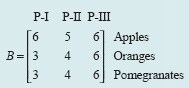
Cost of packages are obtained by computing AB. That is, by multiplying cost of each item in A (cost matrix A) with number of items in B (Fruit matrix B).
\(A B=\left[\begin{array}{lll} 30 & 15 & 45 \end{array}\right]\left[\begin{array}{lll} 6 & 5 & 6 \\ 3 & 4 & 6 \\ 3 & 4 & 6 \end{array}\right]=\left[\begin{array}{lll} 360 & 390 & 540 \end{array}\right]\)
Pack-I cost Rs. 360, Pack-II cost Rs. 390, Pack-III costs Rs. 540.
113.
Let p(n) : 2n < (n + 2)! for all k\(\in\)N.
Step1: P(1) 2.1 < (1+2)!
\(\Rightarrow\) 2 < 3!\(\Rightarrow\) 2 < 6 which is true for P(1) [\(\because\) 3! = 3 x 2 x 1 = 6]
Step 2: P(k) : 2k < (k + 2)!. Let it be true for P(k)
Step3:P(k+1) 2(k+1) < (k+1+2)!
Since 2k < (k + 2)! (from Step 2)
\(\Rightarrow\)2k+2 < (k+2)! +2
\(\Rightarrow\) 2(k+1) < (k+2)!+2
Also, (k+ 2)! + 2 < (k+ 3)!
\(\therefore\) 2(k+1) < (k+3)!
\(\Rightarrow\) 2(k + 1) < (k + 2 + 1)! which is true for P(k + 1)
Hence, P(k + 1) is true whenever P(k) is true.
114.
Given h = 61.4 + 2.3 F
Given h = 160 ⇒160 = 61.4 + 2.3 F
⇒ 2.3 F = 160-61.4 = 98.6
F =\(\frac { 98.6 }{ 2.3 } \) = 42.87
Given h = 170,
170 = 61.4 + 2.3 F
⇒ 170 - 61.4 = 2.3 F
2.3 F = 108.6
⇒ F =\(\frac { 108.6 }{ 2.3 } \)= 47.23
So the ranges of values are
42.8 < x < 47.23
115.
cosec (90° + A) = sec A, cot (90° + A) = - tan A
LHS sec A + x cos A(-tan A)
\(=\frac{1}{cosA}-xcosA\times\frac{sinA}{cosA}=\frac{1}{cosA}-xsinA\)
RHS = sin(90°+A) = cos A
\(\therefore\frac{1}{cosA}-xsinA=cosA\)
\(\Rightarrow \frac{1}{cosA}-sinA=xsinA\Rightarrow\frac{1-cos^2A}{cosA}=xsinA\)
\(\Rightarrow \frac{sin^2A}{sinAcosA}=x\)
\(x=\frac{sinA}{cosA}=tanA\)
116.
Given that:
2x+y=5.....(i)
x+3y+8=0...(ii)
3x+4y=7 ....(iii)
Equation of any line passing through the point of intersection of equation (i) and (ii) is
(2x+y-5)+λ(x+3y+8)=0 ...(iv) (λ=constant)
⇒ 2x+y-5+λx+3λy+8λ=0
⇒ (2+λ)x+(1+3λ)y-5+8λ=0
Slope of line m1 (say) = \(\frac { -(2+\lambda ) }{ 1+3\lambda } \) \(\left[ \because m=\frac { -a }{ b } \right] \)
Now slope of line 3x + 4y = 7 is
m2(say) = -\(\frac { 3 }{ 4 } \)
If equation (iii) is parallel to equation (iv) then m1 = m2
⇒ \(\frac { -(2+\lambda ) }{ 1+3\lambda } =-\frac { 3 }{ 4 } \)
⇒ \(\frac { 2+\lambda }{ 1+3\lambda } =\frac { 3 }{ 4 } \) ⇒ 8+4λ=3+9λ
⇒ 9λ-4λ=5 ⇒ 5λ=5 ⇒ λ=1
On putting the value of A.in equation (iv) we get
(2x+y-5)+1(x+3y+8)=0
⇒ 2x+y-5+x+3y+8=0 ⇒ 3x+4y+3=0
Hence, the required equation is 3x+4y+3=0
117.
Let tk denote the kth term of the given series.
Then \(t_k{1\over k(k+1)}.\)
By using partial fraction we get
\({1 \over k(k+1)}={1\over k}-{1\over{k+1}}\)
Thus \(t_1+t_2+....+t_n=\left( 1-{1\over 2} \right)+\left( {1\over 2}+{1\over 3} \right)+\left( {1\over 3}-{1\over 4} \right)+...+\left( {1\over n} -{1\over n+1} \right)=1-{1\over n+1}.\)
118.
\(\frac{2^n+3^n}{n}\)
119.
(i) general equation is ax2 + 2hxy + by2 + 2gx + 2fy + C = 0
given equation is λx2-10xy + 12y2 + 5x -16y - 3 = 0
Comparing the given equation with the general equation of the second degree we have
a = λ, b = 12, c = 3, h = -5, g = 5/2, f = -8
Now applying the condition for pair of straight lines
abc + 2fgh-af2- bg2- ch2 = 0
i.e., λ(12)(-3)+2(-8)\(\left( \frac { 5 }{ 2 } \right) \)(-5)-λ(-8)2-12\(\left( \frac { 5 }{ 2 } \right) \)2-(-3)(-5)2 = 0
⇒ -36λ + 200 - 64λ - 75 + 75 = 0 ⇒ λ = 2
∴ The equation is 2x2-10xy + 12y2 + 5x - 16y - 3 = 0
Let us first factorize the terms of second degree terms from the above equation,
we get 2x2 - 10xy + 12y2 = (x - 2y) (2x - 6y)
⇒ 2x2- 10xy + 12y2+ 5x - 16y - 3 ≡ (x - 2y)(2x - 6y)
⇒ 2x2-10xy + 12y2+5x -16y - 3 ≡ (x - 2y + c1)(2x - 6y + c2)
Equating like terms, we get
2c1 + c2 = 5, 3c1 + c2 = 8, c1c2 = -3
Solving first two equation, we get c1= 3, c2 = -1
∴ The separate equations of the lines are x - 2y + 3 = 0 and 2x - 6y - 1 = 0
(ii) Point of intersection of the lines is given by solving the two equation of the lines, we get
(x,y) = \(\left( -10,-\frac { 7 }{ 2 } \right) \) (or use the formula \(\left( \frac { hf-bg }{ ab-h^{ 2 } } ,\frac { hg-af }{ ab-{ h }^{ 2 } } \right) \))
(iii) Angle between the lines is given by
tanፀ = \(\left| \frac { 2\sqrt { { h }^{ 2 }-ab } }{ a+b } \right| \)
= \(\frac { 2\sqrt { 25-24 } }{ 2+12 } =\frac { 1 }{ 7 } \)
∴ \(\theta ={ tan }^{ -1 }\left( \frac { 1 }{ 7 } \right) \).
120.
The Sine formula is, \({a\over sin A}={b\over s in B}={c\over s in C}=2R\)
LHS = \({a^2+b^2\over a ^2+c^2}={({2RsinA})^2+({2RsinB})^2\over ({2RsinA})^2+({2RsinC})^2 }\)
\(={sin^2A+sin^2B\over sin^2A+sin^2C }={1-cos^2A+sin^2B\over 1-cos^2A+sin^2C }\)
\(={1-(cos^2A-sin^2B)\over 1-(cos^2A-sin^2C) }={1-cos(A+B)cos(A-B)\over 1-cos(A+C)cos(A-C)}\)
\(={1+cos(A-B)cosC\over 1+cos(A-C)cosB}\)
121.
Let, P(n) = 12 + 22 + 32 +...+k2 = \(\frac { n(n+1)(2n+1) }{ 6 } \)
Substituting n = 1 in the statement we get, P(1) = \(\frac { 1(1+1)(2(1)+1) }{ 6 } \) = 1.
Hence, P(1) is true. Let us assume that the statement is true for n = k. Then
P(k) = 12 + 22 + 32+...+k2 = \(\frac { k(k+1)(2K+1) }{ 6 } \)
We need to show that P(k + 1) is true. Consider
\(P(k+1) =\underbrace{1^2+2^2+3^3+...k^2}+(k+1)^2\)
= P(k) + (k+1)2
= \(\frac { k(k+1)(2K+1) }{ 6 } +(k+1)^2\)
= \(\frac { k(k+1)(2k+1)+6(k+1)^{ 2 } }{ 6 } =\frac { (k+1)(k(2k+1)+6(k+1) }{ 6 } \)
= \(\frac { (k+1)(2k^{ 2 }+7k+6) }{ 6 } =\frac { (k+1)[(k+2)(2k+3)] }{ 6 } \)
= \(\frac { (k+1)[(k+1)+1)(2(k+1)+1)] }{ 6 } \)
That is, P(k+1) = \(\frac { (k+1)((k+1)+1)(2(k+1)+1) }{ 6 } \)
This implies P(k + 1) is true. The validity of P(k + 1) follows from that of P(k). Therefore by the principle of mathematical induction,
12 +22 + 32+...n2 = \(\frac { n(n+1)(2n+1) }{ 6 } \), for all n ≥ 1.
122.
sin 72° = sin (90° - 18°)
= cos 18°\(=\frac{1}{4}\sqrt{10+2\sqrt 5}\)
123.
reciprocal of the other
The roots are reciprocal of the other
Let α and \({1\over α}\) be the roots
\(∴\ α+{1\over α}={-b\over a}\)
and \(α.{1\overα}={c\over a}\)
\(⇒\ 1={c\over a}\)
⇒ c = a
which is the required condition
124.
Thrice the other
The roots are thrice the other
Let α and 3α be the roots
\(α+3α=-{b\over a}\)
\(⇒\ 4α=-{b\over a}\)
\(⇒\ α=-{b\over 4a}\)
\((α)(3α)={c\over a}\)
\(⇒\ 3α^2={c\over a}\)
\(⇒\ α^2={c\over 3a}\)
Substituting (1) in (2) we get
\(\left(-b\over 4a\right)^2={c\over 3a}\)
\(⇒\ {b^2\over 16a^2}={c\over 3a}\)
\(⇒\ {b^2\over 16a^2}={c\over 3a}\)
\(⇒\ {b^2\over 16a^2}={c\over 3}\)
⇒ 3b2 = 16ac which is the required condition.
125.
By the given data m and 3m are the slopes of the pair of lines ax2 + 2hxy + by2 = 0
We know that m1 + m2 \(=\frac { -2h }{ b } and\quad m_{ 1 }{ m }_{ 2 }=\frac { a }{ b } \)
\(\therefore \quad m+2m=\frac { -2h }{ b } and\quad m(3m)=\frac { a }{ b } \)
\(\Rightarrow \quad 4m=\frac { -2h }{ b } and\quad { 3m }^{ 2 }=\frac { a }{ b } \)
\(\Rightarrow \quad m=-\frac { 2h }{ 4b } and3{ m }^{ 2 }=\frac { a }{ b } \)
\(\Rightarrow \quad m=\frac { -h }{ 2b } ...91)\quad and\quad 3{ m }^{ 2 }=\frac { a }{ b } ...(2)\)
Substituting (1) in (2) we get,
\(3{ \left( \frac { -h }{ 2b } \right) }^{ 2 }=\frac { a }{ b } \)
\(\Rightarrow 3\left( \frac { { h }^{ 2 } }{ { 4b }^{ 2 } } \right) =\frac { a }{ b } \)
\(\Rightarrow \frac { { 3h }^{ 2 } }{ 4b } =a\)
\(\Rightarrow\) 3h2 = 4ab
126.
(i) Let the variable x represents the quantity of gas, and y represents the number of days.
By the given data,
| x1 (0) Kg |
| x2 (14.2) Kg |
| y1 (0) |
| y2 (24) |
Using two - point form, the linear relationship between quantity of gas in the cylinder to the number of days is
\(\frac { y-0 }{ 24-0 } =\frac { x-0 }{ 14.2-0 } \ \left[ \because \ \frac { y-{ y }_{ 1 } }{ { y }_{ 2 }-{ y }_{ 1 } } =\frac { x-{ x }_{ 1 } }{ { x }_{ 2 }-{ x }_{ 1 } } \right] \)
\(\frac { y }{ 24 } =\frac { x }{ 14.2 } \)
\(\Rightarrow\) 14.2 y = 24x
\(\Rightarrow\) 24x - 14.2y = 0
\(\Rightarrow\) 12x - 7.1y = 0 ....(1)
Which is the required linear relation...(2)
Find the equation relating the quantity of gas in the cylinder to the days.
To find the Time taken to cross the pole, put y = 0
\(\Rightarrow \ \therefore \ 12.5x\ =\ 150\ \ \Rightarrow \ x=\frac { 150 }{ 12.5 } =12\ sec\)
(ii) Draw the graph for first 96 days
.JPG)
y = f(x) is a periodic function with period 24.
Therefore, f(x) = f(x + 24)
127.
There are 7 Indian's and 5 Americans. A committee of 5 members with majority Indian's can be formed by the following ways.
| Indian's (7) | American (5) | Combination | |
| (i) | 4 | 1 | 7C4 \(\times \) 5C1 |
| (ii) | 3 | 2 | 7C3 \(\times \) 5C2 |
| (iii) | 5 | 0 | 7C5 \(\times \) 5C0 |
∴ Total number of ways of forming the committee
= 7C4 \(\times \)5C1+7C3 \(\times \)5C2+7C5 \(\times \)5C0
= 7C3 \(\times \)5 + 7C3\(\times \)5C2 + 7C2\(\times \)1
\(=\frac { 7\times 6\times 5 }{ 3\times 2\times 1 } \times 5+\frac { 7\times 6\times 5 }{ 3\times 2\times 1 } \times \frac { 5\times 4 }{ 2\times 1 } \times \frac { 7\times 6 }{ 2\times 1 } \)
= 175 + 350 + 21
= 546.
128.
Let p = q+h
h is numerically very small and so h12 h3 ... may be neglected
RHS \(={(n+1)p+(n-1)q\over (n-1)p+(n+1)q}={(n+1)(q+h)+(n-1)q\over (n+1)(q+h)+(n+1)q}\)
\(={nq+q-nh+h+nq-q\over nq-q+nh-h+nq+q}={2nq+(n+1)h\over2nq+(n-1)h}\)
\(={1+{n+1\over2n}.{q\over h}\over1+{n-1\over2n}.{h\over q}}=\left(1+{n+1\over2n}.{h\over q}\right)\left(1+{n-1\over2n}.{h\over q}\right)^{-1}\)
\(=\left({1+{n+1\over2n}.{h\over q}}\right)\left(1-{n-1\over2n}.{h\over q}\right)=1+\left({n+1\over 2n}-{n-1\over2n}\right){h\over q}\)
\(={1+{1\over n}}.{h\over q}\)
LHS \(={p\over q}^{1\over n}=\left(q+h\over q\right)^{1\over n}=\left(1+{h\over q}\right)^{1\over n}=1+{1\over n}.{h\over q}\)
From (1) and (2), LHS = RHS
Now \(\sqrt[8]{15\over16}={(8+1)(15)+(8-1)(16)\over(8-1)(15)+(8+1)(16)}\) [n = 8, p = 15 and q = 16]
\(={(9)(15)+7(16)\over(7)(15)+9(16)}={135+112\over105+144}={247\over 249}\)
\(\left( \frac { 15 }{ 16 } \right) =0.9919\)
129.
LHS = 2nCn
= \(\frac { 2n! }{ n!(2n-n)! } =\frac { 2n! }{ n!n! } \)
= \(\frac { (2n)(2n-1)(2n-2)...4.3.2.1 }{ n!n! } =\frac { (2n)(2n-2)...4.2[(2n-1)(2n-3)...3.1] }{ n!n! } \) [Separate the even and odd terms]
= \(\frac { { 2 }^{ n }.n(n-1)...2.1[(2n-1)(2n-3)...3.1] }{ n!n! } \)
= \(\frac { { 2 }^{ n }.(n)![1.3.5...(2n-3)(2n-1)] }{ n!n! } =\frac { { 2 }^{ n }[1.3.5...(2n-3)(2n-1)] }{ n! } \) = RHS
130.
Let P(h, k) be the point on RQ such that ∠ORQ = θ where θ is a variable.
From triangle PLR, we get sin θ = \(\frac{k}{b}\) ...(1)
From triangle PMQ, we get cos θ = \(\frac{h}{b}\) ...(2)
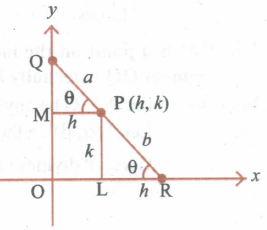
Squaring and adding (1) and (2), we get,
sin2θ + cos2θ = (\(\frac{k}{b}\))2 + (\(\frac{h}{a}\))2
1 = \(\frac{k^2}{b^2}+\frac{k^2}{b^2}\)
ஃ Locus of (h, k) is \(\frac{x^2}{a^2}+\frac{y^2}{b^2}=1\)
131.
LHS = \({ \left( { x }^{ 3 }+6 \right) }^{ \frac { 1 }{ 3 } }-{ \left( { x }^{ 3 }+3 \right) }^{ \frac { 1 }{ 3 } }\)
\(={ x }^{ 3\times \frac { 1 }{ 3 } }{ \left( 1+\frac { 6 }{ { x }^{ 3 } } \right) }^{ \frac { 1 }{ 3 } }-{ x }^{ 3\times \frac { 1 }{ 3 } }{ \left( 1+\frac { 3 }{ { x }^{ 3 } } \right) }^{ \frac { 1 }{ 3 } }\)
\(=x\left[ 1+\frac { 1 }{ 3 } \left( \frac { 6 }{ { x }^{ 3 } } \right) \right] -x\left[ 1+\frac { 1 }{ 3 } \left( \frac { 3 }{ { x }^{ 3 } } \right) \right] \)
\(=x+\frac { 2 }{ { x }^{ 2 } } -x-\frac { 1 }{ { x }^{ 2 } } \)
\(=\frac { 2 }{ { x }^{ 2 } } -\frac { 1 }{ { x }^{ 2 } } =\frac { 1 }{ { x }^{ 2 } } =RHS\)
Hence proved.
132.
(100 - 1)4 (a -b)n = nC0 an b0 - nC1 an-1 b1 +...nCn a0 bn, n \(\epsilon \) N
= 1004 - 4C1 (100)3 (1)1 + 4C2 (100)2 (1)2 - 4C3 (100)(13)+14
= 100000000 + 4(1000000) + \(\frac { 4\times (3) }{ 2\times 1 } \)(10000) - 400+1
= 100000000 -4000000 +60000 - 400 +1
= 96,059,601
133.
Let = 6 + 66 + 666 + ... upto n terms
= 6 (1 + 11 + 111+ ....) upto n terms
\(={6\over9}(9+99+999+ ...)\) upto n terms
\(={63\over 6}[(10 -1) + (10^2-1) + (10^3 -1) + ...]\) upto n terms
\(={6\over 9}[(10+ 10^2 + 10^3+ ...) - (1+ 1+1...)]\) upto n terms
\(={6\over9}\left[{ 10(10^n-1)\over 10-1}n\right]\)[In a G.P with a = 10 r = 10, \(S_n={(r^n-1)\over r-1}\)]
\(={6\over9}\left[{ 10(10^n-1)\over 10-1}n\right]={6\over9}\left[ 10(10^n-1)-9n\over9\right]\)
\({ S }_{ n }=\frac { 6 }{ 81 } \left[ 10\left( { 10 }^{ n }-1 \right) -9n \right] \)
134.
Let p(n) be the statement
\({1\over 1.2.3}+{1\over 2.3.4}+...+{1\over {n(n+1)(n+2)}}={n(n+3)\over 4(n+1)(n+2)}\)
Step 1: Putting n = 1, we get
\({1\over 1.2.3}={1(1+3)\over 4(1+1)(1+2)}⇒{1\over 6}={4\over 4(2)(3)}={1\over 6}\)
∵ p(1) is true
Step 2: Let us assume that p(K) is true.
\(∵\ {1\over 1.2.3}+{1\over 2.3.4}+..+{1\over K(K+1)(K+2)}={K(K+3)\over 4(K+1)(K+2)}\)
Step 3: To prove that p(K + 1) is true
i.e. to P.T. \({1\over 1.2.3}+{1\over 2.3.4}+...+{1\over K(K+1)(K+2)(K+3)}={(K+1)(K+4)\over 4(K+2)(K+3)}\)
LHS = \({1\over 1.2.3}+{1\over 2.3.4}+...+{1\over K(K+1)(K+2)}+{1\over (K+1)(K+2)(K+3)}\)
\(={K(K+3)\over 4(K+1)(K+2)}+{1\over (K+1)(K+2)(K+3)}\)
\(={1\over (K+2)(K+1)}\left[{K(K+3)\over 4}+{1\over (K+3)}\right]={1\over (K+2)(K+1)}\left[K(K+3)^2+4\over 4(K+3)\right]\)
\(={1\over 4(K+1)(K+2)(K+2)}[K(K^2+6K+9)+4]\)
\(={1\over 4(K+1)(K+2)(K+2)}[K^3+6K^2+9K+4]\)
\(={1\over 4(K+1)(K+2)(K+2)}[(K+1)(K+1)(K+4)]\)
= (K + 1)(K + 1)(K + 4)
[Using Synthetic division K3 + 6K2+ 9K +4]
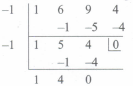
∵ p(K + 1) is true.
Hence, by the principle of mathematical induction
p(K + 1) is true for all values of n.
135.
Let y = 3x -5.
\(\Rightarrow y+5=3x\Rightarrow \frac { y+5 }{ 3 } =x\)
Let g(y) = \(\frac { y+5 }{ 3 } \)
\(gof(x)=g(f(x))=g(3x-5)=\frac { 3x-5+5 }{ 3 } =\frac { 3x }{ 3 } =y\)
Also f o g(y) = f(g(y)) = \(f\left( \frac { y+5 }{ 3 } \right) =3\left( \frac { y+5 }{ 3 } \right) -5=y+5-5=y\)
Thus g o f = Ix and fog = Iy.
This implies that f and g are bijections and inverses to each other.
Hence f is a bijection and f-1(y) = \(\frac { y+5 }{ 3 } \)
Replacing y by x we get, f-1(x) = \(\frac { x+5 }{ 3 } \)
136.
\({ tan }^{ -1 }\left( \frac { cos\quad x }{ 1-sin\quad x } \right) ={ tan }^{ -1 }\left( \frac { sin\left( \frac { \pi }{ 2 } -x \right) }{ 1-cos\left( \frac { \pi }{ 2 } -x \right) } \right) \) \([Since\quad sin(90-\theta )=cos\theta \quad and\quad cos\quad (90-\theta )=sin\quad \theta ]\)
\(={ tan }^{ -1 }\left[ \frac { sin\left( \frac { \pi -2x }{ 2 } \right) }{ 1-cos\left( \frac { \pi -2x }{ 2 } \right) } \right] \)
\(={ tan }^{ -1 }\left[ \frac { 2\quad sin\left( \frac { \pi -2x }{ 4 } \right) .cos\left( \frac { \pi -2x }{ 4 } \right) }{ 2{ sin }^{ 2 }\left( \frac { \pi -2x }{ 4 } \right) } \right] \left[ \because sin\theta =2sin\frac { \theta }{ 2 } cos\frac { \theta }{ 2 } and1-cos\quad \theta =2{ sin }^{ 2 }\frac { \theta }{ 2 } \right] \)
\(={ tan }^{ -1 }\left( \frac { cos\left( \frac { \pi -2x }{ 4 } \right) }{ sin\left( \frac { \pi -2x }{ 4 } \right) } \right) \)
\(={ tan }^{ -1 }\left( cot\left( \frac { \pi -2x }{ 4 } \right) \right) \)
\(={ tan }^{ -1 }\left( tan\left( \frac { \pi }{ 2 } -\frac { \pi -2x }{ 4 } \right) \right) \quad \quad [\because cot\quad \theta =tan(90-\theta )]\)
\(={ tan }^{ -1 }\left( tan\left( \frac { 2\pi -\pi }{ 4 } +2x \right) \right) \)
\(={ tan }^{ -1 }\left( tan\left( \frac { \pi +2x }{ 4 } \right) \right) =\frac { \pi +2x }{ 4 } \quad \quad [\because { tan }^{ -1 }(tan\theta )=\theta ]\)
\(=\frac { \pi }{ 4 } +\frac { 2\pi }{ 4 } =\frac { \pi }{ 4 } +\frac { x }{ 2 } \) which is the simplest form.
137.
f(-3) = (-3)2 - 3 \(\left[ \therefore \ f(x)={ x }^{ 2 }-3\quad when\ x=-3 \right] \)
= 9 - 3 = 6
f(5) = 52 + 3(5)-2 \(\left[ \therefore f(x)={ x }^{ 2 }+3x-2\quad when\quad x=5 \right] \)
= 25 + 15 - 2
= 38
f(2) = 22 - 3
= 4 - 3 = 1 \(\left[ \therefore \ f(x)={ x }^{ 2 }-3\ when\ x=2 \right] \)
f(-1) = (-1)2 + (-1) -5 \(\left[ \therefore \ f(x)={ x }^{ 2 }+x-5\ when\ x=-1 \right] \)
= 1-1-5 = -5
f(0) = 02-3 = -3 \(\left[ \therefore \ f(x)={ x }^{ 2 }-3\ when\ x=0 \right] \)
\(\therefore\) f(-3) = 6, f(5) = 38, f(2) = 1, f(-1) = -5, f(0) = -3
138.
Let P be the intruder, A and B are the soldiers.
Let x be the distance between the intruder and soldier B.
In ΔABP
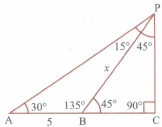
Given ㄥPAB
and ㄥPBC
In ΔABP, ㄥAPB
In ΔABP, using sine formula,
\(⇒\ {5\over sin\ 15^0}={x\over sin30^0}\)
\(⇒\ x{5\over sin15^0}sin30^0=5\times {1\over 2 sin15^0}\)
Now, sin 15 = sin (45 - 30)
= sin 45 cos 30 - cos 45 sin 30
\(={1\over \sqrt2}\times{\sqrt3\over 2}-{1\over \sqrt2}={\sqrt3-1\over 2\sqrt2}\)
Substituting this value in (1) we get,
\(x={5\over {2(\sqrt3-1)\over 2\sqrt2}}={5\sqrt2\over \sqrt3-1}\)
139.
\({{x}\over{(x^2+1)(x-1)(x+2)}}={Ax+B\over (x^2+1)}+{C\over (x-1)}+{D\over (x+2)}\)
\(⇒\ \ {x\over (x^2+1)(x-1)(x+2)}x={(Ax+B)(x-1)(x+2)+C(x^2+1)(x+2)+D(x^2+x)(x-1)\over (x^2+1)(x-1)(x+2)}\)
x = (Ax + B) (x - 1) (x + 2) + C(x2 + 1) (x + 2) + D(x2 + 1) (x - 1) ...(1)
Putting x = 1 in (1) we get
1 = C(2)(3) ⇒ \(C={1\over 6}\)
Putting x = -2 in (1) we get
-2 = D(5)(-3)
⇒ \(D={2\over 15}\)
Putting x = 0 in (1) we get
0 = (B) (-1) (2) + C(1) (2) + D(1) (-1)
⇒ 0 = -2B + 2C - D
⇒ 0 = \(-2B+2\left(1\over 6\right)-{2\over 15}\)[substituting the values of C and D]
⇒ \(2B={2\over 6}-{2\over 15}={1\over 3}-{2\over 15}\)
⇒ \(2B={5-2\over 15}={3\over 15}={1\over 5}\)
⇒ \(B={1\over 10}\)
Equating the Coefficients of x3 in (1) we get
0 = A + C + D
⇒ A = - C - D
⇒ \(A=-{1\over 6}-{2\over 15}\)
⇒ \(A={-5-4\over 30}={-9\over 30}={-3\over10}\)
⇒ \(A={-3\over 10}\)
\(∴\ {x\over (x^2+1)(x-1)(x+2)}={{-3\over 10}x+{1\over 10}\over x^2+1}+{{1\over 6}\over x-1}-{{2\over 15}\over x+2}\)
= \({{-3x+1}\over{10(x^2+1)}}+{{1}\over{6(x-1)}}+{{2}\over{15(x+2)}}\)
140.
The relation is defined by aRb if a + b \(\le\) 6 for all a, b \(\in \)N.
a+b \(\le\)6 \(\Rightarrow\) a \(\le\) 6 - b
| a | 5 | 4 | 3 | 2 | 1 |
| b | 1 | 2 | 3 | 4 | 5 |
\(\therefore\) The list of ordered pairs are (5,1) (4, 2) (3, 3) (2, 4) and (1, 5).
Symmetric : (5, 1) \(\in \) R \(\Rightarrow\) (1, 5) \(\in \) R
(4, 2) \(\in \) R \(\Rightarrow\) (2, 4) \(\in \) R
\(\therefore\) R is symmetric
141.
Given inequality is \({x^3(x-1)\over x-2}>0\)
The critical numbers are 0, 1, 2
The possible intervals are (-∞, 0) (0, 1) (1, 2) (2, ∞)

| Intervals | Sign of x3 | Sign of (x - 1) | Sign of (x - 2) | Sign of \({x^3(x-1)\over x-2}\) |
|---|---|---|---|---|
| (- ∞, 0) Say x = -1 | - | - | - | - |
| (0, 1) Say x = \(\frac{1}{2}\) | + | - | - | + |
| \((1,2)={1\over 2}\) Say x = 1 | + | + | - | - |
| (2, ∞) Say x = 3 | + | + | + | + |
The given inequality \({x^2(x-1)\over x-2}>0\) is satisfied by the intervals (0, 1) and (2, ∞)
∴ Solution set is (0, 1)∪(2, ∞)
∴ Solution set is \((0,1)\bigcup(2, \infty)\)
142.
We have A + B + C = 180°
B + C = 180° - A = 180° - 60° = 120°
\(\Rightarrow \frac { B+C }{ 2 } =60°\)...(1)
Using sine formula, \(\frac { a }{ sinA } =\frac { b }{ sinB } =\frac { c }{ sinC } =k\)
a = k sin A, b = k sin B, c = k sin C
RHS = 2a cos\(\left( \frac { B-C }{ 2 } \right) \)...(2)
= 2.K sin A cos\(\left( \frac { B-C }{ 2 } \right) \)
=2.K sin 60° cos \(\left( \frac { B-C }{ 2 } \right) \)
= 2K.sin\(\left( \frac { B+C }{ 2 } \right) \)cos\(\left( \frac { B-C }{ 2 } \right) \)
= K\(\left[ sin\left( \frac { B+C+B-C }{ 2 } \right) +sin\left( \frac { B+C-B-C }{ 2 } \right) \right] \)
= K[sin B + sin C]
= K sin B + K sin C
= b + c [From(2)]
LHS Hence proved.
143.
Given relation is 2a + 3b = 30 for all a, b \(\in \) N.
2a + 3b = 30 \(\Rightarrow\) 2a =30 - 3b
\(\Rightarrow a=\frac { 30-3b }{ 2 } \)
| a | 12 | 9 | 6 | 3 |
| b | 2 | 4 | 6 | 8 |
\(\therefore\) The list of ordered pairs are (12, 2) (9, 4) (6, 6) (3, 8)
Transitivity: Clearly R is not transitive.
144.
2a + 3b = 30
R = {(3, 8), (6, 6), (9, 4). (12, 2)}
Not reflexive, Not Symmetric, transitive, hence not an equivalence relation.
145.
Given sin θ = \(\frac{1}{25}\)
\(cos\theta =\sqrt { 1-{ sin }^{ 2 }\theta } =\sqrt { 1-\frac { 1 }{ 625 } } =\frac { \sqrt { 624 } }{ 25 } =\frac { 4\sqrt { 39 } }{ 25 } \)
Now, \(sin\frac { \theta }{ 2 } =\sqrt { \frac { 1-cos\theta }{ 2 } } =\sqrt { \frac { 1-\frac { 4\sqrt { 39 } }{ 25 } }{ 2 } } =\sqrt { \frac { 25-4\sqrt { 39 } }{ 50 } } \)
\(cos\frac { \theta }{ 2 } =\sqrt { \frac { 1+cos\theta }{ 2 } } =\sqrt { \frac { 1-\frac { 4\sqrt { 39 } }{ 25 } }{ 2 } =\sqrt { \frac { 25-4\sqrt { 39 } }{ 50 } } } \)
Consider \(sin\left( \frac { \pi }{ 4 } -\frac { \theta }{ 2 } \right) =sin\frac { \pi }{ 4 } cos\frac { \theta }{ 2 } -cos\frac { \pi }{ 4 } sin\frac { \theta }{ 2 } \)
\(sin\left( \frac { \pi }{ 4 } -\frac { \theta }{ 2 } \right) =\frac { 1 }{ \sqrt { 2 } } cos\frac { \theta }{ 2 } -\frac { 1 }{ \sqrt { 2 } } sin\frac { \theta }{ 2 } \)
\(\frac { 1 }{ \sqrt { 2 } } \left( cos\frac { \theta }{ 2 } -sin\frac { \theta }{ 2 } \right) =\frac { 1 }{ \sqrt { 2 } } \left[ \sqrt { \frac { 25+4\sqrt { 39 } }{ 50 } } -\sqrt { \frac { 25-4\sqrt { 39 } }{ 50 } } \right] \)
\(=\frac { 1 }{ 5\sqrt { 2 } } \left[ \sqrt { \frac { 25+4\sqrt { 39 } }{ 50 } } -\sqrt { \frac { 25-4\sqrt { 39 } }{ 50 } } \right] \)
146.
Since \(\alpha \in \left( \pi ,\frac { 3\pi }{ 2 } \right) \), \(\alpha \) lies in III quadrant
So, only tan \(\alpha \) and cot \(\alpha \) are positive
Also \(\beta \in \left( \frac { \pi }{ 2 } ,\pi \right) \) , β lies in II quadrant
So only sin β and cosec β are positive.
Given cot \(\alpha \) =\(\frac{1}{2}\)
\(\sqrt { { 2 }^{ 2 }+{ 1 }^{ 2 } } =\sqrt { 5 } \)
sec β = \(\frac{-5}{3}\)
\(\sqrt { { 5 }^{ 2 }-{ 3 }^{ 2 } } =4\)
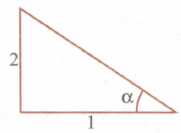
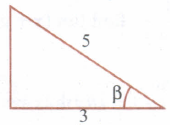
∴ tan \(\alpha \) = 2
tan β =\(\frac{-4}{3}\)
Now, \(tan\left( \alpha +\beta \right) =\frac { tan\alpha +tan\beta }{ 1-tan\alpha tan\beta } =\frac { 2-\frac { 4 }{ 3 } }{ 1-\left( 2 \right) \left( \frac { 4 }{ 3 } \right) } \)
\(=\frac { \frac { 6-4 }{ 3 } }{ 1+\frac { 8 }{ 3 } } =\frac { \frac { 2 }{ 3 } }{ \frac { 3-8 }{ 3 } } =\frac { 2 }{ 3 } \times \frac { 3 }{ 11 } =\frac { 2 }{ 11 } \)
147.
f + g : R ⟶ R and f - g : R ⟶ R
Now (f + g) (x) = f(x) + g(x)
⇒ ( f+ g)(x) = x + |x|
\(⇒\ \left( f+g \right) x =\begin{cases}x +x\quad if\quad x\ge 0 \\ x-x \ if\quad x<0\quad \end{cases}\)
\(⇒\ \left( f+g \right) x =\begin{cases}2x\quad if\quad x\ge 0 \\ 0 \ if\quad x<0\quad \end{cases}\)
Similarly (f - g) (x) = f(x) - g(x) = x - |x|
\(⇒\ \left( f-g \right) x =\begin{cases}x -x\quad if\quad x\ge 0 \\ x-(-x )\ if\quad x<0\quad \end{cases}\)
\(⇒\ \left( f-g \right) \left( x \right) =\begin{cases} 0 \quad if\quad x\ge 0 \\ 2x \ if\quad x<0\quad \end{cases}\)
148.
\(LHS=sin(B+C-A)+sin(C+A-B)+sin(A+B-C)=4sinAsinBsinC\)
\(=sin(180-A-A)+sin(180-B-B)+sin(180-C-C)\)
\(=sin(180-2A)+sin(180-2B)+sin(180-2C)=sin\quad 2A+sin2B+sin2C\)
\(=2sin\left( \frac { 2A+2B }{ 2 } \right) cos\left( \frac { 2A-2B }{ 2 } \right) +2sinC\quad cosC\)
\(=2sin(A+B)cos(A-B)+2sinC\quad cosC=2sinC[cos(A-B)+cosC]\)
\(=2sinC[cos(A-B)+cos(180-(A+B))]\)
\(=2sinC[cos(A-B)-cos(A+B)]=2sinC2sinAsinB\)
\(=4\quad SinASinBsinC=RHS\)
149.
Given log2 x-3log1/6 = 6 [using quotient rule]
\(⇒\ {1\over log_x^2}-{3\over log_x^{1\over 2}}=6\)
\(⇒\ {1\over log_x^2}-{3\over log_x^1-log_x^2}=6\) [using quotient rule]
\(⇒\ {1\over log_x^2}-{3\over 0-log_x^2}=6\)
\(⇒\ {1\over log_x^2}+{3\over log_x^2}=6\)
\(⇒\ {1\over log_x^2}(1+3)=6\)
\(⇒\ {1\over log_x^2}(4)=6\)
\(⇒\ {1\over log_x^2}={6\over 4}={3\over 2}\)
\(⇒\ log_2^x={3\over2}\)
\(⇒\ 2^{3\over2}=x\)
⇒ (23)1/2 = x ⇒ (8)1/2 = x
\(⇒\ x=\sqrt8=\sqrt{4\times2}\)
⇒ \(x=x\sqrt { 2 } \)
150.
If 3x + 5y = 45
| x | 0 | 15 |
| y | 9 | 0 |
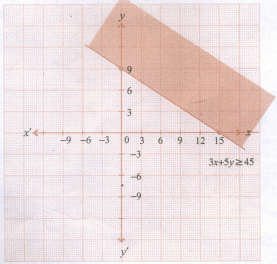
All points bounded above x = 0, y = 0 and 3x + 5y = 45 is required region. Darkly shaded area will represents the solution set of the given linear inequalities.
151.
LHS = sin A + sin B + sin C
= \(2sin\left( \frac { A+B }{ 2 } \right) .cos\left( \frac { A-B }{ 2 } \right) +2sin\frac { C }{ 2 } cos\frac { C }{ 2 } \)
= \(2sin\left( 90-\frac { C }{ 2 } \right) cos\left( \frac { A-B }{ 2 } \right) +2sin\frac { C }{ 2 } cos\frac { C }{ 2 } \)
= \(2cos\frac { C }{ 2 } cos\left( \frac { A-B }{ 2 } \right) +2sin\frac { C }{ 2 } cos\frac { C }{ 2 } \)
= \(2cos\frac { C }{ 2 } \left[ cos\left( \frac { A-B }{ 2 } \right) +sin\frac { C }{ 2 } \right] \)
= \(2cos\frac { C }{ 2 } \left[ cos\left( \frac { A-B }{ 2 } \right) +sin\left( 90-\left( \frac { A+B }{ 2 } \right) \right) \right] \)
= \(2cos\frac { C }{ 2 } \left[ cos\left( \frac { A-B }{ 2 } \right) +cos\left( \frac { A+B }{ 2 } \right) \right] \)
= \(2cos\frac { C }{ 2 } .cos\frac { A }{ 2 } cos\frac { B }{ 2 } \)
= \(4cos\frac { A }{ 2 } cos\frac { B }{ 2 } cos\frac { C }{ 2 } \) = RHS
Hence proved.
152.
f(-4) = +4 + 4 [\(\therefore\) f(x) = -x + 4 when x = -4]
=8
f(1) = 1-12 [\(\therefore\) f(x) = x-x2 when x = 1]
f(1) = 0
f(-2) = (-2)2-(-2) [\(\therefore\) f(x) = x2-x when x = -2]
= 4+2 = 6
f(7) = 0 [\(\therefore\) f(x) = 0 when x = 7]
f(0 = 02-0 [\(\therefore\) f(x) = x2 - x when x = 0]
=0
\(\therefore\) f(-4) = 8, f(1) = 0, f(-2) = 6, f(7) = 0 and f(0) = 1
153.
\(LHS=sin\frac { \theta }{ 2 } sin\frac { 7\theta }{ 2 } +sin\frac { 3\theta }{ 2 } sin\frac { 11\theta }{ 2 } \)
\(=\frac { 1 }{ 2 } \left[ cos\left( \frac { \theta }{ 2 } -\frac { 7\theta }{ 2 } \right) -cos\left( \frac { \theta }{ 2 } -\frac { 7\theta }{ 2 } \right) \right] +\frac { 1 }{ 2 } \left[ cos\left( \frac { 3\theta }{ 2 } -\frac { 11\theta }{ 2 } \right) -cos\left( \frac { 3\theta }{ 2 } -\frac { 11\theta }{ 2 } \right) \right] \)
\(=\frac { 1 }{ 2 } \left[ cos(-3\theta )-cos(4\theta )+cos(-4\theta )-cos7\theta \right] \)
\(=\frac { 1 }{ 2 } \left[ cos3\theta -cos4\theta +cos4\theta -cos7\theta \right] \quad \quad \left[ \because cos(-\theta )=cos\theta \right] \)
\(=\frac { 1 }{ 2 } \left[ cos3\theta -cos7\theta \right] =\frac { 1 }{ 2 } \left[ 2sin\left( \frac { 3\theta +7\theta }{ 2 } \right) .sin\left( \frac { 7\theta -3\theta }{ 2 } \right) \right] \)
\(=sin5\theta .sin2\theta =RHS.\)
154.
(i) \(y=-x^{ \left( \frac { 1 }{ 3 } \right) }\)
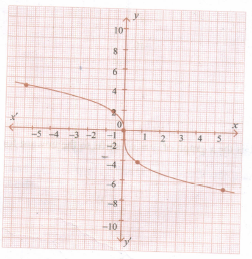
\(Let \ y=-x^{ ^{ \frac { 1 }{ 3 } } }\)
\(Then \ y=-x^{ ^{ \frac { 1 }{ 3 } } }\) is the reflection of the graph of \(y=x^{ ^{ \frac { 1 }{ 3 } } }\) about the x-axis.
(ii) \(y=x^{1\over 3}+1\)
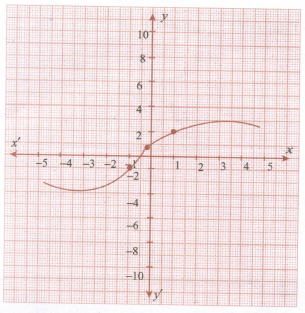
Let \(y=x^{ ^{ \frac { 1 }{ 3 } } }\)
Then \(y=x^{ ^{ \frac { 1 }{ 3 } } }+1\) is the x graph of \(y=x^{ ^{ \frac { 1 }{ 3 } } }\) shifts to the upward for one unit
(iii) \(y=x^{1\over 3}-1\)
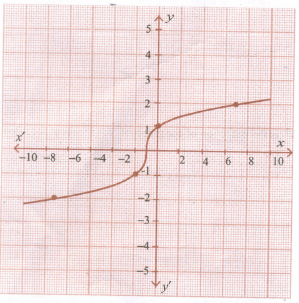
Let \(y=x^{1\over 3}\)
Then \(y=x^{1\over 3}\)-1 is the graph of \(x^{ ^{ \frac { 1 }{ 3 } } }\) shifts to the downward for one unit.
(iv) \(y=(x+1)^{1\over 3}\)
| x | 0 | 1 | 7 | -9 |
| y | 1 | 1 | 2 | -2 |
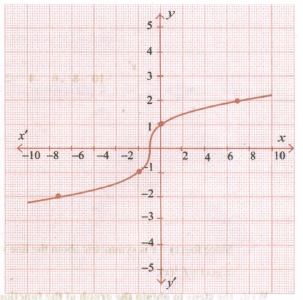
\(y=(x+1)^{1\over 3}\) causes the graph of \({x}^{\frac{1}{3}}\), shifts to the left for one unit.
155.
Let A, B be the land marks and C be the position of the plane,
Given ㄥACB 45°
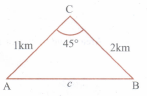
Using cosine formula,
c2 = a2 + b2 - 2ab cos C
c2 = 22 + 12 - 2(2)(1) cos 450
\(=4+1-4\left(1\over \sqrt3\right)\)

c2 = 5 - 2√2
\(c^2=\sqrt{5-2\sqrt2}km\)
156.
Let ABC be the triangles with position vectors \(\vec { OA } ,\vec { OB } \) and \(\vec { OC } \)
(i.e.,) \(\vec { \quad OA } =\left( 4\hat { i } +5\hat { j } +6\hat { k } \right) \) ,\(\vec { OB } =5\hat { i } +6\hat { j } +4\hat { k } \) and \(\vec { OC } =6\hat { i } +4\hat { j } +5\hat { k } \)
\(\vec { AB } =\vec { OB } -\vec { OA } =\left( 5\hat { i } +6\hat { j } +4\hat { k } \right) -\left( 4\hat { i } +5\hat { j } +6\hat { k } \right) \)
= \(\hat { i } +\hat { j } -2\hat { k } \)
\(\left| \vec { AB } \right| =\sqrt { 1+1+4 } =\sqrt { 6 } \)
\(\vec { BC } =\vec { OC } -\vec { OB } =\left( 6\hat { i } +4\hat { j } +5\hat { k } \right) -\left( 5\hat { i } +6\hat { j } +4\hat { k } \right) \)
= \(\hat { i } -2\hat { j } +\hat { k } \)
\(\left| \vec { BC } \right| =\sqrt { 1+4+1 } =\sqrt { 6 } units\)
\(\vec { AC } =\vec { OC } -\vec { OA } =\left( 6\hat { i } +4\hat { j } +5\hat { k } \right) -\left( 4\hat { i } +5\hat { j } +6\hat { k } \right) \)
\(\\ 2\hat { i } -\hat { j } -\hat { k } \)
\(\left| \vec { AC } \right| =\sqrt { 4+1+1 } =\sqrt { 6 } units\)
Now,\(\left| \vec { AB } \right| =\left| \vec { BC } \right| =\left| \vec { AC } \right| =\sqrt { 6 } \)
⇒ ΔABC is an equilateral triangle
157.
\(LHS=\left| \begin{matrix} -{ a }^{ 2 } & ab & ac \\ ab & -{ b }^{ 2 } & bc \\ ac & bc & -{ c }^{ 2 } \end{matrix} \right| ={ 4a }^{ 2 }{ b }^{ 2 }{ c }^{ 2 }\)
Taking a from R1 b from R2 and c from R3 as common factors we get,
= \(\left( abc \right) \left| \begin{matrix} -a & b & c \\ a & -b & c \\ a & b & -c \end{matrix} \right| \)
Again taking a from C1' b from C2 and e from C3 we get,
= \(\left( abc \right) \left( abc \right) \left| \begin{matrix} -1 & 1 & 1 \\ 1 & -1 & 1 \\ 1 & 1 & -1 \end{matrix} \right| \)
= \(\left( abc \right) ^{ 2 }\left| \begin{matrix} 0 & 0 & 2 \\ 2 & 0 & 0 \\ 1 & 1 & -1 \end{matrix} \right| \begin{matrix} { R }_{ 1 }\rightarrow { { R }_{ 1 }+{ R }_{ 2 } } \\ { R }_{ 2 }\rightarrow { R }_{ 2 }+{ R }_{ 3 } \end{matrix}\)
= \(\left( abc \right) { c }^{ 2 }\left[ 0+0+2\left| \begin{matrix} 2 & 0 \\ 1 & 1 \end{matrix} \right| \right] \)
= (abc)2 (4) = 4a2b2c2 = RHS
158.
\(tan\quad \frac { A }{ 2 } =\sqrt { \frac { (s-b)(s-c) }{ s(s-a) } } ...(1)\)
\(tan\quad \frac { C }{ 2 } =\sqrt { \frac { (s-a)(s-b) }{ s(s-c) } } ...(2)\)
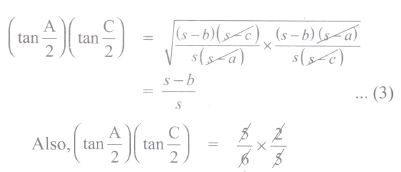
\(\\ \therefore \frac { s-b }{ s } =\frac { 1 }{ 3 } \)
3s - 3b = s
2s = 3b
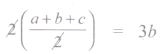
a + b + c = 3b
a + c = -2b
∴ a, b, c are in A.P
159.
= \(\int { \frac { { sin }^{ 6 }x+cos^{ 6 }x }{ sin^{ 2 }xcos^{ 2 }x } } \)
= \(\int { \frac { \left( { sin }^{ 2 }x \right) ^{ 3 }+\left( { cos }^{ 2 }x \right) ^{ 3 } }{ { sin }^{ 2 }x{ cos }^{ 2 }x } } \) dx\(\left[ { a }^{ 3 }+{ b }^{ 3 }=\left( a+b \right) ^{ 3 }-3ab\left( a+b \right) \right] \)
= \(\int { \frac { \left( { sin }^{ 2 }x \right) ^{ 3 }+\left( { cos }^{ 2 }x \right) ^{ 3 }-{ 3sin }^{ 2 }x{ cos }^{ 2 }x\left( { sin }^{ 2 }x+{ cos }^{ 2 }x \right) }{ { sin }^{ 2 }x{ cos }^{ 2 }x } } \)
= \(\int { \frac { { 1 }^{ 3 }-3{ sin }^{ 2 }x{ cos }^{ 2 }x(1) }{ { sin }^{ 2 }x{ cos }^{ 2 }x } } \) dx = \(\int { \frac { 1-3{ sin }^{ 2 }x{ cos }^{ 2 }x }{ { sin }^{ 2 }x{ cos }^{ 2 }x } } \)dx
= \(\int { \left( \frac { 1 }{ { sin }^{ 2 }x{ cos }^{ 2 }x } -3 \right) } \)dx = \(\int { \frac { { sin }^{ 2 }x{ +cos }^{ 2 }x }{ { sin }^{ 2 }x{ cos }^{ 2 }x } } -3\)dx
= \(\int { \frac { { sin }^{ 2 }x }{ { sin }^{ 2 }x{ cos }^{ 2 }x } } dx+\int { \frac { { cos }^{ 2 }x }{ { sin }^{ 2 }x{ cos }^{ 2 }x } } dx-\int { 3 } \)dx
= \(\int { sec^{ 2 } } \) x dx + \(\int { cosec } ^{ 2 }xdx\) - 3 \(\int { dx } \) = tan x - cot x - 3x + c
160.
Let A be the event that the construction job will be complete on time,
E1: There will be a strike and
E2: There will be no strike.
Given P(E1) =0.65, P(E2) = 1-P(E1) = 1-0.65 = 0.35, P(A/E1) = 0.32, P(AE2) = 0.80
By the total probability theorem, we get
P(A) = P(E1). P(A/E1) + P(E2).P(A/E2)
= 0.65 \(\times\) + 0.35 \(\times\) 0.80 = 0.208 + 0.28
P(A) = 0.488
161.
Given f(2)=2
\(\lim _{ x\rightarrow { 2 }^{ - } }{ f\left( x \right) } =\lim _{ x\rightarrow { 2 }^{ + } }{ { x }^{ 2 } } =2(2)=4\)
\(\lim _{ x\rightarrow { 2 }^{ + } }{ f\left( x \right) } =\lim _{ x\rightarrow { 2 }^{ - } }{ 2x } =2^{ 2 }=4\)
\(\therefore \lim _{ x\rightarrow { 2 } }{ f\left( x \right) } =4\neq f\left( 2 \right)\)
\(\therefore \quad f\quad has\quad a\quad removable\quad discontinuity\quad at\quad x=2.\)
162.
\(Put\quad x-\pi =\theta \Rightarrow x\quad =\pi +\theta \)
\(Also\quad \theta =x-\pi \rightarrow 0\quad as\quad x\rightarrow \pi \)
\(\lim _{ x\rightarrow \pi }{ \frac { \sin { x } }{ x-\pi } } =\quad \lim _{ \theta \rightarrow 0 }{ \frac { \sin { (\pi +\theta ) } }{ \theta } } = \lim _{ \theta \rightarrow 0 }{ \frac { -\sin { \theta } }{ \theta } } \)
\(=(-1).\lim _{ \theta \rightarrow 0 }{ \frac { \sin { \theta } }{ \theta } } =(-1)(1)=-1\)
163.
\(x=a\sec ^{ 3 }{ \theta } \)
\(\Rightarrow \frac { dx }{ d\theta } =3a\sec ^{ 2 }{ \theta } .\frac { d }{ d\theta } (\sec { \theta } )=3a\sec ^{ 2 }{ \theta } .\sec { \theta } \tan { \theta } =3a\sec ^{ 3 }{ \theta } \tan { \theta } \)
\(y=a\tan ^{ 3 }{ \theta } \)
\(\Rightarrow \frac { dy }{ d\theta } =a.3\tan ^{ 2 }{ \theta } .\frac { d }{ d\theta } (\tan { \theta } )=3a\tan ^{ 2 }{ \theta } .\sec ^{ 2 }{ \theta } \)
\(\frac { dy }{ dx } =\frac { dy }{ d\theta } /\frac { dx }{ d\theta } =\frac { 3a\tan ^{ 2 }{ \theta } \sec ^{ 2 }{ \theta } }{ 3a\sec ^{ 3 }{ \theta } \tan { \theta } } =\frac { \tan { \theta } }{ \sec { \theta } } =\frac { \sin { \theta } }{ \cos { \theta \times \frac { 1 }{ \cos { \theta } } } } =\sin { \theta } \)
\(\therefore \frac { dy }{ dx } \quad at\quad \theta =\frac { \pi }{ 3 } =\sin { \frac { \pi }{ 3 } } =\frac { \sqrt { 3 } }{ 2 } \)
164.
Let S be the sample space and A be the event of taking 2 hundred rupee note.
THerefore, n(S) = 12c2 = 66, n(A) = 4c2 = 6 and \(\left( \overline { A } \right) \) = 66 - 6 = 60
Therefore, odds in favour of A is 6 : 60
That is, odds in favour of A is 1 : 10, and P(A) = \(\frac { 1 }{ 11 } \)
165.
Ten coins are tossed simultaneously one time = one coin is tossed 10 times
Let S the sample space,
that is,

Let A be the event of getting exactly two heads,
B be the event of getting at most two heads, and
C be the event of getting at least two heads.
When ten coins are tossed, the number of elements in sample space is 2n = 210 = 1024
n(S) = 1024
n(A) = 10C2 = 45
n(B) = 10C10 + 10C1 + 10C2 = 1 + 10 + 45 = 56
n(C) = 10C2 + 10C3 + 10C4 + .... + 10C10
= n(S) - (10C0 + 10C1) = 1024 - 11 = 1013
The required probabilities are
(i) P(A) = \(\frac { n(A) }{ n(S) } =\frac { 45 }{ 1024 } \)
(ii) P(B) = \(\frac { n(B) }{ n(S) } =\frac { 56 }{ 1024 } =\frac { 7 }{ 8 } \)
(iii) P(C) = \(\frac { n(C) }{ n(S) } =\frac { 1013 }{ 1024 } \)
166.
\(\int \frac{x \sin ^{-1} x}{\sqrt{1-x^2}} d x=\int \sin ^{-1} x \times \frac{x}{\sqrt{1-x^2}} d x \)
\(Let\ u=\sin ^{-1} x\)
Differentiating on both sides
\(\frac{d u}{d x}=\frac{1}{\sqrt{1-x^2}}\)
\(d u=\frac{1}{\sqrt{1-x^2}} d x \)
\(d v=\frac{x}{\sqrt{1-x^2}} \)
\(v=\int \frac{x}{\sqrt{1-x^2}} d x\)
Take \(t=\sqrt{1-x^2}\)
\( \mathrm{t}^2 =1-x^2\)
\(2 \mathrm{td} t =-2 x \mathrm{~d} x \)
\(\mathrm{tdt} =-x \mathrm{~d} x \)
\(x \mathrm{~d} x =-\mathrm{t} \mathrm{dt}\)
\( v =\int \frac{1-1 d }{1} \)
\(=-\int d=-1 \)
\(v =-\sqrt{1-x^2} \)
\(\therefore \int \frac{x \sin ^{-1} x}{\sqrt{1-x^2}} d x =\sin ^{-1} x\left(-\sqrt{1-x^2}\right)- \int\left(-\sqrt{1-x^2}\right) \times \frac{1}{\sqrt{1-x^2}} d x \ {\left[\because \int u d v=u v-\int v d u\right] } \)
\(=-\sqrt{1-x^2} \sin ^{-1} x+\int d x\)
\( =-\sqrt{1-x^2} \sin ^{-1} x+x+c\)
167.
\(\int{1\over (5-4x)}dx=-{1\over4}log|(5-4x)|+c\)
168.
We differentiate both sides of the equation,
\({d\over dx}(x^2)+{d\over dx}(y^2)={d\over dx}(1)\)
\(2x+2y{dy\over dx}=0\)
Solving for the derivative yields
\({dy\over dx}=-{x\over y}\)
169.
\(y=5^{\frac{-1}{x}}\)
\(u =\frac{-1}{x}\)
\(\frac{d u}{d x} =1 / x^2\)
\(y =5^u\)
\(\frac{d y}{d x} =\frac{d y}{d u} \cdot \frac{d u}{d x}\)
\(=5^u \log 5\left(\frac{1}{x^2}\right)=\frac{5^{-1 / x} \log 5}{x^2} \) \({\left[\because d\left(a^x\right)=a^x \log a\right] }\)
170.
y = x sin x cos x
\(\frac{d y}{d x}=\frac{d}{d x}(x) \sin x \cos x+x \frac{a}{d x}(\sin x) \cos x +x \sin x \frac{d}{d x}(\cos x)\) \([\because d(u v w)=u v(d w)+u(d v) w+(d u) v w]\)
\(=(1) \sin x \cos x+x \cos x \cos x+x \sin x(-\sin x)\)
\(=\sin x \cos x+x \cos ^2 x-x \sin ^2 x\)
\(=\sin x \cos x+x\left(\cos ^2 x-\sin ^2 x\right)\)
\(=\sin x \cos x+x \cos 2 x \ \left[\because \cos ^2 A-\sin ^2 A=\cos 2 A\right] \)
171.
\(y={tan \ x \over x}\)
\(\frac{d y}{d x}=\frac{x \frac{d}{d x}(\tan x)-\tan x \frac{d}{d x}(x)}{x^2}\)
\(=\frac{x\left(\sec ^2 x\right)-\tan x(1)}{x^2}\left[\because d\left(\frac{u}{v}\right)=\frac{v d u-u d v}{v^2}\right]\)
\(=\frac{x \sec ^2 x-\tan x}{x^2}\)
172.
\(y={cos \ x \over x^3}\)
\({dy\over dx}={x^3(-sin \ x)-cos \ x(3x^2)\over x^6}={-x^2(x \ sin \ x+3cos \ x)\over x^6}=-{(x \ sin \ x+3cos \ x)\over x^4}\)
173.
\(f^{\prime}\left(2^{-}\right)=\lim _{x \rightarrow 2^{-}} \frac{f(x)-f(2)}{x-2}=\lim _{x \rightarrow 2^{-}} \frac{(-x+2)-0}{x-2}\)
\(=\lim _{x \rightarrow 2^{-}} \frac{-(x-2)}{(x-2)}=-1\)
\(f^{\prime}\left(2^{+}\right)=\lim _{x \rightarrow 2^{+}} \frac{f(x)-f(2)}{x-2}\)
\(=\lim _{x \rightarrow 2^{+}} \frac{2 x-4-0}{x-2}\)
\(=\lim _{x \rightarrow 2^{+}} \frac{2(x-2)}{(x-2)}=2\)
\(\text {by (1) & (2), } f^{\prime}\left(2^{-}\right) \neq f^{\prime}\left(2^{+}\right)\)
\(\therefore\) It is not differentiable.
174.
\(f(x)=\sqrt{1-x^2}\)
\(f^{\prime}\left(1^{-}\right)=\lim _{x \rightarrow 1^{-}} \frac{f(x)-f(1)}{x-1}\)
\(=\lim _{x \rightarrow 1^{-}} \frac{\sqrt{1-x^2}-0}{x-1} \quad \begin{aligned} f(x) &=\sqrt{1-x^2} \\ f(1) &=\sqrt{1-1} \\ &=0 \end{aligned}\)
\(=\lim _{x \rightarrow 1^{-}} \frac{\sqrt{1-x^2}}{x-1}=\lim _{x \rightarrow 1^{-}} \frac{\sqrt{(1-x)(1+x)}}{x-1}\)
\(=\lim _{x \rightarrow 1^{-}} \frac{\sqrt{1-x} \sqrt{1+x}}{x-1}\)
\(\therefore f^{\prime}(x)=\lim _{x \rightarrow 1^{-}} \frac{+\sqrt{1-x} \sqrt{1+x}}{-(1-x)}\)
\(=\lim _{x \rightarrow 1^{-}} \frac{\sqrt{1-x} \sqrt{1+x}}{-\sqrt{1-x} \sqrt{1-x}}\)
\(=\lim _{x \rightarrow 1^{-}} \frac{\sqrt{1+x}}{-\sqrt{1-x}} \rightarrow-\infty\)
\(\therefore f^{\prime}(x) \rightarrow-\infty^{-} \text {as } x \rightarrow 1^{-}\)
It is not diferentiable.
175.
Given \(g(x)= \begin{cases}x^{2}-b^{2} & \text { if } x<4 \\ b x+20 & \text { if } x \geq 4\end{cases}\)
\(lim_{x\rightarrow 4^-}g(x)=lim_{x\rightarrow 4^-}x^2-b^2=(4)^2-b^2=16-b^2\)..(1)
\(lim_{x\rightarrow 4^+}g(x)=lim_{x\rightarrow 4^+}bx+20=b(4)+20=4b+20\)...(2)
Also, g(4) = bc + 20 = 4b + 20..(3)
Since g(x)is continuous on \((-\infty,\infty)\)
\(\Rightarrow lim_{x\rightarrow 4^-}g(x)=lim_{x\rightarrow 4^+}g(x)=g(4)\)
From (1), (2) and (3) we get
16-b2 = 4b + 20
\(\Rightarrow b^2+4b+20-16=0\)
\(\Rightarrow b^2+4b+4=0\)
\(\Rightarrow (b+2)^2=0\)
\(\Rightarrow (b+2)=0\)
\(\Rightarrow b=-2\)
176.
Given f(x) = {\(\begin{matrix} x+2, & if\quad x\ge 2 \\ { x }^{ 2 }, & if\quad x<2 \end{matrix}\)
\(lim_{x \rightarrow 2^-}f(x)=lim_{x\rightarrow2^-}x^2=2^2=4\)
\(lim_{x \rightarrow 2^+}f(x)=lim_{x\rightarrow2^+}x+2=2+2=4\)
Also f(2) = x+2 = 2+2 = 4
\(\therefore lim_{x\rightarrow 2^-}f(x)=lim_{x\rightarrow 2^+}f(x)=f(2)=4\)
\(\therefore\) f(x)is continuous in R.
177.
\(lim_{x \rightarrow \infty}\{ x[log(x+a)-log(x)]\}\)\(lim_{x\rightarrow \infty}x.log({x+a\over a})=lim_{x\rightarrow }xlog(1+{a\over x})\)
\(=lim_{x\rightarrow \infty }{log(1+{a\over x})\times a\over {1\over x}\times a}\)
Put \({1\over x}\times y\)
\(a.lim_{y\rightarrow0}{log(1+y)\over y}=a(1)=a\) \([\because lim_{x\rightarrow 0}log{(1+x)\over x}=1]\)
178.
\(lim_{x\rightarrow{3}^-}{x^2-9\over x^2(x^2-6x+9)}\)
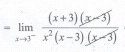
\(lim_{x\rightarrow{3}^-}{x+3\over x^2(x-3)}\)
\(=-\infty\)
\(\therefore f(3)\rightarrow -\infty \ as \ x\rightarrow 3^-\)
\(lim_{x\rightarrow{3}^+}f(x)=lim_{x\rightarrow{3}^+}{x+3\over x^2(x-3)}\)
\(=\infty\)
\(\therefore f(3)\rightarrow \infty \ as \ x\rightarrow 3^+\)
179.

\(={-1\over 2(2)}=-{1\over4}\)
180.
\(lim_{x\rightarrow3^-}f(x)=9a-4b+1\)
\(lim_{x\rightarrow3^+}f(x)=3a+b.\) Now the existence of limit forces us to have
\(lim_{x\rightarrow3^-}f(x)=lim_{x\rightarrow3^+}f(x)\).
\(\Rightarrow \) 9a - 4b + 1 = 3a + b
\(\Rightarrow \)6a - 5b + 1 = 0.
181.
Let \(\overrightarrow{r}=x\hat{i}+y\overrightarrow{j}+z\hat{k}\)
\(\overrightarrow{r}.\hat{i}=(x\hat{i}+y\hat{j}+z\hat{k}).\hat{i}=x\)
\(\overrightarrow{r}.\hat{j}=(x\hat{i}+y\hat{j}+z\hat{k}).\hat{j}=y\)
\(\overrightarrow{r}.\hat{k}=(x\hat{i}+y\hat{j}+z\hat{k}).\hat{k}=z\)
\((\overrightarrow{r}.\hat{i})\hat{i}+(\overrightarrow{r}.\hat{j})\hat{j}+(\overrightarrow{r}.\hat{k})\hat{k}=x\hat{i}+y\hat{j}+z\hat{k}=\overrightarrow{r}\)
Thus \(\overrightarrow{r}=(\overrightarrow{r}.\hat{i})\hat{i}+(\overrightarrow{r}.\hat{j})\hat{j}+(\overrightarrow{r}.\hat{k})\hat{k}\) .
182.
The given vector is 3\(\hat{i}\) - 3\(\hat{k}\) + 4\(\hat{j} \Rightarrow\) 3\(\hat{i}\) + 4\(\hat{j}\) - 3\(\hat{k}\)
The direction ratios are 3, 4, -3.
r = \(\sqrt{x^2+y^2+z^2}=\sqrt{3^2+4^2+(-3)^2}\)
\(=\sqrt{9+16+9}=\sqrt{34}\)
Hence, the direction cosines are \({3\over \sqrt{34}},{4\over \sqrt{34}},{-3\over \sqrt{34}}\)
183.
Given vertices are (0, 0), (1, 2) and (4, 3)
Area of the triangle \(=\left|\frac{1}{2}\right| \begin{array}{lll} x_1 & y_1 & 1 \\ x_2 & y_2 & 1 \\ x_3 & y_3 & 1 \end{array} \mid\)
\(=\left|\frac{1}{2}\right| \begin{array}{lll} 0 & 0 & 1 \\ 1 & 2 & 1 \\ 4 & 3 & 1 \end{array}|=| \frac{1}{2}[1(3-8)] \mid\)
\(=\left|\frac{1}{2}(-5)\right|=\frac{5}{2}=2.5\)
Area of the triangle = 2.5 sq units
184.
Given a, b, c are pth, qth, rth terms of an A.P.
\(p^{\text {th }} \text { term } \Rightarrow A+(p-1) R=a \Rightarrow A+p R-R=a\)
\(q^{\text {th }} \text { term } \Rightarrow A+(q-1) R=b \Rightarrow A+q R-R=b\)
\(r^{\text {th }} \text { term } \Rightarrow A+(r-1) R=c \Rightarrow A+r R-R=c\)
Here A → first term, R → Common difference.
\(\mathrm{LHS}=\left|\begin{array}{ccc} a & b & c \\ p & q & r \\ 1 & 1 & 1 \end{array}\right|\)
\(=\left|\begin{array}{ccc} A+p R-R & A+q R-R & A+r R-R \\ p & q & r \\ 1 & 1 & 1 \end{array}\right|\)
Multiply R2 & R3 by R respectively.
\(=\frac{1}{R^2}\left|\begin{array}{ccc} A+p R-R & A+q R-R & A+r R-R \\ p R & q R & r R \\ R & R & R \end{array}\right|\)
\(\text { Applying } R_1 \rightarrow R_1-R_2+R_3\)
\(=\frac{1}{R^2}\left|\begin{array}{ccc} A & A & A \\ p R & q R & r R \\ R & R & R \end{array}\right|\)
\(=\frac{1}{R^2}(0)=0\) [Since R1 and R2 are proportional.]
185.
Let A be a 3 \(\times\) 3 skew symmetric matrix. Thus we have \(A^T=-A\) (by defined)
\(\text {If } \mathrm{A}=\left[\mathrm{a}_{\mathrm{ij}}\right]_{\mathrm{n} \times \mathrm{n}}\) is a skew symmetric matrix, then aij = -aji for all i anddj.
This means that all the diagonal elements of a skew symmetric matric are 'zero.
The general form of 3 \(\times\) 3 skew symmetric matric are 'zero.
The general form of 3 \(\times\) 3 skew symmetric matrix is
\(A=\left[\begin{array}{ccc}
0 & a_{12} & a_{13} \\
a_{21} & 0 & a_{23} \\
a_{31} & a_{32} & 0
\end{array}\right]\)
We&now that
\(\operatorname{det}(A)=\operatorname{det}\left(A^T\right) \quad \text { [by property (1)] }\)
\(=\operatorname{det}(-A)\)
since A is skew symmetric
\(=(-1)^3 \operatorname{det} A\
[by \ property (2)]\)
\(\operatorname{det} A=-\operatorname{det} A\)
\(\operatorname{det} A+\operatorname{det} A=0\)
\(2 \operatorname{det} A=0\)
\(\operatorname{det} A=0\)
Hence proved.
186.
\(\text { LHS }=\left|\begin{array}{ccc} a^2 & b c & a c+c^2 \\ a^2+a b & b^2 & a c \\ a b & b^2+b c & c^2 \end{array}\right|\)
Take a, b, c from C1 C2, C3 respectively
\(=a b c\left|\begin{array}{ccc} a & c & a+c \\ a+b & b & a \\ b & b+c & c \end{array}\right|\)
\(\text { Applying } C_1 \rightarrow C_1+C_2-C_3\)
\(=a b c\left|\begin{array}{ccc} 0 & c & a+c \\ 2 b & b & a \\ 2 b & b+c & c \end{array}\right|\)
\(\text { Applying } R_2 \rightarrow R_2-R_3\)
\(=a b c\left|\begin{array}{ccc} 0 & c & a+c \\ 0 & -c & a-c \\ 2 b & b+c & c \end{array}\right|\)
\(=a b c[2 b[c(a-c)+c(a+c)]]\)
\(=2 a b^2 c\left[a c-c^2+a c+c^2\right]\)
\(=2 a b^2 c(2 a c)=4 a^2 b^2 c^2=\text { RHS }\)
Hence Proved.
187.
We have \({n!\over 3!(n-4)!}: {n!\over 5!(n-5)!}=5:3\)
\(\Rightarrow {n!\over 3!(n-4)!}\times {n!\over 5!(n-5)!}={5\over3}\Rightarrow{5\times4\times3!(n-5)!\over3!(n-4)(n-5)!}={5\over3}\Rightarrow{20\over n-4}={5\over3}\)
\(\Rightarrow n-4=20\times {3\over5}\Rightarrow n-4=12\Rightarrow n=16\)
188.
Let AB be a line passing through a point (-4, 3) and meets x-axis at A (a, 0) andy-axis at B (0, b).
\(\therefore -4=\frac{5\times 0+3a}{5+3}\Rightarrow -4=\frac{3a}{8}\)
\(\Rightarrow 3a=-32\)
\(\therefore a=\frac{-32}{3}\)
and \(3=\frac{5.b+3.0}{5+3}\Rightarrow 3=\frac{5.b}{8}\)
\(\Rightarrow 5b=24 \Rightarrow b=\frac{24}{5}\)
Intercept form of line is \(\frac{x}{\frac{-32}{3}}+\frac{y}{\frac{24}{5}}=1\Rightarrow \frac{-3x}{32}+\frac{5y}{24}=1\)
\(\Rightarrow -9x+20y=96\Rightarrow 9x-20y+96=0\)
Hence, the required equation is 9x - 20y + 96 = 0.
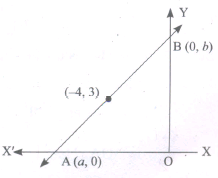
189.
(sin \(\alpha\) + sin \(\beta\))2+ (cos \(\alpha\) + cos \(\beta\))2
\(=(\frac{-21}{65})^2+(\frac{27}{65})^2=\frac{1170}{4225}=\frac{18}{65}\)
\(\Rightarrow\) (sin2\(\alpha\) + sin \(\beta\))+ (cos2\(\alpha\) + cos2\(\beta\))+ 2 (sin \(\alpha\) sin \(\beta\)+ cos \(\alpha\) cos \(\beta\))=\(\frac{18}{65}\)
(i.e.) (sin2\(\alpha\) + cos2\(\alpha\)) + (sin2\(\beta\)+ cos2\(\beta\))+ 2 (sin\(\alpha\) sin\(\beta\)+ cos\(\alpha\) cos\(\beta\))=\(\frac{18}{65}\)
\(\Rightarrow\) 1 + 1 + 2 cos (\(\alpha\) - \(\beta\))=\(\frac{18}{65}\) \(\Rightarrow\ 2+2cos(\alpha-\beta)=\frac{18}{65}\)
\(\Rightarrow 2(2cos^2\frac{\alpha-\beta}{2})=\frac{18}{65}\Rightarrow 4cos^2\frac{\alpha-\beta}{2}=\frac{18}{65}\)
\(\Rightarrow cos^2\frac{\alpha-\beta}{2}=\frac{9}{65\times2}\Rightarrow cos\frac{\alpha-\beta}{2}=\pm\frac{3}{\sqrt {130}}\)
Now,\(\pi<\alpha-\beta<3\pi,i.e.\frac{\pi}{2}<\frac{\alpha-\beta}{2}<\frac{3\pi}{2}\)
\(\therefore cos\frac{\alpha-\beta}{2}=-\frac{3}{\sqrt {130}}\)
190.
Given that, Sum of the coefficients in the expansion of (x+y)n = 4096
∴ nC0 + nC1 + nC2 +..+nCn = 4096
[∴ Sum of binomial coefficients in the expansion of (x + a)n is 2n]
⇒ 2n = 4096 = 212
⇒ n = 12 (even)
So the greatest coefficient = Coefficient of the middle term \((\frac{n}{2}+1)\)th term
= Coefficient of the middle term \((\frac{12}{2}+1)\)th term
= Coefficient of the 7th term
Hence the greatest coefficient = 12C6=\(\frac{(12)!}{6!(12-6)!}=\frac{(12)!}{6!6!}=\frac{12\times11\times10\times9\times8\times7}{6\times5\times4\times3\times2\times1}=924\)
191.
Let P (h, k) be any point on the required path. From the given information we have
h = a sec θ and k = b tan θ
⇒ \(\frac{h}{a}\) = sec θ and \(\frac{k}{b}\) = tan θ
To eliminate the parameter θ, squaring and subtracting, we get
\((\frac{h}{a})^2-(\frac{k}{b})^2=sec^2\theta-tan^2\theta\)
\((\frac{h}{a})^2-(\frac{k}{b})^2=1\)
Therefore the locus of the given point is
\(\frac{x^2}{a^2}-\frac{y^2}{b^2}=1\)
192.
Observe that \(\sqrt{x+20}\) is defined only if x + 20 ≥ 0
By definition, \(\sqrt{x+20}\ge0\). So, x is positive.
Now squaring we get x2= x + 20. x2- x - 20 = 0
(x - 5)(x + 4) = 0, which gives x = 5, x = -4
Since, x is positive, the required solution is x = 5
193.
Let s be the length of the arc of a circle of radius r subtending a central angle θ, Then s = rθ, We have,
\(\theta=15^0=15\times\frac{\pi}{180}=\frac{\pi}{12}\ radians\)
so that, s = rθ gives \(s=5\times\frac{\pi}{12}=\frac{5\pi}{12}cm\)
194.
Let x denote the number of units used. Note that x ≥ 0. Then, his electricity bill will be Rs. 110 + 4x.
The person wants his bill to be below Rs. 250. Let us solve the inequality 110 + 4x < 250. Thus, 4x < 140; which gives 0 ≤ x < 35.
The person should keep his usage below 35 units in order to keep his bill below Rs. 250.
195.
Let the equation of the line in intercept form be \(\frac{x}{a}+\frac{y}{b}=1\)
Its intercepts on x and y axes are a and b.
Given that \(\frac{1}{a}+\frac{1}{b}\) = constant = K
\(\therefore \frac{1}{K_a}+\frac{1}{K_b}=1\)
\(\Rightarrow \frac{\frac{1}{K}}{a}+\frac{\frac{1}{K}}{b}=1\)
\(\Rightarrow (\frac{1}{k},\frac{1}{k})\) satisfies the equation \(\frac{x}{a}+\frac{y}{b}=1\)
Hence the equation (1), passes through the fixed point \( (\frac{1}{k},\frac{1}{k})\).
196.
We have log (1 - x) = \(-x-\frac { { x }^{ 2 } }{ 2 } -\frac { { x }^{ 3 } }{ 3 } -\frac { { x }^{ 4 } }{ 4 } ....\)
\(\therefore \log { \left( 1-2x \right) } =-\left( 2x \right) -\frac { { \left( 2x \right) }^{ 2 } }{ 2 } -\frac { { \left( 2x \right) }^{ 3 } }{ 3 } -\frac { { \left( 2x \right) }^{ 4 } }{ 4 } +\frac { { \left( 2x \right) }^{ 5 } }{ 5 } -\frac { { \left( 2x \right) }^{ 6 } }{ 6 } +....\)
\(\log { \left( 1-2x \right) } =-2x-\frac { { 4x }^{ 2 } }{ 2 } -\frac { { 8x }^{ 3 } }{ 3 } -\frac { { 16x }^{ 4 } }{ 4 } -\frac { { 32x }^{ 5 } }{ 5 } -\frac { 6{ 4x }^{ 6 } }{ 6 } +....\)
This series is valid only when \(\left| 2x \right| <1\Rightarrow \left| x \right| <\frac { 1 }{ 2 } \)
Hence, this series is valid only in the interval \(-\frac { 1 }{ 2 }
197.
Let P(h, k) be the locus of centroid of \(\Delta \) PQR.
Given P(6, 2 ) and Q(-2, 1) are the vertices of \(\Delta \) PQR and R(\(\alpha \), \(\beta \)) be the third vertex.
Using the centroid formula,
\(\left( \frac { 6-2+\alpha }{ 3 } ,\frac { 2+1+\beta }{ 3 } \right) =(h,\ k)\) \(\left[ \because \ centroid\ is=\left( \frac { { x }_{ 1 }+{ x }_{ 2 }+{ x }_{ 3 } }{ 3 } ,\frac { { y }_{ 1 }+{ y }_{ 2 }+{ y }_{ 3 } }{ 3 } \right) \right] \)
\(\Rightarrow \left( \frac { 4+\alpha }{ 3 } ,\frac { 3+\beta }{ 3 } \right) =(h,k)\)
Equating the like co-ordinates both sides we get,
\(\Rightarrow \frac { 4+\alpha }{ 3 } =h\)
\(\Rightarrow 4+\alpha =3h\)
\(\Rightarrow \alpha =3h-4....(1)\)
\(\Rightarrow \frac { 3+\beta }{ 3 } =k\quad \)
\(\Rightarrow 3+\beta =3k \Rightarrow \beta =3k-3...(2)\)
Since R(\(\alpha\), \(\beta\)) lies on the locus of y = x2 - 3x + 4 \(\Rightarrow\) \(\beta\) = \(\alpha\)2 - 3a + 4 ..(3)
Substituting (1) and (2) in (3) we get,
3k - 3 = (3h-4)2- 3(3h-4) + 4
\(\Rightarrow \) 3k-3 = 9h2+16-24h-9h+12 + 4
\(\Rightarrow \) 3k - 3 = 9h2 - 33h + 32
\(\Rightarrow \) 9h2- 33h - 3k + 35 = 0
\(\therefore\) Locus of (h, k) is 9x2- 33x - 3y + 35 = 0
198.
Given that P (-3,1) lie on the locus of x2 - 5x + ky = 0.
⇒ (-3)2-5 (-3)+k(1) = 0
⇒ 9 +15 + k = 0
⇒ k = -24
Also, it is given that (2, b) lie on the locus of x2 - 5x + ky = 0.
⇒ 22 - 5 (2) + kb = 0
⇒ 4 - 10 - 24 (b) = 0
⇒ - 6 - 24b = 0
⇒ -24b = 6
⇒ b = \(\frac{-6}{24}=\frac{-1}{4}\)
199.
(i) When coin is tossed 1 time, Possibilities of heads and tails = 11 = 1
When the coin is tossed 2 times, Possibilities of head and tails is 24.
In this way we get,
When a coin tossed at 8 times, possibilities of head and tail of different sequences is 28
(ii) Since there are 6 heads of one kind and 4 tails of other kind, required number of sequences = \(\frac { { 2 }^{ 8 } }{ 6!2! } \)
200.
Given nPr = 720 and nCr = 120
⇒ \(\frac { n! }{ (n-r)! } \) = 720 .... (i)
\(\frac { n! }{ r!(n-r)! } \) = 120..... (ii)
⇒ \(\frac { \frac { n! }{ (n-r)! } }{ \frac { n! }{ r!(n-r)! } } =\frac { 720 }{ 120 } \)
[Dividing (i) by (ii)]
⇒ \(\frac { n! }{ (n-r)! } \times \frac { n! }{ r!(n-r)! } =6\)
⇒ r! = 6 ⇒ r! = 3 \(\times\) 2 \(\times\) 1 = 3!
⇒ r = 3
Substituting r = 3 in (i) we get
\(\frac { n! }{ (n-r)! } =\frac { n! }{ (n-r)! } =720\Rightarrow \frac { n! }{ (n-3)! } =720\)
⇒ \(\frac { n(n-1)(n-2)(n-3)! }{ (n-3)! } \) = 720 ⇒ n(n-1) (n-2) = 720
⇒ n(n-1) (n-2) = 10 \(\times\) 9 \(\times\) 8
⇒ n = 10
201.
In the letters of the word, ARTICLE, there are three vowels namely A, I, E.
There are 3 even places.
3 vowels can occupy the even places in 3P3 = 3! ways.
Remaining 4 letters can occupy 4 places in 4! ways.
Hence, total number of ways of arrangement = 4! \(\times\) 3!
= \(4\times 3\times 2\times 3\times 2\)
=144
202.
Let P and Q be the positions of two ships at the end of 3 hours.
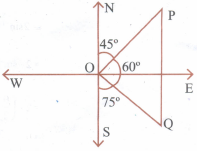
Then OP = 3 \(\times\)24 = 72 km and OQ = 3 \(\times\)32 = 96 km.
Using cosine formula in ΔOPQ, we get
PQ2 = OP2 + OQ2 - 2OP.OQ cos∠POQ
= 722 + 962 -2 \(\times\) 72 \(\times\) 96 \(\times\) cos 60°
= 5184 + 9216 - 6912 = 7488
⇒ PQ =\(\sqrt{7488}\) km = 86.533 km
203.
Given that ㄥA, ㄥB, ㄥC are in A.P.
ஃ 2ㄥB = ㄥA + ㄥC
3ㄥB = 180°
ㄥB = \(\frac{180}{3}\) = 60°
Now \(\frac { b }{ c } =\frac { sinB }{ sinC } \)
\(\Rightarrow \frac { \sqrt { 3 } }{ \sqrt { 2 } } =\frac { sin60° }{ sinC } \)
\(\Rightarrow \frac { \sqrt { 3 } }{ \sqrt { 2 } } =\frac { \frac { \sqrt { 3 } }{ \sqrt { 2 } } }{ sinC } \)
\(\Rightarrow sinC=\frac { \sqrt { 3 } }{ 2\sqrt { 3 } } \times \sqrt { 2 } =\frac { \sqrt { 2 } }{ 2 } =\frac { \sqrt { 2 } }{ \sqrt { 2 } \times \sqrt { 2 } } =\frac { 1 }{ \sqrt { 2 } } \)
⇒ ㄥC = 45°
ㄥA = 180°-(ㄥB+ㄥC) = 180 - (60 + 45) = 75°
ㄥA = 75°, ㄥB = 60° and ㄥC = 45°
204.
Given \(cos\theta =\frac { 1 }{ 2 } \left( a+\frac { 1 }{ a } \right) \)
LHS = cos 3θ = 4cos3θ-3cosθ
= \(4\left[ \frac { 1 }{ 2 } { \left( a+\frac { 1 }{ a } \right) }^{ 3 } \right] -3.\frac { 1 }{ 2 } \left( a+\frac { 1 }{ a } \right) \)
= \(4\left( \frac { 1 }{ 8 } \left( { a }^{ 3 }+{ 3a }^{ 2 }\left( \frac { 1 }{ a } \right) +3a\left( \frac { 1 }{ { a }^{ 2 } } \right) +\left( \frac { 1 }{ { a }^{ 3 } } \right) \right) \right) -\frac { 3 }{ 2 } \left( a+\frac { 1 }{ a } \right) \)
= \(\frac { 1 }{ 2 } \left( { a }^{ 3 }+3a+\frac { 3 }{ a } +\frac { 1 }{ { a }^{ 3 } } \right) -\frac { 3 }{ 2 } \left( a+\frac { 1 }{ a } \right) =\frac { 1 }{ 2 } \left( { a }^{ 3 }+\frac { 1 }{ a } \right) +\frac { 1 }{ 2 } \left( 3a+\frac { 3 }{ a } \right) -\frac { 3 }{ 2 } \left( a+\frac { 1 }{ a } \right) \)
= \(\frac { 1 }{ 2 } \left( { a }^{ 3 }+\frac { 1 }{ { a }^{ 3 } } \right) +\frac { 3 }{ 2 } \left( a+\frac { 1 }{ a } \right) -\frac { 3 }{ 2 } \left( a+\frac { 1 }{ a } \right) \)
\(\frac { 1 }{ 2 } \left( { a }^{ 3 }+\frac { 1 }{ { a }^{ 3 } } \right) \) = RHS
Hence proved.
205.
Let f and g denote the identity function and the modulus function.
Then f : R ⟶ R is defined as f(x) = x and g : R ⟶ R is defined as g(x) = |x|
g(x) = 0 ⇒ |x| = 0 ⇒ x =0
∴ The quotient of f by g is \({f\over g}:R-\{0\}⟶R\) and is defined as
\(\left(f\over g \right)(x )={f(x)\over g(x)}={x\over |x|}=\begin{cases} {x\over x}=1\ if\ xx>0 \\{x\over -x}=-1\ if\ x<0 \end{cases}\)
206.
Let \(\frac { log\ x }{ y-z } \) =
⇒ log x = k(y-z) = ky-kz ...(1)
log y = k(z-x) = kz-kx ...(2)
log z = k(x-y) = kx-ky ....(3)
Adding (1),(2) and (3)
log x + log y + log z = ky - kz + kz - kx + kx - ky =0
⇒ log xyz = 0 = log1
⇒ xyz = 1 Hence proved
207.
Given \({{a}\over{x}}+{{y}\over{b}}=1\)
\(\Rightarrow\) \({{a}\over{x}}=1-{{y}\over{b}}={{b-y}\over{b}}\) ...(1)
\(\Rightarrow\) \({{x}\over{a}}={{b}\over{b-y}}\)
Also, \({{b}\over{y}}+{{z}\over{c}}=1\)
\(\Rightarrow\) \({{z}\over{c}}=1-{{b}\over{}y}={{y-b}\over{y}}\)
\(\Rightarrow\) \({{c}\over{z}}={{y}\over{y-b}}\) ...(2)
Adding (1) and (2) we get,
\({{x}\over{a}}+{{c}\over{z}}=\frac{b}{b-y}+\frac{y}{y-b}-\frac{b}{b-y}-\frac{y}{b-y}=\frac{b-y}{b-y}=1\)
\(\therefore{{x}\over{a}}+{{c}\over{z}}=1\)
208.
Given A\(\times\)B = {(x, 1)(y, 2) (z, 1)}
Since n(A) = 3 and n(B) = 2,
A \(\times\) B will have 6 elements.
The remaining elements of A \(\times\) B will be (x, 2) (y, 1) (z, 2)
\(\therefore\) A\(\times\) B = {(x,1)(y,2)(z,1)(x,2)(y,1)(z,2)}
\(\therefore\) A = {x, y, z} and B = {1, 2}
209.
Given \(\frac { 1 }{ \left| 2x-1 \right| } <6\)
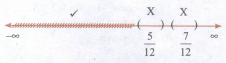
Multiplying the numerator and denominator by |2x-1| we get, \({|2-1|\over |2x-1|^2}<6\)
⇒ |2x-1| < 6|2x-1|2
⇒ 1< 6 |2x-1|
\(⇒\ {1\over 6}<|2x-1|\)
\(⇒\ |2x-1|> {1\over 6}\)
\(⇒\ {-1\over 6}\ge2x-1\ge{1\over 6}\)
\(⇒\ {-1\over 6}+1\ge2x\ge{1\over 6}+1\)
\(⇒\ {5\over 6}\ge2x\ge{7\over6}\)
\(⇒\ {5\over12}\ge x\ge {7\over 12}\)
∴ The solution set is \(\left( -\infty,{5\over 12}\cup [ {7\over 12},\infty\right)\)
210.
Given \(\frac { { 3 }^{ 2n }{ 9 }^{ 2 }{ 3 }^{ -n } }{ { 3 }^{ 3n } } \) = 27
⇒ \(\frac { { 3 }^{ 2n-n }.{ 9 }^{ 2 } }{ { 3 }^{ 3n } }\) = 27 [∵ am.an = am+n]
⇒ \(\frac { { 3 }^{ n }.({ 3 }^{ 2 })^{ 2 } }{ { 3 }^{ 3n } } \) = 27
⇒ 3n-3n (34) = 27 \(\left[ \because \frac { a^{ m } }{ a^{ n } } ={ a }^{ m-n }\& ({ a }^{ m })^{ n }={ a }^{ mn } \right] \)
⇒ 3-2n.34 = 27
⇒ 3-2n+4 = 33
Equating the powers both sides we get
-2n+4 = 3
⇒ -2n = 3-4 = -1
⇒ 2n = 1
⇒ n = \(\frac { 1 }{ 2 } \)
211.
4500
4500 = -7200 +2700
\(\Rightarrow \) -4500 - 2700 = -7200
∴ Coterminal angle of (-450) is 2700
212.
11500
11500 = 360 +360 +3600 +700
= 2 \(\times\) 3600 + 700
\(\Rightarrow \) 11500 - 700 = 2 \(\times\) 3600
∴ Coterminal angle of 11500 is 700
213.
Since \(\pi,x<{{3\pi}\over{2}},\) x lies in the III quadrant only cot x and tan x are positive
Also \(\pi,x<{{3\pi}\over{2}},\) y is also lies in the III quadrant
Only cot y and tan y are positive
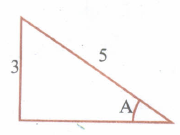
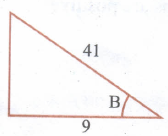
\(sinx=-\frac { 3 }{ 5 } \quad siny=-\frac { 24 }{ 25 } \)
\(cosx=-\frac { 4 }{ 5 } \quad cosy=-\frac { 7 }{ 25 } \)
ஃ cos(x - y) = cosx cosy + sinx siny
\(=\left( -\frac { 4 }{ 5 } \right) \left( -\frac { 7 }{ 25 } \right) +\left( -\frac { 3 }{ 5 } \right) \left( -\frac { 24 }{ 25 } \right) \)
\(=\frac { 28 }{ 125 } +\frac { 72 }{ 125 } =\frac { 100 }{ 125 } =\frac { 4 }{ 5 } \)
214.
Since 0
ஃ All the trigonometric ratios are positive
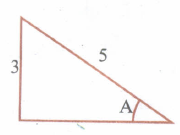
= \(\sqrt { { 5 }^{ 2 }-{ 3 }^{ 2 } } =4\)
= \(\sqrt { { 41 }^{ 2 }-{ 9 }^{ 2 } } \)
= 40
\(sinA=\frac { 3 }{ 5 } \quad sinB=\frac { 40 }{ 41 } \)
\(cosA=\frac { 4 }{ 5 } \quad cosB=\frac { 9 }{ 41 } \)
cos (A - B) = cosA cosB + sinAsinB
= \(\frac { 4 }{ 5 } .\frac { 9 }{ 41 } +\frac { 3 }{ 5 } .\frac { 40 }{ 41 } \)
= \(\frac { 36 }{ 205 } +\frac { 120 }{ 205 } =\frac { 156 }{ 205 } \)

11th Standard Syllabus & Materials
11th Standard
TN 11th Tamil பீடு பெற நில் - செய்யுள் - காவடிச்சிந்து Important Questions And Answers Study Material - QB365 Set A
NEW11th Standard
TN 11th Tamil பீடு பெற நில் - உரைநடை - மலை இடப்பெயர்கள் : ஓர் ஆய்வு Important Questions And Answers Study Material - QB365 Set A
NEW11th Standard
TN 11th Tamil மாமழை போற்றுதும் - துணைப்பாடம் - யானை டாக்டர் Important Questions And Answers Study Material - QB365 Set A
NEW11th Standard
TN 11th Tamil மாமழை போற்றுதும் - செய்யுள் - ஐங்குறுநூறு Important Questions And Answers Study Material - QB365 Set A



Tamilnadu Stateboard 11th Standard Subjects
Maths

Commerce

Economics

Biology

Business Maths and Statistics

Accountancy

Computer Science

Physics

Chemistry
Maths
Biology
Economics
Physics
Chemistry

History
Business Maths and Statistics

Computer Science
Accountancy

Computer Applications
History
Computer Technology
Commerce
Computer Applications
Computer Technology

Tamil

English

French
Tamilnadu Stateboard Standards

