
 100% FREE ACCESS
11th Standard Syllabus & Materials
11th Standard
TN 11th Tamil இயற்கை வேளாண்மை,சுற்றுச்சூழல் -செய்யுள் - மனோன்மணீயம் Important Questions And Answers Study Material - QB365 Set A
NEW11th Standard
TN 11th Tamil என்னுயிர் என்பேன் -துணைப்பாடம் - இசைத்தமிழர் இருவர் Important Questions And Answers Study Material - QB365 Set A
NEW11th Standard
TN 11th Tamil மொழி கலை -செய்யுள் - ஒவ்வொரு புல்லையும் Important Questions And Answers Study Material - QB365 Set A
NEW11th Standard
TN 11th Tamil பீடு பெற நில் - இலக்கணம் - பகுபத உறுப்புகள் Important Questions And Answers Study Material - QB365 Set A
NEW11th Standard
TN 11th Tamil பீடு பெற நில் - துணைப்பாடம் - வாடிவாசல் Important Questions And Answers Study Material - QB365 Set A
NEW11th Standard
TN 11th Tamil பீடு பெற நில் - செய்யுள் - குறுந்தொகை Important Questions And Answers Study Material - QB365 Set A

Published on: 09/10/2019
Introduction To Probability Theory
Download Tamil Nadu 11th Standard Maths question papers, model tests, one-mark questions, important questions, and public exam papers in PDF format. Free study materials and answer keys for TN State Board students.
Questions + Answers key
Take MCQ Maths Test1.
The ratio of the number of boys to the number of girls in a class is 1:2. It is known that the probability of a girl and a boy getting a first class are 0.25 and 0.28 respectively. Find the probability that a student chosen at random will get first class?
2.
A die is tossed thrice. find the probability of getting an odd number atleast once?
3.
Given that P(A) =0.52, P(B)=0.43, and P(A∩B)=0.24, find
\(P(\overline { A } \cup \overline { B } )\)
4.
Nine coins are tossed once, find the probability to get at least two heads
5.
If two coins are tossed simultaneously, then find the probability of getting (i) one head and one tail (ii) at most two tails
6.
If an experiment has exactly the three possible mutually exclusive outcomes A, B, and C, check in each case whether the assignment of probability is permissible.
P(A) = 0.421, P(B) = 0.527 P(C) = 0.042
7.
If an experiment has exactly the three possible mutually exclusive outcomes A, B, and C, check in each case whether the assignment of probability is permissible.
\(P(A)=\frac { 4 }{ 7 } ,P(B)=\frac { 1 }{ 7 } ,P(C)=\frac { 2 }{ 7 } \)
8.
If for two events A and B, P(A) = \(\frac{3}{4}\), P(B) = \(\frac{2}{5}\) and A\(\cup \)B = S (sample space), find the conditional probability P(A/B).
9.
A consulting firm rents car from three agencies such that 50% from agency L, 30% from agency M and 20% from agency N. If 90% of the cars from L, 70% of cars from M and 60% of the cars from N are in good conditions
(i) what is the probability that the firm will get a car in good condition?
(ii) if a car is in good condition, what is probability that it has come from agency N?
10.
If A and B are two events associated with a random experiment for which P(A) = 0.35, P(A or B) = 0.85, and P(A and B) = 0.15. Find (i) P(only B) (ii) \(P(\bar{B})\) (iii) P(only A)
11.
The chances of A, B, and C becoming manager of a certain company are 5 : 3: 2. The probabilities that the office canteen will be improved if A, B, and C become managers are 0.4, 0.5 and 0.3 respectively. If the office canteen has been improved, what is the probability that B was appointed as the manager?
12.
13.
Two cards are drawn from a pack of 52 cards in succession. Find the probability that both are Jack when the first drawn card is (i) replaced (ii) not replaced.
14.
Given P(A) = 0.4 and P(A\(\cup \)B)=0.7. Find P(B) if
(i) A and B are mutually exclusive
(ii) A and B are independent events
(iii) P(A / B) = 0.4
(iv) P(B / A) = 0.5
15.
One bag contains 5 white and 3 black balls. Another bag contains 4 white and 6 black balls. If one ball is drawn from each bag, find the probability that (i) both are white (ii) both are black (iii) one white and one black.
16.
If m is a number such that m \(\le\) 5, then the probability that quadratic equation 2x2 + 2mx + m + 1 = 0 has real roots is
\({1\over 5}\)
\({2\over 5}\)
\({3\over 5}\)
\({4\over 5}\)
17.
Ten coins are tossed. The probability of getting at least 8 heads is
\(7\over 64\)
\(7\over 32\)
\(7\over 16\)
\(7\over 128\)
18.
In a certain college 4% of the boys and 1% of the girls are taller than 1.8 meter. Further 60% of the students are girls. If a student is selected at random and is taller than 1.8 meters, then the probability that the student is a girl is
\({2\over 11}\)
\({3\over 11}\)
\({5\over 11}\)
\({7\over 11}\)
19.
If a and b are chosen randomly from the set {1,2,3,4} with replacement, then the probability of the real roots of the equation \(x^2+ax+b=0\) is
\({3\over 16}\)
\({5\over 16}\)
\({7\over 16}\)
\({11\over 16}\)
20.
If two events A and B are such that \(P(\overline{A})={3\over10}\) and \(P(A \cap \overline{B})={1\over2},\) then \(P(A\cap B)\) is
\({1\over2}\)
\({1\over3}\)
\({1\over4}\)
\({1\over5}\)
21.
A number x is chosen at random from the first 100 natural numbers. Let A be the event of numbers which satisfies\({(x-10)(x-50)\over x-30}\ge0\), then P(A) is
0.20
0.51
0.71
0.70
22.
If A and B are two events such that A ⊂ B and P(B)\(\neq o\), then which of the following is correct?
\(P(A/B)={P(A)\over P(B)}\)
P(A/B)
P(A/B)\(\ge\)P(A)
P(A/B)>P(B)
23.
A matrix is chosen at random from a set of all matrices of order 2, with elements 0 or 1 only. The probability that the determinant of the matrix chosen is non zero will be
\({3\over 16}\)
\({3\over 8}\)
\({1\over 4}\)
\({5\over 8}\)
24.
A man has 3 fifty rupee notes, 4 hundred rupees notes, and 6 five hundred rupees notes in his pocket. If 2 notes are taken at random, what are the odds in favour of both notes being of hundred rupee denomination?
1:12
12:1
13:1
1:13
25.
26.
The probability that a girl, preparing for competitive examination will get a State Government service is 0.12, the probability that she will get a Central Government job is 0.25, and the probability that she will get both is 0.07. Find the probability that (i) she will get atleast one of the two jobs (ii) she will get only one of the two jobs.
27.
A bag contains 7 red and 4 black balls, 3 balls are drawn at random. Find the probability that (i) all are red (ii) one red and 2 black.
28.
An experiment has the four possible mutually exclusive and exhaustive outcomes A, B, C, and D. Check whether the following assignments of probability are permissible.
P(A) = 0.15, P(B) = 0.30, P(C) = 0.43 , P(D) = 0.12
1.
Let E1 and E2 be the events of choosing a boy and a girl respectively from the class.
Given that the number of boys to the number of girls = 1: 2
\(\therefore P({ E }_{ 1 })=\frac { 1 }{ 1+2 } =\frac { 1 }{ 3 } \) and P(E2) = \(\frac { 2 }{ 1+12 } =\frac { 2 }{ 3 } \)
Let A be the event that a student chosen will get first class
Given P(A/E1) = 0.28 and P(A/E2) = 0.25
\(\therefore\) By theorem of total probability,
P(A) = P(E1).P(A/E1) + P(E2).P(A/E2)
\(\Rightarrow \quad =\frac { 1 }{ 3 } \times 0.28+\frac { 2 }{ 3 } \times 0.25\)
\(=\frac { 28 }{ 300 } +\frac { 50 }{ 300 } =\frac { 78 }{ 300 } =0.26\)
2.
Probability of getting odd number = \(\frac { 3 }{ 6 } =\frac { 1 }{ 2 } \)
Probability of getting even numbers = 1-\(\frac { 1 }{ 2 } =\frac { 1 }{ 2 } \)
Now, probability of getting no odd number when the die is tossed twice = Probability of getting even number when the die is tossed thrice.
\(\Rightarrow \quad \frac { 1 }{ 2 } \times \frac { 1 }{ 2 } \times \frac { 1 }{ 2 } =\frac { 1 }{ 8 } \)
\(\therefore\) P(Odd number atleast once) = \(1-\frac { 1 }{ 8 } =\frac { 7 }{ 8 } \)
3.
\(P(\overline { A } \cup \overline { B } )\)=\(\left( \overline { A\cap B } \right) \)(By de Morgan's law)
1-P(A∩B)=1-0.24
=0.76
4.
Let S be the sample space and A be the event of getting at least two heads.
Therefore, the event Ā denotes, getting at most one head.
n(S) = 29 = 512, n(Ā) = 9C0 + 9C1= 1 + 9 = 10
\(P(\bar{A})=\frac{10}{512}=\frac{5}{256} \)
\(
P(A)=1-P(\bar{A})=1-\frac{5}{256}=\frac{251}{256}\)


5.
The sample space is S = {HH, HT, TH, TT}
⇒ n(S) = 4
(i) Let A be the event of getting one head and one tail, then
A = {HT, TH}
n(A) = 2
\(\therefore\) \(P(A)=\frac{n(B)}{n(S)}=\frac{4}{4}=1\)
(ii) Let A be the event of getting atmose two tails, then
\(\therefore\) B = {HH,HT,TH,TT}
\(\therefore\) \(P(B)=\frac{n(B)}{n(S)}=\frac{4}{4}=1\)
6.
since the experiment has exactly the three possible mutually exclusive outcomes A, B and C, they must be exhaustive events.
\(\Rightarrow S=A\cup B\cup C\)
Therefore, by axioms of probability
\(P(A)\ge 0,P(B)\ge P(C)\ge 0\) and
\(P(A\cup B\cup C)=P(A)+P(B)+P(C)=P(S)=1\)
Even though P(A) + P(B) + P(C) = 0.421 + 0.527 + 0.042 = 0.990 < 1
therefore, the assignment is not permissible

7.
Since the experiment has exactly the three possible mutually exclusive outcomes A, B and C, they must be exhaustive events.
\(\Rightarrow S=A\cup B\cup C\)
Therefore, by axioms of probability
\(P(A)\ge 0,P(B)\ge P(C)\ge 0\) and
\(P(A\cup B\cup C)=P(A)+P(B)+P(C)=P(S)=1\)
Given that \(P(A)=\frac { 4 }{ 7 } \ge 0,\quad P(B)=\frac { 1 }{ 7 } \ge 0,\quad P(C)=\frac { 2 }{ 7 } \ge 0\)
Also \(P(S)=P(A)+P(B)+P(C)=\frac { 4 }{ 7 } +\frac { 1 }{ 7 } +\frac { 2 }{ 7 } =1\)
Therefore the assignment of probability is permissible

8.
\(P(A)=\frac{3}{4}, P(B) =\frac{2}{5}, A \cup B=S \)
\(\Rightarrow P(A \cup B) =1\)
\(P(A \cap B) =P(A)+P(B)-P(A \cup B)\)
\(=\frac{3}{4}+\frac{2}{5}-1\)
\(=\frac{15+8}{20}-1=\frac{23-20}{20}=\frac{3}{20} \)
\(P(A / B) =\frac{P(A \cap B)}{P(B)} \)
\(=\frac{3 / 20}{2 / 5}=\frac{3}{8}\)
9.
Let A1, A2, and A3 be the events that the cars are rented from the agencies X, Y, and Z respectively.
Let G be the event of getting a car in good condition.
We have to find
(i) the total probability of event G that is, P(G)

(ii) find the conditional probability A3 given G that is, P(A3 /G)
We have P(A1) = 0.50,P(G/A1) = 0.90
P(A2) = 0.30, P(G/A2) = 0.70
P(A3) = 0.20, P(G/A3) =0.60.
(i) Since A1,A2, and A3 are mutually exclusive and exhaustive events and G is an event in S,then the total probability of event G is P(G).
P(G) = P(A1)P(G/A1) + P(A2)P(G/A2) + P(A3)P(G/A3)
P(G) = (0.50)(0.90) + (0.30)(0.70) + (0.20)(0.60)
P(G) = 0.78
(ii) The conditional probability A3 given G is P(A3 /G)
By Bayes’theorem,
P(A3/G)\(={P(A_3)P(G/A_3)\over P(A_1)P(G/ A_1)+P(A_2)P(G/A_2)+P(A_3)P(G/ A_3)}\)
P(A3/G) = \({(0.20)(0.60)\over(0.50)(0.90)+(0.30)(0.70)+(0.20)(0.60)}\)
\(={2\over13}\)
10.
Given \(P(A)=0.35\)
\(P(A \text { or } B)=0.85 \text { and } P(A \text { and } B)=0.15\)
\((i) P(A \cup B)=P(A)+P(B)-P(A \cap B)\)
\(0.85 =0.35+P(B)-0.15 \)
\(P(B) =0.85-0.20\)
\(=0.65\)
\((ii) P(\bar{B})=1-P(B)=1-0.65=0.35\)
\((iii) P( only\ A)=P(A)-P(A \cap B)\)
\(=0.35-0.15=0.20\)
11.
Let A1, A2 and A3 be the event of A, B, C becoming managers of the company respectively. Let X be the event that the office canteen will be improved.
Then, \(P\left(A_1\right)=\frac{5}{10}=0.5 \)
\(P\left(A_2\right)=\frac{3}{10}=0.3 \)
\(P\left(A_3\right)=\frac{2}{10}=0.2 \)
\(P\left(X / A_1\right)=0.4 \)
\(P\left(X / A_2\right)=0.5\)
\(P\left(X / A_3\right)=0.3\)
\(P\left(A_2 / X\right)=\frac{P\left(A_2\right) P\left(X / A_2\right)}{P\left(A_1\right) P\left(X / A_1\right)+P\left(A_2\right) P\left(X / A_2\right)}+P\left(A_3\right) P\left(X / A_3\right)\)
\(=\frac{0.3(0.5)}{0.5(0.4)+0.3(0.5)+0.2(0.3)} \)
\(=\frac{0.15}{0.2+0.15+0.06} \)
\(=\frac{0.15}{0.41}=\frac{15}{41}\)
12.
13.
Let A be the event of drawing a Jack in the first draw,
B be the event of drawing a Jack in the second draw.
Case (i)
Card is replaced
n(A) = 4 (Jack)
n(B) = 4 (Jack)
and n(S) = 52 (Total)
Clearly the event A will not affect the probability of the occurrence of event B and therefore A and B are independent.
P(A\(\cap \) B) = P(A). P(B)
P(A) = \(\frac{4}{52}\) , P(B) = \(\frac{4}{52}\)
P(A\(\cap \) B) = P(A).P(B)
=\(\frac{4}{52}\).\(\frac{4}{52}\)
=\(\frac{1}{169}\) .
Case (ii)
Card is not replaced
In the first draw, there are 4 Jacks and 52 cards in total. Since the Jack, drawn at the first draw is not replaced, in the second draw there are only 3 Jacks and 51 cards in total. Therefore the first event A affects the probability of the occurrence of the second event B.
Thus A and B are not independent. That is, they are dependent events.
Therefore, P( A \(\cap \) B ) = P(A). P(B)
P(A) = \(\frac{4}{52}\)
P(B/A) = \(\frac{3}{51}\)
P( A \(\cap \) B ) = P(A).P(B/A)
=\(\frac { 4 }{ 52 } .\frac { 3 }{ 51 } \)
=\(\frac { 1 }{ 121 } \) .
14.
\(\text {(i) } P(A)=0.4 \ \&\ P(A \cup B)=0.7\)
A and B are mutually exclusive then
\(P(A \cup B) =P(A)+P(B) \)
\(0.7 =0.4+P(B) \)
\(0.3 =P(B)\)
\(P(B) =0.3\)
(ii) A and B are independent then,
\(P(A \cup B) =P(A)+P(B)-P(A \cap B) \)
\(\therefore 0.7 =P(A)+P(B)-P(A) \cdot P(B) \)
\(0.7 =0.4+P(B)[1-0.4]\)
\(P(B) =\frac{0.7-0.4}{1-0.4}=\frac{0.3}{0.6}=\frac{1}{2}=0.5\)
\(\text { (iii) } P(A / B)=0.4\)
\(\frac{P(A \cap B)}{P(B)}=0.4\)
\(\Rightarrow \frac{P(A)+P(B)-P(A \cup B)}{P(B)}=0.4\)
\(\frac{0.4+P(B)-0.7}{P(B)}=0.4\)
\(P(B)-0.3=0.4 P(B)\)
\((1-0.4) P(B)=0.3\)
\(P(B)=\frac{0.3}{0.6}=\frac{1}{2}=0.5\)
\(\text {(iv) } P(B / A)=0.5\)
\(\frac{P(A \cap B)}{P(A)}=0.5\)
\(P(A)+P(B)-P(A \cup B)=0.5 P(A)\)
\(0.4+P(B)-0.7=0.5 \times 0.4\)
\(P(B)=0.2+0.3=0.5\)
15.
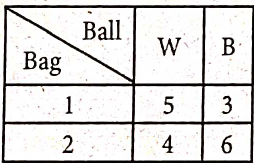
Let W, W, be the event that the white ball is drawn from bag. 1 and bag 2 respectively. Also let B,B, be the event that the black ball is drawn from bag 1 and 2 respectively.
Then \(P\left(W_1\right)=\frac{5}{8}, \quad P\left(W_2\right)=\frac{4}{10}\)
\(P\left(B_1\right)=\frac{3}{8}, \quad P\left(B_2\right)=\frac{6}{10}\)
(i) P (Both are white \(=P\left(W_1 \cap W_2\right)\)
\(=P\left(W_1\right) \cdot P\left(W_2\right)\)
\(=\frac{5}{8} \times \frac{4}{10}=\frac{1}{4}\)
(ii) P (Both are black) \(=P\left(B_1 \cap B_2\right) \)
\(=P\left(B_1\right) \cdot P\left(B_2\right) \)
\(=\frac{3}{8} \times \frac{6}{10}=\frac{9}{40}\)
(ii) P (One white and one black) \(=P\left(W_1 \cap B_2\right)+P\left(W_2 \cap B_1\right) \)
\(=P\left(W_1\right) \cdot P\left(B_2\right)+P\left(W_2\right) \cdot P\left(B_1\right) \)
\(=\frac{5}{8} \times \frac{6}{10}+\frac{4}{10} \times \frac{3}{8} \)
\(=\frac{3}{8}+\frac{3}{20}=\frac{15+6}{40}=\frac{21}{40}
\)
16.
\(m \leq 5\)
\(2 x^{2}+2 m x+m+1>0\)
For real roots
\(4 m^{2}-8(m+1)>0 \)
\(4 m^{2} - 8 m-8>0 \)
\(m^{2}-2 m-2>0 \)
\(\text {Then } m \text { can be } 5,4,3\)
\(n(S)=5 ,n(A)=3 ,P(A)=\frac{3}{5} \)
17.
Probabilrty of getting atleast 8 heads
\(=P(8)+P(9)+P(10) \)
\(=10 C_{8}\left(\frac{1}{2}\right)^{10}+10 C_{9}\left(\frac{1}{2}\right)^{10}+10 C_{10}\left(\frac{1}{2}\right)^{10} \)
\(=\frac{45+10+1}{1024}=\frac{56}{1024}=\frac{7}{128} \)
18.
\(P\left(A_{1}\right)=0.6, \quad P\left(A_{2}\right)=0.4\)
\(A_{1}=\text { Event of selecting a girl }\)
\(\mathrm{B}=\text { Event of student taller than } 1.8 \mathrm{~m}\)
\(A_{2}=\text { Event of selecting a boy }\)
\(P\left(B / A_{1}\right)=\frac{1}{100}, P\left(B / A_{2}\right)=\frac{4}{100}\)
To find \(=\frac{P\left(A_{1}\right) \cdot P\left(B / A_{1}\right)}{P\left(A_{1}\right) \cdot P\left(B / A_{1}\right)+P\left(A_{2}\right) \cdot P\left(B / A_{2}\right)} \)
\(=\frac{0.6 \times \frac{1}{100}}{0.6 \times \frac{1}{100}+0.4 \times \frac{4}{100}} \)
\(=\frac{6}{\frac{6}{1000}+\frac{16}{1000}} \)
\(=\frac{6}{22}=\frac{3}{11} \)
19.
\(n(S)=n(A \times A) \quad=16\)
\(\text {To find } n(A)\)
\(\text {Let } a=4, b=1 \text { then } a^{2}-4 b \text { is }\)
A = 1,b = 1 then 16 - 4 > 0
b = 2. then 16 - 8 > 0
b=3 then 16-L2>0
b = 4 then 16 - 16 = 0
Let Q = 3,b = 1 thg,l, 9-4 > 0
b = 2 then 9 - 8 > 0
Let a = 2,b = l then 4 - 4 > 0
n(A).= 7,
\(P(A)=\frac{n(A)}{n(S)}=\frac{7}{16}\)
20.
\(P(A \cap \bar{B})=P(A)-P(A \cap B) \)
\(\frac{1}{2} =\frac{7}{10}-P(A \cap B) \)
\(P(A \cap B) =\frac{7}{10}-\frac{1}{2}=\frac{1}{5} \)
21.
The equation is not valid for 1 to 9. 30 to 49
(i.e) for 9 + 20 = 29 numbers
Valid for 10 to 29 and 50 to 100 = 71 numbers
n(A) = 71, n(S) = 100
\(\mathrm{P}(\mathrm{A})=\frac{71}{100}=0.71\)
22.
\(P(A / B)=\frac{P(A \cap B)}{P(B)}=\frac{P(A)}{P(B)}[\because A \subset B \Rightarrow A \cap B=A]\)
23.
\(n(S) =2^{14}=16 \)
\(A =\left\{\begin{array}{ll} 1 & 0 \\ 0 & 1 \end{array}|,| \begin{array}{ll} 0 & 1 \\ 1 & 0 \end{array}|,| \begin{array}{ll} 1 & 1 \\ 0 & 1 \end{array}|,| \begin{array}{ll} 1 & 0 \\ 1 & 1 \end{array}|,| \begin{array}{ll} 0 & 1 \\ 1 & 1 \end{array}|,| \begin{array}{ll} 1 & 1 \\ 1 & 0 \end{array} \mid\right\} \)
\(n(A) =6 \)
\(P(A) =\frac{6}{16}=\frac{3}{8} \)
24.
Fifty rupee note = 3
Hundred rupee note = 4
500 rupee note = 6
Totsl = 13
\(\mathrm{n}(\mathrm{S})=13 \mathrm{C}_{2}=78\)
\(\text {No. of ways the event to occur }=4\)
\(n(A)=4 C_{2}=6\)
\(\text {No. of ways the event not to occur }=72\)
The odds of event are a:b
\(6: 72 \Rightarrow 1: 12\)
25.
(d)
26.
Let I be the event of getting State Government service and C be the event of getting Central Government job.
Given that P(I) = 0.12, P(C) = 0.25, and \(P(I \cap C)\) = 0.07
(i) P( at least one of the two jobs) \(=P(I \text { or } C)=P(I \cup C)\)
\(=P(I)+P(C)-P(I \cap C) \)
\(=0.12+0.25-0.07=0.30\)
(ii) P(only one of the two jobs) = P [only I or only C]
=\(P\left( I\cap \overline { C } \right) +P\left( \overline { I } \cup C \right) \)
\(=\{0.12-0.07\}+\{0.25-0.07\}\)
\(=0.23 \)

27.
Let A be the event of getting 3 red balls, and B be the evenl of getting onered and 2 black balls, then
\((i) P(A)=\frac{7 C_3}{11 C_3}=\frac{7 \times 6 \times 5}{11 \times 10 \times 9}=\frac{7}{33} \)
\((ii) P(B)=\frac{7 C_1 \times 4 C_2}{11 C_3}=\frac{7 \times \frac{A^2 \times \not p}{1 \times \not 2}}{\frac{11 \times 10^5 \times \phi^2}{1 \times 2 \times} \times \not p}=\frac{14}{55}\)
28.
\(
P(A)>0 ; P(B)>0 ; P(C)>0 ; P(D)>0 \) and
\(
P(A)+P(B)+P(C)+P(D)
=0.15+0.30+0.43+0.12=1.0
\)
\(\therefore\) The assignment of probability are permissible.

11th Standard Syllabus & Materials
11th Standard
TN 11th Tamil பீடு பெற நில் - செய்யுள் - காவடிச்சிந்து Important Questions And Answers Study Material - QB365 Set A
NEW11th Standard
TN 11th Tamil பீடு பெற நில் - உரைநடை - மலை இடப்பெயர்கள் : ஓர் ஆய்வு Important Questions And Answers Study Material - QB365 Set A
NEW11th Standard
TN 11th Tamil மாமழை போற்றுதும் - துணைப்பாடம் - யானை டாக்டர் Important Questions And Answers Study Material - QB365 Set A
NEW11th Standard
TN 11th Tamil மாமழை போற்றுதும் - செய்யுள் - ஐங்குறுநூறு Important Questions And Answers Study Material - QB365 Set A



Tamilnadu Stateboard 11th Standard Subjects
Maths

Commerce

Economics

Biology

Business Maths and Statistics

Accountancy

Computer Science

Physics

Chemistry
Maths
Biology
Economics
Physics
Chemistry

History
Business Maths and Statistics

Computer Science
Accountancy

Computer Applications
History
Computer Technology
Commerce
Computer Applications
Computer Technology

Tamil

English

French
Tamilnadu Stateboard Standards

