
 100% FREE ACCESS
11th Standard Syllabus & Materials
11th Standard
TN 11th Tamil இயற்கை வேளாண்மை,சுற்றுச்சூழல் -செய்யுள் - மனோன்மணீயம் Important Questions And Answers Study Material - QB365 Set A
NEW11th Standard
TN 11th Tamil என்னுயிர் என்பேன் -துணைப்பாடம் - இசைத்தமிழர் இருவர் Important Questions And Answers Study Material - QB365 Set A
NEW11th Standard
TN 11th Tamil மொழி கலை -செய்யுள் - ஒவ்வொரு புல்லையும் Important Questions And Answers Study Material - QB365 Set A
NEW11th Standard
TN 11th Tamil பீடு பெற நில் - இலக்கணம் - பகுபத உறுப்புகள் Important Questions And Answers Study Material - QB365 Set A
NEW11th Standard
TN 11th Tamil பீடு பெற நில் - துணைப்பாடம் - வாடிவாசல் Important Questions And Answers Study Material - QB365 Set A
NEW11th Standard
TN 11th Tamil பீடு பெற நில் - செய்யுள் - குறுந்தொகை Important Questions And Answers Study Material - QB365 Set A

Published on: 26/09/2019
Matrices and Determinants
Download Tamil Nadu 11th Standard Maths question papers, model tests, one-mark questions, important questions, and public exam papers in PDF format. Free study materials and answer keys for TN State Board students.
Questions + Answers key
Take MCQ Maths Test1.
In a certain city there are 30 colleges. Each college has 15 peons, 6 clerks, 1 typist and 1 section of Express the given information as a column matrix. Using sclar multiplication find the total number of each kind in all the colleges.
2.
If (k, 2), (2, 4) and (3, 2) are vertices of the triangle of area 4 square units then determine the value of k.
3.
Show that the points (a, b + c), (b, c + a), and (c, a + b) are collinear
4.
If AT = \(\begin{bmatrix} 4 & 5 \\ -1 & 0 \\ 2 & 3 \end{bmatrix}\) and B = \(\begin{bmatrix} 2 & -1&1 \\7 & 5&-2 \end{bmatrix}\), verify (A + B)T = AT + BT = BT + AT
5.
Construct an m \(\times\) n matrix A = [aij], where a ij is given by
\(a_{ij}={|3i-4j|\over 4}with \ m=3,n=4\)
6.
Suppose that a matrix has 12 elements. What are the possible orders it can have? What if it has 7 elements?
7.
If A = \(\left[ \begin{matrix} \alpha & 0 \\ 1 & 1 \end{matrix} \right] \) and B = \(\left[ \begin{matrix} 1 & 0 \\ 5 & 1 \end{matrix} \right] \) find the values of \(\alpha\) for which A2 = B.
8.
If A = \(\begin{bmatrix} 4 & 2 \\ -1 & x \end{bmatrix}\) and such that (A - 2I)(A - 3I) = O, find the value of x.
9.
If A =\(\begin{bmatrix} 4 & 6 & 2 \\ 0 & 1 & 5 \\ 0 & 3 & 2 \end{bmatrix}\) and B = \(\begin{bmatrix} 0 & 1 & -1 \\ 3 & -1 & 4 \\ -1 & 2 & 1 \end{bmatrix}\) verify (A - B)T = AT - BT
10.
If A =\(\begin{bmatrix} 4 & 6 & 2 \\ 0 & 1 & 5 \\ 0 & 3 & 2 \end{bmatrix}\) and B= \(\begin{bmatrix} 0 & 1 & -1 \\ 3 & -1 & 4 \\ -1 & 2 & 1 \end{bmatrix}\)
verify (AB)T = BTAT
11.
If A =\(\begin{bmatrix} 0 &c &b \\ c & 0 &a \\ b & a & 0 \end{bmatrix}\), compute A2
12.
If \(\lambda =-2\) , determine the value of \(\begin{vmatrix} 0& 2\lambda &1 \\ \lambda^2 &0 &3\lambda^3+1 \\ -1 &6\lambda-1 &0 \end{vmatrix}\) .
13.
If A = \(\begin{bmatrix} 1 & 2 & 2 \\ 2 & 1 & -2 \\ x & 2 & y \end{bmatrix}\) is a matrix such that AAT = 9I, find the values of x and y.
14.
A fruit shop keeper prepares 3 different varieties of gift packages. Pack-I contains 6 apples, 3 oranges, and 3 pomegranates. Pack-II contains 5 apples, 4 oranges and 4 pomegranates and Pack –III contains 6 apples, 6 oranges and 6 pomegranates. The cost of an apple, an orange and a pomegranate respectively are Rs. 30, Rs. 15 and Rs. 45. What is the cost of preparing each package of fruits?
15.
Solve for x if \(\left[\begin{array}{lll} x & 2 & -1 \end{array}\right]\)\(\begin{bmatrix} 1&1 &2 \\ -1 & -4 &1 \\ -1 &-1 &-2 \end{bmatrix}\)\(\begin{bmatrix} x \\ 2 \\ 1 \end{bmatrix}\)=0
16.
Identify the singular and non-singular matrices:\(\begin{bmatrix} 0&a-b &k \\ b-a & 0 &5 \\ -k & -5 & 0 \end{bmatrix}\)
17.
If A is skew-symmetric of order n and C is a column matrix of order n \(\times\) 1, then CT AC is
an identity matrix of order n
an identity matrix of order 1
a zero matrix of order 1
an identity matrix of order 2
18.
19.
If A and B are symmetric matrices of order n, where (A \(\neq\) B), then
A + B is skew-symmetric
A + B is symmetric
A + B is a diagonal matrix
A + B is a zero matrix
20.
If A is a square matrix, then which of the following is not symmetric?
A + AT
AAT
AT A
A − AT
21.
If A = \(\begin{bmatrix}\lambda & 1 \\ -1 & -\lambda \end{bmatrix}\), then for what value of \(\lambda\), A2 = O?
0
\(\pm 1\)
-1
1
1.
Let A be the required column matrix
Then A =\(\begin{matrix} Peons \\ \begin{matrix} Clerks \\ \begin{matrix} Typist \\ Section \ officer \end{matrix} \end{matrix} \end{matrix}\left[ \begin{matrix} 15 \\ \begin{matrix} 6 \\ \begin{matrix} 1 \\ 1 \end{matrix} \end{matrix} \end{matrix} \right] \)
Since there are 30 collegs,
30 A = 30\(\left[ \begin{matrix} 15 \\ \begin{matrix} 6 \\ \begin{matrix} 1 \\ 1 \end{matrix} \end{matrix} \end{matrix} \right] =\left[ \begin{matrix} 450 \\ \begin{matrix} 180 \\ \begin{matrix} 30 \\ 30 \end{matrix} \end{matrix} \end{matrix} \right] \)
2.
Given vertices are (k. 2). (2, 4) and (3, 2)
And also Given Area of a triangle = 4 sq,units
We know that, area of \(\triangle\)ABC =absolute value of \(\frac { 1 }{ 2 } \left| \begin{matrix} { x }_{ 1 } & { y }_{ 1 } & 1 \\ { x }_{ 2 } & { y }_{ 2 } & 1 \\ { x }_{ 3 } & { y }_{ 3 } & 1 \end{matrix} \right| \)
\(\Rightarrow\) 4 = absolute of \(\frac { 1 }{ 2 } \left| \begin{matrix} k & 2 & 1 \\ 2 & 4 & 1 \\ 3 & 2 & 1 \end{matrix} \right| \)
\(\Rightarrow\) 4 = absolute value of \(\frac{1}{2}\)[k(4 - 2)-2(2 - 3) + 1(4 - 12)]
[Expanded along R1]
\(\Rightarrow\) 4 = absolute value of \(\frac{1}{2}\)[2k + 2 - 8]
\(\Rightarrow\) 4 =absolute value of \(\frac{1}{2}\)[2k - 6]
\(\Rightarrow\) 4 = \(\pm \frac { 1 }{ 2 } \)(2k - 6)
Case (i) when 4 =\(\frac{1}{2}\)(2k - 6)
\(\Rightarrow\) 8 = 2k - 6
\(\Rightarrow\)14 = 2k
\(\Rightarrow\) k =7
Case(ii) When 4 = -\(\frac{1}{2}\)(2k - 6)
\(\Rightarrow\) 8 = -2k + 6
\(\Rightarrow\) 8 - 6 = -2k
\(\Rightarrow\) 2 = -2k
\(\Rightarrow\) k = -1
\(\therefore\) The values of k are -1 or 7.
3.
To prove the given points are collinear, it suffices to prove |A| = \(\begin{vmatrix} a&b+c &1 \\ b &c+a &1 \\ c & a+b &1 \end{vmatrix}=0\)
Applying C1\(\rightarrow\) C1 + C2, we deduce that
|A| = \(\begin{vmatrix} a+b+c&b+c &1 \\ a+b+c &c+a &1 \\ a+b+c & a+b &1 \end{vmatrix}=(a+b+c)\begin{vmatrix} 1&b+c &1 \\ 1 &c+a &1 \\ 1 & a+b &1 \end{vmatrix}=(a+b+c)\times0=0\)
which shows that the given points are collinear.
4.
Given AT = \(\left[ \begin{matrix} 4 & 5 \\ -1 & 0 \\ 2 & 3 \end{matrix} \right] \) and B = \(\left[ \begin{matrix} 2 & -1 & 1 \\ 7 & 5 & -2 \end{matrix} \right] \)
(ii) Verify (A + B)T= AT + BT = BT = BT + AT
(A)T =\({ \left[ \begin{matrix} 4 & 5 \\ -1 & 0 \\ 2 & 3 \end{matrix} \right] }^{ T }=\left[ \begin{matrix} 4 & -1 & 2 \\ 5 & 0 & 3 \end{matrix} \right] \)
A = \(\left[ \begin{matrix} 4 & -2 & 2 \\ 5 & 0 & 3 \end{matrix} \right] \)
Now, A + B = \(\left[ \begin{matrix} 4 & -1 & 2 \\ 5 & 0 & 3 \end{matrix} \right] +\left[ \begin{matrix} 2 & -1 & 1 \\ 7 & 5 & -2 \end{matrix} \right] =\left[ \begin{matrix} 6 & -2 & 3 \\ 12 & 5 & 1 \end{matrix} \right] \)
\(\therefore\) (A + B)T= \(\left[ \begin{matrix} 6 & 12 \\ -2 & 5 \\ 3 & 1 \end{matrix} \right] \) ---(1)
BT = \(\left[ \begin{matrix} 6 & 12 \\ -2 & 5 \\ 3 & 1 \end{matrix} \right] \)
\(\therefore\) AT + BT = \(\left[ \begin{matrix} 4 & 5 \\ -1 & 0 \\ 2 & 3 \end{matrix} \right] +\left[ \begin{matrix} 2 & 7 \\ -1 & 5 \\ 1 & -2 \end{matrix} \right] =\left[ \begin{matrix} 6 & 12 \\ -2 & 5 \\ 3 & 1 \end{matrix} \right] \)----(2)
BT + AT = \(\left[ \begin{matrix} 2 & 7 \\ -1 & 5 \\ 1 & -2 \end{matrix} \right] +\left[ \begin{matrix} 4 & 5 \\ -1 & 0 \\ 2 & 3 \end{matrix} \right] =\left[ \begin{matrix} 6 & 12 \\ -2 & 5 \\ 3 & 1 \end{matrix} \right] \) ----------------------(3)
From (1), (2) and (3), (A + B)T = AT + BT = BT+ AT
5.
Let B be a 3 \(\times\) 4 matrix with entries as
B = \(\left( \begin{matrix} { a }_{ 11 } & a_{ 12 } & { a }_{ 13 } \\ { a }_{ 21 } & { a }_{ 22 } & { a }_{ 23 } \\ { a }_{ 31 } & { a }_{ 32 } & { a }_{ 33 } \end{matrix}\begin{matrix} { a }_{ 14 } \\ { a }_{ 24 } \\ { a }_{ 34 } \end{matrix} \right) \)
\({ a }_{ ij }=\frac { \left| 3i-4j \right| }{ 4 } \)
\({ a }_{ 11 }=\frac { \left| 3-4 \right| }{ 4 } =\frac { \left| -1 \right| }{ 4 } =\frac { 1 }{ 4 } \)
\({ a }_{ 12 }=\frac { \left| 3-8 \right| }{ 4 } =\frac { \left| -5 \right| }{ 4 } =\frac { 5 }{ 4 } \)
\({ a }_{ 13 }=\frac { \left| 3-12 \right| }{ 4 } =\frac { \left| -9 \right| }{ 4 } =\frac { 9 }{ 4 } \)
\({ a }_{ 14 }=\frac { \left| 3-16 \right| }{ 4 } =\frac { \left| -13 \right| }{ 4 } =\frac { 13 }{ 4 } \)
\({ a }_{ 21 }=\frac { \left| 3(2)-(4)1 \right| }{ 4 } =\frac { \left| 6-4 \right| }{ 4 } =\frac { 2 }{ 4 } \)
\({ a }_{ 22 }=\frac { \left| 3(2)-4(2) \right| }{ 4 } =\frac { \left| 6-8 \right| }{ 4 } =\frac { 2 }{ 4 } \)
\({ a }_{ 23 }=\frac { \left| 3(2)-4(3) \right| }{ 4 } =\frac { \left| 6-12 \right| }{ 4 } =\frac { 6 }{ 4 } \)
\({ a }_{ 24 }=\frac { \left| 3(2)-4(4) \right| }{ 4 } =\frac { \left| 6-16 \right| }{ 4 } =\frac { 10 }{ 4 } \)
\({ a }_{ 31 }=\frac { \left| 3(3)-4(1) \right| }{ 4 } =\frac { \left| 9-4 \right| }{ 4 } =\frac { 5 }{ 4 } \)
\({ a }_{ 32 }=\frac { \left| 3(3)-4(2) \right| }{ 4 } =\frac { \left| 9-8 \right| }{ 4 } =\frac { 1 }{ 4 } \)
\({ a }_{ 33 }=\frac { \left| 3(3)-4(3) \right| }{ 4 } =\frac { \left| 9-12 \right| }{ 4 } =\frac { 3 }{ 4 } \)
\({ a }_{ 34 }=\frac { \left| 3(3)-4(4) \right| }{ 4 } =\frac { \left| 9-16 \right| }{ 4 } =\frac { 7 }{ 4 } \)
\(\therefore B=\left[ \begin{matrix} 1/4 & 5/4 & 9/4 \\ 2/4 & 2/4 & 6/4 \\ 5/4 & 1/4 & 3/4 \end{matrix}\begin{matrix} 13/4 \\ 10/4 \\ 7/4 \end{matrix} \right] =\frac { 1 }{ 4 } \left[ \begin{matrix} 1 & 5 & 9 \\ 2 & 2 & 6 \\ 5 & 1&3 & \end{matrix}\begin{matrix} 13 \\ 10 \\ 7 \end{matrix} \right] \)
6.
The number of elements is the product of number of rows and number of columns.
Therefore, we will find all ordered pairs of natural numbers whose product is 12.
Thus, all the possible orders of the matrix are 1 \(\times\) 12, 12 \(\times\) 1, 2 \(\times\)6, 6 \(\times\)2, 3 \(\times\) 4 and 4 \(\times\) 3.
Since 7 is prime, the only possible orders of the matrix are 1 \(\times\) 7 and 7 \(\times\) 1.
7.
Given A2 = B
\(\Rightarrow \left[ \begin{matrix} \alpha & 0 \\ 1 & 1 \end{matrix} \right] \left[ \begin{matrix} \alpha & 0 \\ 1 & 1 \end{matrix} \right] =\left[ \begin{matrix} 1 & 0 \\ 5 & 1 \end{matrix} \right] \)
\(\Rightarrow \left[ \begin{matrix} { \alpha }^{ 2 }+0 & 0+0 \\ \alpha +1 & 0+1 \end{matrix} \right] =\left[ \begin{matrix} 1 & 0 \\ 5 & 1 \end{matrix} \right] \)
\(\Rightarrow \left[ \begin{matrix} { \alpha }^{ 2 } & 0 \\ \alpha +1 & 1 \end{matrix} \right] =\left[ \begin{matrix} 1 & 0 \\ 5 & 1 \end{matrix} \right] \)
\(\Rightarrow\) \({ \alpha }^{ 2 }\) = 1 or \(\alpha +1\) = 5
\(\Rightarrow\) = \(\pm \) 1 or \(\alpha\) = 4 which is not possible.
Hence, there is no value of for which A2 = B is true.
8.
\(A=\left[\begin{array}{cc}
4 & 2 \\
-1 & x
\end{array}\right] ; I=\left[\begin{array}{ll}
1 & 0 \\
0 & 1
\end{array}\right]\)
\(A-2 I=\left[\begin{array}{cc}
4 & 2 \\
-1 & x
\end{array}\right]-2\left[\begin{array}{ll}
1 & 0 \\
0 & 1
\end{array}\right]=\left[\begin{array}{cc}
4-2 & 2+0 \\
-1+0 & x-2
\end{array}\right]\)
\(=\left[\begin{array}{cc}
2 & 2 \\
-1 & x-2
\end{array}\right]\)
\(A-3 I=\left[\begin{array}{rr}
4 & 2 \\
-1 & x
\end{array}\right]-3\left[\begin{array}{ll}
1 & 0 \\
0 & 1
\end{array}\right]=\left[\begin{array}{cc}
4-3 & 2+0 \\
-1+0 & x-3
\end{array}\right]\)
\(=\left[\begin{array}{cc}
1 & 2 \\
-1 & x-3
\end{array}\right]\)
Given, \((A-2 I)(A-3 I)=\left[\begin{array}{cc}
2 & 2 \\
-1 & x-2
\end{array}\right]\left[\begin{array}{cc}
1 & 2 \\
-1 & x-3
\end{array}\right]\)
\(=\left[\begin{array}{ll}
0 & 0 \\
0 & 0
\end{array}\right]\)
\(\left[\begin{array}{cc}
2-2 & 4+2 x-6 \\
-1-x+2 & -2+(x-2)(x-3)
\end{array}\right]=\left[\begin{array}{ll}
0 & 0 \\
0 & 0
\end{array}\right]\)
\(-1-x+2=0\)
\(-x+1=0\)
\(x=1\)
9.
A -B =\(\begin{bmatrix} 4 & 6 & 2 \\ 0 & 1 & 5 \\ 0 & 3 & 2 \end{bmatrix}\)-\(\begin{bmatrix} 0 & 1 & -1 \\ 3 & -1 & 4 \\ -1 & 2 & 1 \end{bmatrix}\)=\(\begin{bmatrix} 4 & 5 & 3 \\ -3 & 2 & 1 \\1 & 1 & 1 \end{bmatrix}\)
(A - B)T =\(\begin{bmatrix} 4 & -3 & 1 \\ 5 & 2 & 1 \\3 & 1 & 1 \end{bmatrix}\) ..(1)
AT - BT =\(\begin{bmatrix} 4 & 0 & 0 \\ 6 & 1 & 3 \\ 2 & 5 & 2 \end{bmatrix}\)-\(\begin{bmatrix} 0 & 3 & -1 \\ 1 & -1 & 2 \\ -1 & 4 & 1 \end{bmatrix}\)=\(\begin{bmatrix} 4 & -3 & 1 \\ 5 & 2 & 1 \\3 & 1 & 1 \end{bmatrix}\).....(2)
From (1) and (2), (A - B)T= AT - BT.
10.
AB =\(\begin{bmatrix} 4 & 6 & 2 \\ 0 & 1 & 5 \\ 0 & 3 & 2 \end{bmatrix}\)\(\begin{bmatrix} 0 & 1 & -1 \\ 3 & -1 & 4 \\ -1 & 2 & 1 \end{bmatrix}\)=\(\begin{bmatrix} 16 & 2 & -1 \\ -2 & 9 & 9 \\ 7 & 1 & 14 \end{bmatrix}\)
(AB)T =\(\begin{bmatrix} 16 & -2 & 7 \\ 2 & 9 & 1 \\ 22 & 9 & 14 \end{bmatrix}\)...(1)
BT = \(\begin{bmatrix} 0 & 3 & -1 \\ 1 & -1 & 2 \\ -1 & 4 & 1 \end{bmatrix}\), AT=\(\begin{bmatrix} 4 & 0 & 0 \\ 6 & 1 & 3 \\ 2 & 5 & 2 \end{bmatrix}\)
BTAT=\(\begin{bmatrix} 0 & 3 & -1 \\ 1 & -1 & 2 \\ -1 & 4 & 1 \end{bmatrix}\)\(\begin{bmatrix} 4 & 0 & 0 \\ 6 & 1 & 3 \\ 2 & 5 & 2 \end{bmatrix}\)=\(\begin{bmatrix} 16 & -2 & 7 \\ 2 & 9 & 1 \\ 22 & 9 & 14 \end{bmatrix}\)...(2)
From (1) and (2), (AB)T = BTAT.
11.
A2 = AA =\(\begin{bmatrix} 0 &c &b \\ c & 0 &a \\ b & a & 0 \end{bmatrix}\)\(\begin{bmatrix} 0 &c &b \\ c & 0 &a \\ b & a & 0 \end{bmatrix}\)=\(\begin{bmatrix} C_{11} &C_{12} &C_{13} \\ C_{21} & C_{22} &C_{23} \\ C_{31} & C_{32} & C_{33} \end{bmatrix}\)
12.
Given \(\lambda \)=-2
Let A= \(\begin{vmatrix} 0& 2\lambda &1 \\ \lambda^2 &0 &3\lambda^3+1 \\ -1 &6\lambda-1 &0 \end{vmatrix}\)=\(\left| \begin{matrix} 0 & -4 & 1 \\ 4 & 0 & 13 \\ -1 & -13 & 0 \end{matrix} \right| \) [put \(\lambda \)=-2]
\(=0+4(0+13)+1(-52-0)=4(13)-52\)
\(=52-52=0\)
13.
\(Given A=\left[\begin{array}{ccc}1 & 2 & 2 \\ 2 & 1 & -2 \\ x & 2 & y\end{array}\right]\)
\(A^T=\left[\begin{array}{ccc} 1 & 2 & x \\ 2 & 1 & 2 \\ 2 & -2 & y \end{array}\right]\)
\(A A^T=9 I\)
\(\left[\begin{array}{ccc} 1 & 2 & 2 \\ 2 & 1 & -2 \\ x & 2 & y \end{array}\right]\left[\begin{array}{ccc} 1 & 2 & x \\ 2 & 1 & 2 \\ 2 & -2 & y \end{array}\right]=9\left[\begin{array}{lll} 1 & 0 & 0 \\ 0 & 1 & 0 \\ 0 & 0 & 1 \end{array}\right]\)
\(\left[\begin{array}{ccc} 1+4+4 & 2+2-4 & x+4+2 y \\ 2+2-4 & 4+1+4 & 2 x+2-2 y \\ x+4+2 y & 2 x+2-2 y & x^2+4+y^2 \end{array}\right]=\left[\begin{array}{lll} 9 & 0 & 0 \\ 0 & 9 & 0 \\ 0 & 0 & 9 \end{array}\right]\)
\(\left[\begin{array}{ccc} 9 & 0 & x+2 y+4 \\ 0 & 9 & 2 x-2 y+2 \\ x+4+2 y & 2 x+2-2 y & x^2+4+y^2 \end{array}\right]=\left[\begin{array}{lll} 9 & 0 & 0 \\ 0 & 9 & 0 \\ 0 & 0 & 9 \end{array}\right]\)
\(x+2 y+4=0 \Rightarrow x+2 y=-4 ....(1)\)
\(2 x-2 y+2=0 \Rightarrow 2 x-2 y=-2 ....(2)\)
\(\begin{aligned} &\text { Add (1) & (2) } \Rightarrow 3 x=-6 \\ &x=-2 \end{aligned}\)
\(\text { Put } x=-2 \text { in }(1) \Rightarrow-2+2 y=-4\)
\(-2+4=-2 y\)
\(2=-2 y\)
\(y=-1\)
\(\therefore x=-2\)
14.
Cost matrix A = [30 15 45], Fruit matrix
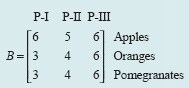
Cost of packages are obtained by computing AB. That is, by multiplying cost of each item in A (cost matrix A) with number of items in B (Fruit matrix B).
\(A B=\left[\begin{array}{lll} 30 & 15 & 45 \end{array}\right]\left[\begin{array}{lll} 6 & 5 & 6 \\ 3 & 4 & 6 \\ 3 & 4 & 6 \end{array}\right]=\left[\begin{array}{lll} 360 & 390 & 540 \end{array}\right]\)
Pack-I cost Rs. 360, Pack-II cost Rs. 390, Pack-III costs Rs. 540.
15.
\(\left[\begin{array}{lll} x & 2 & -1 \end{array}\right]\) \(\begin{bmatrix} 1&1 &2 \\ -1 & -4 &1 \\ -1 &-1 &-2 \end{bmatrix}\)\(\begin{bmatrix} x \\ 2 \\ 1 \end{bmatrix}\)= 0
That is, [x - 2 +1 x - 8 + 1 2x + 2 + 2] \(\begin{bmatrix} x \\ 2 \\ 1 \end{bmatrix}\)= 0
[x - 1 x - 7 2x + 4] \(\begin{bmatrix} x \\ 2 \\ 1 \end{bmatrix}\)= 0
x (x - 1) + 2(x - 7) + 1(2 x +4) = 0
x2 + 3x − 10 = 0 \(\Rightarrow\) x = -5, 2.
16.
\(|A|=\left|\begin{array}{ccc} 0 & a-b & k \\ b-a & 0 & 5 \\ -k & -5 & 0 \end{array}\right|\)
\(=0-(a-b)[0+5 k]+k(-5(b-a)-0)\)
\(=(-a+b)(5 k)+k(-5 b+5 a)\)
\(=-5 k a+5 k b-5 k b+5 a k\)
= 0
\(|A|=0\)
\(\therefore\) A is singular
17.
(c)
a zero matrix of order 1
18.
(d)
19.
\(A \& B \text { are symmetric } \Rightarrow A+B \text { is symmetric }\)
20.
(d)
A − AT
21.
\(A^{2}=A \times A=\left[\begin{array}{cc} \lambda & 1 \\ -1 & -\lambda \end{array}\right]\left[\begin{array}{cc} \lambda & 1 \\ -1 & -\lambda \end{array}\right]\)
\(=\left[\begin{array}{cc} \lambda^{2}-1 & \lambda-\lambda \\ -\lambda+\lambda & -1+\lambda^{2} \end{array}\right]=0\)
\(\therefore \lambda^{2} =1 \)
\(\lambda =\pm 1\)

11th Standard Syllabus & Materials
11th Standard
TN 11th Tamil பீடு பெற நில் - செய்யுள் - காவடிச்சிந்து Important Questions And Answers Study Material - QB365 Set A
NEW11th Standard
TN 11th Tamil பீடு பெற நில் - உரைநடை - மலை இடப்பெயர்கள் : ஓர் ஆய்வு Important Questions And Answers Study Material - QB365 Set A
NEW11th Standard
TN 11th Tamil மாமழை போற்றுதும் - துணைப்பாடம் - யானை டாக்டர் Important Questions And Answers Study Material - QB365 Set A
NEW11th Standard
TN 11th Tamil மாமழை போற்றுதும் - செய்யுள் - ஐங்குறுநூறு Important Questions And Answers Study Material - QB365 Set A



Tamilnadu Stateboard 11th Standard Subjects
Maths

Commerce

Economics

Biology

Business Maths and Statistics

Accountancy

Computer Science

Physics

Chemistry
Maths
Biology
Economics
Physics
Chemistry

History
Business Maths and Statistics

Computer Science
Accountancy

Computer Applications
History
Computer Technology
Commerce
Computer Applications
Computer Technology

Tamil

English

French
Tamilnadu Stateboard Standards

