
 100% FREE ACCESS
11th Standard Syllabus & Materials
11th Standard
TN 11th Tamil இயற்கை வேளாண்மை,சுற்றுச்சூழல் -செய்யுள் - மனோன்மணீயம் Important Questions And Answers Study Material - QB365 Set A
NEW11th Standard
TN 11th Tamil என்னுயிர் என்பேன் -துணைப்பாடம் - இசைத்தமிழர் இருவர் Important Questions And Answers Study Material - QB365 Set A
NEW11th Standard
TN 11th Tamil மொழி கலை -செய்யுள் - ஒவ்வொரு புல்லையும் Important Questions And Answers Study Material - QB365 Set A
NEW11th Standard
TN 11th Tamil பீடு பெற நில் - இலக்கணம் - பகுபத உறுப்புகள் Important Questions And Answers Study Material - QB365 Set A
NEW11th Standard
TN 11th Tamil பீடு பெற நில் - துணைப்பாடம் - வாடிவாசல் Important Questions And Answers Study Material - QB365 Set A
NEW11th Standard
TN 11th Tamil பீடு பெற நில் - செய்யுள் - குறுந்தொகை Important Questions And Answers Study Material - QB365 Set A

Published on: 04/03/2019
11th Public Exam March 2019 Model Test
Download Tamil Nadu 11th Standard Maths question papers, model tests, one-mark questions, important questions, and public exam papers in PDF format. Free study materials and answer keys for TN State Board students.
Questions + Answers key
Take MCQ Maths Test1.
Let A, Band C represent the angles of a \(\triangle\)ABC and a, band c represent the lengths of the sides opposite to them, then prove that a2 = b2 + c2 - 2bc cos A (Law of cosines)
2.
Evaluate \(\int { \frac { { e }^{ x }dx }{ { e }^{ 2x }+6{ e }^{ x }+5 } } \)
3.
The probability of simultaneous occurrence of atleast one of two events A and B is p. if the probability that exactly one A, B occurs is q then prove that P(\(\bar { A } \)) + P(\(\bar { B } \)) = 2-2 p+q.
4.
If \(f\left( 2 \right) =4\ and f^{ ' }\left( 2 \right) =1, \) then find \(\lim _{ x\rightarrow 2 }{ \frac { xf\left( 2 \right) -(2)f\left( x \right) }{ x } }\)
5.
The probability that a car being filled with petrol will also need an oil change is 0.30; the probability that it needs a new oil filter is 0.40; and the probability that both the oil and filter need changing is 0.15.
(i) If the oil had to be changed, what is the probability that a new oil filter is needed?
(ii) If a new oil filter is needed, what is the probability that the oil has to be changed?
6.
According to Einstein’s theory of relativity, the mass m of a body moving with velocity v is m = \({m_O\over \sqrt{1-{v^2\over c^2}}},\) where m0 is the initial mass and c is the speed of light. What happens to m as \(v\rightarrow{c}^-\). Why is a left hand limit necessary?
7.
Determine the region in the Plane determined by the inequalities x+y≥4,2x-y>0
8.
A point moves so that square of its distance from the point (3, -2) is numerically equal to its distance from the line 5x -12y = 3. The equation of its locus is .................
9.
The Pamban Sea Bridge is a railway bridge of length about 2065m constructed on the PalkStrait, which connects the Island town of Rameswaram to Mandapam, the main land of India. The Bridge is restricted to a uniform speed of only 12.5 m/s. If a train of length 560 m starts at the entry point of the bridge from Mandapam, then
(i) find an equation of the motion of the train.
(ii) when does the engine touch island.
(iii) when does the last coach cross the entry point of the bridge.
(iv) what is the time taken by a train to cross the bridge.
10.
Solve \(\sqrt{3}tan^2\theta+(\sqrt{3}-1)tan\theta-1=0\)
11.
A spring was hung from a hook in the ceiling. A number of different weights were attached to the spring to make it stretch, and the total length of the spring was measured each time shown in the following table.
| Weight, (kg) | 2 | 4 | 5 | 8 |
| Length, (cm) | 3 | 4 | 4.5 | 6 |
(i) Draw a graph showing the results.
(ii) Find the equation relating the length of the spring to the weight on it.
(iii) What is the actual length of the spring.
(iv) If the spring has to stretch to 9 cm long, how much weight should be added?
(v) How long will the spring be when 6 kilograms of weight on it?
12.
Compute the sum of first n terms of 1 + (1 + 4) + (1 + 4 + 42) + (1 + 4 + 42 + 43) + ...
13.
By the principle of mathematical induction, prove that for n > 1,
\(1^2 + 3^2 + 5^2 + ... + (2n-1)^2 = {n(2n-1)(2n+1)\over 3}\)
14.
On the set of natural numbers let R be the relation defined by aRb if a + b \(\le\) 6. Write down the relation by listing all the pairs. Check whether it is transitive
15.
A fighter jet has to hit a small target by flying a horizontal distance. When the target is sighted, the pilot measures the angle of depression to be 300. If after 100 km, the target has an angle of depression of 600, how far is the target from the fighter jet at that instant?
16.
Differentiate \(\log _{ 7 }{ (\log _{ 7 }{ x } ) } \)
17.
Evaluate : \(\int e^{xlog2}e^x dx\)
18.
If A and B are symmetric matrices of same order, prove that
AB - BA is a skew-symmetric matrix.
19.
Evaluate the following:
\(\sqrt [ 3 ]{ 1003 } \) correct to 4 places of decimals
20.
In the set Z of integers, define mRn if m - n is divisible by 7. Prove that R is an equivalence relation.
21.
Find x if \({{1}\over{2}}\) log10 \((11+4\sqrt{7})\) = log10 (2 + x).
22.
\(\int { \frac { sin\sqrt { x } }{ x } } \) dx = ________ +c.
2 cos \(\sqrt { x } \)
2 sin \(\sqrt { x } \)
-2 sin \(\sqrt { x } \)
-2 cos \(\sqrt { x } \)
23.
Two dice are thrown. It is known that the sum of the numbers on the dice was less than 6, the probability of getting a sum 3 is
\(\frac { 1 }{ 18 } \)
\(\frac { 5 }{ 18 } \)
\(\frac { 1 }{ 5 } \)
\(\frac { 2 }{ 5 } \)
24.
The points of discontinuity of the function \(\frac { { x }^{ 2 }+6x+8\quad }{ { x }^{ 2 }-5x+6\quad } is\)
3,2
3,-2
-3,2
-3,-2
25.
The negative of a matrix is obtained by multiplying it by ___________ .
1
-1
I
AT
26.
If X and Y be two events such that P(X/Y) = \({1\over2},P(Y/X)={1\over3}\) and \(P(X\cap Y)={1\over6}\), then P(X\(\cup\)Y) is
\({1\over3}\)
\({2\over5}\)
\({1\over6}\)
\({2\over3}\)
27.
\(\int \sqrt{\frac{1-x}{1+x}} d x\) is
\(\sqrt{1-x^2}+sin^{-1}x+c\)
\(sin^{-1}x-\sqrt{1-x^2}+c\)
\(log|x+\sqrt{1-x^2}|-\sqrt{1-x^2}+c\)
\(\sqrt{1-x^2}+log|x+\sqrt{1-x^2}|+c\)
28.
If g(x) = (x2 + 2x + 3) f(x) and f(0) = 5 and \(lim_{x \rightarrow 0}{f(x)-5\over x}=4\), then g'(0) is
20
14
18
12
29.
If \(lim_{x \rightarrow 0}{sin \ px\over tan \ 3x}=4\) , then the value of p is
6
9
12
4
30.
If \(\overrightarrow{a}=\hat{i}+2\hat{j}+2\hat{k},|\overrightarrow{b}|=5\) and the angle between \(\overrightarrow{a}\) and \(\overrightarrow{b}\) is \({\pi\over 6},\) then the area of the triangle formed by these two vectors as two sides, is
\(7\over4\)
\(15\over4\)
\(3\over4\)
\(17\over4\)
31.
If x1, x2, x3 as well as y1, y2, y3 are in geometric progression with the same common ratio, then the points (x1, y1 ), (x2, y2), (x3, y3 ) are
vertices of an equilateral triangle
vertices of a right angled triangle
vertices of a right angled isosceles triangle
collinear
32.
The equation x2+ kxy + y2- 5x - 7y + 6 = 0 represents a pair of straight lines then k = ______________
\(\frac{5}{3}\)
\(\frac{10}{3}\)
\(\frac{3}{2}\)
\(\frac{3}{10}\)
33.
The domain of the function \(f(x)=\sqrt{ x - 5 }+ \sqrt{6 - x}\) is
[5, ∞)
(- ∞, 6)
[5, 6]
(-5, ≠6)
34.
\(\frac{1}{1!}+\frac{1}{3!}+\frac{1}{5!}+...\) is ______________
\(\frac{e^{-1}}{2}\)
\(\frac{e+e^{-1}}{2}\)
\(\frac{e-e^{-1}}{2}\)
none of these
35.
The number of parallelogram formed if 5 parallel lines intersect with 4 other paralle llines is _________
10
45
30
60
36.
The length of \(\bot\) from the origin to the line \(\frac{x}{3}-\frac{y}{4}=1,\) is
\(\frac{11}{5}\)
\(\frac{5}{12}\)
\(\frac{12}{5}\)
\(\frac{-5}{12}\)
37.
In an examination there are three multiple choice questions and each question has 5 choices. Number of ways in which a student can fail to get all answer correct is
125
124
64
63
38.
In any ΔABC, a(b cosC - c cos B) = __________
a2
b2-c2
0
b2 + c2
39.
If a and b are the real roots of the equation x2- kx + c = 0, then the distance between the points (a, 0) and (b, 0) is
\(\sqrt { { k }^{ 2 }-4c } \)
\(\sqrt { { 4k }^{ 2 }-c } \)
\(\sqrt { 4c-{ k }^{ 2 } } \)
\(\sqrt { k-8c } \)
40.
\(\left( 1+cos\frac { \pi }{ 8 } \right) \left( 1+cos\frac { 3\pi }{ 8 } \right) \left( 1+cos\frac { 5\pi }{ 8 } \right) \left( 1+cos\frac { 7\pi }{ 8 } \right) \) =
\(\frac { 1 }{ 8 } \)
\(\frac { 1 }{ 2 } \)
\(\frac { 1 }{ \sqrt { 3 } } \)
\(\frac { 1 }{ \sqrt { 2 } } \)
41.
If two sets A and B have 17 elements in common, then the number of elements common to the set A \(\times\)B and B \(\times\)A is
217
172
34
insufficient data
42.
Find the position vector of a point R which divides the line joining points P and Q whose position vectors are \(\hat{i}+2\hat{j}-\hat{k}\) and \(-\hat{i}+\hat{j}+\hat{k}\) respectively in the ratio 2:1 externally.
43.
A die is tossed thrice. find the probability of getting an odd number atleast once?
44.
\(If\lim _{ x\rightarrow 2 }{ \frac { { x }^{ n }-{ 2 }^{ n } }{ x-2 } } =80\quad and\quad n\in N,\quad find\quad n.\)
45.
Integrate the following functions with respect to x : sin 3x
46.
Integrate the following with respect to x : \(\left(1-x^2\right)^{-\frac{1}{2}}\)
47.
Find the derivatives of the following functions using first principle. f(x) = - x2 + 2
48.
Calculate \(\lim _{ x\rightarrow0}{|x| } \).
49.
Determine the values of b so that the following matrices are singular:\(\begin{bmatrix}b-1 &2 &3 \\3 & 1 & 2 \\ 1 & -2 &4 \end{bmatrix}\)
50.
Find the equation of the line through the point of intersection of the line 5x - 6y = 1 and 3x + 2y + 5 = 0 and cutting off equal intercepts on the coordinate axis.
51.
A family of 4 brothers and 3 sisters is to be arranged in a row for a photograph, in how many ways can they be seated if
(i) all the sisters sit together
(ii) all the sisters are not together.
52.
Find the general solution of sin\(\theta =-{\sqrt{3}\over 2}\).
53.
Find the 5th term in the sequence whose first three terms are 3, 3, 6 and each term after the second is the sum of the two terms preceding it.
54.
Discuss the following relations for reflexivity, symmetricity and transitivity :
On the set of natural numbers, the relation R is defined by "xRy if x + 2y = 1".
1.
Let \(\overrightarrow{BC}=\overrightarrow{a},\overrightarrow{AC}=\overrightarrow{b},\overrightarrow{BA}=\overrightarrow{c}\)
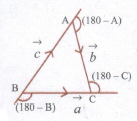
Then \(|\overrightarrow{a}|=a,|\overrightarrow{b}|=b,\) and \(|\overrightarrow{c}|=c\)
Since \(\overrightarrow{BC}=\overrightarrow{BA}+\overrightarrow{AC}\)
We have \(\overrightarrow{a}=\overrightarrow{c}+\overrightarrow{b}\) and angle between \(\overrightarrow{c}\) and \(\overrightarrow{b}\) is (180-A)
\(=|\overrightarrow{a}|^2=|\overrightarrow{c}+\overrightarrow{b}|^2=|\overrightarrow{c}|^2+|\overrightarrow{b}|^2+2|\overrightarrow{c}||\overrightarrow{b}|cos (180-A)\)
\(=c^2+b^2+2cb \ cos (180-A)\)
\(=b^2+c^2-2cb \ cos A\) \([\because cos(180-A)=-cos \ A]\)
2.
Let I = \(\int { \frac { { e }^{ x }dx }{ { e }^{ 2x }+6{ e }^{ x }+5 } } \) = \(\int { \frac { { e }^{ x }dx }{ \left( { e }^{ x } \right) ^{ 2 }+6{ e }^{ x }+5 } } \)
Put t= ex \(\Rightarrow\) dt = ex dx
I = \(\int { \frac { dt }{ { t }^{ 2 }+6t+5 } =\int { \frac { dt }{ { t }^{ 2 }+6t+9-9+5 } } =\int { \frac { dt }{ \left( t+3 \right) ^{ 2 }-4 } } \int { \frac { dt }{ \left( t+3 \right) ^{ 2 }-{ 2 }^{ 2 } } } } \)
= \(\frac { 1 }{ 2\left( 2 \right) } log\left| \frac { t+3-2 }{ t+3+2 } \right| +c\)
= \(\frac { 1 }{ 4 } log\left| \frac { { e }^{ x }+1 }{ { e }^{ x }+5 } \right| +c\)
3.
Given P(Simultaneous occurrence of atleast one of A and B) =p
\(\Rightarrow P(AUB)\) = p and P (occurrence of exactly one of A and B) = q
\(\Rightarrow P(AUB)-P(A\cap B)=q\)
\(\therefore p-P(A\cap B)=q\)
\(\Rightarrow P(A\cap B)=p-q\)
\(\Rightarrow 1-P(\overline { A\cap B) } =p-q\) \(\left[ \because P(A\cap B)+P(\overline { A\cap B } )=1 \right] \)
\(\Rightarrow 1-P(\bar { A } \cup \bar { B } )=p-q\)
\(\Rightarrow P(\bar { A } \cup \bar { B } )=p-q\)
\(\Rightarrow P(\bar { A } )+P(\bar { B } )-P(\bar { A } \cap \bar { B } )=1-p+q\)
\(\Rightarrow P(\bar { A } )+(P\bar { B } )=1-p+q+p(\bar { A } \cap \bar { B } )=1-p+q+P(\overline { A\cup B } )\)
= 1 - p + q +1 - p \(\left[ \because P\overline { A\cup B } =1-P(AUB)=1-p \right] \)
= 2 - p+q
\(\therefore P(\bar { A } )+P(\bar { B } )\) = 2 - 2 p+q Hence proved.
4.
Using definition of derivative
We have \(f^{ ' }\left( 2 \right) =\lim _{ x\rightarrow 2 }{ \frac { xf\left( x \right) -f(2) }{ x-2 } } \)
\(\Rightarrow \lim _{ x\rightarrow 2 }{ \frac { xf\left( x \right) -f(2) }{ x-2 } } =1 \quad \left[ \because \quad f^{ ' }\left( 2 \right) =1 \right] ...(1)\)
\(Now,\quad \lim _{ x\rightarrow 2 }{ \frac { xf\left( 2 \right) -2f(x) }{ x } } =\lim _{ x\rightarrow 2 }{ \frac { xf\left( 2 \right) -2f(2)+2f\left( 2 \right) -2f(x) }{ x-2 } } =\lim _{ x\rightarrow 2 }{ \frac { (x-2)(f.(2))-2(f\left( x \right) -f\left( 2 \right) ) }{ x-2 } } \)
\(=\lim _{ x\rightarrow 2 }{ \frac { (x-2)f\left( 2 \right) }{ x-2 } } -2.\lim _{ x\rightarrow 2 }{ \frac { f\left( x \right) -f\left( 2 \right) }{ x-2 } } =\lim _{ x\rightarrow 2 }{ f(2)-2.f^{ ' }\left( 2 \right) } \)
\(=f(2)-2.f^{ ' }\left( 2 \right) =4-2(1)=4-2=2.\)
5.
Let A be the oil change, P(A) = 0.3
B be the filter change, P(B) = 0.4
And \(P(A \cap B)=0.15\)
\(\text { (i) } P(B / A) =\frac{P(A \cap B)}{P(A)}\)
\(=\frac{0.15}{0.3}=\frac{15}{30}=0.5\)
\(\text { (ii) } P(A / B) =\frac{P(A \cap B)}{P(B)}\)
\(=\frac{0.15}{0.4}=\frac{15}{40}=\frac{3}{8}=0.375\)
6.
\(\lim _{v \rightarrow c^{-}}(m)=\lim _{v \rightarrow c^{-}} \frac{m_0}{\sqrt{1-\frac{v^2}{c^2}}}=\frac{m_0}{\sqrt{\lim _{v \rightarrow c^{-}}\left(1-\frac{v^2}{c^2}\right)}}\)
For h > 0, c- h < v < c . This implies,(c-h)2 \(<v^2<c^2\)
That is, \(\frac{(c-h)^2}{c^2}<\frac{v^2}{c^2}<1\)
That is, \(\lim _{h \rightarrow 0} \frac{(c-h)^2}{c^2}<\lim _{h \rightarrow 0} \frac{v^2}{c^2}<\lim _{h \rightarrow 0} 1\)
That is, \(1<\lim _{h \rightarrow 0} \frac{v^2}{c^2}<1\)
That is \(1<\lim _{v \rightarrow c^{-}} \frac{v^2}{c^2}<1\). By Sandwich theorem, \(lim_{v\rightarrow c^-}=1.\)
Therefore, \(lim_{v-c^-}(m)\rightarrow \infty.\)
That is, the mass becomes very very large (infinite) as \(v\rightarrow c^-.\)
The left hand limit is necessary.
Otherwise as\(v \rightarrow c^+\) makes \(1-{v^2\over c^2}<0\) and consequently we cannot find the mass.
7.
The given inequality is x+y ≥ 4
Draw the graph of the line x+y =4
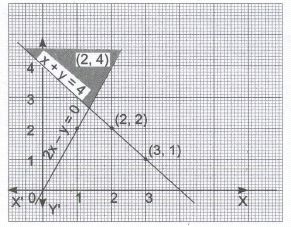
Table of values satisfying the equation
x+y =4
| x | 3 | 2 |
| y | 1 | 2 |
Putting (0, 0) in the given inequation, we have 0+0≥4⇒0≥4, which is false.
∴ Half plane of x+y≥4 is away from origin.
Also, the given inequality is 2x-y>0
Draw the graph of the line 2x - y =0
Table of values satisfying the equation
2x-y =0
| x | 1 | 2 |
| y | 2 | 4 |
Putting (3, 0) in the given inequation, we have 2\(\times\)3-0>0⇒6> 0, which is true.
∴ Half plane of 2x-y≥0 containing (3,0)
8.
The given equation of line is 5x - 12y = 3 and the given point is (3, -2).
Let (a, b) be any moving point.
\(\therefore\) Distance between (a, b) and the point (3, -2) = \(\sqrt{(a-3)^2+(b+2)^2}\) and the distance of (a, b) from the line 5x - 12y = 3 = \(|\frac{5a-12b-3}{\sqrt{25+144}}|=|\frac{5a-12b-3}{13}|\)
According to the question, we have \([\sqrt{(a-3)^2+(b+2)^2}]=|\frac{5a-12b-3}{13}|\)
\(\Rightarrow (a-3)^2(b+2)^2=\frac{5a-12b-3}{13}\)
Taking numerical values only, we have \((a-3)^2(b+2)^2=\frac{5a-12b-3}{13}\)
\(\Rightarrow a^2-6a+9+b^2+4b+4=\frac{5a-12b-3}{13}\)
\(\Rightarrow a^2+b^2-6a+4b+13=\frac{5a-12b-3}{13}\)
\(\Rightarrow\) 13a2 + 13b2 - 78a + 52b + 169 = 5a - 12b - 3
\(\Rightarrow\) 13a2 + 13b2 - 83a + 64b + 172 = 0
So, only locus of the point is 13x2 + 13y2 - 83x + 64y + 172 = 0
Hence, the value of the filter is 13x2 + 13y2 - 83x + 64y + 172 = 0.
9.
Let the x-axis be the time in seconds the y-axis be the distance in metres.
Let the engine be at the origin O.
Therefore the length of the train 560m is the negative y-intercept.
The uniform speed 12.5 m/s is the slope of the motion of the train.
\((speed=\frac{distance}{time})\)
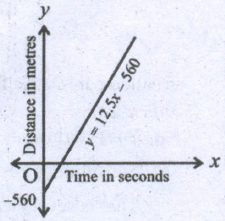
Since we are given slope and y-intercept, the equation of the line is y = mx + b
(i) The equation of the motion of the train,
when m = 12.5 and b = 560,
is y = 12.5x - 560
(ii) When the engine touches the other side of the bridge (island)
y = 2065 and b = 0
x = 165.2 seconds.
(iii) When y = 0, the last coach cross the entry point of the bridge,
0 = 12.5x - 560
x = 44.8 seconds.
(iv) When y = 2065, the time taken for the train to cross the other end of the bridge is given by
2065 = 12.5x - 560
x = 210 seconds
10.
\(\sqrt{3}tan^2\theta+(\sqrt{3}-1)tan\theta-1=0\)
\(\sqrt{3}tan^2\theta+\sqrt{3}tan\theta-tan\theta-1=0\)
\((\sqrt{3}tan\theta-1)(tan\theta+1)=0\)
Thus, either \(\sqrt{3}tan\theta-1=0(or)tan\theta+1=0\)
| If\(\sqrt{3}tan\theta-1=0, \ then\) \(tan\theta={1\over\sqrt{3}}=tan {\pi\over 6}\) \(\Rightarrow \theta =n\pi+{\pi\over6},n \in Z ....(i)\) |
If \(tan\theta+1=0 \ then\) \(tan\theta=-1=tan ({-\pi\over 4})\) \(\Rightarrow \theta =n\pi-{\pi\over4},n \in Z ....(ii)\) |
From (i) and (ii) we have the general solution.
11.
(i) Let the x - axis represent the weight and the y-axis represent the length
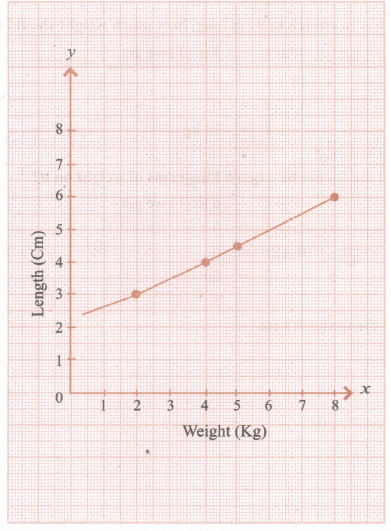
(ii) Consider the point \(\begin{pmatrix} { x }_{ 1 } & { y }_{ 1 } \\ 2 & 3 \end{pmatrix}\begin{pmatrix} { x }_{ 2 } & { y }_{ 2 } \\ 4 & 4 \end{pmatrix}\)
Equation of the straight line using two point form is
\(\frac { y-{ y }_{ 1 } }{ { y }_{ 2 }-{ y }_{ 1 } } =\frac { x-{ x }_{ 1 } }{ { x }_{ 2 }-{ x }_{ 1 } } \)
\(\Rightarrow \quad \frac { y-3 }{ 4-3 } =\frac { x-2 }{ 4-2 } \)
\(\Rightarrow \quad \frac { y-3 }{ 1 } =\frac { x-2 }{ 2 } \)
\(\Rightarrow\) 2y - 6 = x-2
\(\Rightarrow\) x - 2y + 4 = 0
(iii) To find the actual length of the spring,
Put x = 0
\(\Rightarrow\) 0 - 2y + 4 = 0
\(\Rightarrow\) -2y = -4
\(\Rightarrow\) y = 2 cm
(iv) Put y = 9 in (1) we get
\(\Rightarrow\) x - 18 + 4 = 0
\(\Rightarrow\) x - 14 = 0
\(\Rightarrow\) x = 14 kg
\(\therefore\) 14 Kg must be added
(v) Put x = 6 in (1) we get,
\(\Rightarrow\) 6 - 2y + 4 = 0
\(\Rightarrow\) 10 - 2y = 0
\(\Rightarrow\) 10 = 2y
\(\Rightarrow\) y = 5
\(\therefore\) Length of the spring = 5 cm
12.
Let Tn be the nth term of the given series
Then Tn = 1 + 4 + 42 + 43 + ...
\(=1\left(4^n-1\over 4-1\right)\)
\(={4^n-1\over 3}\)
Let Sn be the sum to n terms of the given series
Then \(S_n={\sum_{k=1}^n}T_k=\sum_{k=1}^n{4^n-3\over3}\)
\(⇒\ S_n={1\over3}\left[ \sum_{k=1}^n4^n-\sum_{k=1}^n3\right]\)
\(⇒\ S_n= {1\over3}[4^1+4^]+...+4^n-3^n\)
\(⇒\ S_n={1\over3}\left[ 4{(4^n-1)\over4-1}-3n\right]\)
\(⇒\ S_n={1\over3}\left[ 4{(4^n-1)\over4-1}-3n\right]={1\over 3}\left[4{(4^n-1)-9n\over3}\right]\)
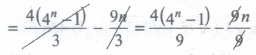
\({ S }_{ n }=\frac { 4 }{ 9 } \left[ \left( { 4 }^{ n }-1 \right) -n/3 \right] \)
13.
Let p(n) denote the statement
\(1^2+3^2+5^2+...+(2n-1)^2={n(2n-1)(2n+1)\over 3}\)
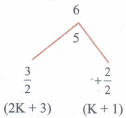
Step1: Putting n = 1
\(1^2={1(2-1)(2+1)\over3}={3\over 3}=1\)
∵ p(1) is true
Step 2: Let us assume that p(K) is true
i.e. \(1^2+3^2+5^2+..+(2K-1)^2={K(2K-1)\over3}\)
To prove that p(K + 1) is true
\(∵\ 1^2+3^2 +5^2 + ..+ (2K-1)^2 + [2(K + 1)-1]^2={(K+1)(2(K+1)-1)(2(K+1)+1)\over 3}\)
i.e. to P.T. \(1^2 + 3^2 + 5^2 + ... + (2K -1)^2(2K + 1)^2 ={(K+1)(2K+1)(2K+3)\over 3}\)
LHS = 12+ 32 + 52 + ... + (2K - 1)2 + (2K + 1)2
\(={K(2K-1)(2K+1)\over3}+(2K+1)^2\)
\(=(2K+1)\left[{K(2K-1)\over 3}+2K+1\right]\)
\(=(2K+)\left[2K^2-K+6K+3\over3\right]={(2K+1)(2K^2+5K+3)\over3}\)
\(={(2K+1)(2K^2+5K+3)\over3}\)=RHS
∵ p(K+1) is true
∵ By mathematical induction, P(n) is true for all values of n.
14.
The relation is defined by aRb if a + b \(\le\) 6 for all a, b \(\in \)N.
a+b \(\le\)6 \(\Rightarrow\) a \(\le\) 6 - b
| a | 5 | 4 | 3 | 2 | 1 |
| b | 1 | 2 | 3 | 4 | 5 |
\(\therefore\) The list of ordered pairs are (5,1) (4, 2) (3, 3) (2, 4) and (1, 5).
(4, 2) \(\in \) R and (2, 4) \(\in \) R \(\Rightarrow\) (4, 4) \(\notin \) R
\(\therefore\) R is not transitive.
15.
Let C be the position of the target and A and B be the positions of the fighter jet
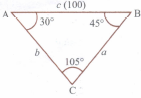
Given ㄥBAC = 30, ㄥABC = 45
ஃ ㄥC = 180 - (30 - 45) = 180 - 75 = 105
Given AB = 100 km
Using sine formula,
\(\frac { a }{ sinA } =\frac { c }{ sinC } \)
\(\Rightarrow \frac { a }{ sin30° } =\frac { 100 }{ sin105° } \)
\(\Rightarrow \frac { a }{ \frac { 1 }{ 2 } } =\frac { 100 }{ sin105° } \Rightarrow 2a=\frac { 100 }{ sin105° } \Rightarrow a=\frac { 50 }{ sin105° } \)
Now, sin 105° = sin (60 + 45) = sin 60 cos 45 + cos 60 sin 45
= \(\frac { \sqrt { 3 } }{ 2 } .\frac { 1 }{ \sqrt { 2 } } +\frac { 1 }{ 2 } .\frac { 1 }{ \sqrt { 2 } } =\frac { \sqrt { 3 } +1 }{ 2\sqrt { 2 } } \)
Substituting (2) in (1) we get,
a = \(\frac { 50 }{ \frac { \sqrt { 3 } +1 }{ 2\sqrt { 2 } } } \Rightarrow a=\frac { 50\left( 2\sqrt { 2 } \right) }{ \sqrt { 3 } +1 } =\frac { 100\sqrt { 2 } }{ \sqrt { 3 } +1 } \times \frac { \sqrt { 3 } -1 }{ \sqrt { 3 } -1 } \)
a = \(\frac { 100\left( \sqrt { 6 } -\sqrt { 2 } \right) }{ 3-1 } =50\left( \sqrt { 6 } -\sqrt { 2 } \right) km\)
16.
Let y = \(\log _{ 7 }{ u }\quad and\quad u=\log _{ 7 }{ x } \)
\(\therefore \frac { dy }{ du } =\frac { 1 }{ u\quad \log _{ 7 }{ e } } \ and\ \frac { du }{ dx } =\frac { 1 }{ x\quad \log _{ e }{ 7 } } \)
\( Now\quad \frac { dy }{ dx } =\frac { dy }{ du } \times \frac { du }{ dx } \)
\( \Rightarrow \frac { dy }{ dx } =\frac { 1 }{ u\quad \log _{ 7 }{ e } } \times \frac { 1 }{ x\quad \log _{ e }{ 7 } } \)
\(\Rightarrow \frac { dy }{ dx } =\frac { 1 }{ \log _{ 7 }{ x. } \log _{ e }{ 7 } \times x\quad \log _{ e }{ 7 } } =\frac { 1 }{ x\log _{ 7 }{ x. } { \left( \log _{ e }{ 7 } \right) }^{ 2 } } \)
17.
\(\int e^{x \log 2} e^x d x=\int e^{\log 2^x} e^x d x=\int 2^x e^x d x\)
\(=\int(2 e)^x d x=\frac{(2 e)^x}{\log (2 e)}+c\)
18.
(ii) AB and BA is a symmetric matrices
(AB - BA)T = (AB)T + (BA)T
= BTAT + ATBT
= BA - AB
(AB - BA)T = -(AB - BA)
\(\therefore\)(AB - BA) is a skew-symmetric matrix.
19.
\(\sqrt [ 3 ]{ 1003 } ={ (1003) }^{ \frac { 1 }{ 3 } }={ (1000+3) }^{ 1/3 }={ (1000) }^{ 1/3 }\left[ 1+\frac { 3 }{ 1000 } \right] ^{ 1/3 }=10[1+0.003]^{ 1/3 }\)
\(=10\left[ 1+\frac { 1 }{ 3 } (0.003)+\frac { \left( \frac { 1 }{ 3 } \right) \left( -\frac { 2 }{ 3 } \right) }{ 1.2 } { (0.003) }^{ 2 }+... \right] \)
= 10 [1 + 0.001 - 0.0000001 + ...] = 10.00999 = 10.0100
20.
As m - m = 0,
m - m is divisible by 7 \(\Rightarrow\) mRm
\(\therefore\) R is reflexive.
Let mRn. Then m - n = 7k for some integer k
Thus n-m = 7 (-k) and hence nRm
\(\therefore\) R is symmetric.
Let mRn and nRp
\(\Rightarrow\) m-n = 7k and n - p = 7l for some
\(\Rightarrow\) m = 7k + n and - p = 7l- n integers k and l
so m-p = 7k+n+7l-n
\(\Rightarrow\) m - p = 7(k+l) \(\Rightarrow\) mRp
\(\therefore\) R is transitive.
Thus, R is an equivalence relation.
21.
Given \({{1}\over{2}}\) log10 \((11+4\sqrt{7})\) = log10 (2 + x).
\(\Rightarrow\) \({{1}\over{2}} \) log10 \((7+4+4\sqrt{7})\) = log10(2 + x)
\(\Rightarrow \) \({{1}\over{2}}\) log10 \(((\sqrt{7})^2+2^2+2.2\sqrt{7})\) = log10(2 + x)
\(\Rightarrow\) \({{1}\over{2}}\) log10\({(\sqrt{7}+2)}^{2}\)= log10(2 + x)
\(\Rightarrow\) log10\((\sqrt{7}+2)\) = log10(2 + x)
\(\Rightarrow\) \((\sqrt{7}+2)\)= (2 + x)
\(\Rightarrow\) \(x=\sqrt{7}\)
22.
(d)
-2 cos \(\sqrt { x } \)
23.
(c)
\(\frac { 1 }{ 5 } \)
24.
(a)
3,2
25.
(b)
-1
26.
\(P(X / Y)=\frac{1}{2} \Rightarrow \frac{P(X \cap Y)}{P(Y)}=\frac{1}{2} \)
\(P(Y / X)=\frac{1}{3} \Rightarrow \frac{P(X \cap Y)}{P(X)}=\frac{1}{3} \)
\(\text {But } P(X \cap Y)=\frac{1}{6} \Rightarrow \frac{\frac{1}{6}}{P(Y)}=\frac{1}{2}\)
\(P(Y)=\frac{\frac{1}{6}}{\frac{1}{2}}=\frac{1}{3}\)
\(\text {and } P(X)=\frac{\frac{1}{6}}{\frac{1}{3}}=\frac{1}{2}\)
\(P(X \cup Y)=P(X)+P(Y)-P(X \cap Y)\)
\(=\frac{1}{2}+\frac{1}{3}-\frac{1}{6}=\frac{3+2-1}{6} =\frac{2}{3} \)
27.
\(\int \sqrt{\frac{1-x}{1+x}} d x =\int \sqrt{\frac{1-x}{1+x} \times \frac{1-x}{1-x}} d x \)
\(=\int \sqrt{\frac{(1-x)^{2}}{1^{2}-x^{2}}} d x \)
\(=\int \frac{1-x}{\sqrt{1-x^{2}}} d x \)
\(=\int\left(\frac{1}{\sqrt{1-x^{2}}}-\frac{x}{\sqrt{1-x^{2}}}\right) d x \)
\(=\sin ^{-1} x-\left(-\sqrt{1-x^{2}}\right)+c \)
\(=\sin ^{-1} x+\sqrt{1-x^{2}}+c \)
28.
\(\text { Given } f(0)=5\)
\(\lim _{x \rightarrow 0} \frac{f(x)-5}{x} =4 \)
\(\lim _{x \rightarrow 0} \frac{f(x)-f(0)}{x-0} =4 \)
\(f^{\prime}(0) =4 \)
\(g(x) =\left(x^{2}+2 x+1\right) f(x) \)
\(g^{\prime}(x) =\left(x^{2}+2 x+1\right) f^{\prime}(x)+(2 x+2) f(x) \)
\(g^{\prime}(0) =(1) f^{\prime}(0)+2 f(0) \)
\(=1(4)+2(5) \)
\(=4+10=14 \)
29.
\(\lim _{x \rightarrow 0} \frac{\sin p x}{\tan 3 x}=4 \Rightarrow \frac{p}{3}=4 \Rightarrow p=12\)
30.
(b)
\(15\over4\)
31.
(d)
collinear
32.
(b)
\(\frac{10}{3}\)
33.
(c)
[5, 6]
34.
(c)
\(\frac{e-e^{-1}}{2}\)
35.
(d)
60
36.
Perpendicular distance from origin to the given line is
\(\frac{1}{\sqrt{\frac{1}{3^{2}}+\frac{1}{4^{2}}}}=\frac{1}{\sqrt{\frac{1}{9}+\frac{1}{16}}}=\frac{1}{\sqrt{\frac{16+9}{144}}}=\frac{12}{5}\)
37.
No. of ways of answering = 53 = 125
Correct answer - 1
.'. Number of incorrect answer = 125 - 1 = 124
38.
(c)
0
39.
\(x^{2}-\mathrm{k} x+\mathrm{c}=0\)
a and b are the roots
\(\therefore a+b=k, a b=c\)
To find
\(\sqrt{(a-b)^{2}+0^{2}}=a-b=\sqrt{(a+b)^{2}-4 a b}=\sqrt{k^{2}-4 c}\)
40.
\(\left(2 \cos ^{2} \frac{\pi}{16}\right)\left(2 \cos ^{2} \frac{3 \pi}{16}\right)\left(2 \cos ^{2} \frac{5 \pi}{16}\right)\left(2 \cos ^{2} \frac{7 \pi}{16}\right) \)
\(=2^{4}\left[\cos \frac{\pi}{16} \cos \frac{3 \pi}{16} \cos \frac{5 \pi}{16} \cos \frac{7 \pi}{16}\right]^{2} \)
\(=\left(\cos \frac{8 \pi}{16}+\cos \frac{6 \pi}{16}\right)^{2}\left(\cos \frac{8 \pi}{16}+\cos \frac{2 \pi}{16}\right)^{2} \)
\(=\left(\cos \frac{6 \pi}{16}\right)^{2}\left(\cos \frac{2 \pi}{16}\right)^{2} \)
\(=\left\{\frac{1}{2}\left[\cos \frac{8 \pi}{16}+\cos \frac{4 \pi}{16}\right]\right\}^{2} \)
\(=\frac{1}{4} \cdot \frac{1}{2}=\frac{1}{8} \)
41.
Let A = {1, 2,3,4,8} = {5, 2,3,6}
A and B have two elements in common.
Number of elements common to A \(\times\) B and B x A = 2 \(\times\)2 = 22
Similarly here we have 172 element in common
42.
Let R be the point which divides the line joining the points P and Q externally in the ratio 2:1
=\(\frac { 2(-\hat { i } +\hat { j } +\hat { k } )-1(\hat { i } +2\hat { j } -\hat { k } ) }{ 2-1 } \)
=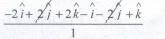
=\(\frac { -3\hat { i } +3\hat { k } }{ 1 } =-3\hat { i } +3\hat { k } \)
43.
Probability of getting odd number = \(\frac { 3 }{ 6 } =\frac { 1 }{ 2 } \)
Probability of getting even numbers = 1-\(\frac { 1 }{ 2 } =\frac { 1 }{ 2 } \)
Now, probability of getting no odd number when the die is tossed twice = Probability of getting even number when the die is tossed thrice.
\(\Rightarrow \quad \frac { 1 }{ 2 } \times \frac { 1 }{ 2 } \times \frac { 1 }{ 2 } =\frac { 1 }{ 8 } \)
\(\therefore\) P(Odd number atleast once) = \(1-\frac { 1 }{ 8 } =\frac { 7 }{ 8 } \)
44.
\(Given,\quad \lim _{ x\rightarrow 2 }{ \frac { { x }^{ n }-{ 2 }^{ n } }{ x-2 } } =80\)
\( \Rightarrow n.{ 2 }^{ n-1 }=80\)
By trial method, put n 5
\(\Rightarrow 5({ 2 }^{ 5-1 })=80\)
\(\Rightarrow 5({ 2 }^{ 4 })=80\)
\( \Rightarrow 5(16)=80\)
\( \Rightarrow 80=80\)
\(\therefore n=5\)
45.
\(
\int \sin x d x =-\cos x+c
\)
\(\therefore \int \sin 3 x d x =\frac{-\cos 3 x}{3}+c\)
46.
\(
\int\left(1-x^2\right)^{-\frac{1}{2}} d x =\int \frac{1}{\left(1-x^2\right)^{1 / 2}} d x \)
\(=\int \frac{1}{\sqrt{1-x^2}} d x=\sin ^{-1} x+c\)
47.
\(f(x)=-x^2+2\)
\(f(x+h)=-(x+h)^2+2=-x^2-h^2-2 x h+2\)
\(f^{\prime}(x)=\lim _{h \rightarrow 0} \frac{f(x+h)-f(x)}{h}\)
\(=\lim _{h \rightarrow 0} \frac{-x^2-h^2-2 x h+2+x^2-2}{h}\)
\(=\lim _{h \rightarrow 0} \frac{+h(-h-2 x)}{h}\)
= -0 - 2x
\(f^{\prime}(x)=-2 x\)
48.
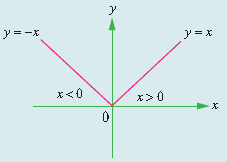
\(|x|= \begin{cases}-x & \text { if } x<0 \\ 0 & \text { if } x=0 \\ x & \text { if } x>0\end{cases}\)
If x > 0,then |x| = x, which tends to 0 as
\(x \rightarrow 0\) from the right of 0. That is, \(\lim _{ x\rightarrow0^+}{|x| } =0\)
If x < 0, then |x| = - x which again tends to 0 as x\(\rightarrow\)0. from the left of 0. That is, \(\lim _{ x\rightarrow0^-}{|x| } =0\).
Thus, \(\lim _{ x\rightarrow0^-}{|x| } =0=\lim _{ x\rightarrow0^+}{|x| }.\)
Hence \(\lim _{ x\rightarrow0}{|x| } =0\).
49.
Given B is singular
\(\therefore|B|=0\)
\(\left|\begin{array}{ccc}
b-1 & 2 & 3 \\
3 & 1 & 2 \\
1 & -2 & 4
\end{array}\right|=0\)
\((b-1)(4+4)-2(12-2)+3(-6-1)=0\)
\((b-1)(8)-2(10)+3(-7)=0\)
\(8 b-8-20-21=0\)
\(8 b-49=0\)
\(8 b=49\)
\(b=\frac{49}{8}\)
50.
x +y + 2 = 0
51.
720, 4320
52.
The general solution of sin \(\theta\) = sin \(\alpha,\alpha \in [-{\pi\over2},{\pi \over 2}],is \ \theta =n\pi +(-1)^n \alpha,n \in Z\)
\(sin \theta =-{\sqrt{3}\over2}=sin(-{\pi\over 3}),\)
Thus the general solution is
\(\theta =n\pi +(-1)^n(-{\pi\over3})=n\pi+(-1)^{n+1}{\pi\over 3};n \in Z ....(i)\)
53.
Let Tn be the nth term of the sequence
Then, given T1 = 3, T2 = 3, T3 = 6 and
Tn = Tn-1 + Tn-2, n > 2.
T3 = T2 + T1 = 3 + 3 = 6
T4 = T3 + T2 = 6 + 3 = 9
T5 = T4 + T3 = 9 + 6 = 15.
54.
The relation R is defined by xRy if x + 2y = 1 for x, y \(\in \) N.
Reflexivity : Let x, y \(\in \) N
xRx \(\Rightarrow\) x + 2x = 1 \(\Rightarrow\) 3x = 1 \(\Rightarrow\) x = \(\frac { 1 }{ 3 } \notin N\)
\(\therefore\) R is reflexive.
Symmetricity: xRy \(\Rightarrow\) yRx for x, y \(\in \) N
xRy \(\Rightarrow\) x + 2y = 1 which is not possible for any values of x, Y \(\in \) N
\(\therefore\) R is not symmetric
Transitivity: xRy and yRz \(\Rightarrow\) xRz.
xRy and yRz are not possible for any values of x, y, z \(\in \) N
\(\therefore\) R is not transitive.
\(\therefore\) R is neither reflexive, nor symmetric and not transitive.

11th Standard Syllabus & Materials
11th Standard
TN 11th Tamil பீடு பெற நில் - செய்யுள் - காவடிச்சிந்து Important Questions And Answers Study Material - QB365 Set A
NEW11th Standard
TN 11th Tamil பீடு பெற நில் - உரைநடை - மலை இடப்பெயர்கள் : ஓர் ஆய்வு Important Questions And Answers Study Material - QB365 Set A
NEW11th Standard
TN 11th Tamil மாமழை போற்றுதும் - துணைப்பாடம் - யானை டாக்டர் Important Questions And Answers Study Material - QB365 Set A
NEW11th Standard
TN 11th Tamil மாமழை போற்றுதும் - செய்யுள் - ஐங்குறுநூறு Important Questions And Answers Study Material - QB365 Set A



Tamilnadu Stateboard 11th Standard Subjects
Maths

Commerce

Economics

Biology

Business Maths and Statistics

Accountancy

Computer Science

Physics

Chemistry
Maths
Biology
Economics
Physics
Chemistry

History
Business Maths and Statistics

Computer Science
Accountancy

Computer Applications
History
Computer Technology
Commerce
Computer Applications
Computer Technology

Tamil

English

French
Tamilnadu Stateboard Standards

