
 100% FREE ACCESS
11th Standard Syllabus & Materials
11th Standard
TN 11th Tamil இயற்கை வேளாண்மை,சுற்றுச்சூழல் -செய்யுள் - மனோன்மணீயம் Important Questions And Answers Study Material - QB365 Set A
NEW11th Standard
TN 11th Tamil என்னுயிர் என்பேன் -துணைப்பாடம் - இசைத்தமிழர் இருவர் Important Questions And Answers Study Material - QB365 Set A
NEW11th Standard
TN 11th Tamil மொழி கலை -செய்யுள் - ஒவ்வொரு புல்லையும் Important Questions And Answers Study Material - QB365 Set A
NEW11th Standard
TN 11th Tamil பீடு பெற நில் - இலக்கணம் - பகுபத உறுப்புகள் Important Questions And Answers Study Material - QB365 Set A
NEW11th Standard
TN 11th Tamil பீடு பெற நில் - துணைப்பாடம் - வாடிவாசல் Important Questions And Answers Study Material - QB365 Set A
NEW11th Standard
TN 11th Tamil பீடு பெற நில் - செய்யுள் - குறுந்தொகை Important Questions And Answers Study Material - QB365 Set A

Published on: 04/03/2019
+1 Public Official Model Question 2019
Download Tamil Nadu 11th Standard Maths question papers, model tests, one-mark questions, important questions, and public exam papers in PDF format. Free study materials and answer keys for TN State Board students.
Questions + Answers key
Take MCQ Maths Test1.
Show that\(f\left( x \right) ={ x }^{ 2 }\) is differentiable at x = 1 and find \(f^{ ' }\left( 1 \right) \)
2.
If A =\(\begin{bmatrix} 1 &0 &2 \\0 & 2 & 1 \\2 &0 &3 \end{bmatrix}\) and A3 - 6A2 + 7A + KI = O, find the value of k.
3.
Find the value of \(cot(\frac{-15\pi}{4})\).
4.
Find the equations of lines parallel to 3x - 4y- 5 = 0 at a unit distance from it.
5.
Show that the sequence where log a,\(log\frac { { a }^{ 2 } }{ b^{ 1 } } log\frac { { a }^{ 2 } }{ { b }^{ 2 } } \) ..is an A.P
6.
How many three-digit numbers are there with 3 in the unit place?
(i) with repetition
(ii) without repetition.
7.
Resolve into partial fractions: \({{x^3+1}\over{x(x+1)^2}}\)
8.
The owner of a small restaurant can prepare a particular meal at a cost of Rupee 100. He estimate that if the menu price of the meal is x rupees, then the number of customers who will order that meal at that price in an evening is given by the function D(x) = 200 - x. Express his day revenue total cost and profit on this meal as a function of x.
9.
Let \(\overrightarrow { a } ,\overrightarrow { b } \) and \(\overrightarrow { c } \) be unit vectors such that \(\overrightarrow { a } \) is perpendicular to both \(\overrightarrow { b } \) and \(\overrightarrow { c } \) and further the angle between \(\overrightarrow { b } \) and \(\overrightarrow { c } \) is \(\frac { \pi }{ 6 } \). Then \(\overrightarrow { a } =\pm 2\left( \overrightarrow { b } \times \overrightarrow { c } \right) \)
10.
Evaluate \(\int { \frac { { x }^{ 2 }{ tan }^{ -1 }\left( { x }^{ 3 } \right) }{ 1+{ x }^{ 6 } } } \)dx
11.
Two integers are selected at random from integers 1 to 11. If the sum is even, find the probability that both the numbers are odd.
12.
Differentiate xx with respect to x log x
13.
Let the matrix M = \(\left[ \begin{matrix} x & y \\ z & 1 \end{matrix} \right] \), If x,y and z are chosen at random from the set {1, 2,3, } and repetition is allowed (i.e., x = y = z ), what is the probability that the given matrix M is a singular matrix?
14.
Integrate the following with respect to x : \(\frac{1}{3} \cos \left(\frac{x}{3}-4\right)+\frac{7}{7 x+9}+e^{\frac{x}{5}+3}\)
15.
Integrate the following with respect to x : \({8\over \sqrt{1-(4x)^2}}+{27\over \sqrt{1-9x^2}}-{15\over 1+25x^2}\)
16.
The function \(f(x)={x^2-1\over x^3-1}\) is not defined at x = 1. What value must we give f(1) inorder to make f(x) continuous at x = 1?
17.
Let \(\vec a\) and \(\vec b\) be the position vectors of the points A and B. Prove that the position vectors of the points which trisects the line segment AB are \(\frac{\vec{a}+2 \vec{b}}{3} \text { and } \frac{\vec{b}+2 \vec{a}}{3} \text {. }\)
18.
Determine the roots of the equation \(\begin{vmatrix} 1 &4 &2 0 \\ 1 & -2 & 5 \\ 1 &2x &5x^2 \end{vmatrix}=0\)
19.
Prove that \(\sqrt { 5 } \) is an irrational number
20.
Show that the locus of the mid-point of the segment intercepted between the axes of the variable line x cos \(\alpha\) + y sin \(\alpha\) = p is \(\frac{1}{x^2}+\frac{1}{y^2}=\frac{4}{p^2}\) where p is a constant.
21.
Solve sin x - 3 sin 2x+ sin 3x = cos x - 3 cos 2x + cos 3x.
22.
In a certain town, a viral disease caused severe health hazards upon its people disturbing their normal life. It was found that on each day, the virus which caused the disease spread in Geometric Progression. The amount of infectious virus particle gets doubled each day, being 5 particles on the first day. Find the day when the infectious virus particles just grow over 1,50,000 units?
23.
Let A = {a, b, c}, What is the equivalence relation of smallest cardinality on A? What is the equivalence relation of largest cardinality on A?
24.
On the set of natural numbers let R be the relation defined by aRb if a + b \(\le\) 6. Write down the relation by listing all the pairs. Check whether it is transitive
25.
If \(\frac { cos^{ 4 }\alpha }{ { cos }^{ 2 }\beta } +\frac { { sin }^{ 4 }\alpha }{ { sin }^{ 2 }\beta } =1\) prove that \({ sin }^{ 4 }\alpha +{ sin }^{ 4 }\beta =2{ sin }^{ 2 }\alpha { sin }^{ 2 }\beta\)
26.
If \(|\overrightarrow { a } |=10,|\overrightarrow { b } |=2,\) and \(|\overrightarrow { a } .\overrightarrow { b } |=12\) then the value of \(|\overrightarrow { a } \times \overrightarrow { b } |\) is ___________ .
5
10
14
16
27.
\(\int { \frac { 4\left( sin^{ -1 }x \right) ^{ 3 } }{ \sqrt { 1-{ x }^{ 2 } } } } \) dx = ________+c.
log (sin -1x)
(sin -1 x)4
4 (sin-1 x)4
\(\frac { \left( { sin }^{ -1 }x \right) ^{ 4 } }{ 4 } \)
28.
Out of 30 consecutive integers, 2 are chosen at random. The probability that their sum is odd is
\(\frac { 14 }{ 29 } \)
\(\frac { 16 }{ 29 } \)
\(\frac { 15 }{ 29 } \)
\(\frac { 10 }{ 29 } \)
29.
For what values of x is the rate of increase of x3 - 2x2 + 3x + 8 is twice the rate of increase of x?
\(\left( -\frac { 1 }{ 3 } ,-3 \right) \)
\(\left( \frac { 1 }{ 3 } ,3 \right) \)
\(\left( -\frac { 1 }{ 3 } ,3 \right) \)
\(\left( \frac { 1 }{ 3 } ,1 \right) \)
30.
A matrix which is not a square matrix is called a_________matrix.
singular
non-singular
non-square
rectangular
31.
If A and B are two events such that A ⊂ B and P(B)\(\neq o\), then which of the following is correct?
\(P(A/B)={P(A)\over P(B)}\)
P(A/B)
P(A/B)\(\ge\)P(A)
P(A/B)>P(B)
32.
\(\int e^{-4 x} \cos x d x\) is
\({e^{-4x}\over 17}[4cos \ x-sin \ x]+c\)
\({e^{-4x}\over 17}[-4cos \ x+sin \ x]+c\)
\({e^{-4x}\over 17}[4cos \ x+sin \ x]+c\)
\({e^{-4x}\over 17}[-4cos \ x-sin \ x]+c\)
33.
34.
\(lim_{x \rightarrow \infty}{\sqrt{x^2-1}\over 2x+1}=\)
1
0
-1
\(1\over 2\)
35.
If x1, x2, x3 as well as y1, y2, y3 are in geometric progression with the same common ratio, then the points (x1, y1 ), (x2, y2), (x3, y3 ) are
vertices of an equilateral triangle
vertices of a right angled triangle
vertices of a right angled isosceles triangle
collinear
36.
The maximum value of 3 sin θ+4 cos θ is _______________
1
3
4
5
37.
The lines x cos \(\alpha\) + y sin \(\alpha\) = p and xcos\(\beta\) + y sin\(\beta\) = q will be perpendicular if ______________
\(\alpha =\beta\)
\(\alpha-\beta=\frac{\pi}{2}\)
\(|\alpha-\beta|=\frac{\pi}{2}\)
\(\alpha-\beta=0\)
38.
Slope of x-axis or a line parallel to x-axis is ______________
0
positive
negative
infinity
39.
The number of ways to arrange the letters of the word CHEESE are _________
120
240
720
6
40.
The sum up to n terms of the series \(\sqrt { 2 } +\sqrt { 8 } +\sqrt { 18 } +\sqrt { 32 } +\).....is
\(\frac { n(n+1) }{ 2 } \)
2n(n+1)
\(\frac { n(n+1) }{ \sqrt { 2 } } \)
1
41.
If (n+5)P(n+1)=\((\frac { 11(n-1) }{ 2 } )\).(n+3)Pn, then the value of n are
7 and 11
6 and 7
2 and 11
2 and 6
42.
The value of log3 11.log11 13.log13 15.log15 27.log27 81 is
1
2
3
4
43.
The maximum value of 4sin2x + 3 cos2x + \(sin\frac { x }{ 2 } +cos\frac { x }{ 2 } \) is
\(4 + \sqrt{2}\)
\(3+ \sqrt{2}\)
9
4
44.
If n((A \(\times\) B) ∩(A \(\times\) C)) = 8 and n(B ∩ C) = 2, then n(A) is
6
4
8
16
45.
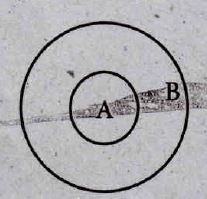
The shaded region in the adjoining diagram represents.

A\B
B\A
AΔB
A'
46.
A die is tossed thrice. find the probability of getting an odd number atleast once?
47.
Discuss the continuity at x = 0 for \(f\left( x \right) =\begin{cases} \frac { 1-\cos { x } }{ { x }^{ 2 } } ,\quad x\neq 0 \\ \frac { 1 }{ 2 } ,\quad \quad \quad x=0 \end{cases}\)
48.
Evaluate : \(\int \sqrt{1+\cos 2 x} d x\)
49.
Differentiate the following: y = sin(ex)
50.
Evaluate the following limits :\(lim_{x\rightarrow 0}{1-cosx\over x^2}\)
51.
If the equation 12x2 - 10xy + 2y2 + 14x - 5y + k = 0 represents a pair of straight lines, find k, find separate equation and also angle between them.
52.
How many three digit odd numbers can be formed by using the digits 4, 5, 6, 7, 8, 9 if
(i) repetition of digit is not allowed,
(ii) repetition is allowed.
53.
Find the sum of first n terms of the series 12 + 32 + 52+...
54.
Find the distance between the parallel lines
12x + 5y = 7 and 12x + 5y + 7 = 0.
1.
\(f^{ ' }\left( 1^{ - } \right) =\lim _{ x\rightarrow 1^{ - } }{ \frac { f\left( x \right) -f\left( 1 \right) }{ x-1 } } =\lim _{ x\rightarrow 1^{ - } }{ \frac { { x }^{ 2 }-1 }{ x-1 } } =\lim _{ x\rightarrow 1^{ - } }{ \frac { (x+1)(x-1) }{ x-1 } } =\lim _{ x\rightarrow 1^{ - } }{ (x+1) } =1+1=2\quad ...(1)\)
\(f^{ ' }\left( 1^{ + } \right) =\lim _{ x\rightarrow 1^{ + } }{ \frac { f\left( x \right) -f\left( 1 \right) }{ x-1 } } =\lim _{ x\rightarrow 1^{ + } }{ \frac { { x }^{ 2 }-1 }{ x-1 } } =\lim _{ x\rightarrow 1^{ + } }{ \frac { (x+1)(x-1) }{ x-1 } } =\lim _{ x\rightarrow 1^{ + } }{ x+1 } =1+1=2 ...(2)\)
From (1)and (2), \(f^{ ' }\left( 1^{ - } \right) =f^{ ' }\left( 1^{ + } \right) \)
\(\therefore f\left( x \right) \)is differentiable at x = 1 and \(f^{ ' }\left( 1 \right) =2\)
2.
\(Given A=\left[\begin{array}{lll}1 & 0 & 2 \\ 0 & 2 & 1 \\ 2 & 0 & 3\end{array}\right]\)
\(A^2=A \times A=\left[\begin{array}{lll} 1 & 0 & 2 \\ 0 & 2 & 1 \\ 2 & 0 & 3 \end{array}\right]\left[\begin{array}{lll} 1 & 0 & 2 \\ 0 & 2 & 1 \\ 2 & 0 & 3 \end{array}\right]\)
\(A^2=\left[\begin{array}{lll} 1+0+4 & 0+0+0 & 2+0+6 \\ 0+0+2 & 0+4+0 & 0+2+3 \\ 2+0+6 & 0+0+0 & 4+0+9 \end{array}\right]\)
\(=\left[\begin{array}{ccc} 5 & 0 & 8 \\ 2 & 4 & 5 \\ 8 & 0 & 13 \end{array}\right]\)
\(A^3=A^2 \times A=\left[\begin{array}{ccc} 5 & 0 & 8 \\ 2 & 4 & 5 \\ 8 & 0 & 13 \end{array}\right]\left[\begin{array}{lll} 1 & 0 & 2 \\ 0 & 2 & 1 \\ 2 & 0 & 3 \end{array}\right]\)
\(=\left[\begin{array}{lll} 5+0+16 & 0+0+0 & 10+0+24 \\ 2+0+10 & 0+8+0 & 4+4+15 \\ 8+0+26 & 0+0+0 & 16+0+39 \end{array}\right]\)
\(=\left[\begin{array}{lll} 21 & 0 & 34 \\ 12 & 8 & 23 \\ 34 & 0 & 55 \end{array}\right]\)
\(A^3-6 A^2+7 A+k I=0\)
\(\left[\begin{array}{ccc} 21 & 0 & 34 \\ 12 & 8 & 23 \\ 34 & 0 & 55 \end{array}\right]-6\left[\begin{array}{ccc} 5 & 0 & 8 \\ 2 & 4 & 5 \\ 8 & 0 & 13 \end{array}\right]+7\left[\begin{array}{lll} 1 & 0 & 2 \\ 0 & 2 & 1 \\ 2 & 0 & 3 \end{array}\right]+k\left[\begin{array}{lll} 1 & 0 & 0 \\ 0 & 1 & 0 \\ 0 & 0 & 1 \end{array}\right]=0\)
\(\left[\begin{array}{ccc} 21-30+7+k & 0+0+0+0 & 34-48+14+0 \\ 12-12+0+0 & 8-24+14+k & 23-30+7+0 \\ 34-48+14+0 & 0+0+0+0 & 55-78+21+k \end{array}\right]=0\)
\(\left[\begin{array}{ccc} -2+k & 0 & 0 \\ 0 & -2+k & 0 \\ 0 & 0 & -2+k \end{array}\right]=0\)
\(-2+k=0\)
\(\therefore k=2\)
Alternative Method:
W.K.T, Product of roots \(=|A|\) ...........(1)
\(\text { Given } A^3-6 A^2+7 A+k I=0\)
\(\text {Product }=\frac{-c}{a}=\frac{-k}{1}\)
\((1) \Rightarrow \frac{-k}{1}=\left|\begin{array}{lll} 1 & 0 & 2 \\ 0 & 2 & 1 \\ 2 & 0 & 3 \end{array}\right|\)
\(-k=1(6-0)-0+2(0-4)\)
\(-k=6-8\)
-k = -2
\(\therefore\) k = 2
3.
\(cot(\frac{-15\pi}{4})=-cot(\frac{15\pi}{4})=-cot(4\pi-\frac{\pi}{4})=cot\frac{\pi}{4}=1\)
4.
Equation of a line parallel to 3x-4y-5=0 is (1) 3x-4y+k=0
putting x = -1 in 3x-4y-5=0,we get -3-4y-5=0, we get -3-4y-5=0\(\Rightarrow \)-4y=8\(\Rightarrow \)y=-2
\(\therefore \)(-1, -2) is a point on 3x-4y-5=0
Given distance between equation (1) and (2) is 1.
\(\Rightarrow \)length of perpendicular from (-1, -2) to 3x-4y+k is one unit
\(\therefore \)\(\left| \frac { 3\left( -1 \right) -4\left( -2 \right) +k }{ \sqrt { { 3 }^{ 2 }+{ \left( -4 \right) }^{ 2 } } } \right|=1\)
\(\Rightarrow \left| \frac { 3+8+K }{ 5 } \right| =1\Rightarrow \left| \frac { 5+K }{ 5 } \right| =1\)
\(\Rightarrow \left| 5+K \right| =5\Rightarrow 5+K=\pm 5\)
If 5 + K = 5 then K = 0
If 5 + K = -5 then K = -10
3x - 4y = 0 and 3x - 4y - 10 as the equations of the required lines.
5.
Here T2-T1 = \(log\frac { { a }^{ 2 } }{ b } -log\quad a=log\frac { { a }^{ 2 }/b }{ a } \)
= \(log\frac { a }{ b } \)
T3-T2 = \(log\frac { a^{ 3 } }{ b^{ 2 } } -log\frac { a^{ 2 } }{ b^{ 2 } } =log\frac { a^{ 3 } }{ b^{ 2 } } +log\frac { a^{ 2 } }{ b^{ 2 } } \)
= \(log\frac { a^{ 3 } }{ b^{ 2 } } \times \frac { b }{ { a }^{ 2 } } =log\frac { a }{ b } \)
∴ T2-T1 = T3-T2 = \(log\left( \frac { a }{ b } \right) \)
∴ The given sequences is an A.P
6.
(i) With repetition
| hundreds | tens | unit |
| 9 | 10 | 1 |
The given digits are 0, 1, 2, 3, 4, 5, 6, 7, 8, 9.
The unit place can be filled in only one way using 3.
Since repetition is allowed, the tens place can be filled in 10 ways using any one of the digits from 0, 1, 2, 3, 4, 5, 6, 7, 8, 9.
The hundreds place can be filled in 9 ways using the digits 1, 2, 3, 4, 5, 6, 7, 8, 9 (excluding 0)
∴ By fundamental principle of multiplication, total number of 3 digit numbers = 9 \(\times\) 10 \(\times\) 1 = 90.
(ii) Repetition of digits is not allowed
| hundreds | tens | unit |
| 8 | 8 | 1 |
The unit place can be filled in 1 way
Since repetition of digits is not allowed, the tens place can be filled in 8 ways.
Hundreds place can be filled in 8 ways.
∴ Total number of 3-digit numbers without repetition = 1 \(\times\) 8 \(\times\) 8 = 64
7.
\({x^2+1\over x(x+1)^2}={A\over x}+{B\over x+1}+{c\over x(x+1)^2}\) [Since the denominator is linear factor of repeated factors]
\(⇒\ {x^2+1\over x(x+1)^2}={A(x+)^2+Bx(x+1)+Cx\over x(x+1)^2}\)
⇒ x2+ 1 = A(x + 1)2 + Bx(x + 1) + Cx
Putting x = 0, we get
1 = A ⇒ = 1
Putting x = -1, we get
1 + 1 = C(-1) ⇒ 2 = -C ⇒ C = -2
Putting x = 1 in (1) we get
2 = A(4) + B(2) + C
⇒ 24A + 2B + C [∴ A = 1, C = -2]
⇒ 2 = 4 + 2B - 2
⇒ 2 + 2 - 4 = 2B ⇒ B =0
\(∴\ {x^2+1\over x(x+1)^2}={1\over x}+{0\over x+1}-{2\over (x+1)^2}\)
\(\frac { { x }^{ 2 }+1 }{ x\left( x+1 \right) ^{ 2 } } =\frac { 1 }{ x } \frac { 2 }{ \left( x+1 \right) ^{ 2 } } \)
8.
Given cost of one meal = Rs. 100
Number of customers is given by the function D(x) = 200 - x
∴ Day cost function = (200 - x)(100)
= 20000 - 100x
9.
Given \(\overrightarrow { a } \) is perpendicular to both \(\overrightarrow { b } \) and \(\overrightarrow { c } \)
\(\overrightarrow { a } =\lambda (\overrightarrow { b } \times \overrightarrow { c } )\) for some scalar \(\lambda \)
\(\Rightarrow \quad 1={ |\overrightarrow { a } | }^{ 2 }={ \lambda }^{ 2 }|\overrightarrow { b } \times \overrightarrow { c } |^{ 2 }\quad \Rightarrow 1={ \lambda }^{ 2 }[|{ \overrightarrow { b } | }^{ 2 }{ |\overrightarrow { c } | }^{ 2 }-(\overrightarrow { b } .\overrightarrow { c } )^{ 2 }]\)
\(\Rightarrow 1={ \lambda }^{ 2 }[1(1)-{ |\overrightarrow { b } | }^{ 2 }{ |\overrightarrow { c } | }^{ 2 }-{ cos }^{ 2 }\left( \frac { \pi }{ 6 } \right) ]\quad \Rightarrow 1={ \lambda }^{ 2 }[1-{ cos }^{ 2 }\left( \frac { \pi }{ 6 } \right) ]\)
\(\Rightarrow 1={ \lambda }^{ 2 }[1-{ \left( \frac { \sqrt { 3 } }{ 2 } \right) }^{ 2 }]\ \Rightarrow 1={ \lambda }^{ 2 }[1-\frac { 3 }{ 4 } ]\)
\(\Rightarrow 1={ \lambda }^{ 2 }\left( \frac { 1 }{ 4 } \right) \)
\({ \lambda }^{ 2 }=4\)
\(\lambda =\pm 2\)
\(\therefore \overrightarrow { a } =\pm 2(\overrightarrow { b } \times \overrightarrow { c } )\)
10.
Let I = \(\int { \frac { { x }^{ 2 }{ tan }^{ -1 }\left( { x }^{ 3 } \right) }{ 1+{ x }^{ 6 } } } dx=\int { \frac { { x }^{ 2 }{ tan }^{ -1 }\left( { x }^{ 3 } \right) }{ 1+\left( { x }^{ 3 } \right) ^{ 2 } } } \)dx
put x3 = t \(\Rightarrow\) 3x2 dx = dt \(\Rightarrow\) x2 dx = \(\frac { dt }{ 3 } \)
I = \(\int { \frac { tan^{ -1 }(t) }{ 1+{ t }^{ 2 } } } .\frac { dt }{ 3 } =\frac { 1 }{ 3 } \int { \frac { tan^{ -1 }(t) }{ 1+{ t }^{ 2 } } } dt\)
Let tan-1 (t) = u \(\Rightarrow\) \(\frac { dt }{ 1+{ t }^{ 2 } } \) = du
I = \(\frac { 1 }{ 3 } \int { udu } =\frac { 1 }{ 3 } \left( \frac { { u }^{ 2 } }{ 2 } \right) +c=\frac { { u }^{ 2 } }{ 6 } +c=\frac { 1 }{ 6 } \left[ { tan }^{ -1 }\left( t \right) \right] ^{ 2 }+c\) [\(\therefore\)u = tan-1 (t)]
= \(\frac { 1 }{ 6 } \left[ { tan }^{ -1 }\left( x^{ 3 } \right) \right] ^{ 2 }+c\) [\(\because\) t = x3]
11.
Out of integers from 1 to 11, there are 5 even integers and 6 odd integers.
Let A; Both the numbers chosen are odd
B: Sum of he numbers chosen is even
[Number of ways of selecting odd nos = 6C2 No. of ways of getting sum as an even number = 5C2 + 6C2]
\(\therefore P(A/B)=\frac { p(A\cap B) }{ P(B) } =\frac { ^{ 6 }{ { C }_{ 2 } } }{ ^{ 5 }{ { C }_{ 2 }+ }^{ 6 }{ { C }_{ 2 } } } =\frac { \frac { 6\times 5 }{ 2\times 1 } }{ \frac { 5\times 4 }{ 2\times 1 } +\frac { 6\times 5 }{ 2\times 1 } } =\frac { 15 }{ 10+15 } =\frac { 15 }{ 25 } =\frac { 3 }{ 5 } \)
\(\therefore P(A/B)=\frac { 3 }{ 5 } \)
12.
\(Let\quad u={ x }^{ x }\quad and\quad v=x\log { x }\)
\( u={ e }^{ \log _{ x }{ x } }={ e }^{ x\log _{ x }{ x } }\quad and\quad v=x\log { x } \)
\(\Rightarrow \frac { dy }{ dx } ={ e }^{ x\log { x } }\times \frac { d }{ dx } (x\log { x } )\quad and\)
\( \Rightarrow \frac { du }{ dx } ={ e }^{ x\log { x } }\left( x\frac { 1 }{ x } +\log { x } \right) \)
\(\Rightarrow \frac { dy }{ dx } ={ x }^{ x }(1+\log { x } )\quad ...(1)\\ v=x\log { x } \)
\(\frac { dv }{ dx } ={ x }.\frac { 1 }{ x } +\log { (x) } =1+\log { x } ..(2)\)
\(From\quad (1)\quad and\quad (2),\quad \frac { du }{ dv } =\frac { du }{ dx } /\frac { dv }{ dx } \)
\(\Rightarrow \frac { du }{ dv } =\frac { { x }^{ x }(1+\log { x } ) }{ 1+\log { x } } ={ x }^{ x }\)
13.
If the given matrix M is singular, then
\(\left| \begin{matrix} x & y \\ z & 1 \end{matrix} \right| \) = 0.
That is , x - yz = 0
Hence the possible ways of selecting (x, y, z) are
{(1,1,1), (2,1,2), (,2,2,1), (3,1,3), (3,3,1)} = A(say)
The number of favourable cases n(A) = 5
The total number of cases are n(S) = 33 = 27
The probability of the given matrix is a singular matrix is
P = \(\frac { n(A) }{ n(S) } =\frac { 5 }{ 27 } \)
14.
\(\int { \frac { 1 }{ 3 } cos } \left( \frac { x }{ 3 } -4 \right) +\frac { 7 }{ 7x+9 } +{ e }^{ \frac { x }{ 5 } +3 }dx\)
= \(\frac { 1 }{ 3 } \int { cos } \left( \frac { x }{ 3 } -4 \right) dx+7\quad \int { \frac { 1 }{ 7x+9 } dx } +\int { { e }^{ \frac { x }{ 5 } +3 }dx } \)
= \(\frac { 1 }{ 3 } \frac { sin\left( \frac { x }{ 3 } -4 \right) }{ \frac { 1 }{ 3 } } +7.\frac { log\left| 7x+9 \right| }{ 7 } +\frac { { e }^{ \frac { x }{ 5 } +3 } }{ \frac { 1 }{ 5 } } +c\)
= \(sin({x\over 3}-4)+log|7x+9|+5e^{{x\over 5}+3}+c\)
15.
\(
= \int\left[\frac{8}{\sqrt{1-(4 x)^2}}+\frac{27}{\sqrt{1-9 x^2}}-\frac{15}{1+25 x^2}\right] d x \)
\(= 8 \int \frac{1}{\sqrt{1-(4 x)^2}} d x+27 \int \frac{1}{\sqrt{1-9 x^2}} d x-15 \int \frac{1}{1+25 x^2} d x \)
\(= 8 \int \frac{1}{\sqrt{1-(4 x)^2}} d x+27 \int \frac{1}{\sqrt{1-(3 x)^2}} d x-15 \int \frac{1}{1+(5 x)^2} d x \)
\(= 8\left(\frac{\sin ^{-1}(4 x)}{4}\right)+27\left(\frac{\sin ^{-1}(3 x)}{3}\right)-15\left(\frac{\tan ^{-1}(5 x)}{5}\right)+c\)
\(= 2 \sin ^{-1}(4 x)+9 \sin -1(3 x)-3 \tan ^{-1}(5 x)+c\)
16.
Given \(f(x)={x^2-1\over x^3-1}\)
The function f(x) is not defined at x = 1.
\(\therefore lim_{x\rightarrow 1}f(x)=lim_{x\rightarrow 1}{x^2-1\over x^3-1}\)
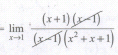
\( lim_{x\rightarrow 1}{(x+1)\over(x^2+x+1)}={1+1\over1+1+1}={2\over3}\)
To make f(x) continuous at x = 1,
\( lim_{x\rightarrow 1}f(x)=f(1)={2\over3}\)
\(\Rightarrow f(x)={2\over3}\)
17.
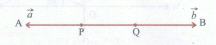
Let \(\overrightarrow{a}\) and \(\overrightarrow{b}\) be the position vectors of the points A and B.
\(\Rightarrow \overrightarrow{OA}=\overrightarrow{a}\) and \( \overrightarrow{OB}=\overrightarrow{b}\).
Let P divides the line segment AB in the ratio 1:2 and Q divides the line segment AB in the ratio 2 : 1
\(\therefore \overrightarrow{OP}={1.(\overrightarrow{OB})+2(\overrightarrow{OA})\over 1+2}={1(\overrightarrow{b})+2(\overrightarrow{a})\over 3}={\overrightarrow{b}+2\overrightarrow{a}\over 3}\)
and \( \overrightarrow{OQ}={2(\overrightarrow{OB})+1(\overrightarrow{OA})\over 2+1}={2\overrightarrow{b}+\overrightarrow{a}\over 3}={\overrightarrow{a}+2\overrightarrow{b}\over 3}\)
Hence, the required position vectors are \({\overrightarrow{b}+2\overrightarrow{a}\over 3}\)and \({\overrightarrow{a}+2\overrightarrow{b}\over 3}\).
18.
Given \(\left|\begin{array}{ccc} 1 & 4 & 20 \\ 1 & -2 & 5 \\ 1 & 2 x & 5 x^2 \end{array}\right|=0\)
\(\Rightarrow\left|\begin{array}{ccc} 1 & 4 & 20 \\ 0 & 6 & 15 \\ 0 & -2-2 x & 15-5 x^2 \end{array}\right|=0 \quad \begin{aligned} &R_1 \rightarrow R_1 \\ &R_2 \rightarrow R_1-R_2 \\ &R_3 \rightarrow R_2-R_3 \end{aligned}\)
expand by C1
\(1\left[6\left(5-5 x^2\right)-15(-2-2 x)\right]-0+0=0\)
\(-30 x^2+30 x+60=0\)
\((\div 30)-x^2+x+2=0\)
\(x^2-x-2=0\)
\((x-2)(x+1)=0\)
\(\therefore x=2 \text { (or) } x=-1\)
19.
Suppose that is rational
then \(\sqrt { 5 } \) = (where p and q are integer which are co-prime)
⇒ p =\(\sqrt { 5 } \)q = p2 = 5q2 ....(1)
\(\frac { { p }^{ 2 } }{ 5 } \)= q2 ⇒ 5 is a factor of p
So let P = 5c
substituting p = 5c in (1) we get
(5c)2 = 5q2 ⇒ 252 = 5q2
⇒ c2 = \(\frac { { 5q }^{ 2 } }{ 25 } =\frac { { q }^{ 2 } }{ 5 } \)
⇒ 5 is a factor of q also
⇒ So 5 is a factor of p and q which is a contradiction.
⇒ \(\sqrt { 5 } \) is not a rational number.
⇒\(\sqrt { 5 } \) is an irrational number.
20.
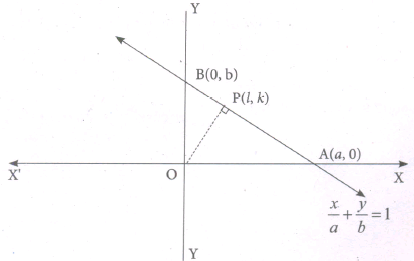
The given equation is x cos \(\alpha\) + y sin \(\alpha\) = p or \(\frac{x}{p/\cos\alpha}+\frac{y}{p/sin\alpha}=1\) ........(i)
This cuts the coordinate axes at \(A(p/\cos\alpha,0)\) and \(B(0,p/\sin\alpha)\). Let P (h, k)be the mid point of the intercept AB. Then,
\(h=\frac{p/\cos\alpha+0}{2},k=\frac{0+p/\sin\alpha}{2}\)
\(\Rightarrow h=\frac{p}{2\cos\alpha},k=\frac{p}{2\sin\alpha}\)
\(\Rightarrow \cos\alpha=\frac{p}{2h},\sin\alpha=\frac{p}{2k}\)
Here, u is a variable. to find the locus of P (h, k), we have to eliminate c.
From (i), we obtain
\(\cos^2\alpha+\sin^2\alpha=\frac{p^2}{4h^2}+\frac{p^2}{4k^2}\Rightarrow 1=\frac{p^2}{4h^2}+\frac{p^2}{4k^2}\Rightarrow \frac{4}{p^2}=\frac{1}{h^2}+\frac{1}{k^2}\)
Hence, the locus of (h, k) is \(\frac{1}{x^2}+\frac{1}{y^2}=\frac{4}{p^2}\)
21.
sin x - 3 sin 2x + sin 3x = cos x -3 cos 2x + cos 3x
sin 3x + sin x - 3 sin 2x = cos 3x + cos x - 3 cos 2x
2sin 2x cos x - 3 sin 2x = 2 cos 2x cos x - 3 cos 2x
(sin 2x -cos2x) (2 cos x - 3) = 0
Then, sin 2x - cos 2x = 0 since 2 cosx- 3 \(\neq\) 0
sin 2x = cos 2x \(\Rightarrow\)tan 2x = 1 \(\Rightarrow x={n\pi \over2}+{\pi \over8},n\in Z\)
22.
Given a = 5
Since the particle gets doubled, the G.P will be 5, 10,20,40, ... 1,50,000
⇒ a.rn-1 > 1,50,000
⇒ a.(2n-1) > 1,50,000
⇒ 5(2n-1) > 1,50,000
⇒ \(2^{n-1}>{1,50,000\over5}\)
⇒ 2n-1 > 30,000
⇒ 2n-1 > 24 x 1875
⇒ \({2^{n-1}\over24}>1875\)
⇒ 2n-5 > 1875
⇒ (n - 5) log 2 > log 1875
⇒ \(n-5>{log1875\over log2}\)
⇒ \(n-5>{3.2730\over 0.3010}\)
⇒ n-5 > 10.873
⇒ n > 10.873 + 5
⇒ n > 15.873
⇒ n = 15
Hence the 15th day, the infectious Virus particles just grow over 1,50,000 units.
23.
Given A = {a, b,c}
(i) Let R = {(a, a) (b, b) (c,c)}
R is reflexive
R is symmetric and R is transitive \(\Rightarrow\) R is an equivalence relation.
This is the equivalence relation of smallest cardinality on A.
\(\therefore\) n(R) = 3
(ii) Let R = {(a, a) (a, b) (a,c) (b,a) (b, b) (b, c) (c, a) (c, b) (c, c)}
R is reflexive since (a, a) (b, b) and (c, c) \(\in \) R
R is symmetric since (a, b) \(\in \) R \(\Rightarrow\)(b, a) \(\in \) R
(b, c) \(\in \) R \(\Rightarrow\) (c, a) \(\in \) R
(c, a) \(\in \) R \(\Rightarrow\) (a, c) \(\in \)R
R is also transitive since (a, b) (b, c) \(\in \) R \(\Rightarrow\) (a, c) \(\in \)R
Hence R is an equivalence relation of largest cardinality on A.
\(\therefore\) n(R) = 9
24.
The relation is defined by aRb if a + b \(\le\) 6 for all a, b \(\in \)N.
a+b \(\le\)6 \(\Rightarrow\) a \(\le\) 6 - b
| a | 5 | 4 | 3 | 2 | 1 |
| b | 1 | 2 | 3 | 4 | 5 |
\(\therefore\) The list of ordered pairs are (5,1) (4, 2) (3, 3) (2, 4) and (1, 5).
(4, 2) \(\in \) R and (2, 4) \(\in \) R \(\Rightarrow\) (4, 4) \(\notin \) R
\(\therefore\) R is not transitive.
25.
Given \(\frac { cos^{ 4 }\alpha }{ { cos }^{ 2 }\beta } +\frac { { sin }^{ 4 }\alpha }{ { sin }^{ 2 }\beta } \)
⇒ cos4\(\alpha\)sin2β + sin4\(\alpha\)cos2β = cos2β sin2β
⇒ cos4\(\alpha\)(1-cos2β)+cos2β(1-cos2\(\alpha\))2 = cos2β(1-cos2β)

⇒ cos4\(\alpha\)-2cos2\(\alpha\)cos2β + cos4β = 0
⇒ (cos2\(\alpha\)-cos2β)2 = 0
⇒ cos2\(\alpha\)-cos2β = 0
⇒ cos2\(\alpha\) = cos2β...(1)
⇒ 1-sin2\(\alpha\) = 1-sin2β
⇒ sin2\(\alpha\) = sin-2β
sin4\(\alpha\)+sin4β = 2sin2\(\alpha\)sin2β
LHS = sin4\(\alpha\) + sin4β = (sin2-sin2β)2 + 2sin2\(\alpha\)sin2β
= 2sin2\(\alpha\)sin2β = [∵ sin θ sin2\(\alpha\) = sin2β, from (2)]
= RHS
Hence proved.
26.
(d)
16
27.
(b)
(sin -1 x)4
28.
(c)
\(\frac { 15 }{ 29 } \)
29.
(d)
\(\left( \frac { 1 }{ 3 } ,1 \right) \)
30.
(d)
rectangular
31.
\(P(A / B)=\frac{P(A \cap B)}{P(B)}=\frac{P(A)}{P(B)}[\because A \subset B \Rightarrow A \cap B=A]\)
32.
WKT
\(\int e^{a x} \cos b x d x=\frac{e^{a x}}{a^{2}+b^{2}}[a \cos b x+b \sin b x]+c\)
\(\text { Putting } a=-4 \text { and } b=1\)
\(\int e^{-4 x} \cos x d x=\frac{e^{-4 x}}{17}[-4 \cos x+\sin x]+c\)
33.
(a)
34.
\(\lim _{x \rightarrow \infty} \frac{\sqrt{x^{2}-1}}{2 x+1}=\lim _{x \rightarrow \infty} \frac{\sqrt{1-\frac{1}{x^{2}}}}{2+\frac{1}{x}}=\frac{\sqrt{1-0}}{2+0}=\frac{1}{2}\)
35.
(d)
collinear
36.
(d)
5
37.
(c)
\(|\alpha-\beta|=\frac{\pi}{2}\)
38.
(a)
0
39.
(a)
120
40.
\(\sqrt{2}+\sqrt{8}+\sqrt{18}+\sqrt{32} \ldots . . =\sqrt{2}+2 \sqrt{2}+3 \sqrt{2}+4 \sqrt{2} . \)
\(=\sqrt{2}[1+2+3+\ldots .] \)
\(S_{n} =\frac{\sqrt{2}[n(n+1)]}{2} \)
\(=\frac{n(n+1)}{\sqrt{2}} \)
41.
\({ }^{(n+5)} P_{(n+1)} \quad=\frac{11(n-1)}{2}{ }^{n+3} P_{n}\)
\(\frac{(n+5) !}{(n+5-n-1) !} =\frac{11(n-1)}{2} \times \frac{(n+3) !}{(n+3-n) !} \)
\(\frac{(n+5)(n+4)(n+3) !}{4 !} =\frac{11(n-1) \times(n+3) !}{2 \times 3 !} \)
\(\frac{(n+5)(n+4)}{4 \times 3 !} =\frac{11(n-1)}{2 \times 3 !} \)
\(n^{2}+9 n+20 =22 n-22 \)
\(n^{2}-13 n+42 =0 \)
\((n-6)(n-7) =0 \)
\(n=6 \text { or } 7 \)
42.
The value of
\(\log _{3} 11 \log _{11} 13 \log _{13} 15 \log _{15} 27 \log _{27} 81=\log _{3} 81 \)
\(=\log _{3} 3^{4}=4 \log _{3} 3=4 \)
43.
\(4 \sin ^{2} x+3 \cos ^{2} x+\sin \frac{x}{2}+\cos \frac{x}{2} \)
\(=3\left(\sin ^{2} x+\cos ^{2} x\right)+\sin ^{2} x+\sin \frac{x}{2}+\cos \frac{x}{2} \)
\(=3+\sin ^{2} x+\sin \frac{x}{2}+\cos \frac{x}{2} \)
\(\text { Maximum of } \sin x=1\)
\(\text { Maximum value of } \sin ^{2} x=1\)
\(\text { Maximum value of } \sin \frac{x}{2} \text { occurs where } x=45^{\circ}\)
\(\text { Maximum value is } 3+1+\frac{1}{\sqrt{2}}+\frac{1}{\sqrt{2}}=4+\frac{2}{\sqrt{2}}=4+\sqrt{2}\)
44.
\((A \times B) \cap(A \times C) =A \times(B \cap C) \)
\(n[(A \times B) \cap(A \times C)] =n(A) \times n(B \cap C) \)
\(\Rightarrow 8 =n(A) \times 2 \Rightarrow n(A)=4 \)
45.
(c)
AΔB
46.
Probability of getting odd number = \(\frac { 3 }{ 6 } =\frac { 1 }{ 2 } \)
Probability of getting even numbers = 1-\(\frac { 1 }{ 2 } =\frac { 1 }{ 2 } \)
Now, probability of getting no odd number when the die is tossed twice = Probability of getting even number when the die is tossed thrice.
\(\Rightarrow \quad \frac { 1 }{ 2 } \times \frac { 1 }{ 2 } \times \frac { 1 }{ 2 } =\frac { 1 }{ 8 } \)
\(\therefore\) P(Odd number atleast once) = \(1-\frac { 1 }{ 8 } =\frac { 7 }{ 8 } \)
47.
Given f(0) = \(\frac { 1 }{ 2 } \)
\(\lim _{ x\rightarrow 0 }{ f\left( x \right) } =\lim _{ x\rightarrow 0 }{ \frac { 1-\cos { x } }{ { x }^{ 2 } } } =\lim _{ x\rightarrow 0 }{ \frac { 2\sin { ^{ 2 }\frac { x }{ 2 } } }{ { x }^{ 2 } } } =\lim _{ x\rightarrow 0 }{ \frac { 2 }{ 4 } } { \left[ \frac { \sin { \frac { x }{ 2 } } }{ \frac { x }{ 2 } } \right] }^{ 2 }=\frac { 2 }{ 4 } { (1) }^{ 2 }=\frac { 1 }{ 2 } .\)
48.
\(\int \sqrt{1+\cos 2 x} d x=\int \sqrt{2 \cos ^2 x} d x=\sqrt{2} \int \cos x d x=\sqrt{2} \sin x+c\)
49.
\(y=\sin \left(e^x\right)\)
Take \(u=e^x \Rightarrow \frac{d u}{d x}=e^x\)
\(y =\sin u\)
\(\frac{d y}{d x} =\frac{d y}{d u} \cdot \frac{d u}{d x}=\cos u\left(e^x\right)\)
\(=\cos \left(e^x\right) e^x=e^x \cos \left(e^x\right)\)
50.
\(lim_{x\rightarrow 0}{1-cosx\over x^2}=lim_{x\rightarrow 0}{2sin^2{x \over 2}\over x^2}[\because cos 2x=1-2sin^2x]\)
\(=2.lim_{x\rightarrow0}{sin^2({x\over 2})\over {x^2\over 4}\times 4}={2\over4}[lim{{x\over 2}\rightarrow 0}{sin({x\over2})\over ({x\over2})}]^2\)
\(={2\over4}\times 1^2={2\over4}={1\over2}\) \([\because lim_{\theta \rightarrow o}{sin \theta \over \theta}=1]\)
\(\therefore lim_{x\rightarrow 0}{1-cosx\over x^2}={1\over2}\)
51.
k = 2, 2x - y + 2 = 0, 6x - 2y + 1 = 0, \(\theta={\tan}^{-1}\left({1\over 7} \right)\)
52.
60, 108
53.
Given series is 12 + 32 + 52 +...
Let Tn be the nth term
Tn = (nth term of 1, 3, 5,...)2
= [1+(n-1)2]2 = (1 + 2n - 2)2 = (2n-1)2
= 4n2 + 1 - 4n
∴ Sum of n terms = \(\sum { 4{ n }^{ 2 } } -4n+1=4\sum { n^{ 2 } } -4\sum { n } +n\)
= \(4\frac { (n)(n+1)(2n+1) }{ 6 } -\frac { 4n(n+1)+n }{ 2 } \)
= \(\frac { n }{ 2 } \) [2(n + 1)(n + 1) - 6(n + 1) + 3]
= \(\frac { n(4{ n }^{ 2 }-1) }{ 3 } \)
54.
12x + 5y = 7 and 12x + 5y + 7 = 0
Given parallel lines are 12x + 5y = 7 and 12x + 5y + 7 = 0
Here a = 12, b = 5, c1 = -7 and c2 = 7
Distance between parallel lines = \(\left| \frac { { c }_{ 1 }-{ c }_{ 2 } }{ \sqrt { { a }^{ 2 }+{ b }^{ 2 } } } \right| \)
= \(\left| \frac { -7-7 }{ \sqrt { { 12 }^{ 2 }+{ 5 }^{ 2 } } } \right| =\left| \frac { -14 }{ \sqrt { 169 } } \right| \)
Distance between parallel lines = \(\frac { 14 }{ 13 } \)

11th Standard Syllabus & Materials
11th Standard
TN 11th Tamil பீடு பெற நில் - செய்யுள் - காவடிச்சிந்து Important Questions And Answers Study Material - QB365 Set A
NEW11th Standard
TN 11th Tamil பீடு பெற நில் - உரைநடை - மலை இடப்பெயர்கள் : ஓர் ஆய்வு Important Questions And Answers Study Material - QB365 Set A
NEW11th Standard
TN 11th Tamil மாமழை போற்றுதும் - துணைப்பாடம் - யானை டாக்டர் Important Questions And Answers Study Material - QB365 Set A
NEW11th Standard
TN 11th Tamil மாமழை போற்றுதும் - செய்யுள் - ஐங்குறுநூறு Important Questions And Answers Study Material - QB365 Set A



Tamilnadu Stateboard 11th Standard Subjects
Maths

Commerce

Economics

Biology

Business Maths and Statistics

Accountancy

Computer Science

Physics

Chemistry
Maths
Biology
Economics
Physics
Chemistry

History
Business Maths and Statistics

Computer Science
Accountancy

Computer Applications
History
Computer Technology
Commerce
Computer Applications
Computer Technology

Tamil

English

French
Tamilnadu Stateboard Standards

