
 100% FREE ACCESS
11th Standard Syllabus & Materials
11th Standard
TN 11th Tamil இயற்கை வேளாண்மை,சுற்றுச்சூழல் -செய்யுள் - மனோன்மணீயம் Important Questions And Answers Study Material - QB365 Set A
NEW11th Standard
TN 11th Tamil என்னுயிர் என்பேன் -துணைப்பாடம் - இசைத்தமிழர் இருவர் Important Questions And Answers Study Material - QB365 Set A
NEW11th Standard
TN 11th Tamil மொழி கலை -செய்யுள் - ஒவ்வொரு புல்லையும் Important Questions And Answers Study Material - QB365 Set A
NEW11th Standard
TN 11th Tamil பீடு பெற நில் - இலக்கணம் - பகுபத உறுப்புகள் Important Questions And Answers Study Material - QB365 Set A
NEW11th Standard
TN 11th Tamil பீடு பெற நில் - துணைப்பாடம் - வாடிவாசல் Important Questions And Answers Study Material - QB365 Set A
NEW11th Standard
TN 11th Tamil பீடு பெற நில் - செய்யுள் - குறுந்தொகை Important Questions And Answers Study Material - QB365 Set A

Published on: 30/08/2019
Sets, Relations and Functions
Download Tamil Nadu 11th Standard Maths question papers, model tests, one-mark questions, important questions, and public exam papers in PDF format. Free study materials and answer keys for TN State Board students.
Questions + Answers key
Take MCQ Maths Test1.
The rule f(x) = x2 is a bijection if the domain and the co-domain are given by
R, R
R, (0, ∞)
(0, ∞), R
[0, ∞), [0,∞)
2.
The range of the function \(f(x) = \left| \left\lfloor x \right\rfloor - x \right| ,x \in R\) is
[0, 1]
[0, ∞)
[0, 1)
(0, 1)
3.
The range of the function \({1\over 1-2sinx}\) is
\((-∞,-1)\cup\left( {1\over 3},\infty\right)\)
\(\left( -1,{1\over 3}\right)\)
\(\left[ -1,{1\over 3}\right]\)
\((-∞,-1]\cup [\frac { 1 }{ 3 } ,∞)\)
4.
Let X = {1, 2, 3, 4} and R = {(1, 1), (1, 2), (1, 3), (2, 2), (3, 3), (2, 1), (3, 1), (1, 4),(4, 1)}. Then R is
reflexive
symmetric
transitive
equivalence
5.
Let R be the universal relation on a set X with more than one element. Then R is
not reflexive
not symmetric
transitive
none of the above
6.
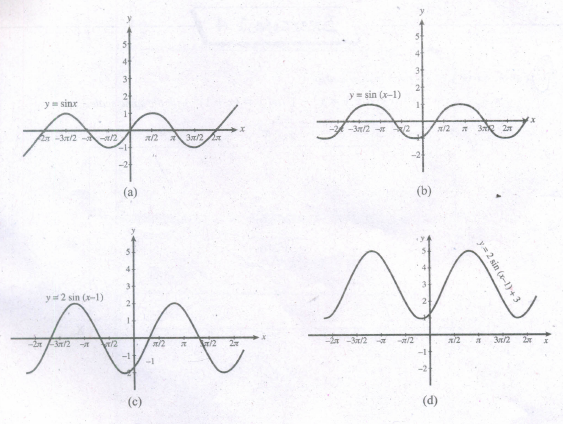
Let us now draw the graph of y = 2 sin ( x - 1 ) + 3.
7.
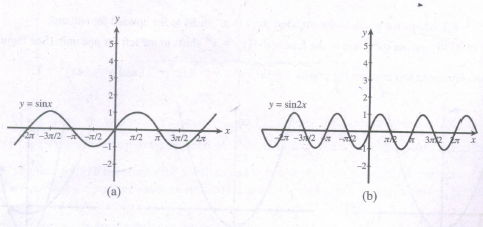
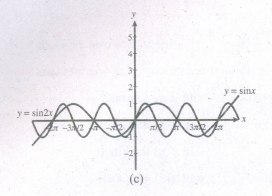
By using the same concept applied in previous example, graphs of y = sin x and y = sin 2x, and also their combined graphs are given figures (a), (b) and (c). The minimum and maximum values of sin x and sin 2x are the same. But they have different x-intercepts. The x-intercepts for y = sin x are \(\pm n\pi\) and for y = sin 2x are \(\pm{1\over 2}n\pi,\ n\in Z.\)
8.
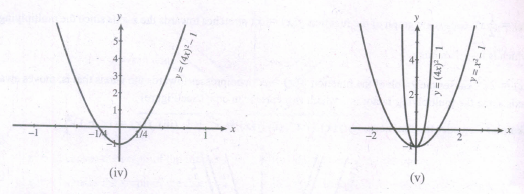
Compare and contrast the graph y = x2 - 1, y = 4(x2 - 1) and y = (4x)2 = 1.
9.
If p(A) denotes the power set of A, then find \(n(P(P(P(\phi)))).\)
10.
If n(A) = 10 and \(n(A\cap B)=3,\) find \(n((A\cap B')\cap A).\)
11.
If A = {1, 2, 3, 4} and B = {3, 4, 5, 6}, find \(n((A\cup B)\times(A\cap B)\times(A \triangle B))\)
12.
If \(f:R\rightarrow R\) is defined by f(x) = 2x- 3, prove that f is a bijection and find its inverse
13.
Let f, g: \(R \rightarrow R\) be defined as f (x) = 2x -|x| and g(x) = 2x + |x|. find f o g.
1.
\(\text { The domain is }[0, \infty)\)
\(\text { The codomain is also }[0, \infty)\)
2.
\(\mathrm{f}(x)=\left\lfloor\begin{array}{lll} x & -x \mid, \mathrm{f}(x) \end{array}=\left\lfloor\begin{array}{ll} x & -x \end{array}\right.\right.\)
\(f(0) =0-0=0 \)
\(f(6.5) =6-6.5=|-0.5|=0.5 \)
\(f(-7.2) =8-7.2=0.8 \)
\(\therefore \text { Range is }[0,1)\)
3.
\(-1 \leq \sin x \leq 1 \)
\(-2 \leq 2 \sin x \leq 2 \)
\(2 \geq-2 \sin x \geq-2 \)
\(-2 \leq-2 \sin x \leq 2 \)
Adding 1,
\(1-2 \leq 1-2 \sin x \leq 1+2 \)
\(-1 \leq 1-2 \sin x \leq 3 \)
\(-1 \geq \frac{1}{1-2 \sin x} \geq \frac{1}{3} \)
\(\frac{1}{3} \leq \frac{1}{1-2 \sin x} \leq-1 \)
\(\therefore \text { Range is }(-\infty,-1] \cup\left[\frac{1}{3}, \infty\right)\)
4.
\(\text { If } 4 \in X \text { then }(4,4) \notin \mathrm{R}\)
R is not reflexive
symmetric can be easily checked
5.
Let X = (a, b, c)
Then R = Universal relation
= {(a, a), (a, b), (a, c), (b, a), (b, b), (b, c), (c, a), (c, b), (c, c)}.
It is transitive
6.
It is clear that the curve can be obtained from that of y = sin x using translation and dilation. So first we draw y = sin x. From that it is easy to draw the curve y = sin (x - 1), then draw y = 2 sin (x - 1) and finally y = 2 sin (x - 1) + 3.
7.
8.
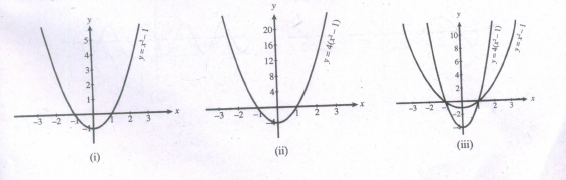
The graphs figures (i) and (ii) look identical until we compare the scales on the y-axis. The scale in figure(ii) is four times as large, reflecting the multiplication of the original function by 4 (i).
The effect looks different when the functions are plotted on the same scale as in figure(iii).
The graph of y = (4x)2 - 1 is shown in figure (iv). Can you spot the difference between figure (i) and figure (iv)? In this case, x-scale has now changed, by the same factor of 4 as in the function (figure (iv)).
To see this, note that substituting \(x={1\over 4}\) into (4x)2 - 1 produces 12 - 1, 1, exactly the same as substituting x = 1 into the original function (figure (i)), When plotted on the same set of axes (as in figure (v» the parabola y = (4x)2 - 1 looks thinner.
Here, the x-intercepts are different, but y-intercepts are the same.
9.
Since \(P(\phi)\) contains 1 element, \(P(P(\phi))\) contains 21 elements and hence \(P(P(P(\phi)))\) contains 22 elements. That is, 4 elements.
10.
\((A\cap B)'\cap A=(A'\cup B')\cap A=(A'\cap A)\cup(B'\cap A)\)
\(=\oslash\cup(B'\cap A)=(B'\cap A)\)
= A - B
So \(n((A\cap B)'\cap A)=n(A-B))=n(A)-n(A\cap B)=7\)
11.
We have \(n(A \cup B)=6,n(A\cap B)=2\) and \(n(A \triangle B)=4.\)
So, \(n((A\cup B)\times(A\cap B)\times(A \triangle B))=n(A \cup B)\times n(A\cap B)\times n(A\triangle B)= 6 \times 2 \times 4 = 48.\)
12.
Method 1:
One-to-one: Let f(x) = f(y). Then 2x - 3 = 2y - 3; this implies that x = y. That is, f(x) = f(y) implies that x = y. Thus f is one-to-one.
Onto: Let y \(\in\) R. Let x \(={y+3 \over 2}.\) Then \(f(x)=2\left( {y+3\over2} \right)-3=y.\) Thus f is onto. This also can be proved by saying the following statement. The range of f is R (how?) which is equal to the co-domain and hence f is onto.
Inverse: Let y = 2x - 3. Then y + 3 = 2x and hence \(x={y+3\over 2}.\) Thus \({f}^{-1}(y)={y+3\over2}\). By replacing y as x, we get \({f}^{-1}(x)={x+3\over 2}.\)
Method 2:
Let y = 2x − 3. Then \(x=\frac{y+3}{2}\). Let \(g(y)=\frac{y+3}{2}\)
Now
\((g \circ f)(x)=g(f(x))=g(2 x-3)=\frac{(2 x-3)+3}{2}=x .\)
\((f \circ g)(y)=f(g(y))=f\left(\frac{y+3}{2}\right)=2\left(\frac{y+3}{2}\right)-3=y\)
Thus, \(g \circ f=I_{X} \text { and } f \circ g=I_{Y}\)
This implies that f and g are bijections and inverses to each other. Hence f is a bijection and \(f^{-1}(y)=\frac{y+3}{2}\). Replacing y by x we get \(f^{-1}(x)=\frac{x+3}{2}\)
13.
We know \(|x|=\begin{cases} -x\ \ if\ x\le0 \\ x\quad if\ x>0 \end{cases}\)
So, \(f(x)=\begin{cases} 2x-(-x)\quad if x \le 0\\ 2x-x\quad if\ x>0 \end{cases}\)
Thus, \(f(x)=\begin{cases}3x\quad ifx\le0\\x\quad if\ x>0 \end{cases}\)
Also, \(g(x)=\begin{cases} 2x+(-x)\quad if \ x\le 0\\2x+x\quad if\ x>0 \end{cases}\)
Thus, \(g(x)=\begin{cases} x\quad if x \le 0\\3x\quad if x >0 \end{cases}\)
Let \(x\le0.\) Then
(f o g) (x) = f(g{x)) = f(x) = 3x.,
The last equality is taken because \(3x\le0\) whenever \(x\le0.\)
Let x > 0. Then
(f o g)(x) = f(g(x)) = f(3x) = 3x.
Thus (f o g)(x) = 3x for all x.

11th Standard Syllabus & Materials
11th Standard
TN 11th Tamil பீடு பெற நில் - செய்யுள் - காவடிச்சிந்து Important Questions And Answers Study Material - QB365 Set A
NEW11th Standard
TN 11th Tamil பீடு பெற நில் - உரைநடை - மலை இடப்பெயர்கள் : ஓர் ஆய்வு Important Questions And Answers Study Material - QB365 Set A
NEW11th Standard
TN 11th Tamil மாமழை போற்றுதும் - துணைப்பாடம் - யானை டாக்டர் Important Questions And Answers Study Material - QB365 Set A
NEW11th Standard
TN 11th Tamil மாமழை போற்றுதும் - செய்யுள் - ஐங்குறுநூறு Important Questions And Answers Study Material - QB365 Set A



Tamilnadu Stateboard 11th Standard Subjects
Maths

Commerce

Economics

Biology

Business Maths and Statistics

Accountancy

Computer Science

Physics

Chemistry
Maths
Biology
Economics
Physics
Chemistry

History
Business Maths and Statistics

Computer Science
Accountancy

Computer Applications
History
Computer Technology
Commerce
Computer Applications
Computer Technology

Tamil

English

French
Tamilnadu Stateboard Standards

