
 100% FREE ACCESS
11th Standard Syllabus & Materials
11th Standard
TN 11th Tamil இயற்கை வேளாண்மை,சுற்றுச்சூழல் -செய்யுள் - மனோன்மணீயம் Important Questions And Answers Study Material - QB365 Set A
NEW11th Standard
TN 11th Tamil என்னுயிர் என்பேன் -துணைப்பாடம் - இசைத்தமிழர் இருவர் Important Questions And Answers Study Material - QB365 Set A
NEW11th Standard
TN 11th Tamil மொழி கலை -செய்யுள் - ஒவ்வொரு புல்லையும் Important Questions And Answers Study Material - QB365 Set A
NEW11th Standard
TN 11th Tamil பீடு பெற நில் - இலக்கணம் - பகுபத உறுப்புகள் Important Questions And Answers Study Material - QB365 Set A
NEW11th Standard
TN 11th Tamil பீடு பெற நில் - துணைப்பாடம் - வாடிவாசல் Important Questions And Answers Study Material - QB365 Set A
NEW11th Standard
TN 11th Tamil பீடு பெற நில் - செய்யுள் - குறுந்தொகை Important Questions And Answers Study Material - QB365 Set A

Published on: 30/10/2019
Download Tamil Nadu 11th Standard Maths question papers, model tests, one-mark questions, important questions, and public exam papers in PDF format. Free study materials and answer keys for TN State Board students.
Questions + Answers key
Take MCQ Maths Test1.
Find F'(x) if F(x) = \(\sqrt{x^2+1}\)
2.
Prove that \(lim_{x\rightarrow 0}sin x=0\)
3.
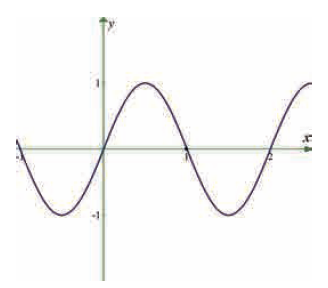
Use the graph to find the limits (if it exists). If the limit does not exist, explain why?
\(lim_{x\rightarrow{1}}sin \pi x\)
4.
Find the value of tan 120°.
5.
If \(f:R-\{ -1,1\}\rightarrow R\) is defined by \(f(x)={x \over x^2-1},\) verify whether f is one-to-one or not.
6.
By taking suitable sets A, B, C, verify the following results:
(A\(\times\) B)\(\cap \)(B\(\times\)A) = (A\(\cap \)B) \(\times\) (B\(\cap \)A)
7.
Solve for x \(\left| 3-x \right| <7\)
8.
Prove that \(\cos { \left( \pi +\theta \right) } =-\cos { \theta } \)
9.
Write the following in roster form.
{x\(\in \)N : x2<121 and x is a prime}
10.
Simplify \({ 16 }^{ -\frac { 3 }{ 4 } }\)
11.
Find the square root of 7-4\(\sqrt{3}\)
12.
If A + B + C = \(\pi\), prove that cos2A + cos2B + cos2C = 1 - 2 cos A cos B cos C.
13.
There are 11 points in a plane. No three of these lies in the same straight line except 4 points, which are collinear. Find,
(i) the number of straight lines that can be obtained from the pairs of these points?
(ii) the number of triangles that can be formed for which the points are their vertices?
14.
If P(2,-7) is a given point and Q is a point on (2x2 + 9y2 = 18), then find the equations of the locus of the mid-point of PQ.
15.
A straight tunnel is to be made through a mountain. A surveyor observes the two extremities A and B of the tunnel to be built from a point P in front of the mountain. If AP = 3 km, BP = 5 Km and \(\angle APB\) 12
16.
A researcher wants to determine the width of a pond from east to west, which cannot be done by actual measurement. From a point P, he finds the distance to the eastern-most point of the pond to be 8 km, while the distance to the western-most point from P to be 6 km. If the angle between the two lines of sight is 600, find the width of the pond.
17.
If x=\(\sqrt { 2 } +\sqrt { 3 } \) find \(\frac { { x }^{ 2 }+1 }{ { x }^{ 2 }-2 } \)
18.
The function for exchanging American dollars for Singapore Dollar on a given day is f(x) = 1.23x, where x represents the number of American dollars. On the same day function for exchanging Singapore dollar to Indian Rupee is g(y) = 50.50y, Where y represents the number of Singapore dollars. Write a function which will give the exchange rate of American dollars in terms of Indian rupee
19.
The angle between two vectors \(\vec{a}\) and \(\vec{b}\) with magnitudes\(\sqrt{3}\) and 4 respectively and \(\vec{a}.\vec{b}=2\sqrt{3}\) is ________ .
\(\frac{\pi}{6}\)
\(\frac { \pi }{ 3 } \)
\(\frac { \pi }{ 2 } \)
\(\frac { 5\pi }{ 2 } \)
20.
If \(|\overrightarrow { a } |=10,|\overrightarrow { b } |=2,\) and \(|\overrightarrow { a } .\overrightarrow { b } |=12\) then the value of \(|\overrightarrow { a } \times \overrightarrow { b } |\) is ___________ .
5
10
14
16
21.
The number of points in R in which the function \(f(x)=|x-1|+|x-3|+sin \ x\) is not differentiable, is
3
2
1
4
22.
If the derivative of (ax - 5)e3x at x = 0 is -13, then the value of a is
8
-2
5
2
23.
\(lim_{x\rightarrow0}{\sqrt{1-cos 2x}\over x} \)
0
1
\(\sqrt{2}\)
does not exist
24.
If ABCD is a parallelogram, then \(\overrightarrow{AB}+\overrightarrow{AD}+\overrightarrow{CB}+\overrightarrow{CD}\) is equal to
\(2(\overrightarrow{AB}+\overrightarrow{AD})\)
\(4\overrightarrow{AC}\)
\(4\overrightarrow{BD}\)
\(\overrightarrow{0}\)
25.
26.
Let A and B be two symmetric matrices of same order. Then which one of the following statement is not true?
A + B is a symmetric matrix
AB is a symmetric matrix
AB = (BA)T
AT B = ABT
27.
If x1, x2, x3 as well as y1, y2, y3 are in geometric progression with the same common ratio, then the points (x1, y1 ), (x2, y2), (x3, y3 ) are
vertices of an equilateral triangle
vertices of a right angled triangle
vertices of a right angled isosceles triangle
collinear
28.
If A = \(\begin{bmatrix}\lambda & 1 \\ -1 & -\lambda \end{bmatrix}\), then for what value of \(\lambda\), A2 = O?
0
\(\pm 1\)
-1
1
29.
In \(\triangle\)ABC, \(\hat{C}\) = 90° then a cos A + b cos B is _______________
2R sin B
2 sin B
0
2a sin B
30.
Equation of the straight line perpendicular to the line x - y + 5 = 0, through the point of intersection of the y-axis and the given line
x - y - 5 = 0
x + y - 5 = 0
x + y + 5 = 0
x + y + 10 = 0
31.
1+3+5+7+........+17 is equal to
101
81
71
61
32.
The equation of the locus of the point whose distance from y-axis is half the distance from origin is
x2 + 3y2 = 0
x2- 3y2 = 0
3x2+ y2 = 0
3x2- y2 = 0
33.
Everybody in a room shakes hands with everybody else. The total number of shake hands is 66. The number of persons in the room is
11
12
10
6
34.
The HM of two positive numbers whose AM and GM are 16, 8 respectively is
10
6
5
4
35.
36.
\(\frac { 1 }{ cos{ 80 }^{ 0 } } -\frac { \sqrt { 3 } }{ sin{ 80 }^{ 0 } } \)=
\(\sqrt{2}\)
\(\sqrt{3}\)
2
4
37.
Let A and B be subsets of the universal set N, the set of natural numbers. Then A'∪[(A⋂B)∪B'] is
A
A'
B
N
38.
If the function f:[-3,3]➝S defined by f(x) = x2 is onto, then S is
[-9,9]
R
[-3,3]
[0,9]
39.
Find the direction cosines of the vector joining the points A(1,2, -3) and B(-1, -2,1) directed from A to B.
40.
Differentiate y \(=x^{\sqrt{x}}\)
41.
How many strings can be formed from the letters of the word ARTICLE, so that vowels occupy the even places?
1.
Take u = g(x) = x2 + 1 and f(u) =\(\sqrt{u}\)
\(\therefore F(x)=(fog)(x)=f(g(x))\)
Since \(f'(u)={1\over2}u^{1\over2}={1\over 2\sqrt{u}}\) and
\(g'(x)=2x,\) we get
\(F'(x)=f'(g(x))g'(x)\)
\(={1\over 2\sqrt{x^2+1}}.2x={x\over \sqrt{x^2+1}}\).
2.
Since -x \(\le sin x\le x\) for all x\(\ge 0\)
\(lim_{x\rightarrow 0}(-x)=0 \) and
\(lim_{x\rightarrow 0}(x)=0 \)
By Sandwich theorem
\(lim_{x\rightarrow 0}sinx=0 \)
3.
\(lim_{x\rightarrow{1}}sin \pi x\)
At x = 1, the curve meets the x-axis.
\(\therefore lim_{x\rightarrow{1}}sin \pi x=0\)
4.
tan 120° = tan (180° - 60°)
= - tan(60°) =\(-\sqrt 3\)
(or) write tan 120° as tan (90° + 30°) and find the value.
5.
We start with the assumption f(x) = f(y). Then
\({x \over x^2-1}={y \over y^2-1}\)
\(\Rightarrow x(y^2-1)=(x^2-1)\)
\(\Rightarrow xy^2-x-yx^2+y-0\Rightarrow (y-x)(xy+1)=0\)
This implies that x =y or xy = - 1. So if we select two numbers x and y so that xy = -1, then f(x) = f(y). \(f(x)=f(y) \cdot\left(2,-\frac{1}{2}\right),\left(7,-\frac{1}{7}\right),\left(-2, \frac{1}{2}\right)\)are some among the infinitely many possible pairs. Thus \(f(2)=f\left(\frac{-1}{2}\right)=\frac{2}{3}\). That is, f(x) = f(y) does not imply x = y. Hence it is not one-to-one.
6.
(A\(\times\) B) = {(1,4) (1,5) (1,6) (1,7) (2,4) (2,5) (2,6) (2,7) (3,4) (3,5) (3,6) (3,7)}
(B\(\times\)A) = {(4,1) (4,2) (4,3) (5,1) (5,2) (5,3) (6,1) (6,2) (6,3) (7,1) (7,2) (7,3)}
LHS = (A\(\times\)B)\(\cap \)(B\(\times\)A) = { }....(1)
(A\(\cap \)B) = { }, (B\(\cap \)A) = { }
\(\therefore\) RHS = (A\(\cap \)B) \(\times\) (B\(\cap \)A) = { }.....(2)
From (1) and (2), LHS = RHS
7.
.png)
[a < b ⇒ ay > by for all y< 0]
Here y = -1
Given |3-x| < 7
This means -7 < 3 -x < 7
⇒-7-3 < -x < 7-3
⇒-10 < -x < 4
⇒10 > x > -4
\(\therefore\) The Solution set is \(x\in \left( -\infty ,-4 \right) \cup \left( -4,10 \right) \)
8.
\(\cos { \left( \pi +\theta \right) } =-\cos { \theta } \)
LHS = \(\cos { \left( \pi +\theta \right) } =-\cos { \theta } \)
= RHS
Hence proved.
9.
{x\(\in \)N : x2<121 and x is a prime}
Let A = {x\(\in \)N : x2<121, and x is a prime}
A = {2,3,5,7}.
10.
= \(({ 2 }^{ 4 })^{ -\frac { 3 }{ 4 } ={ 2 }^{ 4\times \frac { 2 }{ 4 } }={ 2 }^{ -3 } }=\frac { 1 }{ { 2 }^{ 3 } } =\frac { 1 }{ 8 } \)
11.
Let\(\sqrt{7-4\sqrt{3}}=a+b\sqrt{3}\) with a,b rationals.
Squaring on both sides, we get 7-4\(\sqrt{3}\) = a2+3b2+ 2ab\(\sqrt{3}\)
So, a2+ 3b2 = 7 and 2ab = -4
Therefore a = \(\frac{-2}{b}\)
From a2 + 3b2 = 7, we get \((\frac{-2}{b})^2+3b^2=7\), which gives \(\frac{4}{b^2}+3b^2=7\) or 3b4- 7b2 + 4 = 0
Solving for b2 we get b2 = \(\frac{(7\pm\sqrt{49-48})}{8}\), which gives b2 = 1 or b2 = \(\frac{4}{3}.\)
Thus, b = 士1 or b = 士 \(\frac{2}{\sqrt{3}}\)
Since b is rational, we have b = 土1 and hence the corresponding values for a are ∓ 2.
Since \(\sqrt{7-4\sqrt{3}}>0\) we have \(\sqrt{7-4\sqrt{3}}=2-\sqrt{3}.\)
12.
cos2A + cos2B + cos2C = \({1\over2}\)[2 cos2A + 2 cos2B + 2 cos2C]
= \({1\over2}\) [(1 + cos 2A) + (1 + cos 2B) + (1 + cos 2C)]
= \({3\over2}\)+\({1\over2}\) [(cos 2A + cos 2B) +cos 2C]
= \({3\over2}\)+\({1\over2}\)[2 cos(A + B) cos (A - B) + (2 cos2C-1)]
= \({3\over2}\)+\({1\over2}\)[-2 cos C cos (A -B) + 2 cos2C -1] (A + B =\(\pi\)-C)
= \({3\over2}\)-\({1\over2}\)+\({1\over2}\) [-2 cos C (cos (A - B)-cos C)]
= 1- cos C [cos (A - B) - cos C]
= 1 - cos C [cos (A - B) + cos (A + B)]
= 1- cos C [2 cos A cos B]
= 1- 2 cos A cos B cos C
13.
(i) Assume that no three points out of 11 points are collinear. Then we can draw unique straight line through any arbitrary pair of points out of the 11 given points. This is a combination of 2 objects taken at a time from a total of 11 and can be done in 11C2 = 55 ways.
However, it is given that 4 points are collinear. Had they not been collinear the number of unique lines that could have been drawn through them is a combination of 2 objects taken at a time from a total of 5 and can be done in 4C2 = 6 ways. Since they are collinear we get only one line out of these 4 points instead of 6.
So, the total number of straight lines that can be drawn through 13 points on a plane with 5 of the points being collinear is 55 - 6 + 1 = 50.
(ii) To form a triangle we need 3 points. The following are the choices.
a) If we take one point from 4 collinear points and 2 from remaining 7. So this case will give \({ 4C }_{ 1 }\times { 7C }_{ 2 }\) points = \(4\times 21=84\)
b) If we take two points from 4 collinear points and 1 from remaining 7. So this will give \({ 4C }_{ 2 }\times { 7C }_{ 1 }=6\times 7=42\)
c) If we take all the three points from 7 non collinear points. Which will give 7C3 = 35
∴ Total number of triangles are 84 + 42 + 35 = 161.
14.
Let R(h, k) be the locus of the mid-point of PQ where, P is (2, -7) and Q is a point on (2x2 + 9y2 = 18)
Given equation is 2x2 + 9y2 = 18
Dividing by 18 we get,
\(\Rightarrow \quad \frac { { x }^{ 2 } }{ 9 } +\frac { { y }^{ 2 } }{ 2 } =1\)
\(\Rightarrow \quad \frac { { x }^{ 2 } }{ { 3 }^{ 2 } } +\frac { { y }^{ 2 } }{ { \left( \sqrt { 2 } \right) }^{ 2 } } =1\)
\(\Rightarrow \quad a=3\quad and\quad b=\sqrt { 2 } \)
Any point on the ellipse is (a cos \(\theta\), b sin \(\theta\))
\(\therefore\) Q is (3 cos \(\theta\), \(\sqrt { 2 } \) sin \(\theta\)
Since R is the mid-point of PQ, we get, (h,k) = \(\left( \frac { 2+3cos\theta }{ 2 } ,\frac { -7+\sqrt { 2 } sin\theta }{ 2 } \right) \)
\(\Rightarrow \quad h=\frac { 2+3\quad cos\quad \theta }{ 2 } \)
\(\Rightarrow \quad 2h=2+3cos\theta \)
\(\Rightarrow \quad 2h-2=3cos\theta \)
\(\Rightarrow \quad \frac { 2h-2 }{ 3 } =cos\quad \theta \)
\(k=\frac { -7+\sqrt { 2 } sin\theta }{ 2 } \)
\(\Rightarrow \quad 2k=-7+\sqrt { 2 } sin\theta \)
\(\Rightarrow \quad 2k+7\quad =\quad \sqrt { 2 } sin\theta \)
\(\Rightarrow \quad \frac { 2k+7 }{ \sqrt { 2 } } =sin\quad \theta \)
Squaring and adding we get,
\({ \left( \frac { 2h-2 }{ 3 } \right) }^{ 2 }+{ \left( \frac { 2k+7 }{ \sqrt { 2 } } \right) }^{ 2 }={ cos }^{ 2 }\theta +{ sin }^{ 2 }\theta \)
\(\Rightarrow \quad \frac { { 4h }^{ 2 }+4-8h }{ 9 } +\frac { { 4k }^{ 2 }+49+28k }{ 2 } =1\quad [\because { cos }^{ 2 }\theta +{ sin }^{ 2 }\theta =1]\)
\(\Rightarrow \quad 2({ 4h }^{ 2 }+4-8h)=9({ 4k }^{ 2 }+49+28k)=18\)
\(\Rightarrow \quad { 8h }^{ 2 }+8-16h+36{ k }^{ 2 }+441+252k-18=0\)
\(\Rightarrow \quad { 8h }^{ 2 }+36{ k }^{ 2 }-16h+252k+431=0\)
\(\therefore\) Locus of (h,k) is
8x2+36y2-16x+252y+431=0
15.
Let ABC be the length of the tunnel.
Let a = 5, b = 3 and ㄥc = 120°
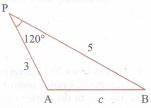
Using cosine formula,
c2 = a2 + b2 - 2ab cos C
= 25 + 9 - 2(5) (3) cos (120°)
= 34 - 30 cos (180 - 60)
= 34 -30 (-cos 60°) = 34 -\(\left(-1\over 2\right)\) = 34 + 15 = 49
c2= 49
c = 7 km.
Hence, length of the tunnel = 7 km.
16.
Let A be the point on the eastern side and B be the point on the western side.
Given PA = 8, PB = 6
Let a = 6, b = 8 and ㄥC = 60°
Using cosine formula
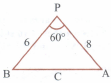
c2 = a2 + b2 - 2ab cos C
= 36 + 64 - 2(6) (8) cos 60°
= 100 - 12 \(\times\) 8 \(\times\) \(1\over 2\)
= 100 - 48 = 52
\(⇒\ C=\sqrt {52}=\sqrt{4\times13}\)
\(∴\ C=2\sqrt{13}km\)
Hence the width of the river is \(2\sqrt{13}km\)
17.
Given x =\(\sqrt { 2 } +\sqrt { 3 } \)
⇒ x3 = \((\sqrt { 2 } +\sqrt { 3 } )^{ 2 }=2+3+2\sqrt { 6 } =5+2\sqrt { 6 } \)
∴ \(\frac { { x }^{ 2 }+1 }{ { x }^{ 2 }-1 } =\frac { 5+2\sqrt { 6 } +1 }{ 5+2\sqrt { 6 } -2 } =\frac { 6+2\sqrt { 6 } }{ 3+2\sqrt { 6 } } \)
⇒ \(\frac { 6+2\sqrt { 6 } }{ 3+2\sqrt { 6 } } \times \frac { 3-2\sqrt { 6 } }{ 3-2\sqrt { 6 } } =\frac { (6+2\sqrt { 6 } )(3-2\sqrt { 6 } ) }{ 9-(2\sqrt { 6 } )^{ 2 } } \)
⇒ \(\frac { 18-12\sqrt { 6 } +6\sqrt { 6 } -4(\sqrt { 6 } )^{ 2 } }{ 9-24 } =\frac { 18-12\sqrt { 6 } -24 }{ -15 } \)
⇒ \(\frac { -6-6\sqrt { 3 } }{ -15 } \)
\(=\frac{2(1+\sqrt{6})}{5}=\frac{2+2 \sqrt{6}}{5}\)
18.
Given f(x) = 1.23x where x represents the number of American dollars.
and g(y) = 50.50y where y represents the number of Singapore dollars.
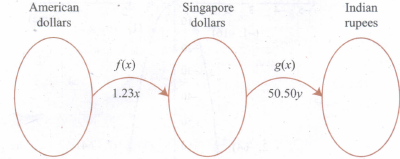
To convert American dollars to Indian rupees, we have to find out go f(x)
∴ go f(x) = g(f(x))
= g(1.23x)
= 50.50[1.23x]
= 62.115x
∴ The function for exchange rate of American dollars in terms of Indian rupee is g o f (x) = 62.115x.
19.
(b)
\(\frac { \pi }{ 3 } \)
20.
(d)
16
21.
\(f(x)=|x-1|+|x-3|+\sin x\)
\(\text { Since } \sin x \text { is differentiable everywhere }\)
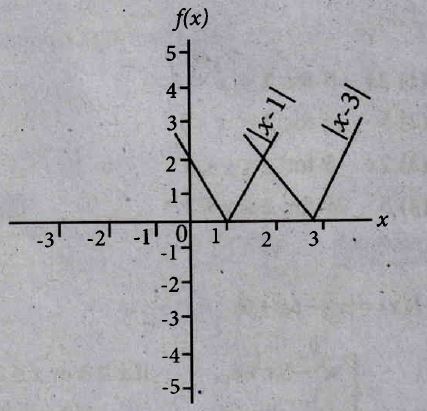
At x = 1 and x = 3. The graph admit cups.
\(\therefore\) The derivative is not exist.
\(\therefore\) The number of points in R is 2.
22.
\(y =(a x-5) e^{3 x} \)
\(\frac{d y}{d x} =(a x-5) e^{3 x}(3)+e^{3 x}(a) \)
\(-13 =(-5)(3)+a \quad(\text { At } x=0) \)
\(-13 =-15+a \)
\(a =-13+15=2 \)
\(\therefore a =2 \)
23.
\(\text { Let } f(x)=\frac{\sqrt{1-\cos 2 x}}{x}\)
\(=\frac{\sqrt{2 \sin ^{2} x}}{x} \)
\(=\frac{\sqrt{2} \sqrt{\sin ^{2} x}}{x} \)
\(=\frac{\sqrt{2}|\sin x|}{x}\left(\therefore \sqrt{x^{2}}=|x|\right) \)
\(= \begin{cases}\frac{\sqrt{2}(-\sin x)}{x}, & \sin x<0 \\ \sqrt{2}\left(\frac{\sin x}{x}\right), & \sin x>0\end{cases} \)
\(= \begin{cases}-\sqrt{2} \frac{\sin x}{x}, x \in\left(-\frac{\pi}{2}, 0\right) \\ \sqrt{2} \frac{\sin x}{x}, x \in\left(0, \frac{\pi}{2}\right)\end{cases} \)
\(\therefore \lim _{x \rightarrow 0^{-}} f(x)=\lim _{x \rightarrow 0^{-}} \frac{-\sqrt{2} \sin x}{x}=-\sqrt{2}\)
\(\text { and } \lim _{x \rightarrow 0^{+}} f(x)=\lim _{x \rightarrow 0^{+}} \frac{\sqrt{2} \sin x}{x}=\sqrt{2}\)
\(\text { From (1) and (2) }\)
\(\lim _{x \rightarrow 0^{-}} f(x) \neq \lim _{x \rightarrow 0^{+}} f(x)\)
\(\therefore \lim _{x \rightarrow 0} f(x) \text { does not exist }\)
24.
\(\overrightarrow{A B}=-\overrightarrow{C D}\)
\(\overrightarrow{A D}=\overrightarrow{B C}=-\overrightarrow{C B}\)
\(\therefore \overrightarrow{A B}+\overrightarrow{A D}+\overrightarrow{C B}+\overrightarrow{C D}=-\overrightarrow{C D}-\overrightarrow{C B}+\overrightarrow{C B}+\overrightarrow{C D}=\overrightarrow{0}\)
25.
(c)
26.
\(A \& B \text { are symmetric }\)
\(A^{T}=A \text {, and } B^{T}=B\)
\(\text { 1) }(A+B)^{T}=B^{T}+A^{T}=B+A=A+B \Rightarrow A+B\text { is symmetric }\)
\(\text { 2) }(A B)^{T}=B^{T} A^{T}=B A \neq A B\)
\(\therefore A B \text { is not symmetric }\)
\(\text { 3) } A B=A^{T} B^{T}=(B A)^{T}\)
\(\text { 4) } A^{T} B=A B=A B^{T}\)
27.
(d)
collinear
28.
\(A^{2}=A \times A=\left[\begin{array}{cc} \lambda & 1 \\ -1 & -\lambda \end{array}\right]\left[\begin{array}{cc} \lambda & 1 \\ -1 & -\lambda \end{array}\right]\)
\(=\left[\begin{array}{cc} \lambda^{2}-1 & \lambda-\lambda \\ -\lambda+\lambda & -1+\lambda^{2} \end{array}\right]=0\)
\(\therefore \lambda^{2} =1 \)
\(\lambda =\pm 1\)
29.
(d)
2a sin B
30.
x - y + 5 = 0;
Put x = 0, then y = 5
The point is (0, 5)
Any line perpendicular to x - y + 5 = 0 is
x + y + k = 0,
This passes through (0, 5)
k = -5
Required equation is x + y - 5 = 0
31.
\(1+3+5+7+\ldots \ldots+17 \text { is equal to } 9^{2}=81\)
32.
Let the point be (x, y)
Its distance from origin is \(\sqrt{x^{2}+y^{2}}\)
Given \(x =\frac{1}{2} \sqrt{x^{2}+y^{2}} \)
\(\Rightarrow 2 x =\sqrt{x^{2}+y^{2}} \)
\(4 x^{2} =x^{2}+y^{2} \)
\(3 x^{2}-y^{2}=0 \) is the required equation of the locus
33.
Number of shake hands = 66
Let there be n persons.
No. of Shake hands
= (n - 1) + (n - 2) + .......+.2 + 1
\(66 =\frac{(n-1)}{2} n \)
\(n^{2}-n =132 \)
\(n^{2}-n-132 =0 \)
\((n-12)(n+11) =0 \)
\(\mathrm{n}=2 \text { (or) }-11 \text { (not valid) }\)
34.
\(\mathrm{AM}=16, \quad \mathrm{GM}=8, \quad \mathrm{HM}=?\)
\(\frac{a+b}{2}=16 \Rightarrow a+b=32\)
\(\sqrt{a b}=8 \Rightarrow a b=64\)
\(\therefore \mathrm{HM} =\frac{2 a b}{a+b} \)
\(=\frac{2(64)}{32}= 4 \)
35.
(b)
36.
\(x =\frac{1}{\cos 80^{\circ}}-\frac{\sqrt{3}}{\sin 80^{\circ}} \)
\(=\frac{\sin 80^{\circ}-\sqrt{3} \cos 80^{\circ}}{\sin 80^{\circ} \cos 80^{\circ}} \)
\(\frac{x}{2} =\frac{\frac{1}{2} \sin 80^{\circ}-\frac{\sqrt{3}}{2} \cos 80^{\circ}}{\frac{1}{2} \sin 80^{\circ} \cos 80^{\circ}} \)
\(=\frac{\sin 80^{\circ} \cos 60^{\circ}-\cos 80^{\circ} \sin 60^{\circ}}{\frac{1}{2} \sin 80^{\circ} \cos 80^{\circ}} \)
\(=\frac{\sin 20^{\circ}}{\frac{1}{2} \sin 80^{\circ} \cos 80^{\circ}} \)
\(=\frac{\sin 160^{\circ}}{\frac{1}{2} \sin 80^{\circ} \cos 80^{\circ}} \)
\(=\frac{2 \sin 80^{\circ} \cos 80^{\circ}}{\frac{1}{2} \sin 80^{\circ} \cos 80^{\circ}}=4 \)
37.
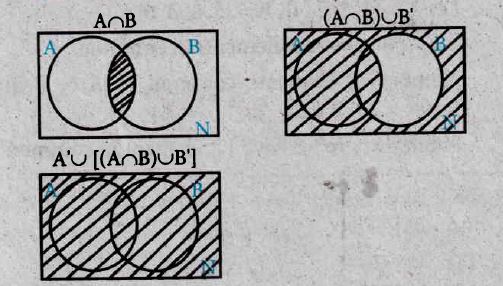
38.
f(0) = 0, f(-3) = 9 and f(3) = 9
.'. S is [0,9]
39.
Given points are A(1, 2, -3) and B(-1, -2, 1).
Then \(\overrightarrow { AB } =\overrightarrow { OB } -\overrightarrow { OA } =(-\hat { i } -2\hat { j } +\hat { k } )-(\hat { i } +2\hat { j } -3\hat { k } 0=-2\hat { i } -4\hat { j } +4\hat { k } \)
\(|\overrightarrow { AB } |=\sqrt { { (-2) }^{ 2 }+{ (-4) }^{ 2 }+{ 4 }^{ 2 } } =\sqrt { 4+16+16 } =\sqrt { 36 } =6\)
Now, \(l=\frac { x }{ |\overrightarrow { AB } | } =\frac { -2 }{ 6 } =\frac { -1 }{ 3 } \)
\(m=\frac { y }{ |\overrightarrow { AB } | } =\frac { -4 }{ 6 } =\frac { -2 }{ 3 } \)
\(n=\frac { z }{ |\overrightarrow { AB } | } =\frac { 4 }{ 6 } =\frac { 2 }{ 3 } \)
Thus, the direction cosines of \(\overrightarrow { AB } \) are \(\left( -\frac { 1 }{ 3 } ,-\frac { 2 }{ 3 } ,\frac { 2 }{ 3 } \right) \)
40.
Take logarithm :
log y = \(\sqrt{x} \log x\)
Differentiating implicitly,
\({y'\over y}=\sqrt{x}.{1\over x}+{1\over 2\sqrt{x}}.log\ x\)
\(={log \ x+2\over 2\sqrt{x}}\)
Therefore, \({d\over dx}(x^{\sqrt{x}})=y'=x^{{\sqrt{x}}}({log \ x+2\over 2\sqrt{x}})\) .
41.
In the letters of the word, ARTICLE, there are three vowels namely A, I, E.
There are 3 even places.
3 vowels can occupy the even places in 3P3 = 3! ways.
Remaining 4 letters can occupy 4 places in 4! ways.
Hence, total number of ways of arrangement = 4! \(\times\) 3!
= \(4\times 3\times 2\times 3\times 2\)
=144

11th Standard Syllabus & Materials
11th Standard
TN 11th Tamil பீடு பெற நில் - செய்யுள் - காவடிச்சிந்து Important Questions And Answers Study Material - QB365 Set A
NEW11th Standard
TN 11th Tamil பீடு பெற நில் - உரைநடை - மலை இடப்பெயர்கள் : ஓர் ஆய்வு Important Questions And Answers Study Material - QB365 Set A
NEW11th Standard
TN 11th Tamil மாமழை போற்றுதும் - துணைப்பாடம் - யானை டாக்டர் Important Questions And Answers Study Material - QB365 Set A
NEW11th Standard
TN 11th Tamil மாமழை போற்றுதும் - செய்யுள் - ஐங்குறுநூறு Important Questions And Answers Study Material - QB365 Set A



Tamilnadu Stateboard 11th Standard Subjects
Maths

Commerce

Economics

Biology

Business Maths and Statistics

Accountancy

Computer Science

Physics

Chemistry
Maths
Biology
Economics
Physics
Chemistry

History
Business Maths and Statistics

Computer Science
Accountancy

Computer Applications
History
Computer Technology
Commerce
Computer Applications
Computer Technology

Tamil

English

French
Tamilnadu Stateboard Standards

