
 100% FREE ACCESS
11th Standard Syllabus & Materials
11th Standard
TN 11th Tamil இயற்கை வேளாண்மை,சுற்றுச்சூழல் -செய்யுள் - மனோன்மணீயம் Important Questions And Answers Study Material - QB365 Set A
NEW11th Standard
TN 11th Tamil என்னுயிர் என்பேன் -துணைப்பாடம் - இசைத்தமிழர் இருவர் Important Questions And Answers Study Material - QB365 Set A
NEW11th Standard
TN 11th Tamil மொழி கலை -செய்யுள் - ஒவ்வொரு புல்லையும் Important Questions And Answers Study Material - QB365 Set A
NEW11th Standard
TN 11th Tamil பீடு பெற நில் - இலக்கணம் - பகுபத உறுப்புகள் Important Questions And Answers Study Material - QB365 Set A
NEW11th Standard
TN 11th Tamil பீடு பெற நில் - துணைப்பாடம் - வாடிவாசல் Important Questions And Answers Study Material - QB365 Set A
NEW11th Standard
TN 11th Tamil பீடு பெற நில் - செய்யுள் - குறுந்தொகை Important Questions And Answers Study Material - QB365 Set A

Published on: 02/09/2019
Trigonometry
Download Tamil Nadu 11th Standard Maths question papers, model tests, one-mark questions, important questions, and public exam papers in PDF format. Free study materials and answer keys for TN State Board students.
Questions + Answers key
Take MCQ Maths Test1.
Prove that (1 + sec 2\(\theta\)) (1 + sec 4\(\theta\)) ... (1 + sec 2n\(\theta\)) = tan 2n\(\theta\) cot \(\theta\).
2.
If \(\cos { \left( \alpha -\beta \right) } +\cos { \left( \beta -\gamma \right) } +\cos { \left( \gamma -\alpha \right) } =\frac { -3 }{ 2 } \) then prove that \(\cos { \alpha } +\cos { \beta } +\cos { \gamma } =\sin { \alpha } +\sin { \beta } +\sin { \gamma } =0\)
3.
If x = \(\sum _{ n=0 }^{ \infty }{ { cos }^{ 2n } } \theta ;\) y = \(y=\sum _{ n=0 }^{ \infty }{ { sin }^{ 2n } } \theta \) and z = \(\sum _{ n=0 }^{ \infty }{ { cos }^{ 2n }\theta } \) sin2n\(\theta \), 0 < \(\theta \) < \(\frac { \pi }{ 2 } \), then show that xyz = x+y+z
Hint :1+x+x2+x3+.......= \(\frac { 1 }{ 1-x } \), where \(\left| x\right| \)< 1].
4.
If \(\frac { cos^{ 4 }\alpha }{ { cos }^{ 2 }\beta } +\frac { { sin }^{ 4 }\alpha }{ { sin }^{ 2 }\beta } =1\) prove that \({ sin }^{ 4 }\alpha +{ sin }^{ 4 }\beta =2{ sin }^{ 2 }\alpha { sin }^{ 2 }\beta\)
5.
Suppose that a satellite in space, an earth station and the centre of earth all in the same plane. Let r be the radius of earth and R be the distance from the centre of earth to the satellite. Let d be the distance from the earth station to the satellite. Let 30 be the angle of elevation from the earth station to the satellite. If the line segment connecting earth station and satellite subtends angle α at the centre of earth, then prove that d =\(\sqrt { 1+\left( \frac { r }{ R } \right) ^{ 2 }-2\frac { r }{ R } cos\alpha } \) .
6.
A fighter jet has to hit a small target by flying a horizontal distance. When the target is sighted, the pilot measures the angle of depression to be 300. If after 100 km, the target has an angle of depression of 600, how far is the target from the fighter jet at that instant?
7.
Find a quadratic equation whose roots are sin 15o and cos 15o
8.
If sin A = \(\frac{3}{5}\) and cos B = \(\frac{9}{41}\), 0 < A < \(\frac{\pi}{2}\), 0 < B < \(\frac{\pi}{2}\). Find the value of cos (A - B)
9.
The triangle of maximum area with constant perimeter 12m
is an equilateral triangle with side 4m
is an isosceles triangle with sides 2m, 5m, 5m
is a triangle with sides 3m, 4m, 5m
Does not exist
10.
11.
If cos pፀ + cos qፀ = 0 and if p ≠ q, then ፀ is equal to (n is any integer)
\(\frac { \pi (3n+1) }{ p-q } \)
\(\frac { \pi (2n+1) }{ p\pm q } \)
\(\frac { \pi (n\pm 1) }{ p\pm q } \)
\(\frac { \pi (n+2) }{ p+q } \)
12.
If \(\pi <2\theta <\frac { 3\pi }{ 2 } \), then \(\sqrt { 2+\sqrt { 2+2cos4\theta } } \) equals to
-2 cosፀ
-2 sinፀ
2 cosፀ
2 sinፀ
13.
If cos 280+ sin 280 = k3, then cos 170 is equal to
\(\frac { { k }^{ 3 } }{ \sqrt { 2 } } \)
-\(\frac { { k }^{ 3 } }{ \sqrt { 2 } } \)
±\(\frac { { k }^{ 3 } }{ \sqrt { 2 } } \)
-\(\frac { { k }^{ 3 } }{ \sqrt { 3 } } \)
1.
LHS = (1 + sec2θ)(1 + sec4θ)...(1 + sec2nθ)
= \(\left( 1+\frac { 1 }{ cos2\theta } \right) \left( 1+\frac { 1 }{ cos4\theta } \right) ...\left( 1+\frac { 1 }{ cos{ 2 }^{ n }\theta } \right) \)
= \(\frac { \left( cos2\theta +1 \right) \left( cos4\theta +1 \right) ...\left( cos{ 2 }^{ n }\theta +1 \right) }{ cos2\theta .cos4\theta ...cos{ 2 }^{ n }\theta } \)
= \(\frac { \left( 2{ cos }^{ 2 }\theta \right) \left( 2{ cos }^{ 2 }2\theta \right) ...\left( 2{ cos }^{ 2 }{ 2 }^{ n-1 }x \right) }{ cos2\theta \quad cos{ 2 }^{ 2 }\theta \quad cos{ 2 }^{ n }\theta } \)
= \(\frac { { 2 }^{ n }cos\theta }{ { cos }^{ 2n }\theta } \left[ cosx.cos2x.cos{ 2 }^{ 2 }x...cos{ 2 }^{ n-1 }x \right] \)
= \(\frac { { 2 }^{ n }cos\theta }{ { cos }^{ 2n }\theta } \times \frac { cos{ 2 }^{ n }\theta }{ { 2 }^{ n }sinx } \)
= tan2nθ.cotθ
= RHS
2.
Given cos(\(\alpha \) - β)+cos(β - \(\gamma \))+cos(\(\gamma \) - \(\alpha \)) = - \(\frac{3}{2}\)
\(cos\alpha cos\beta +sin\alpha sin\beta +cos\beta cos\gamma +sin\beta sin\gamma +cos\gamma cos\alpha +sin\alpha sin\gamma =-\frac { 3 }{ 2 } \)
\(2\left[ cos\alpha cos\beta +cos\beta cos\gamma +cos\gamma cos\alpha +sin\alpha sin\beta +sin\beta sin\gamma +sin\alpha sin\gamma \right] =-3\)
\(\left( 2cos\alpha cos\beta +2cos\beta cos\gamma +2cos\gamma cos\alpha \right) +\left( 2sin\alpha sin\beta +2sin\beta sin\gamma +2sin\alpha sin\gamma \right) +3=0\)
\(\left( 2cos\alpha cos\beta +2cos\beta cos\gamma +2cos\gamma cos\alpha \right) +\left( 2sin\alpha sin\beta +2sin\beta sin\gamma +2sin\alpha sin\gamma \right) +\left( { cos }^{ 2 }\alpha +{ sin }^{ 2 }\alpha \right) +\left( { cos }^{ 2 }\beta +{ sin }^{ 2 }\beta \right) +\left( { cos }^{ 2 }\gamma +{ sin }^{ 2 }\gamma \right) =0\)
\({ \left( cos\alpha +cos\beta +cos\gamma \right) }^{ 2 }+{ \left( sin\alpha +sin\beta +sin\gamma \right) }^{ 2 }=0\)
\(cos\alpha +cos\beta +cos\gamma =0\) and \(sin\alpha +sin\beta +sin\gamma =0\)
3.
Given \(x=\sum _{ n=0 }^{ \infty }{ { cos }^{ 2n }\theta } ={ cos }^{ 0 }\theta +{ cos }^{ 2 }\theta +{ cos }^{ 4 }\theta +...\)
= \(1+{ cos }^{ 2 }\theta +{ cos }^{ 4 }\theta +...\)
= \(1+{ \left( cos\theta \right) }^{ 2 }+{ \left( { cos }^{ 2 }\theta \right) }^{ 2 }+...=\frac { 1 }{ 1-{ cos }^{ 2 }\theta } \)
= \(\frac { 1 }{ { sin }^{ 2 }\theta } \) ...(1)
\(y=\sum _{ n=0 }^{ \infty }{ { sin }^{ 2n }\theta } ={ sin }^{ 0 }\theta +{ sin }^{ 2 }\theta +{ sin }^{ 4 }\theta +...\)
= \(1+{ sin }^{ 2 }\theta +{ sin }^{ 4 }\theta +...\)
= \(1+{ \left( sin\theta \right) }^{ 2 }+{ \left( { sin }^{ 2 }\theta \right) }^{ 2 }+...=\frac { 1 }{ 1-{ sin }^{ 2 }\theta } =\frac { 1 }{ { cos }^{ 2 }\theta } \)...(2)
Similarly z = \(\sum _{ n=0 }^{ \infty }{ { cos }^{ 2n }\theta } { sin }^{ 2n }\theta ={ cos }^{ 0 }\theta { sin }^{ 0 }\theta +{ cos }^{ 2 }\theta { sin }^{ 2 }\theta +{ cos }^{ 4 }\theta +{ sin }^{ 4 }\theta ...\)
= \(1+{ \left( sin\theta cos\theta \right) }^{ 2 }+{ \left( { sin }^{ 2 }\theta { cos }^{ 2 }\theta \right) }^{ 2 }+...\)
= \(\frac { 1 }{ 1-{ sin }^{ 2 }\theta { cos }^{ 2 }\theta } \) ...(3)
Now x + y + z = \(\frac { 1 }{ { sin }^{ 2 }\theta } +\frac { 1 }{ { cos }^{ 2 }\theta } +\frac { 1 }{ 1-{ sin }^{ 2 }\theta { cos }\theta } \)(using 1, 2 and 3)
= \(\frac { { cos }^{ 2 }\theta \left( 1-{ sin }^{ 2 }\theta { cos }^{ 2 }\theta \right) +{ sin }^{ 2 }\theta \left( 1-{ sin }^{ 2 }\theta { cos }^{ 2 }\theta \right) +{ sin }^{ 2 }\theta { cos }^{ 2 }\theta }{ { sin }^{ 2 }\theta { cos }^{ 2 }\theta \left( 1-{ sin }^{ 2 }\theta { cos }^{ 2 }\theta \right) } \)
= \(\frac { { cos }^{ 2 }\theta -{ sin }^{ 2 }\theta { cos }^{ 4 }\theta +{ sin }^{ 2 }\theta --{ sin }^{ 4 }\theta { cos }^{ 4 }\theta +{ sin }^{ 2 }\theta { cos }^{ 2 }\theta }{ { sin }^{ 2 }\theta { cos }^{ 2 }\theta \left( 1-{ sin }^{ 2 }\theta { cos }^{ 2 }\theta \right) } \)
= \(\frac { 1-\left( { sin }^{ 2 }\theta { cos }^{ 4 }\theta +{ sin }^{ 2 }\theta { cos }^{ 4 }\theta \right) +{ sin }^{ 2 }\theta { cos }^{ 2 }\theta }{ { sin }^{ 2 }\theta { cos }^{ 2 }\theta \left( 1-{ sin }^{ 2 }\theta { cos }^{ 2 }\theta \right) } \)
= \(\frac { 1-{ sin }^{ 2 }\theta { cos }^{ 2 }\theta (1)+{ sin }^{ 2 }\theta { cos }^{ 2 }\theta }{ { sin }^{ 2 }\theta { cos }^{ 2 }\theta \left( 1-{ sin }^{ 2 }\theta { cos }^{ 2 }\theta \right) } \)
= \(\frac { 1 }{ { sin }^{ 2 }\theta { cos }^{ 2 }\theta \left( 1-{ sin }^{ 2 }\theta { cos }^{ 2 }\theta \right) } =\frac { 1 }{ { sin }^{ 2 }\theta } \times \frac { 1 }{ { cos }^{ 2 }\theta } \times \frac { 1 }{ 1-{ sin }^{ 2 }\theta { cos }^{ 2 }\theta } \)
∴ x + y + z = xyz
Hence proved.
4.
Given \(\frac { cos^{ 4 }\alpha }{ { cos }^{ 2 }\beta } +\frac { { sin }^{ 4 }\alpha }{ { sin }^{ 2 }\beta } \)
⇒ cos4\(\alpha\)sin2β + sin4\(\alpha\)cos2β = cos2β sin2β
⇒ cos4\(\alpha\)(1-cos2β)+cos2β(1-cos2\(\alpha\))2 = cos2β(1-cos2β)

⇒ cos4\(\alpha\)-2cos2\(\alpha\)cos2β + cos4β = 0
⇒ (cos2\(\alpha\)-cos2β)2 = 0
⇒ cos2\(\alpha\)-cos2β = 0
⇒ cos2\(\alpha\) = cos2β...(1)
⇒ 1-sin2\(\alpha\) = 1-sin2β
⇒ sin2\(\alpha\) = sin-2β
sin4\(\alpha\)+sin4β = 2sin2\(\alpha\)sin2β
LHS = sin4\(\alpha\) + sin4β = (sin2-sin2β)2 + 2sin2\(\alpha\)sin2β
= 2sin2\(\alpha\)sin2β = [∵ sin θ sin2\(\alpha\) = sin2β, from (2)]
= RHS
Hence proved.
5.
Let s be the position of the satellite, E be the position of the earth station and C be the centre of the earth.
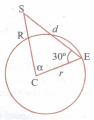
Given CE = r, CS= Rand SE = d
Given LSCE = \(\alpha\)
In ΔSCE, applying cosine rule, we get
d2 = -2 + R2 - 2 (r)(R)cos\(\alpha\)
d2 = r2+ R2 - 2r.R.cos \(\alpha\)
Dividing by R2 throughout we get,
\(\frac { { d }^{ 2 } }{ { R }^{ 2 } } =\frac { { r }^{ 2 } }{ { R }^{ 2 } } +\frac { { R }^{ 2 } }{ { R }^{ 2 } } -\frac { 2rR }{ { R }^{ 2 } } cos\alpha \)
\(\Rightarrow \frac { { d }^{ 2 } }{ { R }^{ 2 } } =\frac { { r }^{ 2 } }{ { R }^{ 2 } } +1-\frac { 2r }{ R } cos\alpha \)
\(\Rightarrow { d }^{ 2 }={ R }^{ 2 }\left[ 1+\frac { { r }^{ 2 } }{ { R }^{ 2 } } -\frac { 2r }{ R } cos\alpha \right] \)
Taking positive square root both sides we get,
\(d=R\sqrt { 1+\frac { { r }^{ 2 } }{ { R }^{ 2 } } -\frac { 2r }{ R } } cos\alpha \)
d = \(R\sqrt { 1+\left( \frac { r }{ R } \right) ^{ 2 }-2\frac { r }{ R } cos\alpha } \)
Hence proved.
6.
Let C be the position of the target and A and B be the positions of the fighter jet
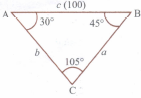
Given ㄥBAC = 30, ㄥABC = 45
ஃ ㄥC = 180 - (30 - 45) = 180 - 75 = 105
Given AB = 100 km
Using sine formula,
\(\frac { a }{ sinA } =\frac { c }{ sinC } \)
\(\Rightarrow \frac { a }{ sin30° } =\frac { 100 }{ sin105° } \)
\(\Rightarrow \frac { a }{ \frac { 1 }{ 2 } } =\frac { 100 }{ sin105° } \Rightarrow 2a=\frac { 100 }{ sin105° } \Rightarrow a=\frac { 50 }{ sin105° } \)
Now, sin 105° = sin (60 + 45) = sin 60 cos 45 + cos 60 sin 45
= \(\frac { \sqrt { 3 } }{ 2 } .\frac { 1 }{ \sqrt { 2 } } +\frac { 1 }{ 2 } .\frac { 1 }{ \sqrt { 2 } } =\frac { \sqrt { 3 } +1 }{ 2\sqrt { 2 } } \)
Substituting (2) in (1) we get,
a = \(\frac { 50 }{ \frac { \sqrt { 3 } +1 }{ 2\sqrt { 2 } } } \Rightarrow a=\frac { 50\left( 2\sqrt { 2 } \right) }{ \sqrt { 3 } +1 } =\frac { 100\sqrt { 2 } }{ \sqrt { 3 } +1 } \times \frac { \sqrt { 3 } -1 }{ \sqrt { 3 } -1 } \)
a = \(\frac { 100\left( \sqrt { 6 } -\sqrt { 2 } \right) }{ 3-1 } =50\left( \sqrt { 6 } -\sqrt { 2 } \right) km\)
7.
Sum of the roots = sin 15o + cos 15o
= sin (45 - 30) + cos (45 - 30)
= (sin 45 cos 30 - cos 45 sin 30) + (cos 45 cos 30 + sin 45 sin 30)
= \(\left( \frac { 1 }{ \sqrt { 2 } } .\frac { \sqrt { 3 } }{ 2 } -\frac { 1 }{ \sqrt { 2 } } .\frac { 1 }{ 2 } \right) +\left( \frac { 1 }{ \sqrt { 2 } } .\frac { \sqrt { 3 } }{ 2 } -\frac { 1 }{ \sqrt { 2 } } .\frac { 1 }{ 2 } \right) \)
= \(\frac { \sqrt { 3 } }{ 2\sqrt { 2 } } -\frac { 1 }{ 2\sqrt { 2 } } +\frac { \sqrt { 3 } }{ 2\sqrt { 2 } } +\frac { 1 }{ 2\sqrt { 2 } } =\frac { 2\sqrt { 3 } }{ 2\sqrt { 2 } } =\frac { \sqrt { 3 } }{ \sqrt { 2 } } \times \frac { \sqrt { 2 } }{ \sqrt { 2 } } =\frac { \sqrt { 6 } }{ 2 } \)
Product of the roots = sin 15o cos 15o = \(\frac { 2\sin { { 15 }^{ o } } \cos { { 15 }^{ o } } }{ 2 } \)
= \(\frac { \sin { { 30 }^{ o } } }{ 2 } =\frac { 1 }{ 2 } \times \frac { 1 }{ 2 } =\frac { 1 }{ 4 } \left[ \begin{matrix} since & \sin { 2A } \\ =2\sin { A } & \cos { A } \end{matrix} \right] \)
Required equation is
x2 - x (sum of the roots) + product of the roots = 0
\(\Rightarrow { x }^{ 2 }-x\left( \frac { \sqrt { 6 } }{ 2 } \right) +\frac { 1 }{ 4 } =0\)
Multiplying by 4 we get \({ 4x }^{ 2 }-2\sqrt { 6x } +1=0\)
8.
Since 0
ஃ All the trigonometric ratios are positive
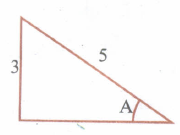
= \(\sqrt { { 5 }^{ 2 }-{ 3 }^{ 2 } } =4\)
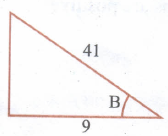
= \(\sqrt { { 41 }^{ 2 }-{ 9 }^{ 2 } } \)
= 40
\(sinA=\frac { 3 }{ 5 } \quad sinB=\frac { 40 }{ 41 } \)
\(cosA=\frac { 4 }{ 5 } \quad cosB=\frac { 9 }{ 41 } \)
cos (A - B) = cosA cosB + sinAsinB
= \(\frac { 4 }{ 5 } .\frac { 9 }{ 41 } +\frac { 3 }{ 5 } .\frac { 40 }{ 41 } \)
= \(\frac { 36 }{ 205 } +\frac { 120 }{ 205 } =\frac { 156 }{ 205 } \)
9.
\(3 \mathrm{a}=12 \Rightarrow \mathrm{a}=4\)
Maximum area is obtained when it is an equilateral triangle with side 4 m each
10.
(c)
11.
\(\cos p \theta+\cos q \theta=0 \)
\(2 \cos \left(\frac{p+q}{2}\right) \theta \cdot \cos \left(\frac{p-q}{2}\right) \theta=0 \)
\(\Rightarrow 2 \cos \left(\frac{p+q}{2}\right) \theta=0 \)
\(\cos \left(\frac{\mathrm{p}-\mathrm{q}}{2}\right) \theta=0\)
\(\text { Principal angle is } \pi / 2\)
\(\therefore\left(\frac{p+q}{2}\right) \theta =n \pi \pm \pi / 2 \)
\(\Rightarrow(p+q) \cdot \theta =2 n \pi \pm \pi \)
\(\theta =\frac{\pi(2 n \pm 1)}{p+q} \)
\(\text { Similarly, } \theta=\frac{\pi(2 n \pm 1)}{p-q}\)
12.
\(\sqrt{2+2 \cos 4 \theta} =\sqrt{2+2\left(2 \cos ^{2} 2 \theta-1\right)} \)
\(=\sqrt{4 \cos ^{2} 2 \theta} \)
\(=2 \cos 2 \theta \)
\(\sqrt{2+\sqrt{2+2 \cos 4 \theta}} =\sqrt{2+2 \cos 2 \theta} \)
\(=\sqrt{2+2\left(2 \cos ^{2} \theta-1\right)} \)
\(=\sqrt{4 \cos ^{2} \theta} \)
\(=\pm 2 \cos \theta \)
\(\Rightarrow \pi<2 \theta<\frac{3 \pi}{2} \)
\(\Rightarrow \frac{\pi}{2}<\theta<\frac{3 \pi}{4} \text { in II quadrant. } \)
\(\therefore \sqrt{2+\sqrt{2+2 \cos 4 \theta}}=-2 \cos \theta\)
13.
\(\cos 28^{\circ}+\sin 28^{\circ} =\mathrm{k}^{3} \)
\(\cos 28^{\circ}+\sin \left(90^{\circ}-62^{\circ}\right) =\mathrm{k}^{3} \)
\(\cos 28^{\circ}+\cos 62^{\circ} =\mathrm{k}^{3} \)
\(2 \cos 45^{\circ} \cos 17^{\circ} =\mathrm{k}^{3} \)
\(2 \frac{1}{\sqrt{2}} \cos 17^{\circ} =\mathrm{k}^{3} \)
\(\cos 17^{\circ} =\frac{\mathrm{k}^{3}}{\sqrt{2}} \)

11th Standard Syllabus & Materials
11th Standard
TN 11th Tamil பீடு பெற நில் - செய்யுள் - காவடிச்சிந்து Important Questions And Answers Study Material - QB365 Set A
NEW11th Standard
TN 11th Tamil பீடு பெற நில் - உரைநடை - மலை இடப்பெயர்கள் : ஓர் ஆய்வு Important Questions And Answers Study Material - QB365 Set A
NEW11th Standard
TN 11th Tamil மாமழை போற்றுதும் - துணைப்பாடம் - யானை டாக்டர் Important Questions And Answers Study Material - QB365 Set A
NEW11th Standard
TN 11th Tamil மாமழை போற்றுதும் - செய்யுள் - ஐங்குறுநூறு Important Questions And Answers Study Material - QB365 Set A



Tamilnadu Stateboard 11th Standard Subjects
Maths

Commerce

Economics

Biology

Business Maths and Statistics

Accountancy

Computer Science

Physics

Chemistry
Maths
Biology
Economics
Physics
Chemistry

History
Business Maths and Statistics

Computer Science
Accountancy

Computer Applications
History
Computer Technology
Commerce
Computer Applications
Computer Technology

Tamil

English

French
Tamilnadu Stateboard Standards

