
 100% FREE ACCESS
11th Standard Syllabus & Materials
11th Standard
TN 11th Tamil இயற்கை வேளாண்மை,சுற்றுச்சூழல் -செய்யுள் - மனோன்மணீயம் Important Questions And Answers Study Material - QB365 Set A
NEW11th Standard
TN 11th Tamil என்னுயிர் என்பேன் -துணைப்பாடம் - இசைத்தமிழர் இருவர் Important Questions And Answers Study Material - QB365 Set A
NEW11th Standard
TN 11th Tamil மொழி கலை -செய்யுள் - ஒவ்வொரு புல்லையும் Important Questions And Answers Study Material - QB365 Set A
NEW11th Standard
TN 11th Tamil பீடு பெற நில் - இலக்கணம் - பகுபத உறுப்புகள் Important Questions And Answers Study Material - QB365 Set A
NEW11th Standard
TN 11th Tamil பீடு பெற நில் - துணைப்பாடம் - வாடிவாசல் Important Questions And Answers Study Material - QB365 Set A
NEW11th Standard
TN 11th Tamil பீடு பெற நில் - செய்யுள் - குறுந்தொகை Important Questions And Answers Study Material - QB365 Set A

Published on: 04/09/2019
Two Dimensional Analytical Geometry
Download Tamil Nadu 11th Standard Maths question papers, model tests, one-mark questions, important questions, and public exam papers in PDF format. Free study materials and answer keys for TN State Board students.
Questions + Answers key
Take MCQ Maths Test1.
The length L (in cm) of a copper rod is a linear function of its Celsius temperature C. In an experiment if L = 124.942 when C = 20 and L = 125.134 when C = 110, express L in terms of C.
2.
The sum of the squares of the distances of a moving point from two fixed points (a, 0) and (-a, 0) is equal to 2c2. Find the equation to its locus.
3.
Find the equation of the straight line parallel to 5x - 4y + 3 = 0 and having x-intercept 3.
4.
Find the locus of P, if for all values of \(\alpha\) the co-ordinates of a moving point P is (9 cos \(\alpha\) 9 sin \(\alpha\))
5.
The equation of the line with slope 2 and the length of the perpendicular from the origin equal to \(\sqrt5\) is
x - 2y = \(\sqrt5\)
2x - y =\(\sqrt5\)
2x - y = 5
x - 2y - 5 = 0
6.
The intercepts of the perpendicular bisector of the line segment joining (1, 2) and (3, 4) with coordinate axes are
5, -5
5, 5
5, 3
5, -4
7.
Equation of the straight line that forms an isosceles triangle with coordinate axes in the I-quadrant with perimeter 4 + 2\(\sqrt{2}\) is
x + y + 2 = 0
x + y - 2 = 0
\(x+y-\sqrt{2}=0\)
\(x+y+\sqrt{2}=0\)
8.
Which of the following point lie on the locus of 3x2+ 3y2- 8x - 12y + 17 = 0
(0, 0)
(-2, 3)
(1, 2)
(0, -1)
9.
The equation of the locus of the point whose distance from y-axis is half the distance from origin is
x2 + 3y2 = 0
x2- 3y2 = 0
3x2+ y2 = 0
3x2- y2 = 0
10.
If P is length of perpendicular from origin to the line whose intercepts on the axes are a and b, then show that \(\frac{1}{p^2}=\frac{1}{a^2}+\frac{1}{b^2}\)
11.
If the points P(6, 2) and Q(-2, 1) and R are the vertices of a Δ PQR and R is the point on the locus of y = x2- 3x + 4, then find the equation of the locus of centroid of Δ PQR
12.
If θ is a parameter, find the equation of the locus of a moving point, whose coordinates are x = a cos3 θ, y = a sin3 θ.
13.
A straight rod of length 8 units slides with its ends A and B always on the x and y axes respectively. Find the locus of the mid point of the line segment AB.
1.
Given L1 = 124.942, C1 = 20 \(\Rightarrow\) (124.942,20)
and L2 = 125.134, C2 = 110 \(\Rightarrow\) (125.134,110)
Using two point form,
\(\frac{L-L_1}{L_2-L_1}=\frac{C-C_1}{C_2-C_1}\Rightarrow\frac{L-124.942}{125.134-124.942}\)
\(=\frac{C-20}{110-20}\)
\(\Rightarrow\frac{L-124.942}{0.192}=\frac{C-20}{90}\)
\(\Rightarrow L-124.942=\frac{0.192}{90}(C-20)\)
\(\Rightarrow\) L-124.942 = 0.0021 (C - 20)
\(\Rightarrow\) L-124.942 = 0.0021 (C - 20)
\(\Rightarrow\) L-124.942 = 0.0021C-.042
\(\Rightarrow\) L = 0.0021C - 0.042 + 124.942
\(\Rightarrow\) L = 0.0021C + 124.9
2.
Let P(x1, y1) be the moving point and A(a, 0) B(-a, 0) are the fixed points
Given PA2 + PB2 = 2C2
\(\Rightarrow\) (x1 - a)2+ (y1 - 0)2 + (x1 + a)2 + (y1 - 0)2 = 2c2 [using distance formula]

\(\Rightarrow2x^2_1+2y^2_1+2a^2=2c^2\)
\(\Rightarrow x^2_1+y^2_1+a^2=c^2\)
\(\Rightarrow x^2_1+y^2_1=c^2-a^2\)
\(\therefore\) Locus of (x1, y1) is x2+ y2 = c2- a2
3.
Since x-intercept is 3, A (3, 0) will be a point on the required line.
Any line parallel to 5x - 4y + 3 = 0 will be of the form 5x - 4y + k = 0
Substituting the point (3, 0) we get
+15 - 0 + k = 0
\(\Rightarrow \) k = -15
\(\therefore\) Required equation of the line is 5x - 4y + -15 = 0
4.
(9 cos \(\alpha\), 9 sin \(\alpha\))
Let P (h, k) be any point on the required path
From the given information, we have
h = 9 cos \(\alpha\) and k = 9 sin \(\alpha\)
\(\Rightarrow\) \({{h}\over{9}}\) = cos \(\alpha\) and \({{k}\over{9}}\) = sin \(\alpha\)
\({\left({{h}\over{9}} \right)}^{2}+{\left({{k}\over{9}} \right)}^{2}=cos^2\alpha+sin^2\alpha\)
\(\Rightarrow\) \({{h^2}\over{81}}+{{k^2}\over{81}}=1\) \([\because sin^2\ \alpha+cos^2\ \alpha=1]\)
\(\Rightarrow\) h2+ k2 = 81
\(\therefore\) Locus of (h, k) is x2 + y2 = 81
5.
Let y = 2x + c be the required line.
Given perpendicular distance from origin'to this line is \(\sqrt5\)
\(\frac{c}{\sqrt{1+4}}=\sqrt{5}\)
c = 5
This required line is y - 2x + 5
2x - y + 5 = 0
6.
Equation of line joining (1, 2) and (3, 4) is
\(\frac{y-2}{4-2} =\frac{x-1}{3-1} \)
\(x-y+1 =0 \)
Any line perpendicular to this x + y + k = 0
This passes through midpoint of (1, 2) and (3, 4)
That is (2, 3)
k = -5, x+y-5 = 0
x intercept is 5, y intercept is 5.
7.
\(\text {Perimeter }=4+2 \sqrt{2}\)
\(a+a+\sqrt{2} =4+2 \sqrt{2} \)
\(2 a+\sqrt{2} a =4+2 \sqrt{2} \)
\(\therefore a =2 \)
\(\text {Equation of line is } \frac{x}{2}+\frac{y}{2}=1\)
\(x+y-2=0\)
8.
\((1,2) \text { lies on } 3 x^{2}+3 y^{2}-8 x-12 y+17=0\)
\(\text { Because, } 3(1)^{2}+3(2)^{2}-8(1)-12(2)+17\)
\(=3+12-8-24+17=0\)
9.
Let the point be (x, y)
Its distance from origin is \(\sqrt{x^{2}+y^{2}}\)
Given \(x =\frac{1}{2} \sqrt{x^{2}+y^{2}} \)
\(\Rightarrow 2 x =\sqrt{x^{2}+y^{2}} \)
\(4 x^{2} =x^{2}+y^{2} \)
\(3 x^{2}-y^{2}=0 \) is the required equation of the locus
10.
Equation of the line in intercept form is \(\frac{x}{a}+\frac{y}{b}=1\)
⇒ \(\frac{x}{a}+\frac{y}{b}-1=0\)
p=Length of perpendicular from (0, 0) to (1)
= \(\frac { \left| 0+0-1 \right| }{ \sqrt { { \left( \frac { 1 }{ a } \right) }^{ 2 }+{ \left( \frac { 1 }{ b } \right) }^{ 2 } } } \)
= \(\frac { 1 }{ \sqrt { \frac { 1 }{ { a }^{ 2 } } +\frac { 1 }{ { b }^{ 2 } } } } \)
⇒ p\(\frac { 1 }{ \sqrt { \frac { 1 }{ { a }^{ 2 } } +\frac { 1 }{ { b }^{ 2 } } } } \) = 1
Squaring on both sides we get,
\({ p }^{ 2 }\left( \frac { 1 }{ { a }^{ 2 } } +\frac { 1 }{ { b }^{ 2 } } \right) =1\)
⇒ \(\frac { 1 }{ { a }^{ 2 } } +\frac { 1 }{ { b }^{ 2 } } =\frac { 1 }{ { p }^{ 2 } } \)
Hence proved
11.
Let P(h, k) be the locus of centroid of \(\Delta \) PQR.
Given P(6, 2 ) and Q(-2, 1) are the vertices of \(\Delta \) PQR and R(\(\alpha \), \(\beta \)) be the third vertex.
Using the centroid formula,
\(\left( \frac { 6-2+\alpha }{ 3 } ,\frac { 2+1+\beta }{ 3 } \right) =(h,\ k)\) \(\left[ \because \ centroid\ is=\left( \frac { { x }_{ 1 }+{ x }_{ 2 }+{ x }_{ 3 } }{ 3 } ,\frac { { y }_{ 1 }+{ y }_{ 2 }+{ y }_{ 3 } }{ 3 } \right) \right] \)
\(\Rightarrow \left( \frac { 4+\alpha }{ 3 } ,\frac { 3+\beta }{ 3 } \right) =(h,k)\)
Equating the like co-ordinates both sides we get,
\(\Rightarrow \frac { 4+\alpha }{ 3 } =h\)
\(\Rightarrow 4+\alpha =3h\)
\(\Rightarrow \alpha =3h-4....(1)\)
\(\Rightarrow \frac { 3+\beta }{ 3 } =k\quad \)
\(\Rightarrow 3+\beta =3k \Rightarrow \beta =3k-3...(2)\)
Since R(\(\alpha\), \(\beta\)) lies on the locus of y = x2 - 3x + 4 \(\Rightarrow\) \(\beta\) = \(\alpha\)2 - 3a + 4 ..(3)
Substituting (1) and (2) in (3) we get,
3k - 3 = (3h-4)2- 3(3h-4) + 4
\(\Rightarrow \) 3k-3 = 9h2+16-24h-9h+12 + 4
\(\Rightarrow \) 3k - 3 = 9h2 - 33h + 32
\(\Rightarrow \) 9h2- 33h - 3k + 35 = 0
\(\therefore\) Locus of (h, k) is 9x2- 33x - 3y + 35 = 0
12.
Given x = a cos3 \(\theta\) , y = a sin3 \(\theta\)
\(\Rightarrow \quad \frac { x }{ a } ={ cos }^{ 3 }\theta \quad and\quad \frac { y }{ a } ={ sin }^{ 3 }\quad \theta \)
Taking power \(\left( \frac { 2 }{ 3 } \right) \)for both the equations, we get
\({ \left( \frac { x }{ a } \right) }^{ \frac { 2 }{ 3 } }={ \left( { cos }^{ 3 }\theta \right) }^{ \frac { 2 }{ 3 } }and\)
\({ \left( \frac { y }{ a } \right) }^{ \frac { 2 }{ 3 } }={ { (sin }^{ 3 }\theta })^{ \frac { 2 }{ 3 } }\)
\({ \left( \frac { x }{ a } \right) }^{ \frac { 2 }{ 3 } }={ cos }^{ 2 }\theta \quad and\quad { \left( \frac { y }{ a } \right) }^{ \frac { 2 }{ 3 } }={ sin }^{ 2 }\theta \)
We know that cos2 \(\theta\) + sin2 \(\theta\) = 1
\(\therefore { \left( \frac { x }{ a } \right) }^{ \frac { 2 }{ 3 } }+{ \left( \frac { y }{ a } \right) }^{ \frac { 2 }{ 3 } }=1\)
\(\Rightarrow \quad \frac { { x }^{ \frac { 2 }{ 3 } } }{ { x }^{ \frac { 2 }{ 3 } } } +\frac { { x }^{ \frac { 2 }{ 3 } } }{ { x }^{ \frac { 2 }{ 3 } } } =1\)
\(\Rightarrow \quad \frac { { x }^{ \frac { 2 }{ 3 } }+{ y }^{ \frac { 2 }{ 3 } } }{ { a }^{ \frac { 2 }{ 3 } } } =1\)
\(\Rightarrow \quad { x }^{ \frac { 2 }{ 3 } }+{ y }^{ \frac { 2 }{ 3 } }={ a }^{ \frac { 2 }{ 3 } }\)
\(\therefore \) The required point is (0, 12)
13.
Let (h, k) be the mid-point on the required path.
Let the co-ordinates of A and B be A(a, 0) and B(0, b).
As the rod slides, the values of a and b change.
So a and b are two variables.
Then \(h=\frac { a+0 }{ 2 } ,and\quad k=\frac { 0+b }{ 2 } \)
\(\Rightarrow \ h=\frac { a }{ 2 } and\quad k=\frac { b }{ 2 } \)
\(\Rightarrow\) a = 2h and b = 2k
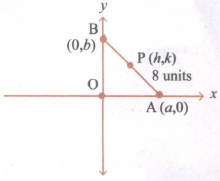
From \(\Delta\)OAB we have
AB2 = OA2 + OB2
\(\Rightarrow\) a2 + b2 = 82 [\(\because\) AB = 8 units]
\(\Rightarrow\) (2h)2 + (2k)2 = 64
\(\Rightarrow\) 4h2 + 4k2 = 64
\(\Rightarrow\) h2 + k2 = 16 [Dividing by 4]
\(\therefore\) Locus of (h, k) is x2 + y2 = 16

11th Standard Syllabus & Materials
11th Standard
TN 11th Tamil பீடு பெற நில் - செய்யுள் - காவடிச்சிந்து Important Questions And Answers Study Material - QB365 Set A
NEW11th Standard
TN 11th Tamil பீடு பெற நில் - உரைநடை - மலை இடப்பெயர்கள் : ஓர் ஆய்வு Important Questions And Answers Study Material - QB365 Set A
NEW11th Standard
TN 11th Tamil மாமழை போற்றுதும் - துணைப்பாடம் - யானை டாக்டர் Important Questions And Answers Study Material - QB365 Set A
NEW11th Standard
TN 11th Tamil மாமழை போற்றுதும் - செய்யுள் - ஐங்குறுநூறு Important Questions And Answers Study Material - QB365 Set A



Tamilnadu Stateboard 11th Standard Subjects
Maths

Commerce

Economics

Biology

Business Maths and Statistics

Accountancy

Computer Science

Physics

Chemistry
Maths
Biology
Economics
Physics
Chemistry

History
Business Maths and Statistics

Computer Science
Accountancy

Computer Applications
History
Computer Technology
Commerce
Computer Applications
Computer Technology

Tamil

English

French
Tamilnadu Stateboard Standards

