
 100% FREE ACCESS
11th Standard Syllabus & Materials
11th Standard
TN 11th Tamil இயற்கை வேளாண்மை,சுற்றுச்சூழல் -செய்யுள் - மனோன்மணீயம் Important Questions And Answers Study Material - QB365 Set A
NEW11th Standard
TN 11th Tamil என்னுயிர் என்பேன் -துணைப்பாடம் - இசைத்தமிழர் இருவர் Important Questions And Answers Study Material - QB365 Set A
NEW11th Standard
TN 11th Tamil மொழி கலை -செய்யுள் - ஒவ்வொரு புல்லையும் Important Questions And Answers Study Material - QB365 Set A
NEW11th Standard
TN 11th Tamil பீடு பெற நில் - இலக்கணம் - பகுபத உறுப்புகள் Important Questions And Answers Study Material - QB365 Set A
NEW11th Standard
TN 11th Tamil பீடு பெற நில் - துணைப்பாடம் - வாடிவாசல் Important Questions And Answers Study Material - QB365 Set A
NEW11th Standard
TN 11th Tamil பீடு பெற நில் - செய்யுள் - குறுந்தொகை Important Questions And Answers Study Material - QB365 Set A

Published on: 02/09/2019
Laws of Motion
Download Tamil Nadu 11th Standard Physics question papers, model tests, one-mark questions, important questions, and public exam papers in PDF format. Free study materials and answer keys for TN State Board students.
Questions + Answers key
Take MCQ Physics Test1.
If a person moving from pole to equator, the centrifugal force acting on him
increases
decreases
remains the same
increases and then decreases
2.
When an object is at rest on the inclined rough surface ____________.
static and kinetic frictions acting on the object is zero
static friction is zero but kinetic friction is not zero
static friction is not zero and kinetic friction is zero
static and kinetic frictions are not zero
3.
Force acting on the particle moving with constant speed is
always zero
need not be zero
always non zero
cannot be concluded
4.
A book is at rest on the table which exerts a normal force on the book. If this force is considered as reaction force, what is the action force according to Newton's third law?
Gravitational force exerted by Earth on the book
Gravitational force exerted by the book on Earth
Normal force exerted by the book on the table
None of the above
5.
When a car takes a sudden left turn in the curved road, passengers are pushed towards the right due to
inertia of direction
inertia of motion
inertia of rest
absence of inertia
6.
What are concurrent forces? State Lami's theorem.
7.
Explain the concept of inertia. Write two examples each for inertia of motion, inertia of rest and inertia of direction.
8.
Can a single isolated force exist in nature? Explain your answer
9.
There is a limit beyond which the polishing of a surface increases frictional resistance rather than decreasing it why?
10.
Why it is not possible to push a car from inside?
11.
Define one newton.
12.
13.
Prove the law of conservation of linear momentum. Use it to find the recoil velocity of a gun when a bullet is fired from it.
1.
(a)
increases
2.
(c)
static friction is not zero and kinetic friction is zero
3.
(b)
need not be zero
4.
(c)
Normal force exerted by the book on the table
5.
(a)
inertia of direction
6.
A collection of forces is said to be concurrent, if the lines of forces act at a common point. Concurrent forces need not be in the same plane. If they are in the same plane, they are concurrent as well as coplanar forces.
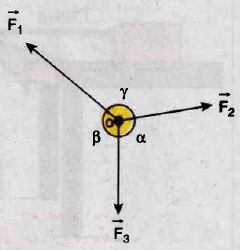
A body, under the action of concurrent forces, is said to be in equilibrium, when there is no change in the state of rest or of uniform motion along a straight line.
The necessary condition for the equilibrium of a body under the action of concurrent forces is that the vector sum of all the forces acting on the body must be zero.
Lami's Theorem: For concurrent forces \(\frac { { F_{ 1 } } }{ sin\ \alpha } =\frac { { F_{ 2 } } }{ sin \ \beta } =\frac { { F_{ 3 } } }{ sin\ \gamma } \). If a system of three concurrent and coplanar forces is in equilibrium, then Lami's theorem states that the magnitude of each force of the system is proportional to sine of the angle between the other two forces. The constant of proportionality is same for all three forces.
7.
Inherent property of all the bodies by virtue of which they cannot change their state of rest or uniform motion along a straight line by their own is called inertia.
Inertia of rest: It is the inability of a body to change by itself, its state of rest. This means a body at rest remains at rest and cannot start moving by its own.
(i) When a horse starts suddenly, the rider tends to fall backward on account of inertia of rest of upper part of the body as explained above.
(ii) Passengers experience a backward push due to inertia of rest.
Inertia of motion: It is the inability of a body to change itself its state of uniform motion i.e., a body in uniform motion can neither accelerate nor retard by its own.
(i) Passengers experience a forward push due to inertia of motion.
(ii) A person jumping out of a moving train may fall forward.
Inertia of direction: It is the inability of a body to change by itself direction of motion.
(i) A stone moves tangential to circle due to inertia of direction.
(ii) When a car goes round a curve suddenly, the person sitting inside is thrown outwards.
8.
No, a single isolated force cannot exist in nature because it violates the Newton's third law.
9.
(i) Due to excessive polishing, more molecules of the two surfaces come closer. Thus they form more bonds and offer great resistances.
(ii) Because friction arises due to molecular adhesion i.e. due to electrostatic forces.
10.
(i) According to Newton's third law when one body exerts a force on a second body, the second body simultaneously exerts a force equal in magnitude and opposite in direction on the first body.
(ii) When you push a car from inside, the reaction force of your pushing is balanced out by your body moving backward and eventually the seat behind you pushes against to bring things to static equilibrium.
11.
One Newton is that force which produces an acceleration of 1 m/s-2 in a body of mass 1 kilogram.
∴ 1 Newton = 1 kg m/s2
12.
13.
Conservation of linear momentum is equivalent to Newton's third law of motion. If no external force acts on a system (called isolated) of constant mass, the total momentum of the system remains constant with time.
According to this law for a system of particles \(\vec{F}=\frac{d \vec{p}}{d t}\)
In the absence of external force F = 0 and \(\vec{p}\) = constant
i.e., \(p_{1}+\vec{p}_{2}+\vec{p}_{3}+\dots=\) constant
or \(m_{1} \vec{v}_{1}+m_{2} \vec{v}_{2}+m_{3} \vec{v}_{3}+\dots=\) constant
This equation shows that in absence of external force for a closed system the linear momentum of individual particles may change but their sum remains unchanged with time. For a system of two particles in absence of external force by law of conservation of linear momentum.
\(\vec{p}_{1}+\vec{p}_{2} =\text { constant } \)
\(m_{1} \vec{v}_{1}+m_{2} \vec{v}_{2} =\text { constant } \)
\(m_{1} \frac{d \vec{v}_{1}}{d t}+m_{2} \frac{d \vec{v}_{2}}{d t} =0 \Rightarrow m_{1} \vec{a}_{1}+m_{2} \vec{a}_{2}=0 \Rightarrow \vec{F}_{1}+\vec{F}_{2}=0 \)
\(\therefore \vec{F}_{2} =-\vec{F}_{1}\)
For every action there is equal and opposite reaction which is Newton's third law of motion.
Recoiling of a gun: For bullet and gun system, the force exerted by trigger will be internal so the momentum of the system remains unaffected.
Let mG= mass of gun, mB= mass of bullet, vG velocity of gun, vB= velocity of bullet Initial momentum of system =0
Final momentum of system \(=m_{G} \vec{v}_{G}+m_{B} \vec{v}_{B}\)
By the law of conservation linear momentum \(m_{G} \vec{v}_{G}+m_{B} \vec{v}_{B}=0\)
So recoil velocity \(v_{G}=-\frac{m_{B}}{m_{G}} \vec{v}_{B}\)
Here negative sign indicates that the velocity of recoil \(\vec{v}_{G}\) is opposite to the velocity of the bullet.
\(v_{G} \propto \frac{1}{m_{G}}\) i.e. higher the mass of gun, lesser the velocity of recoil of gun.
While firing the gun must be held tightly to the shoulder, this would save hurting the shoulder because in this condition the body of the shooter and the gun behave as one body. Total mass become large and recoil velocity becomes too small.
\(\vec{v}_{G} \propto \frac{1}{m_{G}+m_{\operatorname{man}}}\)

11th Standard Syllabus & Materials
11th Standard
TN 11th Tamil பீடு பெற நில் - செய்யுள் - காவடிச்சிந்து Important Questions And Answers Study Material - QB365 Set A
NEW11th Standard
TN 11th Tamil பீடு பெற நில் - உரைநடை - மலை இடப்பெயர்கள் : ஓர் ஆய்வு Important Questions And Answers Study Material - QB365 Set A
NEW11th Standard
TN 11th Tamil மாமழை போற்றுதும் - துணைப்பாடம் - யானை டாக்டர் Important Questions And Answers Study Material - QB365 Set A
NEW11th Standard
TN 11th Tamil மாமழை போற்றுதும் - செய்யுள் - ஐங்குறுநூறு Important Questions And Answers Study Material - QB365 Set A



Tamilnadu Stateboard 11th Standard Subjects

Maths

Commerce

Economics

Biology

Business Maths and Statistics

Accountancy

Computer Science
Physics

Chemistry
Maths
Biology
Economics
Physics
Chemistry

History
Business Maths and Statistics

Computer Science
Accountancy

Computer Applications
History
Computer Technology
Commerce
Computer Applications
Computer Technology

Tamil

English

French
Tamilnadu Stateboard Standards

