
 100% FREE ACCESS
11th Standard Syllabus & Materials
11th Standard
TN 11th Tamil இயற்கை வேளாண்மை,சுற்றுச்சூழல் -செய்யுள் - மனோன்மணீயம் Important Questions And Answers Study Material - QB365 Set A
NEW11th Standard
TN 11th Tamil என்னுயிர் என்பேன் -துணைப்பாடம் - இசைத்தமிழர் இருவர் Important Questions And Answers Study Material - QB365 Set A
NEW11th Standard
TN 11th Tamil மொழி கலை -செய்யுள் - ஒவ்வொரு புல்லையும் Important Questions And Answers Study Material - QB365 Set A
NEW11th Standard
TN 11th Tamil பீடு பெற நில் - இலக்கணம் - பகுபத உறுப்புகள் Important Questions And Answers Study Material - QB365 Set A
NEW11th Standard
TN 11th Tamil பீடு பெற நில் - துணைப்பாடம் - வாடிவாசல் Important Questions And Answers Study Material - QB365 Set A
NEW11th Standard
TN 11th Tamil பீடு பெற நில் - செய்யுள் - குறுந்தொகை Important Questions And Answers Study Material - QB365 Set A

Published on: 26/07/2019
Laws of Motion
Download Tamil Nadu 11th Standard Physics question papers, model tests, one-mark questions, important questions, and public exam papers in PDF format. Free study materials and answer keys for TN State Board students.
Questions + Answers key
Take MCQ Physics Test1.
Three blocks of masses 2 kg, 3 kg and 5 kg are connected to each other with light string & then placed on a frictionless surface. The system is pulled by a force F = 10N, then tension T1 is ______________.
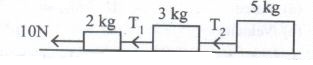
1N
8N
5N
10N
2.
A spacecraft of mass M moving with velocity v in free space explodes and breaks into two pieces. After the explosion a mass m of the spacecraft is left stationary. The velocity of other part is _______________.
\(\frac { mv }{ M-n } \)
\(\frac { M+n }{ Mv } \)
\(\frac { Mv }{ M-m } \)
\(\frac { Mv }{ m } \)
3.
A body of mass 3 kg moves with an acceleration 2ms-2. The change in momentum in one second is _______________.
2/3 kgms-1
3/2 kgms -1
6 kgms -1
1.5 kgms -1
4.
A body is moving in a circle with uniform speed v. In moving from a point to another diametrically opposite point.
The momentum changes by mv
K.E. changes by 1/2mv2
The momentum changes by 2mv
K.E changes by mv2
5.
Momentum is closely related to _______________.
Force
Impulse
Velocity
K.E
6.
Action and reaction ___________
act on two different objects
have opposite direction
have equal magnitude
all of these
7.
An object of mass m begins to move on the plane inclined at an angle θ. The coefficient of static friction of inclined surface is μs. The maximum static friction experienced by the mass is
mg
μs mg
μs mg sin ፀ
μs mg cos ፀ
8.
A particle of mass m sliding on the smooth double inclined plane (shown in figure) will experience
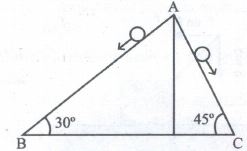
greater acceleration along the path AB
greater acceleration along the path AC
same acceleration in both the paths
no acceleration in both the paths
9.
Two masses m1 and m2 are experiencing the same force where m1 < m2.The ratio of their acceleration \(\frac { { a }_{ 1 } }{ { a }_{ 2 } } \) is _____________.
1
less than 1
greater than 1
all the three cases
10.
When a car takes a sudden left turn in the curved road, passengers are pushed towards the right due to
inertia of direction
inertia of motion
inertia of rest
absence of inertia
11.
Give examples for action - reaction forces
12.
Give examples for inertia frames
13.
When a person walks on a surface, the frictional force exerted by the surface on the person is opposite to the direction of motion. True or false?
14.
When walking on ice one should take short steps. Why?
15.
Why does a parachute descend slowly?
16.
State the empirical laws of static and kinetic friction.
17.
What is the meaning by 'pseudo force'?
18.
Briefly explain how is a vehicle able to go round a level curved track. Determine the maximum speed with which the vehicle can negotiate this curved track safely.
19.
Briefly explain rolling friction.
20.
Explain the motion of blocks connected by a string in
i) Vertical motion
ii) Horizontal motion.
21.
A force of 10 N changes velocity of a body from 20 ms-1 to 40 ms-1 in 8 seconds. How much force is required to bring about the same change in 4s.
22.
Write the effects of centrifugal force
23.
What is Centripetal force? Write the expression for it?
1.
(b)
8N
2.
(c)
\(\frac { Mv }{ M-m } \)
3.
(c)
6 kgms -1
4.
(c)
The momentum changes by 2mv
5.
(b)
Impulse
6.
(d)
all of these
7.
(d)
μs mg cos ፀ
8.
(b)
greater acceleration along the path AC
9.
(c)
greater than 1
10.
(a)
inertia of direction
11.
It means that when the object 1 exerts force on the object 2, the object 2 exerts equal and opposite force on the body 1 at the same instant.
(a) Hammer and the nail
(b) Ball bouncing off the wall
(c) Walking on the floor with friction.
12.
(i) The car is moving with uniform velocity v with respect to a person standing (at rest) on the ground.
(ii) As the car is moving with constant velocity with respect to ground to the person is at rest on the ground, both frames (with respect to the car and to the ground) are inertial frames.
13.
False
14.
It is to avoid slipping. Smaller step causes more normal force and thereby more friction.
15.
The surface area of parachute is very large. And when it descends downwards, the air provides resistance to it and so it descends slowly.
16.
Limiting static/kinetic friction between any pair of dry unlubricated surfaces is independent of apparent area in contact.
Limiting static/kinetic friction between any pair of unlubricated surfaces depends on nature of material of the surfaces in contact.
Limiting static/kinetic friction between any pair of dry unlubricated surfaces is directly proportional to the normal reaction.
Static Friction: If Fs is static friction and R (N) is a normal reaction
Then
Fs ∝ R
∴ Fs = μsR
μs = coefficient of static friction.
∴ μs = \(\frac{F_s}{R}\)
The coefficient of static friction is defined as the ratio of the static friction to normal reaction
Kinetic friction: If Fs is static friction and R (N) is a normal reaction
Then
Fk ∝ R
∴ Fk = μsR
μk = coefficient of static friction.
∴ μk = \(\frac{F_k}{R}\)
The coefficient of kinetic friction is defined as the ratio of the kinetic friction to normal reaction
17.
The centrifugal force appears to act on the particle, only when we analyses the motion from a rotating frame. With respect to an inertial frame there is only centripetal force which is given by the tension in the string. For this reason centrifugal force is called as a 'pseudo force'. A pseudo force has no origin, It arises due to the non-inertial nature of the frame considered.
18.
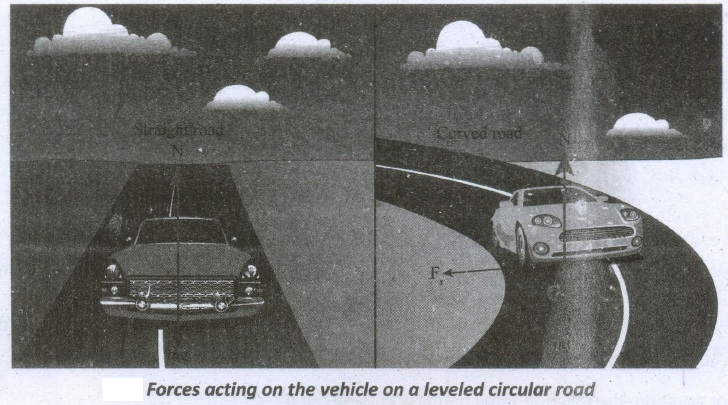
When a vehicle travels in a curved path, there must be a centripetal force acting on it. This centripetal force is provided by the frictional force between tyre and surface of the road. Consider a vehicle of mass 'm' moving at a speed 'v' in the circular track of radius 'r'. There are three forces acting on the vehicle when it moves as shown in the figure.
(i) Gravitational force (mg) acting downwards
(ii) Normal force (mg) acting upwards
(iii) Frictional force (Fs) acting horizontally inwards along the road
Suppose the road is horizontal then the normal force and gravitational force are exactly equal and opposite. The centripetal force is provided by the force of static friction Fs between the tyre and surface of the road which acts towards the center of the circular track,
\(\frac { m{ v }^{ 2 } }{ r } ={ F }_{ s }\)
As we have already seen in the previous section, the static friction can increase from zero to a maximum value
Fs ≤ μsmg
There are two conditions possible namely without skidding and skidding.
For without skidding \(\frac { m{ v }^{ 2 } }{ r } \le { \mu }_{ s }mg\), or \({ \mu }_{ s }\ge \frac { { v }^{ 2 } }{ rg } \) or \(\sqrt { { \mu }_{ s }rg } \ge v\)
The static friction would be able to provide necessary-centripetal force to bend the car on the road.
19.
(i) One of the important applications is suitcases with rolling on coasters. Rolling wheels makes it easier than carrying luggage.
(ii) When an object moves on a surface, essentially it is sliding on it. But wheels move on the -surface through rolling motion.
(iii) In rolling motion when a wheel moves on a surface, the point of contact with surface is always at rest.
(iv) Since the point of contact is at rest, there is no relative motion between the wheel and surface. Hence the frictional force is very less. At the same time if an object moves without a wheel, there is a relative motion between the object and the surface.
(v) As a result frictional force is larger. This makes it difficult to move the object.
(vi) Ideally in pure rolling, motion of the point of contact with the surface should be at rest, but in practice it is not so.
(vii) Due to the elastic nature of the surface at the point of contact there will be some deformation on the object at this point on the wheel or surface.
(viii) Due to this deformation, there will be minimal friction between wheel and surface. It is called 'rolling friction'. In fact, 'rolling friction' is much smaller than kinetic friction.
20.
i) Vertical motion
Consider two blocks of masses m1 and m2 (m1 > m2) connected by a light and inextensible string that passes over a pulley as shown in fig. A little consideration will show, that the greater mass m1 will move downwards, whereas the smaller one will move upwards. Since the string is inextensible, the upward acceleration of the mass m2 will be equal to the downward acceleration of the mass m1
| Condition | Acceleration | Tension |
.JPG) |
T - m2g = m2a .......(1) T - m1g = m1a m1g - T = m1a .......(2) Adding equations (1) and (2), we get m1g - m2g = m1a + m2a (m1 - m2)g = (m1 + m2)a .......(3) (vi) From equation (3), the acceleration of both the masses is \(a=\left( {{m_1-m_2}\over{m_1+m_2}} \right)g\) .......(4) If both the masses are equal (m1 = m2), from equation then a = 0 |
T - m2g = m2a .......(1)\(a=\left({m_1-m_2 \over m_1+m_2 } \right)g\) .......(4) Substituting the equation (4) into(1) \(T-m_2g=m_2\left({m_1-m_2 \over m_1+m_2 } \right)g\) \(T=m_2 g\left(1+{m_1-m_2 \over m_1+m_2 } \right)\) \(T=g\left({2m_1m_2\over m_1+m_2} \right)\) |
ii) Horizontal Motion: Mass m, is kept on a horizontal table and mass m, is hanging through a small pulley as shown in the figure. Assume that there is no friction on the surface. As both blocks are connected to the unstretchable string, if m, moves with an accelerating 'a' downward them m2 move with the same acceleration 'a' horizontally.
| Condition | Acceleration | Tension |
.JPG) (i) The forces acting on mass m2 are 1. Downward gravitational force (m2g) 2. Upward normal force (N) exerted by the surface 3. Horizontal tension (T) exerted by the string. (ii) The forces acting on mass m1 are 1. Downward gravitational force (m1g). 2. Tension (T) acting upwards |
T-m1g= -m1a ...........(1) T = m2 a .......(2) There is no acceleration along y-direction for m2 N - m2g = 0 ⇒ N= m2g .... (3) m2a-m1g= -m1a m2a+m1a= m1g \(a={m_1 \over m_1+m_2}g\) ......(4) |
Tension in the string can be obtained by substituting equation (4) in equation (2). \(T=m_2({m_1 \over m_1+m_2})g\) \(T=g({m_1m_2 \over m_1+m_2})\) This result has an important application in industries. The ropes used in conveyor belts (horizontal motion) work for longer duration than those of cranes and lifts (vertical motion). |
21.
Force F = F1 = F2
F1 = \(\frac { dp }{ { dt }_{ 1 } } ,{ F }_{ 2 }=\frac { dp }{ { dt }_{ 2 } } \)
\({ F }_{ 2 }={ F }_{ 1 }=\frac { { dt }_{ 1 } }{ { dt }_{ 2 } } \)
\(=10\times \frac { 8 }{ 4 } =20N\)
22.
(i) Centrifugal force is a pseudo force, its effects are real.
(ii) When a car takes a turn in a curved road, person inside the car feels an outward force which pushes the person away.
(iii) This outward force is also called centrifugal force.
(iv) If there is sufficient friction between the person and the seat, it will prevent the person from moving-outwards.
23.
(i) If a particle is in uniform circular motion, there must be centripetal acceleration towards the center of the circle.
(ii) If there is acceleration then there must be some force acting on it with respect to an inertial frame. This force is called centripetal force.
(iii) The centripetal acceleration of a particle in the circular motion is given by \(a=\frac { { V }^{ 2 } }{ r } \) and it acts towards center of the circle. According to Newton's second law, the centripetal force is given by
\({ F }_{ Cp }={ ma }_{ cp }=\frac { { MV }^{ 2 } }{ r } \quad a=\frac { { V }^{ 2 } }{ r } \)
(iv) The word Centripetal force means center seeking force in vector notation \({ F }_{ Cp }=\frac { { MV }^{ 2 } }{ r } \hat { r } \). For Uniform circular Motion \({ F }_{ Cp }=-m\omega ^{ 2 }r\hat { r } \)

11th Standard Syllabus & Materials
11th Standard
TN 11th Tamil பீடு பெற நில் - செய்யுள் - காவடிச்சிந்து Important Questions And Answers Study Material - QB365 Set A
NEW11th Standard
TN 11th Tamil பீடு பெற நில் - உரைநடை - மலை இடப்பெயர்கள் : ஓர் ஆய்வு Important Questions And Answers Study Material - QB365 Set A
NEW11th Standard
TN 11th Tamil மாமழை போற்றுதும் - துணைப்பாடம் - யானை டாக்டர் Important Questions And Answers Study Material - QB365 Set A
NEW11th Standard
TN 11th Tamil மாமழை போற்றுதும் - செய்யுள் - ஐங்குறுநூறு Important Questions And Answers Study Material - QB365 Set A



Tamilnadu Stateboard 11th Standard Subjects

Maths

Commerce

Economics

Biology

Business Maths and Statistics

Accountancy

Computer Science
Physics

Chemistry
Maths
Biology
Economics
Physics
Chemistry

History
Business Maths and Statistics

Computer Science
Accountancy

Computer Applications
History
Computer Technology
Commerce
Computer Applications
Computer Technology

Tamil

English

French
Tamilnadu Stateboard Standards

