
 100% FREE ACCESS
11th Standard Syllabus & Materials
11th Standard
TN 11th Tamil இயற்கை வேளாண்மை,சுற்றுச்சூழல் -செய்யுள் - மனோன்மணீயம் Important Questions And Answers Study Material - QB365 Set A
NEW11th Standard
TN 11th Tamil என்னுயிர் என்பேன் -துணைப்பாடம் - இசைத்தமிழர் இருவர் Important Questions And Answers Study Material - QB365 Set A
NEW11th Standard
TN 11th Tamil மொழி கலை -செய்யுள் - ஒவ்வொரு புல்லையும் Important Questions And Answers Study Material - QB365 Set A
NEW11th Standard
TN 11th Tamil பீடு பெற நில் - இலக்கணம் - பகுபத உறுப்புகள் Important Questions And Answers Study Material - QB365 Set A
NEW11th Standard
TN 11th Tamil பீடு பெற நில் - துணைப்பாடம் - வாடிவாசல் Important Questions And Answers Study Material - QB365 Set A
NEW11th Standard
TN 11th Tamil பீடு பெற நில் - செய்யுள் - குறுந்தொகை Important Questions And Answers Study Material - QB365 Set A

Published on: 31/07/2019
Work, Energy and Power
Download Tamil Nadu 11th Standard Physics question papers, model tests, one-mark questions, important questions, and public exam papers in PDF format. Free study materials and answer keys for TN State Board students.
Questions + Answers key
Take MCQ Physics Test1.
2.
What is the minimum velocity with which a body of mass m must enter a vertical loop of radius R so that it can complete the loop?
\(\sqrt{2gR}\)
\(\sqrt{3gR}\)
\(\sqrt{5gR}\)
\(\sqrt{gR}\)
3.
The potential energy of a system increases, if work is done
by the system against a conservative force
by the system against a non-conservative force
upon the system by a conservative force
upon the system by a non- conservative force
4.
The coefficient of restitution e for a perfectly elastic collision is ______________.
1
0
\(\alpha\)
-1
5.
A particle of mass m is being rotated on a vertical circle of radius r. If the speed of particle at the highest point be v, then ______________.
mg=\(\frac{mv^{2}}{r}\)
mg>\(\frac{mv^{2}}{r}\)
mg<\(\frac{mv^{2}}{r}\)
mg≥\(\frac{mv^{2}}{r}\)
6.
Consider an object of mass 2 kg moved by an external force 20 N in a surface having coefficient of kinetic friction 0.9 to a distance 10 m. What is the work done by the external force and kinetic friction? Comment on the result. (Assume g = 10 ms-2)
7.
A car starts from rest and moves on a surface with uniform acceleration. Draw the graph of kinetic energy versus displacement. What information you can get from that graph?
8.
A ball with a velocity of 5 ms-1 impinges at angle of 60° with the vertical on a smooth horizontal plane. If the coefficient of restitution is 0.5. find the velocity and direction after the impact.
9.
Explain the characteristics of elastic and inelastic collision.
10.
Define gravitational potential energy.
11.
Define Potential energy. Write the expression of it.
12.
Two objects of masses 2 kg and 4 kg are moving with the same momentum of 20 kg m s-1.
(a) Will they have same kinetic energy?
(b) Will they have same speed?
13.
What does the work-kinetic energy theorem imply?
14.
What is mechanical energy? What are its two types?
15.
Obtain graphically and mathematically work done by a variable force.
16.
A body of mass of 3 kg initially at rest makes under the action of an applied horizontal force of 10 N on a table with co-efficient of kinetic friction = 0.3, then what is the work done by the applied force in 10s:
17.
What is meant by elastic potential energy? Derive an expression for the elastic potential energy of the spring.
18.
What is inelastic collision? In which way it is different from elastic collision. Mention few examples in day to day life for inelastic collision.
19.
Explain with graphs the difference between work done by a constant force and by a variable force.
1.
(c)
2.
Radius =R
\(v_{1}^{2}-v_{2}^{2}=4 g R\)
\(\text { Tension } T_{2}=\frac{m v_{2}^{2}}{R_{2}}-m g\)
\(\text {To find minimum speed, let } T_{2}=0\)
\(0 =\frac{m v_{2}^{2}}{R}-m g \)
\(\frac{m v^{2}}{R} =m g \)
\(v_{2}^{2}=R g \ v_{2} =\sqrt{g R} \)
\(\text { sub (2) in the eqn (1) we get }\)
\(v_{1}^{2}-(\sqrt{g R})^{2} =4 g R \)
\(v_{1}^{2}-g R =4 g R \)
\(v_{1}^{2} =4 g R+g R \)
\(=5 g R \)
\(v_{1} =\sqrt{5 g R} \)
3.
(a)
by the system against a conservative force
4.
For a perfectly elastic collision
\(\left|v_{1}-v_{2}\right|=\left|u_{1}-u_{2}\right| \)
\(v_{e}=\frac{\left|v_{1}-v_{2}\right|}{\left|u_{1}-u_{2}\right|}=1
\)
5.
(c)
mg<\(\frac{mv^{2}}{r}\)
6.
m = 2 kg, d = 10 m, Fext = 20 N, \(\mu\)k = 0.9.
when an object is in motion on he horizontal surface, it experiences two forces.
(a) External force, Fext = 20 N
(b) Kinetic friction,
fk = \(\mu\)k mg = 0.9 \(\times\) (2) \(\times\) 10 = 18N
The work done by the external force Wext = Fd = 20 x 10 = 200J
The work done by the force of kinetic friction Wk = fkd = (-18) \(\times\) 10 = -180 J. Here the negative sign implies that the force of kinetic friction is opposite to the direction of displacement.
The total work done on the object Wtotal = Wext + Wk = 200 J - 180 J = 20 J.
Since the friction is a non-conservative force, out of 200 J given by the external force, the 180 J is lost and it can not be recovered.
7.
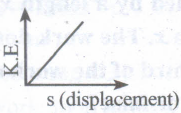
K.E=\(\frac{1}{2}\)mv2
=\(\frac{1}{2}\)m(2 as) [From equation of motion II]
∴ K.E.α S.
8.
The impulse on the ball acts perpendicular to the smooth plane.
(i) The component of velocity of ball parallel to the surface.
(ii) For the component of velocity of ball perpendicular to the surface, apply law of restitution.
The component of velocity parallel to the surface will be changed.
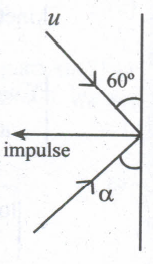
v cos α = u cos 60°
v cos α = 5\(\times\frac{1}{2}=\frac{5}{2}\)
According to law of restitution
v sin α = e.u sin 60° ....(2)
v sin α =\(\frac{1}{2}\times5\times\frac{\sqrt3}{2}=5\frac{\sqrt3}{4}\)
Squaring and adding (1) and (2)
v2 (sin2 α + cos2 α) =\(\left[ \frac { 25 }{ 4 } +\frac { 25\times 3 }{ 16 } \right] \)
v2 = \(\left[ \frac { 25 }{ 4 } +\frac { 75 }{ 16 } \right] \)
v2 = 10.9
∴ v = 3.3 ms-1
9.
Characteristics of elastic collision are
1. Total momentum remains conserved
2. Total kinetic energy remains conserved.
3. In elastic collision conservative forces are involved. Hence total kinetic energy is conserved.
4. In elastic collision, mechanical energy is not dissipated.
Characteristics of inelastic collision are
1. Total momentum is conserved.
2. Total kinetic energy is not conserved.
3. Forces involved are non-conservative forces
4. Mechanical energy is dissipated into heat, light, sound etc.
10.
The gravitational potential energy (U) at some height h is equal to the amount of work required to take the object from ground to that height h with constant velocity.
11.
(i) Potential energy of an object at a point P is defined as the amount of work done by an external force in moving the object at constant velocity from the point 0 (initial location) to the point P (final location).
(ii) At initial point O potential energy can be taken as zero.
(iii) Mathematically, potential energy is defined as \(U=\int { { \vec { F } }_{ a } } .\vec { dr } \)
where the limit of integration ranges from initial, location point O to final location point P.
12.
(a) The kinetic energy of the mass is given by \(KE=\frac { { p }^{ 2 } }{ 2m } \)
For the object of mass 2 kg, kinetic energy is KE1 = \(\frac { ({ 20 })^{ 2 } }{ 2\times 2 } =\frac { 400 }{ 4 } =100 \ J\)
For the object of mass 4 kg, kinetic energy is KE2 = \(\frac { { (20) }^{ 2 } }{ 2\times 4 } =\frac { 400 }{ 8 } =50 \ J\)
Note that KE1 \(\neq \) KE2 i.e., even though both are having the same momentum, the kinetic energy of both masses is not the same. The kinetic energy of the heavier object has lesser kinetic energy than smaller mass. It is because the kinetic energy is inversely proportional to the mass (KE \(\infty \frac { 1 }{ m } \) ) for a given momentum.
(b) As the momentum, p = mv, the two objects will not have same speed.
13.
It implies the following.
(i) If the work done by the force on the body is positive then its kinetic energy increases.
(ii) If the work done by the force on the-body is negative then its kinetic energy decreases.
(iii) If there is no work done by the force on the body then there is no change in its, kinetic energy, which means that the body has moved at constant speed provided its mass remains constant.
14.
(i) The energy produced by mechanical means is called mechanical energy.
(ii) It is classified into 2 types : (1) Kinetic energy (2) Potential energy.
(iii) The energy possessed by a body due to its motion is called kinetic energy. The energy possessed by the body by virtue of its position is called potential energy. SI unit of energy: N m (or) joule (J).
15.
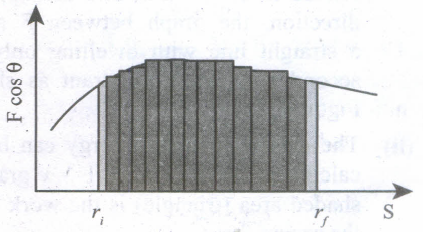
(i) When the component of a variable force F acts on a body, the small work done (dW) by the force in producing a small displacement dr is given by the relation
dw=(f cosθ)dr
[F cos θ is the component of the variable force F]
where, F and θ are variables.
(ii) The total work. done for a displacement from initial position ri to final position rf is given by the relation,
\(W=\int _{ { r }_{ i } }^{ { r }_{ f } }{ dW } =\int _{ { r }_{ i } }^{ { r }_{ f } }{ F\cos\theta \ dr } \ \) ---- (1)
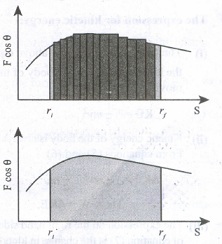
(iii) A graphical representation of the work done by a variable force is shown in Figure 1. The area under the graph is the work done by the variable force.
16.
Applied force = 10 N
Opposing friction forcej= Mk. N = Mk·mg.
= 0.3\(\times\)3\(\times\)9.8 = 8.82 N.
Net accelerating forceF - f = 10N - 8.82N
=1.18N
Acceleration a =\(\frac{force}{mass}\)=\(\frac{8.82N}{3Kg}=2.94 ms^{-2}\)
Distance covered in 10s (assuming w = 0)
\(s=0+\frac{1}{2}at^{2}=\frac{1}{2}\times2.94\times(10^{2}) = 147 m\)
there force workdone by a applied force,
W = Fs = 10\(\times\)147
W = 1470 J
17.
(i) The potential energy possessed by a spring due to a deforming force which stretches or compresses the spring is termed as elastic potential energy. The work done by the applied force against the restoring force of the spring is stored as the elastic potential energy in the spring.
(ii) Consider a spring-mass system. Let us assume a mass, m lying on a smooth horizontal table as shown in Figure. Here, x = 0 is the equilibrium position. One end of the spring is attached to a rigid wall and the other end to the mass.
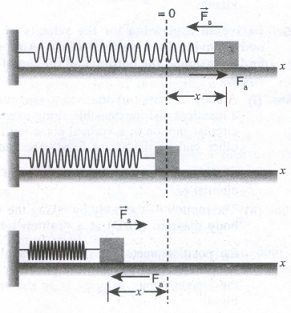
(iii) As long as the spring remains in equilibrium position, its potential energy is zero. Now an external force \(\overrightarrow { { F }_{ a } } \) is applied so that it is stretched by a distance (x) in the direction of the force.
(iv) There is a restoring force called spring force \(\overrightarrow { { F }_{ s } } \) developed in the spring which tries. to bring the mass back to its original position. This applied force and the spring force are equal in magnitude but opposite in direction i.e \(\overrightarrow { { F }_{ a } } \) = - \(\overrightarrow { { F }_{ s } } \) According Hooke's law, the restoring force developed in the spring is
\(\overrightarrow { { F }_{ s } } \) = -k\(\overrightarrow { x } \)
(v) The negative sign in the above expression implies that the spring force is always opposite to that of displacement \(\overrightarrow { x } \) and k is the force constant. There, fore applied force is \(\overrightarrow { { F }_{ a } } \) = +k\(\overrightarrow { x } \) The positive sign implies. that the applied force is in the direction of displacement \(\overrightarrow { x } \). The spring force is an example of variable force as it depends on the displacement \(\overrightarrow { x } \). Let the spring be stretched to a small distance d\(\overrightarrow { x } \). The work done by the applied force on the spring to stretch it by a displacement \(\overrightarrow { x } \) is stored as elastic potential energy.
\(U=\int \overrightarrow { { F }_{ a } } .d\overrightarrow { r } =\overset { x }{ \underset { 0 }{ \int } } \left| \overrightarrow { { F }_{ a } } \right| \left| d\overrightarrow { r } \right| \cos { \theta } \)
\(=\overset { x }{ \underset { 0 }{ \int } } { F }_{ a }dx\cos { \theta } \)
(vi) The applied force \(\overrightarrow { { F }_{ a } } \) and the displacement d\(\overrightarrow { { r } } \) (i.e., here dx ) are in the same direction. As, the initial position is taken as the equilibrium position or mean position, x = 0 is the lower limit of integration.
\(U=\overset { x }{ \underset { 0 }{ \int } } Kxdx\)
\(U={ \left[ \frac { { x }^{ 2 } }{ 2 } \right] }_{ 0 }^{ x }\)
\(U=\frac { 1 }{ 2 } { kx }^{ 2 }\)
(vii) If the initial position is not zero, and if the mass is changed from position xi to xf then the elastic potential energy is
\(U=\frac { 1 }{ 2 } k\left( { x }_{ f }^{ 2 }-{ x }_{ i }^{ 2 } \right) \)
From equations (1) and (2), we observe that the' potential energy of the stretched spring depends on the force constant k and elongation or compression x.
18.
If there is a loss of kinetic energy during a collision, then it is called as an inelastic collision
In the case of inelastic collision,
(i) Total kinetic energy is not conserved.
(ii) Some or all of the forces involved are non-conservative.
(iii) A part of the mechanical energy is transformed into heat, sound, light etc.
Examples for inelastic collision:
(i) Collision between ball and floor
(ii) Collision between two vehicles
Examples for perfectly inelastic collision:
(i) Mud thrown on a wall and sticking to it
(ii) a man jumping into a moving trolley
(iii) a bullet fired into a wooden block and remaining embedded in it.
19.
Work done by a constant force:
(i) When a constant force F acts on a body, the small work done (dW) by the force in producing a small displacement dr is given by the relation,
dW= (F cos\(\theta\) ) dr
(ii) The total work done in producing a displacement from initial position ri to final position rf is,
\(W=\overset { { r }_{ f } }{ \underset { { r }_{ i } }{ \int } } dw\)
\(W=\overset { { r }_{ f } }{ \underset { { r }_{ i } }{ \int } } \left( F\cos { \theta } \right) dr=\left( F\cos { \theta } \right) \)\(\overset { { r }_{ f } }{ \underset { { r }_{ i } }{ \int } } dr=\left( F\cos { \theta } \right) \left( { r }_{ f }-{ r }_{ i } \right) \)
(iii) The graphical representation of the work done by a constant force is shown in Figure. The area under the graph shows the work done by the constant force.
.jpg)
Work done by a variable force:
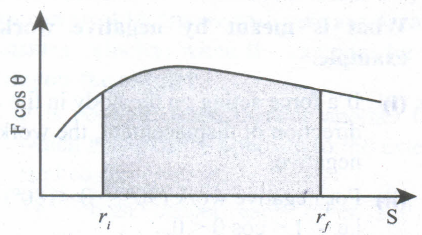
(i) When the component of a variable force F acts on a body, the small work done (dW) by the force in producing a small displacement dr is given by the relation
dw = (F cos\(\theta\)) dr
[F cos\(\theta\) is the component of the variable force F]
where, F and \(\theta\) are variables. The total work done for a displacement from initial position ri to final position rf is given by the relation,
\(W=\overset { { r }_{ f } }{ \underset { { r }_{ i } }{ \int } } dw=\overset { { r }_{ f } }{ \underset { { r }_{ i } }{ \int } } F\cos { \theta } dr\)
(ii) A graphical representation of the work done by a variable force is shown in Figure. The area under the graph is the work done by the variable force.

11th Standard Syllabus & Materials
11th Standard
TN 11th Tamil பீடு பெற நில் - செய்யுள் - காவடிச்சிந்து Important Questions And Answers Study Material - QB365 Set A
NEW11th Standard
TN 11th Tamil பீடு பெற நில் - உரைநடை - மலை இடப்பெயர்கள் : ஓர் ஆய்வு Important Questions And Answers Study Material - QB365 Set A
NEW11th Standard
TN 11th Tamil மாமழை போற்றுதும் - துணைப்பாடம் - யானை டாக்டர் Important Questions And Answers Study Material - QB365 Set A
NEW11th Standard
TN 11th Tamil மாமழை போற்றுதும் - செய்யுள் - ஐங்குறுநூறு Important Questions And Answers Study Material - QB365 Set A



Tamilnadu Stateboard 11th Standard Subjects

Maths

Commerce

Economics

Biology

Business Maths and Statistics

Accountancy

Computer Science
Physics

Chemistry
Maths
Biology
Economics
Physics
Chemistry

History
Business Maths and Statistics

Computer Science
Accountancy

Computer Applications
History
Computer Technology
Commerce
Computer Applications
Computer Technology

Tamil

English

French
Tamilnadu Stateboard Standards

