
 100% FREE ACCESS
11th Standard Syllabus & Materials
11th Standard
TN 11th Tamil இயற்கை வேளாண்மை,சுற்றுச்சூழல் -செய்யுள் - மனோன்மணீயம் Important Questions And Answers Study Material - QB365 Set A
NEW11th Standard
TN 11th Tamil என்னுயிர் என்பேன் -துணைப்பாடம் - இசைத்தமிழர் இருவர் Important Questions And Answers Study Material - QB365 Set A
NEW11th Standard
TN 11th Tamil மொழி கலை -செய்யுள் - ஒவ்வொரு புல்லையும் Important Questions And Answers Study Material - QB365 Set A
NEW11th Standard
TN 11th Tamil பீடு பெற நில் - இலக்கணம் - பகுபத உறுப்புகள் Important Questions And Answers Study Material - QB365 Set A
NEW11th Standard
TN 11th Tamil பீடு பெற நில் - துணைப்பாடம் - வாடிவாசல் Important Questions And Answers Study Material - QB365 Set A
NEW11th Standard
TN 11th Tamil பீடு பெற நில் - செய்யுள் - குறுந்தொகை Important Questions And Answers Study Material - QB365 Set A

Published on: 13/03/2020
11th Standard Physics English Medium All Chapter Book Back and Creative Five Marks Questions 2020
Download Tamil Nadu 11th Standard Physics question papers, model tests, one-mark questions, important questions, and public exam papers in PDF format. Free study materials and answer keys for TN State Board students.
Questions + Answers key
Take MCQ Physics Test1.
Moon and an apple are accelerated by the same gravitational force due to Earth. Compare the acceleration of the two.
2.
Consider a particle undergoing simple harmonic motion. The velocity of the particle at position x1 is v1 and velocity of the particle at position x2 is v2. Show that the ratio of time period and amplitude is
\(\frac { T }{ A } =2\pi \sqrt { \frac { { x }_{ 2 }^{ 2 }-{ x }_{ 1 }^{ 2 } }{ { { v }_{ 1 }^{ 2 }x }_{ 2 }^{ 2 }-{ { v }_{ 2 }^{ 2 }x }_{ 1 }^{ 2 } } } \)
3.
Calculate the angle θ subtended by the two adjacent wooden spokes of a bullock cart wheel is shown in the figure. Express the angle in both radian and degree.
.png)
4.
A solid sphere is undergoing pure rolling. What is the ratio of its translational kinetic energy to rotational kinetic energy?
5.
Suppose an object is thrown with initial speed 10 ms-1 at an angle \(\frac{\pi}{4}\) with the horizontal, what is the range covered? Suppose the same object is thrown similarly in the Moon, will there be any change in the range? If yes, what is the change? (The acceleration due to gravity in the Moon \(g_{moon}=\frac{1}{6}g\)).
6.
An object of mass 10 kg moving with a speed of 15 ms-1 hits the wall and comes to rest within
(a) 0.03 second
(b) 10 second.
Calculate the impulse and average force acting on the object in both the cases.
7.
Explain the similarities and differences of centripetal and centrifugal forces.
8.
The bob of simple pendulum executes S.H.M is water with a period t, while the period of oscillation of the bob is to in air, neglecting frictional force of water and given that the density of the bob is \(\frac{4000}{3}\)kg m-3, find the relationship between t and t0?
9.
Drive the relation between g & Gravitational constant.
10.
Explain the freely falling apple on Earth using the concept of gravitational potential V(r)?
11.
A transverse harmonic wave on a string is described by y(x, t) = 5.0 sin (48t + 0.0264x + ), where x and y are in cm and t in sec. The positive direction of x is from left to right.
(a) What are its amplitude and frequency?
(b) What is the least distance between two success in crests in the wave?
12.
For the travelling : harmonic wave y(x, t) = 2.0 cos 2π [St - 0.0060x + 0.27], where x and yare in cm and t in s.
Calculate the phase difference between oscillatory motion of two points separated by a distance of,
(a) 300 cm
(b) 0.75 m (c)\(\lambda\over 4\)
13.
Motor volume is occupied 1 moleof any (ideal) gas at standard temperature and pressure. Show that it is 22.4 litres.
14.
Explain briefly about oscillations.
15.
What is meant by coefficient of linear expansion superficial & cubical expansion?
16.
Explain postulates of the kinetic theory of gases.
17.
Distinguish between conduction, convection and radiation.
18.
If a ball of skeel (density p =7.8 g cm-3) attains a terminal velocity of 10 cm S-1 when falling in a tank of water (coefficient of viscosity) water = 8.5\(\times\)10-4pa s. What will the terminal velocity in glycerine (P = 1.2 g cm-3, η = 13.2 ρa.s) be?
19.
What is the effect of pressure on the boiling point of a liquid. Describe a simple experiment to demonstrate the boiling of H2O at a temperature much lower than 100°C. Give a practical application of this phenomenon.
20.
What is meant by Doppler effect?
Discuss the following cases
(1) Source in motion and Observer at rest
(a) Source moves towards observer
(b) Source moves away from the observer
(2) Observer in motion and Source at rest
(a) Observer moves towards Source
(b) Observer resides away from the Source
(3) Both are in motion
(a) Source and Observer approach each other
(b) Source and Observer resides from each other
(c) Source chases Observer
(d) Observer chases Source
21.
Discuss the simple pendulum in detail.
22.
Explain Wien’s law and why our eyes are sensitive only to visible rays?
23.
Discuss the ideal gas laws.
24.
State and prove Bernoulli’s theorem for a flow of incompressible, non-viscous, and streamlined flow of fluid.
25.
Derive the expression for the terminal velocity of a sphere moving in a high viscous fluid using stokes force.
26.
Consider a thin uniform circular ring rolling down in an inclined plane without slipping. Compute the linear acceleration along the inclined plane if the angle of inclination is \(45 ^{0}\).
27.
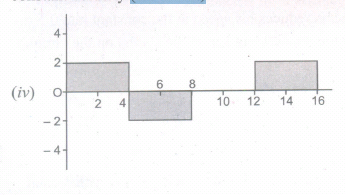
The velocity time graph of a particle is given by
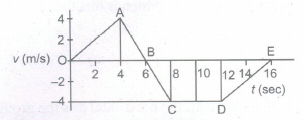
(i) Calculate distance and displacement of particle from given v-t graph.
(ii) Specify the time for which particle undergone acceleration, retardation and moves with constant velocity.
(iii) Calculate acceleration, retardation from given v-t graph.
(iv) Draw acceleration-time graph of given v-t graph.
28.
Two resistors of resistances R1= 150 ± 2 Ohm and R2 = 220 ± 6 Ohm are connected in parallel combination. Calculate the equivalent resistance.
Hint:\(\frac{1}{R'}=\frac{1}{R_1}+\frac{1}{R_2}\)
29.
The force F acting on a body moving in a circular path depends on mass of the body (m), velocity (v) and radius (r) of the circular path. Obtain the expression for the force by dimensional analysis method. (Take the value of k = 1)
30.
Write the rules for "Rounding off" with example
31.
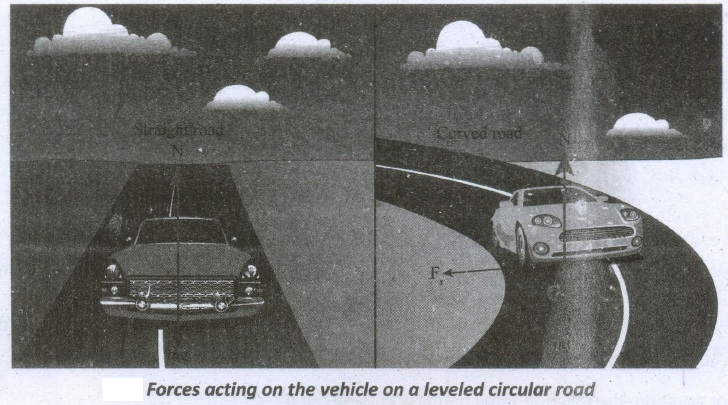
Briefly explain how is a vehicle able to go round a level curved track. Determine the maximum speed with which the vehicle can negotiate this curved track safely.
32.
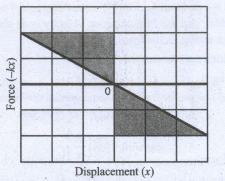
Discuss the force - displacement graph for a spring.
33.
Briefly explain the different types of errors and their causes with an example. How can these error be minimised?
34.
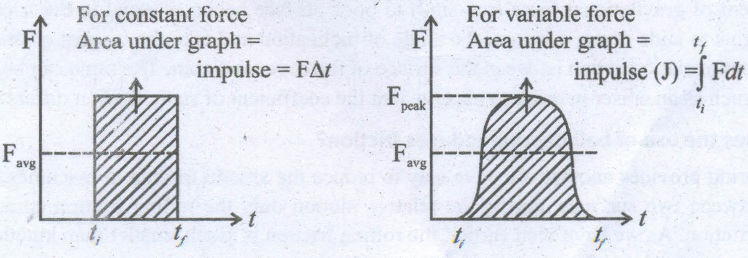
Show how impulse force can be measured graphically.
35.
A car moving uniform motion with speed 120 kmh-2 is brought to a stop within a distance of 200 m. How long does it take for the car to stop?
36.
A car of mass 1200 kg is travelling around a circular path of radius 300 m with a constant speed of 54 km/h. Calculate its angular momentum.
37.
A particle of mass 2 kg moving with a velocity \({ v }_{ 1 }=(\overset { \wedge }{ 2i } -\overset { \wedge }{ 3j } )m/s\) experience a perfectly inelastic collision with another particle of mass 2 kg having velocity \({ v }_{ 2 }=(\overset { \wedge }{ 3i } -\overset { \wedge }{ 6k } )m/s\). Find the velocity and speed of the particle formed.
38.
Define angular momentum and derive the expression of it.
39.
What is inelastic collision? In which way it is different from elastic collision. Mention few examples in day to day life for inelastic collision.
40.
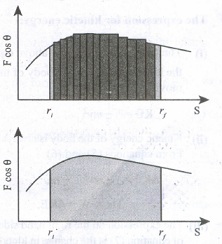
Explain with graphs the difference between work done by a constant force and by a variable force.
41.
Find out the value of g' in your school laboratory?
42.
Consider a mixture of 2 mol of helium and 4 mol of oxygen. Compute the speed of sound in this gas mixture at 300 K.
43.
Calculate the rms speed, average speed and the most probable speed of 1 mole of hydrogen molecules at 300 K. Neglect the mass of electron.
44.
A football at 27°C has 0.5 mole of air molecules. Calculate the internal energy of air in the ball.
1.
The gravitational force experienced by the apple due to Earth
\(F=\frac { { GM }_{ E }M_{ A } }{ { R }^{ 2 } } \)
Here MA– Mass of the apple, ME – Mass of the Earth and R – Radius of the Earth.
Equating the above equation with Newton’s second law
\(M_{ A }a_{ A }=\frac { { GM }_{ E }M_{ A } }{ { R }^{ 2 } } \)
Simplifying the above equation we get,
\(a_{ A }=\frac { { GM }_{ E } }{ { R }^{ 2 } } \)
Here aA is the acceleration of apple that is equal to ‘g’.
Similarly the force experienced by Moon due to Earth is given by
\(F=-\frac { { GM }_{ E }M_{ m } }{ { R }_{ m }^{ 2 } } \)
Here Rm- distance of the Moon from the Earth, Mm – Mass of the Moon
The acceleration experienced by the Moon is given by
\(a_{ m }=\frac { { GM }_{ E } }{ { R }_{ m }^{ 2 } } \)
The ratio between the apple’s acceleration to Moon’s acceleration is given by
\(\frac { { a }_{ A } }{ { a }_{ m } } =\frac { { R }_{ m }^{ 2 } }{ { R }^{ 2 } } \)
From the Hipparchrus measurement, the distance to the Moon is 60 times that of Earth radius. Rm = 60R.
\({ a }_{ A }/{ a }_{ m }=\frac { { \left( 60R \right) }^{ 2 } }{ { R }^{ 2 } } =3600.\)
The apple’s acceleration is 3600 times the acceleration of the Moon.
The same result was obtained by Newton using his gravitational formula. The apple’s acceleration is measured easily and it is 9.8 ms-2. Moon orbits the Earth once in 27.3 days and by using the centripetal acceleration formula, (Refer unit 3).
\(\frac { { a }_{ A } }{ { a }_{ m } } =\frac { 9.8 }{ { 0.00272 } } =3600\)
which is exactly what he got through his law of gravitation.
2.
Using equation
v = \(\omega \sqrt { { A }^{ 2 }-{ x }^{ 2 } } \Rightarrow { v }^{ 2 }={ \omega }^{ 2 }\left( { A }^{ 2 }-{ x }^{ 2 } \right) \)
Therefore, at position x1,
\({ v }_{ 1 }^{ 2 }={ \omega }^{ 2 }\left( { A }^{ 2 }-{ x }_{ 1 }^{ 2 } \right) \) .................(1)
Similarly, at position x2,
\({ v }_{ 2 }^{ 2 }={ \omega }^{ 2 }\left( { A }^{ 2 }-{ x }_{ 2 }^{ 2 } \right) \) ...................(2)
Subtrating (2) from (1), we get
\({ v }_{ 1 }^{ 2 }-{ v }_{ 2 }^{ 2 }={ \omega }^{ 2 }\left( { A }^{ 2 }-{ x_1 }^{ 2 } \right) -{ \omega }^{ 2 }\left( { A }^{ 2 }-{ x }_{ 2 }^{ 2 } \right) \)
\(= { \omega }^{ 2 }\left( { x }_{ 2 }^{ 2 }-{ x }_{ 1 }^{ 2 } \right) \)
\({ \omega }=\sqrt { \frac { { v }_{ 1 }^{ 2 }-{ v }_{ 2 }^{ 2 } }{ { x }_{ 2 }^{ 2 }-{ x }_{ 1 }^{ 2 } } } \Rightarrow T=2\pi \sqrt { \frac { { x }_{ 2 }^{ 2 }-{ x }_{ 1 }^{ 2 } }{ { { v }_{ 1 }^{ 2 } }-{ { v }_{ 2 }^{ 2 } } } } \) ....................(3)
Dividing (1) and (2), we get
\(\frac { { v }_{ 1 }^{ 2 } }{ { v }_{ 2 }^{ 2 } } =\frac { { \omega }^{ 2 }\left( { A }^{ 2 }-{ x }_{ 1 }^{ 2 } \right) }{ { \omega }^{ 2 }\left( { A }^{ 2 }-{ x }_{ 2 }^{ 2 } \right) } \Rightarrow A=\sqrt { \frac { { { v }_{ 1 }^{ 2 }x }_{ 2 }^{ 2 }-{ v }_{ 2 }^{ 2 }{ x }_{ 1 }^{ 2 } }{ { { v }_{ 1 }^{ 2 } }-{ { v }_{ 2 }^{ 2 } } } } \) .................(4)
Dividing equation (3) and equation (4), we have
\(\frac { T }{ A } =2\pi \sqrt { \frac { { x }_{ 2 }^{ 2 }-{ x }_{ 1 }^{ 2 } }{ { { v }_{ 1 }^{ 2 }x }_{ 2 }^{ 2 }-{ { v }_{ 2 }^{ 2 }x }_{ 1 }^{ 2 } } } \)
3.
The full wheel subtends \(2\pi\) radians at the center of the wheel. The wheel is divided into 12 parts (arcs).
So one part sub tends an angle \(\theta=\frac{2\pi}{12}=\frac{\pi}{6}\) radian at the center
Since, \(\pi\) rad=1800, \(\frac{\pi}{6}\) radian is equal to 30 degree.
\(\therefore\) The angle subtended by two adjacent wooden spokes is 30 degree at the center.
4.
The expression for total kinetic energy in pure rolling is,
KE = KETRANS + KEROT
For any object the total kinetic energy as per given equation
\(KE=\frac{1}{2}Mv^{2}_{CM}+\frac{1}{2}Mv^{2}_{CM}(\frac{K^{2}}{R^{2}})\)
\(KE=\frac{1}{2}Mv^{2}_{CM}(1+\frac{K^{2}}{R^{2}})\)
Then, \(\frac{1}{2}Mv^{2}_{CM}(1+\frac{K^{2}}{R^{2}})\)=\(\frac{1}{2}Mv^{2}_{CM}+\frac{1}{2}Mv^{2}_{CM}(\frac{K^{2}}{R^{2}})\)
The above equation suggests that in pure rolling the ratio of total kinetic energy, translational kinetic energy and rotational kinetic energy is given as,
KE:KETRANS KEROT::\((1+\frac{K^{2}}{R^{2}}):1:(\frac{K^{2}}{R^{2}})\)
Now, KETRANS: KEROT::1:\((\frac{K^{2}}{R^{2}})\)
For a solid sphere, \(\frac{K^{2}}{R^{2}}=\frac{2}{5}\)
Then, KETRANS: KEROT::1:\(\frac{2}{5}\) or KETRANS: KEROT:: 5:2
5.
In projectile motion, the range of particle is given by,
\(R=\frac{u^2sin\ 2\theta}{g}\)
\(\theta=\frac{\pi}{4}\ u=v_0=10\ ms^{-1}\)
\(\therefore\ R_{earth}=\frac{(10)^2\sin\frac{\pi}{2}}{9.8}=\frac{100}{9.8}\)
Rearth = 10.20 m (Approximately 10 m)
If the same object is thrown in the Moon, the range will increase because in the Moon, the acceleration due to gravity is smaller than g on Earth,
\(g_{moon}=\frac{g}{6}\)
\(R_{moon}=\frac{u^2sin2\theta}{g_{moon}}=\frac{v_0^2sin2\theta}{\frac{g}{6}}\)
\(\therefore\ R_{moon}=6\times10.24=61.22m\) (Approximately 60 m)
The range attained on the Moon is approximately six times that on Earth.
6.
Initial momentum of the object Pi = 10 \(\times\)15 = 150 kgm s-1
Final momentum of the object pf = 0
Δp = 150 - 0 = 150 kg ms-1
(a) Impulse J = Δp = 150 N s and Average force \({ F }_{ avg }=\frac { \triangle p }{ \triangle t } =\frac { 150 }{ 0.03 } \)= 5000N
b) Impulse J = Δp = 150 N s and Average force Favg =\(\frac { 150 }{ 10 } \)= 15N
7.
| Centripetal | Centrifugal forces |
| It is a real force which is exerted on the body by the external agencies like gravitational force, tension in the string, normal force etc |
It is a pseudo force or fictitious force which cannot arise from gravitational force, tension. force, normal force etc |
| Acts in both inertial and non-inertial frames | Acts only in rotating frames (non-inertial frame) |
| It acts towards the axis of rotation or center of the circle in Circular motion |
It acts outwards from the axis of rotation or radially outwards from the center of the circular motion |
| \(\left| { F }_{ cp } \right| =m{ \omega }^{ 2 }r=\frac { { mv }^{ 2 } }{ r } \) | \(\left| { F }_{ cf } \right| =m{ \omega }^{ 2 }r=\frac { { mv }^{ 2 } }{ r } \) |
| Real force and has real effects | Pseudo force but has real effects |
| Origin of centripetal force is interaction between two objects |
Origin of centrifugal force is inertia. It does not arise from interaction. |
| In inertial frames centripetal force has to be included when free body diagrams are drawn |
In inertial frames there is no centrifugal force. In rotating frames, both centripetal and centrifugal force have to be included when free body diagrams are drawn. |
8.
In air t0=\(2\pi \sqrt { \frac { l }{ g } } \)
Let V be the volume of the bob. Then apparent weight of bob in water = weight of bob in air - up thrust
\(V\rho { g }^{ ' }=V\rho g-v\sigma g\)
\({ g }^{ ' }=\left( 1-\frac { \sigma }{ \rho } \right) g\)
Density of bob, \(\rho \)=\(\frac{400}{3}\) kg m-3
Density of water, \(\sigma \)= 1000 kg m-3
g'=\(\left( 1-\frac { 1000\times 3 }{ 4000 } \right) g\)
=\(\frac{g}{4}\)
Time period of the-pendulum in water
t=\(2\pi \sqrt { \frac { l }{ g } } =2\pi \sqrt { \frac { l }{ \frac { g }{ 4 } } } =2\times 2\pi \sqrt { \frac { l }{ g } } \)
9.
The gravitational force exerted by Earth on the mass m near the surface of the Earth is given by
\(\overrightarrow { F } =-\frac { { GMM }_{ e } }{ { R }_{ e }^{ 2 } } \hat { r } \)
Now equating Gravitational force to Newton's second law,
\(ma=-\frac { { GMM }_{ e } }{ { R }_{ e }^{ 2 } } \hat { r } \)
Hence, acceleration is,
\(\overrightarrow { a } =-\frac { { GM }_{ e } }{ { R }_{ e }^{ 2 } } \hat { r } \)
The acceleration experienced by the object near the surface of the Earth due to its gravity is called acceleration due to gravity. It is denoted by the symbol g. The magnitude of acceleration due to gravity is
\(\left| g \right| =\frac { { GM }_{ e } }{ { R }_{ e }^{ 2 } } \hat { r } \)
It is to be noted that the acceleration experienced by any object is independent of its mass. The value of g depends only on the mass and radius of the Earth.
10.
The gravitational potential V (r) at a point of height h from the surface of the Earth is given by,
V(r = R + h) =\(\frac { { GM }_{ e } }{ \left( { R }+h \right) } \)
The gravitational potential V(r) on the surface of Earth is given by,
V(r = R) = \(\frac { { GM }_{ e } }{ R}\)
Thus we see that
V(r = R) < V(r = R + h)
Gravitational potential energy near the surface of the Earth at height h is mgh. The gravitational potential at this point is simply V(h) = U(h)/m = gh. In fact, the gravitational potential on the surface of the Earth is zero since h is zero. So the apple falls from a region of a higher gravitational potential to a region of lower" gravitational potential.
11.
Here,
y(x, t) = 5.0 sin (48t + 0.0264x + \(\pi\over 6\))
The general equation of a plane progressive wave is,
v(x,t) = a Sin\(\left[{2\pi\over \lambda}(vt+x)+\phi\right]\)
It is observed that the given equation represent a travelling waveform right to left.
Velocity \(V={48\over 0.0264}=1818.18cms^{-1}, r=5cm\)
(a) Amplitude and frequency:
Amplitude,
\({2\pi\over \lambda}=0.0264\)
or
\(\lambda={2\pi\over 0.0264}cm={2\times3.14\over 0.0264}={6.28\over 0.0264}=237.8cm\)
frequency,
From the equation
v = ⋋v,
\(v={v\over \lambda}={1818.18\over 2\pi}\times0.0264\)
\(={1818.18\over 2\times3.14}\times0.0264\)
= 289.51 x 0.0264
= 7.64 Hz
b) To find least distance between two successive crests in the wave.
\(\lambda={2\pi\over 0.0264 }={2\times3.14\over 0.0264}={6.28\over0.0264}\)
= 237.8 em = 2.38 m
(c) When \(x={\lambda\over 4}\)
\(\phi={2\pi\over \lambda}\times{\lambda\over 4}={\pi\over 2}rad\)
12.
Here,
y = 2.0 cos 2π(8t - 0.0060x + 0.27)
= 2.0 cos [2π (8t - 0.0060x) + 2π(0.27)]
Standard equation for a travelling wave is,
\(y=r\ cos\left[ {2\pi\over \lambda}(vt-x)+\phi\right]\)
Here
\(\phi={2\pi\over \lambda}x=2\pi\times0.006x\)
\({2\pi\over \lambda}=0.006\)
(a) When x = 300 em,
ψ= 2π\(\times\) 0.006\(\times\)300
=3.6π rad.
(b) When x = 0.75 m = 75 em,
ψ = 2π\(\times\)0.006\(\times\)75
= 0.9π rad
(c) When \(x={{\lambda}\over 4}\)
\(\phi={2\pi\over \lambda}\times{\lambda\over4}={\lambda \over 2}rad\)
13.
The ideal gas equation relating pressure (P),
volume (v), and absolute temperature (T) is
given as: pv = nRT, where R is the universal gas
constant = 8.314 J mol-1 K-1.
n = Number of moles = 1
T = Standard temperature = 273 K
P = Standard pressure = 1atm = 1.013\(\times\)105 Nm-2
\(\therefore v=\frac { nRT }{ P } =\frac { 1\times 8.314\times 273 }{ 1.013\times { 10 }^{ 5 } } \)
\(=\frac { 2269.7 }{ 1.013 } \times { 10 }^{ -5 }\)
= 0.0224m3
= 22.4 litres
Hence, the molar volume of gas at STP is 22.4 litres.
14.
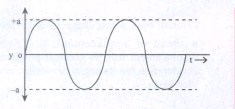
(1) Free oscillation:
(i) The oscillation of a particle with fundamental frequency under the influence of restoring force are defined as free oscillation.
(ii) The amplitude, frequency, and energy of oscillation remains constant.
(iii) Frequency of oscillation is called natural frequency because it depends upon the nature and structure of the body.
(2) Damped oscillation:
(i) The oscillation of a body whos amplitude goes on decreasing with time are defined as damped oscillation.
(ii) In these oscillation the amplitude oscillation decreases exponentially due to damping forces like frictional fore viscouse force, etc.
(iii) Due to decrease in amplitude the energy of the oscillator also goes on decreasing exponentially.
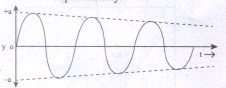
(iv) The force produces a resistance to the oscillation is called damping force.
If the velocity of oscillator is v then Damping force Fd=-bv, b = damping constant.
(v) Resultant force on a damped oscillator is given by
F = FR+Fd= -kx-kv ⇒ \(\frac { md^{ 2 }x }{ dt^{ 2 } } +b\frac { dx }{ dt } +kx\) = 0
(vi) Displacement of damped oscillator given by
x = \({ x }_{ m }e^{ \frac { bt }{ 2m } }sin(w't+\psi )\)
where w' = angular frequency of the damped oscillator = \(\sqrt { { W }_{ 0 }^{ 2 }-\left( \frac { b }{ 2m } \right) ^{ 2 } } \)
The amplitude decreases continuously with time according to x =\(x_{ m }e^{ \left( \frac { b }{ 2m } \right) t }\)
(vii) For a damped oscillator if the damping is small then the mechanical energy decreases exponentially with time as
E = \(\frac { 1 }{ 2 } kx_{ m }^{ 2 }e^{ \frac { ht }{ m } }\) .
15.
Linear:
When a: solid rod of initial length I is heated through a temperature \(\triangle\)T, its final length (increased) is given by
L1 = L + \(\triangle\)L = L (1 + \(\alpha\)\(\triangle\)T)
Where
\(\alpha\) is coefficient of linear expansion, It is given by
\(\alpha =\frac { \triangle L }{ L } \times \frac { 1 }{ \triangle T } \)
\(\alpha\) is defined as the increase in length per unit length per degree rise in temperature.
Superficial expansion:
When a solid, sheet of initial surface area A is heated through a temperature J). T, its final area (increased) is given by
A1 = A + \(\triangle\)A = A (1 + \(\beta\)\(\triangle\)T)
\(\beta\) - coefficient of superficial expansion. It is given by
\(\beta\) = \(\beta =\frac { \triangle A }{ A } \times \frac { 1 }{ \triangle T } \)
It is defined as the increase in surface area per unit area per degree rise in temperature.
Cubical expansion:
When a solid of initial volume V is heated through a temperature. J). T, its final volume is given by
V1 = V + \(\triangle\)V = V (1 + \(\gamma \)\(\triangle\)T)
\(\gamma \) - coefficient of cubical expansion and it is defined as the increase in volume per unit volume per degree rise in temperature.
\(\gamma =\frac { \triangle V }{ V } \times \frac { 1 }{ \triangle T } \)
16.
(i) The molecules in a gas are small and very far apart. Most of the volume which a gas occupies is empty space.
(ii) Gas molecules are in constant random motion. Just as many molecule are moving in one direction as in any other.
(iii) Molecules can collide with each other and with the walls of the container. Collisions with the walls account for the pressure of the gas.
(iv) When collisions occur, the molecules lose no kinetic energy; that is, the collisions are said to be perfectly elastic. The total kinetic energy of all the molecules remains constant unless there is some outside interference with the molecules.
(v) The molecule exert no attractive or repulsive forces on one another except during the process of collision. Between collisions, they move in straight lines.
17.
| S.No | Condcution | Convection | Rediation |
|---|---|---|---|
| 1. | Material medium is required. | Material medium is required. | No material medium is required. |
| 2. | It is due to temperature difference. Heat flows from high temperature to low temperature. |
It is due to difference in density. Heat flows from low density to high density region. |
It occurs at temperature above 0 K |
| 3. | It occurs in solids through molecular collisions without actual movement of particles. | It occurs in fluids by the actual movement of particles. | It takes place at large distances and does not the inversting medium. |
| 4. | It is a slow process. | It is also a slow process. | It propagates at the speed of light. |
| 5. | It does not obey the laws of reflection & refraction | It does not obey the laws. | It obeys the laws of of reflection reflection. |
18.
Here ρ = 7.8 g/cm3 ; rw = 10 cm/s
ηw = 8.5\(\times\)10-4 ρa.s
Pg=1.2g/cm3 ; ηg =13.2 ρa s; Vg=?
Terminal velocity V = \(\frac{2r^{2}(\rho-\rho_{0})g}{9\eta}\)
\(v \propto \frac{(\rho-\rho_{0})}{\eta}\)
When ball falls in water, then
\(V_{w} \propto \frac{(\rho-\rho_{w})}{\eta_{w}}\)
When ball falls in glycerine
\(V_{g} \propto \frac{(\rho-\rho_{g})}{\eta_{g}}\)
\(\frac{V_{g}}{V_{w}}=(\frac{\rho-\rho_{g}}{\rho-\rho_{w}})\frac{\eta_{w}}{\eta_{g}}\)
\(V_{g}={V_{w}}=(\frac{\rho-\rho_{g}}{\rho-\rho_{w}})\frac{\eta_{w}}{\eta_{g}}\)
= 10\((\frac{7.8-1.2}{7.8-1})\times \frac{8.5 \times 10^{-4}}{13.2}\)
= 6.25 \(\times\)10-4 cm/s
19.
(i) Effect of pressure on the boiling point of a liquid.
(ii) The boiling of a liquid increases with the increase in pressure. The boiling point of water (H2O) is 100°C at 1 atm pressure (Atmospheric pressure) and it is 128°C at 2 atmospheric pressure.
(iii) Experiment to demonstrate the boiling of H2O at temperature below 100°C:
(1) The boiling point is the temperature at which a liquid's vapor pressure is equal to the surrounding pressure pushing down .on it. For water on earth, the standard boiling point of water is given to be 100°C.
(2) This temperature assumes that the water has one atmosphere of pressure pushing down on it. When this pressure is decreased the temperature at which water can boil will decrease.
(3) To look at is another way, we can at water at the (simplified) molecular level.
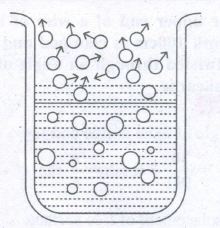
(iv) Bubbles can form and rise since the vapor pressure can overcome atmospheric pressure liquid turning into bubbles and escaping as it boils.
20.
When the source and the observer are in relative motion with respect to each other and to the medium in which sound propagates, the frequency of the sound wave observed is different from the frequency of the source. This phenomenon is called Doppler Effect.
Source in motion and Observer at rest
(a) Source moves towards the observer
Suppose a source S moves to the right (as shown in Figure with a velocity vs and fs let the frequency of the sound waves produced by the source be f s. We assume the velocity of sound in a medium is v. The compression (sound wave front) produced by the source S at three successive instants of time are shown in the Figure. When S is at position x1 the compression is at C1. When S is at position x2, the compression is at C2 and similarly for x3 and C3. Assume that if C1 reaches the point B and C3 reaches the point C as shown in the Figure. It is obvious to see that the distance between compressions C2 and C3 is shorter than distance between C1 and C2. This means the wavelength decreases when the source S moves towards the observer O (since sound travels longitudinally and wavelength is the distance between two consecutive compressions). But frequency is inversely related to wavelength and therefore, frequency increases.
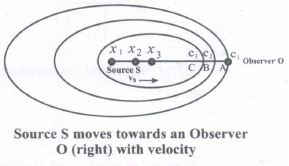
Let ⋋ be the wavelength of the source S as measured by the observer when S is at position X1 and ⋋' be wave length of the source observed by the observer when S moves to position x2. Then the change in wavelength is Δ⋋ =⋋ - ⋋' = vs, t, where t is the time taken by the source to travel between x3 and x2. Therefore,
⋋' = ⋋ - vs,t ......(1)
But \(t={⋋\over v}\) ......(2)
On substituting equation (2) in equation (1), we get
\(⋋'=⋋\left(1-{v_s\over v}\right)\)
Since frequency is inversely proportional to wavelength, we have
\(f'={v_s\over \lambda}\ and\ f={v_s\over \lambda}\)
Hence \(f'={f\over \left( 1-{v_s\over v}\right)}\) .....(3)
Since, \({v_s\over v}\) <<1 we use the binomial expansion and retaining only first order in \(v_s\over v\) we get
\(f'={f\left(1+{v_s\over v}\right)}v\) .....(4)
(b) Source moves away from the observer:
Since the velocity here of the source is opposite in direction when compared to case (a), therefore, changing the sign of the velocity of the source in the above case i.e, by substituting (vs➝-vs) in equation (1) we get
\(f={f\over \left(1-{v_s\over v}\right)}\) .....(5)
Using binomial expansion again, we get
\(f'={f\left(1-{v_s\over v}\right)}\) .......(6)
(2) Observer in motion and Source at rest:
(a) Observer moves towards Source:
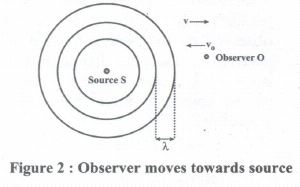
Assume that the observer O moves towards the source S with velocity vo. The source S is at rest and the velocity of sound waves (with respect to the medium) produced by the source is v. From the figure (2), we observe that both vo and v are in opposite direction. Then, their relative velocity is vp = v + vo. The wavelength of the sound wave is \(⋋={v\over f}\), which means the frequency observed by the observer O is \(f'={v_r\over \lambda}\). Then
\(f'={v_r\over \lambda}=\left(v+v_0\over v\right)f=f\left(1+{v_0\over v}\right)\) .....(7)
(b) Observer recedes away from the Source:
If the observer O is moving away (receding away), from the source S, then velocity vo and v moves in the same direction. Therefore, their relative velocity is vr = v - vo, Hence, the frequency observed by the observer O is
\(f'={v_r\over \lambda}=\left(v-v_0\over v\right)f=f\left(1-{v_0\over v}\right)\) .......(8)
(3) Both are in motion:
(a) Source and Observer approach each other:
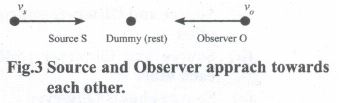
Let vs and Vo be the respective velocities of source and observer .approaching each other as shown in Figure 3. In order to calculate the apparent frequency observed by the observer, as a simple calculation, let us have a dummy (behaving as observer or source) in between the source and observer. Since the dummy is at rest, the dummy (observer) observes the apparent frequency due to approaching source as given in equation (3) is
\(f_d={f\over \left(1-{v_s\over v}\right)}\) ...(9)
At that instant of time, the true observer approaches the dummy from the other side. Since the source (true source) comes in a direction opposite to true observer, the dummy (source) is treated as stationary source for the true observer at that instant. Hence, apparent frequency when the true observer approaches the stationary source (dummy source), from equation (7) is
\(f'=f_d\left(1+{v_0\over v}\right)⇒f_d={f'\over\left(1+{v_0\over v}\right)}\)......(10)
Since this is true for any arbitrary time, therefore, comparing equation (9) and equation (10), we get
\({f\over \left(1-{v_o\over v}\right)}={f\over \left(1+{v_o\over v}\right)}\)
\(⇒{vf'\over (v+v_0)}={vf\over (v-v_1)}\)
Hence, the apparent frequency as seen by the observer is
\(f'=\left( (v+v_0)\over (v-v) \right)f\) ...(11)
(b) Source and Observer recedes from each other:
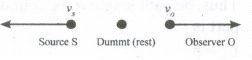
Here, we can derive the result as in the previous case. Instead of a detailed calculation, by inspection from Figure, we notice that the velocity of the source and the observer each point in opposite directions with respect to the case in (a) and hence, we substitute (vs ⟶ -vs) and (vo ⟶ -vo) in equation (11), and therefore, the apparent frequency observed by the observer when the source and observer recede from each other is
\(f'=\left( (v-v_0)\over (v+v_s) \right)f\) ....(12)
(c) Source chases Observer:
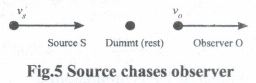
Only the observer's velocity is oppositely directed when compared to case (a). Therefore, substituting (vo ⟶-vo) in equation (11), we get
\(f^{\prime}=\left(\frac{v-v_{0}}{v-v_{2}}\right) f\) ....(13)
(d) Observer chases Source:
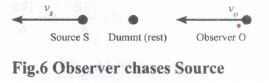
Only the source velocity is oppositely directed when compared to case (a). Therefore, substituting vs ⟶ -vs in equation (11), we get
\(f'=\left( (v+v_0)\over (v+v_s)\right)f\) .....(14)
21.
A pendulum is a mechanical system which exhibits periodic motion. It has a bob with mass m suspended by a long string (assumed to be massless and in extensible string) and the other end is fixed on a stand as shown in figure. (a). At equilibrium, the pendulum does not oscillate and hangs vertically downward. Such a position is known as mean position or equilibrium position. When a pendulum is displaced through a small displacement from its equilibrium position and released, the bob of the pendulum executes to and fro motion. Let l be the length of the pendulum which is taken as the distance between the point of suspension and the centre of gravity of the bob. Two forces act on the bob of the pendulum at any displaced position, as shown in the figure.
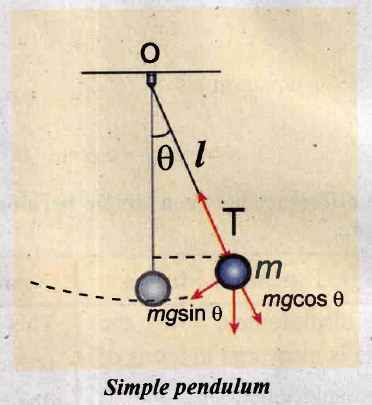
(i) The gravitational force acting on the body \((\vec{F}=\mathrm{m} \vec{g})\) which acts vertically downwards.
(ii) The tension in the string \(\vec{T}\)which acts along the string to the point of suspension.
Resolving the gravitational force into its components:
a) Normal component: The component along the string but in opposition to the direction of tension, \(F_{a s}=m g \cos \theta\).
b) Tangential component: The component perpendicular to the string i.e., along tangential direction of arc of swing, \(F_{p s}=m g \sin \theta\).
Therefore, The normal component of the force is, along the string,
\(T-W_{a s}=m \frac{v^{2}}{l}\)
Here v is speed of bob
\(\mathrm{T}-\mathrm{mg} \cos \theta=\mathrm{m} \frac{v^{2}}{l}\)
From the Figure, we can observe that the tangential component \(\mathrm{W}_{\mathrm{ps}}\) of the gravitational force always points towards the equilibrium position, i.e., the direction in which it always points opposite to the direction of displacement of the bob from the mean position. Hence, in this case, the tangential force is nothing but the restoring force. Applying Newton's second law along tangential direction, we have
\(m \frac{d^{2} s}{d t^{2}}+F_{p s} =0 \Rightarrow m \frac{d^{2} s}{d t^{2}}=F_{p s}
\)
\(m \frac{d^{2} s}{d t^{2}} =m g \sin \theta\) ......(1)
where, s is the position of bob which is measured along the arc. Expressing arc length in terms of angular displacement i.e.,
\(s =l \theta
\) .....(2)
\(\text {then its acceleration, } \frac{d^{2} s}{d t^{2}} =l \frac{d^{2} \theta}{d t^{2}}\) .....(3)
Substituting equation (3) in equation (1) we get
\(l \frac{d^{2} \theta}{d t^{2}}=-g \sin \theta
\)
\(\frac{d^{2} \theta}{d t^{2}}=-\frac{g}{l} \sin \theta\) ....(4)
Because of the presence of sin θ in the above differential equation, it is a non-linear differential equation (Here, homogeneous second order). Assume "the small oscillation approximation". sin θ ≈ θ, the above differential equation becomes linear differential equation.
.JPG)
\(\frac{d^{2} \theta}{d t^{2}}=-\frac{g}{l} \theta\) ....(5)
This is the well known oscillatory differential equation. Therefore, the angular frequency of this oscillator (natural frequency of this system) is
\(\omega^{2} =\frac{g}{l}
\) ....(6)
\(\Rightarrow \omega=\sqrt{\frac{g}{l}} \text { in } \mathrm{rad} \mathrm{s}^{-1}\) .....(7)
The frequency of oscillations is
\(\mathrm{f}=\frac{1}{2 \pi} \sqrt{\frac{\mathrm{g}}{l}} \text { in } \mathrm{Hz}\) .....(8)
and time period of oscillation is
\(T=2 \pi \sqrt{\frac{l}{g}} \text { in second }\) ......(9)
22.
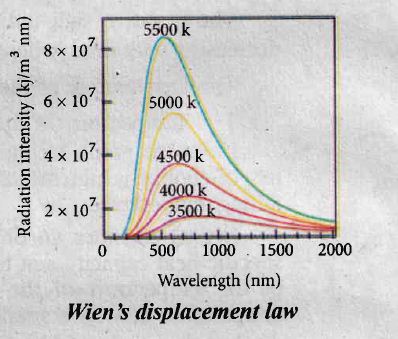
Wien's law states that, the wavelength of maximum intensity of emission of a black body radiation is inversely proportional to the absolute temperature of the black body.
\({ \lambda }_{ m }{ \alpha }\cfrac { 1 }{ T } \left( or \right) { \lambda }_{ m }=\cfrac { b }{ T } \)...(1)
Where, b is known as Wien's constant. Its value is 2.898 x 10⁻³ m K
It implies that if temperature of the body increases, maximal intensity wavelength \({ \lambda }_{ m }\) shifts towards lower wavelength (higher frequency) of electromagnetic spectrum.
It is shown in Figure
Graphical representation
From the graph it is clear that the peak of the wavelengths is inversely proportional to temperature. The curve is known as 'black body radiation curve'.
The sun is approximately taken as a black body. Since any object above 0 K emit radiation, sun also emits radiation. Its surface temperature is about 5700 K. By substituting this value in the equation (1),
\({ \lambda }_{ m }=\cfrac { b }{ t } =\cfrac { 2.898\times { 10 }^{ 8 } }{ 5700 } \approx 508nm\)
It is the wavelength at which maximum intensity is 508 nm. Since the Sun's temperature is around 5700 K, the spectrum of radiations emitted by Sun lie between 400 nm to 700 nm which is the visible part of the spectrum.
23.
When the gas is kept at constant temperature, the pressure of the gas is inversely proportional to the volume. \(P \propto \frac{1}{V}\). It was discovered by Robert Boyle (1627-1691) and is known as Boyle's law.
When the gas is kept at constant pressure, the volume of the gas is directly proportional to absolute temperature. \(V \propto T\). It was discovered by Jacques Charles (1743-1823) and is known as Charles' law.
By combining these two equations we have
PV = CT. Here C is a positive constant.
We can infer that. C is proportional to the number of particles in the gas container by considering the following argument. If we take two containers of same type of gas with same volume V, same pressure P and same temperature T, then the gas in each container obeys the above equation. PV = CT. If the two containers of gas is considered as a single system, then the pressure and temperature of this combined system will be same but volume will be twice and number of particles will also be double as shown in Figure.
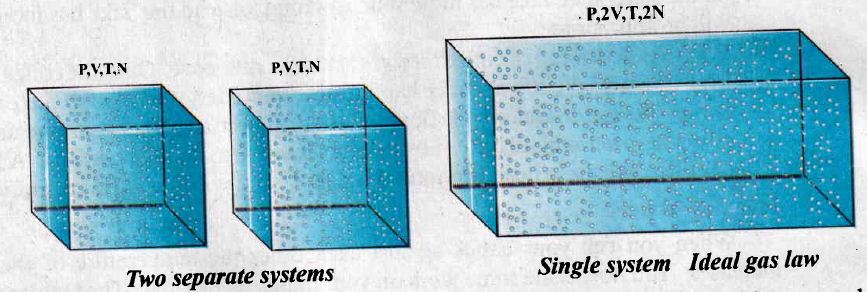
For this combined system, V becomes 2V, so C should also double to match with the ideal gas equation \(\frac { P(2V) }{ T } =2C\). It implies that C must depend on the number of particles in the gas and also should have the dimension of \(\left[ \frac { PV }{ T } \right] ={ JK }^{ -1 }\). So we can write the constant C as k times the number of particles N.
Here k is the Boltzmann constant (1.381\(\times\)10-23 JK-1) and it is found to be a universal constant.
So the ideal gas law can be stated as follows
PV = NkT ....(1)
The equation (1 )can also be expressed in terms of mole.
Suppose if a gas contains \(\mu\) mole of particles then the total number of particles can be written as
\(\mathrm{N}=\mu \mathrm{N}_{\mathrm{A}}\) .....(2)
where NA is Avogádro number \(\left(6.023 \times 10^{23} \mathrm{~mol}^{-1}\right)\)
Substituting for N from equation (2), the equation (1) becomes
\(\mathrm{PV}=\mu N_{A} k T\)
Here \(\mathrm{N}_{\mathrm{A}} \mathrm{k}=\mathrm{R}\) called universal gas constant and its value is \(8.314 \mathrm{~J} / \mathrm{mol}. \mathrm{K}\).
So the ideal gas law can be written for $\mu$ mole of gas as
\(\mathrm{PV}=\mu R T\)
This is called the equation of state for an ideal gas. It relates the pressure, volume and temperature of thermodynamic system at equilibrium.
24.
According to Bernoulli's theorem, the sum of pressure energy, kinetic energy, and potentialenergy per unit mass of an incompressible, nonviscous fluid in a streamlined flow remains a constant. Mathematically,
\(\frac{P}{\rho}+\frac{1}{2}v^{2}+gh\) = constant
This is known as Bernoulli's equation.
Proof:
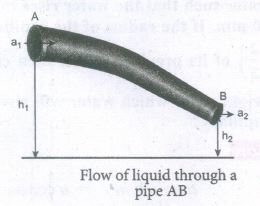
Let us consider a flow of liquid through a pipe AB as shown in Figure. Let V be the volume of the liquid when it enters A in a time t which is equal to the volume of the liquid leaving B in the same time. Let aA, vA and PA be the area of cross section of the tube, velocity of the liquid and pressure exerted by the liquid at A respectively.
Let the force exerted by the liquid at A is
FA= PAaA
Distance travelled by the liquid in time t is
d = vAt
Therefore, the work done is
W = FAd = PAaAvA t
But aAvAt = aAd = V, volume of the liquid entering at A.
Thus, the work done is the pressure energy (at A), W = FAd = PAV
Pressure energy per unit volume at
A = \(\frac{Pressure \ energy}{volume}=\frac{P_{A} V}{V}=P_{A}\)
Pressure energy per unit mass at
A = \(\frac{Pressure \ energy}{volume}=\frac{P_{A} V}{m}=\frac{P_{A}}{\frac{m}{V}}=\frac{P_{A}}{\rho}\)
Since m is the mass of the liquid entering at A in a given time, therefore, pressure energy of the liquid at A is
\(E_{PA}=P_{A}V=P_{A}V\times (\frac{m}{m})=m \frac{P_{A}}{\rho}\)
Potential energy of the liquid at A, PEA = mg hA,
Due to the flow of liquid, the kinetic energy of the liquid at A,
\(KE_{A}=\frac{1}{2}m V_{A}^{2}\)
Therefore, the total energy due to the flow of liquid at A, EA= EPA+ KEA + PEA
\(E_{A}=m \frac{P_{A}}{\rho}+\frac{1}{2}m V^{2}_{A}+mg \ h_{A}\)
Similarly, let aB, vB, and PB be the area of cross section of the tube, velocity of the liquid, and pressure exerted by the liquid at B. Calculating the total energy at EB, we get
\(EB=m \frac{P_{B}}{\rho}+\frac{1}{2}mv^{2}_{B}+mg h_{B}\)
From the law of conservation of energy,
EA = EB
\(m \frac{P_{A}}{\rho}+\frac{1}{2} mv^{2}_{A}+mgh_{A}=m\frac{P_{B}}{\rho}+\frac{1}{2}mv^{2}_{B}+mgh_{B}\)
\(\frac{P_{A}}{\rho}+\frac{1}{2}V^{2}_{A}+gh_{A}=\frac{P_{B}}{\rho}+\frac{1}{2}V^{2}_{B}+gh_{B}\) = constant
Thus, the above equation can be written as
\(\frac{P}{\rho g}+\frac{1}{2}\frac{v^{2}}{g}+h\) = constant
The above equation is the consequence of the conservation of energy which is true until there is no loss of energy due to friction. But in practice, some energy is lost due to friction. This arises due to the fact that in a fluid flow, the layers flowing with different velocities exert frictional forces on each other. This loss of energy is generally converted into heat energy. Therefore, Bernoulli's relation is strictly valid for fluids with zero viscosity or non-viscous liquids. Notice that when the liquid flows through a horizontal pipe, then \(\mathrm{h}=0 \Rightarrow \frac{P}{\rho g}+\frac{1}{2} \frac{v^{2}}{g}=\) constant.
25.
Consider a sphere of radius r which falls freely through a highly viscous liquid of coefficient of viscosity η. Let the density of the material of the sphere be p and the density of the fluid be σ.
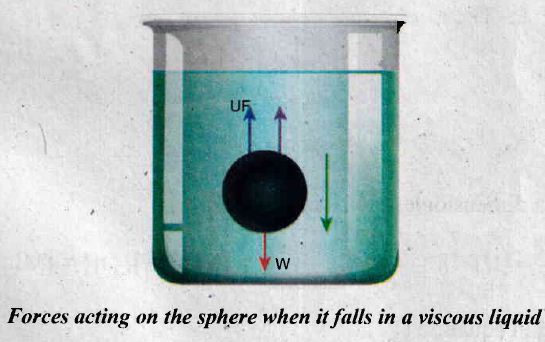
Gravitational force acting on the sphere,
\(F_{G}=mg=\frac{4}{3}\pi r^{3}\rho g \) (downward force)
Up thrust, U = \(\frac{4}{3} \pi r^{3} g\) (upward force)
viscous force F = 6ㅠηrvt
At terminal velocity vt
downward force = upward force
\(F_{G}-U=F \Rightarrow \frac{4}{3}\pi r^{3}\rho g - = \frac{4}{3}\pi r^{3} \sigma g =6\pi \eta r v_{t}\)
\(v_{t}=\frac{2}{9} \times \frac{r^{2} (\rho-\sigma)}{\eta}g \Rightarrow v_{t} \infty r^{2}\)
Here, it should be noted that the terminal speed of the sphere is directly proportional to the square of its radius.
26.
The linear acceleration along the inclined plane can be computed by
\(a=\frac{g sin\theta}{1+\frac{K^{2}}{R^{2}}}\)
For a thin uniform circular ring, axis passing through its center is I = MR2.
\(\therefore K^{2}=R^{2} \Rightarrow \frac{K^{2}}{R^{2}}=1\)
And the angle of inclination, \(\theta=45 ^{0}\)
\(\Rightarrow (sin 45^{0}=\frac{1}{\sqrt{2}})\)
Hence, \(a=\frac{g+\frac{1}{\sqrt{2}}}{1+1}\)
\(a=\frac{g}{2\sqrt{2}}\)ms-2.
27.
(i) distance = area of \(\triangle\)OAB + area of trapezium BCDE = 12 + 28 = 40 m
(ii) displacement = area of \(\triangle\)OAB - area of trapezium BCDE = 12 - 28 = -16 m
(iii) times ace. (0 ≤ t ≤ 4) and (12 ≤ t ≤ 16)
retardation (4 ≤ t ≤ 8)
constant velocity (8 ≤ t ≤ 12)
28.
The equivalent resistance of a parallel combination
\(R'=\frac{R_1R_2}{R_1+R_2}=\frac{150\times220}{150+220}=\frac{33000}{370}=89.1\ Ohm\)
We know that, \(\frac{1}{R'}=\frac{1}{R_1}+\frac{1}{R_2}\)
\(\frac { \triangle { R }^{ ' } }{ \left( { R }^{ ' } \right) ^{ 2 } } =\frac { \triangle { R }_{ 1 } }{ { R }_{ 1 }^{ 2 } } +\frac { \triangle { R }_{ 2 } }{ { R }_{ 2 }^{ 2 } } \)
\(\triangle { R }^{ ' }=\left( { R }^{ ' } \right) ^{ 2 }\frac { \triangle { R }_{ 1 } }{ { R }_{ 1 }^{ 2 } } +\left( { R }^{ ' } \right) ^{ 2 }\frac { \triangle { R }_{ 2 } }{ { R }_{ 2 }^{ 2 } } =\left( \frac { { R }^{ ' } }{ { R }_{ 1 } } \right) ^{ 2 }\triangle { R }_{ 1 }+\left( \frac { { R }^{ ' } }{ { R }_{ 2 } } \right) ^{ 2 }\triangle { R }_{ 2 }\)
Substituting the value,
\(\triangle { R }^{ ' }=\left[ \frac { 89.1 }{ 150 } \right] ^{ 2 }\times 2+\left[ \frac { 89.1 }{ 220 } \right] ^{ 2 }\times 6=0.070+0.098=0.168\)
R' = 89.1 ± 0.168 Ohm.
29.
F ∝ ma vb rc ;
F = k ma vb rc
where k is a dimensionless constant of proportionality. Rewriting above equation in terms of dimensions and taking k= 1, we have
[MLT-2] = [M]a [LT-1]b [L]c
= [MaLbT-bLc]
[MLT-2] = [MaLb+cT-b]
Comparing the powers of M, L and T on both sides
a = 1 ; b + c = 1; -b =-2
2 + c = 1 ; b = 2;
a = 1 b = 2 and c = -1
From the above equation we get
F = mavbrc
F =m1v2r-1
or F = \(\frac { m{ v }^{ 2 } }{ r } \)
30.
| Rule | Example |
| If the digit to be dropped is smaller than 5, then the preceding digit should be left unchanged. | 7.32 is rounded off to 7.3 8.94 is rounded off to 8.9 |
| If the digit to be dropped is greater than 5, then the preceding digit should be increased by 1. | 17.26 is rounded off to 17.3 11.89 is rounded off to 11.9 |
| If the digit to be dropped is 5 followed by digits other than zero, then the preceding digit should be raised by 1. | 7.352, on being rounded off to first decimal becomes 7.4 18.159 on being rounded off to first decimal, become 18.2 |
| If the digit to be dropped is 5 or 5 followed by zeros, then the preceding digit is not changed if it is even. | 3.45 is rounded off to 3.4 8.250 is rounded off to 8.2 |
| If the digit to be dropped is 5 or 5 followed by zeros, then the preceding digit is raised by 1 if it is odd. | 3.35 is rounded off to 3.4 8.350 is rounded off to 8.4 |
31.
When a vehicle travels in a curved path, there must be a centripetal force acting on it. This centripetal force is provided by the frictional force between tyre and surface of the road. Consider a vehicle of mass 'm' moving at a speed 'v' in the circular track of radius 'r'. There are three forces acting on the vehicle when it moves as shown in the figure.
(i) Gravitational force (mg) acting downwards
(ii) Normal force (mg) acting upwards
(iii) Frictional force (Fs) acting horizontally inwards along the road
Suppose the road is horizontal then the normal force and gravitational force are exactly equal and opposite. The centripetal force is provided by the force of static friction Fs between the tyre and surface of the road which acts towards the center of the circular track,
\(\frac { m{ v }^{ 2 } }{ r } ={ F }_{ s }\)
As we have already seen in the previous section, the static friction can increase from zero to a maximum value
Fs ≤ μsmg
There are two conditions possible namely without skidding and skidding.
For without skidding \(\frac { m{ v }^{ 2 } }{ r } \le { \mu }_{ s }mg\), or \({ \mu }_{ s }\ge \frac { { v }^{ 2 } }{ rg } \) or \(\sqrt { { \mu }_{ s }rg } \ge v\)
The static friction would be able to provide necessary-centripetal force to bend the car on the road.
32.
Since the restoring spring force and displacement are linearly related as F = -kx, and are opposite in direction, the graph between F and x is a straight line with dwelling only in the second and fourth quadrant as shown in the figure. The elastic potential energy can be easily calculated by drawing a F - x graph. The shaded area (triangle) is the work done by the spring force.
\(Area={1\over 2}(base)(height)\)
\(={1\over2}\times(x)\times(kx)={1\over2}kx^2\)
33.
The uncertainty in a measurement is called an error. The three possible errors are
(i) Systematic error
(ii) Random error and
(iii )Gross error
(i) Systematic Errors: Systematic errors are reproducible inaccuracies that are consistently in the same direction. These occur often due to a problem that persists throughout the experiment. Systematic errors can be classified as follows,
Instrumental errors: When an instrument is not calibrated properly at the time of manufacture, instrumental errors may arise. If a measurement is made with a meter scale whose end is worn out, the result obtained will have errors. These errors can be corrected by choosing the instrument carefully.
Imperfections in experimental technique or procedure: These errors arise due to the limitations iri the experimental arrangement. As an example, while performing experiments with a calorimeter, if there is no proper insulation, there will be radiation losses. This results in errors and to overcome these, necessary correction has to be applied.
Personal errors: These errors are due to, individuals performing the experiment, may be due to incorrect initial setting up of the experiment or carelessness of the individual making the observation due to improper precautions. Errors due to external causes: The change in the external conditions during an experiment can cause error in measurement. For example, changes in temperature, humidity, or pressure during measurements may affect-the result of the measurement.
Least count error: Least count is the smallest value that can be measured by the measuring instrument, and the error due to this measurement is least count error. The instrument's resolution hence is the cause of this error. Least count error can be reduced by using a high precision instrument for the measurement.
(ii) Random errors: Random errors may arise due to random and unpredictable variations in experimental conditions like pressure, temperature, voltage supply etc. Errors may also be due to personal errors by the observer who performs the experiment. Random errors are sometimes called "chance error". When different readings are obtained by a person every time he repeats the experiment, personal error occurs. For example, consider the case of the thickness of a wire measured using a screw .gauge. The readings taken may be different for different trials. In this case, a large number of measurements are made and then the arithmetic mean is taken.
If n number of trial readings are taken in an experiment, and the readings are a1,a2,a3,..... an. The arithmetic mean is
\(a_m={a_1+a_2+a_3+...a_n\over n}(or)a_m={1\over n}\sum _{ i=1 }^{ i=n }{ { a }_{ i } } \)
Usually this arithmetic mean is taken as the best way to minimize the error.
(iii) Gross Error: The error caused clue to the shear carelessness of an observer is called gross error.
for example
(a) Reading an instrument without setting it properly.
(b) Taking observations in a wrong manner without bothering about the sources of errors and the precautions.
(c) Recording wrong observations.
(d) Using wrong values of the observations in calculations.
These errors can. be minimized only when an observer is careful and mentally alert.
| Type of error | Example | How to minimize it |
| Random error | Suppose you measure the mass of a ring three times using the same balance and get slightly different values. 15.46g,15.42g, 15.44g. | Take more data. Random errors can be evaluated through statistical analysis and can be reduced by averaging over a large number of observations. |
| Systematic error | Suppose the cloth tape measure that you use to measure the length of an object has been stretched out from years of use. (As a result all of the length measurements are not correct). | Systematic errors are difficult to detect and cannot be analysed statistically, because all of the data is in the same direction. (Either too high or too low) |
34.
35.
Speed u = 120 km/h = 120\(\times\)\(\frac { 5 }{ 18 } \)
u = 33 m/s
Final velocity v =0, distances = 200 m
We know,
v2=u2 +2as
02=(33)2+2a \(\times\) (200)
a = (-33)2/(2\(\times\)200)
\(a=\frac { 1089 }{ 400 } =2.722\quad { ms }^{ -2 }\)
As
v = u + at
0 = 33+(2.72)t
\(t=\frac { 33 }{ 2.72 } \)
t=12.13s
36.
mass, m=1200 kg
v=54 km/h=\(54\times \frac { 5 }{ 18 } \) m/sec=15 m/s
Angular momentum, L =r m v= 300 \(\times\) 1200 \(\times\)15
=54,00,000
=5.4 x 10⁶ kg m2/s
37.
Mass m1 = 2kg
Mass m2 = 2kg
Velocity \({ v }_{ 1 }=(\overset { \wedge }{ 2i } -\overset { \wedge }{ 3j } )m/s\)
Velocity \({ v }_{ 2 }=(\overset { \wedge }{ 3i } -\overset { \wedge }{ 6k } )m/s\)
When two particles experiences a perfectly inelastic collision. So,
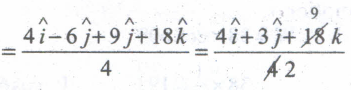
\(V=\frac{m_1v_1+m_2v_2}{m-1+m_2}\)=\(\frac { 2\left( 2\overset { \wedge }{ i } -3\overset { \wedge }{ j } \right) +3\left( 3\overset { \wedge }{ j } +6\overset { \wedge }{ k } \right) }{ 2+2 } \)
Speed of combined two particles,
\(v=\sqrt{1^{2}+(\frac{3}{4})^{2}+(\frac{9}{2})^{2}}\)
\(v=\sqrt{1+\frac{9}{16}+\frac{81}{4}}\)
Velocity, v = \(\sqrt{21.81}\)m/s.
38.
(i) The angular momentum of a point mass is defined as the moment of its linear momentum. In other words, the angular momentum Lof a point mass having a linear momentum p at a position r with respect to a point or axis is mathematically written as,
\(\overset { \rightarrow }{ L } =\overset { \rightarrow }{ r } \overset { \rightarrow }{ p } \)
(ii) The magnitude of angular momentum could be written as, L= rp sin\(\theta\) where, ፀ is the angle between \(\overset { \rightarrow }{ r } \) and \(\overset { \rightarrow }{ p } .\overset { \rightarrow }{ L } \) is perpendicular to the plane containing \(\overset { \rightarrow }{ r } \) and \(\overset { \rightarrow }{ p } \)
(iii) As we have written in the case of torque, here also we can associate sinፀ with either \(\overset { \rightarrow }{ r } \) and \(\overset { \rightarrow }{ p } \)
L=r(p sin\(\theta\)) = r(p丄)
L=(r sin\(\theta\)) p = (r丄)p
where, p丄 is the component of linear momentum p perpendicular to r, and r丄 is the component of position r perpendicular to p.
(iv) The angular momentum is zero (L = 0), if the linear momentum is zero (p = 0) or if the particle is at the origin (\(\overset { \rightarrow }{ r } \)=0) or if \(\overset { \rightarrow }{ r } \) and \(\overset { \rightarrow }{ p } \) are parallel or antiparallel to each other\(\theta\) =00 or 1800)
39.
If there is a loss of kinetic energy during a collision, then it is called as an inelastic collision
In the case of inelastic collision,
(i) Total kinetic energy is not conserved.
(ii) Some or all of the forces involved are non-conservative.
(iii) A part of the mechanical energy is transformed into heat, sound, light etc.
Examples for inelastic collision:
(i) Collision between ball and floor
(ii) Collision between two vehicles
Examples for perfectly inelastic collision:
(i) Mud thrown on a wall and sticking to it
(ii) a man jumping into a moving trolley
(iii) a bullet fired into a wooden block and remaining embedded in it.
40.
Work done by a constant force:
(i) When a constant force F acts on a body, the small work done (dW) by the force in producing a small displacement dr is given by the relation,
dW= (F cos\(\theta\) ) dr
(ii) The total work done in producing a displacement from initial position ri to final position rf is,
\(W=\overset { { r }_{ f } }{ \underset { { r }_{ i } }{ \int } } dw\)
\(W=\overset { { r }_{ f } }{ \underset { { r }_{ i } }{ \int } } \left( F\cos { \theta } \right) dr=\left( F\cos { \theta } \right) \)\(\overset { { r }_{ f } }{ \underset { { r }_{ i } }{ \int } } dr=\left( F\cos { \theta } \right) \left( { r }_{ f }-{ r }_{ i } \right) \)
(iii) The graphical representation of the work done by a constant force is shown in Figure. The area under the graph shows the work done by the constant force.
.jpg)
Work done by a variable force:
(i) When the component of a variable force F acts on a body, the small work done (dW) by the force in producing a small displacement dr is given by the relation
dw = (F cos\(\theta\)) dr
[F cos\(\theta\) is the component of the variable force F]
where, F and \(\theta\) are variables. The total work done for a displacement from initial position ri to final position rf is given by the relation,
\(W=\overset { { r }_{ f } }{ \underset { { r }_{ i } }{ \int } } dw=\overset { { r }_{ f } }{ \underset { { r }_{ i } }{ \int } } F\cos { \theta } dr\)
(ii) A graphical representation of the work done by a variable force is shown in Figure. The area under the graph is the work done by the variable force.
41.
Calculate the latitude of the city or village where the school is located. The information is available in Google search. For example, the latitude of Chennai is approximately 13 degree.
g' = g − \(\omega \)2Rcos2\(\lambda \)
Here \(\omega \)2R = (2\(\times\)3.14/86400)2 \(\times\)(6400\(\times\)103) = 3.4\(\times\)10−2 m/s−2.
It is to be noted that the value of λ. should be in radian and not in degree. 13 degree is equivalent to 0.2268 rad.
g' = 9 8−(3 4\(\times\)10−2)\(\times\)( cos 0.2268)2
g' = 9.7677 ms-2
42.
Number of molecules of Helium -2
Number of molecules of Oxygen -4
When helium and oxygen are mixed, the molecular weight of the mixture of gases is
\(\mathrm{M}_{\text {mix }}=\frac{n_{1} M_{1} n_{2} M_{2}}{n_{1}+n_{2}}=\left(\frac{2 \times 4+4 \times 32}{2+4}\right) \times 10^{-3} \mathrm{~kg} / \mathrm{mol}\)
\(=\frac{8+128}{6}=\frac{136}{6}=22.6 \times 10^{-3} \mathrm{~kg} / \mathrm{mol}\)
In addition, Helium is mono atomic \(C_{v_{1}}=\frac{3 R}{2}\)
Oxygen is diatomic \(C_{v_{2}}=\frac{5 R}{2}\)
∴ For mixture, \(\left(C_{v}\right)_{\text {mix }}=\frac{n_{1} C_{v_{1}}+n_{2} C_{v_{2}}}{n_{1}+n_{2}}
\)
\(=\left[\frac{2 \times \frac{3}{2} R+4 \times \frac{5}{2} R}{2+4}\right]=\frac{13 R}{6}
\)
\(\left(C_{p}\right)_{\text {mix }}=\left(C_{v}\right)_{\text {mix }}+R=\frac{13 R}{6}+R=\frac{19 R}{6}
\)
\(\therefore r_{\text {mix }}=\frac{C_{p}}{C_{v}}=\frac{19 R / 6}{13 R / 6}=\frac{19}{13}=\frac{19}{3}\)
According to laplace, the velocity of sound is
\(v =\sqrt{\frac{r R T}{M}}
\)
\(v =\sqrt{\frac{19 \times 8.31 \times 300 \times 6}{13 \times 136 \times 10^{-3}}}
\)
\(v =\sqrt{\frac{28420}{1768}} \times 10^{4}
\)
\(=4.009 \times 10^{2}
\)
\(=400.9 \mathrm{~ms}^{-1}\)
43.
The hydrogen atom has one proton and one electron. The mass of electron is negligible compared to the mass of proton.
Mass of one proton = 1.67\(\times\)10−27kg.
One hydrogen molecule = 2 hydrogen
atoms = 2\(\times\)1.67\(\times\)10−27kg.
The average speed
\(\overset { - }{ v } =\sqrt { \frac { 8KT }{ \pi m } } =1.60\sqrt { \frac { KT }{ m } } =\)
\(=1.60\sqrt { \frac { \left( { 1.38\times 10 }^{ -23 } \right) \times \left( 300 \right) }{ 2\left( 1.67\times { 10 }^{ -27 } \right) } } =1.78\times { 10 }^{ 3 }{ ms }^{ -1 }\)
(Boltzmann Constant k = 1.38\(\times\)10−23 J K-1)
The rms speed \({ v }_{ rms }=\sqrt { \frac { 3KT }{ m } } =1.73\sqrt { \frac { kT }{ m } } \)
\(=1.73\sqrt { \frac { \left( { 1.38\times 10 }^{ -23 } \right) \times \left( 300 \right) }{ 2\left( 1.67\times { 10 }^{ -27 } \right) } } =1.9\times { 10 }^{ 3 }{ ms }^{ -1 }\)
Most probable speed \({ v }_{ mp }=\sqrt { \frac { 2KT }{ m } } =1.41\sqrt { \frac { kT }{ m } } \)
\(=1.41\sqrt { \frac { \left( { 1.38\times 10 }^{ -23 } \right) \times \left( 300 \right) }{ 2\left( 1.67\times { 10 }^{ -27 } \right) } } =1.57\times { 10 }^{ 3 }{ ms }^{ -1 }\)
Note that vrms > \(\overset { - }{ V } \) > vmp
44.
The internal energy of ideal gas = \(\frac{3}{2}\)NKT
The number of air molecules is given in terms of number of moles so, rewrite the expression as follows
U = \(\frac{3}{2}\)\(\mu\)RT
Since Nk = μR. Here μ is number of moles.
Gas constant R = 8.31\(\frac{J}{molK}\)
Temperature T = 273 + 27 =300K
U =\(\frac{3}{2}\)\(\times\)0.5\(\times\)8.31\(\times\)300 = 1869.75J
This is approximately equivalent to the kinetic energy of a man of 57 kg running with a speed of 8 m s-1.

11th Standard Syllabus & Materials
11th Standard
TN 11th Tamil பீடு பெற நில் - செய்யுள் - காவடிச்சிந்து Important Questions And Answers Study Material - QB365 Set A
NEW11th Standard
TN 11th Tamil பீடு பெற நில் - உரைநடை - மலை இடப்பெயர்கள் : ஓர் ஆய்வு Important Questions And Answers Study Material - QB365 Set A
NEW11th Standard
TN 11th Tamil மாமழை போற்றுதும் - துணைப்பாடம் - யானை டாக்டர் Important Questions And Answers Study Material - QB365 Set A
NEW11th Standard
TN 11th Tamil மாமழை போற்றுதும் - செய்யுள் - ஐங்குறுநூறு Important Questions And Answers Study Material - QB365 Set A



Tamilnadu Stateboard 11th Standard Subjects

Maths

Commerce

Economics

Biology

Business Maths and Statistics

Accountancy

Computer Science
Physics

Chemistry
Maths
Biology
Economics
Physics
Chemistry

History
Business Maths and Statistics

Computer Science
Accountancy

Computer Applications
History
Computer Technology
Commerce
Computer Applications
Computer Technology

Tamil

English

French
Tamilnadu Stateboard Standards

