
 100% FREE ACCESS
11th Standard Syllabus & Materials
11th Standard
TN 11th Tamil இயற்கை வேளாண்மை,சுற்றுச்சூழல் -செய்யுள் - மனோன்மணீயம் Important Questions And Answers Study Material - QB365 Set A
NEW11th Standard
TN 11th Tamil என்னுயிர் என்பேன் -துணைப்பாடம் - இசைத்தமிழர் இருவர் Important Questions And Answers Study Material - QB365 Set A
NEW11th Standard
TN 11th Tamil மொழி கலை -செய்யுள் - ஒவ்வொரு புல்லையும் Important Questions And Answers Study Material - QB365 Set A
NEW11th Standard
TN 11th Tamil பீடு பெற நில் - இலக்கணம் - பகுபத உறுப்புகள் Important Questions And Answers Study Material - QB365 Set A
NEW11th Standard
TN 11th Tamil பீடு பெற நில் - துணைப்பாடம் - வாடிவாசல் Important Questions And Answers Study Material - QB365 Set A
NEW11th Standard
TN 11th Tamil பீடு பெற நில் - செய்யுள் - குறுந்தொகை Important Questions And Answers Study Material - QB365 Set A

Published on: 13/03/2020
11th Standard Physics English Medium All Chapter Book Back and Creative Three Marks Questions 2020
Download Tamil Nadu 11th Standard Physics question papers, model tests, one-mark questions, important questions, and public exam papers in PDF format. Free study materials and answer keys for TN State Board students.
Questions + Answers key
Take MCQ Physics Test1.
Derive the expression for resultant spring constant when two springs having constant k1 and k2 are connected in parallel.
2.
The maximum acceleration of a simple harmonic oscillator is Qo and the maximum velocity is Vo. What is the displacement amplitude?
3.
Find the period of oscillation of a simple pendulum of length L suspended from the roof of a vehicle which moves without friction down an inclined plane of indentation \(\alpha\).
4.
Why the gravitational force between the Earth and the Sun is so great while the same force between two small objects is negligible?
5.
From an equilibrium state A to another equilibrium state A to another equilibrium state B an amount of work equal to 300 J is done on the system. If the gas is taken from state Ato B via a process in which the net heat observed by the system is 10 cal, how much is the net work done by the system in the later case? [Take 1 cal = 4.2 J]
6.
Write the equation of state for an ideal gas.
7.
Explain how does a gas exert pressure on the bases of kinetic theory of gases.
8.
State and explain Charle's law.
9.
Explain why:
(a) a body with large reflectivity is a poor emitter.
(b) a brass tumbler feels much colder than wooden tray on a chilly day.
10.
Write any three applications of viscosity.
11.
Distinguish between transverse and longitudinal waves.
12.
Write the characteristics of wave motion.
13.
A spring balance has a scale which ranges from 0 to 25 kg and the length of the scale is 0.25m. It is taken to an unknown planet X where the acceleration due to gravity is 11.5 m s−1. Suppose a body of mass M kg is suspended in this spring and made to oscillate with a period of 0.50 s. Compute the gravitational force acting on the body.
14.
During a cyclic process, a heat engine absorbs 500 J of heat from a hot reservoir, does work and ejects an amount of heat 300 J into the surroundings (cold reservoir). Calculate the efficiency of the heat engine?
15.
A 0.5 mole of gas at temperature 300 K expands isothermally from an initial volume of 2 L to 6 L
(a) What is the work done by the gas?
(b) Estimate the heat added to the gas?
(c) What is the final pressure of the gas?
(The value of gas constant, R = 8.31 J mol-1 K-1)
16.
A cube of wood floating in water supports a 300 g mass at the centre of its top face. When the mass is removed, the cube rises by 3 cm. Determine the volume of the cube.
17.
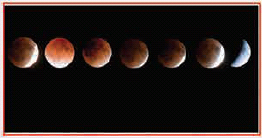
The following photographs are taken from the recent lunar eclipse which occurred on January 31, 2018. Is it possible to prove that Earth is a sphere from these photographs?
18.
A student was asked a question ‘why are there summer and winter for us? He replied as since Earth is orbiting in an elliptical orbit, when the Earth is very far away from the Sun(aphelion) there will be winter, when the Earth is nearer to the Sun(perihelion) there will be winter. Is this answer correct? If not, what is the correct explanation for the occurrence of summer and winter?
19.
A pump on the ground floor of a building can pump up water to fill a tank of volume 30 m3 in 15 min. If the tank is 40 m above the ground, how much electric power is consumed by the pump. The efficiency of the pump is 30%.
20.
An object of mass 2 kg is taken to a height 5 m from the ground (g = 10 ms-2).
(a) Calculate the potential energy stored in the object.
(b) Where does this potential energy come from?
(c) What external force must act to bring the mass to that height?
(d) What is the net force that acts on the object while the object is taken to the height 'h'?
21.
A block of mass m is pushed momentarily along a horizontal surface with an initial velocity u. If uk is the coefficient of kinetic friction between the object and surface, find the time at which the block comes to rest.
22.
The motion of a particle of mass m is described by h = ut + 1/2 gt2. Find the force acting on particle.
23.
What are positive and negative acceleration in straight line motion?
24.
A metre stick is balanced on a knife edge at its centre. When two coins, each of mass 5g are put one on top of the other at the 12.0 cm mark, the stick is found to be balanced at 45.0 cm, what is the mass of the meter stick?
25.
Two particles mass 100 g and 300 g at a given time have velocities \(10\hat{i}-7\hat{j}-3\hat{k}\) and \(7\hat{i}-9\hat{j}+6\hat{k}\) ms-1 respectively. Determine velocity of center of mass.
26.
Convert
G = 6.67\(\times\)10-11 N m2kg-2 to cm3g-1s-2
27.
Arrive at Einstein's mass-energy relation by dimensional method (E = mc2).
28.
Calculate the angle of
(i) 10 (degree)
(ii) 1' (minute of arc or arc min) and
(iii) 1" (second of arc or arc second) in radians. Use 3600 = 2\(\pi\) rad, 10 =60 and 1' = 60"
29.
Find the distance travelled by the particle during the time t = 0 to t = 3 seconds from the figure.
30.
A body of mass 5 kg initially at rest is subjected to a force of 20N: What is the kinetic energy acquired by the body at the end of 10s?
31.
The force that should be applied a body of mass 20 kg. It moves upward with an acceleration of 4 ms-2. Find the force in the vacuum.
32.
Mention any two physical significance of moment of inertia?
33.
State Newton's third law.
34.
Write down the kinematic equations for angular motion.
35.
If humans were to settle on other planets, which of the fundamental quantities will be in trouble? Why?
36.
Define displacement and distance.
37.
The sound level from a musical instrument playing is 50 dB. If three identical musical instruments are played together then compute the total intensity. The intensity of the sound from each instrument is 10-12 W m-2.
38.
Two vibrating tuning forks produce waves whose equation is given by y1 = 5 sin(240\(\pi\)t) and y2 = 4 sin(244πt). Compute the number of beats per second.
39.
Write down the kinetic energy and total energy expressions in terms of linear momentum, For one-dimensional case.
40.
Water rises in a capillary tube to a height of 2.0cm. How much will the water rise through another capillary tube whose radius is one-third of the first tube?
41.
Define centre of gravity.
42.
Derive the expression for mean free path of the gas.
43.
Describe the total degrees of freedom for monoatomic molecule, diatomic molecule and triatomic molecule.
44.
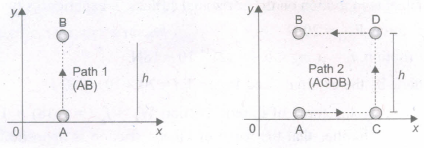
Show that the work done by the conservative force is independent of the path. Consider the following cases
1.
k1 and k2 attached to a mass m as shown in figure. The results can be generalized to any number of springs in parallel.
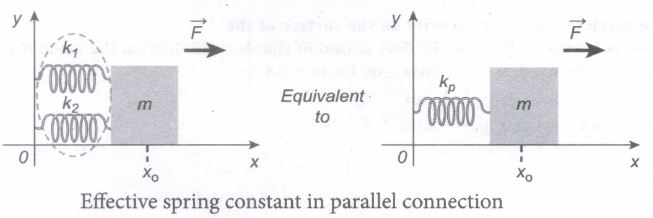
Let the force F be applied towards right as shown in figure. In this case, both the springs elongate or compress by the same amount of displacement. Therefore, net force for the displacement of mass m is
F = - kpx ..(1)
where kp is called effective spring constant.
Let the first spring be elongated by a displacement x due to force F1 and second spring be elongated by the same displacement x due to force F2' then the net force
F = - k1x - k2x ...(2)
Equating equations (2) and (1), we get
kp= k1 + k2 ...(3)
Generalizing, for n springs connected in parallel
\({ k }_{ P }=\sum _{ i=1 }^{ n }{ { k }_{ i } } \) ....(4)
If all spring constants are identical i.e.,k1 = k2 = ... = kn = k then
kp = n k ...(5)
This implies that the effective spring constant increases by a factor n. Hence, for the springs in parallel connection, the effective spring constant is greater than individual spring constant.
2.
Let a be the displacement amplitude and co be the angular frequency of S.H.M then maximum velocity, Vo = \(\omega \)A \(\therefore \omega ={ V }_{ 0 }/A\)
Maximum acceleration, ao= \({ \omega }^{ 2 }A={ \left( \frac { { V }_{ 0 } }{ A } \right) }^{ 2 }\)
A =\(\frac { { V }_{ 0 }^{ 2 } }{ A } \)
\(\therefore\) Displacement amplitude, A = \(\frac { { V }_{ 0 }^{ 2 } }{ { a }_{ 0 } } \)
3.
The effective value of acceleration due to gravity g' = g cos \(\alpha\)
\(T=\quad 2\pi \sqrt { \frac { l }{ g' } } =2\pi \sqrt { \frac { 1 }{ cos\alpha } } \)
4.
(i) The force experienced by a mass 'm' which is on the surface of the Earth is given by F= \(\frac { { GM }_{ 1 }m }{ { r }_{ E }^{ 2 } } \)
(ii) ME-mass of the Earth, m - mass of the object, RE- radius of the Earth.
Equating Newton's second law, F= mg, to equation we get,
mg= \(\frac { { GM }_{ 1 }m }{ { r }_{ E }^{ 2 } } \)
g=\(\frac { { GM }_{ E }m }{ { r }_{ E }^{ } } \)
(iii) Now the force experienced by some other object of mass M at a distance r from the center of the Earth is given by,
F= \(\frac { { GM }_{ E }m }{ { r }_{ }^{ 2 } } \)
Using the value of g in equation, the force F will be,
\(F=-gM\frac { { R }_{ E }^{ 2 } }{ { r }^{ 2 } } \)
From this it is clear that the force can be calculated simply by knowing the value of g. It is to. be. noted that in the above calculation G is not required.
5.
Since, the system is going from A to B and that back to A, it is undergoing a cyclic change. Now in cyclic change, there is no change in internal energy (\(\triangle\)U = 0).From first law of thermodynamic
\(\triangle\)Q = \(\triangle\)U =\(\triangle\)W
= \(\triangle\)W
The amount of heat absorbed by the system
= 10 cal- 30 J
=(10 x 4.2-30)J
= (42 - 30) J
\(\therefore\) The net work done by the system = 12 J
6.
(i) N = \(\mu \) NA
Where NA is Avogadro number (6.023\(\times\)1023mol-1)
(ii) PV = NA 11NAkT. Here NA k = R called universal gas constant and its value is 8.314 j/mol.K
So the ideal gas law can be written for u mole of gas as
PV = \(\mu \)RT
(iii) This.is called the equation of state for an ideal gas. It relates the pressure, volume and temperature of thermodynamic system at equilibrium.
7.
Accumulate to kinetic theory:
(i) The molecules of a gas are in a state of continuous random motion.
(ii) They collide with one another and also with the walls of the vessel. Whenever a molecule collides with the wall. It returns with a changed momentum and an equal momentum is transfused to the wall (conservation of momentum).
Accumulate to Newton's law:
(i) The transfer of momentum to the wall is equal to the force excited on the wall.
(ii) The force excited per unit area of the wall is the pressure of the gas.
Hence a gas excites pres due to the continuous call of its molecules with the walls of the vessel.
8.
It states that if the pressure remains const, then the v0 of a g mass of a gas increases or decreases by \(\frac{1}{2723.15}\) of its volume at 0oC for each 1°C rise or fall of temperature Vo - volume of the gn mass
of a gas at O°C
Accumulate to charle's law, its volume at 1°C is
\({ v }_{ 1 }={ v }_{ 0 }+\frac { { v }_{ 0 } }{ 273.15 } ={ v }_{ 0 }\left( 1+\frac { 1 }{ 273.15 } \right) \)
Volume of the gas at toC
\({ v }_{ 1 }={ v }_{ 0 }\left( 1+\frac { 1 }{ 273.15 } \right) \)
If To and T are temperature on kelvin scale corresponding to 0°C & toC, then
To= 27:3.15+0 = 273.15
T = 273.15 +t
\(\therefore { v }_{ t }={ v }_{ 0 }\left( \frac { T }{ { T }_{ 0 } } \right) or\frac { { v }_{ 1 } }{ T } =\frac { { v }_{ 0 } }{ { T }_{ 0 } } \)
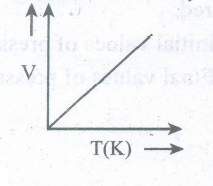
\(\frac{v}{T}\) = constant i.e. v x T.
So, the law states that at constant pressure the volume of a gn mass of a gas is directly proportional to its absolute temperature. The graph. between. V and T for a gn mass of a gas at constant pressure is a St line.
9.
(i) This is because a body with large reflectivity is poor absorber of heat, and poor aborbers of heat are emitters.
(ii) When we touch a brass tumber on a chilly day, heat flows from our body to the tumbler quickly (as thermal conductivity of brass is very high) and as a result, it appears colder.
(iii) On the other hand, as the wood a bad conductor, heat does not flow to the wooden tray from our body, on touching it.
10.
(i) The oil used as a lubricant for heavy machinery parts should have a high viscous coefficient.
(ii) The highly viscous liquid is used to damp the motion of some instruments and is used as brake oil in hydraulic brakes.
(iii) Blood circulation through arteries and veins depends upon the viscosity of fluids.
11.
| S.No | Transverse waves | Longitudinal waves |
|---|---|---|
| 1 | The direction of vibration of particles of the medium is perpendicular to the direction of propagation of waves. | The direction of vibration of particles of the medium is parallel to the direction of propagation of waves. |
| 2 | The disturbances are in the form of crests and troughs. | The disturbances are in the form of compressions and rarefactions. |
| 3 | Transverse waves are possible m elastic medium. | Longitudinal waves are possible in all types of media (solid liquid and gas). |
12.
(i) For the propagation of the waves, the medium must possess both inertia and elasticity, which decide the velocity of the wave in that medium.
(ii) In a given medium, the velocity of a wave is a constant whereas the constituent particles in that medium move with different velocities at different positions. Velocity is maximum at their mean position and zero at extreme positions.
(iii) Waves undergo reflections, refraction, interference, diffraction and polarization.
13.
Let us first calculate the stiffness constant of the spring balance by using equation (10.29),
\(K=\frac { mg }{ l } =\frac { 25\times 11.5 }{ 0.25 } ={ 1150 }Nm^{ -1 }\)
The time period of oscillations is given by
\(T=2\pi \sqrt { \frac { M }{ k } } \)where M is the mass of the body.
Since, M is unknown, rearranging, we get
\(M=\frac { k{ T }^{ 2 } }{ { 4\pi }^{ 2 } } =\frac { \left( 1150 \right) { \left( 0.5 \right) }^{ 2 } }{ { 4\pi }^{ 2 } } =7.3kg\)
The gravitational force acting on the body is W = Mg = 7.3\(\times\)11.5 = 83.95 N ≈ 84 N
14.
The efficiency of heat engine is given by
\(\eta =1-\frac { { Q }_{ L } }{ { Q }_{ H } } \)
\(\eta =1-\frac { 300 }{ 500 } =1-\frac { 3 }{ 5 } \)
\(\eta \) = 1 – 0.6 = 0.4
The heat engine has 40% efficiency, implying that this heat engine converts only 40% of the input heat into work.
15.
(a) We know that work done by the gas in an isothermal expansion
Since μ = 0.5
W = 0.5mol \(\times\)\(\frac { 8.31J }{ mol.K } \times 300 K\ In\ \left( \frac { 6L }{ 2L } \right) \)
W = 1.369 kJ
Note that W is positive since the work is done by the gas.
(b) From the First law of thermodynamics, in an isothermal process the heat supplied is spent to do work.Therefore, Q = W = 1.369 kJ. Thus Q is also positive which implies that heat flows into the system.
(c) For an isothermal process
PiVi = PfVf = μRT
\({ P }_{ f }=\frac { \mu RT }{ { V }_{ f } } =0.5mol\times \frac { 8.31J }{ mol.K } \times \frac { 300K }{ 6\times { 10 }^{ -3 }{ m }^{ 3 } } \)
= 207.75 k Pa
16.
Let each side of the cube be l. The volume occupied by 3 cm depth of cube,
V = (3cm) \(\times\) l2 = 3l2cm
According to the principle of floatation, we have
V\(\rho\)g = mg \(\Rightarrow\) V\(\rho\) = m
\(\rho\) is density of water = 1000 kg m-3
\(\Rightarrow\) (3l2\(\times\)10-2m) \(\times\)(1000 kgm-3) = 300\(\times\)10-3 kg
\({ l }^{ 2 }=\frac { 300\times { 10 }^{ -3 } }{ 3\times { 10 }^{ -2 }\times 1000 } { m }^{ 2 }\Rightarrow { l }^{ 2 }=100\times { 10 }^{ -4 }{ m }^{ 2 }\)
l = 10\(\times\)10-2 m = 10 cm
Therefore, volume of cube V = l3 = 1000 cm3
17.
From the shadows it is revealed that Earth has spherical shape with bulging along equator and flat at poles.
18.
The answer is wrong.
Actually, the seasons in the Earth arise due to the rotation of Earth around the sun with 23.5o tilt.
19.
30% of Power=\(\frac{W}{t}=\frac{mgh}{t}=\frac{V\rho gh}{t}\)
\(\frac{30}{100}\times P=\frac{V\rho gh}{t}\)
P=43.6 KW
20.
(a) The potential energy U = mgh = 2 \(\times\) 10 \(\times\) 5 = 100 J
Here the positive sign implies that the energy is stored on the mass.
(b) This potential energy is transferred from external agency which applies the force on the mass.
(c) The external applied force \(\overrightarrow { { F }_{ a } } \) which takes the object to the height 5 m is \(\overrightarrow { { F }_{ a } } =-\overrightarrow { { F }_{ g } } \)
\(\overrightarrow { { F }_{ a } } =-(-mg\hat { j } )=mg\hat { j } \)
where, \(\hat { j } \) represents unit vector vertical upward direction.
(d) From the definition of potential energy, the object must be moved at constant velocity. So the net force acting on the object is zero.
\(\overrightarrow { { F }_{ g } } +\overrightarrow { { F }_{ a } } =0\)
21.
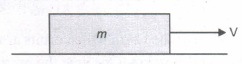
When the block slides, the force acting on the block is kinetic friction which is equal to fk= μsmg.
From Newton's second law ma = -μsmg
The negative sign implies that force acts on the opposite direction of motion.
The acceleration of the block while sliding a =-μkg
The negative sign implies that the acceleration is in opposite direction of the velocity. Note that the acceleration depends only on g and the coefficient of kinetic friction μk. We can apply the following kinematic equation
v=u+at
The final velocity is zero
0=u-ukgt
t=\(\frac { u }{ { \mu }_{ k }g } \).
22.
\(h=ut+\frac { 1 }{ 2 } { gt }^{ 2 }\)
find a by differentiating h twice w.r.t.
a = g
As F = ma so F = mg
23.
If speed of an object increases with time, its acceleration is positive.
(Acceleration is in the direction of motion) and if speed of an object decreases with time its acceleration is negative (Acceleration is opposite to the direction of motion).
24.
m = 66.0 gm.
25.
Velocity of center of mass = \(\frac{31\hat{i}-34\hat{j}+15\hat{k}}{2} ms^{-1}\).
26.
G = 6.67\(\times\)10-11 N m2kg-2
= 6.67\(\times\)10-11 (kg m s-2) (m2 kg-2)
=6.67\(\times\)10-11 kg-1 m3 s-2
= 6.67\(\times\)10-11 (1000 g)-1(100 cm)3 (s-2)
=6.67\(\times\)10-11 x \(1\over 1000\) \(\times\)100 \(\times\)100\(\times\)100g-1cm3 s-2
=6.67\(\times\)10-8 g-1cm3s-2.
27.
Let us assume that the Energy E depends on mass m and velocity of light c.
\(E\alpha m^ac^b\)
\(E=km^ac^b\) where K a constant
Dimensions of E = [ML2T-2]
Dimensions of m = [M]
Dimensions ofc = [LT-1]
Substituting the values in the above equation
[ML2T-2] = K[M]a [LT-1]b
By equating the dimensions
a = 1
b = 2
-b = -2
E = k.mc2
The value of constant k = 1
E = mc2. This is Einstein's mass energy relation.
28.
(i) As 3600 = 2\(\pi \)rad .
\(\therefore\) 10= \(2\pi \over 360\) rad = 1.745\(\times\)10-2 rad
(ii) 10 = 60' = 1.745 \(\times\)10-2 rad
\(\therefore\)1' = 2.908 X 10⁻⁴\(\approx\)2.91\(\times\)10-4 rad
(iii) 1'= 60" = 2.908\(\times\)10-4rad
1" = 4.847\(\times\)10-6 rad\(\approx\)4.85\(\times\)10-6 rad
29.
Given:
t=3s
Distance s = Area of \(\triangle OAB\)
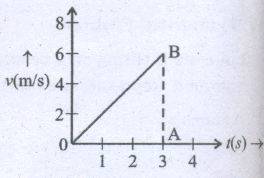
\(=\frac{1}{2}\times OA\times BA\)
\(=\frac{1}{2}\times 3\times 6=9m\)
If the speed varies with the time: Then \(v=\frac{ds}{dt}\Rightarrow ds=v\ dt\)
\(\Rightarrow \int { ds } =\int { v }\ dt\)
\(or\ s=\int { v }\ dt\)
30.
\(a={F \over m}={20 \over 5}={4ms}^{-2}\)
v=u + a t = 0 + 4\(\times\)10 = 40 ms-1
\(AE={1\over2}\times5\times{(40)}^{2}=4000\) Joule
31.
The force F has to act downward, because the body is to move up with an acceleration greater than 'g' acceleration due to gravity.
According to Newton's II law,
In a force acting an a downward} mg + F = ma
F = m(g+a)
= 20(9.8 + 4)
= 20(13.8)
= 276N
32.
1. Greater the mass concentrated away from the axis, greater the moment of inertia.
2. Moment of inertia of a body about an axis of rotation resists a change in it. In rotational motion, moment of inertia increases with increase in torque to change it's rotation.
33.
Newton's third law states that for every action there is an equal and opposite reaction.
34.
| 1. \(\omega ={ \omega }_{ 0 }+\alpha t\) | \(\omega \) = Final angular velocity |
| 2. \(\theta ={ \omega }_{ 0 }t+\frac { 1 }{ 2 } { \alpha t }^{ 2 }\) | \({ \omega }_{ 0 }\) = initial angular velocity |
| 3. \({ \omega }^{ 2 }={ \omega }_{ 0 }^{ 2 }+2\alpha \theta \) | \(\theta \) = Angular displacement |
| 4. \(\theta =\frac { \left( { \omega }_{ 0 }+\omega \right) t }{ 2 } \) | \(\alpha \) = angular acceleration t = time |
35.
Time becomes irrelevant. Because day and year based on spinning and revolution of the planet. So each planet has its own year length.
Eg: Uranus and Neptune move too slow.
36.
(i) Displacement is the difference between the final and initial positions of the object in a given interval of time. It can also be defined as the shortest distance between these two positions of the object and its direction is from the initial to final position of the object, during the given interval of time. It is a vector quantity.
(ii) Distance is the actual path length travelled by an object in the given interval of time during the motion. It is a positive scalar quantity.
37.
\(\Delta L=10\log { _{ 10 }\left[ \frac { { I }_{ 1 } }{ { I }_{ 0 } } \right] =50dB } \)
\(\log { _{ 10 }\left[ \frac { { I }_{ 1 } }{ { I }_{ 0 } } \right] =5dB } \)
\(\frac { { I }_{ 1 } }{ { I }_{ 0 } } ={ 10 }^{ 5 }\Rightarrow { I }_{ 1 }={ 10 }^{ 5 }{ I }_{ 0 }\times { 10 }^{ -12 }{ Wm }^{ -2 }\)
I1 = 10-7 Wm-2
Since three musical instruments are played,
therefore, Itotal = 3I1 = 3\(\times\)10-7 Wm-2.
38.
Given y1 = 5 sin(240\(\pi\)t) and y2 = 4 sin(244\(\pi\)t)
Comparing with y = A sin(2\(\pi\) f1t), we get
2\(\pi\)f1 = 240π \(\Rightarrow\) f1 = 120Hz
2\(\pi\)f2 = 244π \(\Rightarrow\) f2 = 122Hz
The number of beats produced is | f1 − f2| = |120 − 122| = |− 2|=2 beats per sec
39.
Kinetic energy is KE\(=\frac { 1 }{ 2 } { mv }_{ x }^{ 2 }\)
Multiply numerator and denominator by m
\(KE=\frac { 1 }{ 2m } { m^{ 2 }v }_{ x }^{ 2 }=\frac { 1 }{ 2m } \left( { mv }_{ x } \right) ^{ 2 }=\frac { 1 }{ 2m } { P }_{ x }^{ 2 }\)
where, Px is the linear momentum of the particle executing simple harmonic motion.
Total energy can be written as sum of kinetic energy and potential energy, therefore, from equation (10.73) and also from equation (10.75), we get
E = KE + U(x) \(=\frac { 1 }{ 2m } { P }_{ x }^{ 2 }+\frac { 1 }{ 2m } { m\omega ^{ 2 }v }_{ x }^{ 2 }\) = constant
40.
From equation (7.34), we have
h∝\(\frac { 1 }{ r } \Rightarrow hr=\)constant
Consider two capillary tubes with radius r1 and r2 which on placing in a liquid, capillary rises to height h1 and h2, respectively. Then,
h1r1 = h2r2 = constant
\(\Rightarrow { h }_{ 2 }=\frac { { h }_{ 1 }{ r }_{ 1 } }{ { r }_{ 2 } } =\frac { \left( 2\times { 10 }^{ -2 }m \right) }{ \frac { r }{ 3 } } \Rightarrow { h }_{ 2 }=6{ \times 10 }^{ 2 }m\)
41.
The center of gravity of a body is the point at which the entire weight of the body acts irrespective of the position and orientation of the body.
42.
(i) We know from postulates of kinetic theory that the molecules of a gas are in random motion and they collide with each other.
(ii) Between two successive collisions, a molecule moves along a straight path with uniform velocity.
(iii) This path is called mean free path. Consider a system of molecules each with diameter d. Let n be the number of molecules per unit volume.
(iv) Assume that only one molecule is in motion,and all others are at rest.
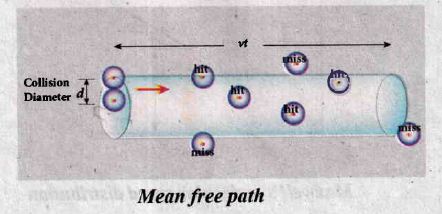
(v) If a molecule moves with average speed v in a time t, the distance travelled is vt.
(vi) In this time t, consider the molecule to move in an imaginary cylinder of volume nd2vr.
(vii) It collides with any molecule. whose center is within this cylinder. Therefore, the number of collisions is equal to the number of molecules in the volume of the imaginary cylinder.
(viii) It is equal to \(\pi\)d2vtn. The total path length divided by the number of collisions in time t is the mean free path.
Mean free pat, \(\lambda =\frac{distance \ travelled}{Number \ of \ collisions}\)
\(\lambda =\frac { vt }{ n{ \pi d }^{ 2 }vt } =\frac { 1 }{ n{ \pi d }^{ 2 } } \) ...(1)
(ix) Though we have assumed that only one molecule is moving at a time and other molecules are at rest, in actual practice all the molecules are in random motion.
(x) So the average relative speed of one molecule with respect to other molecules has to be taken into account. After some detailed calculations (you will learn in higher classes) the correct expression for mean free path .
\(\therefore \ \lambda =\frac { 1 }{ \sqrt { 2 } n{ \pi d }^{ 2 } } \) ...(2)
(xi) The equation (1) implies that the mean free path is inversely proportional to number density.
(xii) When the number density increases the molecular collisions increases and it decreases the distance travelled by the molecule before collisions:
Case1: Rearranging the equation (2) using 'm' (mass of the molecule)
\(\therefore \ \lambda =\frac { 1 }{ \sqrt { 2 } n{ \pi d }^{ 2} mm } \)
But mn = mass per unit volume = p (density of the gas)
\(\therefore \ \lambda =\frac { 1 }{ \sqrt { 2 } n{ \pi d }^{ 2 } p} \)
Also we know that PV = NkT
P =\(\frac{N}{V}\)KT= nKT
\(\therefore n =\frac{P}{KT}\)
Substituting n = \(\frac{P}{KT}\) in equation, we get
\(\lambda =\frac { 1 }{ \sqrt { 2 } n{ \pi d }^{ 2 }P } \)
43.
Monoatomic molecule
A monoatomic molecule by virtue of its nature has only three translational degrees of freedom. Therefore f = 3
Example: Helium, Neon, Argon
Diatomic temperature
At Normal temperature.
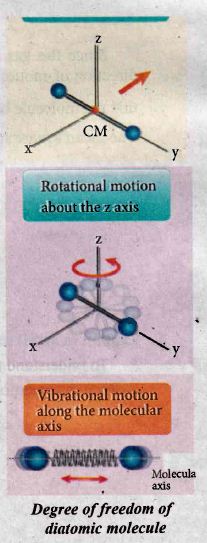
A molecule of a diatomic gas consists of two atoms bound to each other by a force of attraction. Physically the molecule can be regarded as a system of two point masses fixed at the ends of a massless elastic spring.
The center of mass lies in the center of the diatomic molecule. so, the motion of the center of mass requires three translational degrees of freedom. In addition, the diatomic can rotate about three mutually perpendicular axes. But the moment of inertia about its own axis of rotation is negligible. Therefore, it has only two rotational degrees of freedom (one rotation is about Z axis and another rotation is about Y axis). Therefore totally there are five degrees of freedom. f = 5
At High Temperature
At a very high temperature such as 5000 K, the diatomic molecules possess additional two degrees of freedom due to vibrational motion [one due to kinetic energy of vibration and the other is due to potential energy]. So, totally are seven degrees of freedom. f = 7.
Examples: Hydrogen, Nitrogen, Oxygen
Triatomic molecules
There are two cases.
Linear triatomic molecule
In this type, two atoms lie on either side of the central atom.
.JPG)
Linear triatomic molecule has three translational degrees of freedom. It has two rotational degrees of freedom because it is similar to diatomic molecule except there is an addtional atom at the center. At normal temperature, linear triatomic molecule will have five degrees of freedom. At high temperature it has two additional vibrational degrees of freedom. So a linear triatomic molecule has seven degrees of freedom.
Example: Carbon dioxide
Non-Linear triatomic molecule
In this case, the three atoms lie at the vertices of a triangle.
In has three translational degrees of freedom and three rotational degrees of freedom about three mutually orthogonal axes. The total degrees of freedom f = 6
.JPG)
Example: Water, Sulphur dioxide
44.
Force \(\overrightarrow { F } =mg\left( -\hat { j } \right) =-mg\hat { j } \)
Displacement vector \(d\vec{r}\) = dx\(\hat { i } \) + dy \(\hat { j } \)
(As the displacement is in two dimension; unit vectors \(\hat { j } \) and \(\hat { i } \) are used)
(a) Since the motion is only vertical, horizontal displacement component dx s zero. Hence, work done by the force along path 1 (of distance h).
\({ W }_{ push\ \ 1 }=\int _{ A }^{ B }{ \overrightarrow { F } .d\overrightarrow { r } =\int _{ A }^{ B }{ (-mg\hat { j } ).(dy\hat{j})=-mg\int _{ 0 }^{ h }{ dy=-mgh } } } \)
Total work done for path 2 is
\({ W }_{ push\ \ 2 }=\int _{ A }^{ B }{ \overrightarrow { F } .d\overrightarrow { r } =\int _{ A }^{ C }{ \overrightarrow { F } .d\overrightarrow { r } +\int _{ C }^{ D }{ \overrightarrow { F } .d\overrightarrow { r } +\int _{ D }^{ B }{ \overrightarrow { F } .d\overrightarrow { r } } } } } \)
But \(\int _{ A }^{ C }{ \overrightarrow { F } .d\overrightarrow { r } =\int _{ A }^{ B }{ (-mg\hat { j } ).(dx\hat { i } )=0 } } \)
\(\int _{ A }^{ D }{ \overrightarrow { F } .d\overrightarrow { r } =\int _{ C }^{ D }{ (-mg\hat { j } ).(dy\hat { j } )=-mg\int _{ 0 }^{ h }{ dy } =-mgh } } \)
\(\int _{ D }^{ B }{ \overrightarrow { F } .d\overrightarrow { r } =\int _{ A }^{ B }{ (-mg\hat { j } ).(dx\hat { i } )=0 } } \)
Therefore, the total work done by the force along the path 2 is
\({ W }_{ push\ \ 2 }=\int _{ A }^{ B }{ \vec { F } } .d\overrightarrow { r } =-mgh\)
Note that the work done by the conservative force is independent of the path.

11th Standard Syllabus & Materials
11th Standard
TN 11th Tamil பீடு பெற நில் - செய்யுள் - காவடிச்சிந்து Important Questions And Answers Study Material - QB365 Set A
NEW11th Standard
TN 11th Tamil பீடு பெற நில் - உரைநடை - மலை இடப்பெயர்கள் : ஓர் ஆய்வு Important Questions And Answers Study Material - QB365 Set A
NEW11th Standard
TN 11th Tamil மாமழை போற்றுதும் - துணைப்பாடம் - யானை டாக்டர் Important Questions And Answers Study Material - QB365 Set A
NEW11th Standard
TN 11th Tamil மாமழை போற்றுதும் - செய்யுள் - ஐங்குறுநூறு Important Questions And Answers Study Material - QB365 Set A



Tamilnadu Stateboard 11th Standard Subjects

Maths

Commerce

Economics

Biology

Business Maths and Statistics

Accountancy

Computer Science
Physics

Chemistry
Maths
Biology
Economics
Physics
Chemistry

History
Business Maths and Statistics

Computer Science
Accountancy

Computer Applications
History
Computer Technology
Commerce
Computer Applications
Computer Technology

Tamil

English

French
Tamilnadu Stateboard Standards

