
 100% FREE ACCESS
11th Standard Syllabus & Materials
11th Standard
TN 11th Tamil இயற்கை வேளாண்மை,சுற்றுச்சூழல் -செய்யுள் - மனோன்மணீயம் Important Questions And Answers Study Material - QB365 Set A
NEW11th Standard
TN 11th Tamil என்னுயிர் என்பேன் -துணைப்பாடம் - இசைத்தமிழர் இருவர் Important Questions And Answers Study Material - QB365 Set A
NEW11th Standard
TN 11th Tamil மொழி கலை -செய்யுள் - ஒவ்வொரு புல்லையும் Important Questions And Answers Study Material - QB365 Set A
NEW11th Standard
TN 11th Tamil பீடு பெற நில் - இலக்கணம் - பகுபத உறுப்புகள் Important Questions And Answers Study Material - QB365 Set A
NEW11th Standard
TN 11th Tamil பீடு பெற நில் - துணைப்பாடம் - வாடிவாசல் Important Questions And Answers Study Material - QB365 Set A
NEW11th Standard
TN 11th Tamil பீடு பெற நில் - செய்யுள் - குறுந்தொகை Important Questions And Answers Study Material - QB365 Set A

Published on: 13/03/2020
11th Standard Physics English Medium All Chapter Book Back and Creative Two Marks Questions 2020
Download Tamil Nadu 11th Standard Physics question papers, model tests, one-mark questions, important questions, and public exam papers in PDF format. Free study materials and answer keys for TN State Board students.
Questions + Answers key
Take MCQ Physics Test1.
The molecules of a given mass of a gas have rms velocity of 200 ms-1 at 27°C and 1.0\(\times\)105 Nm-2 pressure. When the temperature and pressure of the gas are respectively. 127°C and 0.05\(\times\)105 Nm-2
2.
At .what distance from the centre of Earth, the value acceleration due to gravity 'g' will be half that of the surface?
3.
The escape velocity of a body from Earth's surface is ve. What will be the escape velocity of the same body from a height equal to 7R from Earth's surface.
4.
Calorimeters are made of metals not glass. Why?
5.
A spring stretches by 0.020 m when a 1.5 kg object is suspended from its end. How much mass should be attached to the spring so that its frequency of vibration is f = 3.1 Hz?
6.
What is the nature of intermolecular forces?
7.
For a given material, the youngs modulus is 2 - 4 times that of rigidity modulus. What is its poisson's ratio?
8.
Is it possible that there is a change in temperature of a body without giving/taking heat to from it?
9.
What type of motion is associated with the molecule of a gas?
10.
Write the relation between path difference and phase difference?
11.
What is the effect of pressure on velocity of sound in gas?
12.
Define molar specific heat capacity.
13.
In an empty room why is it that a tone sounds louder than in the room having things like furniture etc.
14.
Define forced oscillation. Give an example.
15.
A fresh air is composed of nitrogen N2(78%) and oxygen O2(21%). Find the rms speed of N2 and O2 at 20°C.
16.
Why moon has no atmosphere?
17.
Calculate the number of moles of air is in the inflated balloon at room temperature as shown in the figure.
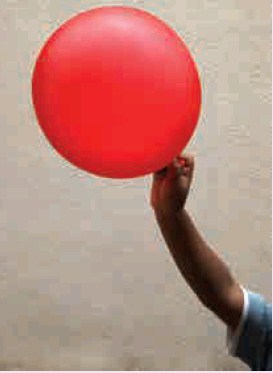
The radius of the balloon is 10 cm, and pressure inside the balloon is 180 kPa.
18.
We use straw to suck soft drinks, why?
19.
Define weight.
20.
A train 100 m long is moving with a speed of 60 km h-1. In how many seconds will it cross a bridge of 1 km long?
21.
What are the examples of projectile motion?
22.
A child sits stationary at one end of a long trolley moving uniformly with speed V on a smooth horizontal floor. If the child gets up and runs about on the trolley in any manner, then what is the effect of the speed of the centre of mass of the (trolley + child) system?
23.
A force \(\vec F=\vec i+2\vec j+3\vec k\) k acts on a particle and displaces it through a distance \(\vec S=4\vec i+6\vec j\). Calculate the work done if force and work done are in the same direction?
24.
A RADAR signal is beamed towards a planet and its echo is received 7 minutes later. If the distance between the planet and the Earth is 6.3\(\times\)1010 m. Calculate the speed of the signal?
25.
Two boys of the same weight sit at the opposite ends of a diameter of a rotating circular table. What happens to the speed of rotation if they move nearer to axis of rotation?
26.
Two bodies of identical masses with 2nd body at rest collides with 1st body, prove that the velocities of the bodies are reversed.
27.
Why are ball bearings used in machinery?
28.
What is free body diagram? What are the steps to be followed for developing free body diagram.
29.
Three identical solid spheres move down through three inclined planes A, B and C all same dimensions. A is without friction, B is undergoing pure rolling and C is rolling with slipping. Compare the kinetic energies EA EB and Ec at the bottom.
30.
Give an example to show that the following statement is false. 'any two forces acting on a body can be combined into single force that would have same effect'.
31.
Write the combined effect of two velocities of a projectile.
32.
Calculate the acceleration of the bicycle of mass 25 kg as shown in Figures
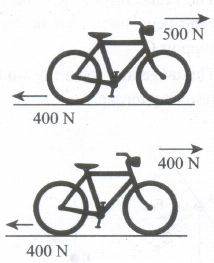
33.
The momentum of a system of particles is always conserved. True or false?
34.
Give the unit and dimension of power?
35.
How Physics is related to technology and define technology with respect to Physics.
36.
What is meant by Range of masses?
37.
The measurement value of length of a simple pendulum is 20cm known with 2mm accuracy. The time for 50 oscillations was measured to be 40 s within is resolution. Calculate the percentage accuracy in the determination of acceleration due to gravity 'g' from the above measurement.
38.
Consider the following function
(a) y = x2 + 2 \(\alpha\) t x
(b) y = (x + vt)2
which among the above function can be characterized as a wave?
39.
Write down the time period of simple pendulum.
40.
Distinguish between streamlined flow and turbulent flow.
41.
If the ratio of the orbital distance of two planets \({d_1\over d_2}=2,\) what is the ratio of gravitational field experienced by these two planets?
42.
A body of mass 10 kg at rest is subjected to a force of 16N. Find the kinetic energy at the end of 10 s.
43.
The following velocity-time graph represents a particle moving in the positive x-direction. Analyse its motion from 0 to 7 s. Calculate the displacement covered and distance travelled by the particle from 0 to 2 s.
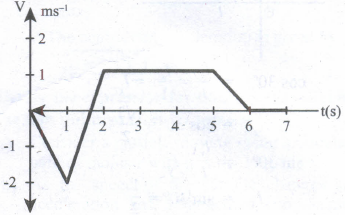
1.
Find the rms velocity of its molecules in ms-1
T1= 27°C + 273 = 300 K, T2 = 127°e + 273 = 400 K
rms speed of molecules is \({ v }_{ rms }=\sqrt { \cfrac { 3RT }{ M } } \)
So it depends only on temperature,
vrms ∝ \(\sqrt { T } \)
\(\cfrac { { v }_{ 1 } }{ { v }_{ 2 } } =\sqrt { \cfrac { { T }_{ 1 } }{ { T }_{ 2 } } } \Rightarrow \cfrac { 200 }{ { V }_{ 2 } } =\sqrt { \cfrac { 300 }{ 400 } } ;\cfrac { 200 }{ { v }_{ 2 } } =\cfrac { \sqrt { 3 } }{ 2 } \)
\({ v }_{ 2 }=\cfrac { 400 }{ \sqrt { 3 } } \)
v2 = 231ms-1
2.
According to acceleration due to gravity
\(\cfrac { g' }{ g } =\left( \cfrac { R }{ R+h } \right) ^{ 2 }\)
\(\cfrac { 1 }{ 2 } =\left( \cfrac { R }{ R+h } \right) ^{ 2 }\Rightarrow \cfrac { 1 }{ \sqrt { 2 } } =\cfrac { R }{ R+h } \)
\(R+h=2\sqrt { R } \Rightarrow h=(\sqrt { 2 } -1)R\)
h = 0.414R
Hence distance from centre = R + 0.414 R = 1.414 R
3.
\({ v }_{ e }\)∝\(\cfrac { 1 }{ \sqrt { r } } \) where r is the position of body from the surface.
\(\cfrac { { v }_{ e } }{ v' } =\sqrt { \cfrac { R+7R }{ R } } =\sqrt { \cfrac { 8R }{ R } } =\sqrt { 8 } =2\sqrt { 2 } \)
\(\therefore v'=\cfrac { { v }_{ e } }{ 2\sqrt { 2 } } \)
4.
This is because metals are good conductors of heat and have low specific heat capacity
5.
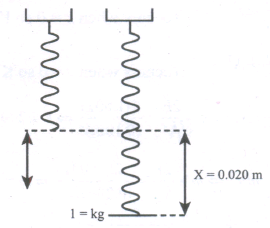
\(\sum { { F }_{ y } } \)= may=0
kx - mg = 0 => k =\(\frac{mg}{x}\)
The force constant is,
k=\(\frac { (1.5kg)(9.8m/{ s }^{ 2 }) }{ (0.020m) } =\frac { 14.7 }{ 0/020 } \) =735 N/m
Frequency =\(\frac { 1 }{ 2\pi } \sqrt { \frac { k }{ m } } \)
\(\Rightarrow\)4\(\pi ^{2}\)f2=\(\frac{k}{m}\)
m=\(\frac { k }{ 4{ \pi }^{ 2 }{ f }^{ 2 } } \Rightarrow m=\frac { (735N/m) }{ 4{ \pi }^{ 2 }({ 3.0Hz) }^{ 2 } } \)
=\(\frac { (735N/m) }{ 4\times ({ 3.75) }^{ 2 }\times ({ 3.0Hz) }^{ 2 } } \)
=\(\frac { 735N/m }{ 4\times 9.85\times 9.0Hz } \)
= \(\frac{735\ N/m}{354.6Hz}\) = 2.07 kg
6.
The intermolecular forces are attractive, but they are repulsive for intermolecular reparations less than 10-10m.
7.
\( Y=2G(1+\sigma)\)
So, 2-4G = 2G(1+σ)
or σ =1.2-1= 0.2
8.
Yes, for example in an adiabatic compression, temperature rises and in an adiabatic expansion, temperature falls, although no heat is given Dr taken from the system.
9.
Brownian motion. In this motion any particular molecule will follow a zig - zag path due to be collision with the other molecule or with the walls of the container.
10.
Phase difference = \(\frac{2\pi}{\lambda}\) (path difference)
\(\Delta \varphi =\frac { 2\pi }{ \lambda } \Delta r=\frac { \lambda }{ 2\pi } \Delta \varphi \)
11.
For a fixed temperature, when the pressure varies, correspondingly density also varies such that the ratio \((\frac{p}{\rho})\) becomes constant. This means that the speed of sound is independent of pressure for a fixed temperature.
12.
The displacement time t = 0s(initial time), the phase φ=φ0 is called epoch (initial phase) where φ0 is called the angle of epoch.
13.
When a room has furniture, reverberation time can be suitably decreased, since furniture have large absorption coefficient of sound so, a tone sounds with lesser amplitude and intensity. Whereas in an empty room, reverberation time will be more than a room having things like furniture.
14.
Any oscillation driven by an external periodic agency to overcome the damping is known as forced oscillation.
Example: Sound boards of stringed instruments.
15.
Molar mass of nitrogen m = 0.028 kg/mol
Temperature T = 20 + 273 = 293 K
Universal gas constant \( R=8.314 \mathrm{~J} / \mathrm{mol} / \mathrm{k}\)
RMS speed of nitrogen (N2),
\(v_{r m s} =\sqrt{\frac{3 R T}{m}}
\)
\(\left(\mathrm{~N}_{2}\right), v_{m s} =\sqrt{\frac{3 \times 8.31 \times 273}{0.028}}
\)
\(\left(\mathrm{~N}_{2}\right), v_{r m s} =\sqrt{2610 \times 10^{2}}=511 \mathrm{~m} / \mathrm{s}\)
Molar mass of Oxygen = 0.032 kg / mol
RMS speed of oxygen (O2),
\(v_{m s}=\sqrt{\frac{3 R T}{m}}\)
RMS speed of (O2) \(v_{m s} =\sqrt{\frac{3 \times 8.31 \times 293}{0.032}} \)
\(=\sqrt{2280 \times 10^{2}}\)
RMS speed of \(\left(\mathrm{O}_{2}\right), \quad v_{m s}=478 \mathrm{~m} / \mathrm{s}\)
16.
The escape speed of gases on the surface of Moon is much less than the root mean square speeds of gases due to low gravity. Due to this all the gases escape from the surface of the Moon.
17.
The pressure inside the balloon
\( P=1.8 \times 10^{5} \mathrm{~N} / \mathrm{m}^{2} \)
The radius of the balloon \(R=10 \times 10^{-2} \mathrm{~m}\)
Room temperature \(T=(30+273)=303 \mathrm{~K}\)
Number of moles of air \(\mu=\frac{V P}{R T}\)
Universal gas constant \(\mathrm{R}=8.314 \mathrm{~J} / \mathrm{K} / \mathrm{mol}\)
Volume of air in balloon \(\mathrm{V}=\frac{4}{3} \pi R^{3}\)
\(\mathrm{V} =\frac{4}{3} \times 3.14 \times\left(10 \times 10^{-2}\right)^{3} \)
\(=4.1866 \times 10^{-3} \mathrm{~m}^{3} \)
\(\text {Number of moles of air } \mu =\frac{4.1866 \times 10^{-3} \times 1.8 \times 10^{5}}{8.314 \times 303} \)
\(\mu \simeq 0.3 \mathrm{moles}\)
18.
When we suck through the straw, the pressure inside the straw becomes less than the atmospheric pressure. Due to the pressure different the soft drink rises in the straw and we are able to take the soft drink easily.
19.
The weight of an object is defined as the downward force whose magnitude W is equal to the upward force that must be applied to the object to hold it at rest or at constant velocity relative to the Earth.
20.
Total distance to be covered = 1 km + 100 m = 1100 m (including both bridge and time)
Then, Speed=60 kmh-1\(=60\times\frac{5}{18}ms^{-1}=\frac{50}{3}\ ms^{-1}\)
Then, time taken to cover this distance \(=\frac{1100}{\frac{150}{9}}s=66s\)
21.
1. An object dropped from window of a moving train.
2. A bullet fired from a rifle.
3. A ball thrown in any direction.
4. A javelin or shot put thrown by an athlete.
5. A jet of water issuing from a hole near the bottom of a water tank.
22.
No change in speed of system as no external force is working.
23.
Force \(\vec F=\vec i+2\vec j+3\vec k\)
Distance \(\vec S=4\vec i+6\vec j\)
Work done \(\vec F.\vec S=(\vec i2\vec j+3\vec k).(4\vec i+6\vec j)=4+12+0=16J\)
24.
The distance of the planet from the Earth
d = 6.3\(\times\)1010 m
Time t = 7 minutes = 7\(\times\)60 s.
The speed of signal v = ?
The speed of signal v = \({2d\over t}={2\times 6.3 \times 10^8\over 7\times 60}=3\times 10^8 ms^{-1}\)
25.
The moment of inertia of the system (circular table + two boys) decreases. To conserve angular momentum (L = 100 = constant), the speed of rotation of the circular table increases.
26.
When bodies have the same mass i.e., m1 = m2 and second body (usually called target) is at rest (u2 = 0), By substituting m1 = m2 and u2 = 0 in equations
\({ v }_{ 1 }=\left( \frac { { m }_{ 1 }-{ m }_{ 2 } }{ { m }_{ 1 }+{ m }_{ 2 } } \right) { u }_{ 1 }+\left( \frac { { 2m }_{ 2 } }{ { m }_{ 1 }+{ m }_{ 2 } } \right) { u }_{ 2 }\)...(1)
and equations \({ v }_{ 2 }=\left( \frac { { 2m }_{ 1 } }{ { m }_{ 1 }+{ m }_{ 2 } } \right) { u }_{ 1 }+\left( \frac { { m }_{ 2 }-{ m }_{ 1 } }{ { m }_{ 1 }+{ m }_{ 2 } } \right) { u }_{ 2 }\) , we get...(2)
from equations (1) => v1 = 0
from equations (2) => v2 = u1
27.
(i) Ball bearings provides another effective way to reduce the kinetic friction.
(ii) If ball bearings are fixed between two surfaces, during the relative motion only the rolling friction comes to effect and not kinetic friction.
(iii) The rolling friction is much smaller than kinetic friction; hence the machines are protected from wear and tear over the years.
28.
Free body diagram is a simple tool to analyse the motion of the object using Newton's laws.
The following systematic steps are followed for developing the free body diagram:
(i) Identify the forces acting on the object.
(ii) Represent the object as a point.
(iii) Draw the vectors representing the forces acting on the object.
29.
The K.E. of A without friction EA = \(\frac{1}{2}\) m(2gh).
The K.E. of B undergoes pure rolling EB
\(= \frac{1}{2}m \left( \frac { 2gh }{ 1+\frac { { K }^{ 2 } }{ { R }^{ 2 } } } \right) \)
The K.E. of C rolling with slipping Ec
=\(\frac{1}{2}\) m(2gh).
30.
Lifting a table from the floor by two persons. Pushing the car by two persons.
31.
(i) A uniform velocity in the horizontal direction, which will not change provided there is no air resistance.
(ii) A uniformly changing velocity (i.e., increasing or decreasing) in the vertical direction.
32.
| From Fig (1) we have equation & | From the Fig.2 |
| F - fk = m x a | F - fk = m x a |
| 500 - 400 = 25 x a | 400 - 400 = 25 x a |
| a = \(\frac { 100 }{ 25 } =4{ m/s }^{ 2 }\) | a = \(\frac { 0 }{ 25 } =0(zero)\) |
33.
True
34.
Power is a scalar quantity. Its dimension is [ML2T-3]. The SI unit of power is watt (W).
35.
Technology is the application of the principles of physics for practical purposes. The application of knowledge for practical purposes in various fields to invent and produce useful products or to solve problems is known as technology
36.
Range of masses: from heavenly bodies to electron, 1055 kg (mass of known observable universe) to 10-31 kg (mass of an electron) [the actual mass of an electron is 9.11\(\times\)10-31 Kg].
37.
Length of a simple pendulum \(l=20 \mathrm{~cm}=20 \times 10^{-2} \mathrm{~m}\)
\(\text {Accuracy }=2 \mathrm{~mm}=2 \times 10^{-3} \mathrm{~m}\)
Time for one oscillation \(=\frac{40}{50}=0.88\)
\(T =2 \pi \sqrt{\frac{l}{g}} ; T^{2}=4 \pi^{2}\left(\frac{l}{g}\right) \)
\(g =\frac{4 \pi^{2} l}{T^{2}}\)
\(\frac{\Delta g}{g} \times 100 ==\frac{\Delta l}{l} \times 100+2 \frac{\Delta T}{T} \times 100
\)
\(l =20 \mathrm{~cm} \Delta l=2 \mathrm{~mm}=0.2 \mathrm{~cm} \Delta T=1 \mathrm{~s}
\)
\(\frac{\Delta g}{g} =\frac{\Delta l}{l}+2 \frac{\Delta T}{T}
\)
\(=\frac{0.2}{20}+2 \times \frac{1}{40} \)
= 0.01 + 0.05 = 0.06
\(\therefore\) Percentage accuracy in the determination of g=0.06 x 100=6 %
38.
Given
Function \(a \rightarrow y=x^{2}+2 \alpha t x\)
Function \(b \rightarrow y=(x+\mathrm{vt})^{2}\)
Formula
For the function to be a wave function
\(\frac{d y / d x}{d y / d t}\) must be a constant.
For function (a)
\(y =x^{2}+2 \alpha t x
\)
\(\frac{d y}{d x} =2 x+2 \alpha t
\) .....(1)
\(\frac{d y}{d t} =0+2 \alpha x=2 \alpha x\) .......(2)
Dividing equation (1) by (2) we get
\(\frac{d y / d x}{d y / d t}=\frac{2 x+2 \alpha t}{2 d x} \text { is not a constant }\)
∴ Function (a) is not describing wave
For function b :
\(\mathrm{y} =(x+\mathrm{vt})^{2}
\)
\(\therefore \frac{d y}{d x} =2(x+\mathrm{vt}) \times 1=2(x+\mathrm{vt})
\) .....(3)
\(\frac{d y}{d t} =2(x+\mathrm{vt}) \times \mathrm{v}
\)
\(=2 \mathrm{v}(x+\mathrm{vt})\) ......(4)
Dividing equation (3) by equation (4) we get
\(\frac{d y / \mathrm{dx}}{d y / \mathrm{dt}}=\frac{2(x+v t)}{2 v(x+v t)}=\frac{1}{v}=\text { constant }\)
Hence function b satisfies the wave equation.
39.
Time period of a simple pendulum is given by
T = \(2\pi \sqrt { \frac { l }{ g } } \)
l - length of a simple pendulum
g - acceleration due to gravity
40.
| S.No | Streamlined flow | Turbulent flow |
| 1. | In this flow, a liquid flows such that each particle of the liquid passing a point moves along the same path and has the same velocity as its predecessor. |
During this flow of fluid when the critical, velocity of the fluid exceeds the critical velocity |
| 2. | Its velocity is less than critical velocity. |
Its velocity is greater than critical velocity. |
| 3. | For this flow the value of Reynold's number lies between 0 and 1000. |
For this flow the value of Reynold's member is more than 2000. |
| 4. | Less energy is dissipated | More energy is dissipated. |
41.
Ratio of orbital distances \(\frac{d_{1}}{d_{2}}=2\).
Gravitational field \(\mathrm{E} =-\frac{G M}{r^{2}} \hat{r}
\)
\(\mathrm{E}_{1} =-\frac{G M}{d_{1}^{2}}
\)
\(\mathrm{E}_{2} =-\frac{G M}{d_{2}^{2}}
\)
\(\frac{E_{1}}{E_{2}} =-\frac{G M}{d_{1}^{2}} \times \frac{d_{2}^{2}}{(-G M)}
\)
\(\frac{E_{1}}{E_{2}} =\left(\frac{d_{2}}{d_{1}}\right)^{2}=\left(\frac{1}{2}\right)^{2}=\frac{1}{4}
\)
\(\therefore \mathrm{E}_{2} =4 \mathrm{E}_{1}\)
42.
Mass m = 10 kg
Force F = 16 N
time t = 10 s
\(a=F/m=\frac { 16N }{ 10 \ kg } =1.6 \ ms^{ -2 }\)
We know that, v = u + at = 0 + 1.6 \(\times\) 10 = 16 ms-1
Kinetic energy K.E = \(\frac { 1 }{ 2 } { mv }^{ 2 }=\frac { 1 }{ 2 } \times 10\times 16\times 16=1280\ J\)
43.
It is a uniform motion
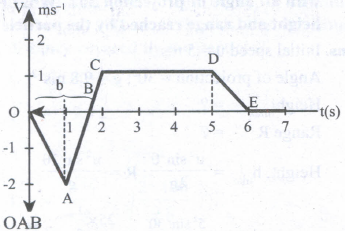
Distance travelled from 0 to 2 s= Area of the shaded portion
\(=\frac{1}{2} b_{1} h_{1}+\frac{1}{2} b_{2} h_{2}=\frac{1}{2} \times 1.5 \times 2+\frac{1}{2} \times 0.5 \times 1 \)
= 1.50 + 0.25 = 1.75m
Displacement
\(=-\frac{1}{2} b_{1} h_{1}+\frac{1}{2} b_{1} h_{2}
\)
\(=-\frac{1}{2} \times 1.5 \times 2+\frac{1}{2} \times 0.50 \times 1 \)
= -1.50 + 0.25 = -1.25 m
0-1 s The velocity increases in the negative direction
1 s-2 s Velocity increases in the positive direction. Change of velocity is 1-(-2)=3 ms-1
2 s-5 s Velocity does not change. So there is no acceleration.
5 s-6 s Velocity reduces to zero.
6 s-7 s The body is at rest.

11th Standard Syllabus & Materials
11th Standard
TN 11th Tamil பீடு பெற நில் - செய்யுள் - காவடிச்சிந்து Important Questions And Answers Study Material - QB365 Set A
NEW11th Standard
TN 11th Tamil பீடு பெற நில் - உரைநடை - மலை இடப்பெயர்கள் : ஓர் ஆய்வு Important Questions And Answers Study Material - QB365 Set A
NEW11th Standard
TN 11th Tamil மாமழை போற்றுதும் - துணைப்பாடம் - யானை டாக்டர் Important Questions And Answers Study Material - QB365 Set A
NEW11th Standard
TN 11th Tamil மாமழை போற்றுதும் - செய்யுள் - ஐங்குறுநூறு Important Questions And Answers Study Material - QB365 Set A



Tamilnadu Stateboard 11th Standard Subjects

Maths

Commerce

Economics

Biology

Business Maths and Statistics

Accountancy

Computer Science
Physics

Chemistry
Maths
Biology
Economics
Physics
Chemistry

History
Business Maths and Statistics

Computer Science
Accountancy

Computer Applications
History
Computer Technology
Commerce
Computer Applications
Computer Technology

Tamil

English

French
Tamilnadu Stateboard Standards

