
 100% FREE ACCESS
11th Standard Syllabus & Materials
11th Standard
TN 11th Tamil இயற்கை வேளாண்மை,சுற்றுச்சூழல் -செய்யுள் - மனோன்மணீயம் Important Questions And Answers Study Material - QB365 Set A
NEW11th Standard
TN 11th Tamil என்னுயிர் என்பேன் -துணைப்பாடம் - இசைத்தமிழர் இருவர் Important Questions And Answers Study Material - QB365 Set A
NEW11th Standard
TN 11th Tamil மொழி கலை -செய்யுள் - ஒவ்வொரு புல்லையும் Important Questions And Answers Study Material - QB365 Set A
NEW11th Standard
TN 11th Tamil பீடு பெற நில் - இலக்கணம் - பகுபத உறுப்புகள் Important Questions And Answers Study Material - QB365 Set A
NEW11th Standard
TN 11th Tamil பீடு பெற நில் - துணைப்பாடம் - வாடிவாசல் Important Questions And Answers Study Material - QB365 Set A
NEW11th Standard
TN 11th Tamil பீடு பெற நில் - செய்யுள் - குறுந்தொகை Important Questions And Answers Study Material - QB365 Set A

Published on: 10/11/2020
11th Standard Physics English Medium Free Online Test One Mark Questions with Answer Key 2020 - Part Nine
Download Tamil Nadu 11th Standard Physics question papers, model tests, one-mark questions, important questions, and public exam papers in PDF format. Free study materials and answer keys for TN State Board students.
Questions + Answers key
Take MCQ Physics Test1.
The kinetic energy of the satellite orbiting around the Earth is
equal to potential energy
less than potential energy
greater than kinetic energy
zero
2.
If a body moving in a circular path with uniform speed, then _____________.
the acceleration is directed towards its centre
velocity and acceleration are perpendicular to each other
speed of the body is constant but its velocity is varying.
all the above
3.
If two vectors \(\vec A\) and \(\vec B\) form adjacent sides of parallelogram, then the magnitude of \(|\vec A\times \vec B|\) will give _______ of parallelogram.
length
area
volume
diagonal
4.
\(|\vec A\times \vec B|\) is equal to ________________
\(-|\vec A\times \vec B|\)
\(|\vec B\times \vec A|\)
\(-|\vec B\times \vec A|\)
\(\frac{\vec A\times \vec B}{|\vec A\times \vec B|}\)
5.
The vectors \(\vec A\) and \(\vec B\) to be mutually orthogonal when _________.
\(\vec A+\vec B=0\)
\(\vec A-\vec B=0\)
\(\vec A.\vec B=0\)
\(\vec A\times \vec B=0\)
6.
The resultant of \(\vec A+\vec B\) acts along x-axis. If A = \(2\hat i-3\hat j+2\hat k\) then B is __________.
\(-2\hat i+\hat j+\hat k\)
\(3\hat j-2\hat k\)
\(-2\hat i-3\hat j\)
\(-2\hat i-2\hat k\)
7.
A unit vector is used to specify ______________.
only magnitude
only direction
either magnitude (or) direction
absolute value
8.
Which of the following is not a scalar?
Volume
angular momentum
Relative density
time
9.
If an object executes a to and fro motion about a fixed point, is an example for ____________.
rotational motion
vibratory motion
circular motion
curvilinear motion
10.
The numbers 3.665 and 3.635 on rounding off to 3 significant figures will give____________
3.66 and 3.63
3.66 and 3.64
3.67 and 3.63
3.67 and 3.64
11.
A car is moving along a straight road with a uniform acceleration. It passes through two points P and Q separated by a distance with velocity 30 km/h and 40 km/h respectively. The velocity of the car midway between P and Q is ______________.
33.3km/h
20\(\sqrt{2}\) km/h
25\(\sqrt{2}\)km/h
35km/h
12.
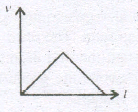
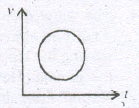
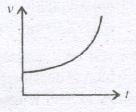
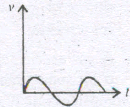
Which of the following curve does not represent motion in one dimension?
13.
Ihe density of a cube is measured by measuring its mass and length of its side. If the maximum error in the measurement of mass and length are 3% and 2% respectively, the maximum error in the measurement of density is ________________.
1%
9%
7%
5%
14.
Vectors can be added _____________
algebrically
geometrically
graphically
both (b) and (c)
15.
1 radian = ________.
50729°
572.9°
\(\frac{\pi}{180}\)
57.295°
16.
A body moving with a constant speed v in a circle of radius r. Its angular acceleration is ______________
0
vr
\(\frac{v}{r}\)
\(\frac{v^2}{r}\)
17.
The expression for maximum height attained when the body is projected at an angle with the horizontal is:
\(\frac{u\sin\theta}{2g}\)
\(\frac{u\sin^2\theta}{2g}\)
\(\frac{u^2\sin^2\theta}{g}\)
\(\frac{u^2\sin^2\theta}{2g}\)
18.
It is found that \(\left|A+B\right|=\left|A\right|.\) This necessarily implies ____________.
B = 0
A, B are anti-parallel
A, B are perpendicular
\(A,B\le 0\)
19.
Which of the following statements is/are not true?
v, a and s are vectors
Mass, energy, work are vectors
Vector has only magnitude whereas scalar has both magnitude and direction
both (b) and (c)
20.
A disc of the moment of inertia Ia is rotating in a horizontal plane about its symmetry axis with a constant angular speed \(\omega\). Another disc initially at rest of moment of inertia Ib is dropped coaxially on to the rotating disc. Then, both the discs rotate with the same constant angular speed. The loss of kinetic energy due to friction in this process is,
\(\frac { 1 }{ 2 } \frac { { I }_{ b }^{ 2 } }{ 2({ I }_{ a }+{ I }_{ b }) } { \omega }^{ 2 }\)
\(\frac { { I }_{ b }^{ 2 } }{ ({ I }_{ a }+{ I }_{ b }) } { \omega }^{ 2 }\)
\(\frac { { ({ I }_{ b }-{ I }_{ a }) }^{ 2 } }{ ({ I }_{ a }+{ I }_{ b }) } { \omega }^{ 2 }\)
\(\frac { 1 }{ 2 } \frac { { { I }_{ b }{ I }_{ b } } }{ ({ I }_{ a }+{ I }_{ b }) } { \omega }^{ 2 }\)
21.
If the linear momentum of the object is increased by 0.1% then the kinetic energy is Increased by
0.1 %
0.2 %
0.4 %
0.01 %
22.
The fractional error \(\left( {{\triangle x}\over{x}} \right)\) _____________.
\(\pm\left( {{\triangle x}\over{x}} \right)\)
\(\pm n\left( {{\triangle a}\over{a}}\right)\)
\(\pm n \log_e \left( {{\triangle a}\over{a}}\right)\)
\(\pm n \log_{10}{{\triangle a}\over{a}}\)
23.
If a person moving from pole to equator, the centrifugal force acting on him
increases
decreases
remains the same
increases and then decreases
24.
Choose appropriate free body diagram for the particle experiencing net acceleration along negative y direction. (Each arrow mark represents the force acting on the system).
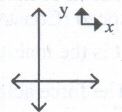
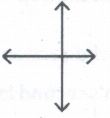
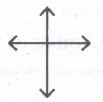
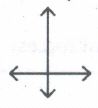
25.
Which of the following pairs of physical quantities have same dimension?
force and power
torque and energy
torque and power
force and torque
1.
Escape speed ve = \(\sqrt 2g R\)
if g' = 4g
then \(v'_e\) = \(\sqrt (4g) R\)
= \(\sqrt 2g R \) \(\times\)2
= 2ve
2.
(d)
all the above
3.
(b)
area
4.
(b)
\(|\vec B\times \vec A|\)
5.
(c)
\(\vec A.\vec B=0\)
6.
(b)
\(3\hat j-2\hat k\)
7.
(b)
only direction
8.
(b)
angular momentum
9.
(b)
vibratory motion
10.
(b)
3.66 and 3.64
11.
(c)
25\(\sqrt{2}\)km/h
12.
(b)
13.
(b)
9%
14.
(d)
both (b) and (c)
15.
(d)
57.295°
16.
(a)
0
17.
(d)
\(\frac{u^2\sin^2\theta}{2g}\)
18.
(b)
A, B are anti-parallel
19.
(c)
Vector has only magnitude whereas scalar has both magnitude and direction
20.
The moments of inertia of two discs are Ia and Ib respectively The angular velocity of the disc A is \(\omega\).
The sum of kinetic energies of two discs before coming in contact is \(k_{1}=\frac{1}{2} I_{a} \omega_{1}^{2}+\frac{1}{2} I_{b} \omega_{2}^{2}\)
\(\text { But angular velocity of the disc be is } \omega_{2}=0 \ \text {(rest)}\)
\(\therefore k_{1}=\frac{1}{2} I_{a} \omega_{1}^{2}\)
The final kinetic energy of the two discs system \(k_{2}=\frac{1}{2} \frac{I_{a}^{2} \omega_{1}^{2}}{I_{a}+I_{b}}\)
The loss of kinetic energy is
\(k_{1}-k_{2} =\frac{1}{2} I_{a} \omega^{2}-\frac{1}{2}\left[\frac{I a^{2} \omega_{1}^{2}}{I_{a}+I_{2 b}}\right] \)
\(=\frac{1}{2} \frac{\left[I_{1}\left(I_{a}+I_{b}\right) \omega^{2}-I_{a}^{2} \omega^{2}\right]}{I_{a}+I_{b}} \)
\(k_{1}-k_{2} =\frac{1}{2} \frac{I_{a} b}{\left(I_{a}+I_{b}\right)} \omega^{2} \)
21.
\(\text { Kinetic energy } E_{k}=\frac{p^{2}}{2 m}\)
\(\frac{\Delta E_{k}}{E_{k}}=\frac{2 \Delta p}{p}\)
\(\text {Given that } \frac{\Delta p}{p}=0.1\)
∴ Increase in kinetic energy
\(\frac{\Delta E_{k}}{E_{k}}=2 \frac{\Delta p}{p} \)
\(\frac{\Delta E_{k}}{E_{k}}=2 \times 0.1=0.2 \% \)
22.
(b)
\(\pm n\left( {{\triangle a}\over{a}}\right)\)
23.
(a)
increases
24.
(c)
25.
\(\text { Torque }=\text { Force } \times \mathrm{r}\)
\(\text { Dimension of torque }\)
\(=\left[\mathrm{MLT}^{-2}\right][\mathrm{L}]=\left[\mathrm{ML}^{2} \mathrm{~T}^{-2}\right]\)
\(\text { Energy }=\text { Force } \times \text { displacement }\)
\(\text { Dimension of Energy }\)
\(=\left[\mathrm{MLT}^{-2}\right][\mathrm{L}]=\left[\mathrm{ML}^{2} \mathrm{~T}^{-2}\right]\)

11th Standard Syllabus & Materials
11th Standard
TN 11th Tamil பீடு பெற நில் - செய்யுள் - காவடிச்சிந்து Important Questions And Answers Study Material - QB365 Set A
NEW11th Standard
TN 11th Tamil பீடு பெற நில் - உரைநடை - மலை இடப்பெயர்கள் : ஓர் ஆய்வு Important Questions And Answers Study Material - QB365 Set A
NEW11th Standard
TN 11th Tamil மாமழை போற்றுதும் - துணைப்பாடம் - யானை டாக்டர் Important Questions And Answers Study Material - QB365 Set A
NEW11th Standard
TN 11th Tamil மாமழை போற்றுதும் - செய்யுள் - ஐங்குறுநூறு Important Questions And Answers Study Material - QB365 Set A



Tamilnadu Stateboard 11th Standard Subjects

Maths

Commerce

Economics

Biology

Business Maths and Statistics

Accountancy

Computer Science
Physics

Chemistry
Maths
Biology
Economics
Physics
Chemistry

History
Business Maths and Statistics

Computer Science
Accountancy

Computer Applications
History
Computer Technology
Commerce
Computer Applications
Computer Technology

Tamil

English

French
Tamilnadu Stateboard Standards

