
 100% FREE ACCESS
11th Standard Syllabus & Materials
11th Standard
TN 11th Tamil இயற்கை வேளாண்மை,சுற்றுச்சூழல் -செய்யுள் - மனோன்மணீயம் Important Questions And Answers Study Material - QB365 Set A
NEW11th Standard
TN 11th Tamil என்னுயிர் என்பேன் -துணைப்பாடம் - இசைத்தமிழர் இருவர் Important Questions And Answers Study Material - QB365 Set A
NEW11th Standard
TN 11th Tamil மொழி கலை -செய்யுள் - ஒவ்வொரு புல்லையும் Important Questions And Answers Study Material - QB365 Set A
NEW11th Standard
TN 11th Tamil பீடு பெற நில் - இலக்கணம் - பகுபத உறுப்புகள் Important Questions And Answers Study Material - QB365 Set A
NEW11th Standard
TN 11th Tamil பீடு பெற நில் - துணைப்பாடம் - வாடிவாசல் Important Questions And Answers Study Material - QB365 Set A
NEW11th Standard
TN 11th Tamil பீடு பெற நில் - செய்யுள் - குறுந்தொகை Important Questions And Answers Study Material - QB365 Set A

Published on: 26/09/2019
Gravitation
Download Tamil Nadu 11th Standard Physics question papers, model tests, one-mark questions, important questions, and public exam papers in PDF format. Free study materials and answer keys for TN State Board students.
Questions + Answers key
Take MCQ Physics Test1.
The work done by Sun on Earth in one year will be
zero
non-zero
positive
negative
2.
If a person moves from Chennai to Trichy, his weight
increases
decreases
remains same
increases and then decreases
3.
The work done by the Sun’s gravitational force on the Earth is
always zero
always positive
can be positive or negative
always negative
4.
5.
The linear momentum and position vector of the planet is perpendicular to each other at
perihelion and aphelion
at all points
only at perihelion
no point
6.
Two bodies of masses m and 4m are placed at a distance r. Calculate the gravitational potential at a point on the line joining them where the gravitational field is zero.
7.
Define weight.
8.
Define gravitational potential.
9.
State Kepler’s three laws.
10.
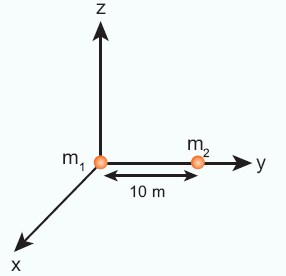
Consider two point masses m1 and m2 which are separated by a distance of 10 meter as shown in the following figure. Calculate the force of attraction between them and draw the directions of forces on each of them. Take m1= 1 kg and m2 = 2 kg.
11.
Find the period of oscillation of a simple pendulum of length \(\alpha\) suspended from the roof a vehicle which moves without friction down an inclined plane of inclination \(\alpha.\)
12.
Draw graphs showing the variation of acceleration due to gravity with
(i) height above the earth's surface
(ii) depth below the earth's surface.
13.
What will be the potential energy of a body of mass 67 kg at a distance of 6.6 x 10¹⁰ m from the centre of the earth? Find gravitational potential at this distance.
14.
Find the expression of the orbital speed of satellite revolving around the earth.
15.
What are the points to be noted to study about gravitational field?
16.
Discuss the forces which depend on the type on the type of interaction.
17.
If the angular momentum of a planet is given by \(\vec{L}=5t^2\hat i-6t\hat j+3\hat k\) . What is the torque experienced by the planet? Will the torque be in the same direction as that of the angular momentum?
18.
Assume that you are in another solar system and provided with the set of data given below consisting of the planets’ semi-major axes and time periods. Can you infer the relation connecting semi-major axis and time period?
| Planet (imaginary) |
Time period(T) (in year) |
Semi major axis (a) (in AU) |
|---|---|---|
| Kurinji | 2 | 8 |
| Mullai | 3 | 18 |
| Marutham | 4 | 32 |
| Neithal | 5 | 50 |
| Paalai | 6 | 72 |
19.
A student was asked a question ‘why are there summer and winter for us? He replied as since Earth is orbiting in an elliptical orbit, when the Earth is very far away from the Sun(aphelion) there will be winter, when the Earth is nearer to the Sun(perihelion) there will be winter. Is this answer correct? If not, what is the correct explanation for the occurrence of summer and winter?
20.
21.
Derive an expression for escape speed.
22.
Explain how Newton verified his law of gravitation.
23.
Discuss the important features of the law of gravitation.
1.
(d)
negative
2.
(b)
decreases
3.
(c)
can be positive or negative
4.
(b)
5.
(a)
perihelion and aphelion
6.
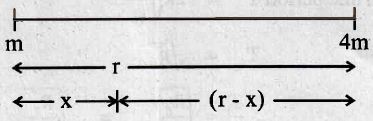
\(\text {The gravitational field }=-\frac{G m}{r^{2}} \hat{r}
\)
\(\frac{G m}{x^{2}}=\frac{G \times 4 m}{(r-x)^{2}}
\)
\(\frac{m}{x^{2}}=\frac{4 m}{(r-x)^{2}}
\)
\(\frac{1}{x^{2}}=\frac{4}{(r-x)^{2}}
\)
\(\frac{1}{x}=\frac{2}{r-x}\)
r - x = 2x
\(\mathrm{r}=3 x \quad \therefore x=\frac{r}{3}
\)
\(\text {Gravitational potential } \mathrm{V}=-\frac{G m}{r}=-\frac{9 \mathrm{Gm}}{r}\)
7.
The weight of an object is defined as the downward force whose magnitude W is equal to the upward force that must be applied to the object to hold it at rest or at constant velocity relative to the Earth.
8.
The gravitational potential at a distance r due to a mass is defined as the amount of work required to bring unit mass from infinity to the distance r and it is denoted as V(r).
\(\mathrm{V}(\mathrm{r})=-\frac{\mathrm{Gm}}{r}\)
9.
1. Law of orbits
Each planet moves around the Sun in an elliptical orbit with the Sun at one of the foci.
2. Law of area
The radial vector (line joining the Sun to a planet) sweeps equal areas in equal intervals of time.
3. Law of period
The square of the time period of revolution of a planet around the Sun in its elliptical orbit is directly proportional to the cube of the semi major axis of the ellipse. It can be written as :
\(T^{2} \propto a^{3} \)
\(\frac{T^{2}}{a^{3}}=\text { constant. }\)
10.
The force of attraction is given by
\(\vec { F } =-\frac { { Gm }_{ 1 }{ m }_{ 2 } }{ { r }^{ 2 } } \)
From the figure, r = 10 m.
First, we can calculate the magnitude of the force
\(F=-\frac { { Gm }_{ 1 }{ m }_{ 2 } }{ { r }^{ 2 } } =\frac { 6.67\times { 10 }^{ -11 }\times 1\times 2 }{ 100 } \)
= 13.34\(\times\)10-13N.
It is to be noted that this force is very small. This is the reason we do not feel the gravitational force of attraction between each other. The small value of G plays a very crucial role in deciding the strength of the force.
The force of attraction \(\left( { \vec { F } }_{ 21 } \right) \) experienced by the mass m2 due to m1 is in the negative ‘y’ direction ie. \(\hat{r}=-\hat{j}.\) According to Newton’s third law, the mass m2 also exerts equal and opposite force on m1. So the force of attraction \(\left( { \vec { F } }_{ 12 } \right) \) experienced by m1 due to m2 is in the direction of positive ‘y' axis ie., \(\hat{r}=\hat{j}.\)
\(\overrightarrow { F } _{ 21 }=-13.34\times { 10 }^{ -13 }\hat { j } \)
\(\overrightarrow { F } _{ 12 }=13.34\times { 10 }^{ -13 }\hat { j } \)
The direction of the force is shown in the figure,
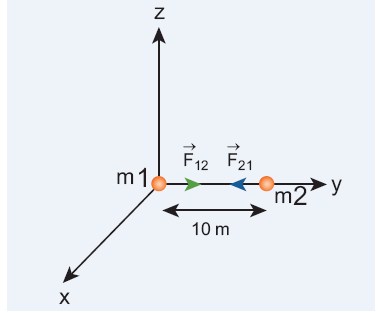
Gravitational force of attraction between m1 and m2
\({ \vec { F } }_{ 12 }=-{ \vec { F } }_{ 21 }\) which confirms Newton’s third law.
11.
The effective value of acceleration due to gravity
g' = g cos \(\alpha\)
\(T=2\pi \sqrt { \frac { l }{ g' } } \)
\(=2\pi \sqrt { \frac { l }{ cos\alpha } } \)
12.
(i) The value of g varies with height has
g a\(\frac { 1 }{ { \left( R+h \right) }^{ 2 } } \ or\ g\ a\ \frac { 1 }{ { r }^{ 2 } } \)
Thus the graph of g versus V is the parabolic curve AB
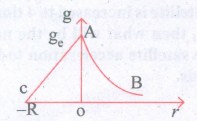
(ii) The value of g varies with depth d as
\(g=g\left( 1-\frac { d }{ R } \right) \)i.e g\(\alpha \)(R-d)
Thus the graph of g versus depth d is the straight line AB.
13.
Mass of the earth M = 6.0\(\times\)1024 kg ; m = 67 kg G = 6.67\(\times\)10-11 Nm2 kg-2
GravitationaI potentia V = -\(\frac{GM}{R}\)
\(=\frac { 6.67\times { 10 }^{ -11 }\times 6\times { 10 }^{ 24 } }{ 6.6\times { 10 }^{ 10 } } \)
V = -6.1\(\times\)103 Jkg-1
14.
A satellite of mass M to move in a circular orbit, centripetal force must be acting on the satellite. This centripetal force is provided by the Earth's gravitational force.
\(\frac { { mv }^{ 2 } }{ \left( { R }_{ E }+h \right) } =\frac { { GMM }_{ E } }{ { \left( { R }_{ e }+h \right) }^{ 2 } } \)
\({ v }^{ 2 }=\frac { { GM }_{ E } }{ \left( { R }_{ E }+h \right) } \)
\(v=\sqrt { \frac { { GM }_{ E } }{ \left( { R }_{ E }+h \right) } } \)
As h increases, the speed of the satellite decreases.
15.
(i) The magnitude of \(\overrightarrow { E } \) decreases as the distance r increases.
(ii) To calculate gravitational interaction. It carries energy and momentum in space.
(iii) The concept of field is inevitable in understanding the behaviour of charges.
16.
(i) Contact forces are the forces applied where one object is in physical contact with the other. The movement of the object is caused by the physical force exerted through the contact between the object and the agent which exerts force
(ii) Consider the case of Earth orbiting around the Sun. Though the Sun and the Earth are not physically in contact with each other, there exists an interaction between them.
(iii) This is because of the fact that the Earth experiences the gravitational force of the Sun.
(iv) This gravitational force is a non-contact force.
17.
Angular momentum \(\mathrm{L} =5 t^{2} \hat{i}-6 t \hat{j}+3 \hat{k} \)
\(\text {Torque } \propto \frac{d L}{d t}
\)
\(=\frac{d}{d t}\left[5 t^{2} \hat{i}-6 t \hat{j}+3 \hat{k}\right]=10 t \hat{i}-6 \hat{j}\)
18.
The value of semi major axis is directly proportional to twice the square of time period of a planet.
i.e, a \(\propto 2 \mathrm{~T}^{2}\)
It is given that for planet Kurinji,
\(\mathrm{T}_{1}=2, \quad \mathrm{a}_{1}=8=2 \times 2^{2} \Rightarrow 2 \mathrm{~T}_{1}{ }^{2}\)
For planet Mullai \(\quad \mathrm{T}_{2}=3, \quad \mathrm{a}_{2}=18=2 \times 3^{2} \Rightarrow 2 \mathrm{~T}_{2}{ }^{2}\)
For planet Marutham \(\quad \mathrm{T}_{3}=4, \quad \mathrm{a}_{3}=32=2 \times 4^{2} \Rightarrow 2 \mathrm{~T}_{3}{ }^{2}\)
For planet Neithal \(\quad \mathrm{T}_{4}=5, \quad \mathrm{a}_{4}=50=2 \times 5^{2} \Rightarrow 2 \mathrm{~T}_{4}{ }^{2}\)
For planet Paalai \(\quad \mathrm{T}_{5}=6, \quad \mathrm{a}_{5}=72=2 \times 6^{2} \Rightarrow 2 \mathrm{~T}_{5}^{2}\)
\(\therefore \alpha \propto 2 \mathrm{~T}^{2}\)
19.
The answer is wrong.
Actually, the seasons in the Earth arise due to the rotation of Earth around the sun with 23.5o tilt.
20.
21.
Consider an object of mass M on the surface of the Earth. When it is thrown up with an initial speed Vi' the initial total energy of the object is
Ei = \(\frac { 1 }{ 2 } { Mv }_{ i }^{ 2 }-\frac { GMM_{ E } }{ R_{ E } } \) ............(1)
where, ME is the mass of the Earth and RE- the radius of the Earth. The term \(\frac { GMM_{ E } }{ R_{ E } } \) is the potential energy of the mass M.
When the object reaches a height far away from Earth and hence treated as approaching infinity, the gravitational potential energy becomes zero [U(∝) = 0] and the kinetic energy becomes zero as well. Therefore the final total energy of the object becomes zero. This is for minimum energy and for minimum speed to escape. Otherwise Kinetic energy can be non-zero.
Ef = 0
According to the law of energy conservation,
Ei = Ef .............(2)
Substituting (1) in (2) we get,
\(\frac { 1 }{ 2 } { Mv }_{ i }^{ 2 }-\frac { GMM_{ E } }{ R_{ E } } \) =0
\(\frac { 1 }{ 2 } { Mv }_{ e }^{ 2 }-\frac { GMM_{ E } }{ R_{ E } } \) = 0 .............(3)
Consider the escape speed, the minimum speed required by an object to escape Earth's gravitational field, hence replace vi with ve. i.e.,
\(\frac { 1 }{ 2 } { Mv }_{ e }^{ 2 }-\frac { GMM_{ E } }{ R_{ E } } \)
\(v_{ e }^{ 2 }-\frac { GMM_{ E } }{ R_{ E } } .\frac { 2 }{ M } \)
\(v_{ e }^{ 2 }=\frac { 2G{ M }_{ E } }{ { R }_{ E } } \) ..............(4)
Using g = \(\frac { G{ M }_{ E } }{ { R }_{ e } } \) ..............(5)
\(v_{ e }^{ 2 }=2g{ R }_{ E }\)
\({ v }_{ e }=\sqrt { 2g{ R }_{ E } } \) .................(6)
22.
(i) Newton verified his law of universal gravitation by comparing the acceleration of a terrestrial object to the acceleration of the moon.
(ii) He knew that the distance from the center of earth to the center of two spheres of known mass at either end of a light rod suspended by a then fiber from the center of the rod.
(iii) He had earlier found the small force that was needed to twist the fiber.
(iv) By bringing a third sphere close to one of the suspended spheres.
(v) He was able to measure the force of gravity between the spheres and hence gravitation.
23.
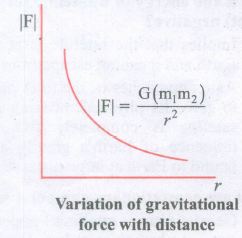
As the distance between two masses increases, the strength of the force tends to decrease because of inverse dependence on r2. Physically it implies that the planet Uranus experiences less gravitational force from the Sun than the Earth since Uranus is at larger distance from the Sun compared to the Earth.
The gravitational forces between two particles always constitute an action reaction pair. It implies that the gravitational force exerted by the Sun on the Earth is always towards the Sun. The reaction-force is exerted by the Earth on the Sun. The direction of this reaction force is towards Earth.
The torque experienced by the Earth due to the gravitational force of the Sum is zero given by
\(\vec { \tau } =\vec { r } \times \vec { F } =\vec { r } \times \left( -\frac { { GM }_{ s }{ M }_{ E } }{ { r }^{ 2 } } \hat { r } \right) =0\)
Since \(\vec { r } =r\hat { r } ,(\hat { r } \times \hat { r } )=0\)
So, \(\hat { \tau } =\frac { d\vec { L } }{ dt } =0\)
It implies that angular momentum \(\vec{L}\) is a constant vector. The angular momentum of the Earth about the Sun is constant throughout the motion. It is true for all the planets. In fact, this constancy of angular momentum leads to the Kepler's second law.
The expression \(\vec{F}=-\frac{G M_{1} M_{2}}{r^{2}} \hat{r}\) has one inherent assumption that both M1 and M2 are treated as point masses. When it is said that Earth orbits around the Sun due to Sun's gravitational force, we assumed Earth and Sun to be point masses. This assumption is a good approximation because the distance between the two bodies is very much larger than their diameters. For some irregular and extended objects separated by a small distance, we cannot directly use the equation. Instead, we have to invoke separate mathematical treatment which will be brought forth in higher classes.
However, this assumption about point masses holds even for small distance for one special case. To calculate force of attraction between a hollow sphere of mass M with uniform density and point mass m kept outside the hollow sphere, we can replace the hollow sphere of mass M as equivalent to a point mass M located at the center of the hollow sphere. The force of attraction between the hollow sphere of mass M and point mass m can be calculated by treating the hollow sphere also as another point the center of the hollow sphere. It is shown in the Figure.
There is also another interesting result. Consider a hollow sphere of mass M. If we place another object of mass 'm' inside this hollow sphere as in Figure, the force experienced by this mass 'm' will be zero.
The triumph of the law of gravitation is that it concludes that the mango that is falling down and the Moon orbiting the Earth are due to the same gravitational force.

11th Standard Syllabus & Materials
11th Standard
TN 11th Tamil பீடு பெற நில் - செய்யுள் - காவடிச்சிந்து Important Questions And Answers Study Material - QB365 Set A
NEW11th Standard
TN 11th Tamil பீடு பெற நில் - உரைநடை - மலை இடப்பெயர்கள் : ஓர் ஆய்வு Important Questions And Answers Study Material - QB365 Set A
NEW11th Standard
TN 11th Tamil மாமழை போற்றுதும் - துணைப்பாடம் - யானை டாக்டர் Important Questions And Answers Study Material - QB365 Set A
NEW11th Standard
TN 11th Tamil மாமழை போற்றுதும் - செய்யுள் - ஐங்குறுநூறு Important Questions And Answers Study Material - QB365 Set A



Tamilnadu Stateboard 11th Standard Subjects

Maths

Commerce

Economics

Biology

Business Maths and Statistics

Accountancy

Computer Science
Physics

Chemistry
Maths
Biology
Economics
Physics
Chemistry

History
Business Maths and Statistics

Computer Science
Accountancy

Computer Applications
History
Computer Technology
Commerce
Computer Applications
Computer Technology

Tamil

English

French
Tamilnadu Stateboard Standards

