
 100% FREE ACCESS
11th Standard Syllabus & Materials
11th Standard
TN 11th Tamil இயற்கை வேளாண்மை,சுற்றுச்சூழல் -செய்யுள் - மனோன்மணீயம் Important Questions And Answers Study Material - QB365 Set A
NEW11th Standard
TN 11th Tamil என்னுயிர் என்பேன் -துணைப்பாடம் - இசைத்தமிழர் இருவர் Important Questions And Answers Study Material - QB365 Set A
NEW11th Standard
TN 11th Tamil மொழி கலை -செய்யுள் - ஒவ்வொரு புல்லையும் Important Questions And Answers Study Material - QB365 Set A
NEW11th Standard
TN 11th Tamil பீடு பெற நில் - இலக்கணம் - பகுபத உறுப்புகள் Important Questions And Answers Study Material - QB365 Set A
NEW11th Standard
TN 11th Tamil பீடு பெற நில் - துணைப்பாடம் - வாடிவாசல் Important Questions And Answers Study Material - QB365 Set A
NEW11th Standard
TN 11th Tamil பீடு பெற நில் - செய்யுள் - குறுந்தொகை Important Questions And Answers Study Material - QB365 Set A

Published on: 09/10/2019
Gravitation
Download Tamil Nadu 11th Standard Physics question papers, model tests, one-mark questions, important questions, and public exam papers in PDF format. Free study materials and answer keys for TN State Board students.
Questions + Answers key
Take MCQ Physics Test1.
Find the period of oscillation of a simple pendulum of length \(\alpha\) suspended from the roof a vehicle which moves without friction down an inclined plane of inclination \(\alpha.\)
2.
A simple pendulum has a times period T1 when on the earth's surface & T2 when taken to a hight & above the earth's surface, where R is the radius of the earth. What is the value of T2/T1?
3.
Suppose the gravitational force varies inversely as the nth power of distance then, fine the expression for the time period of a planet in a circular orbit of radius r around the sun.
4.
Draw graphs showing the variation of acceleration due to gravity with
(i) height above the earth's surface
(ii) depth below the earth's surface.
5.
A mass M is broken into two parts, on & (M-m). How is m related to M so that the gravitational force between two parts is maximum?
6.
What will be the potential energy of a body of mass 67 kg at a distance of 6.6 x 10¹⁰ m from the centre of the earth? Find gravitational potential at this distance.
7.
Obtain an expression for Gravitational Field intensity measured with an object of unit mass.
8.
Why the gravitational force between the Earth and the Sun is so great while the same force between two small objects is negligible?
9.
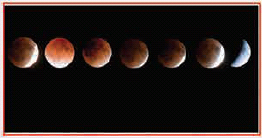
The following photographs are taken from the recent lunar eclipse which occurred on January 31, 2018. Is it possible to prove that Earth is a sphere from these photographs?
10.
A student was asked a question ‘why are there summer and winter for us? He replied as since Earth is orbiting in an elliptical orbit, when the Earth is very far away from the Sun(aphelion) there will be winter, when the Earth is nearer to the Sun(perihelion) there will be winter. Is this answer correct? If not, what is the correct explanation for the occurrence of summer and winter?
1.
The effective value of acceleration due to gravity
g' = g cos \(\alpha\)
\(T=2\pi \sqrt { \frac { l }{ g' } } \)
\(=2\pi \sqrt { \frac { l }{ cos\alpha } } \)
2.
Let g & g' be the acceleration due to gravity on the earths surface at a height R above the earth's surface.
\(g'=\frac { g }{ \left( 1+\frac { n }{ R } \right) } =\frac { g }{ \left( 1+{ \left( \frac { R }{ R } \right) }^{ 2 } \right) } =\frac { g }{ 4 } \)
Time period of simple pendulum \(T=2\pi \sqrt { \frac { l }{ g } } \)
\(\frac { { T }_{ 2 } }{ { T }_{ 1 } } =\sqrt { \frac { g }{ g' } } =\sqrt { \frac { 9 }{ \frac { g }{ 4 } } } =2\)
3.
As the gravitational force varies inversely as the nth power of the distance, so the gravitational force on the planet is given by
\(F=\frac { GMm }{ { r }^{ n } } \)
This force provides the centripetal force mrw2 to the planet
\(\frac { GMm }{ { r }^{ n } } ={ mrw }^{ 2 }\)
\(=mr\left( \frac { 2\pi }{ T } \right) \)
\(or\quad { T }^{ 2 }=\frac { v\times 4\pi 2\times { v }^{ 2 } }{ GM } =\frac { 4{ \pi }^{ 2 }{ r }^{ (n+1) } }{ GM } \)
\(T=\frac { 2\pi }{ \sqrt { GM } } .{ r }^{ (n+1)/2 }\)
\(\therefore T\alpha { r }^{ (n+1)/2 }\)
4.
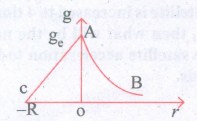
(i) The value of g varies with height has
g a\(\frac { 1 }{ { \left( R+h \right) }^{ 2 } } \ or\ g\ a\ \frac { 1 }{ { r }^{ 2 } } \)
Thus the graph of g versus V is the parabolic curve AB
(ii) The value of g varies with depth d as
\(g=g\left( 1-\frac { d }{ R } \right) \)i.e g\(\alpha \)(R-d)
Thus the graph of g versus depth d is the straight line AB.
5.
Let m1 =m ;m2 =M-m
\(R=\frac { G(M-m).m }{ { r }^{ 2 } } =\frac { G(Mm-{ m }^{ 2 }) }{ { r }^{ 2 } } \)
Differentiating with respect to m,
\(\frac { dF }{ dm } =\frac { G }{ { r }^{ 2 } } (M-2m)\)
For F is maximum \(\frac { dF }{ dm } \)=0
\(\frac { G }{ { r }^{ 2 } } (M-2m)=0\)
M = 2m Þm = \(\frac{M}{2}\)
m1= m2=\(\frac{M}{2}\)
6.
Mass of the earth M = 6.0\(\times\)1024 kg ; m = 67 kg G = 6.67\(\times\)10-11 Nm2 kg-2
GravitationaI potentia V = -\(\frac{GM}{R}\)
\(=\frac { 6.67\times { 10 }^{ -11 }\times 6\times { 10 }^{ 24 } }{ 6.6\times { 10 }^{ 10 } } \)
V = -6.1\(\times\)103 Jkg-1
7.
\(\overrightarrow { F } _{ m }m\overrightarrow { E } \)
Now we can equate this with Newton's second Law \(\overrightarrow { F } =m\overrightarrow { a } \)
\(m\overrightarrow { a } =m\overrightarrow { E } \)
\(\overrightarrow { a } =\overrightarrow { E } \)
In other words, equation implies that the gravitational field at a point is equivalent acceleration experienced by a particle at that point. However, it is to be noted \(\overrightarrow { a } \) that and \(\overrightarrow { E } \) are separate physical quantities that have the same magnitude and direction.
8.
(i) The force experienced by a mass 'm' which is on the surface of the Earth is given by F= \(\frac { { GM }_{ 1 }m }{ { r }_{ E }^{ 2 } } \)
(ii) ME-mass of the Earth, m - mass of the object, RE- radius of the Earth.
Equating Newton's second law, F= mg, to equation we get,
mg= \(\frac { { GM }_{ 1 }m }{ { r }_{ E }^{ 2 } } \)
g=\(\frac { { GM }_{ E }m }{ { r }_{ E }^{ } } \)
(iii) Now the force experienced by some other object of mass M at a distance r from the center of the Earth is given by,
F= \(\frac { { GM }_{ E }m }{ { r }_{ }^{ 2 } } \)
Using the value of g in equation, the force F will be,
\(F=-gM\frac { { R }_{ E }^{ 2 } }{ { r }^{ 2 } } \)
From this it is clear that the force can be calculated simply by knowing the value of g. It is to. be. noted that in the above calculation G is not required.
9.
From the shadows it is revealed that Earth has spherical shape with bulging along equator and flat at poles.
10.
The answer is wrong.
Actually, the seasons in the Earth arise due to the rotation of Earth around the sun with 23.5o tilt.

11th Standard Syllabus & Materials
11th Standard
TN 11th Tamil பீடு பெற நில் - செய்யுள் - காவடிச்சிந்து Important Questions And Answers Study Material - QB365 Set A
NEW11th Standard
TN 11th Tamil பீடு பெற நில் - உரைநடை - மலை இடப்பெயர்கள் : ஓர் ஆய்வு Important Questions And Answers Study Material - QB365 Set A
NEW11th Standard
TN 11th Tamil மாமழை போற்றுதும் - துணைப்பாடம் - யானை டாக்டர் Important Questions And Answers Study Material - QB365 Set A
NEW11th Standard
TN 11th Tamil மாமழை போற்றுதும் - செய்யுள் - ஐங்குறுநூறு Important Questions And Answers Study Material - QB365 Set A



Tamilnadu Stateboard 11th Standard Subjects

Maths

Commerce

Economics

Biology

Business Maths and Statistics

Accountancy

Computer Science
Physics

Chemistry
Maths
Biology
Economics
Physics
Chemistry

History
Business Maths and Statistics

Computer Science
Accountancy

Computer Applications
History
Computer Technology
Commerce
Computer Applications
Computer Technology

Tamil

English

French
Tamilnadu Stateboard Standards

