
 100% FREE ACCESS
11th Standard Syllabus & Materials
11th Standard
TN 11th Tamil இயற்கை வேளாண்மை,சுற்றுச்சூழல் -செய்யுள் - மனோன்மணீயம் Important Questions And Answers Study Material - QB365 Set A
NEW11th Standard
TN 11th Tamil என்னுயிர் என்பேன் -துணைப்பாடம் - இசைத்தமிழர் இருவர் Important Questions And Answers Study Material - QB365 Set A
NEW11th Standard
TN 11th Tamil மொழி கலை -செய்யுள் - ஒவ்வொரு புல்லையும் Important Questions And Answers Study Material - QB365 Set A
NEW11th Standard
TN 11th Tamil பீடு பெற நில் - இலக்கணம் - பகுபத உறுப்புகள் Important Questions And Answers Study Material - QB365 Set A
NEW11th Standard
TN 11th Tamil பீடு பெற நில் - துணைப்பாடம் - வாடிவாசல் Important Questions And Answers Study Material - QB365 Set A
NEW11th Standard
TN 11th Tamil பீடு பெற நில் - செய்யுள் - குறுந்தொகை Important Questions And Answers Study Material - QB365 Set A

Published on: 29/11/2018
Using the model question papers, every student can get an idea about the exam questions in a subject wise and collect more information to score high marks on the board.
Here is the model question paper for Class 11 State board Physics for practicing their half-yearly examination. In this question paper, all the important questions from state board 11th physics have been added based on the current state board syllabus.
Some of the most important questions for 11th standard physics are given based on the academic syllabus. Not only with book back questions, but also included creative questions as well.
Practice with different important model question papers and enhance the conceptual knowledge about the different strategies on questions types which can be framed during the examination. Here you can get all the important model question papers for class 11 along with the answer keys.
Teachers can give this model question to their student for practice and subscribe to get more model question papers.
Parents can use this question to test their children knowledge in particular subjects and subscribe to generate unlimited questions to strengthen their children subject knowledge.
Download Tamil Nadu 11th Standard Physics question papers, model tests, one-mark questions, important questions, and public exam papers in PDF format. Free study materials and answer keys for TN State Board students.
Questions + Answers key
Take MCQ Physics Test1.
Two thermally insulated vessels 1 & 2 are filled with air at temp (T1, T2), volume (V1, V2 & pressure (P1, P2) If the valve going to the 2 vessels is opened, the temperature on the inside of the vessel at equilibrium will be ______________.
T1 + T2
\(\frac { { T }_{ 1 }+{ T }_{ 2 } }{ 2 } \)
\(\frac { { T }_{ 1 }{ T }_{ 2 }\left( { P }_{ 1 }{ V }_{ 1 }+{ P }_{ 2 }{ V }_{ 2 } \right) }{ { P }_{ 1 }{ V }_{ 1 }{ T }_{ 2 }+{ P }_{ 2 }{ V }_{ 2 }{ T }_{ 1 } } \)
\(\frac { { T }_{ 1 }{ T }_{ 2 }\left( { P }_{ 1 }{ V }_{ 1 }+{ P }_{ 2 }{ V }_{ 2 } \right) }{ { P }_{ 1 }{ V }_{ 1 }{ T }_{ 1 }+{ P }_{ 2 }{ V }_{ 2 }{ T }_{ 2 } } \)
2.
A small sphere of radius 2cm falls from rest in a viscous liquid. Heat is produced due to viscous force. The rate of production of heat when the sphere attains its terminal velocity is proportional to
22
23
24
25
3.
The kinetic energies of a planet in an elliptical orbit about the Sun, at positions A, B and C are KA, KB and KC respectively. AC is the major axis and SB is perpendicular to AC at the position of the Sun S as shown in the figure. Then
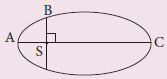
KA > KB >KC
KB < KA < KC
KA < KB < KC
KB > KA > KC
4.
A planet moving along an elliptical orbit is closest to the Sun at distance r1 and farthest away at a distance of r2. If v1 and v2 are linear speeds at these points respectively. Then the ratio \({v_1\over v_2}\) is
\({r_2\over r_1}\)
\(({r_2\over r_1})^2\)
\({r_1\over r_2}\)
\(({r_1\over r_2})^2\)
5.
From this velocity-time graph, which of the following is correct?
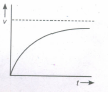
Constant acceleration
Variable acceleration
Constant velocity
Variable acceleration
6.
Dimensional formula for work done is ________________.
MLT-1
ML2T2
M-1L-1T-2
ML2T-2
7.
s-t graph shown in figure is a parabola. From this graph we find that:
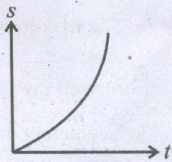
the body is moving with uniform velocity
the body is moving with uniform speed
the body is starting from rest and moving with uniform acceleration
the body is not moving at all
8.
The ratio of the acceleration for a solid sphere (mass m and radius R) rolling down an incline of angle \(\theta\) without slipping and slipping down the incline without rolling is,
5: 7
2: 3
2: 5
7: 5
9.
A rigid body rotates with an angular momentum L. If its kinetic energy is halved, the angular momentum becomes,
L
L/2
2L
L/\(\sqrt{2}\)
10.
A body of mass 4 m is lying in xy-plane at rest. It suddenly explodes into three pieces. Two pieces each of mass m move perpendicular to each other with equal speed v. The total kinetic energy generated due to explosion is
mv2
\(\frac{3}{2}\)mv2
2mv2
4mv2
11.
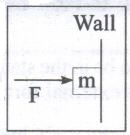
An object of mass m held against a vertical wall by applying horizontal force F as shown in the figure.The minimum value of the force F is
Less than mg
Equal to mg
Greater than mg
Cannot determine
12.
How many gram make 1deca gram?
10g
100g
1kg
100kg
13.
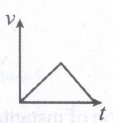
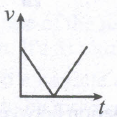
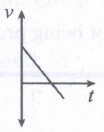
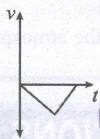
A ball is projected vertically upwards with a velocity v. It comes back to ground in time t. Which v-t graph shows the motion correctly?
14.
If the force is proportional to square of velocity, then the dimension of proportionality constant is
[MLT0]
[MLT-1]
[MLT-2T]
[MLT-1T0]
15.
If the length and time period of an oscillating pendulum have errors of 1% and 3% respectively then the error in measurement of acceleration due to gravity is
4%
5%
6%
7%
16.
Consider the following cyclic process consist of isotherm, isochoric and isobar which is given in the figure.
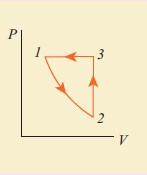
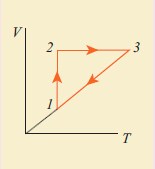
Draw the same cyclic process qualitatively in the V-T diagram where T is taken along x direction and V is taken along y-direction. Analyze the nature of heat exchange in each process.
17.
State and prove Pascal’s law in fluids?
18.
A metal plate of area 2.5\(\times\)10-4m2 is placed on a 0.25\(\times\)10-3m thick layer of castor oil. If a force of 2.5 N is needed to move the plate with a velocity 3\(\times\)10-2m s-1, calculate the coefficient of viscosity of castor oil.
Given: A = 2.5\(\times\)10-4 m2, dx = 0.25\(\times\)10-3 m, F = 2.5N and dv = 3×10⁻² m s-1
19.
What is the gravitational potential energy of the Earth and Sun? The Earth to Sun distance is around 150 million km. The mass of the Earth is 5.9\(\times\)1024 kg and mass of the Sun is 1.9\(\times\)1030 kg.
20.
Consider a circular leveled road of radius 10m having coefficient of static friction 0.81. Three cars (A, B and C) are travelling with speed 7 ms-1, 8 m s-1 and 10 ms-1 respectively. Which car will skid when it moves in the circular level road? (g = 10 m s-2).
21.
A man of mass 50 kg is standing at one end of a boat of mass 300 kg floating on still water. He walks towards the other end of the boat with a constant velocity of 2 ms-1 with respect to a stationary observer on land. What will be the velocity of the boat,
(a) with respect to the stationary observer on land?
(b) with respect to the man walking in the boat?
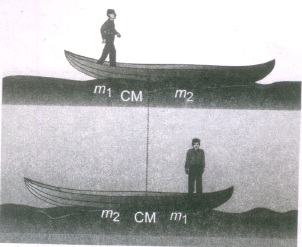
[Given: There is friction between the man and the boat and no friction between the boat and water].
22.
Two point masses 3 kg and 5 kg are at 4 m and 8 m from the origin on X-axis. Locate the position of center of mass of the two point masses
(i) from the origin and
(ii) from 3 kg mass.
23.
Apply Newton's second law to a mango hanging from a tree. (Mass of the mango is 400 gm).
24.
Two vectors \(\vec A\) and \(\vec B\) of magnitude 5 units and 7 units respectively make an angle 60° with each other as shown below. Find the magnitude of the resultant vector and its direction with respect to 7 unit the vector \(\vec A\).
.png)
25.
Find the dimensions of a and b in the formula \(\left[ P+{{a\over V^2}} \right][V-b]=RT\) where P is pressure and V is the volume of the gas
26.
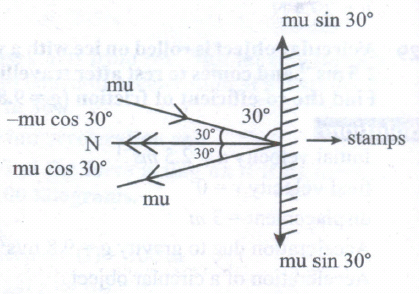
A cricket ball of mass 35 g hits a stumps at an angle of 30° with a velocity of 20 m/s. If the ball rebounds at 60° the to the direction of incidence, calculate the impulse received by the cricket ball.
27.
When an object is moving with variable acceleration then the object possesses different accelerations at different instants. The acceleration of the object at a given instant of time or at a given point of motion is called instantaneous acceleration.
28.
In a physical units, how many units are there in 1 metre?
1 parallactic second (parsec) = 3.08\(\times\)1016 m
Given data:
1 AU = 1.496\(\times\)1011m
1 ly = 9.467\(\times\)1015m
1 mm = 10-6m
1 parsec = 3.08\(\times\)1016m
29.
Assuming that the frequency \(\gamma\) of a vibrating string may depend upon
(i) applied force (F)
(ii) length (I)
(ill) mass per unit length (m), prove that \(\gamma\alpha{{1}\over{l}}\sqrt{{{F}\over{m}}}\) using dimensional analysis.
30.
A comet orbits the sun in highly elliptical orbit. Does a comet has a constant.
(i) Lineal speed
(ii) Angular momentum
(iii) Total Energy throughout its orbit
31.
Define the Avogadro's number?
32.
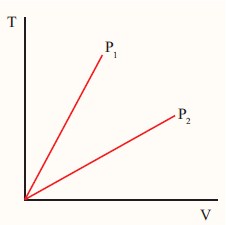
The following graph shows a V-T graph for isobaric processes at two different pressures. Identify which one occurs at higher pressure.
33.
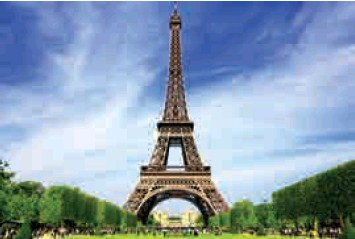
Eiffel tower is made up of iron and its height is roughly 300 m. During winter season (January) in France the temperature is 2°C and in hot summer its average temperature 25°C. Calculate the change in height of Eiffel tower between summer and winter. The linear thermal expansion coefficient for iron α = 10 x 10-6 per °C.
34.
A vehicle of mass 1250 kg is driven with an acceleration 0.2 along a straight level road against an external resistive force 500 N. Calculate the power delivered by the vehicle's engine if the velocity of the vehicle is 30 ms-1.
35.
Two vectors \(\vec A\) and \(\vec B\) are given in the component form as \(\overrightarrow { A } =5\hat { i } +7\hat { j } -4\hat { k } \) and \(\overrightarrow { B } =6\hat { i } +3\hat { j } +2\hat { k } \). Find \(\vec { A } +\vec { B } ,\vec { B } +\vec { A } ,\vec { A } -\vec { B } ,\vec { B } -\vec { A } \)
36.
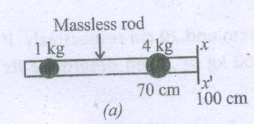
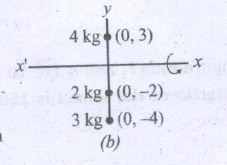
Calculate moment of inertia with respect to rotational axis xx' in following figures (a) and (b).
37.
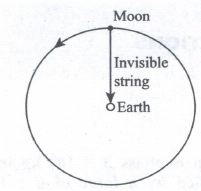
Imagine that the gravitational force between Earth and Moon is provided by an invisible string that exists between the Moon and Earth. What is the tension that exists in this invisible string due to Earth's centripetal force? (Mass of the Moon = 7.34\(\times\)1022 kg, Distance between Moon and Earth = 3.84 \(\times\) 108m).
38.
Find the magnitude of vector 3\(\hat { i } -2\hat { j } +\sqrt { 3 } \hat { k } \) ?
39.
Explain in detail the geostationary and polar satellites.
40.
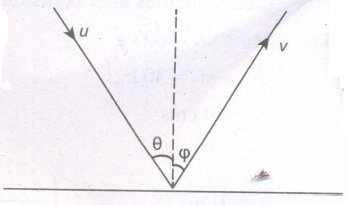
A particle strikes a horizontal frictionless floor with a speed u at an angle \(\theta\) with the vertical and rebounds with the speed v at an angle φ with an vertical. The coefficient of restitution between the particle and floor is e. What is the magnitude of v?
41.
Two resistors of resistances R1= 150 ± 2 Ohm and R2 = 220 ± 6 Ohm are connected in parallel combination. Calculate the equivalent resistance.
Hint:\(\frac{1}{R'}=\frac{1}{R_1}+\frac{1}{R_2}\)
42.
The velocity-time graph of an object moving along a straight line is as shown.
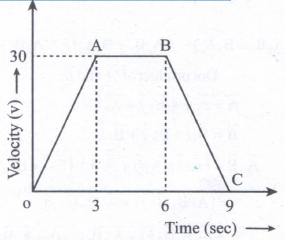
Calculate distance covered by object between t =0 to t = 3 and t = 0 to t = 6.
43.
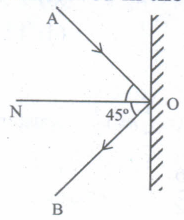
A molecule in gas container hits the wall with speed 350 m/s at an angle 45° with the normal and rebounds with the same speed. Is momentum conserved in the collision?
44.
What is inelastic collision? In which way it is different from elastic collision. Mention few examples in day to day life for inelastic collision.
1.
(a)
T1 + T2
2.
Rate of heat production
\(=\frac{\text { Work done }}{\text { Timetaken }}\)
Terminal velocity
\(v=\frac{2}{a} \frac{r^{2}(f-\sigma)}{\eta} g \)
\(v \propto r^{2} \)
\(\text { Work } \propto \text { Force } \times \text { distance }\)
\(\propto r^{2} \times r \Rightarrow 2^{5}\)
3.
(a)
KA > KB >KC
4.
(a)
\({r_2\over r_1}\)
5.
(b)
Variable acceleration
6.
(d)
ML2T-2
7.
(c)
the body is starting from rest and moving with uniform acceleration
8.
Acceleration of the solid sphere while rolling down without slipping
\(a_{1}=\frac{g \sin \theta}{1+\frac{k^{2}}{r^{2}}}\)
Acceleration developed while slipping down \(a_{2}=g \sin \theta\)
\(\text { Required ratio } \frac{a_{1}}{a_{2}}=\frac{g \sin \theta}{1+\frac{k^{2}}{r^{2}}} / g \sin \theta\)
\(\frac{a_{1}}{a_{2}}=\frac{1}{1+\frac{k^{2}}{r^{2}}}\)
\(\text { For a solid sphere } \frac{k^{2}}{r^{2}}=\frac{2}{5}\)
\(\therefore \text { Ratio of accelerations } \frac{a_{1}}{a_{2}}=\frac{1}{1+\frac{2}{5}}\)
\(=\frac{1}{5+\frac{2}{5}}=\frac{1}{\frac{7}{5}}=\frac{5}{7}\)
\(\therefore a_{1}: a_{2}=5: 7 \)
9.
\(K \cdot E=\frac{1}{2} I \omega^{2} ; \quad L=I \omega ; \quad K \cdot E=\frac{2^{2}}{2^{2}} \)
\(\therefore K \cdot E \alpha L^{2} \quad E_{1} \alpha L_{1}^{2} \quad E_{2} \alpha L_{2}^{2}\)
\(\frac{E_{1}}{E_{2}}=\left(\frac{L_{1}}{L_{2}}\right)^{2} \)
\(\text { Here } E_{1}=E \quad E_{2}=\frac{E}{2} \)
\(L_{1}=L \quad \quad L_{2}=? \)
\(\frac{E}{\frac{E}{2}}=\left(\frac{L}{L_{2}}\right)^{2} \)
\(\frac{2 E}{E}=\left(\frac{L}{L_{2}}\right)^{2}\left(\frac{L_{1}}{L_{2}}\right)^{2}=2 \)
\(\therefore \frac{L}{L_{2}}=\sqrt{2} \)
\(L_{2}=\frac{L}{\sqrt{2}} \)
10.
Using law of conservation of momentum,
\(2 m v =\sqrt{m^{2} v^{2}+m^{2} v^{2}} \)
\(=\sqrt{2 m^{2} v^{2}} \)
\(v =\frac{\sqrt{2} m v}{2 m}=\frac{v}{\sqrt{2}} \)
Energy released in explosion = \(2 \times \frac{1}{2} m v^{2} +\frac{1}{2} \times 2 m \times\left(\frac{v^{2}}{\sqrt{2}}\right)^{2} \)
\(=m v^{2}+m \times \frac{v^{2}}{2} \)
\(=\frac{3}{2} m v^{2} \)
11.
(c)
Greater than mg
12.
(a)
10g
13.
Initially velocity has maximum value and at maximum height velocity becomes zero. After that the velocity becomes negative
14.
F = kv2
Dimensional of k
\(=\frac{\text { Dimension of } \mathrm{F}}{\text { Dimension of }(v)^{2}}\)
\(=\frac{\mathrm{MLT}^{-2}}{\left(\mathrm{LT}^{-1}\right)^{2}}=\frac{\mathrm{MLT}^{-2}}{\mathrm{~L}^{2} \mathrm{~T}^{-2}} \)
\(=\left[\mathrm{ML}^{-1-2} \mathrm{~T}^{-2+2}\right] \)
Dimension of proportionality constant \(=\left[\mathrm{ML}^{-1} \mathrm{~T}^{0}\right]\)
15.
\(T =2 \pi \sqrt{\frac{l}{g}} \)
\(g =4 \pi^{2} l / T^{2} \)
\(\frac{d g}{g} =\frac{d l}{l}-\frac{2 d T}{T} \)
\(\frac{d g}{g} \% =\left(\frac{d l}{l}\right) \%-2\left(\frac{d T}{T}\right) \% \)
\(=1 \%-2 \times(-3 \%) \)
\(=1+6=7 \% \)
16.
Process 1 to 2 = increase in volume. So heat must be added.
Process 2 to 3 = Volume remains constant. Increase in temperature. The given heat is used to increase the internal energy.
Process 3 to 1 = Pressure remains constant. Volume and Temperature are reduced. Heat flows out of the system. It is an isobaric compression where the work is done on the system.
In the process marked as 1-2, the gas undergoes isothermal 'expansion. It receiver certain amount of heat from the outside of spends all this heat in doing work the internal energy of the gas remains unchanged.
In the process marked as 2-3, the gas is heated isochorically (at constant volume). Since its volume does not change, no work is done. The internal energy of the gas is increased only due to the heat transferred to the gas from the outside.
In the process exhibited by 3-1, the gas is compressed isobarically (at constant pressure) of its temperature drops work is done on the gas, but its internal energy is reduced. This means the gas intensively gives up heat to the medium.
17.
If the pressure in a liquid is changed at a particular point, the change is transmitted to the entire liquid without being diminished in magnitude.
Application of pascal's law
A practical application of Pascal's law is the hydraulic lift which is used to lift a heavy load with a small force. It is a force multiplier. It consists of two cylinders A and B connected to each other by a horizontal pipe, filled with a liquid.
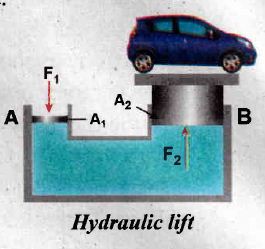
They are fitted with frictionless pistons of cross sectional areas A1 and A2 (A2 > A1). Suppose a downward force F is applied on the smaller piston, the pressure of the liquid under this piston increases to\(\left(\right. where, \left.P=\frac{F_{1}}{A_{1}}\right).\) But according to Pascal's law, this increased pressure P is transmitted undiminished in all directions. So a pressure is exerted on piston B. Upward force on piston B is
\(\mathrm{F}_{2}=\mathrm{P} \times \mathrm{A}_{2}=\frac{F_{1}}{A_{1}} \times A_{2} \Rightarrow \mathrm{F}_{2}=\frac{A_{2}}{A_{1}} \times F_{1}\)
Hence by changing the force on the smaller piston A, the force on the piston B has been increased by the factor \(\frac{A_{2}}{A_{1}}\) and this factor is called the mechanical advantage of the lift.
18.
\(F=-\eta A\frac { dv }{ dx } \)
n magnitude, \(\eta =\frac { F }{ A } \frac { dv }{ dx } \)
\(=\frac { \left( 2.5N \right) \quad \left( 2.5\times { 10 }^{ -3 }m \right) }{ \left( 2.5\times { 10 }^{ -4 }{ m }^{ 2 } \right) \left( 3\times { 10 }^{ -2 }{ ms }^{ -1 } \right) } \)
= 0.083\(\times\)103 Nm-2s
19.
The Earth to Sun distance \(\mathrm{R}_{\mathrm{E}}=150 \times 10^{6} \mathrm{~km}=150 \times 10^{9} \mathrm{~m}\)
Mass of the Earth \( \mathrm{M}_{E}=5.9 \times 10^{24} \mathrm{~kg}\)
Mass of the Sun \(\mathrm{M}_{\mathrm{s}}=1.9 \times 10^{30} \mathrm{~kg}\)
Gravitational energy of the Earth and Sun
\(\mathrm{U} =-\frac{G m_{1} m_{2}}{r} \)
\(\mathrm{U} =-\frac{G m_{E} m_{s}}{R_{E}} \)
\(=-\left[\frac{6.67 \times 10^{-11} \times 5.9 \times 10^{24} \times 1.9 \times 10^{30}}{150 \times 10^{9}}\right] \)
\(=-\left[\frac{6.67 \times 5.9 \times 1.9}{150} \times 10^{-11+24+30-9}\right] \)
\( =-\left[\frac{74.7707}{150} \times 10^{34}\right] \)
\(=-0.49847 \times 10^{34} \)
\(\mathrm{U}=-49.847 \times 10^{32} \mathrm{~J}\)
20.
From the safe turn condition the speed of the vehicle (v) must be less than or equal to \(\sqrt { { \mu }_{ s }rg } \)
v ≤ \(\sqrt { { \mu }_{ s }rg } \)
\(\sqrt { { \mu }_{ s }rg } \)=\(\sqrt { 0.81\times 10\times 10 } \)=9 ms-1
For car C, \(\sqrt { { \mu }_{ s }rg } \) is less than v.
The speed of car A, B and Care 7 m s-1, 8 m s-1 and 10 m s-1 respectively. The cars A and B will have safe turns. But the car C has speed 10 m s-1 while it turns which exceeds the safe turning speed. Hence, the car C will skid.
21.
Mass of the man (m1) is, m1= 50 kg
Mass of the boat (m2) is, m2 = 300 kg
With respect to a stationary observer:
The man moves with a velocity, v1 = 2 m s-1 and the boat moves with a velocity v2 (which is to be found)
(i) To determine the velocity of the boat with respect to a stationary observer on land. As there is no external force acting on the system, the man and boat move due to the friction, which is an internal force in the boat-man system. Hence, the velocity of the center of mass is zero (VCM= 0). Using equation,
\(\overrightarrow{{v}}_{CM}=\frac{\sum { m_1v_1} }{\sum{m_1}}=\frac{m_1v_1+m_2v_2}{m_1+m_2}\)
0 = \(\frac{\sum{m_1v_1}}{\sum{m_1}}=\frac{m_1v_1+m_2v_2}{m_1+v_2}\)
0 = m1v1 + m2v2 - m2v2 = m1v1
-m2v2 = m1v1
\(v_2=-\frac{m_1}{m_2}v_1\)
\(v_2= -\frac{50}{300}\times 2= -\frac{100}{300}\)
v2 = -0.33 ms-1
The negative sign in the answer implies that the boat moves in a direction opposite to that of the walking man on the boat to a stationary observer on land.
(ii) To determine the velocity of the boat with respect to the walking man: We can find the relative velocity as
v21 = v2 - v1
where, v21 is the relative velocity of the boat with respect to the walking man.
v21 = (-0.33)-(2)
v21 = -2.33 ms-1
The negative sign in the answer implies that the boat appears to move in the opposite direction to the man walking in the boat.
22.
Let us take, m1= 3 kg and m2 = 5 kg
(i) To find center of mass from the origin: The point masses are at positions, x1 = 4 m, x2 = 8m from the origin along X-axis.
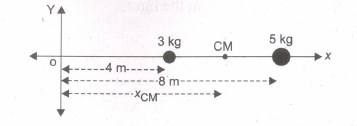
The centre of mass xCM can be obtained using equation 5.4.
\({ x }_{ CM }=\frac { { m }_{ 1 }{ x }_{ 1 }+{ m }_{ 2 }{ x }_{ 2 } }{ { m }_{ 1 }+{ m }_{ 2 } } \)
\({ x }_{ CM }=\frac { \left( 3\times 4 \right) +\left( 5\times 8 \right) }{ 3+5 } \)
\({ x }_{ CM }=\frac { 12+40 }{ 8 } =\frac { 52 }{ 8 } =6.5m\)
(ii) To find the center of mass from 3 kg mass: The origin is shifted to 3 kg mass along X-axis. The position of 3 kg point mass is zero (x1 = 0) and the position of 5 kg point mass is 4 m from the shifted origin (x2 = 4 m).
\({ x }_{ CM }=\frac { \left( 3\times 0 \right) +\left( 5\times 4 \right) }{ 3+5 } \)
\({ x }_{ CM }=\frac { 0+20 }{ 8 } =\frac { 20 }{ 8 } =2.5m\)
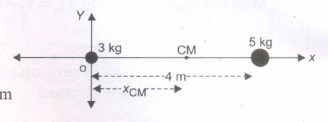
The center of mass is located 2.5 m from 3 kg point mass (and 1.5 m from the 5 kg point mass) on x-axis.
1. This result shows that the center of mass is located closer to larger mass.
2. If the origin is shifted to the center of mass, then the principle of moments holds good m1x1 = m2x2, 3\(\times\)2.5 = 5\(\times\)1.5; 7.5 = 7.5.
When we compare case
(i) with case
(ii), the xCM = 2.5 m from 3 kg mass could also be obtained by subtracting 4 m (the position of 3 kg mass) from 6.5 m, where the center of mass was located in case (i).
23.
Note: Before applying Newton's laws, the following steps have to be followed:
1. Choose a suitable inertial coordinate system to analyse the problem. For most of the cases we can take Earth as an inertial coordinate system.
2. Identify the system to which Newton's laws need to be applied. The system can be a single object or more than one object.
3. Draw the free body diagram.
4. Once the forces acting on the system are identified, and the free body diagram is drawn, apply Newton's second law. In the left hand side of the equation, write the forces acting on the system in vector notation and equate it to the right hand side of equation which is the product of mass and acceleration. Here, acceleration should also be in vector notation.
5. If acceleration is given, the force can be calculated. If the force is given, acceleration can be calculated.
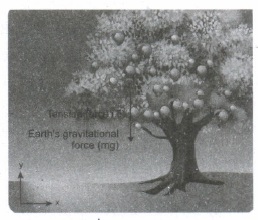
By following the above steps:
We fix the inertial coordinate system. on the ground as shown in the figure.
The forces acting on the mango are
(i) Gravitational force exerted by the Earth on the mango acting downward along negative y-axis.
(ii) Tension (in the cord attached to the mango) acts upward along positive y-axis.
The free body diagram for the mango is shown in the figure
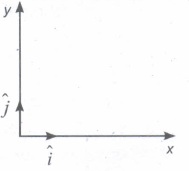

\(\bar { { F }_{ g } } =mg(-\hat { j } )=-mg\hat { j } \)
Here, mg is the magnitude of the gravitational force and \((\hat { -j } )\) represents the unit vector in negative y-direction.
\(\vec { T } =T\hat { j } \)
Here T is the magnitude of the tension force and \((\hat { j } )\) represents the unit vector in positive y direction.
\(\vec { F_{ net } } ={ F }_{ g }+\vec { T } =-mg\hat { j } +T\hat { j } =(T-mg)\hat { j } \)
From Newton's second law \(\vec { F_{ net } } =m\vec { a } \)
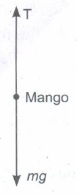
Since the mango is at rest with respect to us (inertial coordinate system) the acceleration is zero \((\vec { a } =0)\)
So, \(\vec { F_{ net } } =m\vec { a } \) = 0
\((T-mg)\hat { j } \) = 0
By comparing the components on both sides of the above equation, we get T - mg = 0. So the tension force acting on the mango is given by T = mg.
Mass of the mango m = 400 g and g = 9.8 ms-2
Tension acting on the mango is T = 0.4\(\times\)9.8 = 3.92 N.
24.
By following the law of triangular addition, the resultant vector is given by \(\vec R\) = \(\vec A\) + \(\vec B\) as illustrated below.
The magnitude of the resultant vector \(\vec R\) is given by
\(R=|\vec R|=\sqrt{5^2+7^2+2\times 5\times 7\cos 60^o}\)
\(R=\sqrt{25+49+\frac{70\times 1}{2}}=\sqrt{109}\) units
i.png)
The angle \(\alpha\) between \(\vec R\) and \(\vec A\) is given by
\(\tan\alpha=\frac{B\sin\theta}{A+B\cos\theta}\)
\(\tan\alpha=\frac{7\times\sin60^o}{5+7\cos60^o}=\frac{7\sqrt{3}}{10+7}=\frac{7\sqrt{3}}{17}\) = 0.713
\(\therefore\alpha=35^o\)
ii.png)
25.
By the principle of homogeneity, a / V2 is of the dimensions of pressure and b is of the dimensions of volume.
[a] = [pressure] [V2] = [ML−1T−2] [L6]
= [ML5T-2]
[b] = [V] = L3
26.
Mass of ball(m) = \(\frac { 35 }{ 100 } =0.035kg\)
A ball hits by a stumps at an angle (\(\theta\)1) = 30°
Ball rebounds at an .angle (\(\theta\)2) = 60°
Change in momentum along horizontal direction
= -mu cos30° - (mu cos300)
= -2 mu cos30°
= -2\(\times\)0.035\(\times\)20\(\times\)cos30°
= -2 \(\times\)0.035\(\times\)20\(\times\)\(\sqrt { \frac { 3 }{ 2 } } \) \(\quad \left[ \because cos{ 30 }^{ 0 }=\sqrt { \frac { 3 }{ 2 } } \right] \)
= \(-1.4\times \frac { \sqrt { 3 } }{ 2 } =1.21\quad kgms^{ -1 }\)
The impulse received by a ball j = 1.2 kg ms-1
27.
(i) Instantaneous acceleration or acceleration of a particle at time 't' is given by the ratio of change in velocity over \(\Delta t\), as \(\Delta t\) approaches zero.
Acceleration \(\overrightarrow { a } =\lim _{ \Delta t\rightarrow 0 }{ \frac { \Delta \overrightarrow { v } }{ \Delta t } =\frac { d\overrightarrow { v } }{ dt } } \)
(ii) In other words, the acceleration of the particle at an instant t is equal to rate of change of velocity.
(iii) Acceleration is a vector quantity. Its SI unit is ms-2 and its dimensional formula is MoL1T-2
(iv) Acceleration is positive if its velocity is increasing, and is negative if the velocity is decreasing. The negative acceleration is called retardation or deceleration.
28.
3.08 x 10¹⁶m equivalent to 1 parsec
1 metre is equivalent to \({{1}\over{3.08\times{10}^{16}}}\)
= 0.324\(\times\)10-16
= 3.24\(\times\)10-17 m
In one metre 3.24\(\times\)10-17 parsec are present.
29.
Frequency of a vibrating body \(\gamma \alpha \frac{1}{l} \sqrt{\frac{F}{M}}\)
\( a\text { Dimension of frequency } =\mathrm{M}^{0} \mathrm{~L}^{0} \mathrm{~T}^{-1} \)
\(\text {Dimension of length } =\mathrm{L}=\mathrm{M}^{0} \mathrm{LT}^{0} \)
\(\text {Dimension of Force } =\mathrm{MLT}^{-2} \)
\(\text {Dimension of Mass } =\mathrm{M}^{1} \mathrm{~L}^{0} \mathrm{~T}^{0} \)
\(\text {Frequency } \gamma =x \)
\(\gamma =\mathrm{K}\left[\mathrm{F}^{x}\right][\mathrm{M}]^{y}[\mathrm{~L}]^{z}\)
Using dimensions we get
\(\mathrm{M}^{0} \mathrm{~L}^{0} \mathrm{~T}^{-1}=\left[\mathrm{MLT}^{-2}\right]^{x}[\mathrm{M}]^{y}[\mathrm{~L}]^{z} \)
\(\mathrm{M}^{0} \mathrm{~L}^{0} \mathrm{~T}^{-1}=\mathrm{M}^{x+y} \mathrm{~L}^{x+z} \mathrm{~T}^{-2 x}\)
Comparing the powers we get
x + y = 0 z = -x = \(\frac{1}{2} \)
x + z = 0 y = -x = \(\frac{-1}{2} \)
-2 x = -1
\(\therefore x =\frac{-1}{-2}=\frac{1}{2} \)
\(\therefore \gamma =1 \times[\mathrm{F}]^{1 / 2}[\mathrm{M}]^{-1 / 2}[\mathrm{~L}]^{-1 / 2} \)
\(\gamma =\frac{1}{l} \sqrt{\frac{F}{m}}\)
30.
(i) According to law of conservation of angular momentum L = mur = constant.
∴ The comet moves faster when it is close to the sun and moves slower when it is farther away from the sun.
The speed of the comet does not remain constant.
(ii) As no external torque is acting on angular momentum \(\tau =\frac { dL }{ dt } =0\)
∴ Angular momentum of the comet remains constant.
(iii) Kinetic energy = \(\frac{1}{2}\)mv2. As the linear speed of the comet changes, kinetic energy also changes. Potential energy also changes as the kinetic energy changes.
But Total energy remam constant throughout its orbit.
31.
The Avogadro's number NA is defined as the number of carbon atoms contained in exactly 12 g Of 12C.
32.
From the ideal gas equation, \(V=\left( \frac { \mu R }{ P } \right) T\)
V-T graph is a straight line passing the origin.
The slope = \(\frac { \mu R }{ P } \)
The slope of V-T graph is inversely proportional to the pressure. If the slope is greater, lower is the pressure.
Here P1 has larger slope than P2. So P2 > P1.
33.
\(\frac { \Delta L }{ L } ={ \alpha }_{ L }{ \Delta }_{ T }\)
\(\Delta L={ L\alpha }_{ L }{ \Delta }_{ T }\)
\(\Delta\)L = 10\(\times\)10-6 \(\times\)300\(\times\)23 = 0.69 m=69 mm
Area Expansion
For a small change in temperatur ΔT the fractional change in area \(\left(ΔA\over A_0\right)\) substance is directly proportional to ΔT and it can be written as
\({ΔA\over A_0}=\alpha_AΔT\)
Therefore, \(\alpha_A={ΔA\over A_0ΔT}\)
Where, αA = coefficient of area expansion.
ΔA = Change in area
A0 = Original area
ΔT = Change in temperature
Volume Expansion
For a small change in temperature ΔT the fractional change in volume \(\left(ΔV\over V_0\right)\) of a substance is directly proportional to ΔT.
\({ΔV\over V_0}=\alpha_VΔT\)
Therefore, \(\alpha_V={ΔV\over V_0ΔT}\)
Where, αV = coefficient of volume expansion.
ΔV = Change in volume
V0 = Original volume
ΔT = Change in temperature
Unit of coeffi cient of linear, area and volumetric expansion of solids is oC-1 or K-1
34.
The vehicle's engine has to do work against resistive force and make vehicle to move with an acceleration. Therefore, power delivered by the vehicle engine is
P (resistive force + mass x acceleration) (velocity)
\(P=\overrightarrow { { F }_{ -tot } } \overrightarrow { v } =\left( { F }_{ resistance }+F \right) \overrightarrow { v } \)
\(P=\overrightarrow { { F }_{ tot } } .\overrightarrow { v } =\left( { F }_{ resistance }+ma \right) \overrightarrow { v } \)
= (500 N + (1250 kg) \(\times\) (0.2 ms-2)) (30 ms-1) = 22.5 kW
35.
\(\vec { A } +\vec { B } =\left( 5\hat { i } +7\hat { j } -4\hat { k } \right) +\left( 6\hat { i } +3\hat { j } +2\hat { k } \right) =11\hat { i } +10\hat { j } -2\hat { k } \)
\(\vec { B } +\vec { A } =\left( 6\hat { i } +3\hat { j } +2\hat { k } \right) +\left( 5\hat { i } +7\hat { j } -4\hat { k } \right) =\left( 6+5 \right) \hat { i } +\left( 3+7 \right) \hat { j } +\left( 2-4 \right) \hat { k } =11\hat { i } +10\hat { j } -2\hat { k } \)
\(\vec { A } -\vec { B } =\left( 5\hat { i } +7\hat { j } -4\hat { k } \right) -\left( 6\hat { i } +3\hat { j } +2\hat { k } \right) =-\hat { i } +4\hat { j } -6\hat { k } \)
\(\vec { B } -\vec { A } =-\hat { i } +4\hat { j } -6\hat { k } \)
Note that the vector \(\vec A+\vec B\) and \(\vec B+\vec A \) are same and the vectors \(\vec A-\vec B\) and \(\vec B-\vec A \) are opposite to each other.
36.
(a) Ixx' = 4 \(\times\) (0.3)2 + 1 \(\times\) (0.8)2 = 1 kgm2
(b) Ixx'= 4 \(\times\) (3)2 + 2 \(\times\) (2)2 + 3 \(\times\) (4)2 = 92 kgm2
37.
Radius (r) of moon orbit from the centre of earth
\(r =(384,000 \mathrm{~km}) \times \frac{1000 \mathrm{~m}}{1 \mathrm{~km}} \)
= 384,000,000 m
Time Period (T) = (27 days ) \(\times \frac{24 \text { hours }}{1 \text { day }} \times \frac{60 \mathrm{~min}}{1 \mathrm{hr}} \times \frac{60 \mathrm{sec}}{1 \mathrm{~min}}\)
= 2,332,800 sec
\(velocity (v)=\frac{\text { circumference }}{\text { Time period }}=\frac{2 \pi \mathrm{r}}{\mathrm{T}}\)
\(=\frac{2 \pi \times 384,000,000 m}{2,332,800 \mathrm{~s}}=329 \pi \mathrm{m} / \mathrm{s}\)
Centripetal acceleration \(\left(a_{\perp}\right)=\frac{v^{2}}{r}=\frac{(329 \pi \mathrm{m} / \mathrm{s})^{2}}{384,000,000 \mathrm{~m}}\)
\(a_{\perp}=2.78 \times 10^{-3} \mathrm{~m} / \mathrm{s}^{2}\)
Tension due to Centripetal force
\(F_{c} =T=m a_{\perp}=7.34 \times 10^{22} \mathrm{~kg} \times 2.78 \times 10^{-3} \mathrm{~m} / \mathrm{s}^{2} \)
\(\mathrm{~T} =2.04052 \times 10^{20} N\)
38.
\(|3\hat { i } -2\hat { j } +\sqrt { 3 } \hat { k } |=\sqrt { { 3 }^{ 2 }+{ 2 }^{ 2 }+{ \sqrt { 3 } }^{ 2 } } \)
\(\sqrt { 9+4+3 } =\sqrt { 16 } =4\)
39.
(i) The satellites orbiting the Earth have different time periods corresponding to different orbital radii. Orbital radius of a satellite if its time period is 24 hours is calculated below:
Kepler's third law is used to find the radius of the orbit.
T2 = \(\frac { 4\pi ^{ 2 } }{ { GM }_{ E } } \) (RE + h)3
(RE + h)3 = \(\frac { { GM }_{ E }{ T }^{ 2 } }{ 4\pi ^{ 2 } } \)
RE + h = \(\left( \frac { { GM }_{ E }{ T }^{ 2 } }{ 4\pi ^{ 2 } } \right) ^{ 1/3 }\)
(ii) Substituting for the time period (24 hrs = 86400 seconds), mass, and radius of the Earth, h turns out to be 36,000 km. Such Satellites are called "geo-stationary satellites", They appear to be stationary when seen from Earth.
India uses the INSAT group of satellites that are basically geo-stationary satellites for the purpose of telecommunication.
Another group of satellite which is placed at a distance of 500 to 800 km from the surface of the Earth orbits the Earth from north to south direction. This type of satellite that orbits Earth from North Pole to South Pole is called a polar satellite. The time period of a polar satellite is nearly 100 minutes and the satellite completes many revolutions in a day. A polar satetrlite covers a small strip of area from pole to pole during one revolution it covers a different strip of area since the Earth would have moved by a small angle. In this way polar satellites cover the entire surface area of the Earth.
40.
Applying component of velocities,
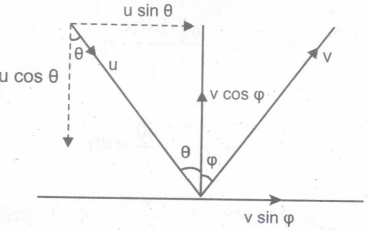
The x - component of velocity is
usin \(\theta\) = vsin f ......(1)
The magnitude of y-component of velocity is not same, therefore, using coefficient of restitution,
\(e=\frac{v \cos \varphi}{u \cos \theta}\) ......(2)
Squaring (1) and (2) and adding we get
\(v^{2} \sin ^{2} \varphi=u^{2} \sin ^{2} \theta
\)
\(v^{2} \cos ^{2} \varphi=e^{2} u^{2} \cos ^{2} \theta\)
adding
\(v^{2}=u^{2} \sin ^{2} \theta+e^{2} u^{2} \cos ^{2} \theta\)
\(\therefore v^{2}=u^{2}\left[\sin ^{2} \theta+e^{2} \cos ^{2} \theta\right]\)
v=u\(\sqrt { { sin }^{ 2 }\theta +{ e }^{ 2 }{ cos }^{ 2 }\theta } \)
41.
The equivalent resistance of a parallel combination
\(R'=\frac{R_1R_2}{R_1+R_2}=\frac{150\times220}{150+220}=\frac{33000}{370}=89.1\ Ohm\)
We know that, \(\frac{1}{R'}=\frac{1}{R_1}+\frac{1}{R_2}\)
\(\frac { \triangle { R }^{ ' } }{ \left( { R }^{ ' } \right) ^{ 2 } } =\frac { \triangle { R }_{ 1 } }{ { R }_{ 1 }^{ 2 } } +\frac { \triangle { R }_{ 2 } }{ { R }_{ 2 }^{ 2 } } \)
\(\triangle { R }^{ ' }=\left( { R }^{ ' } \right) ^{ 2 }\frac { \triangle { R }_{ 1 } }{ { R }_{ 1 }^{ 2 } } +\left( { R }^{ ' } \right) ^{ 2 }\frac { \triangle { R }_{ 2 } }{ { R }_{ 2 }^{ 2 } } =\left( \frac { { R }^{ ' } }{ { R }_{ 1 } } \right) ^{ 2 }\triangle { R }_{ 1 }+\left( \frac { { R }^{ ' } }{ { R }_{ 2 } } \right) ^{ 2 }\triangle { R }_{ 2 }\)
Substituting the value,
\(\triangle { R }^{ ' }=\left[ \frac { 89.1 }{ 150 } \right] ^{ 2 }\times 2+\left[ \frac { 89.1 }{ 220 } \right] ^{ 2 }\times 6=0.070+0.098=0.168\)
R' = 89.1 ± 0.168 Ohm.
42.
(i) t = \(\theta\) to t = 3:
velocity at t = 0, u = 0
velocity at t = 3 see, v = 30 mls
So, from velocity v = u + at
Acceleration \(a={{u}\over{t}}={{30}\over{3}}=10{ms}^{-2}\)
So distance covered between 0 to 3 see
\(s=ut+{{1}\over{2}}{at}^{2}\)
initial velocity u = 0 and t = 3
\(s=ut+{{1}\over{2}}{at}^{2}\)
\(=0\times3+{{1}\over{2}}\times10{(3)}^{2}\)
\(=0+{{1}\over{2}}\times10\times9\)
\(={{1}\over{2}}\times90\)
s = 45 m
From 3 to 6 see, velocity is same 30 m/s.
So distance travelled, = 30\(\times\)3 = 60. m
Total distance covered between 0 to 6 sec.
= 30 + 60
= 90m
(ii) At t = 3 sec, u = 30 ms-1, at t = 6 see,
v = 0 m/s .
So from, v = u + at
0= 30 + a\(\times\) 3
a =-10m/s2
So, distance covered from t = 3 to t = 6 see is,
v2 = u2 +2as
(0)2 = (30)2 - 2\(\times\)10\(\times\) s
\(s={{900}\over{20}}=45\ m\)
So total distance covered = 90 + 45
= 135 m
43.
Momentum is conserved in all types of collision
Let m ➝ mass of the molecule
M ➝ mass of the wall.
kinetic energy after collision = \(\frac{1}{2}mv^{2}+\frac{1}{2}MV^{2}\)
=\(\frac{1}{2}m(350)^{2}+\frac{1}{2}M(0)^{2}\)
=\(6.1250\times10^{4}mJ\)
kinetic energy before collision = \(\frac{1}{2}m(350)^{2}\)
=\(\frac{1}{2}\times m\times122500\)
=6.1250\(\times\)104 mJ
Therefore,
Kinetic energy before collision = kinetic energy after collision.
44.
If there is a loss of kinetic energy during a collision, then it is called as an inelastic collision
In the case of inelastic collision,
(i) Total kinetic energy is not conserved.
(ii) Some or all of the forces involved are non-conservative.
(iii) A part of the mechanical energy is transformed into heat, sound, light etc.
Examples for inelastic collision:
(i) Collision between ball and floor
(ii) Collision between two vehicles
Examples for perfectly inelastic collision:
(i) Mud thrown on a wall and sticking to it
(ii) a man jumping into a moving trolley
(iii) a bullet fired into a wooden block and remaining embedded in it.

11th Standard Syllabus & Materials
11th Standard
TN 11th Tamil பீடு பெற நில் - செய்யுள் - காவடிச்சிந்து Important Questions And Answers Study Material - QB365 Set A
NEW11th Standard
TN 11th Tamil பீடு பெற நில் - உரைநடை - மலை இடப்பெயர்கள் : ஓர் ஆய்வு Important Questions And Answers Study Material - QB365 Set A
NEW11th Standard
TN 11th Tamil மாமழை போற்றுதும் - துணைப்பாடம் - யானை டாக்டர் Important Questions And Answers Study Material - QB365 Set A
NEW11th Standard
TN 11th Tamil மாமழை போற்றுதும் - செய்யுள் - ஐங்குறுநூறு Important Questions And Answers Study Material - QB365 Set A



Tamilnadu Stateboard 11th Standard Subjects

Maths

Commerce

Economics

Biology

Business Maths and Statistics

Accountancy

Computer Science
Physics

Chemistry
Maths
Biology
Economics
Physics
Chemistry

History
Business Maths and Statistics

Computer Science
Accountancy

Computer Applications
History
Computer Technology
Commerce
Computer Applications
Computer Technology

Tamil

English

French
Tamilnadu Stateboard Standards

