
 100% FREE ACCESS
11th Standard Syllabus & Materials
11th Standard
TN 11th Tamil இயற்கை வேளாண்மை,சுற்றுச்சூழல் -செய்யுள் - மனோன்மணீயம் Important Questions And Answers Study Material - QB365 Set A
NEW11th Standard
TN 11th Tamil என்னுயிர் என்பேன் -துணைப்பாடம் - இசைத்தமிழர் இருவர் Important Questions And Answers Study Material - QB365 Set A
NEW11th Standard
TN 11th Tamil மொழி கலை -செய்யுள் - ஒவ்வொரு புல்லையும் Important Questions And Answers Study Material - QB365 Set A
NEW11th Standard
TN 11th Tamil பீடு பெற நில் - இலக்கணம் - பகுபத உறுப்புகள் Important Questions And Answers Study Material - QB365 Set A
NEW11th Standard
TN 11th Tamil பீடு பெற நில் - துணைப்பாடம் - வாடிவாசல் Important Questions And Answers Study Material - QB365 Set A
NEW11th Standard
TN 11th Tamil பீடு பெற நில் - செய்யுள் - குறுந்தொகை Important Questions And Answers Study Material - QB365 Set A

Published on: 05/10/2019
Laws of Motion
Download Tamil Nadu 11th Standard Physics question papers, model tests, one-mark questions, important questions, and public exam papers in PDF format. Free study materials and answer keys for TN State Board students.
Questions + Answers key
Take MCQ Physics Test1.
Apply Newton's second law for an object at rest on Earth and analyse the result.
2.
Under what condition will a car skid on a leveled circular road?
3.
What are inertial frames?
4.
A 40 gm of bullet moving at 250 ms-1 stops after penetrating 20 cm of wood. Calculate the average force exerted by the bullet.
5.
A car of mass 1000 kg moving with a speed of 10 kmh-1 comes to rest in 0.01s. Find the impulse.
6.
The Two masses m1=m2 =0.5kg are connected by a string which passes over a smooth frictionless pulley. What is the, acceleration of the masses
7.
What are the steps which have to be followed before applying Newton's laws?
8.
A body of 3.5 kg in acted upon by two forces of magnitudes 3N and 5N making an angle of 90° with each other. Calculate the magnitude if net acceleration experience by the body is?
9.
A lift is moving down with an acceleration 5.0 ms-2. Calculate the percentage change in the weight of a person in the lift
10.
A force of 10 N changes velocity of a body from 20 ms-1 to 40 ms-1 in 8 seconds. How much force is required to bring about the same change in 4s.
1.
The object is at rest with respect to Earth (inertial coordinate system). There are two forces that act on the object.
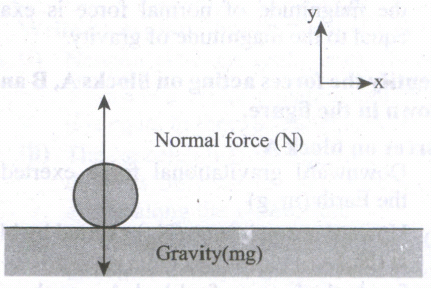
(i) Gravity acting downward (negative y-direction)
(ii) Normal force by the surface of the Earth acting upward (positive y-direction) The free body diagram for this object is
.png)
\(\vec { F } _{ g }=-mg\hat { j } \)
\(\vec { N } =N\vec { j } \)
Net force \({ \vec { F } }_{ net }=-mg\hat { j } +N\vec { j } \)
But there is no acceleration on the ball
So \(\vec { a }\) = 0. By applying newton's second law \(\left( { \vec { F } }_{ net }=m\vec { a } \right) \)
Since \(\vec { a } =0,{ \vec { F } }_{ net }=-mg\hat { j } +N\vec { j } \)
\((-mg+N)\vec { j } =0\)
(iii) By comparing the components on both sides of the equation we get,
-mg + N = 0
N = mg
We can conclude that if the object is at rest, the magnitude of the normal force is exactly equal to the magnitude of gravity
2.
In a leveled circular road, skidding mainly depends on the coefficient of static friction \({ \mu }_{ s }\). The coefficient of static friction depends on the nature of the surface which has a maximum limiting value. If the speed of car exceeds this safe speed, then it starts to skid outward but frictional force comes into effect and provides an additional centripetal force to prevent the outward skidding.
\(tan \ \theta> { \mu }_{ s }\)
When the tangent of the angle of banking is greater than the coefficient of friction, skidding occurs.
3.
(a) A frame of reference which is at rest or which is moving with a uniform velocity along a straight line is called an inertial frame of reference.
(b) In the inertial frame of reference Newton's laws of motion holds good.
Example: The lift at rest, lift moving (up or down) with constant velocity, car moving with constant velocity on a straight road.
4.
Mass of a bullet (m) = \(\frac { 40 }{ 1000 } kg\) = 0.04kg
Initial velocity (u) = 250 ms-1
Final velocity (v) = 0.
displacement (s) = 20cm = 20\(\times\)10-2m
Acceleration a bullet \(a=\frac { { v }^{ 2 }-{ u }^{ 2 } }{ 2s } \)
\(=\frac { { 0 }^{ 2 }-\left( 250 \right) ^{ 2 } }{ 2\times (20\times 10^{ -2 }m) } \)
= \(\frac { -250\times 250 }{ 2\times 20\times { 10 }^{ -2 }m } \)
= \(\frac { -62,50,000 }{ 40\times { 10 }^{ -2 } } \)
Acceleration 'a' = - 156.25 x10⁵ ms-2
Now, Average force F = ma
F = 0.04 \(\times\)(-156.25 x 10⁵)
= 6.25\(\times\)105N
5.
Mass of a car = 1000 kg
Initial velocity u = 90 kmh-1 = 25 m/s
Final velocity v = 0
Time t = 40s
Impulse = change in momentum
= m (v - u)
Impulse = 1000 (0 - 25) = - 25\(\times\)103
6.
The common acceleration of the masses is,
\(a=\frac { \left( { m }_{ 1 }-{ m }_{ 2 } \right) }{ \left( { m }_{ 1 }+{ m }_{ 2 } \right) } \times g\) [\(\therefore\) g \(\longrightarrow \) acceleration due to gravity]
= \(\frac { \left( 0.5-0.5 \right) }{ \left( 0.5+0.5 \right) } \times 9.8\)
= \(\frac { 0 }{ 1 } \times 9.8\)
The acceleration of the masses = 0
7.
(i) Choose a suitable inertial coordinate system to analyse the problem. For most of the cases we can take Earth as an inertial coordinate system.
(ii) Identify the system to which Newton's laws need to be applied. The system can be a single object or more than one object.
(iii) Draw the free body diagram
(iv) Once the forces acting on the system are identified, and the free body diagram is drawn, apply Newton's second law. In the left hand side of the equation, write the forces acting on the system in vector notation and equate it to the right hand side of equation which is the product of mass and acceleration. Here, acceleration should also be in vector notation.
(v) If acceleration is given, the force can be calculated. If the force is given, acceleration can be calculated.
8.
Mass of a body m = 2 kg
Magnitude of the two force, F1= 3N and F2 =5N,
Angle (\(\theta\) ) = 90°
Resultant force on the body =
F = \(\sqrt { { F }_{ 1 }^{ 2 }={ F }_{ 2 }^{ 2 }+2{ F }_{ 1 }{ F }_{ 2 }cos\theta } \)
= \(\sqrt { { 3 }^{ 2 }+{ 5 }^{ 2 }+2\times 3\times 5\times cos90° } \)
= \(\sqrt { 9+25+2\times 3\times 5\times 0 } \) \(\left[ \because \cos90°=0 \right] \)
= \(\sqrt { 9+25 } \)
F = \(\sqrt { 34 } \)
Net acceleration experienced by the body
a =\(\frac { F }{ m } \)
= \(\frac { \sqrt { 34 } }{ 3.5 } \) = 1.66 ms-2
9.
When the lift is moving down with an acceleration
' a ' the weight of the person W is, given by
W = mg = ma = m(g-a)
Fractional change is the weight of the person
= \(\frac { mg-w }{ mg } \)
= \(1-\frac { w }{ mg } -\frac { mg-(mg-ma) }{ mg } \)
\(=\frac { a }{ g } =\frac { 5.0 }{ 9.8 } =0.51\)
=Percentage change = 0.51\(\times\)100
= 51 %
10.
Force F = F1 = F2
F1 = \(\frac { dp }{ { dt }_{ 1 } } ,{ F }_{ 2 }=\frac { dp }{ { dt }_{ 2 } } \)
\({ F }_{ 2 }={ F }_{ 1 }=\frac { { dt }_{ 1 } }{ { dt }_{ 2 } } \)
\(=10\times \frac { 8 }{ 4 } =20N\)

11th Standard Syllabus & Materials
11th Standard
TN 11th Tamil பீடு பெற நில் - செய்யுள் - காவடிச்சிந்து Important Questions And Answers Study Material - QB365 Set A
NEW11th Standard
TN 11th Tamil பீடு பெற நில் - உரைநடை - மலை இடப்பெயர்கள் : ஓர் ஆய்வு Important Questions And Answers Study Material - QB365 Set A
NEW11th Standard
TN 11th Tamil மாமழை போற்றுதும் - துணைப்பாடம் - யானை டாக்டர் Important Questions And Answers Study Material - QB365 Set A
NEW11th Standard
TN 11th Tamil மாமழை போற்றுதும் - செய்யுள் - ஐங்குறுநூறு Important Questions And Answers Study Material - QB365 Set A



Tamilnadu Stateboard 11th Standard Subjects

Maths

Commerce

Economics

Biology

Business Maths and Statistics

Accountancy

Computer Science
Physics

Chemistry
Maths
Biology
Economics
Physics
Chemistry

History
Business Maths and Statistics

Computer Science
Accountancy

Computer Applications
History
Computer Technology
Commerce
Computer Applications
Computer Technology

Tamil

English

French
Tamilnadu Stateboard Standards

