
 100% FREE ACCESS
11th Standard Syllabus & Materials
11th Standard
TN 11th Tamil இயற்கை வேளாண்மை,சுற்றுச்சூழல் -செய்யுள் - மனோன்மணீயம் Important Questions And Answers Study Material - QB365 Set A
NEW11th Standard
TN 11th Tamil என்னுயிர் என்பேன் -துணைப்பாடம் - இசைத்தமிழர் இருவர் Important Questions And Answers Study Material - QB365 Set A
NEW11th Standard
TN 11th Tamil மொழி கலை -செய்யுள் - ஒவ்வொரு புல்லையும் Important Questions And Answers Study Material - QB365 Set A
NEW11th Standard
TN 11th Tamil பீடு பெற நில் - இலக்கணம் - பகுபத உறுப்புகள் Important Questions And Answers Study Material - QB365 Set A
NEW11th Standard
TN 11th Tamil பீடு பெற நில் - துணைப்பாடம் - வாடிவாசல் Important Questions And Answers Study Material - QB365 Set A
NEW11th Standard
TN 11th Tamil பீடு பெற நில் - செய்யுள் - குறுந்தொகை Important Questions And Answers Study Material - QB365 Set A

Published on: 30/09/2018
Important 1mark -chapter 5,6
Download Tamil Nadu 11th Standard Physics question papers, model tests, one-mark questions, important questions, and public exam papers in PDF format. Free study materials and answer keys for TN State Board students.
Questions + Answers key
Take MCQ Physics Test1.
The kinetic energy of the satellite orbiting around the Earth is
equal to potential energy
less than potential energy
greater than kinetic energy
zero
2.
If the acceleration due to gravity becomes 4 times its original value, then escape speed
remains same
2 times of original value
becomes halved
4 times of original value
3.
An object of mass 10 kg is hanging on a spring scale which is attached to the roof of a lift. If the lift is in free fall, the reading in the spring scale is
98 N
zero
49 N
9.8 N
4.
If a person moves from Chennai to Trichy, his weight
increases
decreases
remains same
increases and then decreases
5.
The magnitude of the Sun’s gravitational field as experienced by Earth is
same over the year
decreases in the month of January and increases in the month of July
decreases in the month of July and increases in the month of January
increases during day time and decreases during night time
6.
If the mass and radius of the Earth are both doubled, then the acceleration due to gravity g'
remains same
\({g\over 2}\)
2g
4g
7.
The work done by the Sun’s gravitational force on the Earth is
always zero
always positive
can be positive or negative
always negative
8.
The kinetic energies of a planet in an elliptical orbit about the Sun, at positions A, B and C are KA, KB and KC respectively. AC is the major axis and SB is perpendicular to AC at the position of the Sun S as shown in the figure. Then
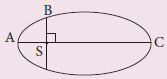
KA > KB >KC
KB < KA < KC
KA < KB < KC
KB > KA > KC
9.
The gravitational potential energy of the Moon with respect to Earth is
always positive
always negative
can be positive or negative
always zero
10.
11.
If the distance between the Earth and Sun were to be doubled from its present value, the number of days in a year would be
64.5
1032
182.5
730
12.
The time period of a satellite orbiting Earth in a cirular orbit is independent of
Radius of the orbit
The mass of the satellite
Both the mass and radius of the orbit
Neither the mass nor the radius of its orbit
13.
A planet moving along an elliptical orbit is closest to the Sun at distance r1 and farthest away at a distance of r2. If v1 and v2 are linear speeds at these points respectively. Then the ratio \({v_1\over v_2}\) is
\({r_2\over r_1}\)
\(({r_2\over r_1})^2\)
\({r_1\over r_2}\)
\(({r_1\over r_2})^2\)
14.
If the masses of the Earth and Sun suddenly double, the gravitational force between them will
remain the same
increase 2 times
increase 4 times
decrease 2 times
15.
The linear momentum and position vector of the planet is perpendicular to each other at
perihelion and aphelion
at all points
only at perihelion
no point
16.
Moment of inertia for bulk object _____________.
rm2
rw2
\(m_ir^{2}_{i}\)
\(\sum{m_ir^{2}_{i}}\)
17.
If \(\overrightarrow {r}\) and \(\overrightarrow {F}\) are parallel or antiparallel, then the torque is _____________.
zero
minimum
maximum
infinity
18.
If the direction of the torque is inward the paper then the rotation is ____________.
clockwise
anticlockwise
straight line
random direction
19.
The ratio of K2/R2 of a thin uniform ring about an axis passing through the center and perpendicular to the plane is _____________.
1
2
\(\frac { 1 }{ 2 } \)
\(\frac { 3 }{ 2 } \)
20.
Moment of inertia of a uniform solid sphere about an axis passing through the center along its diameter is _______________.
\(\frac { 2 }{ 3 } \)MR2
\(\frac { 5 }{ 3 } \)MR2
\(\frac { 7 }{ 5 } \)MR2
\(\frac { 2 }{ 5 } \)MR2
21.
In a two particle system, one particle lies at origin another one lies at a distance of X. Then the position of center of mass of these particles of equal mass is ______________.
\(\frac{m_2 X_2}{m_1+m_2}\)
\(\frac{X}{2}\)
\(\frac{mX}{m_1+m_2}\)
\(\frac{m_1+m_2}{mX}\)
22.
Two rotating bodies A and B of masses m and 2m with moments of inertia IA and IB (IB > IA) have equal kinetic energy of rotation. If LA and LB be their angular momenta respectively, then ______________.
LB>LA
LA>LB
LA=\(\frac { { L }_{ B } }{ 2 } \)
LA=2LB
23.
The product of torque acting on a body and angular velocity is ______________.
Energy
power
workdone
kinetic energy
24.
If E is a rotational kinetic energy then angular momentum is ______________.
\(\sqrt { 2IE } \)
\(\frac { { E }^{ 2 } }{ 2I } \)
\(\frac { 2I }{ { E }^{ 2 } } \)
\(\frac { E }{ { I }^{ 2 }{ \omega }^{ 2 } } \)
25.
Rotational kinetic energy is given by ___________.
\(\frac { 1 }{ 2 } \)mv2
\(\frac { 1 }{ 2 } \)Iv2
\(\frac { { L }^{ 2 } }{ 2I } \)
\(\frac { 2I }{ L^{ 2 } } \).
26.
A car of mass 1000 kg negotiates a banked curve of radius 90 m on a frictionless road. If the banking angle is 45°, the speed of the car is _____________.
20ms-1
30ms-1
5ms-1
10ms-1
27.
The ratio of radius of gyration of a circular ring and a circular disc, of the same mass and radius, about an axis passing through their centres and perpendicular to their planes are _____________.
1:\(\sqrt{2}\)
3:2
2:1
\(\sqrt{2}\):1
28.
A solid sphere of radius R is placed on smooth horizontal surface. A horizontal force F is applied at height h from the lowest point. For the maximum acceleration of centre of mass, which is correct?
h=R
h=2R
h=0
no relation between h and R.
29.
A circular turn table has a block of ice placed at its centre. The system rotates with an angular speed \(ω\) about an axis passing through the centre of the table. If the ice melts on its own without any evaporation, the speed of rotation of the system ________________.
becomes zero
remains constant at the same value \(ω\)
increases to a value greater than \(ω\)
decreases to a value less than \(ω\)
30.
When a child sits stationary at one end of a long trolley moving uniformly with some speed on a smooth horizontal plane. The speed of the centre of mass of the system (child and trolley) ________________.
increases
decreases
remains same
changes
31.
The reduced mass of two particles having masses m and 2m is _____________.
2m
3m
2m/3
m/2
32.
A solid sphere is rotating in free space. If the radius of the sphere is increased keeping mass same, which one of the following will not be affected?
M.I
Angular momentum
Angular velocity
Rotational K.E.
33.
M.I. of a ring of mass M and radius R about an axis passing through the centre & perpendicular to the plane is I. What is M.I. about its diameter?
I
I/2
\(I/\sqrt{2}\)
I + MR2
34.
The M.I of a uniform circular disc is maximum about an axis perpendicular to the disc and passing through _____________.
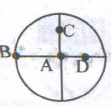
B
D
A
C
35.
If force acts on a body, whose line of action does not pass through its CG, then the body will experience ______________
angular acceleration
lineal acceleration
both (a) and (b)
none
36.
A round object of mass M and radius R rolls down without slipping along an inclined plane. The frictional force,
dissipates kinetic energy as heat
decreases the rotational motion
decreases the rotational and transnational motion
converts transnational energy into rotational energy
37.
When a mass is rotating in a plane about a fixed point, its angular momentum is directed along
a line perpendicular to the plane of rotation
the line making an angle of 45o to the plane of rotation
the radius
tangent to the path
38.
Two discs of same moment of inertia rotating about their regular axes passing through center and perpendicular to the plane of the disc with angular velocities ω1 and ω1. They are brought in to contact face to face coinciding with the axis of rotation. The expression for loss of energy during this process is
\(\frac{1}{4}\)\(I(\omega _{1}-\omega _{2})^2\)
\(I(\omega _{ 1 }-\omega _{ 2 })^{ 2 }\)
\(\frac{1}{8}\)\(I(\omega _{1}-\omega _{2})^2\)
\(\frac{1}{2}I\)\((\omega _{1}-\omega _{2})^2\)
39.
The speed of the center of a wheel rolling on a horizontal surface is vo. A point on the rim in level with the center will be moving at a speed of,
zero
vo
\(\sqrt{2}\)vo
2vo
40.
The speed of a solid sphere after rolling down from rest without sliding on an inclined plane of vertical height h is,
\( \sqrt \frac{4}{3}gh\)
\( \sqrt \frac{10}{7}gh\)
\(\sqrt{2gh}\)
\( \sqrt \frac{1}{2}gh\)
41.
The ratio of the acceleration for a solid sphere (mass m and radius R) rolling down an incline of angle \(\theta\) without slipping and slipping down the incline without rolling is,
5: 7
2: 3
2: 5
7: 5
42.
From a disc of radius R a mass M, a circular hole of diameter R, whose rim passes through the center is cut. What is the moment of inertia of the remaining part of the disc about a perpendicular axis passing through it
15MR2/32
13MR2/32
11MR2/32
9MR2/32
43.
A disc of the moment of inertia Ia is rotating in a horizontal plane about its symmetry axis with a constant angular speed \(\omega\). Another disc initially at rest of moment of inertia Ib is dropped coaxially on to the rotating disc. Then, both the discs rotate with the same constant angular speed. The loss of kinetic energy due to friction in this process is,
\(\frac { 1 }{ 2 } \frac { { I }_{ b }^{ 2 } }{ 2({ I }_{ a }+{ I }_{ b }) } { \omega }^{ 2 }\)
\(\frac { { I }_{ b }^{ 2 } }{ ({ I }_{ a }+{ I }_{ b }) } { \omega }^{ 2 }\)
\(\frac { { ({ I }_{ b }-{ I }_{ a }) }^{ 2 } }{ ({ I }_{ a }+{ I }_{ b }) } { \omega }^{ 2 }\)
\(\frac { 1 }{ 2 } \frac { { { I }_{ b }{ I }_{ b } } }{ ({ I }_{ a }+{ I }_{ b }) } { \omega }^{ 2 }\)
44.
45.
A rigid body rotates with an angular momentum L. If its kinetic energy is halved, the angular momentum becomes,
L
L/2
2L
L/\(\sqrt{2}\)
46.
A closed cylindrical container is partially filled with water. As the container rotates in a horizontal plane about a perpendicular bisector, its moment of inertia
increases
decreases
remains constant
depends on direction of rotation
47.
A rope is wound around a hollow cylinder of mass 3 kg and radius 40 cm. What is the angular acceleration of the cylinder if the rope is pulled with a force 30 N?
0.25 rad s-2
25 rad s-2
5 ms-2
25 ms-2
48.
A particle is moving with a constant velocity along a line parallel to positive X-axis. The magnitude of its angular momentum with respect to the origin is
zero
increasing with x
decreasing with x
remaining constant
49.
A couple produces,
pure rotation
pure translation
rotation and translation
no motion
50.
The center of mass of a system of particles does not depend upon,
position of particles
relative distance between particles
masses of particles
force acting on particle
1.
Escape speed ve = \(\sqrt 2g R\)
if g' = 4g
then \(v'_e\) = \(\sqrt (4g) R\)
= \(\sqrt 2g R \) \(\times\)2
= 2ve
2.
\(\text { Escape speed } v_{e}=\sqrt{2 g R}\)
\(\text { If } g^{\prime}=4 \mathrm{~g}\)
\(\text { Then } v_{e}^{\prime}=\sqrt{2(4 g) R}\)
\(=\sqrt{2 g R} \times 2 \)
\(=2 v_{e}
\)
3.
(b)
zero
4.
(b)
decreases
5.
(c)
decreases in the month of July and increases in the month of January
6.
g = \(\frac{GM_e}{R^2_e}\)
Me = 2 Me Re= 2 Re then,
g' = \(\frac{G \times 2M_e}{(2R_e)^2}\) = \(2 \frac{Gm_e}{4R_e^2}\)
\(2 \frac{Gm_e}{4R_e^2}\) = \(\cfrac g2\)
7.
(c)
can be positive or negative
8.
(a)
KA > KB >KC
9.
(b)
always negative
10.
(b)
11.
T2 = C (R + h)3
\(\therefore T \alpha (R_E)^\frac{3}{2}\)
RE = 2RE
\(\therefore T \alpha (2R_E)^\frac{3}{2}\)
Time period increases by \(2^\frac{2}{3}\)= 2\(\sqrt 2\)
No. of days in a year = (365.4) \(\times\)2\(\sqrt 2\)
= 1032
12.
Time period T = \(\frac{2\pi}{\sqrt GM_E} (R_E+ h)^\frac{3}{2}\)
\(\therefore\) It is independemt of mass
13.
(a)
\({r_2\over r_1}\)
14.
\(\text { Gravitational force } F \propto m_{1} m_{2}\)
\(\text { If } m_{1}=2 m_{1} \text { and } m_{2}=2 m_{2} \text { then }\)
\(\text { Force } F \propto\left(2 m_{1}\right)\left(2 m_{2}\right)\)
\(\propto 4 m_{1} m_{2}\)
15.
(a)
perihelion and aphelion
16.
(d)
\(\sum{m_ir^{2}_{i}}\)
17.
(a)
zero
18.
(a)
clockwise
19.
(a)
1
20.
(d)
\(\frac { 2 }{ 5 } \)MR2
21.
(b)
\(\frac{X}{2}\)
22.
(a)
LB>LA
23.
(b)
power
24.
(a)
\(\sqrt { 2IE } \)
25.
(c)
\(\frac { { L }^{ 2 } }{ 2I } \)
26.
(b)
30ms-1
27.
(d)
\(\sqrt{2}\):1
28.
(d)
no relation between h and R.
29.
(d)
decreases to a value less than \(ω\)
30.
(c)
remains same
31.
(c)
2m/3
32.
(b)
Angular momentum
33.
(a)
I
34.
(a)
B
35.
(c)
both (a) and (b)
36.
(d)
converts transnational energy into rotational energy
37.
(a)
a line perpendicular to the plane of rotation
38.
Moment of inertia of a disc passing through
\(\text { centre } I=\frac{1}{2} M R^{2}\)
\(\text { Energy of the first disc }=\frac{1}{4} I \omega_{1}^{2}\)
\(\text { Energy of the second disc }=\frac{1}{4} I \omega_{2}^{2}\)
\(\text { Loss of energy }=\frac{1}{4} I\left(\omega_{1}-\omega_{2}\right)^{2}\)
39.
\(v_{0}=r \omega ; \quad \therefore v_{0} \alpha r\)
For a wheel (uniform ring) the distance of a point on the rim in level with the center
\(\text { [i.e., radius] is } \sqrt{2} r\)
\(\therefore \text { The speed of the center is } \sqrt{2} v_{0}\)
40.
Potential energy = Translational kinetic energy + Rotational kinetic energy
\(m g h=\frac{1}{2} m v^{2}+\frac{1}{2} I \omega^{2} \)
\(=\frac{1}{2} m v^{2}+\frac{1}{2} \times \frac{2}{5} M R^{2} \times \frac{v^{2}}{R^{2}}\left[\omega=\frac{v}{R}\right] \)
\(=\frac{1}{2} m v^{2}+\frac{1}{5} m v^{2} \)
\(=\frac{5 m v^{2}+2 m v^{2}}{10}=\frac{7 m v^{2}}{10} \)
\(m g h=\frac{7 m v^{2}}{10} \)
\(g h=\frac{7 v^{2}}{10} \)
\(\therefore v^{2}=\frac{10 g h}{7} \)
\(\therefore v=\frac{\sqrt{10 g h}}{7} \)
41.
Acceleration of the solid sphere while rolling down without slipping
\(a_{1}=\frac{g \sin \theta}{1+\frac{k^{2}}{r^{2}}}\)
Acceleration developed while slipping down \(a_{2}=g \sin \theta\)
\(\text { Required ratio } \frac{a_{1}}{a_{2}}=\frac{g \sin \theta}{1+\frac{k^{2}}{r^{2}}} / g \sin \theta\)
\(\frac{a_{1}}{a_{2}}=\frac{1}{1+\frac{k^{2}}{r^{2}}}\)
\(\text { For a solid sphere } \frac{k^{2}}{r^{2}}=\frac{2}{5}\)
\(\therefore \text { Ratio of accelerations } \frac{a_{1}}{a_{2}}=\frac{1}{1+\frac{2}{5}}\)
\(=\frac{1}{5+\frac{2}{5}}=\frac{1}{\frac{7}{5}}=\frac{5}{7}\)
\(\therefore a_{1}: a_{2}=5: 7 \)
42.
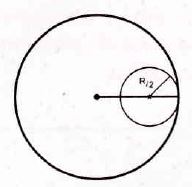
Moment of inertia of a disc
\(\mathrm{I}_{1}=\frac{M R^{2}}{2}\)
\(\text { Mass of small disc }=\frac{M}{\pi R^{2}} \times \pi \times\left(\frac{R}{2}\right)^{2}\)
\(=\frac{M}{\pi R^{2}} \times \frac{\pi R^{2}}{4}=\frac{M}{4}\)
By the theorem of parallel axis, the moment of inertia of the small disc. About an axis passing through 0 is
\(I_{2} =\frac{1}{2} \times \frac{M}{4}\left(\frac{R}{2}\right)^{2}+\frac{M}{4}\left(\frac{R}{2}\right)^{2} \)
\(=\frac{M}{8} \times \frac{R^{2}}{4}+\frac{M}{4} \times \frac{R^{2}}{4} \)
\(=\frac{M R^{2}}{32}+\frac{M R^{2}}{16}=\frac{M R^{2}+2 M R^{2}}{32} \)
\(I_{2} =\frac{3 M R^{2}}{32} \)
Moment of inertia of the remaining part is I= I1 - I2
\(=\frac{M R^{2}}{2}-\frac{3 M R^{2}}{32} \)
\(=\frac{16 M R^{2}-3 M R^{2}}{32}=\frac{13 M R^{2}}{32}\)
\(I =\frac{13 M R^{2}}{32} \)
43.
The moments of inertia of two discs are Ia and Ib respectively The angular velocity of the disc A is \(\omega\).
The sum of kinetic energies of two discs before coming in contact is \(k_{1}=\frac{1}{2} I_{a} \omega_{1}^{2}+\frac{1}{2} I_{b} \omega_{2}^{2}\)
\(\text { But angular velocity of the disc be is } \omega_{2}=0 \ \text {(rest)}\)
\(\therefore k_{1}=\frac{1}{2} I_{a} \omega_{1}^{2}\)
The final kinetic energy of the two discs system \(k_{2}=\frac{1}{2} \frac{I_{a}^{2} \omega_{1}^{2}}{I_{a}+I_{b}}\)
The loss of kinetic energy is
\(k_{1}-k_{2} =\frac{1}{2} I_{a} \omega^{2}-\frac{1}{2}\left[\frac{I a^{2} \omega_{1}^{2}}{I_{a}+I_{2 b}}\right] \)
\(=\frac{1}{2} \frac{\left[I_{1}\left(I_{a}+I_{b}\right) \omega^{2}-I_{a}^{2} \omega^{2}\right]}{I_{a}+I_{b}} \)
\(k_{1}-k_{2} =\frac{1}{2} \frac{I_{a} b}{\left(I_{a}+I_{b}\right)} \omega^{2} \)
44.
(a)
45.
\(K \cdot E=\frac{1}{2} I \omega^{2} ; \quad L=I \omega ; \quad K \cdot E=\frac{2^{2}}{2^{2}} \)
\(\therefore K \cdot E \alpha L^{2} \quad E_{1} \alpha L_{1}^{2} \quad E_{2} \alpha L_{2}^{2}\)
\(\frac{E_{1}}{E_{2}}=\left(\frac{L_{1}}{L_{2}}\right)^{2} \)
\(\text { Here } E_{1}=E \quad E_{2}=\frac{E}{2} \)
\(L_{1}=L \quad \quad L_{2}=? \)
\(\frac{E}{\frac{E}{2}}=\left(\frac{L}{L_{2}}\right)^{2} \)
\(\frac{2 E}{E}=\left(\frac{L}{L_{2}}\right)^{2}\left(\frac{L_{1}}{L_{2}}\right)^{2}=2 \)
\(\therefore \frac{L}{L_{2}}=\sqrt{2} \)
\(L_{2}=\frac{L}{\sqrt{2}} \)
46.
(a)
increases
47.
\(m=3 \mathrm{~kg} \quad r=40 \times 10^{-2} \mathrm{~m}=0.4 \mathrm{~m}\)
\(\text { Force }=30 N\)
Moment of inertia of a hollow-cylinder I= MR2
\(=3 \times\left(40 \times 10^{-2}\right)^{2} \)
\(=3 \times 0.4 \times 0.4=0.48 \mathrm{kgm}^{2} \)
\( F R =I \alpha \)
\(30 \times 40 \times 10^{-2}=0.48 d \)
\(d=\frac{12}{0.48}=\frac{1200}{48}=25 \mathrm{rad} \mathrm{s}^{-2} \)
\(\alpha=25 \mathrm{rad} \mathrm{s}^{-2} \)
48.
(d)
remaining constant
49.
(a)
pure rotation
50.
(d)
force acting on particle

11th Standard Syllabus & Materials
11th Standard
TN 11th Tamil பீடு பெற நில் - செய்யுள் - காவடிச்சிந்து Important Questions And Answers Study Material - QB365 Set A
NEW11th Standard
TN 11th Tamil பீடு பெற நில் - உரைநடை - மலை இடப்பெயர்கள் : ஓர் ஆய்வு Important Questions And Answers Study Material - QB365 Set A
NEW11th Standard
TN 11th Tamil மாமழை போற்றுதும் - துணைப்பாடம் - யானை டாக்டர் Important Questions And Answers Study Material - QB365 Set A
NEW11th Standard
TN 11th Tamil மாமழை போற்றுதும் - செய்யுள் - ஐங்குறுநூறு Important Questions And Answers Study Material - QB365 Set A



Tamilnadu Stateboard 11th Standard Subjects

Maths

Commerce

Economics

Biology

Business Maths and Statistics

Accountancy

Computer Science
Physics

Chemistry
Maths
Biology
Economics
Physics
Chemistry

History
Business Maths and Statistics

Computer Science
Accountancy

Computer Applications
History
Computer Technology
Commerce
Computer Applications
Computer Technology

Tamil

English

French
Tamilnadu Stateboard Standards

