
 100% FREE ACCESS
11th Standard Syllabus & Materials
11th Standard
TN 11th Tamil இயற்கை வேளாண்மை,சுற்றுச்சூழல் -செய்யுள் - மனோன்மணீயம் Important Questions And Answers Study Material - QB365 Set A
NEW11th Standard
TN 11th Tamil என்னுயிர் என்பேன் -துணைப்பாடம் - இசைத்தமிழர் இருவர் Important Questions And Answers Study Material - QB365 Set A
NEW11th Standard
TN 11th Tamil மொழி கலை -செய்யுள் - ஒவ்வொரு புல்லையும் Important Questions And Answers Study Material - QB365 Set A
NEW11th Standard
TN 11th Tamil பீடு பெற நில் - இலக்கணம் - பகுபத உறுப்புகள் Important Questions And Answers Study Material - QB365 Set A
NEW11th Standard
TN 11th Tamil பீடு பெற நில் - துணைப்பாடம் - வாடிவாசல் Important Questions And Answers Study Material - QB365 Set A
NEW11th Standard
TN 11th Tamil பீடு பெற நில் - செய்யுள் - குறுந்தொகை Important Questions And Answers Study Material - QB365 Set A

Published on: 30/09/2018
Important 2mark -chapter 5,6
Download Tamil Nadu 11th Standard Physics question papers, model tests, one-mark questions, important questions, and public exam papers in PDF format. Free study materials and answer keys for TN State Board students.
Questions + Answers key
Take MCQ Physics Test1.
Calculate the change in g value in your district of Tamilnadu. (Hint: Get the latitude of your district of Tamilnadu from the Google). What is the difference in g values at Chennai and Kanyakumari?
2.
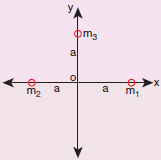
Calculate the gravitational field at point O due to three masses m1, m2 and m3 whose positions are given by the following figure. If the masses m1 and m2 are equal what is the change in gravitational field at the point O?
3.
Suppose unknowingly you wrote the universal gravitational constant value as G = 6.67\(\times\)1011 instead of the correct value G = 6.67\(\times\)1011, what is the acceleration due to gravity g' for this incorrect G? According to this new acceleration due to gravity, what will be your weight W'?
4.
Four particles, each of mass M and equidistant from each other, move along a circle of radius R under the action of their mutual gravitational attraction. Calculate the speed of each particle.
5.
The Moon I0 orbits Jupiter once in 1.769 days. The orbital radius of the Moon I0 is 421700 km. Calculate the mass of Jupiter?
6.
Two bodies of masses m and 4m are placed at a distance r. Calculate the gravitational potential at a point on the line joining them where the gravitational field is zero.
7.
If the masses and mutual distance between the two objects are doubled, what is the change in the gravitational force between them?
8.
An unknown planet orbits the Sun with distance twice the semi-major axis distance of the Earth’s orbit. If the Earth’s time period is T1, what is the time period of this unknown planet?
9.
If the Earth has no tilt, what happens to the seasons of the Earth?
10.
If the Earth’s pull on the Moon suddenly disappears, what will happen to the Moon?
11.
If a comet suddenly hits the Moon and imparts energy which is more than the total energy of the Moon, what will happen?
12.
A solid sphere of mass 20 kg and radius 0.25 m rotates about an axis passing through the center. What is the angular momentum if the angular velocity is 5 rad s-1.
13.
A child sits stationary at one end of a long trolley moving uniformly with speed V on a smooth horizontal floor. If the child gets up and runs about on the trolley in any manner, then what is the effect of the speed of the centre of mass of the (trolley + child) system?
14.
Why there are two propellers in a helicopter?
15.
If no external torque acts on a body, will its angular velocity be constant?
16.
What is the value of torque on the planet due to the gravitational force of sun?
17.
Which physical quantity is conserved when a planet revolves around the sun?
18.
What is the value of instantaneous speed of the point of contact during pure rolling?
19.
A particle moves on a circular path with decreasing speed. What happens to its angular momentum?
20.
The moment of inertia of two rotating bodies A and B are IA and IB ( CA> IB) and their angular momenta are equal. Which one has a greater kinetic energy?
21.
Two solid spheres of the same mass are made of metals of different densities. Which of them has a large moment of inertia about the diameter?
22.
Is radius of gyration a constant quantity ?
23.
A system is in stable equilibrium. What can we say about its potential energy ?
24.
Which component of linear momentum does not contribute to angular momentum?
25.
Can the couple acting on a rigid body produce translator motion?
26.
Write down the moment of inertia of a disc of radius R and mass m about an axis in its plane at a distance R/2 from its centre
27.
State the principle of moments of rotational equilibrium.
28.
About which axis a uniform cube will have minimum moment of inertia ?
29.
A cat is able to land on its feet after a fall. Which principle of physics is being used? Explain.
30.
Are moment of inertia and radius of gyration of a body constant quantities?
31.
A boy sits near the edge of revolving circular disc
(i) What will be the change in the motion of a disc?
(ii) If the boy starts moving from edge to the center of the disc, what will happen?
32.
When an object be in mechanical equilibrium?
33.
When an angular momentum of the object will be zero?
34.
When an object will have precession? Give one example.
35.
What is a rigid body?
36.
Explain with reason why if ice melts at pole then moment of inertia of earth increases, angular velocity ω decreases and day-night will be longer?
37.
Keeping the mass of earth constant, if its radius is halved then what will be the duration of the day and night?
38.
A solid cylinder of mass 20 kg rotates about its axis with angular speed 100 rad s-1. The radius of the cylinder is 0.25m. What is the kinetic energy associated with the rotation of the cylinder? What is the magnitude of angular momentum of the cylinder about its axis?
39.
A particle performing uniform circular motion has angular momentum L. What will be the new angular momentum, if its angular frequency is doubled and its kinetic energy halved?
40.
If angular momentum is conserved in a system whose moment of inertia is decreased, will its rotational kinetic energy be conserved?
41.
A ball tied to a string takes 4s to complete revolution along a horizontal circle. If by pulling the cord, the radius of the circle is reduced to half of the previous value, then how much time the ball will take in one revolution.
42.
The bottom of a ship is made heavy. Why?
43.
If no external torque acts on a body, will its angular velocity remain conserved?
44.
A labourer standing near the top of an old wooden step ladder feels unstable. Why?
45.
Why in hand driven grinding machine, handle is put near the circumference of the stone or wheel?
46.
Is centre of mass a reality?
47.
Should the centre of mass of a body necessarily lie inside the body?
48.
Two identical particles move towards each other with velocity 2 v and v respectively. The velocity of centre of mass?
49.
Three blocks of uniform thickness and masses m, m and 2m are placed at three corners of a triangle having co-ordinates (2.5, 1.5) (3.5, 1.5) and (3, 3) respectively. Find the centre of mass of the system.
50.
The distance between the centres of carbon and oxygen atoms in the carbon monoxide gas molecule is 1.13 \(\mathring{A}\) . Locate the centre of mass of the gas molecule relative to the carbon atom.
51.
Give examples where the centre of mass coincides with the geometrical centre of the body.
52.
A particle moves in a circular path with decreasing speed. What happens to its angular momentum?
53.
Why centripetal force cannot do work?
54.
What is the power needed to maintain uniform circular motion?
55.
Two boys of the same weight sit at the opposite ends of a diameter of a rotating circular table. What happens to the speed of rotation if they move nearer to axis of rotation?
56.
A cat is able to land on its feet after a fall. Why?
57.
About which axis the moment of inertia of a body is minimum?
58.
Some heavy boxes are to be loaded along with some empty boxes on a cart. Which boxes should be put on the cart first and why?
59.
A torque of 2.0 x 10⁻⁴ Nm is applied to produce an angular acceleration of 4 rad S-2 in a rotating body. What is the moment of inertia of the body?
60.
A thin metal hoop of radius 0.25m and mass 2 kg starts from rest and rolls down an inclined plane. If its linear velocity on reaching the foot of the plane is 2 ms-1, what is its rotational K.E. at that instant?
61.
A body of mass 50g is revolving about an axis in a circular path. The distance of the centre of mass of the body from the axis of rotation is 50cm. Find the moment of inertia of the body.
62.
Calculate the moment of inertia of the earth about its diameter taking It to be a sphere of 1025 kg and diameter 12800 km.
63.
A wheel of mass 8 kg and radius of gyration 25cm is rotating at 300 rpm what is its moment of inertia.
64.
Find the torque of a force \(7\widehat { i } -3\widehat { j } -5\widehat { k } \) about the origin which acts on a particle whose position vector is \(\widehat { i } +\widehat { j } -\widehat { k } \)
65.
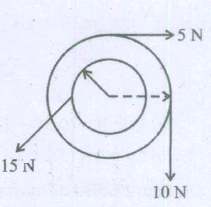
In the following figure radius r1 and r2 are 10 cm and 20 cm respectively. If the moment of inertia of the wheel is 1500 kg m2, then determine its angular acceleration.
66.
The power output of an automobile engine is advertised to be 200 hp at 600 rpm. What is the corresponding torque?
67.
Two rings have their moments of inertia in the ratio of 4 :1 and their diameters are in the ratio of 4 :1. Find the ratio of their masses.
68.
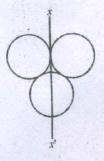
Adjoining diagram has three disc, in which each has mass M and radius R. Find the moment of inertia of this system about axis xx'.
69.
Four bodies of masses 5 kg, 2 kg, 3 kg and 4 kg are respectively placed at position (0, 0, 0), (2, 0, 0) (0, 3, 0) and (-2, -2, 0) calculate the moment of inertia about x-axis, y-axis and z-axis.
70.
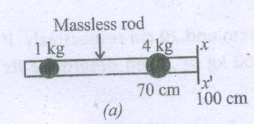
Calculate moment of inertia with respect to rotational axis xx' in following figures (a) and (b).
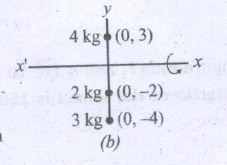
71.
What is meant by rolling friction?
72.
Obtain an expression for the power delivered by torque.
73.
What is the effect of Torque on Rigid Bodies.
74.
State law of Conservation of angular momentum.
75.
State the torque about an axis is independent of the origin.
76.
When does the body have precession?
77.
How will you find the direction of rotation using the direction of torque?
78.
State the rule which is used to find the direction of torque.
79.
What is point mass?
80.
Define the center of mass of a body.
81.
What is rigid body?
82.
What is meant by an internal force & external force?
83.
Suppose we go 200 km above and below the surface of the Earth, what are the g values at these two points? In which case, is the value of g small?
84.
An object is thrown from Earth in such a way that it reaches a point at infinity with non-zero kinetic energy [K.E(r=\(\infty\))= \({1\over 2}MV_{\infty}^2\)], with what velocity should the object be thrown from Earth?
85.
Earth revolves around the Sun at 30 km s−1. Calculate the kinetic energy of the Earth. In the previous example you calculated the potential energy of the Earth. What is the total energy of the Earth in that case? Is the total energy positive? Give reasons.
86.
What is the gravitational potential energy of the Earth and Sun? The Earth to Sun distance is around 150 million km. The mass of the Earth is 5.9\(\times\)1024 kg and mass of the Sun is 1.9\(\times\)1030 kg.
87.
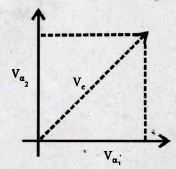
If the angular momentum of a planet is given by \(\vec{L}=5t^2\hat i-6t\hat j+3\hat k\) . What is the torque experienced by the planet? Will the torque be in the same direction as that of the angular momentum?
88.
If the ratio of the orbital distance of two planets \({d_1\over d_2}=2,\) what is the ratio of gravitational field experienced by these two planets?
89.
Assume that you are in another solar system and provided with the set of data given below consisting of the planets’ semi-major axes and time periods. Can you infer the relation connecting semi-major axis and time period?
| Planet (imaginary) |
Time period(T) (in year) |
Semi major axis (a) (in AU) |
|---|---|---|
| Kurinji | 2 | 8 |
| Mullai | 3 | 18 |
| Marutham | 4 | 32 |
| Neithal | 5 | 50 |
| Paalai | 6 | 72 |
1.
\(\mathrm{g}_{\text {latitude'}} \ g^{\prime}=g-\omega^{2} R \cos ^{2} \lambda\)
Value of latitude of g at Chennai \(\simeq 13^{\circ}\)
\(\operatorname{Cos} 13^{\circ} =0.2268 \mathrm{rad}
\)
\(\omega =\frac{2 \pi}{T}=\frac{2 \pi}{24 \times 3600}
\)
\(=\frac{2 \pi}{86400}=\frac{2 \times 3.14}{86400}
\)
\(\therefore \omega^{2} R =\left(\frac{2 \times 3.14}{86400}\right)^{2} \times\left(6400 \times 10^{3}\right)
\)
\(=3.4 \times 10^{-2} \mathrm{~m} / \mathrm{s}^{2}
\)
\(\mathrm{g}_{\text {Cbeanai }} =\mathrm{g}-\omega^{2} R \cos ^{2} \lambda
\)
\(=9.8-\left(3.4 \times 10^{-2}\right)^{2} \cos (0.2268)^{2}
\)
\(\mathrm{~g}_{\text {Chennai }} =9.7677 \mathrm{~m} / \mathrm{s}^{2}\)
Value of latitude at Kanyakumari
\(=8.088^{\circ} \mathrm{N}=8.08=8.1^{\circ} \mathrm{N}
\)
\(\omega =\frac{2 \pi}{T}=\frac{2 \times 3.14}{86400}
\)
\(\omega^{2} R =\left(\frac{2 \times 3.14}{86400}\right)^{2} \times\left(6400 \times 10^{3}\right)
\)
\(=3.4 \times 10^{2} \mathrm{~m} / \mathrm{s}^{2}\)
\(\mathrm{g}_{\text {Kanyakumari }} =g-\omega^{2} R \cos ^{2} \lambda
\)
\(=9.8-\left(3.4 \times 10^{2}\right)^{2}\left[\cos \left(8.1^{\circ}\right)\right]^{2}
\)
\(g_{\text {Kanyakumari }} =9.798 \mathrm{~ms}^{-2}
\)
\(\Delta g =9.798-9.767=0.031 \mathrm{~ms}^{-2}\)
2.
From the figure, the distance of m1 from the origin = a
From the figure, the distance of m2 from the origin = a
Gravitational field \(\mathrm{E}=\frac{G M}{r^{2}} \hat{r}\)
At the origin (Point O) the change in gravitational field is
\(\vec{E}=\frac{G M}{a^{2}}\left[\left(m_{1}-m_{2}\right) \hat{i}+m_{3} \hat{j}\right]\)
It is given that
\(\mathrm{m}_{1} =\mathrm{m}_{2} \)
\(\therefore \vec{E} =\frac{G M}{a^{2}}\left[m_{3} \hat{j}\right]\)
3.
Mass of the earth M = 6.024 5 1024 kg
Radius of the earth R = 6.4\(\times\)106 m
Gravitational constant G' = 6.67\(\times\)1011
Gravitational constant G = 6.67\(\times\)1011
Acceleration due to gravity g' =?
g' =
g' = 9.8\(\times\)1022 m/s2
g = 9.8 m/s2
∴ g' = g\(\times\)1022 (or) 1022
g = g' m/s2
Weight W = mg
W' = mg'
= 1022 .W
W = 1022
4.
The gravitational potential energy
\(\mathrm{V} =-\frac{G M^{2}}{R}\left[1+\frac{4}{\sqrt{2}}\right]
\)
\(\mathrm{V} =-\frac{G M^{2}}{R}[1+2 \sqrt{2}]
\)
\(\text {Gravitational potential } \mathrm{V}_{\mathrm{o}}(\mathrm{r}) =-\frac{4 G M}{R}\)
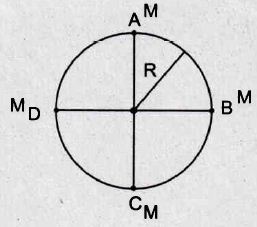
Centripetal acceleration \(a=\frac{V^{2}}{R}\)
Centripetal force \(=\frac{M V^{2}}{R}\)
\(\therefore\) Speed \(V=\frac{1}{2} \sqrt{\frac{G M}{R}(1+2 \sqrt{2})}\)
5.
Time period, T = 1.769 days
Orbital radius, r = 421700 x 103 m
\(\mathrm{T} =2 \pi \sqrt{\frac{R^{3}}{G M}}
\)
\(\mathrm{T}^{2} =\frac{4 \pi^{2} \times R^{3}}{G M}
\)
\(\therefore \mathrm{M} =4 \pi^{2} \times G \times \frac{R^{3}}{T^{2}}
\)
\(\mathrm{~T}^{2} \propto \mathrm{R}^{3}
\)
\(\frac{R^{3}}{T^{2}} =\left[\frac{421700 \times 10^{3}}{1.769}\right]^{3 / 2}=\frac{\left(421.7 \times 10^{6}\right)^{3}}{(1.769)^{2}}
\)
\(=\frac{74991.3 \times 10^{3} \times 10^{18}}{3.1293}=\frac{7499.14 \times 10^{22}}{3.1293}
\)
\(=2396.4 \times 10^{22}\)
\(\mathrm{M} =4 \times 3.14 \times 6.67 \times 10^{-11} \times 2396.4 \times 10^{22}
\)
\(=1.898 \times 10^{27} \mathrm{~kg}\)
6.
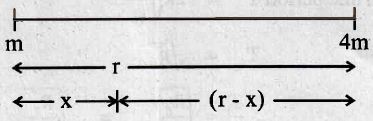
\(\text {The gravitational field }=-\frac{G m}{r^{2}} \hat{r}
\)
\(\frac{G m}{x^{2}}=\frac{G \times 4 m}{(r-x)^{2}}
\)
\(\frac{m}{x^{2}}=\frac{4 m}{(r-x)^{2}}
\)
\(\frac{1}{x^{2}}=\frac{4}{(r-x)^{2}}
\)
\(\frac{1}{x}=\frac{2}{r-x}\)
r - x = 2x
\(\mathrm{r}=3 x \quad \therefore x=\frac{r}{3}
\)
\(\text {Gravitational potential } \mathrm{V}=-\frac{G m}{r}=-\frac{9 \mathrm{Gm}}{r}\)
7.
Gravitational force F = \(\frac { { GM }_{ 1 }{ M }_{ 2 } }{ { r }^{ 2 } } \hat{r}\)
Since mass and mutual distances are double there is no change in the gravitational force between them.
8.
Let the distance of the Earth = RE
The distance of unknown planet = RP = 2 RE
Let the time period of the Earth be T1
The time period of the unknown planet be T2
\(\text {Time period } \mathrm{T} =2 \pi \sqrt{\frac{R_{E}}{g}}
\)
\(\mathrm{~T} \propto \sqrt{R_{E}}
\)
\(\therefore \frac{T_{1}}{T_{2}} =\sqrt{\frac{R_{E}}{R_{P}}}=\sqrt{\frac{R_{E}}{2 R_{E}}}
\)
\(\therefore \frac{T_{1}}{T_{2}} =\frac{1}{\sqrt{2}}
\)
\(\mathrm{~T}_{2} =\sqrt{2} T_{1}\)
9.
If the Earth has us tilt then there would not be seasons of the Earth.
10.
Moon will start to move in spiral path towards the earth and it may hit on the surface of the Earth.
11.
Kinetic energy of the moon will vary but its total energy remains constant.
12.
Mass of the sphere, m = 20 kg
Radius r = 0.25 m
Angular velocity 0 = 5 rad s-1
Angular momentum \(L=I\omega =\frac{2}{5} mr^{2}\omega\)
\(=\frac{2}{5}\times 20 \times (0.25)^{2}\times 5 = 40 \times (0.0625)=2.5\)
L = 2.5 kg m2 s-1.
13.
No change in speed of system as no external force is working.
14.
Due to conservation of angular momentum.
15.
No
16.
Zero.
17.
Angular momentum of planet.
18.
Zero.
19.
As \(\vec L\)= \(\vec r\) \(\times\) \(\vec mv\) i.e., \(\vec L\) magnitude decreases but direction remains constant.
20.
\(K=\frac { { L }^{ 2 } }{ 2I } \Rightarrow K_{ A }>K_{ A }\)
21.
Sphere of smaller density will have larger moment of inertia.
22.
No, it changes with the position of axis of rotation.
23.
P.E. is minimum.
24.
Radial Component.
25.
No. It can produce only rotatory motion.
26.
\(\frac{1}{2}\)MR2
27.
\(\sum { \bar { \tau } } =0\)
28.
It will be about an axis passing through the centre of the cube and connecting the opposite corners.
29.
A cat is able to land on its feet after a fall. This is based on law of conservation of angular momentum. When the cat is about to fall, it curls its body to decrease the moment of inertia and increase its angular velocity. When it lands it stretches out its limbs. By which it increases its moment of inertia and intum it decreases its angular velocity. Hence the cat lands safety.
30.
No, moment of inertia and radius of gyration depends on axis of rotation and also on the distribution of mass of the body about its axis.
31.
(i) As we know L = I\(\omega \) = constant if the boy sits on the edge of revolving disc, its I will be increased in turn it reduces angular velocity.
(ii) If the boy starts moving towards the center of the disc, its I will decrease in turn that increases its angular velocity.
32.
A rigid body is said to be in mechanical equilibrium when both its linear momentum and angular momentum remain constant.
33.
If the straight path of the particle passes through the origin, then the angular momentum is zero, which is also a constant.
34.
The torque about the axis will rotate the object about it and the torque perpendicular to the axis will turn the axis of rotation when both exist simultaneously on a rigid body the body will have a precession.
35.
A rigid body is the one which maintains its definite and fixed shape even when an external force acts on it.
36.
If ice of the pole melts then it will come towards the equator and moment of inertia of earth will increase because mass particle at equator are at more distant from rotational axis as compare to pole.
Time period (T) = \(\frac { 2\pi }{ \omega } \) (∵ Iω= constant)
So if I increases then ω decreases ⇒ T increases. Due to increment of time period the duration of day and night will increase.
37.
I1ω1=I2ω2
⇒ \(\frac{2}{5}\)MR2 \(\times\) \(\frac { 2\pi }{ T_{ 1 } } \) =\(\frac{2}{5}\)M \(\left( \frac { R }{ 2 } \right) ^{ 2 }\)\(\times\) \(\frac { 2\pi }{ T_{ 2 } } \)
⇒ T2 = \(\frac { T_{ 1 } }{ 4 } \) ∴T1 = 24 hr
∴ T2 = 6hr
38.
Given: M = 20 kg, ω= 100 rad s-I, R = 0.25m
M.I. of the cylinder about its own axis, I = \(\frac{1}{2}\)MR2 = \(\frac{1}{2}\) \(\times\) 20 \(\times\) (25)2 = 625 kgm2
Rotational K.E I = \(\frac{1}{2}\)Iω2 = \(\frac{1}{2}\) \(\times\) 0.625 \(\times\) (100)2 =3125J
Angular momentum, L= Iω = 0.625 \(\times\)100 = 62.5 kgm2 s-1
39.
Rotational K.E., K = \(\frac { 1 }{ 2 } \) Iω2 ∴ I=\(\frac { 2K }{ \omega ^{ 2 } } \)
Angular momentum, L = Iω = \(\frac { 2K }{ \omega ^{ 2 } } \).ω = \(\frac { 2K }{ \omega } \)
When angular frequency is doubled and kinetic energy is halved, the angular momentum becomes,
L' = \(\frac { 2\left( \frac { K }{ 2 } \right) }{ 2\omega } \) = \(\frac { 1 }{ 4} \)\(\frac { 2K }{ \omega } \)= \(\frac { L }{4} \)
40.
Given: L = Iω= Constant
Formula: Rotational K.E. is given by,
K = \(\frac { 1 }{ 2 } \) Iω2=\(\frac { 1 }{ 2 } \frac { { I }^{ 2 }\omega ^{ 2 } }{ I } \)= \(\frac { 1 }{ 2 } .\frac { L^{ 2 } }{ I } \)
For constant L, \(K\propto\frac{1}{1}\)
So when the moment of inertia decreases, the rotational K.E. increases. Hence rotational K.E. is not conserved.
41.
Formula: By conservation of angular momentum
l1ω 1 = I2ω2
or mr2. \(\frac { 2\pi }{ T_{ 1 } } \) = m \(\left( \frac { r }{ 2 } \right) ^{ 2 }.\frac { 2\pi }{ T_{ 2 } } \)
\({ T }_{ 2 }=\frac { 1 }{ 4 } { T }_{ 1 }\)
= \(\frac { 1 }{ 4 } \times 4\)=1s
42.
The bottom of a ship is made heavy so that its centre of gravity remains low. This ensures the stability of its equilibrium.
43.
No. Angular velocity is not conserved but angular momentum is conserved.
44.
The ladder can rotate about the point of contact of the ladder with the ground. When the labourer is at the top of the ladder, the lener arm of the force is large. Hence the turning effect on the ladder will be large.
45.
For a given force, torque can be increased if the perpendicular distance of the point of application of the force from the axis of rotation is increased. Hence the handle put near the circumference produces maximum torque.
46.
No. The centre of mass of a system is a hypothetical point which acts as a single mass particle of the system for an external force.
47.
Not necessarily. For example, the eM of a ring lies in its hollow portion.
48.
\(m_1=m_2=m\)
v = 2v and v2 = -v
\(\therefore\) \({V}_{CM}={m_1v_1+m_2v_2\over m+m}={m\times(2v)+m(-v) \over m+m}={v \over 2}\)
49.
\({x}_{CM}={m(2.5)+m(3.5)+2m(3)\over m+m+2m}=3\)
\({y}_{CM}={m(1.5)+m(1.5)+2m(3)\over m+m+2m}=2.25\)
50.
\({x}_{CM}={m_1+m_2+m_2x_2\over m_1+m_2}={12\times0+16\times1.13 \over 12+16}=0.6457\ \mathring{A}\)
51.
For symmetrically shaped bodies of uniform composition (Eg: spheres, cylinders, rectangular solids), the centre of mass is located at the geometrical centre of the body.
52.
The angular momentum of a particle of mass m moving along a circular path of radius r with linear velocity v is given by
\(\bar{L}=\bar{r}\times m \bar{v}\)
If the speed (v) of the particle decreases along the circular path, the magnitude of angular momentum (= mvr) decreases. However, the direction of angular momentum remains unchanged.
53.
The centripetal force cannot do work on the object since it is always perpendicular to the velocity.
54.
No power is needed to maintain uniform circular motion.
Power required = \(\bar{F}.\bar{v}=F v\cos\theta\)
= \(Fv\cos90°=0\)
55.
The moment of inertia of the system (circular table + two boys) decreases. To conserve angular momentum (L = 100 = constant), the speed of rotation of the circular table increases.
56.
When a cat falls to ground from a height, it stretches its body along with the tail so that its moment of inertia becomes high. Since angular momentum (L = Iω) remain constant, the value of angular speed ω decreases and therefore the cat is able to land on the ground gently.
57.
The moment of inertia of a body is minimum about an axis passing through its centre of mass.
58.
The heavy boxes should be loaded first so that the CG of the loaded cart remains in the lowest position. This ensures stability of equilibrium.
59.
Here \(\tau \) = 2.0 \(\times\) 10-4Nm,
α = 4 rad s-2, I = ?
Formula: \(\tau\) = Iα
I = \(\frac { \tau }{ \alpha } =\frac { 2.0\times 10^{ -4 } }{ 4 } \) = 0.5 \(\times\) 10-4 kgm2
60.
Here R = 0.25m
M= 2kg
V= 2ms-1
Rotational K.E = \(\frac { 1 }{ 2 } I\omega ^{ 2 }\) = \(\frac { 1 }{ 2 } MR ^{ 2 }\) \(\times \left( \frac { V }{ R } \right) ^{ 2 }\)
\(\frac { 1 }{ 2 } MV ^{ 2 }\) = \(\frac { 1 }{ 2 }\) x2x4 =4J
61.
Given: m = 50g = 0.05 kg, r = 50cm = 0.50m
Formula: I = mr2
= 0.05 \(\times\) (0.50)2
= 0.0125 kgm2
62.
M = 1025kg
R = 6400 km = 6.4\(\times\)106 m
M.I of the earth about its diameter,
I =\(\frac { 2 }{ 5 } \)MR2 = \(\frac { 2 }{ 5 } \)\(\times\)1025 \(\times\)(6.4\(\times\)106)2
=1.64 \(\times\)1038 kgm2
63.
M = 8 kg, k = 25cm = 0.25m
∴ I = Mk2
= 8 \(\times\) (0.25)2
=0.5 kgm2
64.
Given: \(\widehat { F } =7\widehat { i } -3\widehat { j } -5\widehat { k } \) and \(\widehat { r } =\widehat { i } +\widehat { j } -\widehat { k } \)
Formula: ∴ \(\tau =\widehat { r } \times \widehat { F } =\)\(\left| \begin{matrix} \widehat { i } & \widehat { j } & \widehat { k } \\ 1 & 1 & -1 \\ 7 & -3 & -5 \end{matrix} \right| \)
or \(\tau =-8\widehat { i } -2\widehat { j } -10\widehat { k } \)
65.
\(\alpha =\frac { \tau }{ I } =\frac { (5+10){ r }_{ 2 }-15{ r }_{ 1 } }{ I } \)
=\(\frac { 15(20-10)\times { 10 }^{ 2 } }{ 1500 } \)
= 10-3rad s-2
66.
P = 200 hp = 200 hp \(\times\) \(\frac { 76\omega }{ 1hp } \) = 1.49 \(\times\) 105 \(\omega \)
\(\omega \) = 6000 rev/min
= 6000 \(\times\) \(\frac { 2\pi }{ 60 } \) = 628 rad/sec
\(\tau =\frac { \rho }{ \omega } =\frac { 1.49\times 10^{ 5 } }{ 628 } \) = 237.5 Nm
67.
\(\frac { I_{ 1 } }{ { I }_{ 2 } } =\frac { M_{ 1 }R_{ 1 }^{ 2 } }{ M_{ 2 }R^{ 2 }_{ 2 } } \)
\(\Rightarrow \frac { M_{ 1 } }{ M_{ 2 } } =\frac { I_{ 1 } }{ { I }_{ 2 } } \times \left[ \frac { R_{ 2 } }{ R_{ 1 } } \right] ^{ 2 }\)
\(\frac { 4 }{ 1 } \times \left( \frac { 1 }{ 2 } \right) ^{ 2 }=\ \frac { 1 }{ 4 } \)
68.
Isystem = 2 \(\times\) Iupper + Iinner
= 2 \(\times\)\(\frac { 5 }{ 4 } \) MR2 + \(\frac { MR^{ 2 } }{ 4 } \) = \(\frac { 11 }{ 4 } \)MR2
69.
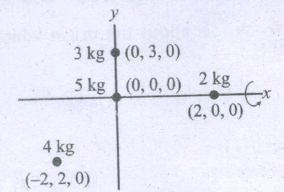
Ix = 3 \(\times\) (3)2 + 4 \(\times\) (2)2 = 43 unit
Iy = 2\(\times\) (2)2 + 4 \(\times\) (2)2 = 24 unit
Iz = 2 \(\times\) (2)2 + 3 \(\times\) (3)2 + 4 \(\times\) (\(\sqrt { 2 } \))2
= 8 + 27 + 32 = 67 unit
70.
(a) Ixx' = 4 \(\times\) (0.3)2 + 1 \(\times\) (0.8)2 = 1 kgm2
(b) Ixx'= 4 \(\times\) (3)2 + 2 \(\times\) (2)2 + 3 \(\times\) (4)2 = 92 kgm2
71.
When the round object moves, it always tends to roll on any surface which has a coefficient of friction any value greater than zero (μ > 0). The friction that enabling the rolling motion is called rolling friction.
72.
Power delivered is the work done per unit time. If we differentiate the expression for work done with respect to time, we get the instantaneous power (P).
p =\(\frac { dw }{ dt } =\tau \frac { d\theta }{ dt } \) \(\because (dw=\tau d\theta )\)
p =ፒω
73.
(i) A rigid body which has non-zero. external torque (ፒ) about the axis of rotation would have an angular acceleration (α) about that axis.
(ii) The scalar relation between the torque and angular acceleration is,
ፒ=Iα
where, I is the moment of inertia of the rigid body. The torque in rotational motion is equivalent to the force in linear motion.
74.
In the absence of external torque, the angular momentum of the rigid body or system of particles is conserved.
If \(\tau\) = 0 then, \(\frac { dL }{ dt } =0\) ; L= constant
75.
(i) The torque of a force about an axis is independent of the choice of the origin as long as it is chosen on that axis itself.
(ii) Let O be the origin on the axis AB, which is the rotational axis of a rigid body. F is the force acting at the point P. Now, choose another point O' anywhere on the axis.
(iii) The torque of F about O' is,
\(\overset { \rightarrow }{ O'P } \times \overset { \rightarrow }{ F } =(\overset { \rightarrow }{ O'O } +\overset { \rightarrow }{ OP } )\times \overset { \rightarrow }{ F } \)
=\((\overset { \rightarrow }{ O'O } \times \overset { \rightarrow }{ F } )+(\overset { \rightarrow }{ OP } \times \overset { \rightarrow }{ F } )\)
(iv) As \(\overset { \rightarrow }{ O'O } \times \overset { \rightarrow }{ F } \) is perpendicular to \(\overset { \rightarrow }{ O'O } \) this term will not have a component along AB. Thus, the component of \(\overset { \rightarrow }{ O'P } \times \overset { \rightarrow }{ F } \) is equal to that of \(\overset { \rightarrow }{ OP } \times \overset { \rightarrow }{ F } \).
76.
(i) The -torque about the axis will rotate the object about it and the torque perpendicular to the axis will turn the axis of rotation.
(ii) When both exist simultaneously on a rigid body, the body will have a precession.
77.
The direction of torque helps us to find the type of rotation caused by the torque. For example, if the direction of torque is out of the paper, then the rotation produced by the torque is anticlockwise. On the other hand, if the direction of the torque is into the paper, then the rotation is clockwise.
78.
The direction of torque is found using right hand rule. This rule says that if fingers of right hand are kept along the position vector with palm facing the direction of the force and when the fingers are curled the thumb points to the direction of the torque.
79.
A point mass is a hypothetical point particle which has nonzero mass and no size or shape.
80.
The center of mass of a body is defined as a point where the entire mass of the body appears to be concentrated.
81.
A rigid body is the one which maintains its definite and fixed shape even when an external force acts on it.
82.
Internal forces are the forces acting among the particles within a system that constitute the body. External forces are the forces acting on the particles of a system from outside.
83.
Height = Altitude h = 200 km
Depth d = 200 km
The value of g at that altitude is
\(\mathrm{g}_{\mathrm{h}}=g\left[1-\frac{2 h}{R_{e}}\right]
\)
\(R_{e}=6400 \mathrm{~km}
\)
\(\therefore \quad \mathrm{g}_{\mathrm{h}}=g\left[1-\frac{2 \times 200}{6400}\right]
\)
\(\therefore g_{u p}=g\left[1-\frac{2 \times 200}{6400}\right]
\)
\(g_{\text {up }} =g\left[\frac{6000 \times 10^{3}}{6400 \times 10^{3}}\right]
\)
\(=g \times \frac{15}{16}=g \times 0.9375
\)
\(\mathrm{g}_{\text {up }}=0.94 \mathrm{~g}
\)
\(\mathrm{g}_{\text {depth }}=\mathrm{g}_{d}=\mathrm{g}\left[1-\frac{d}{R_{E}}\right]
\)
\(g_{\text {down }}=g\left[1-\frac{200 \times 10^{3}}{6400 \times 10^{3}}\right]
\)
\(=g\left[1-\frac{200}{6200}\right]
\)
\(=g\left[1-\frac{1}{32}\right]=g\left[\frac{32-1}{32}\right]
\)
\(=-g \times \frac{31}{32}
\)
\(=0.96875 \mathrm{~g}
\)
\(\mathrm{g}_{\text {down }} \simeq 0.96 \mathrm{~g}\)
84.
At Earth's surface \(\mathrm{KE}=\frac{1}{2} \mathrm{M} v_{\mathrm{e}}^{2}, \mathrm{P} . \mathrm{E}=-\frac{\mathrm{GMM}_{\mathrm{E}}}{\mathrm{R}_{\mathrm{E}}}\)
At infinity K.E = \(\frac{1}{2} M V_{\infty}^{2}, \mathrm{P} . \mathrm{E}=\mathrm{O}\)
By law of conservation of energy,
\(\frac{1}{2} \mathrm{Mv}_{\mathrm{e}}^{2}-\frac{\mathrm{GMM}_{\mathrm{E}}}{\mathrm{R}_{\mathrm{E}}} =\frac{1}{2} \mathrm{M} v_{\infty}^{2}
\)
\(v_{\mathrm{e}}^{2} =v_{\infty}^{2}+\frac{2 \mathrm{GM}_{\mathrm{E}}}{\mathrm{R}_{\mathrm{E}}}
\)
\(\text {But } \mathrm{GM}_{\mathrm{E}} =\mathrm{qR_{ \textrm {E } } ^ { 2 }}
\)
\(\therefore v_{\mathrm{e}}^{2} =v_{\infty}^{2}+2 \mathrm{gR}_{\mathrm{E}}
\)
\(v_{\mathrm{c}} =\sqrt{\mathrm{v}_{\infty}^{2}+2 \mathrm{gR}}\)
85.
Velocity of the Earth around Sun
y = 30 km/s
Kinetic energy \( \mathrm{K} . \mathrm{E}=\frac{1}{2} \frac{G M_{E} M_{\mathrm{s}}}{\left(\mathrm{R}_{E}+\mathrm{h}\right)}\)
Kinetic Energy \( \mathrm{K} . \mathrm{E} =\frac{1}{2} M_{s} V^{2}=\frac{1}{2} \times 1.9 \times 10^{30} \times\left(30 \times 10^{3}\right)^{2} \)
\(=\frac{1.9 \times 900 \times 10^{30+6}}{2} \)
\(\mathrm{~K} . \mathrm{E} =\mathrm{U}_{\mathrm{K}}=26.5 \times 10^{32} \mathrm{~J} \)
Total energy \(\mathrm{E} =-\frac{G M_{s} M_{E}}{2\left(\mathrm{R}_{E}\right)}
\)
\(\mathrm{E}_{\text {tot }} =-\frac{-6.67 \times 10^{-11} \times 1.9 \times 10^{36} \times 5.9 \times 10^{24}}{2 \times 6.4 \times 10^{6}}\)
\(\mathrm{E}_{\mathrm{tot}}=-23.29 \times 10^{32} \mathrm{~J}\)
Total energy has the negative sign. The negative sign in the total energy implies that the satellite is bound to the Earth and Earth cannot escape from the Sun i,e., -ve sign implies that Earth is bounded with Sun.
86.
The Earth to Sun distance \(\mathrm{R}_{\mathrm{E}}=150 \times 10^{6} \mathrm{~km}=150 \times 10^{9} \mathrm{~m}\)
Mass of the Earth \( \mathrm{M}_{E}=5.9 \times 10^{24} \mathrm{~kg}\)
Mass of the Sun \(\mathrm{M}_{\mathrm{s}}=1.9 \times 10^{30} \mathrm{~kg}\)
Gravitational energy of the Earth and Sun
\(\mathrm{U} =-\frac{G m_{1} m_{2}}{r} \)
\(\mathrm{U} =-\frac{G m_{E} m_{s}}{R_{E}} \)
\(=-\left[\frac{6.67 \times 10^{-11} \times 5.9 \times 10^{24} \times 1.9 \times 10^{30}}{150 \times 10^{9}}\right] \)
\(=-\left[\frac{6.67 \times 5.9 \times 1.9}{150} \times 10^{-11+24+30-9}\right] \)
\( =-\left[\frac{74.7707}{150} \times 10^{34}\right] \)
\(=-0.49847 \times 10^{34} \)
\(\mathrm{U}=-49.847 \times 10^{32} \mathrm{~J}\)
87.
Angular momentum \(\mathrm{L} =5 t^{2} \hat{i}-6 t \hat{j}+3 \hat{k} \)
\(\text {Torque } \propto \frac{d L}{d t}
\)
\(=\frac{d}{d t}\left[5 t^{2} \hat{i}-6 t \hat{j}+3 \hat{k}\right]=10 t \hat{i}-6 \hat{j}\)
88.
Ratio of orbital distances \(\frac{d_{1}}{d_{2}}=2\).
Gravitational field \(\mathrm{E} =-\frac{G M}{r^{2}} \hat{r}
\)
\(\mathrm{E}_{1} =-\frac{G M}{d_{1}^{2}}
\)
\(\mathrm{E}_{2} =-\frac{G M}{d_{2}^{2}}
\)
\(\frac{E_{1}}{E_{2}} =-\frac{G M}{d_{1}^{2}} \times \frac{d_{2}^{2}}{(-G M)}
\)
\(\frac{E_{1}}{E_{2}} =\left(\frac{d_{2}}{d_{1}}\right)^{2}=\left(\frac{1}{2}\right)^{2}=\frac{1}{4}
\)
\(\therefore \mathrm{E}_{2} =4 \mathrm{E}_{1}\)
89.
The value of semi major axis is directly proportional to twice the square of time period of a planet.
i.e, a \(\propto 2 \mathrm{~T}^{2}\)
It is given that for planet Kurinji,
\(\mathrm{T}_{1}=2, \quad \mathrm{a}_{1}=8=2 \times 2^{2} \Rightarrow 2 \mathrm{~T}_{1}{ }^{2}\)
For planet Mullai \(\quad \mathrm{T}_{2}=3, \quad \mathrm{a}_{2}=18=2 \times 3^{2} \Rightarrow 2 \mathrm{~T}_{2}{ }^{2}\)
For planet Marutham \(\quad \mathrm{T}_{3}=4, \quad \mathrm{a}_{3}=32=2 \times 4^{2} \Rightarrow 2 \mathrm{~T}_{3}{ }^{2}\)
For planet Neithal \(\quad \mathrm{T}_{4}=5, \quad \mathrm{a}_{4}=50=2 \times 5^{2} \Rightarrow 2 \mathrm{~T}_{4}{ }^{2}\)
For planet Paalai \(\quad \mathrm{T}_{5}=6, \quad \mathrm{a}_{5}=72=2 \times 6^{2} \Rightarrow 2 \mathrm{~T}_{5}^{2}\)
\(\therefore \alpha \propto 2 \mathrm{~T}^{2}\)

11th Standard Syllabus & Materials
11th Standard
TN 11th Tamil பீடு பெற நில் - செய்யுள் - காவடிச்சிந்து Important Questions And Answers Study Material - QB365 Set A
NEW11th Standard
TN 11th Tamil பீடு பெற நில் - உரைநடை - மலை இடப்பெயர்கள் : ஓர் ஆய்வு Important Questions And Answers Study Material - QB365 Set A
NEW11th Standard
TN 11th Tamil மாமழை போற்றுதும் - துணைப்பாடம் - யானை டாக்டர் Important Questions And Answers Study Material - QB365 Set A
NEW11th Standard
TN 11th Tamil மாமழை போற்றுதும் - செய்யுள் - ஐங்குறுநூறு Important Questions And Answers Study Material - QB365 Set A



Tamilnadu Stateboard 11th Standard Subjects

Maths

Commerce

Economics

Biology

Business Maths and Statistics

Accountancy

Computer Science
Physics

Chemistry
Maths
Biology
Economics
Physics
Chemistry

History
Business Maths and Statistics

Computer Science
Accountancy

Computer Applications
History
Computer Technology
Commerce
Computer Applications
Computer Technology

Tamil

English

French
Tamilnadu Stateboard Standards

