
 100% FREE ACCESS
11th Standard Syllabus & Materials
11th Standard
TN 11th Tamil இயற்கை வேளாண்மை,சுற்றுச்சூழல் -செய்யுள் - மனோன்மணீயம் Important Questions And Answers Study Material - QB365 Set A
NEW11th Standard
TN 11th Tamil என்னுயிர் என்பேன் -துணைப்பாடம் - இசைத்தமிழர் இருவர் Important Questions And Answers Study Material - QB365 Set A
NEW11th Standard
TN 11th Tamil மொழி கலை -செய்யுள் - ஒவ்வொரு புல்லையும் Important Questions And Answers Study Material - QB365 Set A
NEW11th Standard
TN 11th Tamil பீடு பெற நில் - இலக்கணம் - பகுபத உறுப்புகள் Important Questions And Answers Study Material - QB365 Set A
NEW11th Standard
TN 11th Tamil பீடு பெற நில் - துணைப்பாடம் - வாடிவாசல் Important Questions And Answers Study Material - QB365 Set A
NEW11th Standard
TN 11th Tamil பீடு பெற நில் - செய்யுள் - குறுந்தொகை Important Questions And Answers Study Material - QB365 Set A

Published on: 03/09/2019
Motion of System of Particles and Rigid Bodies
Download Tamil Nadu 11th Standard Physics question papers, model tests, one-mark questions, important questions, and public exam papers in PDF format. Free study materials and answer keys for TN State Board students.
Questions + Answers key
Take MCQ Physics Test1.
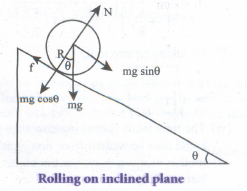
A round object of mass M and radius R rolls down without slipping along an inclined plane. The frictional force,
dissipates kinetic energy as heat
decreases the rotational motion
decreases the rotational and transnational motion
converts transnational energy into rotational energy
2.
The speed of a solid sphere after rolling down from rest without sliding on an inclined plane of vertical height h is,
\( \sqrt \frac{4}{3}gh\)
\( \sqrt \frac{10}{7}gh\)
\(\sqrt{2gh}\)
\( \sqrt \frac{1}{2}gh\)
3.
4.
A particle is moving with a constant velocity along a line parallel to positive X-axis. The magnitude of its angular momentum with respect to the origin is
zero
increasing with x
decreasing with x
remaining constant
5.
The center of mass of a system of particles does not depend upon,
position of particles
relative distance between particles
masses of particles
force acting on particle
6.
A small particle of mass m is projected with an initial velocity v at an angle \(\theta\) with x-axis in X-Y plane as shown in Figure.
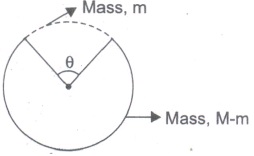
Find the angular momentum of the particle.
7.
An electron of mass 9\(\times\)10-31 kg revolves around a nucleus in a circular orbit of radius 0.53 \(\overset { 0}{ A } \). What is the angular momentum of the electron? (Velocity of electron is, v = 2.2 \(\times\)106 ms-1)
8.
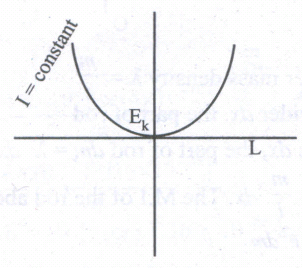
Write the relation between angular momentum and rotational kinetic energy. Draw a graph for the same. For two objects of same angular momentum, compare the moment of inertia using the graph.
9.
What is the condition for pure rolling?
10.
What are the conditions in which force can not produce torque?
11.
State principle of moments
12.
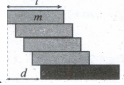
On the edge of a wall, we build a brick tower that only holds because of the bricks own weight. Our goal is to build a stable 1 tower whose overhang d is greater than the length l of a single brick. What is the minimum number of bricks you need?
13.
1.
(d)
converts transnational energy into rotational energy
2.
Potential energy = Translational kinetic energy + Rotational kinetic energy
\(m g h=\frac{1}{2} m v^{2}+\frac{1}{2} I \omega^{2} \)
\(=\frac{1}{2} m v^{2}+\frac{1}{2} \times \frac{2}{5} M R^{2} \times \frac{v^{2}}{R^{2}}\left[\omega=\frac{v}{R}\right] \)
\(=\frac{1}{2} m v^{2}+\frac{1}{5} m v^{2} \)
\(=\frac{5 m v^{2}+2 m v^{2}}{10}=\frac{7 m v^{2}}{10} \)
\(m g h=\frac{7 m v^{2}}{10} \)
\(g h=\frac{7 v^{2}}{10} \)
\(\therefore v^{2}=\frac{10 g h}{7} \)
\(\therefore v=\frac{\sqrt{10 g h}}{7} \)
3.
(a)
4.
(d)
remaining constant
5.
(d)
force acting on particle
6.
Let the particle of mass m cross a horizontal distance x in time t.
Angular momentum \(\overrightarrow{L}=\int{\overrightarrow{\tau}}{dt}\)
But \(\overrightarrow{\tau}=\overrightarrow{r}\times \overrightarrow{F}\)
\(\overrightarrow{r}=x\hat { i } +y\hat { j} \) and \(\hat { F }=-mg \hat { j } \)
\(\therefore \overrightarrow { \tau }=(x\hat { i }+y\hat { j } ) \times (-mg \hat { j } )\)
\(\overrightarrow { \tau } =-mgx(\hat { i } \times \hat { j } )=-mgx\hat { k } \)
\(\overrightarrow { L } = -mg \int{(xdt)}\hat {k} =-gv\ cos\theta (\int t dt)\hat { k } \)
Let initial time t = 0 and final time t = tf
\(\overrightarrow {L}=-mg \cos \theta \left( ^{ t }\int _{ 0 }^{ f }{ tdt } \right) \hat k = -\frac{1}{2}mgv\ cos \theta\ t^{2}_{f} \hat{k}\)
Negative sign indicates, \(\overrightarrow {L}\) point inwards.
7.
Mass of the electron, m = 9 \(\times\)10-31 kg
Radius of the electron, r = 0.53 \(\overset { 0}{ A } \) = 0.53 \(\times\)10-10 m
Velocity of the electron, v = 2.2 \(\times\)106 ms-1
Angular momentum of electron is, L = I\(\omega\)
Electron is considered as a point mass. Hence, its moment of inertia is, I= mr2
The relation, \(\omega=\frac{v}{r}\)could be used.
Angular momentum, \(L=mr^{2}\times \frac{v}{r}=mvr\)
=\(9.1 \times 10^{-31}\times 2.2 \times 10^{6}\times 0.53\times 10^{-10}\)
\(L=1.06\times 10^{-34}\)kg m2 s-1.
8.
Relation between angular momentum and rotational K.E.
Angular momentum, L = IW.
Rotational K.E., EK = \(\frac{1}{2}\)
\(2I={ (I\omega ) }^{ 2 }\)
\({ x }_{ k }=\frac { { L }^{ 2 } }{ 2I } \)
\(\sqrt { { E }_{ k } } =\frac { L }{ \sqrt { 2I } } \)
\(\frac { \sqrt { { E }_{ k } } }{ L } =\frac { I }{ \sqrt { 2I } } =constant\)
If I = 1, graph will be hyperbola.
.png)
9.
The conditions for pure rolling we
1. The total kinetic energy is the sum of kinetic energies of translational and rotational motions.
2. There is no relative motion of the point of contact with the surface.
3. When the rolling object speeds up or slower down, it must accelerate or decelerate respectively. If this suddenly happens the rolling object to ship or slide.
10.
The conditions are
(i) When position vector \(\vec{r}\) and force \(\vec{F}\) are parallel or antiparallel.
(ii) If the force acts at the reference point.
11.
Sum of the clockwise moments is equal to sum of the anticlockwise moments when a body is in rotational equilibrium or algebraic sum of moments at any point is zero.
12.
Since the blocks are identical, the centre of mass of each block is located at its midpoint. Let us take the origin to be at the midpoint [or centre of mass ] of block at the bottom and find out the shift in the position of centre of mass of the stack on the addition of the block of the block each time.
The stack will not fall over till the shift in the position of its centre of mass is less than 1/2 cm. When the stack contains two blocks: if Δx1 and Δx2 are the shifts in the positions of the centre, of the mass of the blocks with respect to origin, then shift in the position of the centre of mass of the stack
\(\Delta X=\frac { M\Delta x_{ 1 }+M\Delta x_{ 2 } }{ M+M } \)
\(=\frac { M\left[ \Delta x_{ 1 }+\Delta x_{ 2 } \right] }{ 2M } \)
\(\Delta X=\frac { \Delta x_{ 1 }+\Delta x_{ 2 } }{ M+M } \)
Here Δx1= 0 and Δx2= d cm
Therefore, ΔX = 0+\(\frac{d}{2}\) = \(\frac{d}{2}\) cm
Here, If \(\frac{d}{2}\) cm < \(\frac{1}{2}\) cm
Then the stack will not fall over.
In the above way, Suppose that let the maximum n block can be stacked before the stack falls over. If Δx1, Δx2, Δx3 .......,Δxn are the shifts in the position of the n blocks then shift in the position of the centre of mass of the stack
ΔX = Δx1 + Δx2 + Δx3 + .... + Δxn
So that the stack does not fall
Δx1 + Δx2 + Δx3 + .... + Δ\(\frac {x^n}{n}\) < \(\frac{1}{2}\)
Sn = Δx1 + Δx2 + Δx3 + ..... + Δxn
Then the above condition becomes,
\(\frac { S_{ n } }{ n }<\frac{1}{2}\)
13.

11th Standard Syllabus & Materials
11th Standard
TN 11th Tamil பீடு பெற நில் - செய்யுள் - காவடிச்சிந்து Important Questions And Answers Study Material - QB365 Set A
NEW11th Standard
TN 11th Tamil பீடு பெற நில் - உரைநடை - மலை இடப்பெயர்கள் : ஓர் ஆய்வு Important Questions And Answers Study Material - QB365 Set A
NEW11th Standard
TN 11th Tamil மாமழை போற்றுதும் - துணைப்பாடம் - யானை டாக்டர் Important Questions And Answers Study Material - QB365 Set A
NEW11th Standard
TN 11th Tamil மாமழை போற்றுதும் - செய்யுள் - ஐங்குறுநூறு Important Questions And Answers Study Material - QB365 Set A



Tamilnadu Stateboard 11th Standard Subjects

Maths

Commerce

Economics

Biology

Business Maths and Statistics

Accountancy

Computer Science
Physics

Chemistry
Maths
Biology
Economics
Physics
Chemistry

History
Business Maths and Statistics

Computer Science
Accountancy

Computer Applications
History
Computer Technology
Commerce
Computer Applications
Computer Technology

Tamil

English

French
Tamilnadu Stateboard Standards

