
 100% FREE ACCESS
11th Standard Syllabus & Materials
11th Standard
TN 11th Tamil இயற்கை வேளாண்மை,சுற்றுச்சூழல் -செய்யுள் - மனோன்மணீயம் Important Questions And Answers Study Material - QB365 Set A
NEW11th Standard
TN 11th Tamil என்னுயிர் என்பேன் -துணைப்பாடம் - இசைத்தமிழர் இருவர் Important Questions And Answers Study Material - QB365 Set A
NEW11th Standard
TN 11th Tamil மொழி கலை -செய்யுள் - ஒவ்வொரு புல்லையும் Important Questions And Answers Study Material - QB365 Set A
NEW11th Standard
TN 11th Tamil பீடு பெற நில் - இலக்கணம் - பகுபத உறுப்புகள் Important Questions And Answers Study Material - QB365 Set A
NEW11th Standard
TN 11th Tamil பீடு பெற நில் - துணைப்பாடம் - வாடிவாசல் Important Questions And Answers Study Material - QB365 Set A
NEW11th Standard
TN 11th Tamil பீடு பெற நில் - செய்யுள் - குறுந்தொகை Important Questions And Answers Study Material - QB365 Set A

Published on: 09/10/2019
Oscillations
Download Tamil Nadu 11th Standard Physics question papers, model tests, one-mark questions, important questions, and public exam papers in PDF format. Free study materials and answer keys for TN State Board students.
Questions + Answers key
Take MCQ Physics Test1.
Define S.H.M.
2.
What is Oscillatory motion?
3.
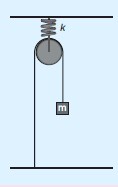
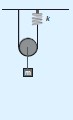
Compute the time period for the following system if the block of mass m is slightly displaced vertically down from its equilibrium position and then released. Assume that the pulley is light and smooth, strings and springs are light.
4.
Explain damped oscillation. Give an example.
5.
State the laws of simple pendulum?
6.
What is an epoch?.
7.
What is meant by force constant of a spring?
8.
Write down the kinetic energy and total energy expressions in terms of linear momentum, For one-dimensional case.
9.
A mass m moves with a speed v on a horizontal smooth surface and collides with a nearly massless spring whose spring constant is k. If the mass stops after collision, compute the maximum compression of the spring.
10.
Consider two springs with force constants 1 N m−1 and 2 N m−1 connected in parallel. Calculate the effective spring constant (kp) and comment on kp.
11.
A nurse measured the average heart beats of a patient and reported to the doctor in terms of time period as 0.8 s. Express the heart beat of the patient in terms of number of beats measured per minute.
12.
Classify the following motions as periodic and non-periodic motions?
a. Motion of Halley’s comet.
b. Motion of clouds.
c. Moon revolving around the Earth
13.
State five characteristics of SHM.
14.
What is meant by free oscillation?
15.
Consider a particle undergoing simple harmonic motion. The velocity of the particle at position x1 is v1 and velocity of the particle at position x2 is v2. Show that the ratio of time period and amplitude is
\(\frac { T }{ A } =2\pi \sqrt { \frac { { x }_{ 2 }^{ 2 }-{ x }_{ 1 }^{ 2 } }{ { { v }_{ 1 }^{ 2 }x }_{ 2 }^{ 2 }-{ { v }_{ 2 }^{ 2 }x }_{ 1 }^{ 2 } } } \)
16.
The x-t graph of a particle undergoing simple harmonic motion is shown. The acceleration of the particle at t =\(\frac{4}{3}\) is ______________.
\(\frac { \sqrt { 3 } }{ 32 } \pi \) cm/s2
\(\frac { -{ \pi }^{ 2 } }{ 32 } \) cm/s2
\(\frac { { \pi }^{ 2 } }{ 32 } \) cm/s2
\(\frac { -\sqrt { 3 } }{ 32 } \)
17.
A mass of 3 kg is attached at the end of a spring moves with simple harmonic motion on a horizontal frictionless table with time period 2π and with amplitude of 2m, then the maximum fore exerted on the spring is
1.5 N
3 N
6 N
12 N
18.
The damping force on an oscillator is directly proportional to the velocity. The units of the constant of proportionality are
kgms−1
kgms−2
kgs−1
kgs
19.
20.
An ideal spring of spring constant k, is suspended from the ceiling of a room and a block of mass M is fastened to its lower end. If the block is released when the spring is un-stretched, then the maximum extension in the spring is
4\(\frac { Mg }{ k } \)
\(\frac { Mg }{ k } \)
2\(\frac { Mg }{ k } \)
\(\frac { Mg }{ 2k } \)
21.
A spring is connected to a mass m suspended from it and its time period for vertical oscillation is T. The spring is now cut into two equal halves and the same mass is suspended from one of the halves. The period of vertical oscillation is
T'= \(\sqrt{2}\)T
\(T'=\frac { T }{ \sqrt { 2 } } \)
T'=\(\sqrt{2T}\)
\(T'=\sqrt { \frac { T }{ 2 } } \)
22.
The length of a second’s pendulum on the surface of the Earth is 0.9 m. The length of the same pendulum on surface of planet X such that the acceleration of the planet X is n times greater than the Earth is
0.9n
\(\frac{0.9}{n}\)m
0.9n2m
\(\frac{0.9}{n^2}\)
23.
In a simple harmonic oscillation, the acceleration against displacement for one complete oscillation will be
an ellipse
a circle
a parabola
a straight line
24.
Discuss in detail the energy in simple harmonic motion.
25.
Discuss the simple pendulum in detail.
26.
What is meant by simple harmonic oscillation? Give examples and explain why every simple harmonic motion is a periodic motion whereas the converse need not be true.
1.
S.H.M is the motion in which the restoring force is proportional to the displacement from the mean position and opposes its increase. Such a motion the displacement varies harmonically with time.
2.
When an object or a particle moves back and forth repeatedly for some duration of time its motion is said to be oscillatory (or vibratory).
Eamples: our heart beat, swinging motion of the wings of an insect,
3.
Case(a):
Pulley is fixed rigidly here.
When the mass displace by y and the spring will also stretch by y.
Hence, F = T = ky
\(T=2\pi \sqrt { \frac { m }{ k } } \)
Case(b):
Mass displace by y, pulley also displaces by y.
T = 4ky.
\(T=2\pi \sqrt { \frac { m }{ 4k } } \)
4.
5.
(i) Law of length:
For a given value of acceleration due to gravity, the time period of a simple pendulum is directly proportional to the square root of length of the pendulum.
T∝\(\sqrt{l}\) .......(1)
(ii) Law of acceleration:
For a fixed length, the time period of a simple pendulum is inversely proportional to square root of acceleration due to gravity.
T∝\(\frac { 1 }{ \sqrt { g } } \) .........(2)
6.
7.
Force constant of a spring is defined as the restoring force per unit length.
8.
Kinetic energy is KE\(=\frac { 1 }{ 2 } { mv }_{ x }^{ 2 }\)
Multiply numerator and denominator by m
\(KE=\frac { 1 }{ 2m } { m^{ 2 }v }_{ x }^{ 2 }=\frac { 1 }{ 2m } \left( { mv }_{ x } \right) ^{ 2 }=\frac { 1 }{ 2m } { P }_{ x }^{ 2 }\)
where, Px is the linear momentum of the particle executing simple harmonic motion.
Total energy can be written as sum of kinetic energy and potential energy, therefore, from equation (10.73) and also from equation (10.75), we get
E = KE + U(x) \(=\frac { 1 }{ 2m } { P }_{ x }^{ 2 }+\frac { 1 }{ 2m } { m\omega ^{ 2 }v }_{ x }^{ 2 }\) = constant
9.
When the mass collides with the spring, from the law of conservation of energy “the loss in kinetic energy of mass is gain in elastic potential energy by spring”.
Let x be the distance of compression of spring, then the law of conservation of energy
\(\frac { 1 }{ 2 } { mv }^{ 2 }=\frac { 1 }{ 2 } kx^{ 2 }\Rightarrow x=v\sqrt { \frac { m }{ k } } \)
10.
k1 = 1 N m−1, k2 = 2 N m−1
kp = k1 + k2 N m−1
kp = 1 + 2 = 3 N m−1
kp > k1 and kp > k2
Therefore, the effective spring constant is greater than both k1 and k2.
11.
Let the number of heart beats measured be f. Since the time period is inversely proportional to the heart beat, then
\(f=\frac { 1 }{ T } =\frac { 1 }{ 0.8 } ={ 1.25 }s^{ -1 }\)
One minute is 60 second,
(1 second = \(\frac{1}{60}\) minute \(\Rightarrow\) 1 s−1 = 60 min−1)
f =1.25 s−1 \(\Rightarrow\) f = 1.25\(\times\)60 min−1 = 75 beats per minute
12.
a. Periodic motion
b. Non-periodic motion
c. Periodic motion
13.
(i) Displacement:
The displacement of a particle executing linear SHM, at an instant is defined as the distance of the particle from the mean position at that instant.
(ii) Velocity:
Is defined as the time rate of change of the displacement of the particle at the given instant.
(iii) Amplitude: The maximum displacement on either side of mean position.
(iv) Acceleration:
It is defined as the time rate of change of the velocity of the particle at the given instant.
(v) Time period:
It is defined as the time taken by the particle executing S.H.M to complete one vibration.
14.
When the oscillator is allowed to oscillate by displacing its position from equilibrium position, it oscillates with a frequency which is equal to the natural frequency of the oscillator. Such an oscillation or vibration is known as free oscillation or free vibration.
15.
Using equation
v = \(\omega \sqrt { { A }^{ 2 }-{ x }^{ 2 } } \Rightarrow { v }^{ 2 }={ \omega }^{ 2 }\left( { A }^{ 2 }-{ x }^{ 2 } \right) \)
Therefore, at position x1,
\({ v }_{ 1 }^{ 2 }={ \omega }^{ 2 }\left( { A }^{ 2 }-{ x }_{ 1 }^{ 2 } \right) \) .................(1)
Similarly, at position x2,
\({ v }_{ 2 }^{ 2 }={ \omega }^{ 2 }\left( { A }^{ 2 }-{ x }_{ 2 }^{ 2 } \right) \) ...................(2)
Subtrating (2) from (1), we get
\({ v }_{ 1 }^{ 2 }-{ v }_{ 2 }^{ 2 }={ \omega }^{ 2 }\left( { A }^{ 2 }-{ x_1 }^{ 2 } \right) -{ \omega }^{ 2 }\left( { A }^{ 2 }-{ x }_{ 2 }^{ 2 } \right) \)
\(= { \omega }^{ 2 }\left( { x }_{ 2 }^{ 2 }-{ x }_{ 1 }^{ 2 } \right) \)
\({ \omega }=\sqrt { \frac { { v }_{ 1 }^{ 2 }-{ v }_{ 2 }^{ 2 } }{ { x }_{ 2 }^{ 2 }-{ x }_{ 1 }^{ 2 } } } \Rightarrow T=2\pi \sqrt { \frac { { x }_{ 2 }^{ 2 }-{ x }_{ 1 }^{ 2 } }{ { { v }_{ 1 }^{ 2 } }-{ { v }_{ 2 }^{ 2 } } } } \) ....................(3)
Dividing (1) and (2), we get
\(\frac { { v }_{ 1 }^{ 2 } }{ { v }_{ 2 }^{ 2 } } =\frac { { \omega }^{ 2 }\left( { A }^{ 2 }-{ x }_{ 1 }^{ 2 } \right) }{ { \omega }^{ 2 }\left( { A }^{ 2 }-{ x }_{ 2 }^{ 2 } \right) } \Rightarrow A=\sqrt { \frac { { { v }_{ 1 }^{ 2 }x }_{ 2 }^{ 2 }-{ v }_{ 2 }^{ 2 }{ x }_{ 1 }^{ 2 } }{ { { v }_{ 1 }^{ 2 } }-{ { v }_{ 2 }^{ 2 } } } } \) .................(4)
Dividing equation (3) and equation (4), we have
\(\frac { T }{ A } =2\pi \sqrt { \frac { { x }_{ 2 }^{ 2 }-{ x }_{ 1 }^{ 2 } }{ { { v }_{ 1 }^{ 2 }x }_{ 2 }^{ 2 }-{ { v }_{ 2 }^{ 2 }x }_{ 1 }^{ 2 } } } \)
16.
(d)
\(\frac { -\sqrt { 3 } }{ 32 } \)
17.
(c)
6 N
18.
\(\mathrm{F}_{\mathrm{d}} \propto \mathrm{v} \)
\(\mathrm{F}_{\mathrm{d}}=-\mathrm{bv} ; \quad \mathrm{F}_{\mathrm{d}}=\mathrm{kv} \)
\(\therefore \mathrm{k}=\frac{F_{d}}{v} \)
\(\text { Units of } k=\frac{k g m s^{-2}}{m s^{-1}}\)
\(\mathrm{k}=\mathrm{kg} \mathrm{s}^{-1}\)
19.
(d)
20.
\(\mathrm{F} =-\mathrm{kx} \)
\(\therefore \mathrm{x} =\left|-\frac{F}{k^{\prime}}\right|=\frac{F}{k^{\prime}} \)
\(\mathrm{F} =\mathrm{Mg} \text { and } k^{\prime}=\frac{k}{2} \)
\(\therefore \mathrm{x} =\frac{M g}{\frac{k}{2}} \)
\(=\frac{2 M g}{k} \)
21.
\(\mathrm{T}=2 \pi \sqrt{\frac{m}{k}}\)
when the spring is cut into two equal halves, than the force constant of each part is 2k. When the mass is suspended from one of the halves, new time period is \(T^{\prime}=2 \pi \sqrt{\frac{m}{2 k}}=\frac{T}{\sqrt{2}}\)
22.
\(l =0.9 \)
\(\mathrm{~T} =2 \pi \frac{l}{g} \)
\(T^{\prime} =2 \pi \frac{l_{X}}{g_{X}} \)
\(\mathrm{~g} \mathrm{x} =\mathrm{ng} \)
\(\therefore \mathrm{x} =0.9 \mathrm{n} \)
23.
The sketch between cause (magnitude of acceleration) and effect (magnitude of displacement) is a straight line.
24.
a. Expression for Potential Energy For the simple harmonic motion, the force and the displacement are related by Hooke's law
\(\vec { F } =-k\vec { r } \)
(i) Since force is a vector quantity, in three dimensions it has three components. Further, the force in the above equation is a conservative force field; such a force can be derived from a scalar function which has only one component. In one dimensional case
F = -kx .....(i)
(ii) As we have discussed in unit 4 of volume I, the work done by the conservative force field is independent of path. The potential energy U can be calculated from the following expression.
F = \(\frac { dU }{ dx } \) .......(2)
Comparing (1) and (2). we get
-\(\frac { dU }{ dx } \) = -kx
dU = kxdx
(iii) This work done by the force F during a small displacement dx stores as potential energy
U(x)=\(\int _{ 0 }^{ x }{ kx'dx=\frac { 1 }{ 2 } (x')^{ 2 }{ |_{ 0 }^{ x } } } =\frac { 1 }{ 2 } kx^{ 2 }\) ....(3)
From equation \(\sqrt { \frac { k }{ m } } \) , we can substitute the value of force constant k=ω2 in equation (3)
where ω is the natural frequency of the oscillating system. For the particle executing simple harmonic motion from equation y =A sin ωt,
we get x =A sin ωt
U(t)=\(\frac { 1 }{ 2 } mv_{ x }^{ 2 }=\frac { 1 }{ 2 } m\left( \frac { dx }{ dty } \right) ^{ 2 }\) ......(4)
This variation of U is shown below.
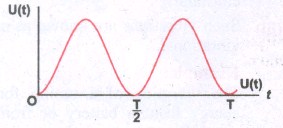
Variation of potential energy with time t
b. Expression for Kinetic Energy
KE = \(\frac { 1 }{ 2 } mv_{ x }^{ 2 }=\frac { 1 }{ 2 } m\left( \frac { dx }{ dy } \right) ^{ 2 }\)
(i) Since the particle is executing simple harmonic motion, from equation
y =A sin ωt
x =A sin ωt
Therefore, velocity is
vx =\(\frac { dx }{ dt } \)Aω cosωt
\(A\omega \sqrt { 1-\left( \frac { x }{ A } \right) ^{ 2 } } \)
vx = \(\omega \sqrt { { A }^{ 2 }-{ x }^{ 2 } } \) ....(5)
Hence
KE = \(\frac { 1 }{ 2 } mv_{ x }^{ 2 }=\frac { 1 }{ 2 } m{ \omega }^{ 2 }({ A }^{ 2 }-{ x }^{ 2 })\) ...(6)
KE = \(\frac { 1 }{ 2 } m{ \omega }^{ 2 }A^{ 2 }cos^{ 2 }\omega t\) ....(7)
This variation with time is shown below.
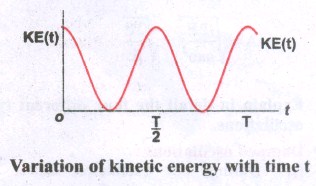
c. Expression for Total Energy
(i) Total energy is the sum of kinetic energy and potential energy
E = KE+U ..............(8)
E = \(\frac { 1 }{ 2 } m{ \omega }^{ 2 }=\frac { 1 }{ 2 } m{ \omega }^{ 2 }({ A }^{ 2 }-{ x }^{ 2 })\)
Hence excelling x2 term,
E = \(\frac { 1 }{ 2 } m{ \omega }^{ 2 }A^{ 2 }\) = constant .....(9)
(ii) Alternatively, from equation (4), and equation (7), we get the total energy as
E =\(\frac { 1 }{ 2 } m{ \omega }^{ 2 }A^{ 2 }sin^{ 2 }\omega t+\frac { 1 }{ 2 } m{ \omega }^{ 2 }A^{ 2 }cos^{ 2 }\omega t\)
= \(\frac { 1 }{ 2 } m{ \omega }^{ 2 }A^{ 2 }(sin^{ 2 }\omega t+cos^{ 2 }\omega t)\)
(iii) From trigonometry identity,
sin2ωt+cos2ωt_=1
E = \(\frac { 1 }{ 2 } m{ \omega }^{ 2 }A^{ 2 }\) = constant
which gives the law of conservation of total energy. This is depicted.
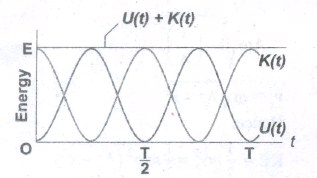
(iv) Thus the amplitude of simple harmonic oscillator, can be expressed in terms of total energy.
A =\(\sqrt { \frac { 2E }{ m{ \omega }^{ 2 } } } =\sqrt { \frac { 2E }{ k } } \) .
25.
A pendulum is a mechanical system which exhibits periodic motion. It has a bob with mass m suspended by a long string (assumed to be massless and in extensible string) and the other end is fixed on a stand as shown in figure. (a). At equilibrium, the pendulum does not oscillate and hangs vertically downward. Such a position is known as mean position or equilibrium position. When a pendulum is displaced through a small displacement from its equilibrium position and released, the bob of the pendulum executes to and fro motion. Let l be the length of the pendulum which is taken as the distance between the point of suspension and the centre of gravity of the bob. Two forces act on the bob of the pendulum at any displaced position, as shown in the figure.
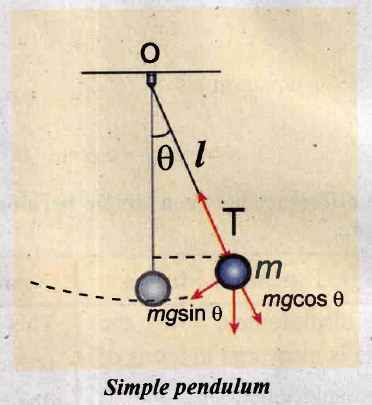
(i) The gravitational force acting on the body \((\vec{F}=\mathrm{m} \vec{g})\) which acts vertically downwards.
(ii) The tension in the string \(\vec{T}\)which acts along the string to the point of suspension.
Resolving the gravitational force into its components:
a) Normal component: The component along the string but in opposition to the direction of tension, \(F_{a s}=m g \cos \theta\).
b) Tangential component: The component perpendicular to the string i.e., along tangential direction of arc of swing, \(F_{p s}=m g \sin \theta\).
Therefore, The normal component of the force is, along the string,
\(T-W_{a s}=m \frac{v^{2}}{l}\)
Here v is speed of bob
\(\mathrm{T}-\mathrm{mg} \cos \theta=\mathrm{m} \frac{v^{2}}{l}\)
From the Figure, we can observe that the tangential component \(\mathrm{W}_{\mathrm{ps}}\) of the gravitational force always points towards the equilibrium position, i.e., the direction in which it always points opposite to the direction of displacement of the bob from the mean position. Hence, in this case, the tangential force is nothing but the restoring force. Applying Newton's second law along tangential direction, we have
\(m \frac{d^{2} s}{d t^{2}}+F_{p s} =0 \Rightarrow m \frac{d^{2} s}{d t^{2}}=F_{p s}
\)
\(m \frac{d^{2} s}{d t^{2}} =m g \sin \theta\) ......(1)
where, s is the position of bob which is measured along the arc. Expressing arc length in terms of angular displacement i.e.,
\(s =l \theta
\) .....(2)
\(\text {then its acceleration, } \frac{d^{2} s}{d t^{2}} =l \frac{d^{2} \theta}{d t^{2}}\) .....(3)
Substituting equation (3) in equation (1) we get
\(l \frac{d^{2} \theta}{d t^{2}}=-g \sin \theta
\)
\(\frac{d^{2} \theta}{d t^{2}}=-\frac{g}{l} \sin \theta\) ....(4)
Because of the presence of sin θ in the above differential equation, it is a non-linear differential equation (Here, homogeneous second order). Assume "the small oscillation approximation". sin θ ≈ θ, the above differential equation becomes linear differential equation.
.JPG)
\(\frac{d^{2} \theta}{d t^{2}}=-\frac{g}{l} \theta\) ....(5)
This is the well known oscillatory differential equation. Therefore, the angular frequency of this oscillator (natural frequency of this system) is
\(\omega^{2} =\frac{g}{l}
\) ....(6)
\(\Rightarrow \omega=\sqrt{\frac{g}{l}} \text { in } \mathrm{rad} \mathrm{s}^{-1}\) .....(7)
The frequency of oscillations is
\(\mathrm{f}=\frac{1}{2 \pi} \sqrt{\frac{\mathrm{g}}{l}} \text { in } \mathrm{Hz}\) .....(8)
and time period of oscillation is
\(T=2 \pi \sqrt{\frac{l}{g}} \text { in second }\) ......(9)
26.
Simple harmonic motion is a special type of oscillatory motion in which the acceleration or force on the particle is directly proportional to its displacement from a fixed point and is always directed towards that fixed point.
If the consider one dimensional case, the restoring force, Fx = -k x. Here the force and displacement (x) are in the opposite directions and the restoring force is always towards the centre irrespective of the position of the particle either at right side or at left side from its mean position.
Examples:
1. The oscillation of a simple pendulum
2. The oscillation of a mass suspended in a spring
.JPG)
To show that simple harmonic is oscillatory and periodic
Consider a particle of mass m moving with uniform speed v along the circumference of a circle of radius r in anti-clockwise. Let us assume that the origin of the coordinate system coincides with the centre of the circle.
The poin P1, P2, P3, ...... P8 in the circle show the various positions of the particle during its circular motion. This motion is periodic.
Now consider the points \(\mathrm{P}_{1}, \mathrm{P}_{2}, \mathrm{P}_{3} \ldots \ldots . \mathrm{P}_{3}\) on the right hand side. They are the projections of the points \(P_{1}, P_{2} \ldots \ldots . P_{8}\) in the circle. If we look at the motion of these projections their motion seems to be periodic and oscillatory. This is called simple harmonic motion.
Thus, the motion of a particle in a circle is periodic and not oscillatory. Hence it is not simple harmonic motion even though the force is acting towards the centre of the circle. It is true that all periodic motions need not be simple harmonic. At the same time all the simple harmonic motion are periodic.
Thus, if a particle undergoes uniform circular motion then the projection of the particle on the diameter of the circle or on a line parallel to the diameter traces straight line motion which is simple harmonic in nature.
Mathematical explanation:
If ω is the angular velocity of the particle P then its displacement on at any instant of time t is given as follows:
.JPG)
\(\sin \theta =\frac{O N}{O P}
\)
\(\mathrm{y}=\mathrm{ON} =\mathrm{OP} \sin \theta
\)
\(\mathrm{y} =\mathrm{A} \sin \omega \mathrm{t}, \text { here } \mathrm{A} \text { is }
\)
\(\text {radius of the circle }
\)
\(\text {velocity } \mathrm{v} =\frac{d y}{d t}=\frac{d}{d t}(\mathrm{~A} \sin \omega \mathrm{t})
\)
\(=\mathrm{A} \omega \cos \omega \mathrm{t}\)
\(\text {Acceleration of the particle a } =\frac{d v}{d t}
\)
\(=\frac{d}{d t}(\mathrm{~A} \omega \cos \omega \mathrm{t})
\)
\(=-\omega^{2} \mathrm{~A} \sin \omega \mathrm{t}
\)
\(a=-\omega^{2} \mathrm{y}\)
The negative sign indicates that displacement (y) and acceleration are in the opposite direction.
By definition, simple harmonic motion is a special type of oscillatory motion in which the acceleration or force on the particle is directly proportional to its displacement from a fixed point.

11th Standard Syllabus & Materials
11th Standard
TN 11th Tamil பீடு பெற நில் - செய்யுள் - காவடிச்சிந்து Important Questions And Answers Study Material - QB365 Set A
NEW11th Standard
TN 11th Tamil பீடு பெற நில் - உரைநடை - மலை இடப்பெயர்கள் : ஓர் ஆய்வு Important Questions And Answers Study Material - QB365 Set A
NEW11th Standard
TN 11th Tamil மாமழை போற்றுதும் - துணைப்பாடம் - யானை டாக்டர் Important Questions And Answers Study Material - QB365 Set A
NEW11th Standard
TN 11th Tamil மாமழை போற்றுதும் - செய்யுள் - ஐங்குறுநூறு Important Questions And Answers Study Material - QB365 Set A



Tamilnadu Stateboard 11th Standard Subjects

Maths

Commerce

Economics

Biology

Business Maths and Statistics

Accountancy

Computer Science
Physics

Chemistry
Maths
Biology
Economics
Physics
Chemistry

History
Business Maths and Statistics

Computer Science
Accountancy

Computer Applications
History
Computer Technology
Commerce
Computer Applications
Computer Technology

Tamil

English

French
Tamilnadu Stateboard Standards

