
 100% FREE ACCESS
11th Standard Syllabus & Materials
11th Standard
TN 11th Tamil இயற்கை வேளாண்மை,சுற்றுச்சூழல் -செய்யுள் - மனோன்மணீயம் Important Questions And Answers Study Material - QB365 Set A
NEW11th Standard
TN 11th Tamil என்னுயிர் என்பேன் -துணைப்பாடம் - இசைத்தமிழர் இருவர் Important Questions And Answers Study Material - QB365 Set A
NEW11th Standard
TN 11th Tamil மொழி கலை -செய்யுள் - ஒவ்வொரு புல்லையும் Important Questions And Answers Study Material - QB365 Set A
NEW11th Standard
TN 11th Tamil பீடு பெற நில் - இலக்கணம் - பகுபத உறுப்புகள் Important Questions And Answers Study Material - QB365 Set A
NEW11th Standard
TN 11th Tamil பீடு பெற நில் - துணைப்பாடம் - வாடிவாசல் Important Questions And Answers Study Material - QB365 Set A
NEW11th Standard
TN 11th Tamil பீடு பெற நில் - செய்யுள் - குறுந்தொகை Important Questions And Answers Study Material - QB365 Set A

Published on: 04/09/2019
Properties of Matter
Download Tamil Nadu 11th Standard Physics question papers, model tests, one-mark questions, important questions, and public exam papers in PDF format. Free study materials and answer keys for TN State Board students.
Questions + Answers key
Take MCQ Physics Test1.
State Archimedes principle.
2.
Define Poisson’s ratio.
3.
Mercury has an angle of contact equal to 140° with soda lime glass. A narrow tube of radius 2 mm, made of this glass is dipped in a trough containing mercury. By what amount does the mercury dip down in the tube relative to the liquid surface outside?. Surface tension of mercury T = 0.456 N m-1; Density of mercury \(\rho\) = 13.6\(\times\)103 kg m-3
4.
Water rises in a capillary tube to a height of 2.0cm. How much will the water rise through another capillary tube whose radius is one-third of the first tube?
5.
Let 2.4\(\times\)10−4 J of work is done to increase the area of a film of soap bubble from 50 cm2 to 100 cm2. Calculate the value of surface tension of soap solution.
6.
7.
8.
Which of the following is not a scalar?
viscosity
surface tension
pressure
stress
9.
With an increase in temperature, the viscosity of liquid and gas, respectively will
increase and increase
increase and decrease
decrease and increase
decrease and decrease
10.
If a wire is stretched to double of its original length, then the strain in the wire is
1
2
3
4
11.
Consider two wires X and Y. The radius of wire X is 3 times the radius of Y. If they are stretched by the same load then the stress on Y is
equal to that on X
thrice that on X
nine times that on X
Half that on X
12.
State and prove Archimedes principle.
13.
Obtain an expression for the excess of pressure inside a
i) liquid drop
ii) liquid bubble
iii) air bubble.
1.
Archimedes principle states that when a body is partially or wholly immersed in a fluid, it experiences an upward thrust equal to the weight of the fluid displaced by it and its up thrust acts through the centre of gravity of the liquid displaced.
2.
Poisson's ratio is defined as the ratio of relative contraction (lateral strain) to relative expansion (longitudinal strain).
3.
Capillary descent, cos140 = cos(90+50)–sin50 = –0.7660
\(h=\frac { 2Tcos\theta }{ r\rho g } =\frac { 2\times ({ 0.465N \ m }^{ -1 })({ cos \ 140 }^{ 0 }) }{ \left( 2\times { 10 }^{ -3 }m \right) \left( 13.6\times { 10 }^{ 3 } \right) \left( { 9.8 }ms^{ -2 } \right) } \)
\(=\frac{2 \times 0.456 \times(-0.7660)}{2 \times 13.6 \times 9.8}
\)
\(=\frac{-0.6986}{266.56}=-2.62 \times 10^{-3} \mathrm{~m}\)
where, negative sign indicates that there is fall of mercury (mercury is depressed) in glass tube.
4.
From equation (7.34), we have
h∝\(\frac { 1 }{ r } \Rightarrow hr=\)constant
Consider two capillary tubes with radius r1 and r2 which on placing in a liquid, capillary rises to height h1 and h2, respectively. Then,
h1r1 = h2r2 = constant
\(\Rightarrow { h }_{ 2 }=\frac { { h }_{ 1 }{ r }_{ 1 } }{ { r }_{ 2 } } =\frac { \left( 2\times { 10 }^{ -2 }m \right) }{ \frac { r }{ 3 } } \Rightarrow { h }_{ 2 }=6{ \times 10 }^{ 2 }m\)
5.
A soap bubble has two free surfaces,
therefore increase in surface area \(\Delta\)A = A2 − A1 = 2(100 - 50)\(\times\)10-4m2 = 100\(\times\)10-4m2.
Since, work done W = T\(\times\) \(\Delta\)A \(\Rightarrow\) T \(=\frac { W }{ \Delta A }\)
\( =\frac { 2.4\times 10^{ -4 }J }{ 100\times { 10 }^{ -4 }{ m }^{ 2 } } =2.4\times { 10 }^{ -2 }Nm^{ -1 }\)
6.
7.
(b)
8.
(d)
stress
9.
(c)
decrease and increase
10.
\(\text { Strain }=\frac{\text { Change in length }}{\text { Original length }}\)
\(=\frac{2 l-l}{l}=\frac{l}{l}=1\)
11.
\(\text { Stress, } \ \frac{F}{A}=Y \frac{\Delta L}{L}\)
\(\text { Stress } \mathrm{S}=\frac{\text { Force }}{\pi r^{2}}\)
\(S_{1} \propto \frac{1}{r_{1}^{2}} \ S_{2} \propto \frac{1}{r_{2}^{2}} \ F \text { is same }\)
\(\frac{S_{1}}{S_{2}}=\frac{r_{2}^{2}}{r_{1}^{2}} \quad r_{1}=3 r_{2}\)
\(\text { Let } S_{1}=S_{x} \text { and } S_{2}=S_{y}\)
\( \frac{S_{x}}{S_{y}}=\frac{r_{2}^{2}}{\left(3 r_{2}\right)^{2}}=\frac{r_{2}^{2}}{9 r_{2}^{2}}=\frac{1}{9} \)
\( \frac{S_{x}}{S_{y}}=\frac{1}{9} \)
\(\therefore S_{y}=9 S_{x} \)
12.
It states that when a body is partially or wholly immersed in a fluid, it experiences an upward thrust equal to the weight of the fluid displaced by it and its upthrust acts through the centre of gravity of the liquid displaced.
upthrust or buoyant force = weight of liquid displaced
Proof:
Consider a body of height h lying inside a liquid of density ρ at a depth x below the free surface of the liquid.
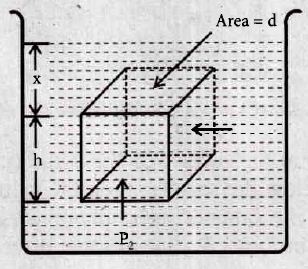
Let the area of cross section be a.
The forces on the sides of the body cancel out. Pressure at the upper face of the body
\(\mathrm{P}_{1}=x \rho g\)
Pressure at the lower surface of the body
\(\mathrm{P}_{2}=(x+h) \rho g\)
Thrust acting on the upper face of the body is
\(\mathrm{F}_{1}=\mathrm{P}_{1} \mathrm{a}=x \rho g a\)
acting vertically downwards.
Thrust acting on the lower face of the body is
\(\mathrm{F}_{2}=\mathrm{P}_{2} \mathrm{a}=(x+h) \rho g a\)
acting vertically upwards.
The resultant force \(\left(\mathrm{F}_{2}-\mathrm{F}_{1}\right)\) is acting on the body is the upward direction and is called upthrust (U)
\(\therefore \mathrm{U} =\mathrm{F}_{2}-\mathrm{F}_{1}=(x+h) \rho g a-x \rho g a \)
\(=\mathrm{a} \rho g h
\)
\(\text {But ah } =\mathrm{V}=\text { Volume of the body }
\)
\(=\text {Volume of the displaced liquid }
\)
\(\mathrm{U} =\mathrm{V} \rho \mathrm{g}=\mathrm{Mg}\)
\(\because M=V \rho=\) mass of liquid displaced i.e., upthrust or buoyant force = Weight of liquid displaced.
This proves the Archimedes principle.
13.
(1) Excess of pressure inside air bubble in a liquid.
Consider an air bubble of radius R inside a liquid having surface tension T as shown in Figure. Let P1 and P2 be the pressures outside and inside the air bubble, respectively. Now, the, excess pressure inside the air bubble is
\(\Delta P=P_{1}-P_{2}.\)
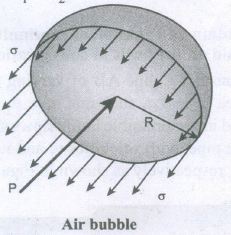
In order to find the excess pressure inside the air bubble, let us consider the forces acting on the air bubble. For the hemispherical portion of the bubble, considering the forces acting on it, we get,
(i) The force due to surface tension acting towards right around the rim of length \(2 \pi \mathrm{R} \ is \ \mathrm{F}_{\mathrm{T}}=2 \pi \mathrm{RT}\)
(ii) The force due to outside pressure P1 is to the right acting across a cross sectional area of \(\pi \mathrm{R}^{2} \ is \ F_{P_{1}}=P_{1} \pi R^{2}\)
(iii) The force due to pressure P2 inside the bubble, acting to the left is \(F_{P_{2}}=P_{2} \pi R^{2}\).
As the air bubble is in equilibrium under the action of these forces, \(F_{P_{2}}=F_{T}+F_{P_{1}}\)
\(\mathrm{P}_{2} \pi \mathrm{R}^{2} =2 \pi \mathrm{RT}+\mathrm{P}_{1} \pi \mathrm{R}^{2}
\)
\(\Rightarrow\left(\mathrm{P}_{2}-\mathrm{P}_{1}\right) \pi \mathrm{R}^{2} =2 \pi \mathrm{RT}\)
Excess pressure is \(\Delta \mathrm{P}=P_{2}-P_{1}=\frac{2 T}{R}\)
(2) Excess pressure inside a soap bubble
Consider a soap bubble of radius R and the surface tension of the soap bubble be T. A soap bubble has two liquid surfaces in contact with air, one inside the bubble and other outside the bubble. Hence, the force on the soap bubble due to surface tension is \(2 \times 2 \pi\) RT. The various forces acting on the soap bubble are,
(i) Force due to surface tension \(F_{T}=4 \pi R T\) towards right
(ii) Force due to outside pressure, \(F_{P_{1}}=P_{1} \pi R^{2}\) towards right
(iii) Force due to inside pressure, \(F_{P_{2}}=P_{2} \pi R^{2}\) towards left
As the bubble is in equilibrium, \(F_{P_{2}}=F_{T}+F_{P_{1}}\)
\(\mathrm{P}_{2} \pi \mathrm{R}^{2} =4 \pi \mathrm{RT}+\mathrm{P}_{1} \pi \mathrm{R}^{2}
\)
\(\Rightarrow\left(\mathrm{P}_{2}-\mathrm{P}_{1}\right) =\pi \mathrm{R}^{2}=4 \pi \mathrm{RT} \pi \mathrm{R}^{2}
\)
\(\text {Excess pressure is } \Delta \mathrm{P} =\mathrm{P}_{2}-\mathrm{P}_{1}=\frac{4 T}{R}\)
(3) Excess pressure inside the liquid drop
Consider a liquid drop of radius R and the surface tension of the liquid is T.
The various forces acting on the liquid drop are,
(i) Force due to surface tension \(F_{T}=2 \pi R T\) towards right
(ii) Force due to outside pressure, \(F_{P_{1}}=P_{1} \pi R^{2}\) towards right
(iii) Force due to inside pressure, \(F_{P_{2}}=P_{2} \pi R^{2}\) towards left
As the bubble is in equilibrium, \(F_{P_{2}}=F_{T}+F_{P_{1}}\)
\(\mathrm{P}_{2} \pi \mathrm{R}^{2} =2 \pi \mathrm{RT}+\mathrm{P}_{1} \pi \mathrm{R}^{2}
\)
\(\Rightarrow\left(\mathrm{P}_{2}-\mathrm{P}_{1}\right) \pi \mathrm{R}^{2}=2 \pi \mathrm{RT}
\)
\(\text {Excess pressure is } \Delta \mathrm{P} =\mathrm{P}_{2}-\mathrm{P}_{1}=\frac{2 T}{R}\)

11th Standard Syllabus & Materials
11th Standard
TN 11th Tamil பீடு பெற நில் - செய்யுள் - காவடிச்சிந்து Important Questions And Answers Study Material - QB365 Set A
NEW11th Standard
TN 11th Tamil பீடு பெற நில் - உரைநடை - மலை இடப்பெயர்கள் : ஓர் ஆய்வு Important Questions And Answers Study Material - QB365 Set A
NEW11th Standard
TN 11th Tamil மாமழை போற்றுதும் - துணைப்பாடம் - யானை டாக்டர் Important Questions And Answers Study Material - QB365 Set A
NEW11th Standard
TN 11th Tamil மாமழை போற்றுதும் - செய்யுள் - ஐங்குறுநூறு Important Questions And Answers Study Material - QB365 Set A



Tamilnadu Stateboard 11th Standard Subjects

Maths

Commerce

Economics

Biology

Business Maths and Statistics

Accountancy

Computer Science
Physics

Chemistry
Maths
Biology
Economics
Physics
Chemistry

History
Business Maths and Statistics

Computer Science
Accountancy

Computer Applications
History
Computer Technology
Commerce
Computer Applications
Computer Technology

Tamil

English

French
Tamilnadu Stateboard Standards

