
 100% FREE ACCESS
11th Standard Syllabus & Materials
11th Standard
TN 11th Tamil இயற்கை வேளாண்மை,சுற்றுச்சூழல் -செய்யுள் - மனோன்மணீயம் Important Questions And Answers Study Material - QB365 Set A
NEW11th Standard
TN 11th Tamil என்னுயிர் என்பேன் -துணைப்பாடம் - இசைத்தமிழர் இருவர் Important Questions And Answers Study Material - QB365 Set A
NEW11th Standard
TN 11th Tamil மொழி கலை -செய்யுள் - ஒவ்வொரு புல்லையும் Important Questions And Answers Study Material - QB365 Set A
NEW11th Standard
TN 11th Tamil பீடு பெற நில் - இலக்கணம் - பகுபத உறுப்புகள் Important Questions And Answers Study Material - QB365 Set A
NEW11th Standard
TN 11th Tamil பீடு பெற நில் - துணைப்பாடம் - வாடிவாசல் Important Questions And Answers Study Material - QB365 Set A
NEW11th Standard
TN 11th Tamil பீடு பெற நில் - செய்யுள் - குறுந்தொகை Important Questions And Answers Study Material - QB365 Set A

Published on: 26/09/2019
Properties of Matter
Download Tamil Nadu 11th Standard Physics question papers, model tests, one-mark questions, important questions, and public exam papers in PDF format. Free study materials and answer keys for TN State Board students.
Questions + Answers key
Take MCQ Physics Test1.
What is meant by 'Molecular range'?
2.
Define 'Plasticity'?
3.
Why two holes are made to empty an oil tin?
4.
Define terminal velocity.
5.
State Archimedes principle.
6.
State Pascal’s law in fluids.
7.
Define Poisson’s ratio.
8.
Define stress and strain.
9.
In a normal adult, the average speed of the blood through the aorta (radius r = 0.8 cm) is 0.33 ms-1. From the aorta, the blood goes into major arteries, which are 30 in number, each of radius 0.4 cm. Calculate the speed of the blood through the arteries.
10.
Water rises in a capillary tube to a height of 2.0cm. How much will the water rise through another capillary tube whose radius is one-third of the first tube?
11.
A metal cube of side 0.20 m is subjected to a shearing force of 4000 N. The top surface is displaced through 0.50 cm with respect to the bottom. Calculate the shear modulus of elasticity of the metal.
12.
Within the elastic limit, the stretching strain produced in wires A, B, and C due to stress is shown in the figure. Assume the load applied are the same and discuss the elastic property of the material.
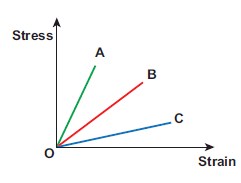
Write down the elastic modulus in ascending order
13.
State and prove Pascal’s law in fluids?
14.
State the principle and usage of Venturimeter.
15.
What is the effect of temperature on elasticity?
16.
Which one of these is more elastic, steel or rubber? Why?
17.
A solid sphere has a radius of 1.5 cm and a mass of 0.038 kg. Calculate the specific gravity or relative density of the sphere.
18.
An air bubble of diameter 4 mm rises steadily i through a solution of density 1500 kgm23 at the rate of 30cm-1 the coefficient of viscosity of the solution is _____________.
3.3\(\times\)10-3 poise
2.2\(\times\)10-3 poise
3.3\(\times\)10-3 poise
4.4\(\times\)10-3 poise
19.
The wettability of a surface by a liquid depends primarily on
viscosity
surface tension
density
angle of contact between the surface and the liquid
20.
The young’s modulus for a perfect rigid body is
0
1
0.5
infinity
21.
A small sphere of radius 2cm falls from rest in a viscous liquid. Heat is produced due to viscous force. The rate of production of heat when the sphere attains its terminal velocity is proportional to
22
23
24
25
22.
Consider two wires X and Y. The radius of wire X is 3 times the radius of Y. If they are stretched by the same load then the stress on Y is
equal to that on X
thrice that on X
nine times that on X
Half that on X
23.
State and prove Bernoulli’s theorem for a flow of incompressible, non-viscous, and streamlined flow of fluid.
24.
What is capillarity? Obtain an expression for the surface tension of a liquid by capillary rise method.
25.
State Hooke’s law and verify it with the help of an experiment?
1.
It is the maximum distance upto which a molecule can exert force of attraction on another molecule. It is of the order of 10-9 m for solids and liquids.
2.
If a body does not regain its original shape and size after removal of the deforming force, it is said to be a plastic body and the property is called plasticity. Example: Glass.
3.
When oil comes out through a tin with one hole, the pressure inside the tin becomes less than the atmospheric pressure, soon the oil stops flowing out. When two holes are made in the tin, air keeps on entering the tin, through the other hole and maintains pressure inside.
4.
Terminal velocity of a body is defined as the constant velocity acquired by a body while falling through a viscous liquid, in such a way that there is a net force acting on the body and it moves down with a constant velocity.
5.
Archimedes principle states that when a body is partially or wholly immersed in a fluid, it experiences an upward thrust equal to the weight of the fluid displaced by it and its up thrust acts through the centre of gravity of the liquid displaced.
6.
Pascal's law states that, if the pressure in a liquid is changed at a particular point, the change is transmitted to the entire liquid without being diminished in magnitude.
7.
Poisson's ratio is defined as the ratio of relative contraction (lateral strain) to relative expansion (longitudinal strain).
8.
Stress: Stress is defined as the restoring force per unit area.
Stress, \(\sigma=\frac{Force}{Area}\)
Strain: Strain is defined as the rates of change in size to the original size if an object.
Strain, ε \(=\frac{\Delta l}{l}\)
9.
\({ a }_{ 1 }v_{ 1 }{ =30a }_{ 2 }{ v }_{ 2 }\Rightarrow { \pi { r }_{ 1 }^{ 2 }v }_{ 1 }=30{ \pi { r }_{ 2 }^{ 2 }v }_{ 2 }\)
\({ v }_{ 2 }=\frac { 1 }{ 30 } { \left( \frac { { r }_{ 1 } }{ { r }_{ 2 } } \right) }^{ 2 }{ v }_{ 1 }\Rightarrow { v }_{ 2 }=\frac { 1 }{ 30 } \times { \left( \frac { 0.8\times { 10 }^{ -2 }m }{ 0.4\times { 10 }^{ -2 }m } \right) }^{ 2 }\times \left( 0.33{ ms }^{ -1 } \right) \)
v2 = 0.044 m s-1
10.
From equation (7.34), we have
h∝\(\frac { 1 }{ r } \Rightarrow hr=\)constant
Consider two capillary tubes with radius r1 and r2 which on placing in a liquid, capillary rises to height h1 and h2, respectively. Then,
h1r1 = h2r2 = constant
\(\Rightarrow { h }_{ 2 }=\frac { { h }_{ 1 }{ r }_{ 1 } }{ { r }_{ 2 } } =\frac { \left( 2\times { 10 }^{ -2 }m \right) }{ \frac { r }{ 3 } } \Rightarrow { h }_{ 2 }=6{ \times 10 }^{ 2 }m\)
11.
Here, L = 0.20 m, F = 4000 N, x = 0.50 cm
= 0.005 m and Area A = L2 = 0.04 m2
Therefore,
\(\eta _{ R }=\frac { F }{ A } \times \frac { L }{ x } =\frac { 4000 }{ 0.04 } \times \frac { 0.20 }{ 0.005 } =4\times { 10 }^{ 6 }N \ m^{ -2 }\)
12.
Here, the elastic modulus is Young modulus and due to stretching, stress is tensile stress and strain is tensile strain.
Within the elastic limit, stress is proportional to strain (obey Hooke’s law). Therefore, it shows a straight line behaviour. So, Young modulus can be computed by taking slope of these straight lines. Hence, calculating the slope for the straight line, we get
Slope of A > Slope of B > Slope of C
Which implies,
Young modulus of C < Young modulus of B < Young modulus of A
Notice that larger the slope, lesser the strain (fractional change in length). So, the material is much stiffer. Hence, the elasticity of wire A is greater than wire B which is greater than C. From this example, we have understood that Young’s modulus measures the resistance of solid to a change in its length.
13.
If the pressure in a liquid is changed at a particular point, the change is transmitted to the entire liquid without being diminished in magnitude.
Application of pascal's law
A practical application of Pascal's law is the hydraulic lift which is used to lift a heavy load with a small force. It is a force multiplier. It consists of two cylinders A and B connected to each other by a horizontal pipe, filled with a liquid.
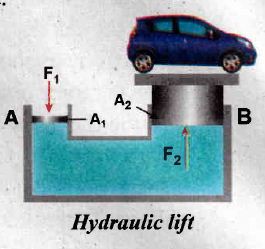
They are fitted with frictionless pistons of cross sectional areas A1 and A2 (A2 > A1). Suppose a downward force F is applied on the smaller piston, the pressure of the liquid under this piston increases to\(\left(\right. where, \left.P=\frac{F_{1}}{A_{1}}\right).\) But according to Pascal's law, this increased pressure P is transmitted undiminished in all directions. So a pressure is exerted on piston B. Upward force on piston B is
\(\mathrm{F}_{2}=\mathrm{P} \times \mathrm{A}_{2}=\frac{F_{1}}{A_{1}} \times A_{2} \Rightarrow \mathrm{F}_{2}=\frac{A_{2}}{A_{1}} \times F_{1}\)
Hence by changing the force on the smaller piston A, the force on the piston B has been increased by the factor \(\frac{A_{2}}{A_{1}}\) and this factor is called the mechanical advantage of the lift.
14.
(i) The principle of venturimeter is Bernoulli's theorem.
(ii) It is used to measure the rate of flow of the incompressible fluid through a pipe.
15.
As the temperature of substance increases, its elasticity decreases.
16.
Steel is more elastic than rubber. If an equal stress is applied to both steel and rubber, the steel produces less strain. So the Young's modulus is higher for steel than rubber. The object which has higher young's modulus is more elastic.
17.
Radius of the sphere R = 1.5 cm
mass m = 0.038 kg
Volume of the sphere V = \(\frac{4}{3}\pi{R^2}\)
= \(\frac{4}{3}\)\(\times\)(3.14)\(\times\)(1.5\(\times\)10-2)3 = 1.413\(\times\)10-5m3
Therefore, density
\(\rho =\frac { m }{ V } =\frac { 0.038kg }{ 1.413\times { 10 }^{ -5 }{ m }^{ 3 } } =2690{ kg \ m }^{ -3 }\)
Hence, the specific gravity of the sphere
\(=\frac { 2690 }{ 1000 } =2.69\)
18.
(d)
4.4\(\times\)10-3 poise
19.
(d)
angle of contact between the surface and the liquid
20.
(d)
infinity
21.
Rate of heat production
\(=\frac{\text { Work done }}{\text { Timetaken }}\)
Terminal velocity
\(v=\frac{2}{a} \frac{r^{2}(f-\sigma)}{\eta} g \)
\(v \propto r^{2} \)
\(\text { Work } \propto \text { Force } \times \text { distance }\)
\(\propto r^{2} \times r \Rightarrow 2^{5}\)
22.
\(\text { Stress, } \ \frac{F}{A}=Y \frac{\Delta L}{L}\)
\(\text { Stress } \mathrm{S}=\frac{\text { Force }}{\pi r^{2}}\)
\(S_{1} \propto \frac{1}{r_{1}^{2}} \ S_{2} \propto \frac{1}{r_{2}^{2}} \ F \text { is same }\)
\(\frac{S_{1}}{S_{2}}=\frac{r_{2}^{2}}{r_{1}^{2}} \quad r_{1}=3 r_{2}\)
\(\text { Let } S_{1}=S_{x} \text { and } S_{2}=S_{y}\)
\( \frac{S_{x}}{S_{y}}=\frac{r_{2}^{2}}{\left(3 r_{2}\right)^{2}}=\frac{r_{2}^{2}}{9 r_{2}^{2}}=\frac{1}{9} \)
\( \frac{S_{x}}{S_{y}}=\frac{1}{9} \)
\(\therefore S_{y}=9 S_{x} \)
23.
According to Bernoulli's theorem, the sum of pressure energy, kinetic energy, and potentialenergy per unit mass of an incompressible, nonviscous fluid in a streamlined flow remains a constant. Mathematically,
\(\frac{P}{\rho}+\frac{1}{2}v^{2}+gh\) = constant
This is known as Bernoulli's equation.
Proof:
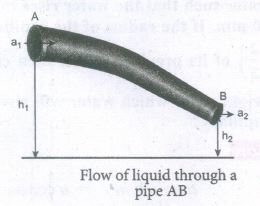
Let us consider a flow of liquid through a pipe AB as shown in Figure. Let V be the volume of the liquid when it enters A in a time t which is equal to the volume of the liquid leaving B in the same time. Let aA, vA and PA be the area of cross section of the tube, velocity of the liquid and pressure exerted by the liquid at A respectively.
Let the force exerted by the liquid at A is
FA= PAaA
Distance travelled by the liquid in time t is
d = vAt
Therefore, the work done is
W = FAd = PAaAvA t
But aAvAt = aAd = V, volume of the liquid entering at A.
Thus, the work done is the pressure energy (at A), W = FAd = PAV
Pressure energy per unit volume at
A = \(\frac{Pressure \ energy}{volume}=\frac{P_{A} V}{V}=P_{A}\)
Pressure energy per unit mass at
A = \(\frac{Pressure \ energy}{volume}=\frac{P_{A} V}{m}=\frac{P_{A}}{\frac{m}{V}}=\frac{P_{A}}{\rho}\)
Since m is the mass of the liquid entering at A in a given time, therefore, pressure energy of the liquid at A is
\(E_{PA}=P_{A}V=P_{A}V\times (\frac{m}{m})=m \frac{P_{A}}{\rho}\)
Potential energy of the liquid at A, PEA = mg hA,
Due to the flow of liquid, the kinetic energy of the liquid at A,
\(KE_{A}=\frac{1}{2}m V_{A}^{2}\)
Therefore, the total energy due to the flow of liquid at A, EA= EPA+ KEA + PEA
\(E_{A}=m \frac{P_{A}}{\rho}+\frac{1}{2}m V^{2}_{A}+mg \ h_{A}\)
Similarly, let aB, vB, and PB be the area of cross section of the tube, velocity of the liquid, and pressure exerted by the liquid at B. Calculating the total energy at EB, we get
\(EB=m \frac{P_{B}}{\rho}+\frac{1}{2}mv^{2}_{B}+mg h_{B}\)
From the law of conservation of energy,
EA = EB
\(m \frac{P_{A}}{\rho}+\frac{1}{2} mv^{2}_{A}+mgh_{A}=m\frac{P_{B}}{\rho}+\frac{1}{2}mv^{2}_{B}+mgh_{B}\)
\(\frac{P_{A}}{\rho}+\frac{1}{2}V^{2}_{A}+gh_{A}=\frac{P_{B}}{\rho}+\frac{1}{2}V^{2}_{B}+gh_{B}\) = constant
Thus, the above equation can be written as
\(\frac{P}{\rho g}+\frac{1}{2}\frac{v^{2}}{g}+h\) = constant
The above equation is the consequence of the conservation of energy which is true until there is no loss of energy due to friction. But in practice, some energy is lost due to friction. This arises due to the fact that in a fluid flow, the layers flowing with different velocities exert frictional forces on each other. This loss of energy is generally converted into heat energy. Therefore, Bernoulli's relation is strictly valid for fluids with zero viscosity or non-viscous liquids. Notice that when the liquid flows through a horizontal pipe, then \(\mathrm{h}=0 \Rightarrow \frac{P}{\rho g}+\frac{1}{2} \frac{v^{2}}{g}=\) constant.
24.
Consider a capillary tube which is held vertically in a beaker containing water; the water rises in the capillary tube to a height h due to surface tension.
The surface tension force FT, acts along the tangent at the point of contact .downwards and its reaction force upwards. Surface tension T, is resolved into two 'components
(i) Horizontal component T sinθ and
(ii) Vertical component T cosθ acting upwards, all along the whole circumference of the meniscus. Total upward force = (T cosθ) (2πr) = 2πrT cosθ where S is the angle of contact, r is the radius of the tube. Let p be the density of water and h be the height to which the liquid rises inside the tube. Then,
(the volume of liquid column in the tube, V = (Volume of the liquid column of radius r height h)+
(Volume of liquid of radius r and height r - Volume of the hemisphere of radius r)
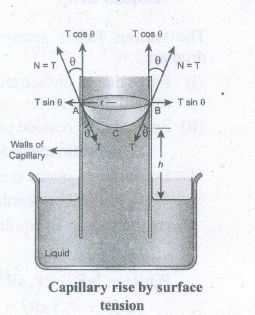
The upward force supports the weight of the liquid column above the free surface, therefore,
\(2\pi rT cos\theta=\pi r^{2} (h+\frac{1}{3}r)\rho g \Rightarrow T= \frac{r(h+\frac{1}{3}r)\rho g}{2 cos \theta}\)
If the capillary is a very fine tube of radius (i.e., radius is very small) then \(\frac{r}{3}\) can be neglected3
when it is compared to the height h. Therefore,
\(T=\frac{r\rho gh}{2 cos \theta}\)
25.
Hooke's law states that within the elastic limit, the strain produced in a body is directly proportional to the stress applied.
It can be verified in a simple way by stretching a thin straight wire (stretches like spring) of length L and uniform cross-sectional area A suspended from a fixed point O. A pan and a pointer are attached at the free end of the wire as shown in Figure. The extension produced on the wire is measured using a vernier scale arrangement. The experiment shows that for a given load, the corresponding stretching force is F and the elongation produced on the wire is ΔL. It is directly proportional to the original length L and inversely proportional to the area of cross section A. A graph is plotted using F on the X-axis and ΔL on the Y-axis. This graph is a straight line passing through the origin as shown in Figure.
.JPG)
.JPG)
Therefore,
ΔL = (slope)F
Multiplying and dividing by volume,
V = AL,
F (slope) = \(\frac{AL}{AL} \Delta L\)
Rearranging, we get
\(\frac{F}{A}=[\frac{L}{A(Slope)}]\frac{\Delta L}{L}\)
Therefore, \(\frac{F}{A} \alpha [\frac{\Delta L}{L}]\)
Comparing with equations stress and strain \(\sigma=\frac{\text { Force }}{\text { Area }}=\frac{F}{A}, \varepsilon=\frac{\text { Change in size }}{\text { Original size }}=\frac{\Delta l}{l}\),
we get volume strain, \(\varepsilon_{v}=\frac{\Delta V}{V}\) equation as
\(\sigma \propto \varepsilon\)
i.e., the stress is proportional to the strain in the elastic limit.

11th Standard Syllabus & Materials
11th Standard
TN 11th Tamil பீடு பெற நில் - செய்யுள் - காவடிச்சிந்து Important Questions And Answers Study Material - QB365 Set A
NEW11th Standard
TN 11th Tamil பீடு பெற நில் - உரைநடை - மலை இடப்பெயர்கள் : ஓர் ஆய்வு Important Questions And Answers Study Material - QB365 Set A
NEW11th Standard
TN 11th Tamil மாமழை போற்றுதும் - துணைப்பாடம் - யானை டாக்டர் Important Questions And Answers Study Material - QB365 Set A
NEW11th Standard
TN 11th Tamil மாமழை போற்றுதும் - செய்யுள் - ஐங்குறுநூறு Important Questions And Answers Study Material - QB365 Set A



Tamilnadu Stateboard 11th Standard Subjects

Maths

Commerce

Economics

Biology

Business Maths and Statistics

Accountancy

Computer Science
Physics

Chemistry
Maths
Biology
Economics
Physics
Chemistry

History
Business Maths and Statistics

Computer Science
Accountancy

Computer Applications
History
Computer Technology
Commerce
Computer Applications
Computer Technology

Tamil

English

French
Tamilnadu Stateboard Standards

