
 100% FREE ACCESS
11th Standard Syllabus & Materials
11th Standard
TN 11th Tamil இயற்கை வேளாண்மை,சுற்றுச்சூழல் -செய்யுள் - மனோன்மணீயம் Important Questions And Answers Study Material - QB365 Set A
NEW11th Standard
TN 11th Tamil என்னுயிர் என்பேன் -துணைப்பாடம் - இசைத்தமிழர் இருவர் Important Questions And Answers Study Material - QB365 Set A
NEW11th Standard
TN 11th Tamil மொழி கலை -செய்யுள் - ஒவ்வொரு புல்லையும் Important Questions And Answers Study Material - QB365 Set A
NEW11th Standard
TN 11th Tamil பீடு பெற நில் - இலக்கணம் - பகுபத உறுப்புகள் Important Questions And Answers Study Material - QB365 Set A
NEW11th Standard
TN 11th Tamil பீடு பெற நில் - துணைப்பாடம் - வாடிவாசல் Important Questions And Answers Study Material - QB365 Set A
NEW11th Standard
TN 11th Tamil பீடு பெற நில் - செய்யுள் - குறுந்தொகை Important Questions And Answers Study Material - QB365 Set A

Published on: 12/03/2019
Plus One Public Exam March 2019 One Mark Question Paper
Download Tamil Nadu 11th Standard Physics question papers, model tests, one-mark questions, important questions, and public exam papers in PDF format. Free study materials and answer keys for TN State Board students.
Questions + Answers key
Take MCQ Physics Test1.
The relation between torque and angular acceleration is _____________.
\(\overrightarrow{\tau}=\frac{I}{\overrightarrow{\alpha}}\)
\(\overrightarrow{\alpha}=\frac{\overrightarrow{\tau}}{I}\)
\(\overrightarrow{\alpha}=I \overrightarrow{\tau}\)
\(\overrightarrow{\tau}=\frac{\overrightarrow{\alpha}}{I}\)
2.
If the direction of torque is out of the paper then the rotation produced by the torque is ____________.
clockwise
anticlockwise
striaght line
random direction
3.
Moment of inertia of a uniform solid cylinder about as axis passing perpendicular to the length and passing through the center is _______________.
MR2
M\(\left( \frac { { R }^{ 2 } }{ 2 } +\frac { { l }^{ 2 } }{ 12 } \right) \)
\(\frac { 1 }{ 2 } \)MR2
M\(\left( \frac { { R }^{ 2 } }{ 4 } +\frac { { l }^{ 2 } }{ 12 } \right) \)
4.
The distance between the centres of carbon and oxygen atoms in the carbon monoxide gas molecule is 1.13 \(\overset{0}{A}\). The centre of mass of the molecule relative to oxygen atom is _______________.
0.602 \(\overset{0}{A}\)
0.527 \(\overset{0}{A}\)
1.13 \(\overset{0}{A}\)
0.565 \(\overset{0}{A}\)
5.
For square and rectangular objects center of mass lies at _____________.
the point where the diagonals meet
at the corners
on the center surface
any point
6.
X = -ky2 is represented by _______________.
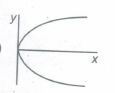
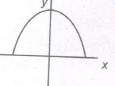
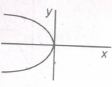
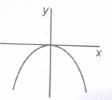
7.
A person moving horizontally with velocity \(\vec{V_m}\) The relative velocity of rain with respect to the person is ___________.
VR + Vm
\(\sqrt{V_R+V_m}\)
VR - Vm
\(\sqrt{V_R^2+V_m^2}\)
8.
The unit of momentum is ____________.
kg m s-1
kg m2 s-2
kg m2 s-1
kg-1 m2 s-1
9.
The ratio of the displacement vector to the corresponding time interval is ____________.
average speed
average velocity
instantaneous speed
instantaneous velocity
10.
From this velocity-time graph, which of the following is correct?
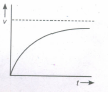
Constant acceleration
Variable acceleration
Constant velocity
Variable acceleration
11.
A bullet hits and gets embedded in a solid block resting on a horizontal frictionless table. Which of the following is conserved?
Momentum and kinetic energy
kinetic energy alone
Momentum alone
potential energy alone
12.
The kinetic energy is not conserved in ______________.
Elastic collision
Inelastic collision
both (a) and (b)
none
13.
The dimension of power is_________________.
ML2T-2
ML2T-3
ML-2T2
ML-2T3
14.
The unit of power is _______________.
J
W
Js-1
both (b) and (c)
15.
The period of a simple pendulum is recorded as 2.56s, 2.42s, 2.71s, and 2.80s respectively. The average absolute error is___________________
0.1S
0.2S
1.0S
0.11S
16.
Two blocks of masses m1 and m2 (m1 > m2) in contact with each other on frictionless, horizontal surface. If a horizontal force F is given on m1, set into motion with acceleration a, then reaction force on mass m1 by m2 is ____________.
\(\frac { { Fm }_{ 1 } }{ { m }_{ 1 }+{ m }_{ 2 } } \)
\(\frac { { m }_{ 1 }{ m }_{ 2 } }{ { Fm }_{ 1 } } \)
\(\frac { { m }_{ 1 }{ m }_{ 2 } }{ { Fm }_{ 2 } } \)
\(\frac { { Fm }_{ 2 } }{ { m }_{ 1 }+m_{ 2 } } \)
17.
The comparison of any physical quantity with its standard unit is known as__________
fundamental quantities
measurement
dualism
derived quantities
18.
To get the best possible true value of the quantity___________has to be taken.
rms value
net value
arithmetic mean
mode
19.
One light year is________________.
3.153\(\times\)107 m
1.496\(\times\)107 m
9.46\(\times\)1012 km
3.26\(\times\)1015 m
20.
A ratio signal sent towards the distant planet, returns after "t"s. If "c" is the speed of radio waves then the distance of the planet and from the earth is______________.
\(c\frac{t}{2}\)
ct2
2ct
\(c^2\frac{t^2}{2}\)
21.
When a force is applied on a body, it can change ____________.
velocity
momentum
direction of motion
all the above
22.
Two masses of 1 g and 9 g are moving with equal kinetic energies. The ratio of the magnitudes of their respective linear momenta is _______________.
1: 9
9: 1
1: 3
3:1
23.
Two equal masses m1 and m2 moving along the same straight line with velocities +3 m/s and -5 m/s respectively collide elastically. Their velocities after the collision will be respectively _______________.
- 4 m/s and +4 m/s
+4 m/s for both
- 3 m/s and +5 m/s
- 5 m/s and + 3 m/s
24.
A vertical spring with force constant k is fixed on a table. A.ball of mass m at a height h above the free upper end of the spring falls vertically on the spring so that the spring is compressed by a distance d. The net work done in the process is _____________.
\(mg(h+d)-\frac{1}{2}kd^2\)
\(mg(h-d)-\frac{1}{2}kd^2\)
\(mg(h-d)+\frac{1}{2}kd^2\)
\(mg(h+d)+\frac{1}{2}kd^2\)
25.
A shell of mass 200 gm is ejected from a gun of mass 4 kg by an explosion that generates 1.05 kJ of energy. The initial velocity of the shell is _____________.
40ms-1
120ms-1
100ms-1
80ms-1
26.
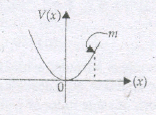
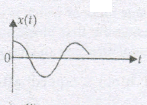
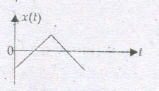
A particle of mass m is released from rest and follows a parabolic path as shown. Assuming that the displacement of the mass from the origin is small, which graph correctly depicts the position of the particle as a function of time?
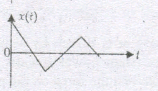
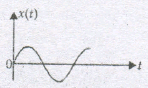
27.
Two identical balls A and B having velocities of 0.5 ms-1 and -0.3 ms-1 respectively collide elastically in one dimension. The velocities of B and A after the collision respectively will be ______________.
-0.5 ms-1 and 0.3 ms-1
0.5 ms-1 and -0.3 ms-1
-0.3 ms-1 and 0.5 ms-1
0.3 ms-1 and 0.5 ms-1
28.
A solid cylinder of mass M and radius R rolls without slipping down an inclined plane of length L and height h. What is the speed of its centre of mass when the cylinder reaches its bottom?
\(\sqrt { 2gh } \)
\(\sqrt { \frac { 3 }{ 4 } gh } \)
\(\sqrt { \frac { 4 }{ 3 } gh } \).
\(\sqrt { 4gh } \)
29.
A symmetrical lamina of mass M consists of a square shape with equilateral triangular section over each of the side of the square as shown. The MI of the lamina about an axis through its centre of mass and perpendicular to its plane is 2.4 Ma2, The moment of inertia of the lamina about AB, at one of the vertices parallel to the line Joining the corners passing through O; is _______________.
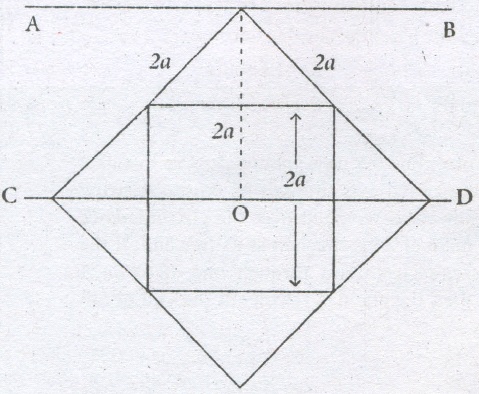
8.67 Ma2
6.4 Ma2
4.2 Ma2
2.4 Ma2
30.
Motion of a particle is given by equation s = (3t3+7t2+14t+8)m. The value of acceleration of the particle at t=1 sec is _____________.
10m/s2
32m/s2
23m/s2
16m/s2
31.
A man weighs 80 kg. He stands on a weighing scale in a lift which is moving upwards with a uniform acceleration of 5 m/s2. What would be the reading on the scale? (g = 10 m/s2).
zero
400 N
800 N
1200 N
32.
The mass of a lift is 2000 kg. When the tension in the supporting cable is 28000 N, then its acceleration is _______________.
4 ms-2 upwards
4 ms-2 downwards
14 ms-2 upwards
30 ms-2 downwards
33.
If the heart pumps blood at the rate of M kg per unit time, with constant velocity 'v' the force required is ________________
\(\frac { M }{ v } \)
Mv2
M2v
Mv
34.
A particle if confined to rotate in a circular path with decreasing linear speed. The which of the following is correct?
\(\bar{L}\) (angular momentum) is conserved about the centre
only direction of angular momentum \(\bar{L}\) is conserved
it spiral towards the centre
its acceleration is towards the centre
35.
Identify the vector quantity among the following _______________.
distance
angular momentum
heat
energy
36.
The 10, cation of the centre of mass of a sphere is at ______________.
its top
its bottom
geometric centre
all the above
37.
Head on collision signifies collision with:
velocities of equal magnitudes
velocities of different magnitudes
velocities acting along same straight line out in opposite direction
velocities acting at right angles
38.
Two springs have their force constant as K1 and K2 (k1 > k2). When they are stretched by the same force?
no work is done in case of both the springs
equal work is done in case of both the springs
more work is done in case of second spring
more work is done in case of first spring
39.
The energy possessed by a body by its state of strain is called as____________.
kinetic energy
mechanical energy
potential energy
none
40.
The same error repeated every time in the series of observation is known as _____________error.
random
constant
gross
systematic
41.
Which of the following digits are significant?
zero digits
zeros at the end without a decimal point
all zeros between two non-zeros digits, irrespective of the decimal point
all the above
42.
When a body is stationary ____________.
there is no force acting on it
the force acting on it is not in contact with it
the combination of forces acting on it balances each other
the body is in vacuum
43.
1 radian = ________.
50729°
572.9°
\(\frac{\pi}{180}\)
57.295°
44.
A book lying on the table continues in its state of rest unless an external force acts on it. It is due to _____________.
inertia of rest
inertia of motion
inertia of direction
both (b) and (c)
45.
Second law of Newton gives the ______ definition of force.
fundamental
quantitative
dimensional
both (b) and (c)
46.
The density of a liquid in CGS system is 0.625 g/cm3. What is its magnitude in SI system?
625 kg/m3
0.0625 kg/m3
0.625 kg/m3
O.00625 kg/m3
47.
The velocity of a particle at an instant t is 10 m/s. After 5 s the velocity is 20 m/s. The velocity, 3 seconds earlier was ______________
2 m/s
3 m/s
4 m/s
5 m/s
48.
A shell, in flight explodes into four unequal parts. Which is conserved?
potential energy
momentum
kinetic energy
both a and c
49.
If a person standing on a rotating disc stretches out his hands the angular speed will ____________.
Increase
Decrease
Remain same
None
50.
A block of mass M is pulled along a horizontal frictionless surface by a rope of mass m. A force F is applied at the free end of the rope. The force exerted by the rope on the block ____________.
\(\frac { MF }{ M+m } \)
\(\frac { M+m }{ MF } \)
\(\frac { M }{ M-m } \) .F
\(\frac { M-m }{ M } \) .F
51.
A round object of mass M and radius R rolls down without slipping along an inclined plane. The frictional force,
dissipates kinetic energy as heat
decreases the rotational motion
decreases the rotational and transnational motion
converts transnational energy into rotational energy
52.
When a mass is rotating in a plane about a fixed point, its angular momentum is directed along
a line perpendicular to the plane of rotation
the line making an angle of 45o to the plane of rotation
the radius
tangent to the path
53.
Two discs of same moment of inertia rotating about their regular axes passing through center and perpendicular to the plane of the disc with angular velocities ω1 and ω1. They are brought in to contact face to face coinciding with the axis of rotation. The expression for loss of energy during this process is
\(\frac{1}{4}\)\(I(\omega _{1}-\omega _{2})^2\)
\(I(\omega _{ 1 }-\omega _{ 2 })^{ 2 }\)
\(\frac{1}{8}\)\(I(\omega _{1}-\omega _{2})^2\)
\(\frac{1}{2}I\)\((\omega _{1}-\omega _{2})^2\)
54.
The speed of the center of a wheel rolling on a horizontal surface is vo. A point on the rim in level with the center will be moving at a speed of,
zero
vo
\(\sqrt{2}\)vo
2vo
55.
The speed of a solid sphere after rolling down from rest without sliding on an inclined plane of vertical height h is,
\( \sqrt \frac{4}{3}gh\)
\( \sqrt \frac{10}{7}gh\)
\(\sqrt{2gh}\)
\( \sqrt \frac{1}{2}gh\)
56.
From a disc of radius R a mass M, a circular hole of diameter R, whose rim passes through the center is cut. What is the moment of inertia of the remaining part of the disc about a perpendicular axis passing through it
15MR2/32
13MR2/32
11MR2/32
9MR2/32
57.
A disc of the moment of inertia Ia is rotating in a horizontal plane about its symmetry axis with a constant angular speed \(\omega\). Another disc initially at rest of moment of inertia Ib is dropped coaxially on to the rotating disc. Then, both the discs rotate with the same constant angular speed. The loss of kinetic energy due to friction in this process is,
\(\frac { 1 }{ 2 } \frac { { I }_{ b }^{ 2 } }{ 2({ I }_{ a }+{ I }_{ b }) } { \omega }^{ 2 }\)
\(\frac { { I }_{ b }^{ 2 } }{ ({ I }_{ a }+{ I }_{ b }) } { \omega }^{ 2 }\)
\(\frac { { ({ I }_{ b }-{ I }_{ a }) }^{ 2 } }{ ({ I }_{ a }+{ I }_{ b }) } { \omega }^{ 2 }\)
\(\frac { 1 }{ 2 } \frac { { { I }_{ b }{ I }_{ b } } }{ ({ I }_{ a }+{ I }_{ b }) } { \omega }^{ 2 }\)
58.
A spring of force constant k is cut into two pieces such that one piece is double the length of the other. Then, the long piece will have a force constant of
\(\frac{2}{3}\)k
\(\frac{3}{2}\)k
3k
6k
59.
A particle is placed at the origin and a force F = kx is acting on it (where k is a positive constant). If U (0) = 0, the graph of U(x) versus x will be (where U, is the potential , energy function)
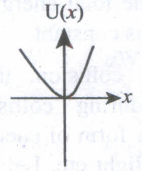
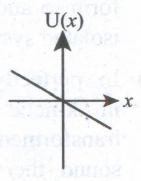
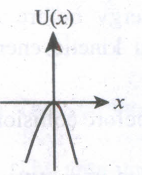
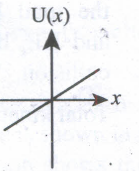
60.
A wind-powered generator converts wind energy into electric energy. Assume that the generator converts a fixed fraction of the wind energy intercepted by its blades into electrical energy. For wind speed v, the electrical power output will be proportional to
v
v2
v3
v4
61.
If the linear momentum of the object is increased by 0.1% then the kinetic energy is Increased by
0.1 %
0.2 %
0.4 %
0.01 %
62.
The potential energy of a system increases, if work is done
by the system against a conservative force
by the system against a non-conservative force
upon the system by a conservative force
upon the system by a non- conservative force
63.
64.
A rigid body rotates with an angular momentum L. If its kinetic energy is halved, the angular momentum becomes,
L
L/2
2L
L/\(\sqrt{2}\)
65.
A closed cylindrical container is partially filled with water. As the container rotates in a horizontal plane about a perpendicular bisector, its moment of inertia
increases
decreases
remains constant
depends on direction of rotation
66.
A rope is wound around a hollow cylinder of mass 3 kg and radius 40 cm. What is the angular acceleration of the cylinder if the rope is pulled with a force 30 N?
0.25 rad s-2
25 rad s-2
5 ms-2
25 ms-2
67.
A particle is moving with a constant velocity along a line parallel to positive X-axis. The magnitude of its angular momentum with respect to the origin is
zero
increasing with x
decreasing with x
remaining constant
68.
A body of mass 4 m is lying in xy-plane at rest. It suddenly explodes into three pieces. Two pieces each of mass m move perpendicular to each other with equal speed v. The total kinetic energy generated due to explosion is
mv2
\(\frac{3}{2}\)mv2
2mv2
4mv2
69.
A ball of mass 1 kg and another of mass 2 kg are dropped from a tall building whose height is 80 m. After, a fall of 40 m each towards Earth, their respective kinetic energies will be in the ratio of
\(\sqrt2:1\)
\(1:\sqrt2\)
2:1
1:2
70.
A couple produces,
pure rotation
pure translation
rotation and translation
no motion
71.
The center of mass of a system of particles does not depend upon,
position of particles
relative distance between particles
masses of particles
force acting on particle
72.
The fractional error \(\left( {{\triangle x}\over{x}} \right)\) _____________.
\(\pm\left( {{\triangle x}\over{x}} \right)\)
\(\pm n\left( {{\triangle a}\over{a}}\right)\)
\(\pm n \log_e \left( {{\triangle a}\over{a}}\right)\)
\(\pm n \log_{10}{{\triangle a}\over{a}}\)
73.
Which of the following Statement is true?
Velocity is a fundamental unit
Solar day = 24 hours.
1 Shake = 104s
mass is a derived unit
74.
If a person moving from pole to equator, the centrifugal force acting on him
increases
decreases
remains the same
increases and then decreases
75.
The centrifugal force appears to exist
only in inertial frames
only in rotating frames
in any accelerated frame
both in inertial and non-inertial frames
76.
77.
Force acting on the particle moving with constant speed is
always zero
need not be zero
always non zero
cannot be concluded
78.
Two blocks of masses m and 2m are placed on a smooth horizontal surface as shown. In the first case only a force F1 is applied from the left. Later only a force F2 is applied from the right. If the force acting at the interface of the two blocks in the two cases is same, then F1 :F2 is
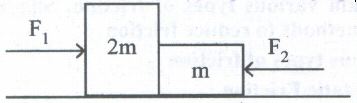
1:1
1:2
2:1
1:3
79.
Choose appropriate free body diagram for the particle experiencing net acceleration along negative y direction. (Each arrow mark represents the force acting on the system).
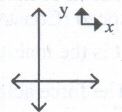
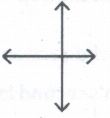
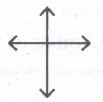
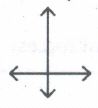
80.
Two masses m1 and m2 are experiencing the same force where m1 < m2.The ratio of their acceleration \(\frac { { a }_{ 1 } }{ { a }_{ 2 } } \) is _____________.
1
less than 1
greater than 1
all the three cases
81.
A vehicle is moving along the positive x direction, if sudden brake is applied, then
frictional force acting on the vehicle is along negative x direction
frictional force acting on the vehicle is along positive x direction
no frictional force acts on the vehicle
frictional force acts in downward direction
82.
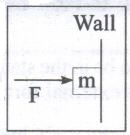
An object of mass m held against a vertical wall by applying horizontal force F as shown in the figure.The minimum value of the force F is
Less than mg
Equal to mg
Greater than mg
Cannot determine
83.
When a car takes a sudden left turn in the curved road, passengers are pushed towards the right due to
inertia of direction
inertia of motion
inertia of rest
absence of inertia
84.
If an object is thrown vertically up with the initial speed u from the ground, then the time taken by the object to return back to ground is
\(\frac{u^2}{2g}\)
\(\frac{u^2}{g}\)
\(\frac{u}{2g}\)
\(\frac{2u}{g}\)
85.
If a particle executes uniform circular motion, choose the correct statement
The velocity and speed are constant
The acceleration and speed are constant.
The velocity and acceleration are constant.
The speed and magnitude of acceleration are constant.
86.
A ball is dropped from some height towards the ground. Which one of the following represents the correct motion of the ball?
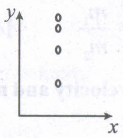
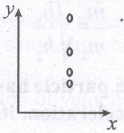
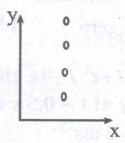
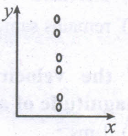
87.
A ball is projected vertically upwards with a velocity v. It comes back to ground in time t. Which v-t graph shows the motion correctly?
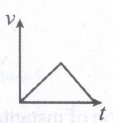
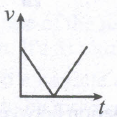
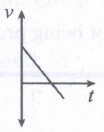
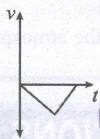
88.
If the velocity is \(\overrightarrow { v } =2\hat { i } +{ t }^{ 2 }\hat { j } -9\overrightarrow { k } \), then the magnitude of acceleration at t = 0.5s is
1 ms-2
2 ms-2
zero
-1 ms-2
89.
If a particle has negative velocity and negative acceleration, its speed
increases
decreases
remains same
zero
90.
Which one of the following physical quantities cannot be represented by a scalar?
Mass
length
momentum
magnitude of acceleration
91.
Planck's constant (h), speed of light in vacuum (c) and Newton's gravitational constant (G) are taken as three fundamental constants. Which of the following combinations of these has the dimension of length?
\({{\sqrt{hG}}\over{{c}^{{{3}\over{2}}}}}\)
\({{\sqrt{hG}}\over{{c}^{{{5}\over{2}}}}}\)
\(\sqrt{{{hc}\over{G}}}\)
\(\sqrt{{{Gc}\over{{h}^{{{3}\over{2}}}}}}\)
92.
If the force is proportional to square of velocity, then the dimension of proportionality constant is
[MLT0]
[MLT-1]
[MLT-2T]
[MLT-1T0]
93.
The density of a material in CGS system of units is 4 g cm-3. In a system of units in which unit of length is 10 cm and unit of mass is 100 g, then the value of density of material will be
0.04
0.4
40
400
94.
The dimensional formula for gravitational constant G is
[ML3T-2]
[M-1L3T-2]
[M-1L-3T-2]
[ML-3T2]
95.
The velocity of a particle v at an instant t is given by v = at + br2. The dimensions of b is
[L]
[LT-1]
[LT-2]
[LT-3]
96.
The dimensional formula of Planck's constant h is
[ML2T-1]
[ML2T3]
[MLT-1]
[ML3T-3]
97.
Which of the following has the highest number of significant figures?
0.007 m2
2.64\(\times\)1024kg
0.0006032 m2
6.3200 J
98.
The length of a body is measured as 3.51 m, if the accuracy is 0.01 mm, then the percentage error in the measurement is
35.1%
1%
0.28%
0.035%
99.
If the length and time period of an oscillating pendulum have errors of 1% and 3% respectively then the error in measurement of acceleration due to gravity is
4%
5%
6%
7%
100.
One of the combinations from the fundamental physical constants is \({{hc}\over{G}},\) The unit of this expression is
Kg2
m3
S-1
m
1.
(b)
\(\overrightarrow{\alpha}=\frac{\overrightarrow{\tau}}{I}\)
2.
(a)
clockwise
3.
(d)
M\(\left( \frac { { R }^{ 2 } }{ 4 } +\frac { { l }^{ 2 } }{ 12 } \right) \)
4.
(b)
0.527 \(\overset{0}{A}\)
5.
(a)
the point where the diagonals meet
6.
(c)
7.
(d)
\(\sqrt{V_R^2+V_m^2}\)
8.
(b)
kg m2 s-2
9.
(b)
average velocity
10.
(b)
Variable acceleration
11.
(d)
potential energy alone
12.
(b)
Inelastic collision
13.
(b)
ML2T-3
14.
(d)
both (b) and (c)
15.
(d)
0.11S
16.
(a)
\(\frac { { Fm }_{ 1 } }{ { m }_{ 1 }+{ m }_{ 2 } } \)
17.
(b)
measurement
18.
(c)
arithmetic mean
19.
(c)
9.46\(\times\)1012 km
20.
(c)
2ct
21.
(a)
velocity
22.
(c)
1: 3
23.
(d)
- 5 m/s and + 3 m/s
24.
(a)
\(mg(h+d)-\frac{1}{2}kd^2\)
25.
(c)
100ms-1
26.
(a)
27.
(b)
0.5 ms-1 and -0.3 ms-1
28.
(c)
\(\sqrt { \frac { 4 }{ 3 } gh } \).
29.
(a)
8.67 Ma2
30.
(b)
32m/s2
31.
(d)
1200 N
32.
(a)
4 ms-2 upwards
33.
(d)
Mv
34.
(b)
only direction of angular momentum \(\bar{L}\) is conserved
35.
(b)
angular momentum
36.
(c)
geometric centre
37.
(c)
velocities acting along same straight line out in opposite direction
38.
(c)
more work is done in case of second spring
39.
(a)
kinetic energy
40.
(b)
constant
41.
(c)
all zeros between two non-zeros digits, irrespective of the decimal point
42.
(c)
the combination of forces acting on it balances each other
43.
(d)
57.295°
44.
(a)
inertia of rest
45.
(d)
both (b) and (c)
46.
(a)
625 kg/m3
47.
(c)
4 m/s
48.
(b)
momentum
49.
(b)
Decrease
50.
(a)
\(\frac { MF }{ M+m } \)
51.
(d)
converts transnational energy into rotational energy
52.
(a)
a line perpendicular to the plane of rotation
53.
Moment of inertia of a disc passing through
\(\text { centre } I=\frac{1}{2} M R^{2}\)
\(\text { Energy of the first disc }=\frac{1}{4} I \omega_{1}^{2}\)
\(\text { Energy of the second disc }=\frac{1}{4} I \omega_{2}^{2}\)
\(\text { Loss of energy }=\frac{1}{4} I\left(\omega_{1}-\omega_{2}\right)^{2}\)
54.
\(v_{0}=r \omega ; \quad \therefore v_{0} \alpha r\)
For a wheel (uniform ring) the distance of a point on the rim in level with the center
\(\text { [i.e., radius] is } \sqrt{2} r\)
\(\therefore \text { The speed of the center is } \sqrt{2} v_{0}\)
55.
Potential energy = Translational kinetic energy + Rotational kinetic energy
\(m g h=\frac{1}{2} m v^{2}+\frac{1}{2} I \omega^{2} \)
\(=\frac{1}{2} m v^{2}+\frac{1}{2} \times \frac{2}{5} M R^{2} \times \frac{v^{2}}{R^{2}}\left[\omega=\frac{v}{R}\right] \)
\(=\frac{1}{2} m v^{2}+\frac{1}{5} m v^{2} \)
\(=\frac{5 m v^{2}+2 m v^{2}}{10}=\frac{7 m v^{2}}{10} \)
\(m g h=\frac{7 m v^{2}}{10} \)
\(g h=\frac{7 v^{2}}{10} \)
\(\therefore v^{2}=\frac{10 g h}{7} \)
\(\therefore v=\frac{\sqrt{10 g h}}{7} \)
56.
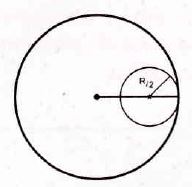
Moment of inertia of a disc
\(\mathrm{I}_{1}=\frac{M R^{2}}{2}\)
\(\text { Mass of small disc }=\frac{M}{\pi R^{2}} \times \pi \times\left(\frac{R}{2}\right)^{2}\)
\(=\frac{M}{\pi R^{2}} \times \frac{\pi R^{2}}{4}=\frac{M}{4}\)
By the theorem of parallel axis, the moment of inertia of the small disc. About an axis passing through 0 is
\(I_{2} =\frac{1}{2} \times \frac{M}{4}\left(\frac{R}{2}\right)^{2}+\frac{M}{4}\left(\frac{R}{2}\right)^{2} \)
\(=\frac{M}{8} \times \frac{R^{2}}{4}+\frac{M}{4} \times \frac{R^{2}}{4} \)
\(=\frac{M R^{2}}{32}+\frac{M R^{2}}{16}=\frac{M R^{2}+2 M R^{2}}{32} \)
\(I_{2} =\frac{3 M R^{2}}{32} \)
Moment of inertia of the remaining part is I= I1 - I2
\(=\frac{M R^{2}}{2}-\frac{3 M R^{2}}{32} \)
\(=\frac{16 M R^{2}-3 M R^{2}}{32}=\frac{13 M R^{2}}{32}\)
\(I =\frac{13 M R^{2}}{32} \)
57.
The moments of inertia of two discs are Ia and Ib respectively The angular velocity of the disc A is \(\omega\).
The sum of kinetic energies of two discs before coming in contact is \(k_{1}=\frac{1}{2} I_{a} \omega_{1}^{2}+\frac{1}{2} I_{b} \omega_{2}^{2}\)
\(\text { But angular velocity of the disc be is } \omega_{2}=0 \ \text {(rest)}\)
\(\therefore k_{1}=\frac{1}{2} I_{a} \omega_{1}^{2}\)
The final kinetic energy of the two discs system \(k_{2}=\frac{1}{2} \frac{I_{a}^{2} \omega_{1}^{2}}{I_{a}+I_{b}}\)
The loss of kinetic energy is
\(k_{1}-k_{2} =\frac{1}{2} I_{a} \omega^{2}-\frac{1}{2}\left[\frac{I a^{2} \omega_{1}^{2}}{I_{a}+I_{2 b}}\right] \)
\(=\frac{1}{2} \frac{\left[I_{1}\left(I_{a}+I_{b}\right) \omega^{2}-I_{a}^{2} \omega^{2}\right]}{I_{a}+I_{b}} \)
\(k_{1}-k_{2} =\frac{1}{2} \frac{I_{a} b}{\left(I_{a}+I_{b}\right)} \omega^{2} \)
58.
For any spring kl = constant
Length of the longer piece
\(=\frac{2 l}{3} \)
\(\therefore k^{1} \times \frac{2 l}{3} =k l \)
\(\therefore k^{1}=\frac{k l \times 3}{2 l}=\frac{3}{2} k \)
\(\therefore k^{1}=\frac{3}{2} k \)
59.
For a conservative force
\(F=-\frac{d v}{d t} \)
\(\int_{0}^{u(x)} d v=-\int_{0}^{x} F d x=-\int_{0}^{x} k x d x \)
\(\text { As } v(0)=0\)
\(U(x)=-\frac{k x^{2}}{2}\)
Thus, the graph of U(x) versus (x) will be a parabola, symmetric about U - ax is bying below x - ax is with its vertex at the origin. Hence the correct answer is C
60.
\(\text { Force }=v \frac{d m}{d t}\)
\(=v \frac{d}{d t} \text { (volume } \times \text { density) }\)
\(=v \frac{d}{d t}(A x p) \)
\(=v A p \frac{d x}{d t} \)
\(=v \times A p \times v \)
\(=A p v^{2} \)
Power = Force x Velocity
\(=A p v^{2} \times v=A p v^{3}\)
\(\therefore \text { Power } \alpha v^{3}\)
61.
\(\text { Kinetic energy } E_{k}=\frac{p^{2}}{2 m}\)
\(\frac{\Delta E_{k}}{E_{k}}=\frac{2 \Delta p}{p}\)
\(\text {Given that } \frac{\Delta p}{p}=0.1\)
∴ Increase in kinetic energy
\(\frac{\Delta E_{k}}{E_{k}}=2 \frac{\Delta p}{p} \)
\(\frac{\Delta E_{k}}{E_{k}}=2 \times 0.1=0.2 \% \)
62.
(a)
by the system against a conservative force
63.
(a)
64.
\(K \cdot E=\frac{1}{2} I \omega^{2} ; \quad L=I \omega ; \quad K \cdot E=\frac{2^{2}}{2^{2}} \)
\(\therefore K \cdot E \alpha L^{2} \quad E_{1} \alpha L_{1}^{2} \quad E_{2} \alpha L_{2}^{2}\)
\(\frac{E_{1}}{E_{2}}=\left(\frac{L_{1}}{L_{2}}\right)^{2} \)
\(\text { Here } E_{1}=E \quad E_{2}=\frac{E}{2} \)
\(L_{1}=L \quad \quad L_{2}=? \)
\(\frac{E}{\frac{E}{2}}=\left(\frac{L}{L_{2}}\right)^{2} \)
\(\frac{2 E}{E}=\left(\frac{L}{L_{2}}\right)^{2}\left(\frac{L_{1}}{L_{2}}\right)^{2}=2 \)
\(\therefore \frac{L}{L_{2}}=\sqrt{2} \)
\(L_{2}=\frac{L}{\sqrt{2}} \)
65.
(a)
increases
66.
\(m=3 \mathrm{~kg} \quad r=40 \times 10^{-2} \mathrm{~m}=0.4 \mathrm{~m}\)
\(\text { Force }=30 N\)
Moment of inertia of a hollow-cylinder I= MR2
\(=3 \times\left(40 \times 10^{-2}\right)^{2} \)
\(=3 \times 0.4 \times 0.4=0.48 \mathrm{kgm}^{2} \)
\( F R =I \alpha \)
\(30 \times 40 \times 10^{-2}=0.48 d \)
\(d=\frac{12}{0.48}=\frac{1200}{48}=25 \mathrm{rad} \mathrm{s}^{-2} \)
\(\alpha=25 \mathrm{rad} \mathrm{s}^{-2} \)
67.
(d)
remaining constant
68.
Using law of conservation of momentum,
\(2 m v =\sqrt{m^{2} v^{2}+m^{2} v^{2}} \)
\(=\sqrt{2 m^{2} v^{2}} \)
\(v =\frac{\sqrt{2} m v}{2 m}=\frac{v}{\sqrt{2}} \)
Energy released in explosion = \(2 \times \frac{1}{2} m v^{2} +\frac{1}{2} \times 2 m \times\left(\frac{v^{2}}{\sqrt{2}}\right)^{2} \)
\(=m v^{2}+m \times \frac{v^{2}}{2} \)
\(=\frac{3}{2} m v^{2} \)
69.
\(m_{1} =1, \quad m_{2}=2 \)
\(K . E . =m g(h-x) \)
\(\text { For both balls }(h-x)\)
\(=40 \text { i.e.) Same }\)
\(g=\text { constant }\)
\(\therefore K \cdot E_{1}=m_{1} g(h-x)=m_{1} g \times 40 \)
\(K \cdot E_{2}=m_{2} g(h-x)=m_{2} g \times 40 \)
\(\therefore \frac{K \cdot E_{1}}{K \cdot E_{2}}=\frac{m_{1} g \times 40}{m_{2} g \times 40}=\frac{m_{1}}{m_{2}} \)
\( \therefore K \cdot E_{1}: K \cdot E_{2}=1: 2 \)
70.
(a)
pure rotation
71.
(d)
force acting on particle
72.
(b)
\(\pm n\left( {{\triangle a}\over{a}}\right)\)
73.
(b)
Solar day = 24 hours.
74.
(a)
increases
75.
(b)
only in rotating frames
76.
(a)
77.
(b)
need not be zero
78.
(c)
2:1
79.
(c)
80.
(c)
greater than 1
81.
(a)
frictional force acting on the vehicle is along negative x direction
82.
(c)
Greater than mg
83.
(a)
inertia of direction
84.
\(\text {Time of flight }=\frac{2 u}{g}\)
85.
It is a uniform circular motion. So the direction of velocity changes but not the magnitude. Therefore speed in considered constant. Again magnitude of acceleration does not change.
86.
Distance travelled \(s=\frac{1}{2} g t^{2} ; s \alpha t^{2}\). The ratio of distances travelled by a freely falling body will be with ratio 1:4:9:...
87.
Initially velocity has maximum value and at maximum height velocity becomes zero. After that the velocity becomes negative
88.
\(\vec{v}=2 \hat{l}+t^{2} \hat{j}-9 \vec{k}\)
\(\vec{a}=\frac{d \vec{v}}{d t}=2 t \hat{j}\)
\(\text { When } t=0.5 \mathrm{~s}\)
\(a=1 \mathrm{~ms}^{-2}\)
89.
Velocity and acceleration are in the same direction: So speed increases.
90.
Mass, length are scalars. Acceleration is a vector but magnitude of acceleration is a scalar
91.
Dimension of Planck's constant is \(\left[\mathrm{ML}^{2} \mathrm{~T}^{-1}\right]\)
Dimension of Gravitational constant is \(\left[\mathrm{M}^{-1} \mathrm{~L}^{+3} \mathrm{~T}^{-1}\right]\)
Dimension of Velocity constant is LT-1
Dimension of Length is L
\(\therefore \text { Dimension of } \frac{\sqrt{h G}}{C^{\frac{3}{2}}}\)
\(=\frac{\sqrt{\left(\mathrm{ML}^{2} \mathrm{~T}^{-1}\right)\left(\mathrm{M}^{-1} \mathrm{~L}^{3} \mathrm{~T}^{-2}\right)}}{\left(\mathrm{LT}^{-1}\right)^{3 / 2}} \)
\(=\frac{\sqrt{\mathrm{L}^{5} \mathrm{~T}^{-3}}}{\mathrm{~L}^{3 / 2} \mathrm{~T}^{-3 / 2}} \)
\(=\frac{\mathrm{L}^{5 / 2} \mathrm{~T}^{-3 / 2}}{\mathrm{~L}^{3 / 2} \mathrm{~T}^{-3 / 2}} \)
\(=\mathrm{L}^{5 / 2-3 / 2} \mathrm{~T}^{3 / 2+3 / 2}=\mathrm{L}^{1} \mathrm{~T}^{0}=\mathrm{L}\)
Dimension of length = L
92.
F = kv2
Dimensional of k
\(=\frac{\text { Dimension of } \mathrm{F}}{\text { Dimension of }(v)^{2}}\)
\(=\frac{\mathrm{MLT}^{-2}}{\left(\mathrm{LT}^{-1}\right)^{2}}=\frac{\mathrm{MLT}^{-2}}{\mathrm{~L}^{2} \mathrm{~T}^{-2}} \)
\(=\left[\mathrm{ML}^{-1-2} \mathrm{~T}^{-2+2}\right] \)
Dimension of proportionality constant \(=\left[\mathrm{ML}^{-1} \mathrm{~T}^{0}\right]\)
93.
(c)
40
94.
\(\text { Gravitational constant } G=\frac{F r^{2}}{m_{l} m_{2}}\)
\(\text { Dimensional formula of } \mathrm{G}=\frac{\left[\mathrm{MLT}^{-2}\right]\left[\mathrm{L}^{2}\right]}{[\mathrm{M}][\mathrm{M}]}\)
\(=\frac{\mathrm{ML}^{3} \mathrm{~T}^{-2}}{\mathrm{M}^{2}}=\mathrm{M}^{-1} \mathrm{~L}^{3} \mathrm{~T}^{-2}\)
95.
\(v=a t+b t^{2}\)
\(\text { Dimensional equation is } \mathrm{LT}^{-1}\)
\(=a T=b T^{2}\)
\(\therefore \text { The dimension of } b=\frac{\mathrm{LT}^{-1}}{\mathrm{~T}^{2}}=\mathrm{LT}^{-3}\)
96.
Dimensional formula of Planck's
\(\text { constant }=\frac{\text { Energy }}{\text { Frequency }}=\frac{\mathrm{ML}^{2} \mathrm{~T}^{-2}}{\mathrm{~T}^{-1}}\)
\(=M L^{2} T^{-2+1}=M L^{2} T^{-1}\)
97.
The number of significant figures of 6.3200 J is 5
98.
\(\Delta l =0.01 \)
\(l =3.51 \)
\(\% \text { error } =\frac{\Delta l}{l} \times 100=\frac{0.01}{3.51} \times 100 \)
\(=0.00284 \times 100 \)
\(=0.284=0.28 \% \)
99.
\(T =2 \pi \sqrt{\frac{l}{g}} \)
\(g =4 \pi^{2} l / T^{2} \)
\(\frac{d g}{g} =\frac{d l}{l}-\frac{2 d T}{T} \)
\(\frac{d g}{g} \% =\left(\frac{d l}{l}\right) \%-2\left(\frac{d T}{T}\right) \% \)
\(=1 \%-2 \times(-3 \%) \)
\(=1+6=7 \% \)
100.
Unit of a (Planck's constant) - Js
Unit of c (Velocity of light) - ms-1
Unit of G (Gravitational Constant) - \(\frac{\mathrm{Nm}^{2}}{\mathrm{Kg}^{2}}\)
\(\therefore \text { Unit of } \frac{h c}{G} \text { is }=\frac{J s \times m s^{-1}}{N m^{2} / k g^{2}} \)
\(=\frac{N m s \times m s^{-1} \times k g^{2}}{N m^{2}}[J=N m] =\mathrm{kg}^{2}\)

11th Standard Syllabus & Materials
11th Standard
TN 11th Tamil பீடு பெற நில் - செய்யுள் - காவடிச்சிந்து Important Questions And Answers Study Material - QB365 Set A
NEW11th Standard
TN 11th Tamil பீடு பெற நில் - உரைநடை - மலை இடப்பெயர்கள் : ஓர் ஆய்வு Important Questions And Answers Study Material - QB365 Set A
NEW11th Standard
TN 11th Tamil மாமழை போற்றுதும் - துணைப்பாடம் - யானை டாக்டர் Important Questions And Answers Study Material - QB365 Set A
NEW11th Standard
TN 11th Tamil மாமழை போற்றுதும் - செய்யுள் - ஐங்குறுநூறு Important Questions And Answers Study Material - QB365 Set A



Tamilnadu Stateboard 11th Standard Subjects

Maths

Commerce

Economics

Biology

Business Maths and Statistics

Accountancy

Computer Science
Physics

Chemistry
Maths
Biology
Economics
Physics
Chemistry

History
Business Maths and Statistics

Computer Science
Accountancy

Computer Applications
History
Computer Technology
Commerce
Computer Applications
Computer Technology

Tamil

English

French
Tamilnadu Stateboard Standards

