
 100% FREE ACCESS
11th Standard Syllabus & Materials
11th Standard
TN 11th Tamil இயற்கை வேளாண்மை,சுற்றுச்சூழல் -செய்யுள் - மனோன்மணீயம் Important Questions And Answers Study Material - QB365 Set A
NEW11th Standard
TN 11th Tamil என்னுயிர் என்பேன் -துணைப்பாடம் - இசைத்தமிழர் இருவர் Important Questions And Answers Study Material - QB365 Set A
NEW11th Standard
TN 11th Tamil மொழி கலை -செய்யுள் - ஒவ்வொரு புல்லையும் Important Questions And Answers Study Material - QB365 Set A
NEW11th Standard
TN 11th Tamil பீடு பெற நில் - இலக்கணம் - பகுபத உறுப்புகள் Important Questions And Answers Study Material - QB365 Set A
NEW11th Standard
TN 11th Tamil பீடு பெற நில் - துணைப்பாடம் - வாடிவாசல் Important Questions And Answers Study Material - QB365 Set A
NEW11th Standard
TN 11th Tamil பீடு பெற நில் - செய்யுள் - குறுந்தொகை Important Questions And Answers Study Material - QB365 Set A

Published on: 30/10/2019
Download Tamil Nadu 11th Standard Physics question papers, model tests, one-mark questions, important questions, and public exam papers in PDF format. Free study materials and answer keys for TN State Board students.
Questions + Answers key
Take MCQ Physics Test1.
The displacement y of a wave travelling in the x direction is given by y = (2\(\times\)10 -3) sin (300t - 2x + \(\frac{\pi}{4}\)), where x and y are measured in metres and t in second. The speed of the wave is
150 ms-1
300 ms-1
450 ms-1
600 ms-1
2.
A particle executes simple harmonic motion and displacement y at time t0, 2t0 and 3t0 are A, B and C, respectively. Then the value of \(\frac{A+C}{2B}\) is
cos ωt0
cos 2ωt0
cos 3ωt0
1
3.
A particle executing SHM crosses points A and B with the same velocity. Having taken 3 s in passing from A to B, it returns to B after another 3 s. The time period is
15 s
6 s
12 s
9 s
4.
If the temperature and pressure of a gas is doubled the mean free path of the gas molecules
remains same
doubled
tripled
quadrapoled
5.
If the internal energy of an ideal gas U and volume V are doubled then the pressure
doubles
remains same
halves
quadruples
6.
When a uniform rod is heated, which of the following quantity of the rod will increase
mass
weight
center of mass
moment of inertia
7.
Which of the following is not a scalar?
viscosity
surface tension
pressure
stress
8.
An object of mass 10 kg is hanging on a spring scale which is attached to the roof of a lift. If the lift is in free fall, the reading in the spring scale is
98 N
zero
49 N
9.8 N
9.
A uniform force of (2\(\hat { i }\)+\(\hat { j }\)) N acts on a particle of mass 1 kg. The particle displaces from position (3\(\hat { j }\)+\(\hat { k }\)) m to (5\(\hat { i }\)+3\(\hat { j }\)) m. The work done by the force on the particle is
9 J
6 J
10 J
12 J
10.
A couple produces,
pure rotation
pure translation
rotation and translation
no motion
11.
Force acting on the particle moving with constant speed is
always zero
need not be zero
always non zero
cannot be concluded
12.
When a car takes a sudden left turn in the curved road, passengers are pushed towards the right due to
inertia of direction
inertia of motion
inertia of rest
absence of inertia
13.
If a particle has negative velocity and negative acceleration, its speed
increases
decreases
remains same
zero
14.
The dimension of \({\left( {\mu}_{0}{\epsilon}_{0} \right)}^{{{1}\over{2}}}\) is
length
time
velocity
force
15.
One of the combinations from the fundamental physical constants is \({{hc}\over{G}},\) The unit of this expression is
Kg2
m3
S-1
m
16.
Describe the formation of beats.
17.
Describe the Brownian motion.
18.
What are the limitations of dimensional analysis?
19.
Define weight.
20.
State Kepler’s three laws.
21.
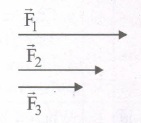
Which is the greatest force among the three force \(\vec { { F }_{ 1 } } ,\vec { { F }_{ 2 } } ,\vec { { F }_{ 3 } } \), shown below:
22.
Define centre of mass.
23.
Explain the characteristics of elastic and inelastic collision.
24.
Why does a parachute descend slowly?
25.
26.
Define acceleration.
27.
Define a vector. Give examples.
28.
Explain the different types of modulus of elasticity?
29.
Discuss the important features of the law of gravitation.
30.
State and prove parallel axis theorem.
31.
State and explain work energy principle. Mention any three examples for it.
32.
1.
The given equation is similar to
\(\mathrm{y} =\mathrm{A} \sin \left(\omega t-\frac{x}{\lambda}\right) \)
\(\omega=300, \ \mathrm{f} =\frac{300}{2 \pi}=\frac{150}{\pi} \)
\(\text { Speed } \mathrm{v} =\mathrm{f} \lambda \)
\(=\frac{150}{\pi} \times \pi \)
\(=150 \mathrm{~ms}^{-1} \)
2.
(a)
cos ωt0
3.
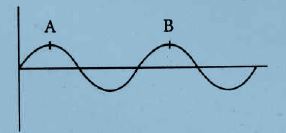
Time period is the time taken by particle is return to B = 4 x 3 = 12s
4.
Mean free path is independent of temperature and pressure
5.
Pressure is independent of internal energy.
6.
Moment of Inertia = MK2
K-Radius of gyration
During heating K would be increased.
Hence moment of inertia will increase
7.
(d)
stress
8.
(b)
zero
9.
\(\text { Force } \overrightarrow{\mathbf{F}}=(2 i+\vec{j}) N\)
\(\text { Displacement } d=(5 \vec{i}+3 \vec{j})-(3 \vec{j}+\vec{k})\)
\(=(5 i-k) m\)
\(\text { Work done } W=F . d\)
\(=(2 \vec{i}+\vec{j})(5 i-k)\)
\(=10-0-0=10 J \)
10.
(a)
pure rotation
11.
(b)
need not be zero
12.
(a)
inertia of direction
13.
Velocity and acceleration are in the same direction: So speed increases.
14.
\(\text { Velocity of light } c=\frac{1}{\sqrt{\mu_{0} \varepsilon_{0}}}\)
\(c=\left(\mu_{0} \varepsilon_{0}\right)^{-\frac{1}{2}}\)
\(\text { Hence dimension }\left(\mu_{0} \varepsilon_{0}\right)^{-\frac{1}{2}} \text { is that of velocity. }\)
15.
Unit of a (Planck's constant) - Js
Unit of c (Velocity of light) - ms-1
Unit of G (Gravitational Constant) - \(\frac{\mathrm{Nm}^{2}}{\mathrm{Kg}^{2}}\)
\(\therefore \text { Unit of } \frac{h c}{G} \text { is }=\frac{J s \times m s^{-1}}{N m^{2} / k g^{2}} \)
\(=\frac{N m s \times m s^{-1} \times k g^{2}}{N m^{2}}[J=N m] =\mathrm{kg}^{2}\)
16.
When two or more waves. superimpose each other with slightly different frequencies, then a sound of periodically varying amplitude at a point is observed. This phenomenon is known as beats. The number of amplitude maxima per second is called beat frequency. If we have two sources, then their difference in frequency gives the beat frequency.
Number of beats per second
n = |f1 - f2| per second
17.
In 1827, Robert Brown, a botanist reported that grains of pollen suspended in a liquid moves randomly from one place to other. The random (Zig - Zag path) motion of pollen suspended in a liquid is called Brownian motion. In fact we can observe the dust particle in water moving in random directions. This discovery puzzled scientists for long time. There were a lot of explanations for pollen or dust to move in random directions were found adequate. After a systematic study, Wiener and Gouy proposed that Brownian motion is to the bombardment of suspended particles by bombardment of suspended particles by molecules of the surrounding fluid. But during 19+++ century people did not accept that every matter is made up of small atoms or molecules. In the year 1905, Einstein gave systematic theory of Brownian motion based on kinetic theory and he deduced the average size of molecules.
According to kinetic theory any particle suspended in a liquid or gas is continuously bombarded from all the directions so that the mean free path is almost negligible. This leads to the motion of the particles in a random and zig-zag manner as shown in Figure. But when we put our hand in water it causes no random motion because the mass of our hand is so large that the momentum transferred. by the molecular collision is not enough to move our hand.
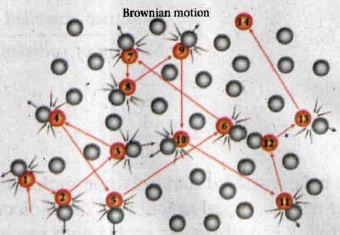
Factors affecting Brownian Motion:
(i) Brownian motion increases with increasing temperature.
(ii) Brownian motion decreases with bigger particle size, high viscosity and density of the liquid (or) gas.
18.
Limitations of Dimensional analysis:
(i) This method gives no information about the dimensionless constants in the formula like 1, 2,................ \(\pi\), e, etc.
(ii) This method cannot decide whether the given quantity is a vector or a scalar.
(iii) This method is not suitable to derive relations involving trigonometric, exponential and logarithmic functions.
(iv) It cannot be applied to an equation involving more than three physical quantities.
(v) It can only check on whether a physical relation is dimensionally correct but not the correctness of the relation.
For example, using dimensional analysis, s = ut + 1/3 at2 is dimensionally correct whereas the correct relation is s = ut+1/2 at2.
19.
The weight of an object is defined as the downward force whose magnitude W is equal to the upward force that must be applied to the object to hold it at rest or at constant velocity relative to the Earth.
20.
1. Law of orbits
Each planet moves around the Sun in an elliptical orbit with the Sun at one of the foci.
2. Law of area
The radial vector (line joining the Sun to a planet) sweeps equal areas in equal intervals of time.
3. Law of period
The square of the time period of revolution of a planet around the Sun in its elliptical orbit is directly proportional to the cube of the semi major axis of the ellipse. It can be written as :
\(T^{2} \propto a^{3} \)
\(\frac{T^{2}}{a^{3}}=\text { constant. }\)
21.
Force is a vector and magnitude of the vector is represented by the length of the vector. Here \(\vec { { F }_{ 1 } } \) has greater length compared to other two. So \(\vec { { F }_{ 1 } } \) is largest of the three.
22.
The centre of mass of a body is defined as a point where the entire mass of the body appears to be concentrated.
23.
Characteristics of elastic collision are
1. Total momentum remains conserved
2. Total kinetic energy remains conserved.
3. In elastic collision conservative forces are involved. Hence total kinetic energy is conserved.
4. In elastic collision, mechanical energy is not dissipated.
Characteristics of inelastic collision are
1. Total momentum is conserved.
2. Total kinetic energy is not conserved.
3. Forces involved are non-conservative forces
4. Mechanical energy is dissipated into heat, light, sound etc.
24.
The surface area of parachute is very large. And when it descends downwards, the air provides resistance to it and so it descends slowly.
25.
26.
The acceleration of a particle at any instant 'r' is equal to the rate of change of velocity.
Acceleration \(\overrightarrow{a}=\frac{d\overrightarrow{v}}{dt}\). It is a vector quantity.
27.
(i) A quantity which is described by both its magnitude and direction is called a vector quantity.
(ii) Geometrically, a vector is a directed line segment
Examples: Force, velocity displacement, acceleration, position vector, linear momentum and angular momentum.
28.
There are three types of elastic modulus.
(a) Young's modulus
(b) Rigidity modulus (or Shear modulus)
(c) Bulk modulus
(a) Young's modulus:
When a wire is stretched or compressed, then the ratio between tensile stress (or compressive stress) and tensile strain (or compressive strain) is defined as Young's modulus. Young modulus of a material =\(\frac{Tensile \ stress \ or \ compressive \ stress}{Tensile \ strain\ or\ compressive\ strain}\)
\(Y=\frac{\sigma_{t}}{\epsilon_{t}} \ or \ Y=\frac{\sigma_{c}}{\epsilon_{c}}\)
The unit for Young modulus has the same unit of stress because, strain has no unit. So, S.I. unit of Young modulus is Nm-2 or pascal.
(b) Bulk modulus:
Bulk modulus is defined as the ratio of volume stress to the volume strain.
Bulk modulus, K = \(\frac{Normal\ (perpendicular)\ stress\ or\ pressure}{Volume \ strain}\)
The normal stress or pressure is
\(\sigma_{n}=\frac{F_{n}}{\Delta A}=\Delta p\)
The volume strain is \(\epsilon_{v}= \frac{\Delta V}{V}\)
Therefore, Bulk modulus is
\(K= - \frac{\sigma_{n}}{\epsilon_{v}}= - \frac{\Delta p}{\frac{\Delta V}{V}}\)
The negative sign in the equation means that when pressure is applied on the body, its volume decreases. Further, the equation implies that a material can be easily compressed if it has a small value of bulk modulus. In other words, bulk modulus measures the resistance of solids to change in their volume.
(c) The rigidity modulus or shear modulus:
The rigidity modulus is defined as Rigidity modulus or Shear modulus,
\(\eta_{R}=\frac{shearing \ stress}{angle\ of \ shear \ or \ shearing \ strain}\)
The shearing stress is \(\sigma _{s}=\frac{trangential \ force}{area\ over\ which\ it\ is\ applied}=\frac{F_{t}}{\Delta A}\)
The angle of shear or shearing strain
\(\epsilon_{s}=\frac{x}{h}=\theta\)
Therefore, Rigidity modulus is
\(\eta = \frac{\sigma_{s}}{\epsilon_{s}}=\frac{\frac{F_{t}}{\Delta A}}{\frac{x}{h}}=\frac{\frac{F_{t}}{\Delta A}}{\theta}\)
Further, the equation implies, that a material can be easily twisted if it has small value of rigidity modulus.
29.
As the distance between two masses increases, the strength of the force tends to decrease because of inverse dependence on r2. Physically it implies that the planet Uranus experiences less gravitational force from the Sun than the Earth since Uranus is at larger distance from the Sun compared to the Earth.
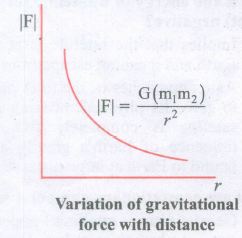
The gravitational forces between two particles always constitute an action reaction pair. It implies that the gravitational force exerted by the Sun on the Earth is always towards the Sun. The reaction-force is exerted by the Earth on the Sun. The direction of this reaction force is towards Earth.
The torque experienced by the Earth due to the gravitational force of the Sum is zero given by
\(\vec { \tau } =\vec { r } \times \vec { F } =\vec { r } \times \left( -\frac { { GM }_{ s }{ M }_{ E } }{ { r }^{ 2 } } \hat { r } \right) =0\)
Since \(\vec { r } =r\hat { r } ,(\hat { r } \times \hat { r } )=0\)
So, \(\hat { \tau } =\frac { d\vec { L } }{ dt } =0\)
It implies that angular momentum \(\vec{L}\) is a constant vector. The angular momentum of the Earth about the Sun is constant throughout the motion. It is true for all the planets. In fact, this constancy of angular momentum leads to the Kepler's second law.
The expression \(\vec{F}=-\frac{G M_{1} M_{2}}{r^{2}} \hat{r}\) has one inherent assumption that both M1 and M2 are treated as point masses. When it is said that Earth orbits around the Sun due to Sun's gravitational force, we assumed Earth and Sun to be point masses. This assumption is a good approximation because the distance between the two bodies is very much larger than their diameters. For some irregular and extended objects separated by a small distance, we cannot directly use the equation. Instead, we have to invoke separate mathematical treatment which will be brought forth in higher classes.
However, this assumption about point masses holds even for small distance for one special case. To calculate force of attraction between a hollow sphere of mass M with uniform density and point mass m kept outside the hollow sphere, we can replace the hollow sphere of mass M as equivalent to a point mass M located at the center of the hollow sphere. The force of attraction between the hollow sphere of mass M and point mass m can be calculated by treating the hollow sphere also as another point the center of the hollow sphere. It is shown in the Figure.
There is also another interesting result. Consider a hollow sphere of mass M. If we place another object of mass 'm' inside this hollow sphere as in Figure, the force experienced by this mass 'm' will be zero.
The triumph of the law of gravitation is that it concludes that the mango that is falling down and the Moon orbiting the Earth are due to the same gravitational force.
30.
(i) Parallel axis theorem states that the moment of inertia of a body about any axis is equal to the sum of its moment of inertia about a parallel axis through its center of mass and the product of the mass of the body and the square of the perpendicular distance between the two axes.
(ii) If IC is the moment of inertia of the body of mass M about an axis passing through the center of mass, then the moment of inertia I about a parallel axis at a distance d from it is given by the relation,
I = IC + Md2
(iii) Let us consider a rigid body as shown in Figure. Its moment of inertia about an axis AB passing through the center of mass is IC DE is another axis parallel to AB at a perpendicular distance d from AB. The moment of inertia of the body about DE is I. We attempt to get an expression for I in terms of IC For this, let us consider a point mass m on the body at position x from its center of mass.
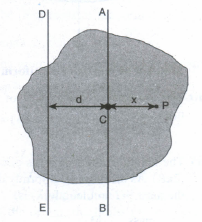
(iv) The moment of inertia of the point mass about the axis DE is, m(x + d)2. The moment of inertia I of the whole body about DE is the summation of the above expression.
\(I=\sum { m\left( x+d \right) ^{ 2 } } \)
This equation could further be written as,
\(I=\sum { m\left( { x }^{ 2 }+{ d }^{ 2 }+2xd \right) } \)
\(I=\sum { \left( { mx }^{ 2 }+m{ d }^{ 2 }+2dmx \right) } \)
\(I=\sum { { mx }^{ 2 }+\sum { m{ d }^{ 2 } } +2d\sum { mx } } \)
(v) Here, \(\sum { mx^{ 2 } } \) is the moment of inertia of the body about the center of mass. Hence,
IC = \(\sum { mx= } 0\) because, x can take positive and negative values with respect to the axis AB. The summation \(\left( \sum { mx } \right) \) will be zero.
Thus, I = Ic + \(\sum { md^{ 2 } } \) = IC + \(\left( \sum { m } \right) d^{ 2 }\)
(vi) Here, \(\sum { m } \) is the entire mass M of the object \(\left( \sum { m=M } \right) \)
I = IC + Md2
Hence the parallel axis theorem is proved.
31.
Work-Kinetic Energy Theorem
Work and energy are equivalents. This is true in the case of kinetic energy also. To prove this, let us consider a body of mass m at rest on a frictionless horizontal surface.
The work (W) done by the constant force (F) for a displacement (s) in the same direction is,
W = Fs
The constant force is given by the equation,
F = ma
The third equation of motion can be written as,
\(v^{2} =u^{2}+2 a s \)
\(a =\frac{v^{2}-u^{2}}{2 s}\)
Substituting for a in equation (2),
\(F=m\left(\frac{v^{2}-u^{2}}{2 s}\right)\)
Substituting equation (2), (1)
\(w=m\left(\frac{v^{2}}{2 s} s\right)-m\left(\frac{u^{2}}{2 s} s\right) \)
\(w=\frac{1}{2} m v^{2}-\frac{1}{2} m u^{2}\)
The expression for kinetic energy:
The term \(\left(\frac{1}{2} m v^{2}\right)\) in the above equation is the kinetic energy of the body of mass (m) moving with velocity(v).
\(K E=\frac{1}{2} m v^{2}\)
Kinetic energy of the body is always positive. From equations (4) and (5)
\(\Delta K E =\frac{1}{2} m v^{2}-\frac{1}{2} m u^{2} \)
\(\text {Thus, } W =\Delta K E\)
The expression on the right hand side (RHS) of equation (6) is the change in kinetic energy (\(\Delta\)KE) of the body.
This implies that the work done by the force on the body changes the kinetic energy of the body, This is called work-kinetic energy theorem.
The work-kinetic energy theorem implies the following.
1. If the work done by the force on the body is positive then its kinetic energy increases.
2. If the work done by the force on the body is negative then its kinetic energy decreases.
3. If there is no work done by the force on the body then there is no change in its kinetic energy, which means that the body has moved at constant speed provided its mass remains constant.
32.

11th Standard Syllabus & Materials
11th Standard
TN 11th Tamil பீடு பெற நில் - செய்யுள் - காவடிச்சிந்து Important Questions And Answers Study Material - QB365 Set A
NEW11th Standard
TN 11th Tamil பீடு பெற நில் - உரைநடை - மலை இடப்பெயர்கள் : ஓர் ஆய்வு Important Questions And Answers Study Material - QB365 Set A
NEW11th Standard
TN 11th Tamil மாமழை போற்றுதும் - துணைப்பாடம் - யானை டாக்டர் Important Questions And Answers Study Material - QB365 Set A
NEW11th Standard
TN 11th Tamil மாமழை போற்றுதும் - செய்யுள் - ஐங்குறுநூறு Important Questions And Answers Study Material - QB365 Set A



Tamilnadu Stateboard 11th Standard Subjects

Maths

Commerce

Economics

Biology

Business Maths and Statistics

Accountancy

Computer Science
Physics

Chemistry
Maths
Biology
Economics
Physics
Chemistry

History
Business Maths and Statistics

Computer Science
Accountancy

Computer Applications
History
Computer Technology
Commerce
Computer Applications
Computer Technology

Tamil

English

French
Tamilnadu Stateboard Standards

