
 100% FREE ACCESS
11th Standard Syllabus & Materials
11th Standard
TN 11th Tamil இயற்கை வேளாண்மை,சுற்றுச்சூழல் -செய்யுள் - மனோன்மணீயம் Important Questions And Answers Study Material - QB365 Set A
NEW11th Standard
TN 11th Tamil என்னுயிர் என்பேன் -துணைப்பாடம் - இசைத்தமிழர் இருவர் Important Questions And Answers Study Material - QB365 Set A
NEW11th Standard
TN 11th Tamil மொழி கலை -செய்யுள் - ஒவ்வொரு புல்லையும் Important Questions And Answers Study Material - QB365 Set A
NEW11th Standard
TN 11th Tamil பீடு பெற நில் - இலக்கணம் - பகுபத உறுப்புகள் Important Questions And Answers Study Material - QB365 Set A
NEW11th Standard
TN 11th Tamil பீடு பெற நில் - துணைப்பாடம் - வாடிவாசல் Important Questions And Answers Study Material - QB365 Set A
NEW11th Standard
TN 11th Tamil பீடு பெற நில் - செய்யுள் - குறுந்தொகை Important Questions And Answers Study Material - QB365 Set A

Published on: 31/08/2019
Kinematics
Download Tamil Nadu 11th Standard Physics question papers, model tests, one-mark questions, important questions, and public exam papers in PDF format. Free study materials and answer keys for TN State Board students.
Questions + Answers key
Take MCQ Physics Test1.
2.
Two objects are projected at angles 30° and 60° respectively with respect to the horizontal direction. The range of two objects are denoted as R30° and R30°. Choose the correct relation from the following
R30° = R60°
R30° = 4R60°
R30° =\(\frac{R_{60°}}{2}\)
R30° = 2R60°
3.
If a particle executes uniform circular motion, choose the correct statement
The velocity and speed are constant
The acceleration and speed are constant.
The velocity and acceleration are constant.
The speed and magnitude of acceleration are constant.
4.
If an object is dropped from the top of a building and it reaches the ground at t = 4 s, then the height of the building is (ignoring air resistance) (g = 9.8 ms-2)
77.3 m
78.4 m
80.5 m
79.2 m
5.
Two objects of masses m1 and m2 fall from the heights h1 and h2 respectively. The ratio of the magnitude of their momenta when they hit the ground is
\(\sqrt { \frac { { h }_{ 1 } }{ { h }_{ 2 } } } \)
\(\sqrt { \frac { { { m }_{ 1 }h }_{ 1 } }{ { { m }_{ 2 }h }_{ 2 } } } \)
\(\frac { { m }_{ 1 } }{ { m }_{ 2 } } \sqrt { \frac { { h }_{ 1 } }{ { h }_{ 2 } } } \)
\(\frac { { m }_{ 1 } }{ { m }_{ 2 } } \)
6.
A train 100 m long is moving with a speed of 60 km h-1. In how many seconds will it cross a bridge of 1 km long?
7.
8.
Two vectors are given as \(\vec r=2\hat i+3\hat j+5\hat k\) and \(\vec F=3\hat i-2\hat j+4\hat k\). Find the resultant vector \(\vec { \tau } =\vec { r } \times \vec { F } \).
9.
A particle has its position moved from \(\overset { \rightarrow }{ { r }_{ 1 } } =3\hat { i } +4\hat { j } \) to \(\overset { \rightarrow }{ { r }_{ 2 } } =\hat { i } +2\hat { j } \) Calculate the displacement vector (\(\Delta \)\(\overrightarrow { r } \)) and draw the \(\overrightarrow { { r }_{ 1 } } \), \(\overrightarrow { { r }_{ 2 } } \) and \(\Delta \overrightarrow { r } \) vector in a two dimensional cartesian coordinate system.
10.
Define acceleration.
11.
A particle moves in a circle of radius 10 m. Its linear speed is given by v = 3t where t is in second and v is in ms-1.
(a) Find the centripetal and tangential acceleration at t = 2 s.
(b) Calculate the angle between the resultant acceleration and the radius vector.
12.
In the cricket game, a batsman strikes the ball such that it moves with the speed 30 ms-1 at an angle 30° with the horizontal as shown in the figure. The boundary line of the cricket ground is located at a distance of 75 m from the batsman? Will the ball go for a six? (Neglect the air resistance and take acceleration due to gravity g = 10 m s-2).
.png)
13.
The velocity of three particles A, B, C are given below. Which particle travels at the greatest speed?
\(\vec {v_A}=3\hat i+5\hat j+2\hat k\)
\(\vec {V_B}=\hat i+2\hat j+3\hat k\)
\(\vec{V_C}=5\hat i+3\hat j+4\hat k\)
14.
A particle is projected at an angle of θ with respect to the horizontal direction. Match the following for the above motion.
(a) vx - decreases and increases
(b) vy - remains constant
(c) Acceleration - varies
(d) Position vector - remains downward
1.
(b)
2.
Range is same for the angle if projection \(\theta \text { and } 90-\theta\)
3.
It is a uniform circular motion. So the direction of velocity changes but not the magnitude. Therefore speed is considered constant. Again magnitude of acceleration does not change.
4.
(b)
78.4 m
5.
For freely falling body, velocity while the body, hit the ground \(v=\sqrt{2 g h}\)
\(v_{1}=\sqrt{2 g h_{1}} \text { and } v_{2}=\sqrt{2 g h_{2}} \)
\(\therefore \frac{m_{1} v_{1}}{m_{2} v_{2}}=\frac{m_{1} \sqrt{h_{1}}}{m_{2} \sqrt{h_{2}}}=\frac{m_{1}}{m_{2}} \sqrt{\frac{h_{1}}{h_{2}}}\)
6.
Total distance to be covered = 1 km + 100 m = 1100 m (including both bridge and time)
Then, Speed=60 kmh-1\(=60\times\frac{5}{18}ms^{-1}=\frac{50}{3}\ ms^{-1}\)
Then, time taken to cover this distance \(=\frac{1100}{\frac{150}{9}}s=66s\)
7.
.png)
8.
\(\vec { \tau } =\vec { r } \times \vec { F } =\left| \begin{matrix} \hat { i } & \hat { j } & \hat { k } \\ 2 & 3 & 5 \\ 3 & -2 & 4 \end{matrix} \right| \)
\(\vec { \tau } =\left( 12-\left( 10 \right) \right) \hat { i } +\left( 15-8 \right) \hat { j } +\left( -4-9 \right) \hat { k } \)
\(\vec { \tau } =22\hat { i } +7\hat { j } -13\hat { k } \)
9.
\(\vec { { r }_{ 1 } } =3\hat { i } +4\hat { j } \)
\(\vec { { r }_{ 2 } } =\hat { i } +2\hat { j } \)
\(\Delta \overrightarrow { r } =\overrightarrow { { r }_{ 2 } } -\overrightarrow { { r }_{ 1 } } \)
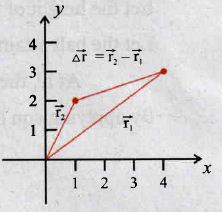
\(=(\hat { i } +2\hat { j } )-(3\hat { i } +4\hat { j } )\)
\(\Delta \overrightarrow { r } =-2\hat { i } +\hat { j } \)
10.
The acceleration of a particle at any instant 'r' is equal to the rate of change of velocity.
Acceleration \(\overrightarrow{a}=\frac{d\overrightarrow{v}}{dt}\). It is a vector quantity.
11.
The linear speed at t = 2 s
v = 3t = 6 ms-1
The centripetal acceleration at t = 2 s is
\(a_c=\frac{v^2}{r}=\frac{(6)^2}{10}=3.6\ ms^{-2}\)
The tangential acceleration is \(a_t=\frac{dv}{dt}=3\ ms^{-2}\)
The angle between the radius vector with resultant acceleration is given by
\(tan\theta=\frac{a_t}{a_c}=\frac{3}{3.6}\)= 0.833
\(\theta=tan^{-1}(0.833)\) = 0.69 radian
In terms of degree \(\theta=0.69\times57.17^0\approx40^0\)
12.
The motion of the cricket ball in air is essentially a projectile motion. As we have already seen, the range (horizontal distance) of the projectile motion is given by
\(R=\frac{u^2sin2\theta}{g}\)
The initial speed u = 30 ms-1
The projection angle θ = 30°
The horizontal distance travelled by the cricket ball \(R=\frac{(30)^2\times sin60^0}{10}=\frac{900\times\frac{\sqrt 3}{2}}{10}=77.94\ m\)
This distance is greater than the distance of the boundary line. Hence the ball will cross this line and go for a six.
13.
We know that speed is the magnitude of the velocity vector. Hence,
Speed of A = \(|\vec{V_A}|=\sqrt{(3)^2+(-5)^2+(2)^2}=\sqrt{9+25+4}=\sqrt{48}ms^{-1}\)
Speed of B = \(\vec{V_B}=\sqrt{(1)^2+(2)^2+(3)^2}=\sqrt{1+4+9}=\sqrt{14}ms^{-1}\)
Spedd of C = \(\vec{V_C}=\sqrt{(5)^2+(3)^2+(4)^2}=\sqrt{25+9+16}=\sqrt{50}ms^{-1}\)
The particle C has the greatest speed.
\(\sqrt{50}>\sqrt{38}>\sqrt{14}\)
14.
(a) vx - remains constant
(b) vy - decreases and increases
(c) a - remains downward
(d) r - varies

11th Standard Syllabus & Materials
11th Standard
TN 11th Tamil பீடு பெற நில் - செய்யுள் - காவடிச்சிந்து Important Questions And Answers Study Material - QB365 Set A
NEW11th Standard
TN 11th Tamil பீடு பெற நில் - உரைநடை - மலை இடப்பெயர்கள் : ஓர் ஆய்வு Important Questions And Answers Study Material - QB365 Set A
NEW11th Standard
TN 11th Tamil மாமழை போற்றுதும் - துணைப்பாடம் - யானை டாக்டர் Important Questions And Answers Study Material - QB365 Set A
NEW11th Standard
TN 11th Tamil மாமழை போற்றுதும் - செய்யுள் - ஐங்குறுநூறு Important Questions And Answers Study Material - QB365 Set A



Tamilnadu Stateboard 11th Standard Subjects

Maths

Commerce

Economics

Biology

Business Maths and Statistics

Accountancy

Computer Science
Physics

Chemistry
Maths
Biology
Economics
Physics
Chemistry

History
Business Maths and Statistics

Computer Science
Accountancy

Computer Applications
History
Computer Technology
Commerce
Computer Applications
Computer Technology

Tamil

English

French
Tamilnadu Stateboard Standards

